Showing posts with label arrest of Iranian tanker “Grace 1”. Show all posts

Thursday, September 12, 2019

Oil Tanker Off Syria: Sanctions-Busting or “US-Ego-Busting?”

Seth Ferris
ADRIA3534522

An oil tanker has been spotted off the coast of Syria and with that comes the latest news flash. This is hardly news, given the leading export of that region. But it was an IRANIAN oil tanker! Shock horror! Iran is again breaching sanctions it maintains it is not subject to! Is there no limit to its perfidy?
It is true that the US has previously detained the Adrian Darya 1, and that it now appears to have entered the Syrian port of Tartus, which is described as “Russian-controlled”, in violation of assurances Iranian Foreign Minister Mohammad Javad Zarif gave that it would not sail to Syria There also appears to be some confusion over whether it has actually delivered any oil, but the fact the tanker was seen off the Syrian coast, when the US had tried its best to prevent it going there, has caused an international outcry.
The US still has never forgiven Iran for conducting a revolution, a well justified one at that, when the State Department didn’t see it coming forty years ago. Revolutions are perfectly alright if the US promotes them, funds them or can anticipate them, highjack them and have a PR and humanitarian response ready. They are only a problem to the US, a country founded by revolution, if the revolutionaries take advantage of an opportunity others did not see – prove themselves better businessmen, in other words.
This is exactly what Iran is doing with its oil. The West wants it, the West claims it needs it. However, more is involved, as the US has bigger concerns about Iran, foremost of which is its alleged non-peaceful nuclear programme.
So Iran has taken to trading nuclear power for oil. It is prepared to make concessions on its nuclear programme in exchange for the ability to sell its oil products to significant markets. This makes sound business sense from an Iranian point of view, regardless of the importance of its domestic nuclear programme.
Iran is not planning to export its nuclear power, or sell nuclear weapons if it has them, but is not going to turn down oil export income when it can use this, Chinese-style, to hold potential enemies economic hostage. It is again taking advantage of an opportunity. Like any other business, it is pushing as far as it can to see what the political market can bear, with increased nuclear capacity, real or perceived, its counter to any objection by its opponents/customers.
So what now?

The tanker was told not to go to Syria, the Foreign Minister promised it would not go, but it has. Are the EU and US going to spell out exactly what their sanctions say, what authority they have and how they are going to be implemented, which they have consistently refused to do when challenged, merely repeating that “sanctions” are whatever the speaker says they are at any given time?
Hence the reason the US has a problem with the Adrian Darya is not that it is delivering oil to Syria, and by implication to its enemies there. It is because it is exposing US hypocrisy once again.
This has long been alleged to be a Russian tactic – wait for the US to compromise itself by acting contrary to its own values, then do the same thing the US just did and ask what it is doing wrong. Now Iran is getting away with the same thing, it puts the web of lies US foreign policy is based on under considerable strain – and other countries might be allowed to get away with doing that, but not Iran, the branded pariah state.

My lies and your lies

What hypocrisy is Iran exposing? This is revealed in one of the details of this story, which most reports only mention in passing, as if there is nothing extraordinary about it.
The tanker is captained by an Indian, not an Iranian. He is not an Iranian government functionary, or he would have Iranian nationality and diplomatic status. He is a merchant seaman doing his job for whoever hires him, as everyone in that profession, like Christopher Columbus, has done for centuries.
Obviously he has been paid by whoever is in charge of this tanker, whether it is the Iranian government, a maritime transport company or an oil company, to take the ship to a certain place carrying a certain agreed load. If he did not agree with the terms of his engagement, he wouldn’t have taken on the job, as the only people who would subsequently employ him would be criminals, who are not the most reliable or transparent of employers.
No one knows how much the captain was paid to take this ship to Syria, if this was even the original intention. But what we do know, because the US has admitted it, is that he was offered millions of dollars to take the ship to a different destination, where the US could seize its cargo.
You don’t offer people less money than they are already getting if you want them to do a special favour. Iran would have known when the tanker set out that any suspicion that is oil was bound for Syria would arouse US interest. It was the UK which detained the firsts ship, but ultimately had to let it go because it had no grounds for doing so, despite US objections. So if the US wanted to stop the ship it could not use legal means, leaving bribery as the best option.
It is highly unlikely that the captain would have been allowed to keep any millions he might have made from being bribed by the US to divert the ship. His employers would have taken the lion’s share, although he would doubtless have been given a consideration. So those employers knew that there were two ways of earning big money from commissioning this tanker: either they could sell the oil to Syria, in alleged defiance of sanctions, or earn more by getting the US to pay them not to do so.
The US complains, rightly, about Somali “pirates”. Yet here it is supporting a system which actively encourages piracy—American made kind. Let’s not forget America’s claim as why it went to war with Britain for the second time in 1812. It too was about the seas and allegations that American ships were being stopped on the high seas. However, that too is what fairy tales are made of.
If the captain had accepted the offered millions of US taxpayer dollars, he would have gained his employers a return on their investment without breaching any sanctions, and won US trust, encouraging further bribery and corruption. By not doing so, he guarantees the original earnings projection, but leaves the door open for future bribery. It is win-win for the ship owners, and would have been regarded as good business if a US company had done it – but it is criminality if Iran does it, simply because Iran is not allowed to be as clever as the US.
Over the limit, under the counter

Say the captain had taken the bribe, and steered the tanker to a US-controlled port. He would hardly have been arrested, as he had voluntarily given up his cargo to the US authorities. The oil itself would also have been cleansed of criminal associations, as no one could have proved that it had been destined for Syria, or terrorists or Russians, if it never reached there.
What would then have happened to the oil? Would the US have held it in a stockpile, or burnt it or thrown it in the sea? Is it not more likely that it would have used the oil, or sold it on to gain a return on its investment?
This opens up a third front in the bribery business. Many US operations are funded by illicit oil and drug sales, made through the ports of client states, at least in terms of the paperwork, such as Georgia It is no coincidence that the biggest of the internal rows of the Saakashvili government was over whether his uncle, or a third party, would control the Kulevi oil terminal, or that Saakashvili was put in charge of Odessa, a major port with a huge oil terminal, after he was spirited out of Georgia and into Ukraine, like many other aspects of the CIA operation in the region.
Oil seized from an Iranian oil tanker is not likely to be officially accounted for, as it has neither been bought on the open market nor become the proceeds of crime, the “crime” having been averted. So ships seized by the US can supply the illicit operations as well as earning money, like drugs and weapons.
Organised supplies would attract different bribery rates – probably smaller, but guaranteed in consequence. This is how groups like Daesh can mount long term operations, via secured supply lines protected by CIA operatives.
It would be no surprise if we suddenly saw a significant increase in oil tankers being “intercepted” by the US, in great victories for democracy, and then discovered the US had chartered them, via the usual suspects who supply the fake end user certificates for the arms deals. This may be the only way the US can recover from its embarrassment at being outsmarted by another Third World nation.
It is the US which insists that Iran’s domestic nuclear programme is a threat. So the US is keeping that issue on the table, and thus giving Iran the opportunity to win oil export concessions.
In this way Iran can hand control of its purported oil smuggling to the US in exchange for regular cash, without the US having to explain why it is dealing officially with Iranian oil. Another win-win situation for Iran, like Iran Contra, but this one works for the US too.

Floating allegiances

Of course organised bribery only works if you can find enough people to bribe and the right people. If you were going to look in any legitimate business to find them, it would be the maritime industry.
The individuals who work in this industry are not inherently corrupt. But the industry has thrived on selling itself to the highest bidder for many years. It knows how to play this game as standard business practice, and those who want to get ahead in it are schooled in its playbook.
The evolution of speedboats has been driven by the drug smuggling industry. The smugglers buy the latest and swiftest models, even subs. They even buy vessels, better ones are developed for the coastguards, then the smugglers want better ones, and on and one it goes.
How can you prove that a boat designer, manufacturer or retailer knew that their client was a drug smuggler? So the speedboat business is funded by the proceeds of crime, when it could not be from government contracts alone.
Larger ships operate the same way. They have bills of lading and inventories, but also unofficial cargo such as the weapons which did not appear on the Lusitania’s cargo list. The sinking of the civilian luxury liner was used as grounds for bringing the Yanks into WW1.
Obviously this contraband is not paid for at the normal rates, and deals have to be made at the highest levels of companies to enable such practices to be introduced – if there is a problem, paths have to be smoothed by people in authority. Ship = smuggling opportunity, and it cannot be otherwise, as they are difficult to stop or search without justification whilst at sea.
None of this has resulted in the maritime industry gaining a negative reputation. Quite the contrary, it is regarded as an important national resource in every country, and few comment on the deals made to support it. Most of it is indeed fully legitimate, so the side deals are not considered too unusual or important, unless a country like Iran is making them.
A certain level of corruption is considered necessary in most areas of life. But only the US and its allies are allowed to take advantage of it. This demonstrates to them that they are at the top of the tree on merit, because they are cleverer than lesser nations.
Only when that perception is challenged by the likes of Iran and North Korea does corruption pose a wider problem. When the US has given these countries the opportunity to challenge them by its own misconduct, it merely amplifies the problem. But the definition of “superpower” is a state which can consistently make sure that its problems are turned into somebody else’s—at least the blamed is fixed.

Seth Ferris, investigative journalist and political scientist, expert on Middle Eastern affairs, exclusively for the online magazine “New Eastern Outlook”.

Thursday, August 08, 2019

Caught in the Strait

It is clear that the United Kingdom could not have thought this through.  Was it a touch of the Suez jitters, the haunting syndrome of 1956 leaving a false impression that the Old Empire still had it?  To taunt a power already under the watchful and punitive eye of the United States was never a recipe for equanimity and calm repose. But taunt they did, using 30 Royal Marines to detain an Iranian tanker Grace I in Gibraltar last month.
The official justification was unconvincing: the need to enforce European Union sanctions against the regime of Syria’s Bashar al-Assad.  The vessel had been supposedly on route to Syria. Some in the diplomatic fraternity were perplexed: it had not previously been UK policy to diligently pursue the impounding of vessels bound for Syria with Iranian cargo.
Local Spanish authorities sensed the hand of US pressure, of which squeezing oil revenue is one; as well as they might, given the unbridled joy expressed by President Donald Trump’s national security advisor, John Bolton.  “Excellent news: UK has detained the supertanker Grace I laden with Iranian oil bound for Syria in violation of US sanctions.” The US and its allies would “continue to prevent regimes in Tehran & Damascus from profiting off this illicit trade.”
Former Swedish prime minister and co-chair of the European Council on Foreign Relations outlinedsome of the inconsistencies in the UK approach.  “The legality of the UK seizure of a tanker heading for Syria with oil from Iran intrigues me.  One refers to EU sanctions against Syria, but Iran is not a member of the EU.  And the EU as a principle doesn’t impose its sanctions on others.  That’s what the US does.”
Becoming the US running dog on enforcement was not going to sit well with Iran.  The Mullahs are spoiling for a fight.  On May 20, Iran’s foreign minister, Mohammad Javad Zarif, cast an eye to historical examples of Persian resistance.  President Donald Trump would fail as others had in their efforts to subdue his country.  Alexander the Great and Genghis Khan had tried, and not succeeded.  (The foreign minister’s sense of history is only as good as his sense of relativity: the Persian entity was, for a time, conquered, but the conquest was never indefinite.)
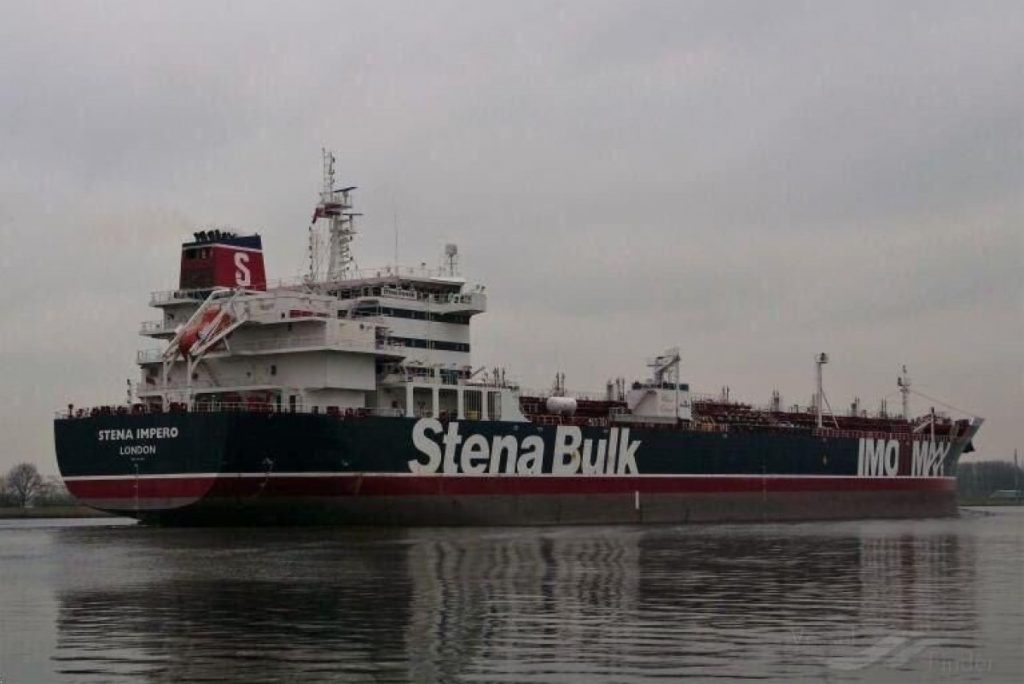
The seizures of vessels constitute a recipe for a tit-for-tat calamity.  We are already seeing the bitter fruit of the harvest arising out of the seizure of Grace I. Two oil tankers – the UK registered Stena Impero, and the Mesdar, another Liberian registered vessel though British operated – were subsequently seized in the Strait of Hormuz.  The Mesdar’s detention was threatening though teasingly brief; the Stena Impero, on the other hand, was to be made an example of.
Another oil tanker has since fallen into the hands of the Iranian forces, one accused of smuggling some 700,000 litres of fuel to Arab states.  “The seizure of the oil tanker,” noted IRGC commander Ramezan Zirahi, “was in coordination with Iran’s judiciary authorities and based on their order.”
In all of this, the UK has made a fateful decision: the US is there to be supported in a policy to protect merchant ships against Iranian efforts.  But Washington has assisted in creating the problem for which it now claims to have the solutions.  It is the supplied choice of a current empire to a former one, and the current empire is keen on misbehaving.  The forces of the US imperium have been doing their bit to ensnare Iran in a troubling vice, be it from al-Asad airbase in Iraq, to Qatar.  At sea, the US Navy holds forth with its carrier strike group.  Sanctions have been ramped; the Iran nuclear deal dumped upon and exited.  The Trump administration persists in causing a certain modicum of mayhem.
Putting up your hands for an unconditional commitment to a US-led effort cuts against the grain for a united European-controlled mission in the strait.  European powers also feel they must be firm, just not in the Trump way. The result has seen hesitation and concern about whether Germany and France might be added to any cobbled coalition.  Farther afield, Australia has also fielded a requestfrom Washington described as “serious and complex”, one that would see oil shipments from Iranian incursions being protected.  Australian Defence Minister Linda Reynolds has not been exactly forthcoming in any way on what qualifies the request as complex and serious, though, like a long retained servant to the lord of a manor, makes it sound grander than it is.
Now, Britain finds itself stretched, the rubber man of international relations keen to maintain shape, if only in distorted fashion.  Iran was bold, even brazen, but its forces feel they have every right to be.  The current conventions are for ditching; the protocols of old are being thrown out like stagnant dishwater.  Now, in with the new, the asymmetrical teasing, be it through sponsored agents in Yemen, allies in Iraq, or a chance to seize, if only arbitrarily, various assets in the Strait of Hormuz.
The Iranian actions have done their bit to strike a degree of consternation.  Moez Hayat, penning a view in The National Interest, exemplifies that consternation.  Iran struck when the UK lacked awareness and cogency.  “Functionally, Britain was leaderless as Iranian forces boarded the vessel.  Prime Minister Theresa May was a lame duck, unable to act as the Conservative Party elected a successor.”  The problems go far deeper than that, telling of European disunity and continued US bellicosity.  On this occasion, a simpler assessment is that Britain was caught in the strait, a true US set-up with continuing consequences.
Dr. Binoy Kampmark was a Commonwealth Scholar at Selwyn College, Cambridge.  He lectures at RMIT University, Melbourne.

Friday, August 02, 2019

KHAMENEI’S THREE COMMANDMENTS FOR THE IRANIANS: THE MIDDLE EAST IS HEADING TOWARDS “MAXIMUM DANGER”

By Elijah J. Magnier
The Middle East is heading for “maximum danger” following the “maximum pressure” imposed on Iran by US President Donald Trump who, unilaterally and unlawfully, withdrew over a year ago from the Joint Comprehensive Plan of Action (JCPOA), known as the nuclear agreement, and imposed harsh sanctions on Iran that Tehran considers a declaration of economic war. Trump’s move against Iran has provoked a gathering storm of tanker wars, the mutual detention of tankers by Iran and Britain. Indeed, the US administration has been pushing London to confront Iran starting from the capture of an Iranian super tanker (Grace 1) at Gibraltar on July 4, which has now triggered an Iranian tit-for-tat reaction (capturing a British tanker in the Straits of Hormuz). While the US and the UK are walking, along with Iran, on the edge of the abyss, the Iranian supreme leader, Sayyed Ali Khamenei, has publicly proclaimed “three points of guidance” for officials in the country, which includes a road map to follow even in his own absence.
Iran has detained a British oil tanker “Stena Impero” hours after the British High Court of Gibraltar announced the extension of an additional month of the arrest of Iranian tanker “Grace 1”, carrying two million barrels of oil. When this news reached the Iranian leadership, they realised that mediation efforts by French President Emmanuel Macron had stumbled and that it was time for Iran to take the matter in hand.
This does not mean that Iran is closing the door to French diplomacy or attempts by other intermediary states to de-escalate the extremely tense situation that is intensifying daily in the Middle East, particularly with the gathering of new British naval war vessels and the arrival of additional US military forces in Saudi Arabia.
President Emmanuel Macron’s chief adviser, Ambassador Emmanuel Bonne, had visited Tehran this month and met with Iranian leaders, and he promised to intervene to secure the release of the Iranian super tanker Grace 1 and to play a mediation role between Tehran and Washington.
According to Iranian sources, the detention of the Iranian super tanker was an effort by the US to implicate Europe further in the US offensive against Iran. The US is lurking behind London, watching the first recent UK confrontation with Tehran escalate, as Iranian Special Forces took the situation in hand and confiscated a British tanker.
The US seems to have pushed the UK to take the decision to hold Grace 1 at the beginning of the tanker crisis, in response to Iran’s downing of a US drone. Unfortunately, London agreed to become involved on behalf of its US ally, further confirming European apprehensions about effects of the US withdrawal from the nuclear agreement, which European states did not support– since Iran has not violated any clause of the agreement for 14 months.
The US decision to revoke the nuclear deal and the US “maximum sanctions” imposed on Iran are in fact causing mounting pressure and increased danger of a possible war in the Middle East.
It is clear that Iran does not intend to back down in the face of US sanctions and aggression. The Middle East is on the path towards “maximum danger” because Iran considers itself already at (economic) war with the US and its allies. At this stage Iran does not differentiate between the economic war imposed by the US administration and a military war: the results in both cases are devastating.
I learned that Sayyed Ali Khamenei met with the Iranian leaders and gave three directives for Iran to follow, whatever difficulties might arise at any time in the future, as fixed principles.
“The US is seemingly aware of Tehran’s planning and objectives. This is why this administration, like previous ones, tried to thwart Iran’s nuclear and missile development, and support for its allies- to no avail”, said the source. 
Khamenei’s directives are:
1 – Adherence to Iran’s right to nuclear enrichment and everything related to this science at all costs. Nuclear enrichment is a sword Iran can hold in the face of the West, which wants to take it from Tehran. It is Iran’s card to obstruct any US intention of “obliterating” Iran.
2 – Continue to develop Iran’s missile capability and ballistic programs. This is Iran’s deterrent weapon that prevents its enemies from waging war against it. Sayyed Ali Khamenei considers the missile program a balancing power to prevent harm against Iran.
3 – Support Iran’s allies in Iraq, Syria, Lebanon and Yemen, and never abandon them, because they are essential to Iran’s national security.
Sayyed Khamenei’s three points are a response to the 12 conditions announced by Secretary of State Mike Pompeo, who asked the Iranian government to stop its nuclear and missile programs and abandon its allies in the Middle East, thus depriving Iran of any defence, and turning it into a vulnerable country.
Sources added: “Sayyed Khamenei recommended these commandments to preserve the Islamic Republic of Iran, and that each of these three items is equally important for the safety of Iran, its existence and continuity, and national and strategic security.”
Iran began to develop its missile capabilities under US sanctions. It has developed its nuclear program during the 40 years that the US has imposed a suffocating blockade on the country. Today, Iran has reached a very advanced stage in both programs to the extent that it will never retreat on either initiative, but will continue to move forward. 
As for its allies, recent years have shown how Iran and its allies in Yemen, Iraq, Syria and Lebanon, have been able to take the initiative in the Middle East and turn things in their favour.
It is not unlikely that Tehran will set up ballistic missiles at close range to the enemies or countries that could be targeted by these missiles. Its allies will defend Iran at a moment’s notice.
The situation today is as follow: Iran has detained the British tanker “Stena Impero” along with its 23 crew members in Bandar Abbas pending the release of its carrier Grace 1. The US Central Command has announced that it is working with its allies to securefreedom of movement. Iran has threatened to not allow any oil exports from the Persian Gulf region if it cannot export its own oil. Tehran downed an American drone. Trump himself announced the shooting down of an unmanned Iranian drone –a claim Iran denies– thus placing himself on the same level as the Iranian IRGC- which Trump calls a terrorist group!
The US is sending new troops to Saudi Arabia, and Britain has sent additional war vessels in the Persian Gulf. All this deployment in a small area in the Middle East, a narrow strait that can hardly accommodate all these events. The region is heading towards maximum danger where all countries and allies are putting their hands on the trigger instead of going to the negotiating table and respecting the agreements signed. What comes next may be even worse.