A Flydubai aircraft landed at Tabuk Airport in Saudi Arabia today after diverting from its scheduled route from Dubai to “Tel Aviv”, following the activation of two emergency codes while flying over Jordanian airspace before changing course toward Saudi Arabia.
Flightradar reported that the aircraft, carrying around 100 people, flew for some time over Jordanian airspace before continuing over Saudi airspace and landing at Tabuk Airport.
Flydubai announced that the aircraft had landed safely in Tabuk, assuring that all passengers were safe. The airline said flight FZ1073, operating from Dubai to “Tel Aviv”, had experienced an incident in flight and that further updates would be issued once additional confirmed details became available.
According to enemy media, the aircraft first activated code “7700,” indicating a general emergency, and shortly afterward transmitted code “7500,” which indicates a hijacking, triggering a state of alert on the “Israeli” side.
The reports said the “Israeli” Air Force went on full alert, with fighter jets taking off toward the Emirati aircraft. All departures from Ben Gurion Airport were also temporarily suspended pending clarification of the incident.
Later, “Israeli” media reported that the current assessment pointed to an altercation between the two pilots, which prompted a distress call and activation of the emergency codes.
Investigators were reportedly examining scenarios in which the incident resulted from a malfunction or an onboard occurrence rather than a hijacking.
A spokesperson for Netanyahu’s office confirmed that the diversion of the Flydubai flight from the UAE toward Saudi Arabia was not believed to be a hijacking, saying that “the situation is under control and all necessary measures are currently being taken to return our passengers safely.”
“Israeli” media later reiterated that there was no basis for the hijacking account, reporting that the incident resulted from a fight between the pilots and confirming that the aircraft had landed in Saudi Arabia.
The reports also said the aircraft was no longer appearing on flight-tracking applications, while the circumstances of the incident remained under investigation.
Sina Azodi says Iran’s security concerns, distrust of US, and regional threats have shaped its nuclear calculations
TEHRAN – Sina Azodi, Assistant Professor of Middle East Politics and Director of the Middle East Studies MA Program at George Washington University's Elliott School of International Affairs, has become one of the most prominent voices on Iran's nuclear program.
His book "Iran and the Bomb: The United States, Iran, and the Nuclear Question" traces the program across five decades, drawing on declassified U.S. documents, Iranian memoirs, and interviews with Iranian scientists and officials. His recent articles argue that zero enrichment was never realistic and that neither airpower nor nuclear superiority forced Iran to capitulate during the 2026 war. Tehran Times spoke with Professor Azodi about his book, the 2026 war, the Islamabad Memorandum of Understanding, and prospects for renewed U.S.-Iran talks. Below is the full text of the interview:
Your book, Iran and the Bomb: The United States, Iran, and the Nuclear Question, traces Iran’s nuclear program back to the 1950s, when the U.S. supported Iran’s nuclear development. What does Washington today seem to have forgotten about that early partnership? I think what is critical is that, yes, Atoms for Peace was provided to Iranians by the Eisenhower administration. But one thing that most people forget is that back then the United States was encouraging Iran to diversify its energy sources and recommended that Iran invest in nuclear energy. There is a report from Stanford University that I cite in the book, and that report suggested to the Iranian government that it would need some 20,000 megawatts of electricity by the year 1994 and that nuclear energy was the best viable option. I say this is something that the American side has forgotten. It is because of the fact that the very same people who were encouraging that later came to question the very reasoning of the Iranian nuclear program, including people like Henry Kissinger, who said many times that the Shah was visionary, that he was investing for Iran’s future, and encouraged him to buy nuclear reactors. Then later he switched sides and questioned the Iranian nuclear program by suggesting that Iran had oil and gas.
In your August 25 article, “Turns out having nukes provided the US very little leverage,” you argued that U.S. nuclear superiority gave Washington little leverage over Iran. What does this tell us about the role of nuclear weapons in U.S.-Iran relations? What I was trying to explain in that article was that I looked at historical episodes where a middle power had fought a war with a great power armed with nuclear weapons, and I highlighted the fact that nuclear weapons played no role in those conflicts. The conflicts that I looked at were the Falklands War between Argentina and the United Kingdom, the Russia-Ukraine conflict, and the recent Iran-United States war, where nuclear weapons played no role whatsoever. What it means is that nuclear weapons are an effective tool of deterrence, but provide no coercive leverage, meaning that you cannot use nuclear weapons to force another state to back down. It is an effective tool of deterrence with the threat of punishment, but I showcased that in these conflicts nuclear weapons played no role and they were not even considered in the political discussions of those countries that had them.
In your book, you mention that the strategic logic of Iran’s nuclear program survived the 1979 revolution. What exactly survived: the technology, the security rationale, or both?
What I was trying to explain was that the logic of the program survived The regime change because the threat perceptions have not fundamentally changed. What I mean by that is that regardless of the ruling regime in Iran, the political leadership that sits in Tehran, when they look at their neighborhood, they see threats coming from all over. From the Persian Gulf, it is a place where Iran was historically invaded. The first time that Iranians had to deal with a naval power was in the 1600s, when the Portuguese Navy showed up and occupied Hormuz Island, and the Iranians did not have the naval power to counter that threat. Again, in World War II, Iran was invaded from the Persian Gulf. This is why the Shah insisted that he needed to be the dominant power in the Persian Gulf. He said that the Strait of Hormuz is our jugular vein, and you hear almost similar remarks from the leaders of the Islamic Republic, who think that the security of the Persian Gulf is paramount to Iran’s security. This is where Iran lives. Iran cannot go anywhere else. Also, Iranians look at their neighborhood with threats coming mostly from the west. The Shah was extremely concerned with the threat of the Ba’athist regimes in Iraq and Syria. He wanted to be ready in case Iraq developed nuclear weapons, and we saw what happened in 1980, when Iraq finally decided that it needed to counter what, in Saddam’s view, was the Iranian threat. So, my argument is that these threat perceptions have survived the 1979 revolution, and I think they will continue to do so. It doesn’t matter, from my perspective, which ruling regime will be in Tehran. They see threats coming from pretty much all over the place.
Your book discusses the internal debates over uranium enrichment. What made enrichment so important to Iran rather than simply obtaining nuclear fuel from abroad?
Many reasons. I mean, two main reasons. First of all, after the revolution, when the leadership in Tehran decided to restart the program, the late President Hashemi Rafsanjani was really the main driver of restarting the program. They quickly realized that the very same countries that were encouraging Iran to buy nuclear reactors from them not only didn’t sell nuclear reactors, but also refused to deliver the fuel that Iran had bought. In the case of Europe, for example, they refused deliver the fuel that Iran had paid for it. They told Iranians that they didn’t have a nuclear reactor, and Iranians asked the Europeans to sell nuclear reactors to Iran, and they said, you know, you have oil and gas; you don’t need nuclear technology. And this was really under the pressure of the Reagan administration, which by 1983 had started a campaign to limit Iran’s access to nuclear technology. Iranians thought that they had made a lot of investments in the nuclear program. They either had the option of abandoning everything or trying to somehow resurrect the program. And this is why they decided by 1987 to pursue enrichment, which could give the Iranians the option of providing nuclear fuel or nuclear weapons. And this leads to my second point, which is the threat that Iraq, the acute security threat that Iraq, its chemical weapons and its nuclear program, posed to Iran. The Iranian leadership back then thought that Iraq had chemical weapons, was using them, nobody was saying anything to them, and if they got their hands on nuclear weapons, they might use one and nobody would say anything to them. So, based on the public interviews that I’ve seen from Iranian officials, they wanted to be ready for the day that if Iraq used or developed a nuclear arsenal, which would impose a serious threat to Iran’s security.
In your article “History tells us coercion through airpower alone won’t work,” published on February 24, you argued that air power alone could not force Iran to capitulate. After the U.S.-Israeli war that began on February 28, 2026, did that argument still hold up?
Absolutely, and we’ve seen what happened. And again, this is a historical case study that I did. I showed that in previous air campaigns, the party that used air power was unable to force the other side to capitulate. I used many examples. I had to cut down some of them, but going back to 1945, when the Allied countries were using firebombs on Dresden and Japanese cities, they were unable to force them to surrender until Germany was defeated on the ground and Japan was bombed twice by nuclear weapons, and was facing the imminent threat of Soviet invasion.
So that’s one case that I did. In the 1990s, Yugoslavia did not back down despite the NATO air campaign until there was a threat of using ground troops, and then they surrendered. So, in all of these cases, you see that air power is a very effective tool of destruction, but it is unable to deliver the political victory that the other side is seeking. You need ground troops to force surrender. And this is why, again, we see that after 40 days of intense air campaigns, Iranians did not surrender.
So, what do you think Washington ultimately achieved? Just coercion and degradation of Iran’s capabilities, or something else?
Well, degrading the military capability was an achievement, but the fact remains that victory in war is not defined by the amount of destruction that you bring. It is defined by whether one side can achieve its political objective of the war. And this is the classic definition of victory. So, if diplomacy and war are the two sides of the same coin, if diplomacy failed to achieve the political objective, the question is whether war was able to achieve the same political objective. And when we look at the political demands of the Trump administration, which was, first of all, an unconditional surrender. This is in Donald Trump’s Truth Social. Was unconditional surrender achieved? The answer is clearly no. Was regime change achieved? The answer is clearly no. Did the United States, or Trump himself, play a role in choosing the next Supreme Leader of Iran, as he had demanded? Did he play a role in that? So, all of these answers are no. So, you cannot say that the U.S. won the war. Now, on the Iranian side, Iran’s political objective of the war was simple: survive. And it was able to survive. That political objective was achieved.
In your May 19 Foreign Policy article, “The Myth of Zero Enrichment,” you argued that zero enrichment was never realistic. Why is enrichment so important to Iran?
There are many factors. One is what I mentioned earlier, the fact that Iranians know that nuclear fuel will never arrive. The guarantees of delivering nuclear fuel are meaningless from the perspective of the Iranian leadership. In fact, as I explain in the book, the reason that Iran decided to start enriching to 20 percent was that the Iranian leadership in 2011 believed that the West would not provide the 20 percent nuclear fuel for the Tehran Research Reactor. And this would cause an embarrassment for the country. This is their words, not mine. And that’s why they needed to start enriching. So, one is the historical precedent, which I think plays a critical role, and the lack of trust that comes with that. And second, I think it’s the prestige that comes with it. This nationalistic sentiment that comes with it, because Iran, along with Israel, is the only country in the Middle East that has the capacity to produce its own material. So, this is why I think that they will not give up on the principle of enrichment. And now that we’re seeing a nuclear agreement between the U.S. and Saudi Arabia, which includes the option of enrichment, I think that this agreement only makes the Iranian position more stiffened.
After the U.S. withdrawal from the JCPOA, the 2026 war, and the failure of the June 17 Islamabad memorandum, can Iran realistically trust another nuclear agreement with Washington?
There was never trust, and there’s never trust in international politics because your friend today can be your enemy tomorrow. I mean, several times it has happened. But international agreements are really about credibility. Now, does Washington have any credibility in Tehran? The answer is really no. I mean, we’ve had the experience of the JCPOA. We had the experience twice of Iranians and Americans negotiating, and as FM Araghchi has called it, the negotiation table was bombed.
So, lack of credibility is there. There are forces in both Tehran and Washington who try to undermine any diplomatic path. So, I think all of these factors play a role.
In your August 25 analysis, you argued that Iran’s conventional capabilities give it more practical leverage than nuclear weapons. After the 2026 war, do you still believe that?
I think so, yes. First of all, the bar for the deployment of nuclear weapons is very high. This is why you’ve seen President Trump say recently, when he was asked about using nuclear weapons in Iran, that it was a stupid question. He said, you know, “I’m not even thinking about it.” And, as a side note, there’s a lot of discussion that a tactical weapon might be used. There’s no such discussion, and it is extremely unlikely. But we saw what happened. Iranians were able to deliver severe punishment on international shipping, disrupt international and global markets, fertilizers, inflation across the world. In the United States, energy markets have been disrupted. So, and plus, the amount of damage that Iran has been able to deliver with its conventional weapons, I think has been enough or punishing enough, in my opinion, rather than just merely having nuclear weapons.
Your book was largely researched before this war. If you rewrote the final chapter today, what is the one thing you would change, and what is the one thing you would keep exactly as it is?
I think I’ll keep everything the way it is. I mean, of course, I will add the recent war, but my conclusions have not changed because, in the conclusion, I make the point that Iran’s nuclear program is extremely unlikely to be dismantled. I still stand by that argument. I still think that the option of Iran going for the bomb is less likely, but the other scenario, which is Iran regaining its nuclear capacity while staying below the finish line, is the most likely scenario. And the evidence that we’ve seen that Iran is trying to rebuild its nuclear program points to this scenario.
After Trump’s September 22 UN speech, in which he presented a nuclear deal as an alternative to further military action, do you think Washington is still seeking a nuclear agreement with Iran, or is regime change now part of its strategy?
I think they are using the regime-change issue to get an agreement with Iran. I don’t think the Trump administration cares who is in power. On June 18, 2026, one day after the U.S.-Iran Islamabad Memorandum of Understanding was signed, Trump praised the Iranian leadership, calling them the “smart people” his administration had dealt with.Then, on July 8, 2026, he described the Iranian leadership in much harsher terms, calling them “sick,” “vicious” and “violent.” So, his position fluctuates. He starts, you know, on his Truth Social at 2 a.m. D.C. time. In a way, I think that he likes to use this unpredictability and outlandish remarks to threaten other states. It works for him, but it doesn’t work for the United States and its credibility around the globe. And we’ve seen how Europeans and Canadians are now even using the threat narrative in reference to the United States. I think this is key now. So, I guess the point I’m trying to make is that all of his remarks, including what he said at the General Assembly on |when he said, “I’m going to annihilate Iran,” and “I’m going to send Iran back to the Stone Age,” are, I think, just threats to force Iran [to negotiate]. At the same time, in that September 22 speech, Trump presented the choice as being between reaching a deal with Iran and “annihilating the Islamic Republic.” He also said he believed a deal could be reached after the U.S. midterm elections.
Despite Trump’s threats in his speech at the UN General Assembly, Iranian and U.S. officials still met and held talks. Do you think these new talks could lead to a concrete outcome, or are we likely to see the cycle of negotiations followed by escalating tensions continue? I think we’ve entered a phase of this conflict, a fragile ceasefire. The Iranian side likes to drag Donald Trump into the midterm elections and keep the political pressure on him. I mean, gas prices again are very high in the U.S. I saw a tweet from Donald Trump from 2012 in which he said, “Fire Obama because gas prices are up.” So this is what the Iranians, I think, are trying to do. But he wants to end everything very quickly and say, “I want the conflict to be over.” But I don’t. And just because of this, I think the conflict, or this fragile ceasefire, is going to hold on for a few months, at least until the elections, the midterm elections in November.
Is there anything else you would like to add that you think is important for understanding the developments we are seeing now? One thing I think is important for understanding the current situation is the three scenarios for Iran’s nuclear program. The first scenario is the so-called Libya model, in which Iran agrees to dismantle its nuclear program in return for sweeping sanctions relief, the promise of nuclear fuel, and so on. Because of the lack of trust I mentioned and the historical precedent, I don’t think it’s going to happen. The second scenario is Iran trying to cross the finish line and develop a small nuclear arsenal. I think this scenario is possible but less likely because if Iran develops nuclear weapons, the Saudis are going to do it too. Then Iran is going to get stuck in a nuclear arms race with Saudi Arabia and Israel, both of which have greater financial resources and better conventional military capabilities. So that’s the second scenario. The third scenario, I think, is going back to threshold status, when Iran reconstructs its enrichment capacity but does not develop nuclear weapons.
When asked about his identity, Hajj Abd al-Qadir, known as “Hajj Tahseen” in the memory of the generation that witnessed the movement’s early beginnings, had no answer other than that he was a “son of Islam.” In doing so, he evoked the spirit of the noble companion Salman al-Farisi. For him, belonging was a purely Quranic vision and a comprehensive way of life, reflected in every aspect of his thinking, leadership, ethics, and sense of responsibility. To a casual listener, the phrase may appear to be a brief answer that puts an end to the question. But to those who knew him, it was the distillation of an entire life journey, one that began in the town of Budnayel in the Bekaa, where Hajj Ibrahim Muhammad Aqil was born on December 24, 1962.
The story did not begin with weapons. At the age of fifteen, he went to the Muslim Scouts Association in Beirut accompanied by a relative. He was captivated by the scouting movement and fascinated by its musical band, so he joined. He mastered playing seven instruments, foremost among them the trumpet and then the piano. He composed several pieces and possessed an exceptionally keen musical ear and refined taste in selecting what he played. After several months, he moved to the Amiliya Scouts, where he remained until the age of nineteen. Then came the “Israeli” invasion of Lebanon, diverting him from this sensitive and artistic aspect of his personality toward another arena: confronting the occupier.
In that arena, he belonged to the founding generation of Islamic activism in Beirut and was among the commanders of operations during the resistance to the “Israeli” invasion of the capital in the early 1980s. He subsequently advanced through various responsibilities. In the early 1990s, he assumed responsibility for central training within Hezbollah and played a key role in developing the human capabilities of the resistance formations. He then took charge of the staff command in the mid-1990s.
Beginning in 1997, he assumed responsibility for the Jabal Amel Operations Unit, remaining in that role until after the liberation in 2000. During that period, he directly led a number of specialized operations. He was among those who established the pillar of the Islamic Resistance’s operations. From 2008 onward, he served as the deputy secretary-general for operations affairs and was appointed a member of the Jihad Council.
When the July 2006 War broke out, he was among the commanders leading the response to the aggression. He supervised the establishment and development of the Radwan Force and led it until his martyrdom. He was also among the commanders who planned and directed operations against takfiri groups. Since the launch of the “Al-Aqsa Flood” Battle, he had been responsible for planning and overseeing the military operations of the Radwan Force on the Lebanese support front.
Perhaps there is a meaning that goes beyond the apparent contrast in the journey of a man who began with musical notes and ended on the battlefield. The ear that distinguishes a precise musical note is the same ear that understands the value of discipline, timing, and harmony between different parts—qualities needed by someone who builds an entire combat formation. But this is a retrospective interpretation that we project onto this commander’s life story. As for him, the only answer he was known to give was the one with which we began: “A son of Islam.”
On September 20, 2024, Hajj Abd al-Qadir was martyred in an “Israeli” airstrike targeting a building in the al-Qa’im area of Beirut’s southern suburbs, along with a number of his fellow resistance fighters. Hezbollah mourned him as a “martyr on the road to Al-Quds” and stated in its announcement that Al-Quds had always occupied a place in his heart, mind, and thoughts.
Today, on the second anniversary of his martyrdom, his life story leaves us with a question—not about who he was, but about what it truly means for a person to be a “son of Islam” in deeds rather than words: to remain true to the commitments he has made and to let his conduct bear witness to him before his tongue does.
Sacred Defense Week, commemorated in Iran each year, stands among the most significant events on the Islamic Republic’s national calendar, marking the anniversary of the first imposed war on the Islamic Republic that began in September 1980 and endured for eight grueling years.
This year’s observance carries particular weight. It comes less than seven months after the forty-day US-Israeli military aggression against Iran, which tested Iran’s resolve, unity, and defensive capabilities and evoked memories of the darkest years of the 1980s, while at the same time revealing how profoundly the country’s capabilities have evolved over four and a half decades.
This week is marked by remembrance of the Sacred Defense generation intertwined with a renewed emphasis on popular mobilization, technological self-reliance, and the enduring conviction that genuine national strength rests on faith, unity, and the bond between the people and their leadership.
The events of the past year have added new chapters to a story of resistance stretching back forty-seven years, since the 1979 Islamic Revolution.
Against that backdrop, this year’s commemorations have served not only as a tribute to those who made the ultimate sacrifice, but also as a declaration of resilience and a showcase of the capabilities Iran has built between the first imposed war in the 1980s and the third imposed war in 2026.
Sacred defense legacy and its continuing relevance
The eight-year war imposed by Saddam Hussein's Ba'athist regime in 1980, barely a year after the ouster of the West-backed Pahlavi dictatorship in Iran, represented more than a military confrontation.
It became a period that strengthened social capital, national cohesion, and strategic self-confidence in a nation still consolidating its revolutionary gains.
The invasion was launched with the expectation of a quick victory, backed by technologically advanced Western powers that saw an opportunity to weaken the nascent Islamic Republic and roll back its growing influence across the region.
Saddam believed he was facing a weak Iran that a swift and massive military offensive could force into submission, and he even promised media persons he would conduct his next interview with them in Tehran within days.
That illusion turned into eight years of devastating war, and he failed to achieve any of the goals he had declared at the outset. Iranian forces, still reorganizing after the Islamic Revolution and facing severe shortages of equipment, mounted a defense that ultimately repelled the aggressor and preserved the country's territorial integrity.
The lesson drawn from that experience, articulated during the war years and carried forward ever since, was that genuine power rests on faith, unity, and the bond between leadership and the people.
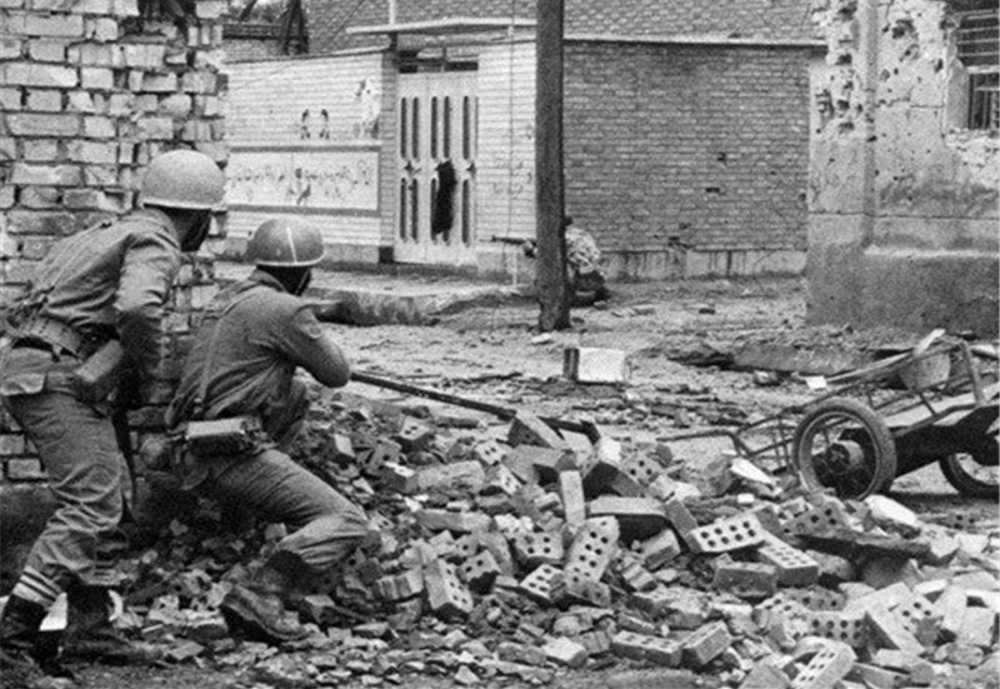
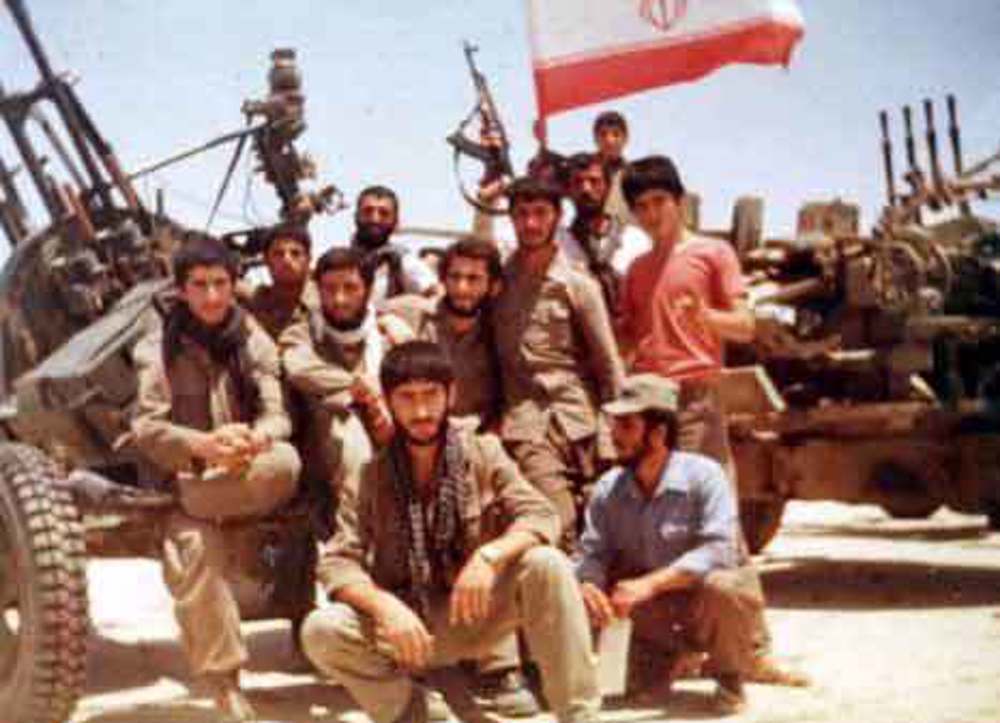
Defending the city of Khorramshahr in 1980
2026 aggression and the miscalculation of the enemy
The forty-day US-Israeli war of aggression against Iran, which began on February 28, 2026, represented the most direct challenge to the country’s security since the Sacred Defense era.
The calculations behind the all-out assault echoed those made by Saddam forty-six years earlier: that overwhelming force could exploit perceived vulnerabilities, fracture the country’s cohesion, and compel Iran to submit before it could mount an effective response.
The expectation was of a rapid campaign. A sustained air offensive against military, strategic, and other targets was intended to degrade Iran’s capabilities and place extraordinary pressure on its leadership and society. At the same time, the attacks were accompanied by expectations, expressed by some Israeli and US figures and supporters of the so-called “regime change” project, that military pressure could trigger political upheaval inside Iran.
Those expectations did not produce the outcome anticipated by the campaign’s proponents. Iran responded with sustained missile and drone retaliatory attacks against Israel and US military positions across the region, backed by popular support. The full-scale war continued for forty days before a Pakistan-mediated two-week ceasefire was announced on April 8.
Response that changed the equation
The scale and reach of Iran’s response demonstrated capabilities that were unavailable to the country during the Sacred Defense era in the 1980s. The Islamic Revolution Guards (IRGC) Corps conducted repeated waves of missile and drone operations against Israeli and American bases and assets across the region, decimating them completely
Among these was Operation True Promise 4, through which the IRGC reported repeated strikes against US and Israeli-linked military infrastructure. Its targets included the enemy’s command centers, air-defense systems, radar installations, missile batteries, logistics facilities, and other military assets in several regional countries.
In one of the waves, the IRGC struck US HIMARS batteries in Kuwait, a Patriot system in Bahrain, and facilities associated with US military personnel in the United Arab Emirates.
By April 7-8, the IRGC reported its 100th wave of retaliatory operations, with strikes against more than 25 strategic sites, including military, security, logistical, energy, and infrastructure targets stretching across the region.
The significance of the response lay not simply in the number of missiles and drones launched, but in the geographic reach of the capabilities Iran had developed over decades. Weapons that could not have been imagined in Iran's arsenal during the 1980s were now being employed against targets far beyond the country's borders, illustrating the transformation of its indigenous missile and drone programs.
The confrontation also underscored the strategic importance of the Strait of Hormuz. Iran's ability to disrupt maritime traffic through one of the world's most important energy corridors gave it a means of exerting pressure far beyond the battlefield and demonstrated how geography, military capability, and economic leverage could be combined in a modern war.
The April 8 ceasefire halted the forty-day phase of direct US-Israeli attacks and Iranian retaliation. Two months later, Washington and Tehran signed a memorandum of understanding that declared an immediate and permanent termination of US-Israeli attacks and established a framework for negotiations on issues including the Strait of Hormuz, illegal sanctions, Iran's nuclear program, and other outstanding issues.
For Iran, therefore, the confrontation became another milestone in the evolution of its strategic doctrine: from a country struggling to defend itself with limited resources in the 1980s to one capable of projecting missile and drone power.
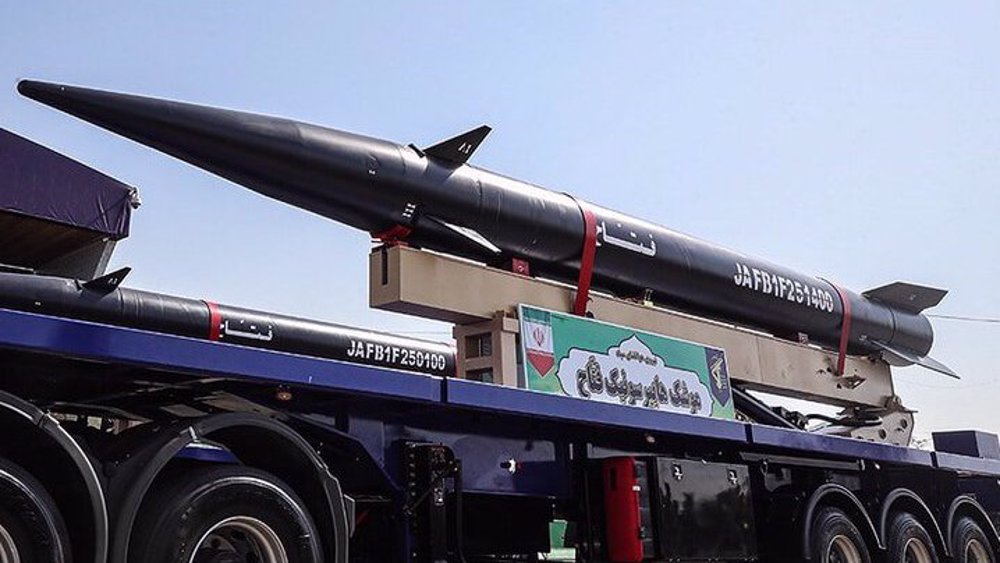
Fattah hypersonic missile
Defense industry as a pillar of national power
The achievements of Iran's defense industry over the past four decades, and particularly in the past year, have been remarkable, and they were on full display during the Sacred Defense Week commemorations.
The production of weapons and defense equipment doubled overall in the year following the aggression, with some strategic products seeing increases of more than three times their pre-war output.
This stood in direct contradiction to claims by American and Israeli leaders that Iran's defense production would be paralyzed by sustained attack.
The cooperation among the armed forces, the defense ministry, knowledge-based companies, private-sector enterprises, and scientific institutions formed the backbone of this production capacity, with two-thirds of defense equipment now produced by private-sector and knowledge-based companies.
The number of these companies grew by 20 percent over the past year, and the volume of cooperation expanded by 70 percent, while 65 percent of research projects translated into actual products.
Plans are underway to increase defense production three- to fivefold, and the IRGC has emphasized that its forces remain fully prepared to deliver a decisive response to any new aggression.
The commander of the Khatam al-Anbiya Joint Air Defense Headquarters stated that the force had achieved self-sufficiency in supplying its required weapons and equipment and that systems developed during the aggression had been tested operationally and were being rapidly reproduced.
New weapons and the widening technological gap
The Sacred Defense Week announcements also revealed new capabilities that have not yet been fully disclosed. The IRGC spokesperson confirmed that a new weapon had been tested successfully against an American aircraft carrier, though details remain classified for security reasons.
At least two US subsurface vessels were captured by IRGC Navy forces, and reverse engineering of their technology has already begun.
The IRGC announced that a second US F-35 fifth-generation fighter jet from the Lakenheath squadron was targeted and struck by the modern air defense of the IRGC Aerospace Force over central Iran.
The downing of such an advanced aircraft by Iranian air defense systems represents a significant achievement, as the F-35 is widely considered among the most capable combat aircraft in the world and is extremely radar-evading, making its interception unprecedented.
These developments, alongside the downing of advanced American aircraft by indigenous air defense systems, demonstrate that Iran has achieved a level of technological sophistication that challenges even the most advanced militaries in the world.
The enemy's equipment advantage, while still significant on paper, has been offset by Iranian tactical innovation, operational planning, and the development of systems designed specifically to counter the technologies deployed against the country.
Former US Navy officer Matt Bracken observed that Iran produces hypersonic missiles in mass quantities, something the United States has not yet achieved operationally, placing China, Russia, and Iran as the only true holders of this capability.
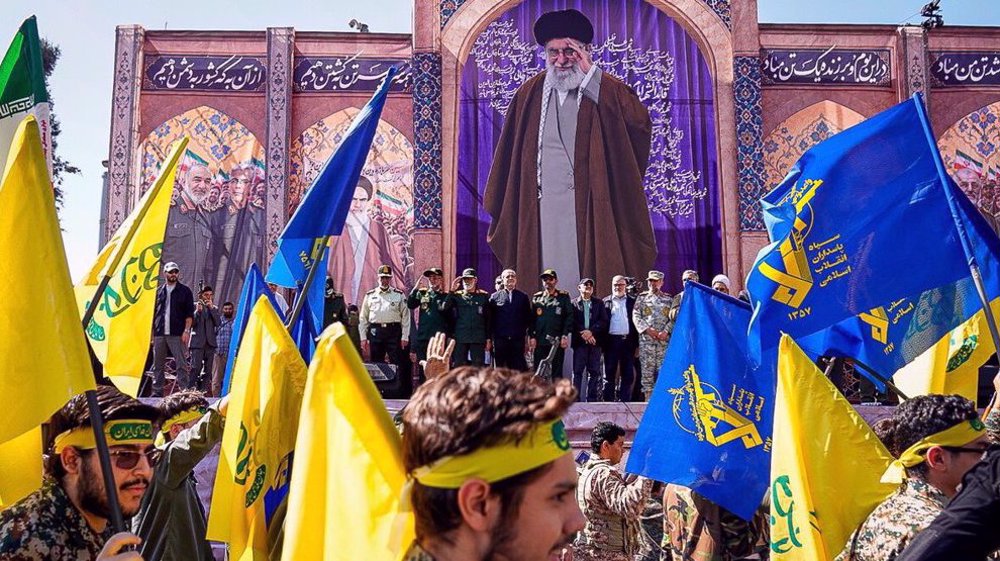
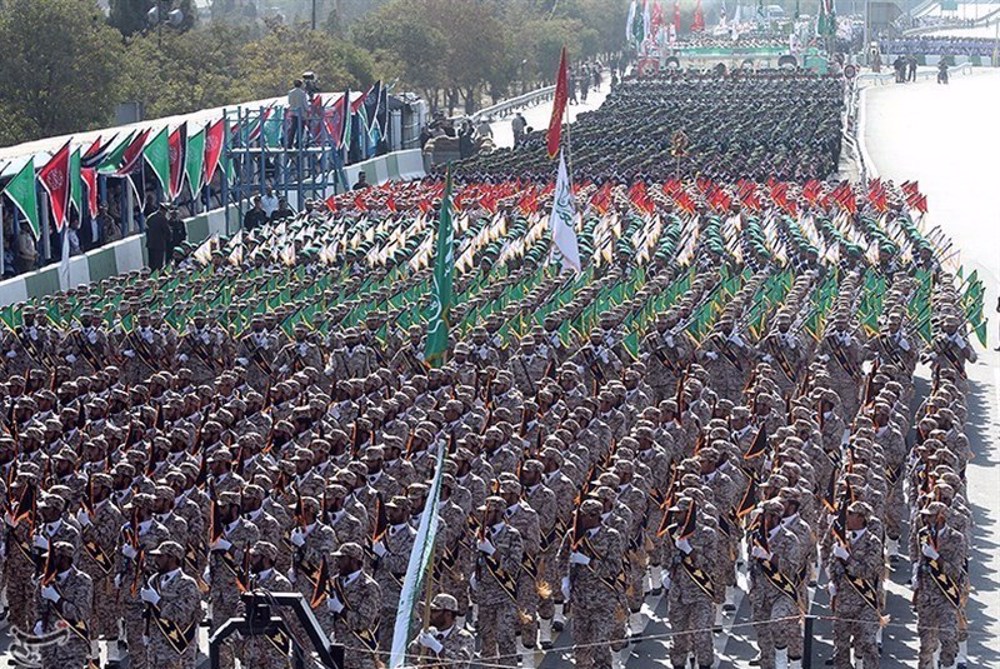
Volunteer forces parades in Tehran on September 18, 2026
Popular mobilization and the renewal of national unity
One of the most striking features of this year's Sacred Defense Week has been the unprecedented display of popular mobilization, reflected by regular rallies across the country.
The "Fada'iyan Iran" exercise, which began with the participation of 313,000 Iranians in Tehran, represented a resurgence of the spirit that sustained the nation during the Sacred Defense and celebrated the two-hundredth night of the people's steadfastness and resistance in the squares.
The choice of 313,000 carried deep symbolic meaning, invoking the 313 companions of the Prophet Muhammad (PBUH) at the Battle of Badr and the devoted companions associated with the Imam of the Age (AS) in Shiite tradition.
President Masoud Pezeshkian declared at the exercise that "if the people are present on the ground, no power is capable of threatening us."
Provincial exercises across the country, including a 96,000-strong rally in Kerman, demonstrated that the readiness to sacrifice for the nation extends far beyond the capital.
The program included various sectors of the population and extended from Imam Hussein Square and the highway intersection to Enghelab Square in Tehran, with a display of Iranian-made drones showcasing part of the country's military capabilities.
The participation of women in military-style uniforms, young people alongside veterans, and families of martyrs reflected the diversity of a society united in its determination to defend its sovereignty and its revolutionary principles.
Cultural and documentary dimension
This year's Sacred Defense Week has placed unusual emphasis on documentation, cultural production, and the transmission of memory to younger generations.
Officials announced the publication of 164 new books dealing with Sacred Defense, including a 22-volume collection concerning the lives and experiences of mothers of fallen soldiers.
Forty-six memorial sites and museums in the former war zones were prepared to receive visitors during the week and throughout the year.
The national television schedule was expanded, with 29 feature films connected with Sacred Defense broadcast across several channels.
A national street-theater program titled Narrating the Epic involved performances from twenty-six provinces, with performances scheduled for a week leading up to the Sacred Defense Week.
The IRGC Ground Forces announced more than nine hundred principal programs nationally.
These included the opening of the specialized Shahid Ghazi Hospital in Sanandaj and the deployment of a mobile specialized hospital in Markazi Province with thirty-two inpatient beds.
The mobile facility offers comprehensive surgical, internal medicine, pediatric, orthopedic, ophthalmological, gynecological, emergency, laboratory, pharmacy and diagnostic services.
Other programs included distribution of school supplies, dowry assistance, construction and opening of schools, and visits to disadvantaged areas.
Military parade
Six-day program and its themes
The national program for the 2026 observance involved 1,194 major programs containing 5,256 individual activities. Of these, 277 programs and 2,000 activities were assigned to military organizations, while 917 programs and 3,256 activities were assigned to civilian institutions.
The first day honored veterans of Sacred Defense and resistance, with the principal national ceremony held at the National Museum of the Islamic Revolution and Sacred Defense in Tehran.
There, Parliamentary Speaker Mohammad Baqer Qalibaf described Sacred Defense not simply as a historical military episode but as a source of political, technological, economic and social lessons.
The second day was designated Youth; Pioneers of Science and National Power, focusing on the role of students and universities in science, education and national defense capabilities.
The third day was dedicated to 'Martyrs, Disabled Veterans and Former Prisoners of War; the Eternal Heroes of the Homeland', concentrating on families of martyrs and visits to cemeteries and memorial sites.
The fourth day honored 'Women; Defenders of the Family, Society and Spirituality', focusing on women's participation during the eight-year defense.
The fifth day carried the title 'Comprehensive Defense; Popular Support, Guilds and Soldiers', moving attention from battlefield operations to the logistical and social infrastructure that sustained the war effort.
The sixth day, which falls today, bears the title 'Defenders of Iran's Security and Dignity; Armed Forces, Basij, Jihadists, Clergy, Nomads, Villagers and Kurdish Muslim Peshmerga', with the central historical theme being the breaking of the siege of Abadan.
Breaking of the siege of Abadan
The sixth day of Sacred Defense Week connects the military dimension of Sacred Defense with the contribution of different social and ethnic groups.
The historical reference is Operation Samen ol-A'emeh, launched in September 1981 and culminating in the breaking of the siege of Abadan on Mehr 5 (September 27). The operation was an important turning point in the early stages of the Imposed War.
The anniversary has consequently received particular attention in Khuzestan, where provincial officials announced a dedicated Abadan commemoration alongside programs honoring veterans and commanders and other events connected with the province's wartime history.
The day also recognizes the Army, IRGC, Basij, clergy, nomadic communities, villagers and Kurdish Muslim Peshmerga as groups whose participation is to be discussed during today's programs.
Iranian victors after the Operation Samen ol-A'emeh
Nationwide university flag ceremony
This week was also marked by a nationwide university ceremony. According to the Ministry of Science announcement, universities across the country held flag-raising and flag-respect ceremonies.
The events coincided with the beginning of the new academic year and is intended to connect the national symbol with themes of identity, independence and national unity.
Reports from individual universities indicate that some institutions had already begun related ceremonies as students returned to campus. This initiative reflects the broader effort to transmit the values of Sacred Defense to younger generations through educational institutions.
Strategic logic of Iranian defense
The pattern that emerges from the 1980s Sacred Defense and the 2026 wars of aggression reflects a consistent strategic logic that has guided Iran's defense development for decades.
The IRGC has stated that effective deterrence stems from constant readiness, strategic and tactical innovation, operational planning in battles, and the continuous advancement of defensive and military technologies and systems.
The experience of both the Iraq-imposed war and the recent US-Israeli aggression has demonstrated that enemies who miscalculate and launch aggression against Iran ultimately fail to achieve their objectives, while Iran emerges stronger and more united.
The miscalculation of the aggressors in 2026 was twofold: they expected a quick victory over Iran, and they anticipated that the Iranian people would turn against the Islamic Republic.
Neither expectation materialized. Instead, the aggression produced the opposite effect, unifying the population and accelerating the development of defense capabilities.
The IRGC has warned that in the event of any new miscalculation or aggression, the Islamic Republic will take the initiative on the battlefield from a commanding position and deliver another deadly response.
Alwaght- As Lebanon and the region mark the second anniversary of martyrdom of Hezbollah chief Sayyed Hassan Nasrallah, regional affairs expert Saadullah Zaree in an exclusive piece to Alwaght has shed light on the most prominent personal and managerial traits of the martyred secretary-general and his role in the resistance movement's power uplift and his vision of future of Hezbollah position in Lebanon.
Mr Zaree said that the Lebanese rarely reach a consensus on a figure because due to religious, sectarian, national, social, and cultural diversity, the Lebanese society is one of plurality. Actually, he continued, various factions are less capable of agreeing on the credibility and position of a political and social figure.
When we look back at Lebanon's century-old history, he said, we can see that their consensus was only over Sayyed Hassan Nasrallah. At a lower level, we can see a similar consensus on Imam Mousa Sadr, though incomparable in terms of vastness.
For the first time in the contemporary history of this country, we can see a high-rate agreement around a figure, a figure that was not on the sidelines and was not disconnected from daily social and political activities, but stepped in any major development and had a long record of activity and involvement.
Typically, figures, even those with utmost credibility, stature, and wisdom, hit rough patches or lose momentum at some point, and may drift from the center of events for a while. But Sayyed Hassan Nasrallah, despite roughly 32 years at the helm of Hezbollah, was never absent from the scene, neither inside Lebanon nor regionally. He was constantly active, and it was this sustained presence, coupled with how he operated, that turned the overall impact of his engagement across various arenas into a rare and almost consensus-building social and political credibility.
But the question is: how did this credibility come about?
Honesty: First conspicuous feature of Sayyed Hassan Nasrallah
Mr Zaree believes that the first trait raised in Lebanon about Sayyed Hassan Nasrallah is his honesty. The Lebanese hold that in his speeches, in his claims, and in his ideals, Sayyed Hassan Nasrallah was candid. He never said anything without holding himself bound to act on it, and to be the first to do so.
When he talked of difficulties and tough days, he was first to feel them. Additionally, his honesty meant that he never deceived others. He was not a power-hungry figure bent on seizing power at any cost, the kind who pushes others aside or resorts to deceptive tactics to gain or hold onto power.
Sayyed Nasrallah was truthful in the sense that he pursued the public interest. If he differed with an individual or a movement, his opposition was never personal; he pursued it within a framework of reform and defending the public good.
Insistence on principles: the same person after thee decades
The second point wasting his steadfastness to his principles. Despite more than three decades running Hezbollah, he never changed his principles or his intellectual and ideological framework. As time passed, he remained the same Sayyed Hassan Nasrallah, with the same ideological framework and the same principles he had entered the fray with.
This consistency matters greatly. Many figures shift their positions over time under the sway of political and social circumstances, or drift from their original principles, but Nasrallah stayed firmly anchored to his principles throughout his long years in charge.
Bluntness in words and bravery in postures
Another trait that shaped his character and standing was his bluntness of speech and tone. He never choked on his words. He said what he meant, fully, precisely, without hedging and without sugarcoating, and never tried to dress up his positions in vague or ambiguous language.
He declared his stance plainly and decisively, unafraid that his frankness would invite accusations or criticism.
For example, on following the leadership and the doctrine of religious authority, Nasrallah would declare openly, loudly, and in unmistakable terms at all sorts of gatherings that he followed Imam Khomeini and Imam Khamenei. He did not worry that saying so might cost him or that others would accuse him of being beholden to the Islamic Republic.
Even today, there are figures in Iraq and elsewhere who are wholly devoted to the Islamic Republic and believe in this thinking, yet refrain from openly declaring that position or stating plainly that they follow the leadership and religious authority of Iran's Supreme Leader. Nasrallah had no such reservations, and that frankness was part of what made him who he was.
Sincerity, the secret to conquering the hearts
Another factor that played a huge role in the character of the martyred Hezbollah chief was the affection he cultivated in people's hearts through his sincerity. Hearts are in God's hands. Nasrallah was sincere toward God Almighty, and God untangled the knots in his path and planted his love in the hearts of believers.
This divine love showed itself on the political and military battlefield as well. Nasrallah enjoyed the support not only of a large swath of Lebanon's Shia community, but of many other figures and groups too. That social and spiritual capital was one of the key factors that allowed Hezbollah to play a role under all kinds of circumstances.
Hezbollah: From an internal party to a regional player
During Nasrallah' s leadership, Hezbollah, along with regional developments, embarked on new conditions as he acted in line with these developments.
For example, at one point West Asia and North Africa were hit by the takfiri phenomenon and its sedition, movements operating under names like Boko Haram, Jabhat al-Nusra, and ISIS sprang up across various countries. That situation created an opening for Sayyed Hassan Nasrallah, as a religious force, to step in and defend the nations exposed to the damage wrought by these groups.
At another juncture, the region faced American aggression, with Afghanistan and Iraq falling under US military occupation. Here, too, a new arena opened up for Hezbollah to play a role, standing as a liberation force alongside nations under occupation.
And when the Zionist regime pursued plans to confront Palestinians and bury the Palestinian cause, yet another opportunity arose for Hezbollah and Nasrallah to enter the fray in support of the Palestinians and in defense of their rights.
Together, these developments gradually transformed Hezbollah from a largely domestic actor and force into a regional player, and to some extent elevated it to an international one. We have seen traces of Hezbollah's and Nasrallah's role beyond the region as well, including in Venezuela and in outreach to help the people of countries like Peru, Chile, Uruguay, and Brazil.
Therefore, Hezbollah's role had outgrown even the regional level, and that standing took shape under Nasrallah's leadership.
Genius in figuring out the developments and seizing the opportunities
Nasrallah's art was that he knew the region's developments well, grasped their depth, and found ways to manage them. He had a precise and sound understanding of the issues, could quickly discern the nature of developments, and on that basis organize a set of measures.
Together, these measures opened up opportunities for Hezbollah and made Nasrallah's leadership era a distinctive chapter in the movement's history.
That said, this does not mean his era ended with his martyrdom, or that we should expect Hezbollah to roll back to the pre-Nasrallah days. Hezbollah is carrying on its path, and the course Nasrallah charted is not one that can simply be reversed. Today, Sheikh Naim Qassem is vigorously pursuing that path.
Hezbollah has moved past period of pressure
If we compare the present time to that of three or four months ago, it seems that pressure on Hezbollah has dropped considerably. If we presume the scale of pressure three or four months was 90, today it is 50 or even 40.
A major part of this situation is that the accumulated pressures of the past two years, though pressed Hezbollah and put costs on it, failed to yield the favored results given Hezbollah’s resistance.
Latest comments of the president and the prime minister of Lebanon bear witness to this reality. So, I think Hezbollah has weathered a tough period and now is in better conditions, which allow it to, indeed, manage the challenges even easier.