Showing posts with label Dr Binoy Kampmark. Show all posts

Friday, September 27, 2019

Rotten in Tunisia: The Corrupt Rule of Ben Ali

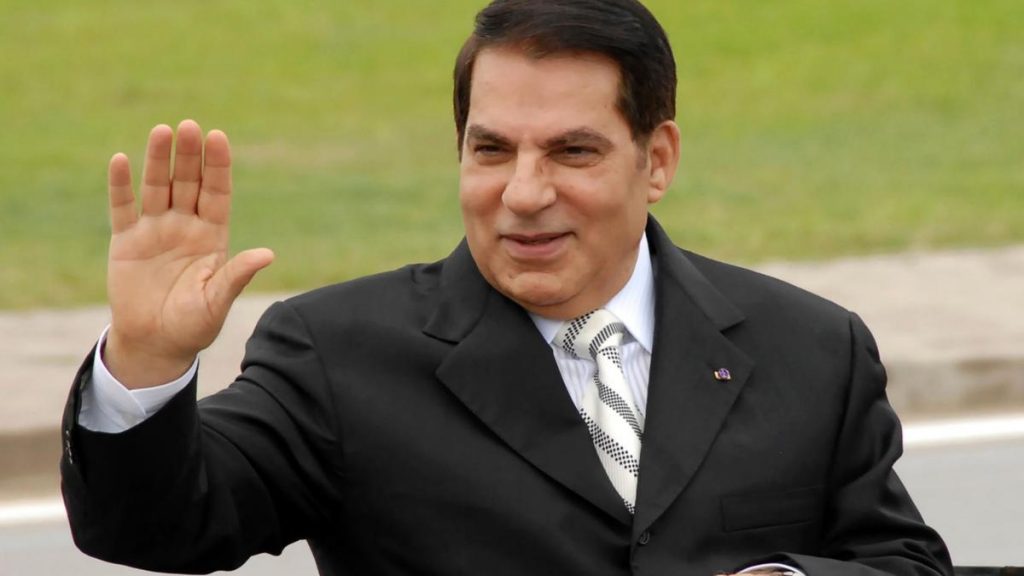
He was the prototypical strong man softened by tactical reforms, blissfully ignorant before the fall, blown off in the violent winds of the Arab Spring.  Having come to power in 1987 on the back of a coup against the 84-year-old Habib Bourguiba, whom he accused of senility, Zine al-Abidine Ben Ali was the face of Tunisia till 2011, when he exited his country’s politics in a swift repairing move to Saudi Arabia.  Previous whiffs of revolution – for instance, in 2008 in Gafsa – had been contained and quelled by what was a distinct mukharabat-intelligence security state.
Ben Ali had the unwitting humour of generally humourless authoritarian rulers, mirthlessly characterising his reign as one of le changement and “democratic transition”.  “I needed to re-establish the rule of law,” he explained to French television after seizing power.  “The president was ill, and his inner circle was harmful.”
The military-security apparatus he presided over burgeoned despite his own efforts at reforming social security, education and women’s rights.  The Presidential Guard was bloated to some 8,000 members; the National Guard, with its headquarters near Tunis-Carthage International Airport, numbered 20,000.  A multiple set of police outfits were also created, including those specifically dealing with universities, tourism and politics.
The sense of non-change marked by extensive surveillance was characterised by indulgent portraits, often enormous, featuring a certain agelessness, a cultish obsession with found on billboard and buildings.  Ben Ali could still claim that he was, relative to his despotic peers, more benevolent.  Economic stability, in a fashion, was brought for a time, though this had the unfortunate effect of encouraging a needy cronyism.  A bigger pie meant greedier hands.
His report card as minister for national security showed that, when needed, he would summon the security forces to do his bidding, crushing the Bread Riots between 1983 and 1984, a protest against the rise in bread prices occasioned by the introduction of an austerity program imposed by the International Monetary Fund.
The sequence of events that saw Ben Ali undone would come to be known as the Jasmine Revolution.  There were the spectacular displays of self-inflicted suffering, including the immolation of Mohamed Bouazizi, Tunisia’s very own indigenous Jan Palach, who had set himself alight before the tanks of the Warsaw Pact in January 1969.  On December 17, 2010, the 26-year-old fruit vendor’s act directed against institutional harassment inflamed protests in Sidi Bouzid.
A country with a national unemployment of 14 percent, numbering as high as 30 percent in the 15 to 24 years age group, was throbbing with revolutionary dissent.  Remittances from Tunisians working abroad had fallen; the global financial crisis from 2008 had bitten savagely.  Policing, hypersensitive to any Islamist upsurge, had become more aggressive.  But looming across the country were the predations of Ben Ali’s kleptomanic family of 140 persons, known colloquially as “The Family”, and a distinctly unholy one at that.  Perhaps with a certain tired inevitability, a femme fatale figure was identified: the first lady and Ben Ali’s second wife Leila Trabelsi.  The Trabelsi name became shorthand for habitual state corruption.
Something rotten in the state of Tunisia was also discernible to a highly literate populace now able to access diplomatic cables on WikiLeaks, which came to be regarded as something of a golden boy for the revolution.  One US government cable from June 23, 2008 stands out: “Whether it’s cash services, land, property, or yes, even your yacht, President Ben Ali’s family is rumoured to covet it and reportedly gets what it wants.”  Investment levels had declined; bribery levels had increased.
US ambassador Robert F. Godec also noted the exploits of the First Lady’s brother, Belhassen Trabelsi, whose rapacity included the illegal acquisition of “an airline, several hotels, one of Tunisia’s two private radio stations, car assembly plants, Ford distribution, a real estate development company, and the list goes on.”  For all that, he remained merely “one of Leila’s ten known siblings, each with their own children.  Among this large extended family, Leila’s brother Moncef and nephew Imed are also particularly important actors.”
The twenty-eight days of protest also saw the extensive, coordinated use of social media, another technological manifestation that continues to terrify states of different ideological shades. In a dry article on the subject – again, another piece that reads oddly given the current rage against social media as a corrupting, conniving incubator of “fake news” – Anita Breuer, Todd Landman and Dorothea Farquhar suggested that, “Social network platforms such as Twitter, YouTube, and Facebook have multiplied the possibilities for retrieval and dissemination of political information and thus afford the Internet user a variety of supplemental and relatively low cost access points to political information and engagement.”
Other factors also came together.  For one thing, the Tunisian army and senior officials refused to turn the guns on protesters with quite the same interest as other regimes might have done.  What transpired was certainly a set of circumstances more profound in change than other states swept up in Arab spring time.  For one, the ruling Rassemblement constitutionnel démocratique (RCD) was given the heave-ho, remarkable for the fact that it had been the party of independence.
As the books, and political system, were being reordered and rescripted, a Tunisian court sentenced Ben Ali and Leila Trabelsi in absentia to 35 years in prison, topped by a $66 million fine for corruption and embezzlement.  The highlights of the trial suggest those of a gangster keen on guns, drugs and archaeological treasures.
The Arab Spring seems, to a large extent, a flutter of history and packed with a good deal of wishful thinking; but for a time, it seemed that lasting change might take place, staged as grand theatrical acts of protest against military thuggery.  The stable of Egyptian politics was turned out; there were protests across North Africa stretching to Iran.  But the strong men returned, and authoritarianism reasserted itself.  We bear witness to a flirt of history rather than any lasting consummation of change.  Tunisia, however, proved the holdout exception.  Ben Ali might well have counted himself unlucky, a victim of posterity’s considerable, mocking condescension.
Dr. Binoy Kampmark was a Commonwealth Scholar at Selwyn College, Cambridge.  He lectures at RMIT University, Melbourne.  

Saturday, August 24, 2019

Imperial Sentiments: Donald Trump, Greenland and Colonial Real Estate

Haven’t the critics worked it out yet?  US President Donald Trump chugs to the coal of nonsense that may come in the wrapping of some sense. Initial mad-cat comments, when cobbled together, might reveal some pattern in time.
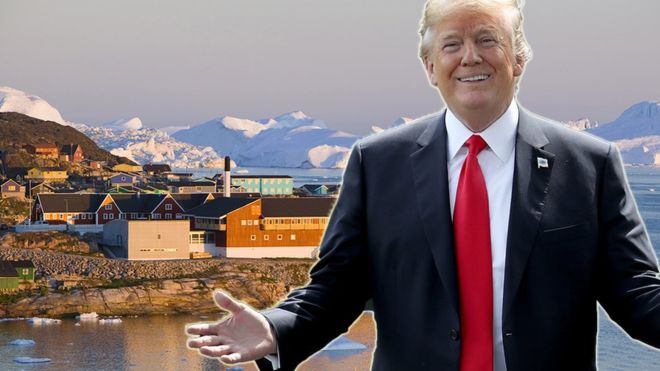
Take, for instance, the recent offer to purchase Greenland.  Considered laughable, purchasing territories has notable, historical precedent in US foreign policy.  Territorial aggrandizement through such means has been something of a US specialty, complementing the usual technique of brutal military conquest.
The Louisiana Purchase of 1803 was a steal by President Thomas Jefferson, almost doubling the territory of the United States.  Alaska also went the way of purchase, being transferred by Russia to the US in 1867 for $7.2 million.  It was something the Russians would come to rue: within a half-century, that amount had been earned back a hundred times over.
That same decade saw US State Department officials turn their attention to Greenland.  An 1868 publication for the department compiled by Benjamin Mills Peirce casts more than a fleeting eye on the resources of both Iceland and Greenland, acknowledging the treaty with Denmark which was ostensibly meant to cede control of the islands of St. Thomas and St. John to the US.  (The US State Department describes this attempt on the part of Secretary of State William Henry Seward to acquire the Danish West Indies rather laconically as “peaceful territorial expansion”.)
This observation in the report comes with its inaccuracies, largely based on premature optimism: the US Senate spitefully rejected the treaty, despite being ratified by the Danish parliament and its approval by the very limited suffrage plebiscite.  Anger was expressed at Seward’s persistent support for the troubled President Andrew Jackson during impeachment proceedings.  US interest persisted, though it was the turn of the Danish upper house to return the serve of repudiation in 1902 in refusing to ratify the agreement.  It took the winds of the First World War to encourage a formal transfer of the Danish West Indies on April 1, 1917.
The 1868 report uses rather familiar language to Trump’s, both in political and economic terms.  The Danish authorities are held to task for their great neglect of invaluable development opportunities.  Iceland is praised for “pasture and arable lands, its valuable mines, its splendid fisheries, and its unsurpassed hydraulic power”.  Fully developed (read, by US efforts), a population of one million might be sustained.  The population of Greenland is similarly “neglected by Denmark”, despite the island having vast quantities of fauna varieties for the kill, among them “whale, walrus, seal, and shark, cod, ivory-cod, salmon, salmon-trout, and herring”.  Obtaining it for the US would make good political and commercial sense: it would flank “British America on the Arctic and Pacific” and force her away from Britain “to become a part of the American Union.”
Enough seriousness was given to Trump’s offer to warrant copy across the media spectrum.  The Brookings Institution’s Scott R. Anderson was not hopeful that discussions would go anywhere. “Unfortunately for the president, buying and selling Greenland is, in all likelihood, a legal and political impossibility.”
Anderson acknowledges a traditional acquisitiveness towards Greenland, being a gem of mineral and natural resource wealth. Furthermore, its proximity to Russia and the Arctic, in Anderson’s words, “makes it a major strategic asset for staging various military and intelligence facilities.”  This point is already noted by a US presence at the Thule Air Base, something maintained since the Second World War with Danish consent.  Admittedly, that presence was encouraged by Nazi Germany’s occupation of the kingdom in 1940, leaving Greenland to slide into the American orbit. Six years later, President Harry Truman wanted to formalise the move by suggesting a sum of $100 million for the island.
Given that the Danish government already permits a degree of US influence, it might have been more prudent of Trump to simply exercise it via traditional forms of seemingly benign encroachment.  That approach can be seen in Australia, where an increased US military presence is being felt by way of US marines on rotation in the Northern Territory.  But such a technique seems all too quiet for the Trump boardroom of hiring and firing.  On Wednesday, he cancelled a planned visit to Denmark, deeming the comments made by Danish Prime Minister Mette Frederiksen “nasty”.
Frederiksen’s degree of nastiness was simply one of puzzlement.  Talking about purchasing Greenland was “an absurd discussion”, even though the US did acquire the Danish West Indies through purchase and has kept a roaming eye, wallet at the ready, to expansion in the Atlantic.  On Sunday, she told a television reporter that, “Thankfully, the time when you buy and sell other countries and populations is over. Let’s leave it there.”  She did make one gentle concession.  “Jokes aside, we would naturally love to have an even closer strategic relationship with the US.”  Deeper cooperation “on Arctic affairs” is still on the table.
Despite Frederiksen’s occasional asides at the United States, Danish foreign policy has been closely aligned with the United States since the attacks of September 11, 2001, bucking a long history of non-interventionism.  The Danish Parliament gave its unqualified approval to US actions in retaliation and committed troops to the warring enterprises in Afghanistan, Iraq and Syria.  Danish military casualties per capita are the highest of any of the coalition partners in those haphazard efforts.  This shedding of blood has led to such emetic observations as those of former Prime Minister Anders Fogh Rasmussen, describing the kingdom as “America’s largest and smallest ally”. (An exhibition at the Museum of Danish America in 2017 proclaimed without reserve that the US and Denmark “have the longest unbroken diplomatic relationship in the world, beginning in 1801.”)
There is also Denmark’s strained and blighted relationship with Greenland, making it susceptible to foreign influence.  The largely self-governing entity has capitalised on Danish indifference, attempting to lure Chinese investment to develop three airports to secure better connections to the US and Europe.  (Denmark reluctantly caved in last year in an effort to keep the PRC at bay.)  Greenland’s Ministry of Foreign Affairs has, however, drawn the line over a proposed sale. “We’re open for business,” went an official tweet, “not for sale”.
The Greenland spat has revealed the obstinate ahistorical context of Trump’s world.  Allies, for one, are to be hectored, their efforts dismissed as paltry.  Despite Danish contributions to the foolhardy efforts of the US imperium, Denmark could still be scolded for spending a mere 1.35% of GDP on NATO.  “They are a wealthy country,” tweeted Trump, “and should be at 2%”.
The president had been insulted, his ego put down by the prime minister of a small state.  “You don’t talk to the United States in that way, at least under me,” he told reporters in Washington.  “I thought it was not a nice statement, the way she blew me off.”  The US was never blown off and remains the oversized fly in the ointment of Denmark’s foreign policy.  As for Greenland, Trump might have asked its own prime minister, Kim Kielsen.
Dr. Binoy Kampmark was a Commonwealth Scholar at Selwyn College, Cambridge.  He lectures at RMIT University, Melbourne.
Thursday, August 08, 2019

Caught in the Strait

It is clear that the United Kingdom could not have thought this through.  Was it a touch of the Suez jitters, the haunting syndrome of 1956 leaving a false impression that the Old Empire still had it?  To taunt a power already under the watchful and punitive eye of the United States was never a recipe for equanimity and calm repose. But taunt they did, using 30 Royal Marines to detain an Iranian tanker Grace I in Gibraltar last month.
The official justification was unconvincing: the need to enforce European Union sanctions against the regime of Syria’s Bashar al-Assad.  The vessel had been supposedly on route to Syria. Some in the diplomatic fraternity were perplexed: it had not previously been UK policy to diligently pursue the impounding of vessels bound for Syria with Iranian cargo.
Local Spanish authorities sensed the hand of US pressure, of which squeezing oil revenue is one; as well as they might, given the unbridled joy expressed by President Donald Trump’s national security advisor, John Bolton.  “Excellent news: UK has detained the supertanker Grace I laden with Iranian oil bound for Syria in violation of US sanctions.” The US and its allies would “continue to prevent regimes in Tehran & Damascus from profiting off this illicit trade.”
Former Swedish prime minister and co-chair of the European Council on Foreign Relations outlinedsome of the inconsistencies in the UK approach.  “The legality of the UK seizure of a tanker heading for Syria with oil from Iran intrigues me.  One refers to EU sanctions against Syria, but Iran is not a member of the EU.  And the EU as a principle doesn’t impose its sanctions on others.  That’s what the US does.”
Becoming the US running dog on enforcement was not going to sit well with Iran.  The Mullahs are spoiling for a fight.  On May 20, Iran’s foreign minister, Mohammad Javad Zarif, cast an eye to historical examples of Persian resistance.  President Donald Trump would fail as others had in their efforts to subdue his country.  Alexander the Great and Genghis Khan had tried, and not succeeded.  (The foreign minister’s sense of history is only as good as his sense of relativity: the Persian entity was, for a time, conquered, but the conquest was never indefinite.)
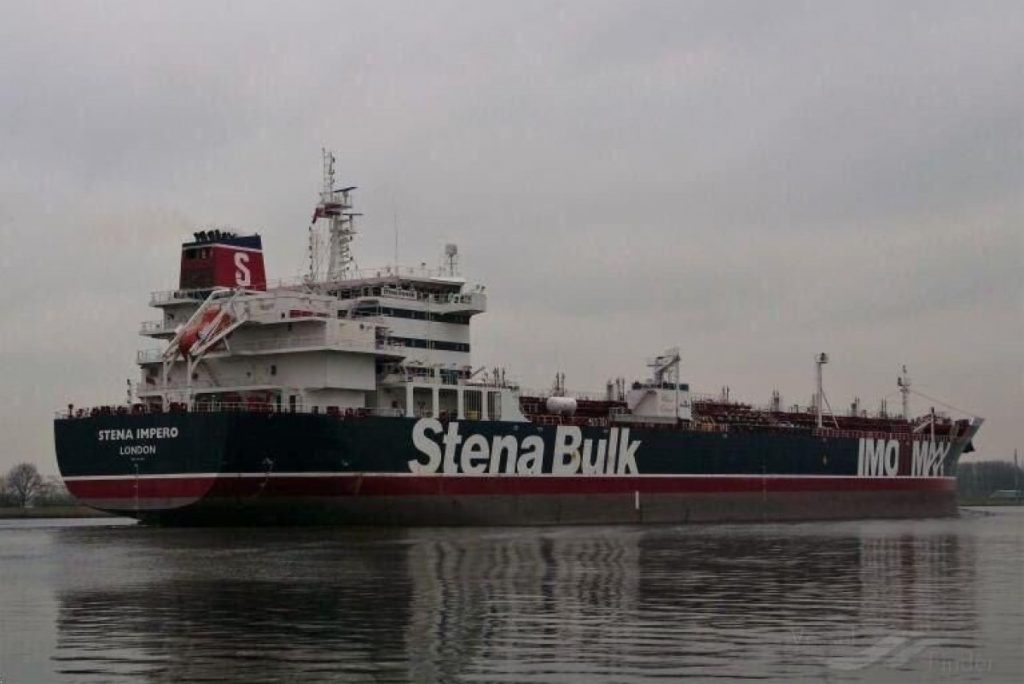
The seizures of vessels constitute a recipe for a tit-for-tat calamity.  We are already seeing the bitter fruit of the harvest arising out of the seizure of Grace I. Two oil tankers – the UK registered Stena Impero, and the Mesdar, another Liberian registered vessel though British operated – were subsequently seized in the Strait of Hormuz.  The Mesdar’s detention was threatening though teasingly brief; the Stena Impero, on the other hand, was to be made an example of.
Another oil tanker has since fallen into the hands of the Iranian forces, one accused of smuggling some 700,000 litres of fuel to Arab states.  “The seizure of the oil tanker,” noted IRGC commander Ramezan Zirahi, “was in coordination with Iran’s judiciary authorities and based on their order.”
In all of this, the UK has made a fateful decision: the US is there to be supported in a policy to protect merchant ships against Iranian efforts.  But Washington has assisted in creating the problem for which it now claims to have the solutions.  It is the supplied choice of a current empire to a former one, and the current empire is keen on misbehaving.  The forces of the US imperium have been doing their bit to ensnare Iran in a troubling vice, be it from al-Asad airbase in Iraq, to Qatar.  At sea, the US Navy holds forth with its carrier strike group.  Sanctions have been ramped; the Iran nuclear deal dumped upon and exited.  The Trump administration persists in causing a certain modicum of mayhem.
Putting up your hands for an unconditional commitment to a US-led effort cuts against the grain for a united European-controlled mission in the strait.  European powers also feel they must be firm, just not in the Trump way. The result has seen hesitation and concern about whether Germany and France might be added to any cobbled coalition.  Farther afield, Australia has also fielded a requestfrom Washington described as “serious and complex”, one that would see oil shipments from Iranian incursions being protected.  Australian Defence Minister Linda Reynolds has not been exactly forthcoming in any way on what qualifies the request as complex and serious, though, like a long retained servant to the lord of a manor, makes it sound grander than it is.
Now, Britain finds itself stretched, the rubber man of international relations keen to maintain shape, if only in distorted fashion.  Iran was bold, even brazen, but its forces feel they have every right to be.  The current conventions are for ditching; the protocols of old are being thrown out like stagnant dishwater.  Now, in with the new, the asymmetrical teasing, be it through sponsored agents in Yemen, allies in Iraq, or a chance to seize, if only arbitrarily, various assets in the Strait of Hormuz.
The Iranian actions have done their bit to strike a degree of consternation.  Moez Hayat, penning a view in The National Interest, exemplifies that consternation.  Iran struck when the UK lacked awareness and cogency.  “Functionally, Britain was leaderless as Iranian forces boarded the vessel.  Prime Minister Theresa May was a lame duck, unable to act as the Conservative Party elected a successor.”  The problems go far deeper than that, telling of European disunity and continued US bellicosity.  On this occasion, a simpler assessment is that Britain was caught in the strait, a true US set-up with continuing consequences.
Dr. Binoy Kampmark was a Commonwealth Scholar at Selwyn College, Cambridge.  He lectures at RMIT University, Melbourne.
Wednesday, May 15, 2019

Maximum Pressure in the Strait of Hormuz: The US-Iran Standoff

Hegemons are never going to sound too sensible when they lock horns or joust in spats of childish anger.  Power corrupts, not merely in terms of perspective but language, and making sense about the next move, the next statement, is bound to be challenging.  Otherwise justified behaviour can be read as provocative; retaliatory moves duly rattle and disturb.
The Iran-US standoff is finding a surge of increments, provocations and howlers.  Since the Trump administration withdrew from the 2015 Iran Nuclear deal (the Joint Comprehensive Plan of Action) last year, Tehran has gnawed and scratched at the arrangements.  Threats to close the Strait of Hormuz as a retaliation for frustrating Iranian oil sales have been made.  President Hassan Rouhani last week made it clear that the Islamic republic would scale back on certain JCPOA commitments.  Limits on building up stockpiles of low-enriched uranium and heavy water would be abandoned.  A 60-day period has been stipulated in the hope that the E3 (Britain, France and Germany), China and Russia provide relief for the Iranian oil and banking sector.  More suspensions of compliance orders threaten to follow if the powers do not muck in.
Despite not being part of the JCPOA anymore, the Trump administration persists in sticking its oar in the matter.  In May 3, the State Department explicitly warned it would sanction individuals and entities involved in swapping permitted uranium (enriched or natural) with Iran.  Nor would excess heavy water limits be permitted.
With such moves to strangle Iran’s economic feelers, it is little wonder that Rouhani has called on “surgery” to be performed on the JCPOA, one far more effectual than “the painkiller pills of the last year”.  Such a process, he promised, was “for saving the deal, not destroying it.”
News this week that Saudi Arabian oil tankers had been sabotaged near the Strait of Hormuz had its effect, even if the Trump administration has yet to pin its colours to the claim that Iran is responsible.  Give it time, and not much at that.  As the Wall Street Journal put it, “The assessment, while not conclusive, was the first suggestion by any nation that Iran was responsible for the attack”.
To reporters in the Oval Office, Trump was keen to make his usual remarks about happiness, or its absence, if things turned out to be darker than he thought.  “It’s going to be a bad problem for Iran if something happens, I can tell you that.”  What, pressed reporters, did the president mean by a “bad problem”?  “You can figure it out for yourself.  They know what I mean by it.”
Brian Hook, the US State Department’s special envoy on Iran, has been doing the circuit in Europe with Washington’s allies, hoping to stir some action against the meddling mullahs in a campaign of “maximum pressure”.  “Everything we are doing,” Hook tried to reason with the Sunday Times, “is defensive.”  Secretary of State Mark Pompeo also journeyed to Brussels to stir the matter.  According to Hook, “The secretary shared information and intelligence with allies and discussed the multiple plot vectors emerging from Iran.”  What a boon Iran is proving to be for the parched hawks, an endless well of threat, much of it imaginary, to draw upon in the hope of actual military engagement.
National Security Advisor John Bolton is making do with the situation, creating much mischief, turning the furniture and belongings of the entire diplomatic stable inside out like a brat in search of attention.  He blames Iran, naturally, for “a number of troubling and escalatory indications and warnings”.  As is the manner with all chicken hawks, he craves the blood of others and is not shy pushing it.  The problem with this attitude is that having a playmate such as Iran is bound to get you, and your fellow playmates, hurt on the way.  The school mistress should intervene, but her sense, and sensibility, is yet to be found.
Washington is certainly keen to make it a bad problem, a habit it has fallen into during stretches of its violent and imperial history.  At Bolton’s instigation, an aircraft carrier and B-52 bombers are being deployed to the Persian Gulf on the supposedly clear grounds that Iran and its proxies are readying themselves for a strike on US forces in the region, bringing to mind similar provocations sought to stoke a potential conflict.
The planning of Operation Prairie Fire was one such ignominious example, designed to provoke Muammar Qaddafi’s Libya into a military incident in 1986.  In what seemed to be a true overegging of the pudding, US Navy Task Force 60 involved three aircraft carriers operating in the Mediterranean off the Libyan coast.  They were involved in exercises falling within that most stretched of terms: freedom-of-navigation.  Prairie Fire turned out to be a bellicose affair, with Task Force 60 put on essentially a wartime footing.  Military exercises were duly conducted to stir the beast; patrols along the coast were conducted.  The beast responded with some six surface-to-air missiles.  A Libyan patrol boat was duly obliterated with some satisfaction, along with two more naval vessels and a missile site in Sirte. “We now consider all approaching Libyan forces,” claimed the White House note with some smugness, “to have hostile intent.”
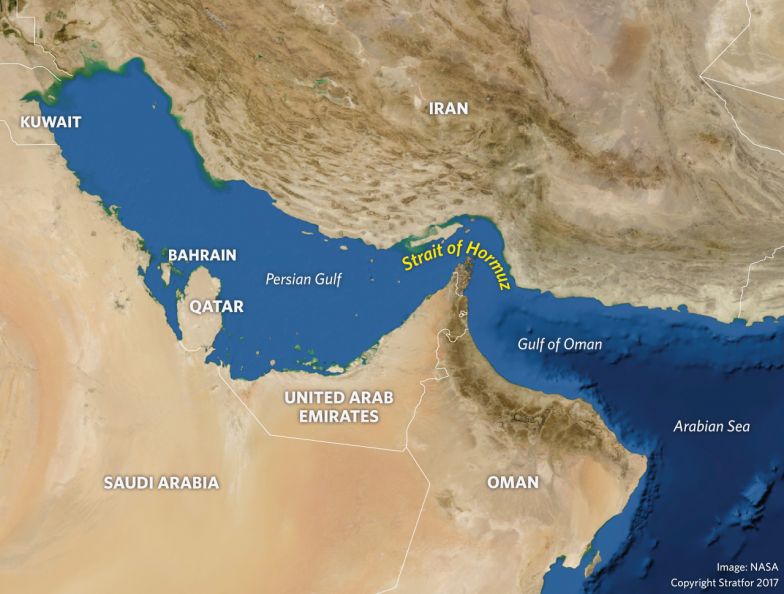
US-Iran encounters in the Strait of Hormuz are also not new: the Iran-Iraq War, one which saw the US throw in its lot with Saddam Hussein’s invading armies against the Iranian Republic, featured a fair share of attacks on merchant shipping.  The importance of the Strait to shipping and international traffic is again coming into play.
Trump has remained inflexible and obstinate regarding Iran. (In his wheeler-dealer world, every crook with a silver lining must be matched by a Lucifer who will be given no quarter.)  In these calculations, the silver lining of North Korea’s Kim Jong-un shines far brighter than any the Islamic Republic of Iran might have.  But by any referee’s estimate of recent conduct by Trump and company, Washington must be seen as responsible for the most aggravating fouls.
Dr. Binoy Kampmark was a Commonwealth Scholar at Selwyn College, Cambridge.  He lectures at RMIT University, Melbourne.