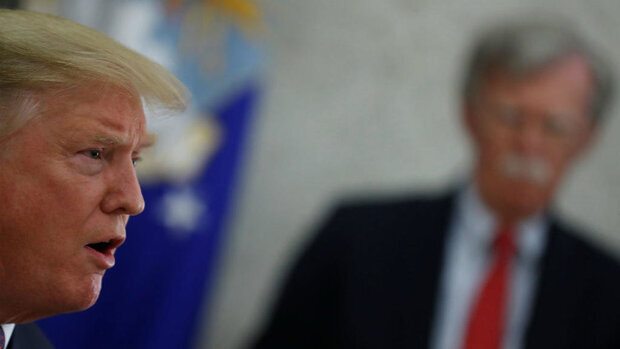
TEHRAN-The President of the United States of America is in a very difficult situation. Although some US media outlets are trying to portray John Bolton's expulsion from the White House as a clever response from Donald Trump, we must not forget that the American president is also responsible for what happened to his country's foreign policy in the last two years! Even Trump has primary responsibility for this.
Here's some analysis on John Bolton's ouster:
Trump Frees Himself from Bolton – But Robert O’Brien Will be Just as Bad
Philip Giraldi Wote in UNZ Review that After months of rumors, John Bolton was finally fired from the White House but the post mortem on why it took so long to remove him continues, with the punditry and media trying to understand exactly what happened and why.
Perhaps the most complete explanation for what occurred came from President Donald Trump himself shortly after the fact. He said, in some impromptu comments, that his national security advisor had israelisrael “…made some very big mistakes when he talked about the Libyan model for Kim Jong Un. That was not a good statement to make. You just take a look at what happened with Gadhafi. That was not a good statement to make. And it set us back.”
Trump has a point in that Bolton was clearly suggesting that North Korea get rid of its nuclear weapons in exchange for economic benefits, but it was the wrong example to pick as Libyan leader Moammar Gadhafi gave up his weapons and was then ousted and brutally killed in a rebel uprising that was supported by Washington. The Bolton analogy, which may have been deliberate attempt to sabotage any rapprochement, made impossible any agreement between Kim and Trump as Kim received the message loud and clear that he might suffer the same fate.More recently, Bolton might have been behind media leaks that scuttled Trump’s plan to meet with Taliban representatives and that also, acting on behalf of Israel, undercut a presidential suggestion that he might meet with Iranian President Hassan Rouhani. Trump summed up his disagreements with Bolton by saying that the National Security Advisor “wasn’t getting along” with other administration officials, adding that “Frankly he wanted to do things — not necessarily tougher than me. John’s known as a tough guy. He’s so tough he got us into Iraq. That’s tough. But he’s somebody that I actually had a very good relationship with, but he wasn’t getting along with people in the administration who I consider very important. And you know John wasn’t in line with what we were doing. And actually in some cases he thought it was too tough, what we were doing. Mr. Tough Guy.”
Trump’s final comment on Bolton was that “I’m sure he’ll do whatever he can do to spin it his way,” a throw-away line that could well set the stage for what comes next. Bolton has many supporters among hardliners in the GOP and the media and will no doubt be inclined to respond to the president in kind, but once the back and forth starts many other factors and relationships will come into play.
After the firing, it was widely believed that Donald Trump might have actually gotten rid of Bolton for all the right reasons, namely that as president he is disinclined to start any new wars and seeks negotiated solutions to existing conflicts, both of which concepts were no doubt regarded as anathema by the National Security Advisor. Unfortunately, that argument runs into problems where rhetoric and deeds disconnect if one considers actual actions undertaken by the president, to include the man that Trump has now named as Bolton’s replacement, Special Presidential Envoy for Hostage Affairs Robert O’Brien.
O’Brien might well have been ranked among the worst possible choices among the names floated in the media for the National Security Advisor position, mostly because he is almost completely lacking in actual experience related to the job. To be sure, he looks more presentable than the wild-eyed and walrus mustachioed Bolton, but Trump has repeatedly been overly deferential towards the bona fides of hardliners like O’Brien who boast of American Exceptionalism. The president will also likely appreciate that the sycophantic O’Brien’s lack of experience will mean that he will be completely deferential to the Chief Executive’s point of view at all times.
Trump’s cabinet choices have been so bad that they have led to musical chairs in nearly all senior positions. The president is to blame for having appointed Bolton, a man he disliked, though admittedly under orders from Israeli-American casino billionaire Sheldon Adelson, and he also did not have to elevate Mike Pompeo first as CIA Director and then as Secretary of State. There is no one around who outdoes Pompeo when it comes to avoiding diplomacy and negotiations while also threatening dire consequences for America’s “enemies.”
O’Brien’s hardline credentials are largely indistinguishable from those of Pompeo and Bolton and it is widely believed that his appointment was due to advocacy by the Secretary of State, who is reportedly assembling his national security team.
And it should be observed that Trump’s claimed avoidance of war credentials are pretty thin. Far from fulfilling campaign promises to end the wars he inherited, Donald Trump has continued and even escalated those conflicts. He has withdrawn from agreements with Russia and Iran that enhanced US national security. Drone strikes under Trump have increased dramatically and have exceeded the number occurring during both of Obama’s terms, while new rules of engagement have led to a major increase in civilian casualties from US bombing directed against ISIS and the Taliban. Most recently in Afghanistan, 30 farm workers were killed in a drone strike. Trump is also doubling down on his support for the Saudi genocide against Yemen.
And the president has demonstrated that he is willing to attack countries that do not threaten the US and with which Washington is not at war. He has twice illegally bombed Syria based on phony intelligence and even when he decided at the last minute not to use force, as he did earlier this year with Iran, there was no serious evidence that he was truly seeking dialogue. He is waging “maximum pressure” economic warfare against both Iran and Venezuela, in both of which countries he has called for regime change. He has threatened Russia over Crimea and Ukraine and is in a trade war with China. Transparent regime change policies coupled with willy-nilly imposing of sanctions are destructive, hostile steps that kill people in the targeted countries and make enemies where none previously existed.
America’s new National Security Advisor Robert O’Brien recently featured in a taxpayer funded trip to Stockholm to obtain the release of rapper ASAP Rocky, who had been arrested after getting involved in a fist fight. O’Brien had orders to threaten unspecified retaliation against the Swedish government if it did not accede to White House demands. That exercise in international bullying means that O’Brien is quintessentially Trump’s kind of guy. He has written a book entitled While America Slept: Restoring American Leadership to a World in Crisis, calling on the United States to end any “appeasement and retreat,” and has described the nuclear agreement with Iran, in predictable neocon fashion, as a repeat of 1938, Hitler and Munich. He was Mitt Romney’s foreign policy adviser and is a Mormon, which means he basically lines up alongside the Christian Zionists when it comes to Israel.
The Israel Lobby has predictably welcomed O’Brien. Sandra Parker or Christians United for Israel (CUFI), enthused how “CUFI enjoys a close working relationship with many officials throughout the Trump Administration, and we look forward to working with Ambassador O’Brien on strengthening the US-Israel relationship, confronting the Iranian menace, and curtailing the threat posed by organizations such as Hamas and Hezbollah.”
Mort Klein President of the Zionist Organization of America observed how “Mr. O’Brien is a great friend of Israel, and is now the top-ranking Mormon in the pro-Israel Trump administration. He is also best friends with ardent Zionist US Ambassador to Germany [Richard] Grenell … And you can’t be a great friend of evangelical Christian Grenell unless you support Israel.”
So, does the firing of John Bolton and replacement by Robert O’Brien mean that there will be a change of direction in US foreign policy? The answer has to be no. Trump might well be maneuvering to avoid a new war as he will be in full 2020 campaign mode and wants to avoid falling into a quagmire, but the basic belligerency of the administration and its strong tilt towards supporting feckless allies like Israel and Saudi Arabia is certain to continue.
Bolton exit won’t dent US diplomacy
Also Globaltimes reported that US President Donald Trump tweeted on September 10 that he fired national security advisor John Bolton, saying "his services are no longer needed at the White House" and "I asked John for resignation." But minutes later, Bolton in his own tweet said he "offered to resign" on the night of September 9, and that Trump told him, "Let's talk about it tomorrow." In any case, the career of the "war maniac" in the White House has temporarily come to an end.
This was not the first time Bolton had to give up his position in the government, but the most dramatic one. Bolton's departure was not a surprise. Many people predicted the failure of the Bolton-Trump partnership from the outset. Trump and Bolton's different explanations for the departure show they were not as close as previously believed. There are many explanations for Bolton's exit. Trump said on Twitter that he "disagreed strongly" with many of Bolton's suggestions and "as did others in the Administration."
Trump's cabinet is being rejigged more frequently than before. One of the primary reasons for officials' dismissal was that they did not live up to Trump's expectations. Trump appointed Bolton not because the bellicose diplomat showed loyalty to him. Actually, there was not much overlap previously between the two. Trump wanted to use Bolton to lead the charge in the domains of diplomacy and security. However, he soon sensed Bolton's unruly war instinct.
With regard to the North Korea nuclear issue, Bolton has become a hurdle to substantive dialogues between Trump and North Korean leader Kim Jong-un. His provocative rhetoric and moves have irritated Pyongyang, affecting Trump's plan to make a historical breakthrough in North Korean nuclear issue. From Trump's perspective, US Special Representative for North Korea Stephen Biegun and US Secretary of State Mike Pompeo tend to be more reliable consultants. Therefore, Bolton had been excluded from the core decision-making circle of North Korea policy for a long time.
In terms of the Iranian nuclear issue, both Trump and Bolton advocated a tough stance, but they have nothing else in common. Trump hopes for a better Iranian nuclear deal and tends to force Tehran to yield by slapping sanctions; while Bolton wants a regime change by force. Such differences between Trump and Bolton have also been seen on the Venezuelan issue.Trump is a good trader. He is obviously not willing to fight an expensive war that is not worth the cost. This is why he called off a military strike on Iran at the last minute. But Bolton, who is bigoted and paranoid, was not thinking like Trump, and instead, doggedly tried to change Trump's mind. That sealed his fate.
Discord between Bolton and other members of the Trump cabinet has accelerated his exit. Pompeo has been at odds with Bolton over national security policymaking for a long time, and disagreement between Bolton and Biegun has grown increasingly. The indifference of Treasury Secretary Steven Mnuchin to Bolton's ouster also indicates the foreign policy hawk's isolation. In fact, Bolton had never aligned with anyone since he entered the White House. As such, when he was facing a crisis of confidence, nobody was on his side.
So what does Bolton's departure mean? Many observers believe that the hawk's exit is a good thing for American diplomacy. However, Bolton has never been a game changer and Trump is the decision-maker. In an editorial, The Guardian said that Bolton's departure is "good riddance, but the problem is his boss."
The main architect and standard-bearer of US diplomacy is Trump. The president, with his "America first" doctrine, withdrew from multilateral systems, undermined global governance, weakened alliances and bullied other countries. His foreign policy, in a sharp departure from the past, has dampened US international reputation and status. This is beyond Bolton's reach. Long before Trump took office, he opted for "America first" oriented foreign policies and has never changed since then. Bolton hardly had achievements since he served as the national security adviser and exerted limited influence on Trump. It's fair to say he didn't bring any substantive change to the Trump government, nor will he leave a diplomatic legacy.
For Trump, Bolton was only a tool used to test the outside acceptance of some extreme ideas. Bolton had long harbored radical and extreme diplomatic and security views and his ideological intransigence is well-known. Without Trump's consent he was unable to survive 520 days in the White House. Bolton is the one being used in his relationship with Trump. If it wasn't Bolton, there will be a different figure of his kind. The White House advisor Peter Navarro is a Bolton in the field of economic affairs to some extent.Bolton has left and few would miss him. The Trump government is going to welcome a fourth national security advisor. Will he or she bring any change to US diplomacy? The answer is probably no.
Don’t expect that to change much about Trump’s foreign policy.
As Washingtonpost reported, On Wednesday, President Trump tweeted that he would appoint Robert C. O’Brien, who currently serves as the State Department’s hostage negotiator, to be the new National Security Advisor after the abrupt departure of John Bolton. Last week, Paul Musgrave provided this analysis of what would--and would not--change after Bolton’s departure.In several tweets midday Tuesday, President Trump announced that he had requested the resignation of his national security adviser, John Bolton. The hawkish Bolton had clashed with the president on a number of issues, most recently over the president’s plan to bring Taliban representatives to Camp David for a peace summit.Though Bolton’s departure may have been dramatic, the Trump administration’s record and studies of White House foreign policymaking suggest that it might not matter very much. The administration’s foreign policy process is likely to remain undisciplined, uncoordinated and volatile.
News reports suggest that Bolton repeatedly and strenuously opposed the president’s tilt toward negotiations with North Korea and Iran in addition to his objections to the president’s Camp David plan. With Bolton gone, some analysts see an opening for more dovish approaches, including diplomacy. MIT security studies professor Vipin Narang tweeted, “Odds of a potentially meaningful deal and process with North Korea just tripled.”
To be sure, in an ordinary administration, the policy preferences of the national security adviser would matter a great deal. National security advisers serve as the president’s coordinator — or enforcer — of policies throughout the bureaucracy. Removing a hawkish staff member might be seen as a signal that the president has adopted a different policy line.
Yet the Trump administration has not followed that playbook. The president dismissed his previous national security adviser, Lt. Gen. H.R. McMaster, in large part because they disagreed substantively. McMaster wanted to focus on competing with China and Russia and strengthening traditional alliances, while the president prioritized issues such as restricting immigration, pursuing aggressively zero-sum trade policies even toward traditional trade partners, and striking a deal with North Korea over its nuclear program. But Trump then replaced McMaster with the far more hawkish Bolton, with whom the president was familiar in part from Bolton’s regular appearances on Fox News.
John Bolton's appointment revealed this much bigger problem. And it's still with us.
This history suggests that personnel changes in the Trump White House may have less to do with the president’s desired policy direction and more with the president’s personal familiarity and comfort with potential advisers — which may be why personally close advisers such as Stephen Miller and Jared Kushner have outlasted McMaster and former secretary of state Rex Tillerson. Moreover, news reports suggest that Trump has been sidelining Bolton for weeks if not months by this point, suggesting it is unlikely that this portends any serious policy change.
Even with Bolton gone, there’s more instability ahead.
Bolton’s tenure and departure shows clearly that, three years into its term, the Trump administration has not yet developed a foreign policy process. It is unclear whether this instability comes from an inability to reconcile conflicting viewpoints or whether the president actively prefers a less structured approach.
The president has said that relying on “acting” officials in nominally Senate-approved positions “gives me more flexibility.” He may similarly believe that eschewing traditional, slow policy processes lets him make policy without enduring laborious vetting by underlings.
But the president probably underestimates the importance of stability and staff in accomplishing his policy objectives. Declaring a policy objective, whether in a formal presidential address or a tweet, is only the first step in implementing it. Usually, such declarations result from a process of gathering information, coordinating staff work and developing and vetting options from which the president can choose.
Ideally, a national security adviser runs that process. The path is rarely smooth. Former White House official Peter W. Rodman described in “Presidential Command,” a study of presidents and their foreign policy staffs, how even the most congenial administrations involve conflicting agendas and interpretations, as well as obstinacy and outright opposition. All of that can thwart a president’s will.
But the Trump administration is far from that ideal. To give just one example, think of reports that an adviser stole paperwork from Trump’s desk to stop him from withdrawing the United States from trade agreements. No process seems to be in place.Bolton’s firing is a symptom, not a cure.
The Trump administration’s volatile foreign policy process was clear before Bolton’s arrival and will probably persist after Bolton’s departure.
For example, as political scientist Mira Rapp-Hooper wrote here at TMC after the first U.S.-North Korea summit in June 2018, the administration did not put in the staff work to generate the kind of agreement that could have been a useful building block for restraining North Korea’s nuclear arsenal. Bolton contributed to that disorder — but his departure doesn’t mean Trump will suddenly become enamored of careful process.
As TMC editor and political scientist Elizabeth Saunders wrote in “International Organization,” the degree of a president’s foreign policy experience matters, and “a seasoned team cannot substitute for an experienced leader.” An inexperienced president “may enable or underwrite risky behavior by advisers.” Given that Trump is the only U.S. president in history with no prior political or military experience, her theory thus predicts that the Trump administration should be a jumble of initiatives by a team of officials each jockeying for their favored policies subject only to the occasional, blunt and transient intervention of the president.
That sort of confusion is exactly what we observe, from the resignation of Secretary of Defense Jim Mattis over Trump’s decision to withdraw troops from Syria — one he later reversed — to the sudden cancellation of U.S. airstrikes against Iran in retaliation for downing a U.S. drone.
These sorts of rushed and confusing decisions reflect a policymaking process in which neither the president nor his team coordinate their actions in a structured way. Ironically, the national security adviser is supposed to provide exactly that management. In a normal administration, Bolton would have either been told to swallow his pride and act as an honest broker — or more likely, never would have been appointed to the role.
Bolton’s Departure Signals Trump’s Foreign-Policy Pivot!
But TheAtlantic reportad that The president is turning away from conflict and toward diplomacy—and that will shape his choice of the next national security adviser.
John Bolton’s sudden departure from the Trump administration was inevitable. It had nothing to do with his fabled mustache or even his very real personality clash with the president. It was a matter of principle. Trump wants to write a new chapter, closing the one marked “Militarism and Maximum Pressure” and opening one called “Dealmaking and the Pursuit of the Nobel Peace Prize.” He wants a summit with Iran’s leaders and deals with the Taliban, Kim Jong Un, and Vladimir Putin on arms control. He does not care about most of the details, as long as he gets the credit.
Few of his officials are particularly enthusiastic about this pivot, but led by Secretary of State Mike Pompeo, they accept it and will seek to shape it. Bolton did not accept it—with the exception of Russia, where he was playing a constructive role in advancing Trump’s goals—and played the role of a saboteur. This tension has been clear for several months, but with Bolton keen to hang on and Trump famously averse to personal confrontation, it dragged on over the summer. With a Trump summit with Iranian President Hassan Rouhani now imminent, it could not drag on much longer. And earlier this week, it came to an end.
I talked with several current or former Trump-administration officials for this piece, all of whom spoke under condition of anonymity to freely discuss Trump’s foreign policy after Bolton. These officials had different views of Bolton. Some saw him as brilliant and a surprisingly good diplomat who fell down on issues such as Iran, Cuba, and Venezuela, where he took a particularly hard line. Others were less forgiving, and argued that Bolton had failed to work well with other senior officials to advance Trump’s strategy.
But all agreed that the Trump pivot is real. We are entering into a new phase. Trump has always had two images of himself on national-security issues—as a militarist and as a dealmaker. As he nears the election, he hopes to move from the former to the latter, spending the capital he built up as a hard-liner, and wrong-footing his Democratic opponents. Ever since he got rid of the axis of adults, he has sought to remove the institutional constraints on his decision making, allowing him maximum room to maneuver in line with his instincts and core beliefs, which date back more than three decades.
Although Trump has fired Bolton, he is not wholly rid of him. Everyone has been waiting for a centrist—Jim Mattis, H. R. McMaster, or Gary Cohn—to turn against the president, but they have stayed silent. Ironically, Bolton is now poised to walk through that door. He tweeted 12 minutes after Trump, contradicting the president’s account of his departure. He answered his door to reporters and texted with them, telling one “I will have my say in due course. But I have given you the facts on the resignation. My sole concern is US national security.” Earlier today, Bloomberg reported that Trump and Bolton disagreed over whether to lift sanctions on Iran to help facilitate a meeting with President Rouhani at the United Nations General Assembly.
If Bolton does speak out, it will grow harder for the so-called hawks in Congress to turn a blind eye to criticism from centrists, and to continue to support Trump unconditionally. This is particularly true given that Bolton’s critique of Trump concerns Iran, an issue about which they care passionately. It is not far-fetched to imagine Trump meeting Rouhani with Bolton criticizing the summit live on cable news. Trump will likely react as is his wont—with full-scale attacks on Bolton personally, and on anyone who associates with him. The result could be a new Republican divide on foreign policy, with the challenge coming from the right.
Trump, of course, will have his supporters on the subject. As one official told me: “Trump is right in his orientation. We need to focus first on China. So, ultimately, we do need to get to a different place with the Russians. The more distracted we are by North Korea, the better for Beijing. And we need to get out of Afghanistan or really reduce our role there.” But many Republican foreign-policy experts remain unconvinced.The international repercussions of this diplomatic pivot will be profound, particularly because it will be carried out with Trumpian characteristics—with little formal preparation, a focus on summits, and an eye on the politics. Martin Indyk, who served in several senior positions in the Clinton and Obama administrations, posed some interesting questions on Twitter: “What do Kim, Rouhani, Xi and the Taliban conclude about Trump’s need for deals with them? And what do Bibi and MBS do as the limb they’re on gets sawn off?” he asked, referring to the Israeli and Saudi leaders. These are the right questions to ask. Absent an external crisis, Trump’s diplomatic pivot will define world politics for the next year, and it has a dynamic of its own. In particular, it puts America’s rivals in pole position. They know that Trump needs his talks not to fail, and they hope he will make concessions to keep them afloat.
Jung Pak, my colleague at the Brookings Institution and formerly an analyst at the CIA, told me, “Kim Jong Un perceives he is in a position of strength going into 2020, and the closer we get to the election, the weaker Trump will be and the more he will want to deal. Trump is so invested in a win with North Korea that all Kim has to do is whisper quietly that he is thinking about breaking Singapore promises to secure concessions from the United States.”
Iran may be in an even stronger position. It could allow the talks to gather pace and then weaponize its diplomacy with Trump as the election approaches. Russia is in a slightly different category because Putin likely wants Trump to win reelection. Putin could capitalize on an arms-control agreement to smooth his reentry into the G8 and have some sanctions lifted. Meanwhile, Israeli Prime Minister Benjamin Netanyahu and Saudi Arabia’s Crown Prince Mohammed bin Salman will be left to stew in their own juices. They only have themselves to blame. They cheered Trump leaving the Iran nuclear deal, but erred in believing they could control the fallout. Trump did what they wanted at the beginning, but he was always unlikely to use force, making diplomacy a more likely outcome.
Trump’s most immediate challenge is picking Bolton’s replacement. More than a dozen names are floating around Washington. If he is true to past form, Trump will revel in the drama and have a parade of candidates interview with him. However, he ultimately has a choice to make—does he go with a personal advocate who will fight for him, or does he go with a seasoned professional?
He may be tempted to go with an advocate like Richard Grenell, the U.S. ambassador to Germany. Grenell is often regarded as a Bolton ally because he served as his spokesman when Bolton was ambassador to the United Nations. But Bolton and Grenell have not been on particularly good terms for the past 18 months. Grenell has been gunning for Bolton’s job from the beginning, frequently using his connections to Trump’s family, particularly Donald Jr., to advance his case. Those ties were in evidence in a tweet by the president’s son in March, when he called for the U.S. ambassador to Ukraine to be fired. He wrote: “We need more @richardgrenell’s and less of these jokers as ambassadors.” Grenell is in Washington this week, having arrived extra early for the UN General Assembly, and will have dinner with Trump on Saturday night—several observers I spoke with believe he is actively angling for the job. Donald Jr.’s support and Grenell’s own tensions with Bolton may work in his favor, but he has other problems.
Trump has no time for bureaucracy or process, but he is tired of the infighting among his staff. He does not care much for the interagency process, but he does understand that if he is to succeed in his pivot, he needs his team to meet a minimum level of cooperation. Grenell would make the combative Anthony Scaramucci look like Mahatma Gandhi. He clashed repeatedly with other administration officials and with other U.S. ambassadors in Europe. Many National Security Council staffers have made clear they would leave if he was appointed. And Grenell has a strained relationship with Pompeo, including a very public disagreement about whether he could fly the rainbow flag over the U.S. embassy in Germany on Pride Day. Under Grenell, an implosion of what’s left of the National Security Council process seems likely. Ultimately, it is hard to imagine Trump staking the success of his pivot on Grenell.
If he passes on Grenell but still wants an advocate, he could opt for retired Colonel Douglas Macgregor, who regularly appears on Tucker Carlson’s show on Fox News. Macgregor always strikes a Trumpian tone and has endorsed the president’s views on Syria and Russia. Trump has consulted with Macgregor on national security matters, including when he canceled the planned missile strikes on Iran in June. However, Macgregor poses one of the same problems as Grenell—he may not actually be able to deliver the diplomatic pivot and he would be seen as a disastrous appointee by the Republican foreign-policy establishment.
If Trump decides to go for a serious professional who follows his lead and works well with Pompeo, he has several options. The top two may be Steve Biegun, the president’s special envoy for North Korea, and Rob Blair, who serves as Mick Mulvaney’s national security adviser. Both are well regarded by their colleagues but have less of a relationship with Trump. Robert O’Brien, who currently serves as the U.S. special envoy for hostage affairs, is said to have the backing of Republican House Minority Leader Kevin McCarthy and several other influential figures. Brian Hook, the U.S. envoy for Iran, has also been mentioned and is close to Pompeo. He is well regarded by Republicans, although some worry that his focus on Iran and the Middle East may detract from Asia and Europe. He could also enter the frame if Pompeo were to follow the lead of Henry Kissinger, and take on the dual role of secretary of state and national security adviser. Pompeo will be wary of this option. He has the Goldilocks level of access to Trump at the moment—enough to always matter, but not so much that he gets under Trump’s skin. But if he fears the wrong person being tapped for the job, he may try to take it on himself, delegating much of the day-to-day responsibility to a deputy like Hook.
Regardless of whom he chooses, Trump is in control. He is calling the shots. Those who survive, like Pompeo, do so because they accept this. Newcomers like Mark Esper are learning the same lesson—he recently raided funds assigned for the U.S. military to counter Russia in Europe to pay for the wall on the southern border. The next national security adviser will have to make similar compromises with his own principles.Many people will undoubtedly breathe a sigh of relief that Trump is embracing diplomacy, but with Trump, things are never that simple or straightforward. His focus on the political benefits of negotiation and his egomaniacal desire to be seen as a dealmaker extraordinaire could undo his project, bringing about the very crises he hopes to avoid.