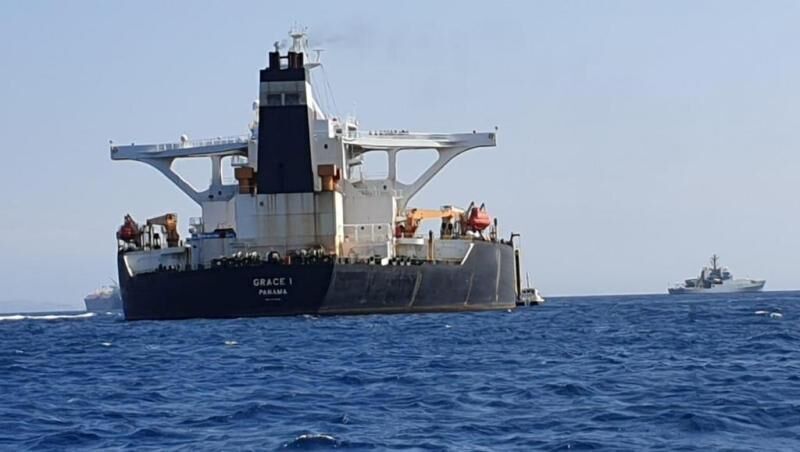
It is clear that the United Kingdom could not have thought this through. Was it a touch of the Suez jitters, the haunting syndrome of 1956 leaving a false impression that the Old Empire still had it? To taunt a power already under the watchful and punitive eye of the United States was never a recipe for equanimity and calm repose. But taunt they did, using 30 Royal Marines to detain an Iranian tanker Grace I in Gibraltar last month.
The official justification was unconvincing: the need to enforce European Union sanctions against the regime of Syria’s Bashar al-Assad. The vessel had been supposedly on route to Syria. Some in the diplomatic fraternity were perplexed: it had not previously been UK policy to diligently pursue the impounding of vessels bound for Syria with Iranian cargo.
Local Spanish authorities sensed the hand of US pressure, of which squeezing oil revenue is one; as well as they might, given the unbridled joy expressed by President Donald Trump’s national security advisor, John Bolton. “Excellent news: UK has detained the supertanker Grace I laden with Iranian oil bound for Syria in violation of US sanctions.” The US and its allies would “continue to prevent regimes in Tehran & Damascus from profiting off this illicit trade.”
Former Swedish prime minister and co-chair of the European Council on Foreign Relations outlinedsome of the inconsistencies in the UK approach. “The legality of the UK seizure of a tanker heading for Syria with oil from Iran intrigues me. One refers to EU sanctions against Syria, but Iran is not a member of the EU. And the EU as a principle doesn’t impose its sanctions on others. That’s what the US does.”
Becoming the US running dog on enforcement was not going to sit well with Iran. The Mullahs are spoiling for a fight. On May 20, Iran’s foreign minister, Mohammad Javad Zarif, cast an eye to historical examples of Persian resistance. President Donald Trump would fail as others had in their efforts to subdue his country. Alexander the Great and Genghis Khan had tried, and not succeeded. (The foreign minister’s sense of history is only as good as his sense of relativity: the Persian entity was, for a time, conquered, but the conquest was never indefinite.)
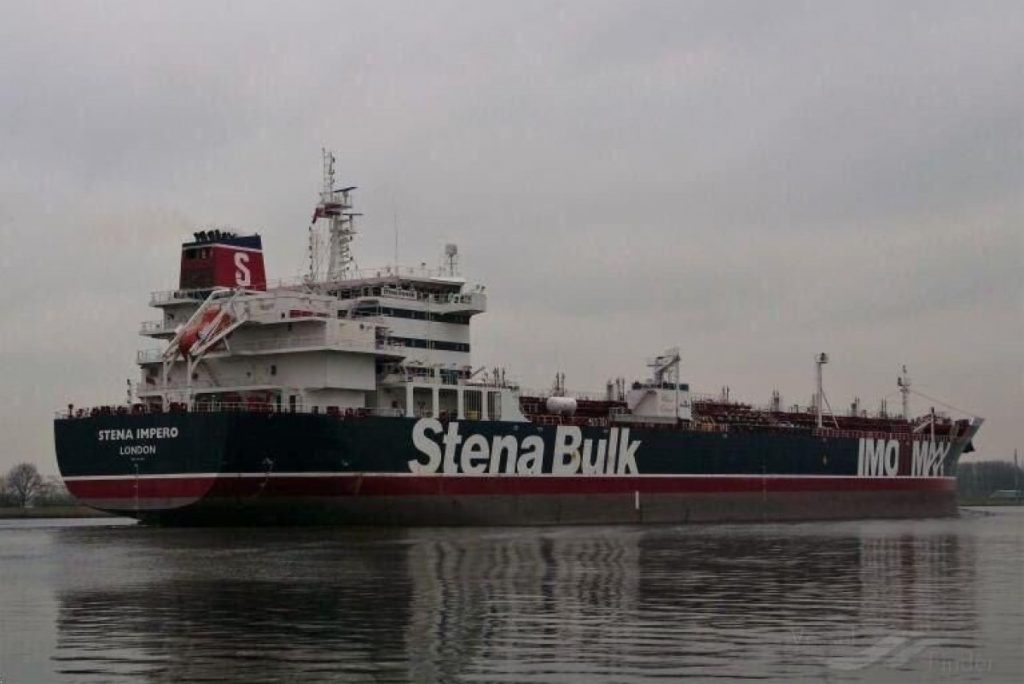
The seizures of vessels constitute a recipe for a tit-for-tat calamity. We are already seeing the bitter fruit of the harvest arising out of the seizure of Grace I. Two oil tankers – the UK registered Stena Impero, and the Mesdar, another Liberian registered vessel though British operated – were subsequently seized in the Strait of Hormuz. The Mesdar’s detention was threatening though teasingly brief; the Stena Impero, on the other hand, was to be made an example of.
Another oil tanker has since fallen into the hands of the Iranian forces, one accused of smuggling some 700,000 litres of fuel to Arab states. “The seizure of the oil tanker,” noted IRGC commander Ramezan Zirahi, “was in coordination with Iran’s judiciary authorities and based on their order.”
In all of this, the UK has made a fateful decision: the US is there to be supported in a policy to protect merchant ships against Iranian efforts. But Washington has assisted in creating the problem for which it now claims to have the solutions. It is the supplied choice of a current empire to a former one, and the current empire is keen on misbehaving. The forces of the US imperium have been doing their bit to ensnare Iran in a troubling vice, be it from al-Asad airbase in Iraq, to Qatar. At sea, the US Navy holds forth with its carrier strike group. Sanctions have been ramped; the Iran nuclear deal dumped upon and exited. The Trump administration persists in causing a certain modicum of mayhem.
Putting up your hands for an unconditional commitment to a US-led effort cuts against the grain for a united European-controlled mission in the strait. European powers also feel they must be firm, just not in the Trump way. The result has seen hesitation and concern about whether Germany and France might be added to any cobbled coalition. Farther afield, Australia has also fielded a requestfrom Washington described as “serious and complex”, one that would see oil shipments from Iranian incursions being protected. Australian Defence Minister Linda Reynolds has not been exactly forthcoming in any way on what qualifies the request as complex and serious, though, like a long retained servant to the lord of a manor, makes it sound grander than it is.
Now, Britain finds itself stretched, the rubber man of international relations keen to maintain shape, if only in distorted fashion. Iran was bold, even brazen, but its forces feel they have every right to be. The current conventions are for ditching; the protocols of old are being thrown out like stagnant dishwater. Now, in with the new, the asymmetrical teasing, be it through sponsored agents in Yemen, allies in Iraq, or a chance to seize, if only arbitrarily, various assets in the Strait of Hormuz.
The Iranian actions have done their bit to strike a degree of consternation. Moez Hayat, penning a view in The National Interest, exemplifies that consternation. Iran struck when the UK lacked awareness and cogency. “Functionally, Britain was leaderless as Iranian forces boarded the vessel. Prime Minister Theresa May was a lame duck, unable to act as the Conservative Party elected a successor.” The problems go far deeper than that, telling of European disunity and continued US bellicosity. On this occasion, a simpler assessment is that Britain was caught in the strait, a true US set-up with continuing consequences.
Dr. Binoy Kampmark was a Commonwealth Scholar at Selwyn College, Cambridge. He lectures at RMIT University, Melbourne.