
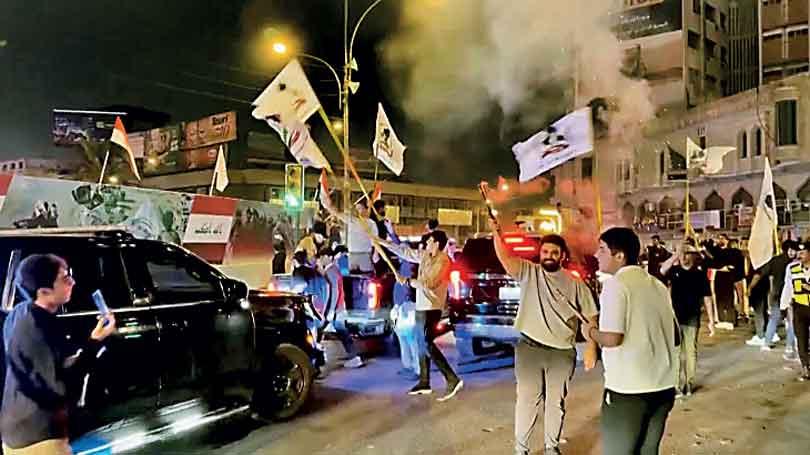
Iraqis celebrate the departure of US troops on Wednesday

There was celebration in Iraq as the government declared Sovereignty Day and a two-day national holiday after the last American troops left the country on Wednesday, marking the second such withdrawal in 23 years.
US President Donald Trump hailed it as the conclusion of “a very expensive excursion into Hell” and a victory for both countries.
However, the occasion was also a time for reflection on Iraq’s lost sovereignty during the US occupation, an experience not dissimilar to the loss of sovereignty under British rule. Like the United States, Britain had two episodes in Iraq: it left in 1932, only to return in 1941 during World War II, before departing again in 1947, while continuing to prop up a puppet monarchy until a coup brought it to an end.
The casus belli for the US invasion of Iraq in 2003 was ostensibly Iraq’s non-existent weapons of mass destruction (WMDs). Not a single WMD was found during the US occupation, which was declared illegal by then UN Secretary-General Kofi Annan. But does the US care about the illegality of its actions or its violations of international law? Its record is appallingly poor. No amount of shaming can shake its conscience.
The occupation was made possible by a web of deception. Iraq, which remained secular under the tyrannical rule of Saddam Hussein, had nothing to do with the 9/11 attacks or with Islamic radical groups, including Al-Qaeda. Yet a majority of Americans believed otherwise. President George W. Bush was reportedly preoccupied with plans for Iraq from the outset of his presidency. It is said that when the 9/11 attacks occurred, he wanted to strike Iraq immediately, and that only after much persuasion did he agree to invade Afghanistan first, thereby setting in motion the Project for the New American Century’s plan to militarily dominate the world and control its resources.
As the Bush administration built its case for invading Iraq, lies, damn lies, and statistics were liberally rolled out. The legacy media dutifully parroted the official lies that would have made Goebbels proud. The Bush administration claimed that Iraq had sought uranium from Niger and presented dubious slide shows at the UN Security Council purporting to reveal Iraqi WMD laboratories. Equally preposterous were the claims of then British Prime Minister Tony Blair. Often derided as Bush’s lapdog, Blair asserted, without compelling evidence, that Iraq could deploy WMDs within 45 minutes and threaten Britain.
Those who challenged or exposed these falsehoods were hounded. In the United States, officials who disputed the administration’s narrative were victimised. In Britain, a senior government scientist was found dead in a wooded area days after questioning Blair’s claims in a BBC interview. The official verdict was suicide. Yet in the deadly world of politics, a suicide can also mean a murder.
The war was deadly. No sooner had the ground invasion begun, with support from the Kurds in the north and the Shiites in the south, than the Iraqi Army was in tatters. According to some accounts, more than a million Iraqis perished as a result of the war. Allegations of war crimes against the US-led coalition forces followed.
As Iraqis celebrate the departure of US troops, they remember Abu Ghraib prison, where detainees were photographed naked, sexually abused and humiliated. They remember Fallujah, where resistance to the US occupation began when Iraqi parents were reportedly massacred for demanding that American troops vacate their children’s schools. They also remember children born with severe deformities that research attributed to the use of depleted uranium munitions by US forces.
In Saddam’s Iraq, sectarianism was largely unheard of. He was equally brutal in suppressing both Sunni and Shiite religious activism. However, the US occupation reinvented sectarianism, weaponising it to pit the Shiite majority against the Sunnis as part of the tried-and-tested colonial strategy of divide and rule.
A war within a war emerged. Iraqis fought Iraqis. Iran backed the Shiites, the Gulf countries the Sunnis; and Israel the Kurds. Israel favoured the Balkanisation of Iraq, or at least the creation of an independent Kurdistan. That plan failed because Turkiye opposed it. Instead, an autonomous Kurdistan Regional Government, complete with its own president and prime minister, was established under a federal arrangement that many regarded as an erosion of Iraq’s sovereignty.
As sectarianism dominated the headlines, the economic plunder of the country continued. US oil giant Kellogg Brown & Root was among the principal beneficiaries, securing contracts worth $39.5 billion. Bechtel, ExxonMobil and Chevron also dipped into the honeypot. So too did Blackwater, a security company that faced numerous allegations of war crimes. Arms manufacturers such as General Electric, Lockheed Martin and Northrop Grumman also made a killing. War was business then, as it is now, and as it always will be.
In 2005, Iraqis experienced democratic elections for the first time since 1958. The United States was compelled to hold elections as it had craftily shifted its justification for the war from the search for WMDs to the promotion of democracy in a nation ruled by a tyrant.
Shiites assumed power for the first time since the creation of Iraq in 1920—following the Ottoman Empire’s defeat in World War I—under a parachuted monarch, King Faisal, a British acolyte imported from Hejaz, which is now under Saudi Arabia.
With US casualties mounting and the war becoming increasingly unpopular, Barack Obama campaigned on a pledge to end the conflict and won the 2008 presidential election. In 2011, the United States officially ended the war while maintaining a substantial security presence within Baghdad’s Green Zone, only to return in 2014: This time to fight ISIS, which had seized large swathes of territory in Iraq and Syria.
The ISIS was widely viewed as a byproduct of the US occupation and was nurtured by a network of Western and regional intelligence agencies working to topple Bashar al-Assad’s regime in Syria, a key ally of Iran. ISIS, which had become a law unto itself, much like Frankenstein’s monster, disobeyed its masters, established its own caliphate and unleashed terror on Iraq’s Yazidi community, raping women and killing men. The US was forced to intervene, largely through an air campaign, while Iraqi forces backed by pro-Iranian militias fought the ground war.
The 2003 US invasion was originally dubbed Operation Iraqi Liberation but was subsequently renamed Operation Iraqi Freedom because the acronym of the former, OIL, let the cat out of the bag.
As Iraqis celebrated Sovereignty Day, the question remains whether Iraq has truly regained its sovereignty. Far from it. Washington still exerts considerable influence over Iraq through economic pressure.
When Iraq held parliamentary elections in November last year, the Shiite Coordination Framework (SCF), a pro-Iranian political bloc, emerged as the overall winner and nominated former Prime Minister Nouri al-Maliki as its candidate for prime minister. The United States threatened to cut funding if a pro-Iranian figure assumed office. A second candidate was put forward, but Washington remained dissatisfied. Finally, businessman Ali al-Zaidi was appointed as a compromise candidate in May this year, ending a six-month political deadlock that highlighted the erosion of Iraqi sovereignty and continued US interference in Iraqi affairs. Questions also remain over Iraq’s economic sovereignty. Under a financial and legal framework established by a UN Security Council resolution, Iraq’s oil revenues are sent to an account maintained at the US Federal Reserve, ostensibly to protect the country from compensation claims arising from past conflicts with states such as Kuwait and Iran. By maintaining control over the release of these funds, which account for roughly 90 per cent of Iraq’s budget, the United States retains significant geopolitical leverage over Iraq’s sovereignty. It is, indeed, a Catch-22 situation for Iraq.

No comments:
Post a Comment