Showing posts with label Ale Khalifa in Bahrain. Show all posts

Tuesday, July 30, 2019

Bahrain Follows U.S. Lead On Executions

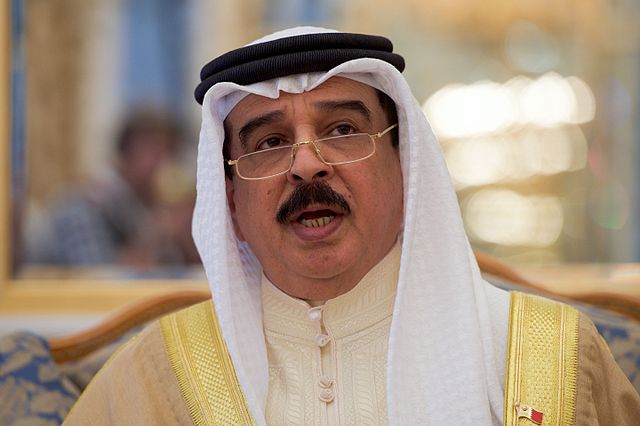
Bahrain's King Hamad bin Isa Al Khalifa (State Department)
by Brian Dooley
Citing the existence of the death penalty in the United States as justification, Bahrain’s government executed political prisoners Ali al-Arab and Ahmed al-Malali by firing squad on the morning of Saturday, July 27. Another man was also executed in a separate, non-political case.
The killings came two days after the Trump administration announced it was reinstating the federal death penalty after an absence of nearly two decades.
The two political prisoners had been convicted of killing a police officer in 2017 in a trial that involved over 50 defendants. I’ve been in Bahraini courtrooms and seen how these mass, sham political trials work, how defendants’ claims of tortured confessions are dismissed, and fabricated evidence permitted. The process doesn’t much resemble anything recognisable as a fair hearing that would meet international legal standards.
In May, five United Nations experts called for the executions to be stopped “amid serious concerns that [the two men] were coerced into making confessions through torture and did not receive a fair trial.” The day before the executions, Agnes Callamard, UN Special rapporteur on extrajudicial, summary or arbitrary executions, urged that the men be spared. “I remind Bahrain that the only thing that distinguishes capital punishment from an arbitrary execution is full respect for the most stringent due process and fair trial guarantees,” she said.
Members of Congress tried to intervene too, with Representatives Jim McGovern (D-MA) and Chris Smith (R-NJ), co-chairs of the Congressional Tom Lantos Human Rights Commission, urging, on the eve of the executions, that they not be killed. Senate Foreign Relations Committee ranking member Senator Bob Menendez, (D-NJ) tweeted a similar appeal.
But the executions went ahead anyway, deepening the island kingdom’s long-simmering political crisis. Hours after the executions, protests broke out across Bahrain, and a demonstrator died from inhaling police tear gas fired in the Manama suburb of Bilad al-Qadeem, according to locals. News of the prisoners’ deaths was also met with jubilation amongst government loyalists, who posted congratulatory messages on Twitter. One local bakery made cakes celebrating the executions.
Bahrain is still reeling from its mass protests for reform in 2011, when the government crushed  huge demonstrations with widespread violence, including torture. The crackdown has silenced most protests, but the tension remains, and it’s hard to see that time will heal the country’s wounds. If anything, the kingdom is more divided than it was a decade ago.
Local civil society has been virtually eliminated, with an increasing emphasis and responsibility on those based outside the country to press for reform. Protestor Moosa Mohamed, in a desperate attempt to stop the executions, climbed onto Bahrain’s embassy in London. Police eventually stormed the building when it appeared he was being attacked by embassy staff.
Bahrain isn’t headed towards safety, but for more unrest. It’s just a matter of time until widespread upheaval breaks out again. A failure to address the grievances that prompted the 2011 uprising, plus a policy of wholesale fear and intimidation, is not a recipe for sustainable security.
The ruling family has increased repression in recent years, banning opposition groups from existing and forbidding former members from taking part in last year’s cosmetic parliamentary elections. The country’s only independent newspaper, Al Wasat, was forced to close down by the authorities two years ago.
Prominent opposition figures and human rights leaders—including Abdulhadi al-Khawaja, Nabeel Rajab and Naji Fateel—remain in prison. Others have been forced into exile. Government promises of an inclusive “national dialogue”, once enthusiastically swallowed by gullible officials in Washington and London, have long disappeared.
Rising tensions between Iran and the U.S. play into the hands of Bahrain’s repressive regime, as Trump administration officials are happy enough to stay silent on the killings and other human rights abuses in exchange for Manama’s loyalty in the fight against Tehran. Local activists pleaded unsuccessfully with the U.S. embassy in Bahrain to say something publicly to halt the executions, and there appears little prospect of any meaningful censure from the Trump administration (or from a UK government headed by Boris Johnson) to force Bahrain’s regime to change.
Over the years, most foreign government officials with whom I’ve discussed Bahrain understand the fundamentals very well. They even agree, privately, that its ruling family is steering the kingdom to disaster and that its repression will eventually backfire, with damaging consequences not only for Bahrain but for its allies.
I’ve never met anyone from the State Department, or from U.S. intelligence agencies, or from the UK or various other foreign ministries, who actually think the Bahraini ruling family is anything but a time bomb. But because they don’t think it’s about to explode immediately, they advocate the path of least resistance, of preserving the status quo, hoping that by the time the trouble comes it will be one of their successors’ responsibility to resolve it.
Western government failure on Bahrain is as much about myopia as ideology. It makes it easier, in the short term, to stay silent about executions rather than to cause a diplomatic fuss. But ignoring the problems won’t make them go away. More executions on Bahrain are expected—eight prisoners are now on death row having exhausted all legal remedies, and two more are waiting for a final appeal against their death sentences.
We’ve seen what happens when U.S. officials turn a blind eye to abuses in Bahrain, and in the neighbouring countries of Saudi Arabia and the United Arab Emirates. It encourages greater state violence. What happened last weekend will eventually be part of the payback for years of repression, and when that happens the U.S. and Bahrain’s other western allies will regret not confronting the problem now.
Brian Dooley is a senior advisor with Human Rights First.

Friday, March 08, 2019

Why US Interests Are More Important Than Bahraini Lives

TEHRAN (FNA)- Bahrain's main opposition group, the al-Wefaq National Islamic Society, has censured the recent jail terms handed down to scores of people over taking part in a sit-in in 2017.
Al-Wefaq has condemned Manama’s judiciary of convicting innocent people after a court handed down prison terms to 167 Bahrainis for holding a sit-in in protest at the regime’s decision to revoke the citizenship of prominent Shia Muslim cleric Sheikh Isa Qassim almost two years ago.

The movement has called on the international community to wake up and take note of the human rights violation unfolding in Bahrain. The defendants convicted have received 
sentences ranging from one to 10 years behind bars. They were charged with rioting and taking part in an illegal gathering.

On May 23, 2017, the Al Khalifah regime forces raided the village of Diraz, which had been under a military siege for almost a year, and stormed into the home of Sheikh Isa Qassim, putting the cleric under house arrest. The ailing cleric has since left the country to receive medical treatment. During the crackdown, regime forces killed at least five demonstrators, wounded dozens and arrested over 280 people.

What’s sad in all this is that the regime’s justice system instead of trying those who killed innocent protesters, unarmed citizens and shot them with live rounds alive in cold blood has done the opposite. It has imprisoned many protesters, stripped the cleric of his citizenship, and later dissolved the Islamic Enlightenment Institution founded by Sheikh Qassim as well as the opposition al-Risala Islamic Association.

Into the argument, the anti-regime protesters never took up arms. They are peacefully demanding that the un-elected Al Khalifah regime relinquish power and allow a just and elected system representing all Bahrainis to be established.

This is yet to be the case, as Al Khalifah regime receives diplomatic impunity from the United States and its European allies. They even allow the kingdom to use wealth to whitewash its legacy of abuses, human rights violations, and silences those who try to draw attention to this pattern.

As is, in Bahrain there are no consequences and accountability for killing and imprisoning the dissent. The regime has been emboldened thanks to President Donald Trump, who has made it clear to Bahrain that “there won’t be strain with this administration.” The United States is in a position to help end these human rights violations, but instead it chooses to stay silent, to keep its Fifth Fleet naval base, and to sell its weapons.

Washington also always sends its Secretary of State Michael Pompeo to Bahrain to praise the “strategic partnership between the two countries”. He never bothers to make any mention of unjust court cases and verdicts for protesters or raise the issue of human rights. The United States has the means to use its leverage, since Bahrain is a close ally and host of the Fifth Fleet, but it never bothers to take a stance. Britain, similarly and shamefully, avoids offering support for peaceful protesters and those behind bars.

If Bahrain has learned anything from all this injustice, it is that the regime can arrest, torture and repress its own people and countries like the United States and Britain will continue to look the other way. It can  flout international human rights law and get away with anything too.

Using mentality of exceptionalism as a free-floating abstraction from reality, as well, the United States and Britain consider their own interests more important than the lives of Bahraini protesters. These tricksters are abandoning human rights at a time when things are worsening in Bahrain and will only continue to deteriorate.

Trump officials claim the US is a “moral beacon.” For that, they need to define themselves in deeds not only by what they are for but by what they are against in Bahrain. In the present instance, what they are against in Bahrain is its long-suffering citizens.

Let’s get real: It’s a fantasy to think American officials would ever find themselves criticizing the Al Khalifah regime over murder, torture, and cruel treatment of its people, much less hold them to account. The US government, which has enthusiastically supported the regime’s war crimes over the years, will never allow it to happen.

Saturday, January 19, 2019

Iran 40 years after victory of the Islamic Revolution (8)

When the US President, Donald Trump, announced al-Quds as the capital of the usurper Israeli regime, the Islamic Republic, in an extraordinary session of Organization of Islamic Cooperation, called for formation of an "expertise group" composed of legal, political and economic specialists of the member states to closely examine and compile the mechanisms for countering the illegal decision of the US government to transfer its embassy from Tel Aviv to al-Quds.
The Islamic Republic of Iran believes in a few principles with regard to the issue of Quds. Firstly, Palestinians are the real owners of the Land of Palestine and no fake alternative or identity can change this reality. Secondly, the international duty and responsibility should be done in exposing the goals of the US's and the Zionists' plot for complete occupation of al-Quds. Thirdly, we believe in the definitiveness of the rights of the Palestinian nation.
The Palestinian people have never accepted to compromise with the occupiers to liberate their land. Today, too, they have stood against the occupiers more decisively than ever; although some of the Arab regimes have approved the Zionist regime's occupation and usurpation of the Palestinian territories through formation of alliances and signing of accords with the regime.
Ayatollah Khamenei said, "Now, the Americans have named their devilish policy on Palestine as 'Deal of the Century', but they must know that, with the divine grace, this deal of the century will never materialize and, to the chagrin of the US statesmen, the issue of Palestine will not be forgotten and al-Quds will remain the capital of Palestine."
The Leader added, "Of course, some of the Islamic governments, which have no belief in Islam, have become the scapegoats of the Americans due to stupidity, ignorance and worldly desires; but with the divine help, the Islamic Ummah and the Palestinian nation will triumph over their enemies and you'll see that the root of the fabricated Zionist regime will be eradicated from the land of Palestine."
The fact of the matter is that the Palestinian nation faces a historical oppression as the usurper and child-killer regime in Tel Aviv, with the support of the US, has turned into an anti-human cancerous tumor. In such circumstances, the international community, including the United Nations and international legal institutions, which assume the heavy responsibility of defending the innocent Palestinian nation, should fulfill their duties; but the record of their performance shows that they have not adhered to their mission and been always danced to the tune of the world powers, especially the US.
A simple glance at the conditions in the world indicates that the culture of resistance is expanding and impacting the global developments.
'Iran's Defence Minister, Brigadier General Amir Hatami, in a speech, stressed that: "The authorities of the occupying and repressive Zionist regime have well understood that, in spite of superficial successes in expansionism till 1979, they haven't been victorious in any war since the victory of the Islamic Revolution in 1979 and they have been declining in achieving their illegitimate objectives; and this trend will continue in future, too, and their definite fate is what the leader has said. What has caused the defeats of this regime has been the lofty thought and ideal of the Islamic Revolution and the current of resistance has followed this thought."
The United States and a few western regimes, which claim to defend democracy, are real hypocrites and imposters as they support the most primitive and undemocratic regimes in West Asia such as Bahrain and Saudi regimes which have never experienced election. History has proved that the crimes of Israel against the Palestinian nation, which began since the very day of illegitimate birth of this regime, will not end except through resistance and perseverance. Abdul Bari Atwan, famous Arab analyst, says on the demonstrators in Gaza who are shot dead by the Israeli criminals, "They were unarmed people who had hoisted their flags and gone to the border. There was only a fence between them and the Israelis. The Israelis used long-range guns. But the western media describe this issue as violent rallies. Did the Palestinians have guns? Did they have explosives? This is indescribable. The measures of the western media are a sort of demonizing every event. They have hidden the reality."
The rights of the oppressed nations have been trampled upon for years and this oppression is not limited to Palestine. Criminal regimes have resorted to the tools like annulment of nationality whenever they see a protest.
This, while article 15 of the Universal Declaration of Human Rights is based on the principle of "Nationality Right."
This declaration, which has been accepted by western regimes masquerading as defenders of human rights, stresses that no one can be deprived of his nationality. Nevertheless, the repressive tyrannical regimes like Ale Khalifa in Bahrain, with full support of the US and Saudi regime, deprive their opponents of their nationality while there is no cry of human rights by westerners. The Islamic Republic of Iran is vehemently opposed to such hypocritical conduct and keeps condemning it. The support for oppressed and downtrodden nations has been internalized in the Islamic Republic system. In the next episode we will further discuss the issue.