
By Ilan Pappe – The Palestine Chronicle
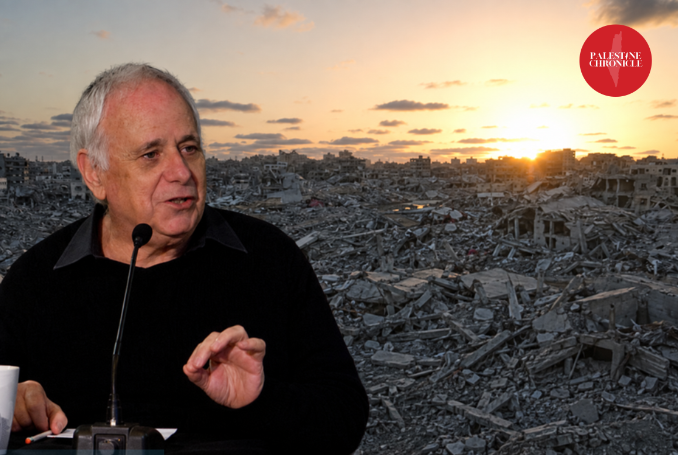 Three years later, Ilan Pappé revisits the siege, calculations and impossible choices behind the Al-Aqsa Flood operation. (Illustration: Palestien Chronicle)
Three years later, Ilan Pappé revisits the siege, calculations and impossible choices behind the Al-Aqsa Flood operation of October 2023.
As we reach the three-year mark since the Al-Aqsa Flood operation and the onset of the Gaza genocide, we can benefit from the passage of time and see more clearly some of the aspects and crucial issues connected with that fateful date that remained blurred or invisible when examined in the immediate aftermath of the operation and the genocide that followed.
It is important to ponder these issues and aspects, as they also relate to the fact that too many people in the world, including some of those who have shown support for the Palestinian struggle, believe that this horrific chapter is behind us. The genocide continues, albeit incrementally, in the Gaza Strip and has now spilled over into the West Bank, where the intensification of the army and settlers’ violence is aimed at turning the West Bank into another Gaza Strip.
The passage of time enables us to learn much more about the motives of the small group of leaders in Hamas who planned the operation. It is important to analyze these motives in a professional way in order to refute the deceptive and fabricated narrative spun by Israel about an operation that was conceived in Tehran as part of a plan to destroy the Jewish state.
This narrative was already successfully challenged as one that willfully ignores the historical context of the long history of Zionist oppression and the more recent inhuman blockade of the Strip. But it also conceals a more intricate reality that evolved in the years immediately preceding Operation Al-Aqsa Flood, and that was also glossed over by Palestinian and pro-Palestinian commentators.
This more focused look at that particular period sheds light on the dilemmas facing Hamas and the Palestinian liberation movement more generally in their existential struggle against the Zionist project of elimination.
The reconstruction of this immediate background reminds me of the way the historiography of the 1948 Nakba benefited from the declassification of the Israeli archives. The fusion of Israeli archival material with Palestinian oral and written history provided a fuller picture of that catastrophe. We now have a better understanding of the developments that led to October 2023 through the erudite work of some Israeli journalists who have access to material most of us are currently unable to see.
Their research sheds light on the difficult choices that faced Hamas leader Yahya Sinwar—and, indeed, that face any leading figure in the Palestinian resistance movement—in the face of seventeen years of blockade of the Gaza Strip and oppression in the West Bank.
It helps refute the common image of Sinwar in the West as a fanatical and messianic leader who embarked on an operation meant to establish an Islamic Caliphate on the ruins of Israel. Such a depiction is born out of the racist and Orientalist approach to Palestine in general and to Palestinians who put their faith in Islamic political movements.
Sinwar confronted Israel in a manner similar to that adopted by Arab leaders such as Anwar Sadat in 1971 and Palestinian leaders such as Yasser Arafat in 2000. Sadat warned the Israeli leaders that if they did not return the Sinai to Egypt through diplomacy, Egypt would go to war, while Arafat warned Ehud Barak and Bill Clinton that if he was unable to return from the Camp David summit in 2000 with a promise to reduce the oppression of the Palestinian people, another uprising would be inevitable.
In Sinwar’s case, we now know that he negotiated with Israel—namely, indirectly, with Netanyahu—over the basic demands of the people of Gaza: an end to the siege, an increase in the food and raw materials entering the besieged enclave, and the release of Palestinian political prisoners.
Sinwar warned the Israelis that rejecting these demands would lead to an operation on the scale of Al-Aqsa Flood. The Israeli army suggested that Netanyahu respond to these demands with an all-out attack on the Gaza Strip—the very attack it executed in response to Operation Al-Aqsa Flood.
It is also clear that Netanyahu hesitated to give the green light to such an operation, but it is equally clear that Hamas commanders, including Sinwar, knew that such an attack on Gaza was imminent. In this respect, Sinwar appears to have been a leader who was looking for limited achievements, while leaving a grander, long-term vision to a far more distant future. Like Sadat, he eventually used the military option when it became clear that Israel had totally rejected the political option. Moreover—and this is the most important part of what is now emerging—the army would have eventually persuaded Netanyahu to launch that devastating attack on the Strip; Al-Aqsa Flood was an attempt to preempt this attack.
What we do not know is when and why Operation Al-Aqsa Flood deteriorated in some places into a massacre of civilians, whether in the Jewish settlements or at the Nova festival. This was a breakout from the ghetto by a people who had suffered thousands of deaths, tens of thousands of injuries among children and women, and hundreds of thousands of people losing their homes in the 2014 Israeli assault and remaining displaced in 2023; they were a traumatized population subjected to starvation as a matter of policy during the seventeen-year Israeli blockade and to frequent bombardment from the air, land, and sea.
What we do know is that Sinwar, very early on, showed that, as far as he was concerned, the abduction of elderly people and children was not part of the operation, as he immediately suggested their release but received no response from Israel.
The destruction of Gaza as a matter of genocidal policy was not an irrational Israeli reaction to the killing of so many soldiers and civilians on October 7, 2023. It was the implementation of the army’s pre-2023 preparations, which went back to 2004, when the army built a dummy city in the desert to practice destroying urban spaces in a possible attack on the Gaza Strip. This strategy was rehearsed in the carpet bombing of the Dahiya suburb of Beirut in 2006.
As in 1948, so too in 2023, Israel was looking for a pretext to advance its impossible vision of a de-Arabized Palestine. “It is a miracle,” exclaimed Ben-Gurion when he watched hundreds of thousands of Palestinians “flee” from Palestine, even as he was the architect of this ethnic cleansing. “It is a miracle,” cried Orit Strock, a minister in Netanyahu’s government, referring to the historical opportunity to commit genocide against the Gazans.
“The drowned cannot get wet” is a famous Arab proverb and encapsulates the Palestinian dilemma, which can be clearly seen from the vantage point of 2026. Any armed attempt by Hamas to end the siege and the occupation was used as a pretext by Israel to intensify its policies of elimination. The alternative of succumbing to the reality of siege, attempted by the Palestinian Authority in Ramallah, resulted in incremental ethnic cleansing and one pogrom after another, carried out by the settlers with the complicity of the Israeli army.
I wonder how many people outside Palestine can fully appreciate this dilemma, one that pushed young teenagers in West Bank refugee camps into confrontations with the Israeli army that they knew they could not win, preferring this to being continually abused, wounded, and killed by an occupying army.
It is the inhuman dilemma that the Zionist project of elimination imposes on the Palestinians, and it is just another manifestation of their plight ever since the Zionist settlers arrived in Palestine in the late nineteenth century.
How to liberate the Palestinians, and indirectly the Israelis, from this impossible reality is not a difficult question to answer. This can only be achieved through the establishment of a democratic, post-Israel Palestine. Such a state would not solve every problem for the people living between the river and the sea and those who will return to it, but it would remove the continuous existential threat experienced daily by all the Palestinians living there.
In such a reality, Palestine would not be divided into separate territories such as Gaza and the West Bank, but would constitute one organic homeland. If Gaza remains a Strip, there will be no peace and no reconciliation.
– Ilan Pappé is a professor at the University of Exeter. He was formerly a senior lecturer in political science at the University of Haifa. He is the author of The Ethnic Cleansing of Palestine, The Modern Middle East, A History of Modern Palestine: One Land, Two Peoples, and Ten Myths about Israel. He is the co-editor, with Ramzy Baroud of ‘Our Vision for Liberation.’ Pappé is described as one of Israel’s ‘New Historians’ who, since the release of pertinent British and Israeli government documents in the early 1980s, have been rewriting the history of Israel’s creation in 1948. He contributed this article to The Palestine Chronicle.

No comments:
Post a Comment