
By Palestine Chronicle Staff
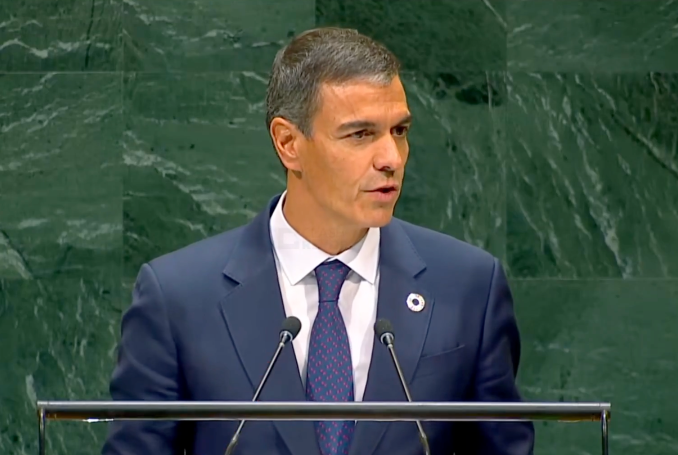 Spanish Prime Minister Pedro Sanchez addresses the UNGA 81 in New York. (Photo: Video grab)
Spanish Prime Minister Pedro Sanchez condemned Israel’s genocide in Gaza at the UN while demanding Security Council reform and abolition of veto powers.
Key Takeaways
- Sanchez called for abolishing the veto held by the UN Security Council’s permanent members and ensuring fair representation for all regions.
- He reiterated Spain’s “unequivocal” condemnation of what he described as the genocide Israeli Prime Minister Benjamin Netanyahu is perpetrating in Gaza.
- Sanchez warned of a “planned and coordinated” attempt to dismantle multilateral institutions and called for renewed international support for the UN.
‘No Country Should Be a Judge in Its Own Case’
Spanish Prime Minister Pedro Sanchez called Wednesday for sweeping reform of the United Nations Security Council, including abolishing the veto power held by its five permanent members.
Addressing the 81st session of the UN General Assembly in New York, Sanchez said the current structure needed to be changed to ensure more equitable representation across the world.
“We need to reform the Security Council so that all of the regions in the world have fair representation, and so that we can do away with the right of veto of the permanent members,” Sanchez said, according to Anadolu news agency.
Because, as established by the UN Charter, “no country should be a judge in its own case, no matter how powerful they are,” he added.
Sanchez warned that the principles underpinning the international system, including peace, sustainability and equal opportunities, were increasingly under attack from governments and political forces seeking to return the world to what he described as a “dark past.”
“I don’t need to point them out. We all know who they are and what their modus operandi is,” he said.
The Spanish prime minister argued that Madrid had sought to defend the principles of the UN Charter in its foreign policy, citing sanctions against Russia and Spain’s arms embargo on Israel.
He also reiterated Spain’s “unequivocal” condemnation of the “genocide that Netanyahu is still perpetrating in Gaza,” referring to Israeli Prime Minister Benjamin Netanyahu.
‘Planned and Coordinated’ Attack on Multilateralism
Sanchez warned that international institutions were facing what he described as a deliberate and coordinated attempt to undermine multilateralism.
According to Anadolu, he characterized the process as a “planned and coordinated demolition attempt,” arguing that its proponents initially question international rules before openly violating them and weakening the institutions created to enforce them.
“They start by questioning the rules, then they break them, knowing well that nobody will dare to hold them accountable,” Sanchez said.
“They cut their contributions to multilateral bodies like this one. They obstruct these organizations’ ability to act, so then write them off as useless entities that we can do without,” he added.
Despite those pressures, Sanchez argued that multilateralism remained the most effective means of managing an increasingly interdependent world.
He urged governments to “ramp up our trust” in the United Nations and strengthen the organization so it could again perform what he described as the central international role it played during the previous century.
Sanchez acknowledged that rebuilding the UN’s effectiveness would “not be easy,” but argued that weakening international institutions would leave the world increasingly governed by power rather than common rules.
A Woman from Latin America to Lead the UN
The Spanish prime minister also called for the next UN secretary-general to be a woman from Latin America, pointing out that all nine people to have held the position since the organization’s creation have been men.
“The time has come for a woman from Latin America to become United Nations Secretary-General,” Sanchez said, describing the issue as a “historic debt that we must settle.”
Sanchez also addressed the migration crisis in the Spanish enclave of Ceuta, rejecting calls for policies that would treat migrants as enemies or abandon human rights protections.
According to the Spanish government, around 72,000 people crossed irregularly from Morocco into Ceuta on July 30 and 31. More than 3,000 migrants, including several hundred minors, remained on the streets of the enclave according to the latest official estimates cited in the report.
“Spain does not choose the easy route,” Sanchez said. “We always choose the fairest route, and I also want to recognize that the world knows this.”
(PC, AA, UN News)

No comments:
Post a Comment