Showing posts with label Europe. Show all posts

Saturday, November 16, 2019

The business of building walls

by columnist, Andrea Germanos

As Europe marked the fall of the Berlin Wall, it is tragic that so many new walls have been built across Europe to keep out the most vulnerable people on the planet.
Stay with us for a report which appeared on the Common Dreams website, titled, “'The Business of Building Walls': New Report Shows Companies Cashing In on Europe's Expanding Anti-Migrant Barriers”. This interesting report has been written by columnist, Andrea Germanos.
There were plenty of headlines over the week marking the 30th anniversary of the fall of the Berlin Wall, but new walls in Europe are very much a big business.
That's the focus of a new report published recently by the Transnational Institute (TNI), the Dutch campaign against the Arms Trade (Stop Wapenhandel), and Delàs Center.
Entitled "The Business of Building Walls," the publication builds on the groups' 2018 report on walls. It names the beneficiaries of this new wave of barriers, which include not just physical walls but also "radar systems to the drones to the surveillance cameras to the biometric fingerprinting systems"—all aimed at blocking refugees and migrants.
This business, the report adds, "has both fueled and benefited from a massive expansion of public spending on border security by the European Union (EU) and its member states."
Niamh Ni Bhriain of TNI said: "As we celebrate the fall of the Berlin Wall, it is tragic that so many new walls have been built across Europe to keep out the most vulnerable people on our planet. This report shows that the new era of building walls is driven by a powerful military and security industry that have shaped EU border policies and reaped the financial rewards."
Since 1989, "European countries have constructed about 1,000 kilometers of border walls and fences, more than six times the length of the Berlin Wall, to keep out refugees and migrants. Most of these have been built since 2015, when the crisis in Syria was at its height," says the report. While Europe had just two walls in the 1990s, the number shot up to 15 in 2019, which combine to a length of 1,000 kilometers.
If anti-refugee maritime operations are included to the count ships, aircraft, and drones used to patrol the Mediterranean, the length of Europe's walls add an additional 4,750 kilometers.
Building Fortress Europe comes with costs, as a press release accompanying the report sums up:
“Data shows at least €900 million has been spent on land walls and fences, €676.4 million on maritime operations (2006 to 2017), and €999.4m on its virtual walls (2000-2019).”
Winners and losers of the wall business are evident:
“A Europe full of walls has proved to be very good for the bottom line of a wide range of corporations including arms, security, IT, shipping and construction companies. The EU's planned budgets for border security for the next decade show it is also a business that will continue to boom.”
Three European military firms—Thales, Leonardo, and Airbus—have been the biggest beneficiaries, according to the analysis. It notes that:
  • Thales also produces maritime surveillance systems for drones and is working on developing border surveillance infrastructure for Eurosur, researching how to track and control refugees before they reach Europe by using smartphone apps, as well as exploring the use of High Altitude Pseudo Satellites (HAPS) for border security, for the European Space Agency and Frontex.
  • Leonardo was also a member of a consortium, awarded €142.1 million in 2019 to implement and maintain EU’s virtual walls, namely its EES. It jointly owns Telespazio with Thales, involved in EU satellite observation projects (REACT and Copernicus) used for border surveillance.
  • Pan-European arms giant Airbus is a key supplier of helicopters used in patrolling maritime and some land borders, deployed by Belgium, France, Germany, Greece, Italy, Lithuania and Spain, including in maritime Operations Sophia, Poseidon and Triton.
The report says, "Perversely these firms are also among the top four biggest European arms dealers to West Asia and North Africa, thus contributing to the conflicts that cause forced migration."
There are big losers in the border wall business as well. As the report notes:
This is also a deadly business. The heavy militarization of Europe's borders on land and at sea has led refugees and migrants to follow far more hazardous routes and has trapped others in desperate conditions in neighboring countries like Libya. Many deaths are not recorded, but those that are tracked in the Mediterranean show that the proportion of those who drown trying to reach Europe continues to increase each year.
The report's author, Mark Akkerman, called for a new, more humane approach to help those uprooted from their homelands.
He wrote, "Today's walls need to be replaced by policies based on providing shelter, assistance, and a safe future for refugees as well as working on eliminating the reasons people are forced to leave their homes in the first place."

Friday, October 11, 2019

Why is Europe still fueling the war in Yemen?

by Romain Mielcarek

Despite attempts to ban arms exports, European countries remain important weapons suppliers to Saudi Arabia and the UAE, and thus accomplices in the war crimes against the people of Yemen.
Stay with us for an article by Romain Mielcarek the author of “Arms dealers: An investigation of a French business”, for ‘The Nation’ site, titled: “Why Is Europe Still Fueling the War in Yemen?”
Marseilles dockers from France’s CGT union this May inspected a shipment intended for the Bahri Tabuk, a Saudi cargo ship they suspected of intending to pick up munitions. A few days earlier another Saudi vessel, the Bahri Yanbu, had loaded Belgian-made arms in Antwerp, but a legal challenge by protesters deterred it from docking in Le Havre for French-made weapons. On May 20 and 21, Italian dockers union members in Genoa announced they would strike unless the Bahri Yanbu left the port; again it failed to load. All these dock workers protested in conjunction with a small group of NGO activists and politicians who have condemned the role of the Saudi-led coalition in the war in Yemen.
The current phase of that war began in 2014 when the popular Ansarallah Movement entered the capital, Sanaa. The Zaydi Shi’a Muslim movement had been fighting government forces since 2004 in view of the official policy of discrimination. In February 2015 the United Nations Security Council passed resolution 2201 calling for an end to hostilities. It repeated this several times, including after March 26, 2015, when the Saudi-led coalition that included the United Arab Emirates (UAE), Egypt, Sudan, and Morocco launched its first military invasion of Yemen – an invasion that has, unfortunately, not been categorically condemned by the UN.
The UN is also concerned about the growing number of Yemenis (24.1 million out of a population of 28.5 million) who needed help; for 14.3 million the need was urgent. By the end of 2018, the fighting had displaced 4.8 million, and according to NGOs, including the Armed Conflict Location & Event Data (ACLED) Project, which has created a large database, more than 90,000 people have died, 11,700 of them civilians. In February 2018 the UN called Yemen’s humanitarian crisis the worst in the world.
Many NGOs believe the Saudi-led coalition has little regard for civilian lives: A funeral was bombed in October 2016, killing 140; a wedding was bombed in April 2018, killing 30, 13 of them children; and a bus was hit in August 2018, killing 51, 40 of them children. Saudi Arabia calls these “unfortunate errors,” but a maritime blockade, allegedly imposed to prevent arms movements, has also stopped shipments of food, starving people and leaving little doubt as to the Saudis’ true intentions.
European organizations working on arms control—such as Amnesty International; Action, Sécurité, Ethique Républicaines (ASER); Action des Chrétiens pour l’Abolition de la Torture (ACAT); Campaign Against Arms Trade (CAAT); and Human Rights Watch—have highlighted that the United States and Europe are supplying arms. Saudi Arabia and the UAE regularly top the table of arms purchases from France, the United Kingdom, Germany, Spain, Italy, Bulgaria, and Sweden. Several NGOs have unilaterally initiated legal proceedings in national courts and the International Criminal Court, hoping to demonstrate the exporting country’s criminal responsibility, but the law remains hard to interpret.
In France, ASER’s case was dismissed by the administrative court this July. In the UK, the Court of Appeal in London found in favor of CAAT this June, stating that the government grant of export licenses for arms sales to Saudi Arabia was “wrong in law.” This judgement is non-binding and then–Secretary of State for International Trade Liam Fox sought permission to appeal against it. But it was a victory, nonetheless for CAAT.
The Arms Trade Treaty (ATT), which came into force in December 2014, and the EU Common Position on Arms Export Controls of 2008 require arms-producing countries not to export arms where there is a clear risk they will be used in breach of international humanitarian law. But NGOs and governments interpret “clear risk” differently. NGOs take any civilian deaths as proof, whereas governments class them as collateral damage but do not condemn the whole military operation. So far, NGOs have failed to move any court for war crimes or collusion by arms manufacturers, because of government pressures.
Most European governments had mildly criticized the carnage in Yemen, but it was the murder of Saudi journalist Jamal Khashoggi inside his country’s consulate in Istanbul in October 2018 that triggered political action. Austria, Denmark, Norway, the Netherlands, and Finland imposed an arms embargo; the Dutch and the Finns also gave up potentially lucrative contracts. There was, though, no concerted action with the market leaders.
In France, the publication of classified documents by the journalists’ collective Disclose on April 15 this year revealed politicians’ responsibility and earned the journalists a summons to appear before the General Directorate for Internal Security (DGSI) as part of an inquiry into a breach of national defense secrecy. The key leaked document was a confidential defense memorandum from the Directorate for Military Intelligence (DRM) to President Emmanuel Macron, Prime Minister Edouard Philippe, Armed Forces Minister Florence Parly and Foreign Minister Jean-Yves Le Drian. It listed major military equipment the Saudis and Emiratis had used and the positions of combat tanks (Leclerc, AMX-30, AMX-10P), armored vehicles (Aravis), warships (Baynunah-class corvettes, Al-Madinah and Al-Makkah-class frigates), artillery (AUF-1, LG1, Milan, RTF1), supply aircraft (A330 MRTT), helicopters (Cougar, Panther and Dauphin), fighter aircraft (Mirage 2000-9), and Damocles long-range laser designators for precision targeting.
According to the DRM, Caesar self-propelled howitzers made by French manufacturer Nexter put 436,370 Yemeni civilians within firing range of mercenary troops and Saudi armed forces in their advance into Yemeni territory. Despite the French government’s silence, Disclose journalists revealed that 35 civilians were killed in artillery bombardments that must have come from Caesars, as no Chinese or U.S. guns there had sufficient range. Unlike the Leclerc tanks and the Mirage 2000-9s, the Caesars are being delivered in phases between 2010 and 2024, so ignorance at the time of delivery is no excuse.
The military intelligence memo also mentions Italian-made Abu Dhabi-class corvettes, British Typhoon and Tornado fighters, German Al-Murjan mine hunters and Murayjib-class corvettes, and Swedish Ghannatha patrol boats and airborne radar systems.
Official export reports make no secret that arms sales have continued throughout the war. In 2017, EU countries granted licenses to export to Saudi Arabia worth €17bn and to the UAE worth €5bn, among them the UK (€1.572bn), Germany (€477m), and Belgium (€152m). Persian Gulf arms shipments earned Bulgaria €484m and Spain €174m in the same year. In its report of June 4, 2019, France stated it had supplied arms worth €1.398bn to the Saudis and €237m to the Emiratis in 2018. While big players in France, Germany and the UK supply the major systems, Saudi Arabia and the UAE are now looking to Eastern Europe for weapons. Saudi Arabia is Bulgaria’s biggest customer for light arms and munitions.
How are these sales justified? France’s armed forces ministry does not comment, but minister Florence Parly told parliamentarians on the national defense committee this May, “It’s vital to our sovereignty.”
Her position oscillates between bad faith and untruth. Despite the information from the DRM, she insisted on France Inter on January 20 this year, “I have no knowledge of [French] weapons being used directly in this conflict.” On May 7 (after the Disclose revelations), she told parliamentarians, “We have never claimed that no French weapons have been used in Yemen. But to date we have no proof that French-made weapons are used.” Yet the DRM memo explicitly states that various weapons, such as Baynunah corvettes, which are equipped with a sophisticated missile-launching system, are “participating in the naval blockade and supporting ground operations on the Yemeni coast’.
Ddeputy Fabien Gouttefarde, a former special legal adviser on armed conflict law at the defense ministry, tried to justify France’s arms sales, saying: “There’s a strategic partnership with Saudi Arabia and the United Arab Emirates.”
Faced with the reasons of state cited by European governments, parliaments have trouble accessing reliable information on arms exports. Though public reporting has become mandatory everywhere, its usefulness varies. Few French politicians willingly plow through the pages of tables they receive. In Italy, the reports are 1,400 pages of raw data. In the UK, several MPs examine the data and produce a counter-report that contains questions the government must answer. The debate in Germany is especially heated within the defense committee. A few countries, including the Netherlands, notify politicians every time an export license over €2m is granted to a country not on an approved list. Only in Sweden is a group of specialist parliamentarians consulted over every risky license before it is awarded. In the UK, CAAT spokesman Andrew Smith was delighted at the judgment in June, as the UK has temporarily stopped issuing new licenses to Saudi Arabia, though not supply and maintenance under existing contracts.
Despite much debate, no major exporting nation took a firm stand until October 22, 2018, when, following the murder of Khashoggi, German Chancellor Angela Merkel said, “As long as it’s not cleared up, there will be no arms exports to Saudi Arabia. I assure you of that very decidedly.”
This was a major shock to the European industry, especially France and the UK. As German companies supply components for a range of defense systems, the biggest arms manufacturers were effectively blocked from fulfilling contracts. Many tried to pressure the Germans behind the scenes, but Thomas Enders, executive president of Airbus (which is keen to supply 48 Eurofighter aircraft to the Saudis), said publicly on February 16, “It has been driving us crazy at Airbus for years that when there is even just a tiny German part involved in, for example, helicopters, the German side gives itself the right to…block the sale of a French helicopter.”
With the Eurofighter, there are few other contractors who can supply the software updates blocked by Berlin; alternative suppliers are often in the United States, and European manufacturers fear nothing more than relying on American goodwill. So France and the UK did all they could to persuade Germany to soften its stance. On March 29, 2019, the German government reduced its restriction to products entirely made in Germany. Components could once again be supplied, even if destined for problematic countries.
German manufacturers had already found ways around the embargo. Rheinmetall continued its munitions shipments via Italian and South African subsidiaries. Industry giants are setting up local facilities in Saudi Arabia and the UAE. Both countries have in recent months announced new joint ventures and plants in partnership with European groups, including Thales, Naval Group, Leonardo, CMI, Navantia, Airbus, and MBDA. The aim is to be able to build and maintain equipment locally, meaning governments and parliaments in partner countries will have less say.
No industry figure was willing to speak officially, but a French executive said off the record, “Saudi Arabia is the world’s second-largest arms importer. So every seller is there.”

Friday, September 13, 2019

IRAN WILL BE A FULL NUCLEAR POWER BY THE END OF 2020: NO RETURN TO THE 2015 AGREEMENT

By Elijah J. Magnier
French President Emmanuel Macron failed to promote successfully his Iranian initiative with the US administration despite the initial blessing of his US counterpart. This failure led Iran to make a third gradual withdrawal from its JCPOA nuclear deal commitment, raising two main issues. Iran has become a regional power to be reckoned with, so we can now scrap from reactions to its policies the words “submit,” or “bow to the international community”. Moreover, since Europe is apparently no longer in a position to fulfil its commitments, Iran will now be headed towards a total pull-out following further gradual withdrawal steps. Just before the US elections due in November 2020, Iran is expected to become a nuclear country with the full capability of producing uranium enriched to more than 20% uranium-235, weapons-usable and therefore in a position to manufacture dozens of nuclear bombs (for which uranium must be enriched to about 90%). However, this does not necessarily mean that this is Iran’s ultimate objective.
Industry data shows that half of the effort goes into enriching from 0.7% to 4%. If Iran reaches the level of 20%, the journey towards 90% is almost done. A few thousand centrifuges are needed to reach 20% enrichment while a few hundred are enough to cross from 20% to the 90% needed for a nuclear bomb. When Iran announces it is reaching a level which is considered critical by the west, there is the possibility that Israel might act militarily against Iran’s capability as it did in Iraq in 1981, in Syria in 2009, and in assassinating nuclear scientists. If this happens, the Middle East will be exposed to a mega earthquake whose outcome is unpredictable. But if Israel and the US are not in a position to react against Iran’s total withdrawal from the JCPOA (nuclear deal), Iran will no longer accept a return to the 2015 deal. Its position will become much stronger and any deal would be difficult to reach.
Sources within the decision-making circle have said “Iran will become a state with full nuclear capability. It is also aiming for self-sufficiency and is planning to move away from counting solely on its oil exports for its annual budget. It is starting to generate and manufacture in many sectors and it will certainly increase its missile development and production. Missile technology has proved to be the most efficient and cheapest deterrent weapon for Iran and its allies in Lebanon, Syria, Iraq and the Yemen”.
Iran has been following a “strategy of patience” since US President Donald Trump unlawfully revoked the nuclear deal. Tehran allowed Europe, for an entire year, to think about a way to tempt Iran to stay within the nuclear deal on the basis of 4 (France, Russia, China, UK) + 1 (Germany), excluding the US. After that long waiting period, Iran has taken the initiative into its own hands and is gradually pulling out of the deal. It seems Trump did not learn from President Obama who signed the deal, convinced that US sanctions would be ineffective.
But Iran is not missing an opportunity worth trying to make its case. At the G7 in France, Iran Foreign Minister Jawad Zarif cut short his visit to Beijing to meet European leaders and ministers at the request of President Macron. It was hinted that there were chances for Iran to sell its oil and that Macron had managed to break through the US-Iran tension.
Iran President Hassan Rouhani thought there was a real opportunity to smooth over tensions and that Trump, according to the source in Tehran, was ready to ease the sanctions in exchange for a meeting and the beginning of discussion. This is why Rouhani overtly stated his readiness to meet any person if that helped. But Zarif was surprised to learn that Macron didn’t fulfil his promises- because Trump had changed his mind. The initiative was stillborn and all are back at square one.
Macron understood that the problem doesn’t lie with the US President but in his consigliere Prime Minister Benyamin Netanyahu and his neo-con team Pompeo-Bolton. The meeting between the French Minister of Armed Forces Florence Parly and the Pentagon Chief Mark Esper was an attempt to convince the US Secretary of Defence to distance himself from the Pompeo-Bolton team before the situation gets out of control and Iran became unstoppable. 
“Trump rejected the French idea to offer Iran a line of credit of 15 billions of Euros (not Dollars). This credit is part of Iran’s acquired right since it has agreed with Europe to sell 700,000 barrels of oil daily as part of a signed deal. Following the US sanctions on any country or company buying Iranian oil, Europe refrained from honouring the agreement. Vice Foreign Minister Abbas Araghchi calculated the amount at stake of 15 billion euros with European representatives. The agreement was that Iran would sell oil to Europe for this amount in the future, and that Iran could buy any product, not limited to food and medicine which were originally excluded from the US sanctions. Iran, according to the deal with European partners, would have had the right to take the money in cash and transfer it to any other country, including Iran”, said the source.
All this has been thrown to the winds. The result is simple: Iran will continue its nuclear programme but will allow the International Atomic Energy Agency to monitor development. It is relying on the nuclear deal articles 26 and 36 to partially withdraw, a deal that was not signed based on trust, but on respect for law. This is the reason why Iran announced its third withdrawal step, increasing its stockpile of enriched uranium and replacing its IR-1 and IR-2m with IR-6 centrifuges (supposed to happen in 2026, as stated in paragraph 39).
Europe has used all its resources to persuade Iran from taking withdrawal steps, but to no avail. Iran has moved from a “patience strategy” to an “aggressive strategy” and will no longer accept a soft approach. It has undergone sanctions since 1979 and though it has learned to live with them, its patience is exhausted.
The US has nothing to offer to Iran but further sanctions and additional pressure on Europe, so the old continent follows its withdrawal path. The US administration planned to form various coalitions, including an Arab NATO, but failed so far to pull off any such alliance. US officials believed the Iranian regime would fall in months and that the population would turn against their leaders. Nothing of the sort happened. On the contrary: Trump and his neo-cons brought Iranian pragmatists and hardliners together for the same cause. The US destroyed the possibility of any moderate argument with people like Rouhani and Zarif, and showed that it was too untrustworthy for any reliable deal or agreement.
Iran is feeling stronger: it has downed a US drone, sabotaged several tankers and confiscated a British-flagged tanker despite the presence of the Royal Navy nearby. It has shown its readiness for war without pushing for it. Iran knows its allies in Lebanon, Syria, Iraq, Yemen and Palestine will be united as one in the case of war. The Iranian officials did not use revolutionary or sectarian slogans to face down US sanctions but instead managed to create national solidarity behind its firm policy of confrontation with the US. Washington, largely responsible for the status quo in the Gulf, failed to weaken Iran’s resolve and has so far been unsuccessful in undermining the Iranian economy. It is putting about the idea that its “suffocation policy” has been successful, but Iran is not giving the submission signals the US administration wants and needs, to justify the tension it has created in the Middle East and the Gulf.
Iran is handling its policy towards the US and Europe in the same way Iranians weave carpets. It takes several years to finish an artisanal carpet and many more years to sell it. The nuclear deal needed several years of preparation but even more time for establishing acceptance and the bona fides of the signatories. Trump’s simple-minded decision destroyed all that work. The US and Europe have lost the initiative. Europe is not politically in any position to stand against the US sanctions, nor does it have sufficient tools or standing to offer Iran and thus force it to the negotiating table. 
Iran is becoming stronger and much more difficult to tame than in the past. It is imposing itself as a regional power and a challenge to the west. It has advanced nuclear technology and capabilities, a self-sufficient armament programme and it is strengthening its allies in the Middle East.
It is difficult to foresee any negotiation between Iran and the West before November 2020, the date of the US elections. Iran is no longer willing to accept in 2019 what it signed in 2015; Trump is responsible for the new scenario. Destroying the nuclear deal now redounds to the benefit of Iran. There will be a time when the US administration, due to the realisation of its ignorance in Iranian affairs, will feel regret, and will ask to return to the negotiating table- perhaps after Trump? But conditions will definitely no longer be the same and it may very well come too late to see Iran accepting what it signed for in 2015.

Saturday, August 31, 2019

Prospect for INSTEX is not good: Paul Pillar

By Javad Heirannia

TEHRAN – Professor Paul Pillar, who was CIA intelligence analyst for 28 years, tells that the Europeans still want to save the JCPOA. 
Pillar says “Doing so will require the Europeans to facilitate enough commerce with Iran for Iranian leaders to conclude that their country is receiving enough economic benefit to make continued observance of the nuclear limits justifiable.”  
He also adds that “The prospects for this happening are not good.”
Following is the text of the interview:
Q: Iran has announced that it will implement a third step to reduce its obligations under the JCPOA. Will Europe takes effective and convincing action to prevent this?
A: The challenge for Europe has not changed since the Trump administration reneged on U.S. obligations under the JCPOA and, a year later, Iran began exceeding some of the limits of the agreement.  The Europeans still want to save the JCPOA. Doing so will require the Europeans to facilitate enough commerce with Iran for Iranian leaders to conclude that their country is receiving enough economic benefit to make continued observance of the nuclear limits justifiable.  The prospects for this happening are not good.  The European governments mostly have the will but not the ability to make it happen.  The governments do not control the private sector, and most European businesses that are big enough to matter fear being shut out of the U.S. market if they do business with Iran.    
Q: What would be the possible reaction of Russia and China to reducing Iran's commitments under JCPOA?
A: Russia and China also want to preserve the JCPOA.  If Iran continues to exceed more of the nuclear limits, Russia and China will not impose additional sanctions of their own.  They regard the Trump administration's imposition of new U.S. sanctions as the obvious cause of the agreement breaking down.  Russia and China will seek to exploit the absence of Iranian dealings with the United States and any new conflict in Iranian-European relations by developing their own relations with Iran, which they see in their own economic interests.  Russian President Putin also has a strategic interest in maintaining reasonably good relations with all countries in the Middle East, including Iran.  China possibly could be deterred from making major new commercial deals with Iran by not wanting to complicate its trade negotiations with the United States.  But right now those negotiations do not seem to being going anywhere, and so Beijing probably believes it has nothing to lose by doing business with Iran.   
Q: In your opinion, will the third phase of reducing Iran's commitments in the JCPOA be dangerous? Will Iran's case go to the United Nations Security Council after third step of reducing its commitments?
A: There is nothing distinctive about the third step that is different from the first couple of steps.  Iran still is limiting itself to steps that are easily reversible, and keep it a long way from any capability to build a nuclear weapon.  The JCPOA specifies procedures for any referral to the UN Security Council.  The Trump administration would favor such a referral, but it no longer is a participant in the JCPOA and thus does not have the standing to initiate such action.  A relevant question is whether the new British government of Boris Johnson, weakened by the Brexit mess and more dependent than ever on the United States, will start adopting the Trump administration's policy line on Iran.   
Q: Can the United States impose new sanctions on Iran after the third step in reducing Iran's commitments under JCPOA?
A: The Trump administration already has imposed nearly every sanction it has the power to impose on Iran.  It can always find something else that it can describe as a further step in its "maximum pressure" campaign, but the practical difference from what exists right now will be minimal.

The costs of European integration to the White House

By Mohammad Ghaderi

In one of his most recent statements, French President Emmanuel Macron has announced the end of US and Western hegemony in the international system. The remarks come as the EU and eurozone are also facing a severe crisis of leadership.
Macron has warned Western nations against the “strategic mistake” of alienating Russia – but in doing so, he seeks a bigger role for himself in international politics.
“We are living the end of Western hegemony,” Macron told diplomats , after hosting the G7 meeting in the city of Biarritz on France’s Atlantic coast over the weekend. He named the rise of Beijing and Moscow as signs of a shift on the world scene.
The reality is that the European Union and the eurozone, on the one hand, acknowledge the end of Western hegemony, and in particular the United States, and on the other hand, continue to be dominated by Washington. The EU's inactivity towards Europe has led to anger and frustration among citizens.
The EU and the eurozone have a very uncertain future. In other words, America and Europe can no longer speak of international domination.
In such a situation, people like the French President and German Chancellor are worried about the future of the eurozone and the European Union. This concern increases over time. The occurrence of a variety of security, political, economic and social crises has created many challenges in the European Union and the eurozone.
The emergence of these challenges has led to a sharp decline in the popularity of traditional parties in Europe. In such a way, nationalist parties have been able to increase their popularity with the public. Which side are the European Union and the eurozone really heading to?
ill the future of Europe finally be clear these are the questions that concern the mentally ill, such as Merkel and Macron?
Ultimately, the more Europe delays  in moving away from the United States, the more it will pay. It is as if European officials have not yet understood it. There is a long gap between the recent remarks of the French President and the EU's practical approach.

Friday, August 02, 2019

Belgian globetrotters share us their new perception of Iran

By Afshin Majlesi, Mehdi Sepahvand

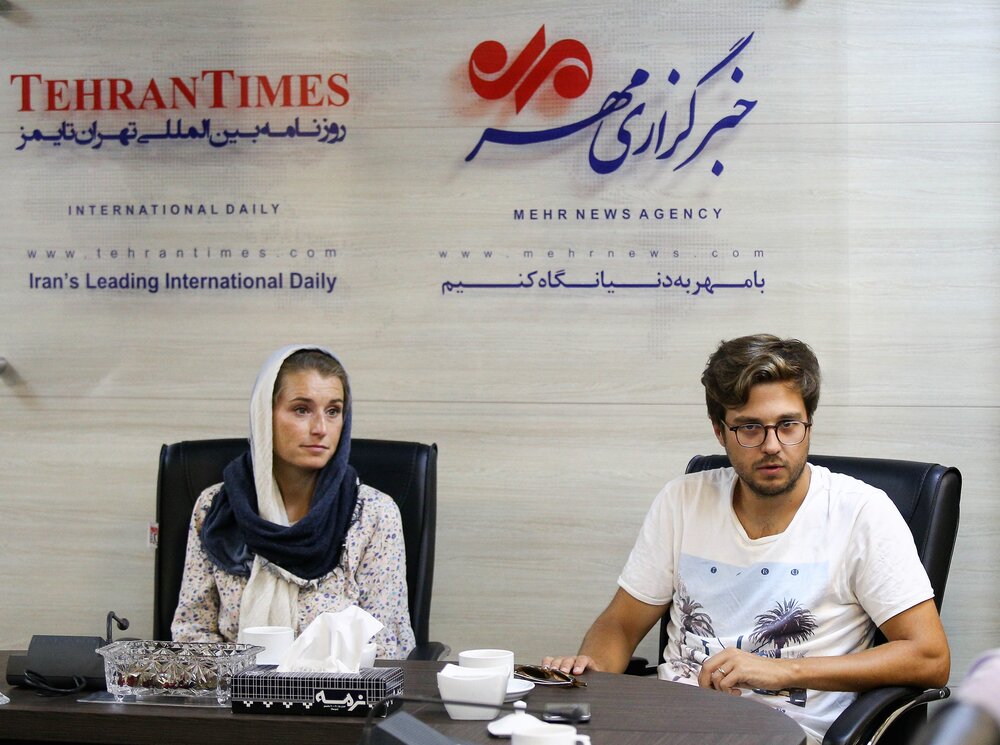
TEHRAN – Last Monday, a Belgian couple, who are on an overland journey to China, paid a visit to The Tehran Times, where they let us share their views, experiences and feelings about Iran in a cozy chat with the daily.
Ciara Reid and Lennart Gheysens in particular noted that the hospitality of Iranian people was beyond their expectations, saying “One of the reasons that we love Iran so much is the hospitality and kindness of the people.”
Western media don’t help very much to give a clear picture
“I think that is what a lot of other nationalities can take as an example and learn from it,” Ciara said.
When it came to driving in Iran, Lennart, however, didn’t give a good score, saying he had heard that Georgian people had earned a bad reputation for driving carelessly, but he thinks that the situation is even worse in Iran!
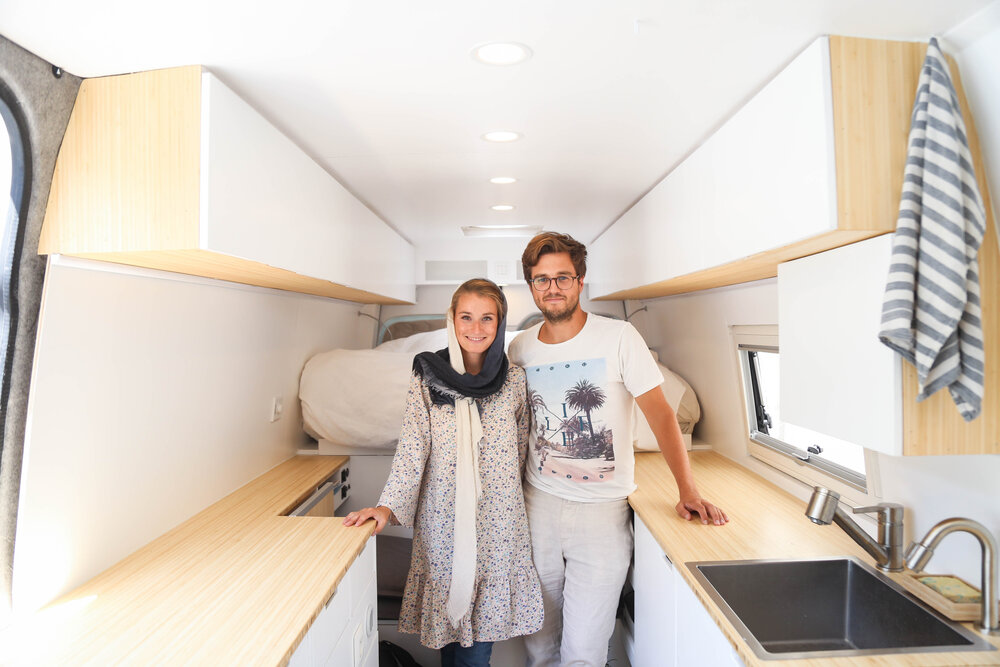
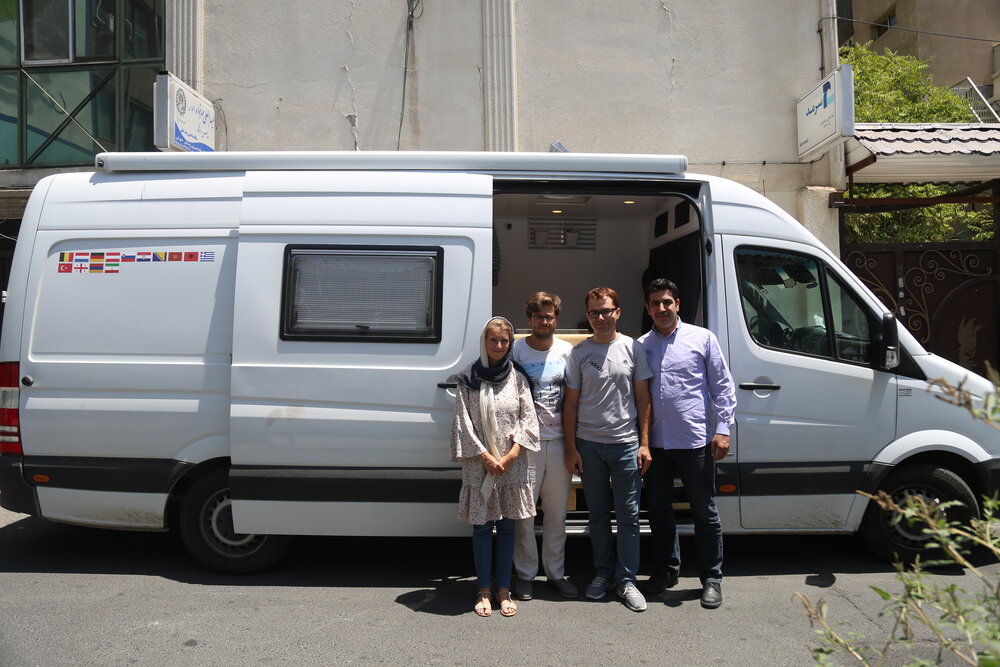
The couple also showed us various parts of their camper van, which was like a well-made miniature home equipped with almost everything including a bed, a dining table, chairs, a stove, sets of closets, cabinets, a toilet, a shower, a sink, electronic equipment and other amenities! There were powerful solar panels to charge the batteries that powered their moving home.
The transcript of the interview is given below:
Is this the first time you’re visiting Iran?
Lennart:  No, the second time. We visited in 2016 and that was only Iran that we visited [during that trip].
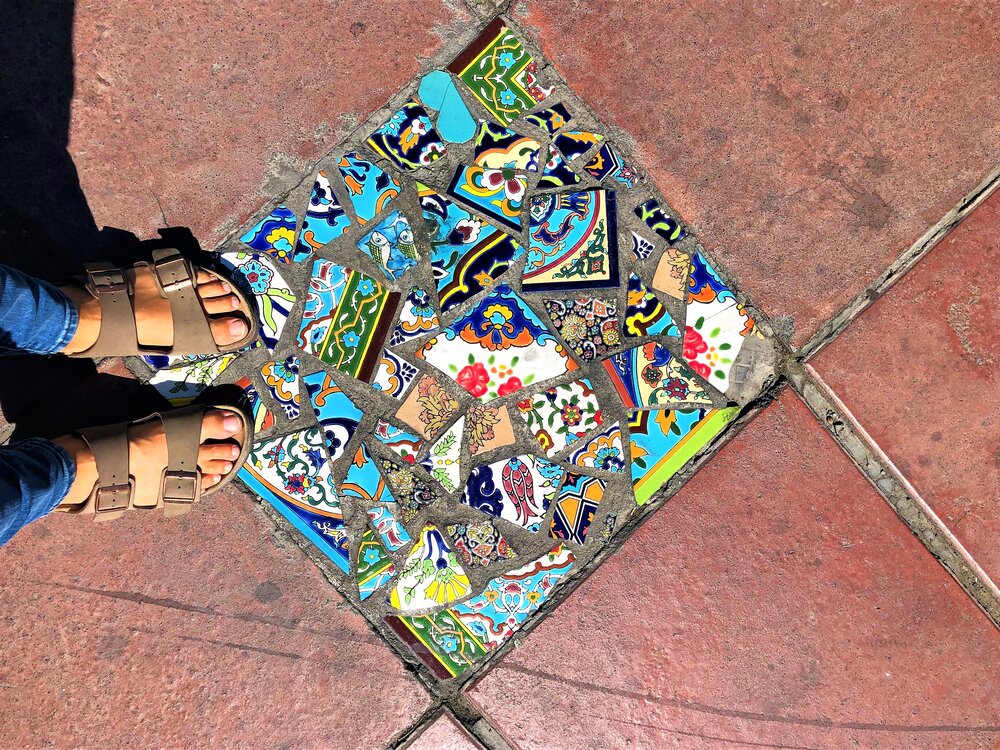
Ciara contemplates broken Iranian mosaics used to fix a missing tile (Photo: Ciara Reid, for The Tehran Times, July 29, 2019)
 
Ciara: We visited Iran in 2016 in a trip that was recommended by a friend of ours. And when we were here we really fell in love with the country. We never had that [experience] before. Everything is so beautiful and people are so friendly. And at that time we said we definitely want to go [come] back and then maybe all the different countries around Iran, maybe they’re beautiful too. And European people usually don’t get to see them so that’s why we decided to go on a trip along the Silk Road so it was really our trip in Iran in 2016 that sparked the idea of our current trip.
Please tell us more about the itinerary of your trip.
Lennart: We drove from Belgium quite fast through all the European countries like the Netherlands, Germany, Austria, Slovenia, Croatia, and Bosnia because we want to focus on the Caucasus region and then central Asia. We drove from Croatia to Albania, Montenegro, and then Greece to Turkey, where actually the real trip started for us. We started to take things slower. So we are driving from Belgium to China.
TT: Some foreign travelers say that driving in Iran resembles a video game. What do you say about that?
Lennart: Yes, it is. We had heard that Georgia is very bad [when it comes to reckless driving] but I think in Iran it’s even worse. But for us, our big car helps us to somehow avoid accidents. [Our rule is] to try to drive like a local… because in Europe, this is your lane and you cannot drive over it or whatever, but here….
If this happens in Europe, they will just leave you at the side saying it’s your own fault, no one will help you. So we told this story to people back home where a lot of people were saying us “Oh Iran is dangerous”! But for me it is one of the safest countries
TT: What about the quality of roads and highways in Iran?
Lennart: Actually, very good, I mean, for me, it’s comparable with European roads… actually the roads in Iran are quite good, they are almost flat and smooth.
TT: What’s your opinion about the Iranian hospitality?
Lennart: Well, it’s famous for a reason, because it’s true, one of the reasons that we love Iran so much is the hospitality and kindness of the people, like, the first time that we got here in 2016, we were in a taxi and the taxi driver invited us to his home and even though he couldn’t speak English, we were talking on Google Translate to each other.
Ciara and Lennart speak to The Tehran Times (Photo: Maryam Kamyab, July 29,  2019)
It was very nice to meet his wife and their toddler and a friend of whom we also met in Mashhad. We’re still friends now and we are staying with his family here in Tehran and I mean [while in Iran] everybody likes to help you.
 For example, all of a sudden we were in Tabriz and one gas station after the next said we don’t have diesel, we don’t have diesel, and we were like “Oh my God!”
You know, our car, runs on diesel -- not a lot of cars running on diesel in here, only the trucks and buses.
Ciara:  And we posted something on Instagram and said oh we’re scared, we don’t have any more diesel…. And then some Iranian people picked it up and posted their own [massages] on our Instagram page and suddenly we were like flooded with…; “Do you still need diesel?”, “You can get it there!”, …, “I can help you!”, and “We have diesel!”
And we posted something on Instagram and said oh we’re scared…. Some ten people reached out to us that we didn’t know… just out of kindness
Some ten people reached out to us that we didn’t know… just out of the kindness saying oh these are foreigners, they are in trouble, we can help!
Yes, this is a phenomenon that Iran is famous for.
Ciara:  I think that is what a lot of other nationalities can take as an example and learn from it. One time in 2016, we wanted to go to Yazd and in the bus station we went to different offices saying Yazd, Yazd, Yazd -- we were in Shiraz at that time -- and we [finally] took a wrong bus!
On the Google Map we found the bus was going all the way to the south so we asked the driver, saying Yazd? And the driver said, Bandar Abbas, Bandar Abbas! And we were like “Uh-oh!”
The driver pulled to the side, a bus full of people just stopped to the side. The driver said get out! We thought what we were going to do with our packs… we were thinking like “Oh my God! They want to leave us here on the side of the road!”
Then a man showed up. He said “Come with me, come with me!” And he drove us to a police station were there were a lot of taxies and he even paid us the taxi to get back to the bus station and we were very excited.
If this happens in Europe, they will just leave you at the side saying it’s your own fault, no one will help you. So we told this story to people back home where a lot of people were saying us “Oh Iran is dangerous”! But for me it is one of the safest countries. 
Have you selected a motto or a theme for your whole journey?
Ciara: Not really a theme but we actually want to see more of the countries along the Silk Road, so the “Silk Road” maybe our theme. We prefer to focus more on nature than cities during our journey!
We are also very amazed of the diversity of nature in Iran.
Tell us more about your portable home!
Lennart: We chose a Mercedes [camper] because it’s easy to find parts for Mercedes everywhere and because it’s also very reliable so we bought it second hand in Holland…. We removed everything from its back and started to modify everything from electricity to water and heating because I am a handy guy we did all the carpentry, installing a solar panel, air vents, curtains …. Everything!
And now, a tough question! Before your first visit Iran in 2016, you had a perception of the country, whatever it was, and after you felt the country, encountering its people, you developed another perception. How do you compare them, the first which was mainly shaped by Western media, and the one you have developed in person?
Lennart: Yeah, in the beginning for us, Iran was not very well known, just a Middle Eastern country, some said don’t go there because it’s dangerous …. So in the beginning we had a perception that it was very dangerous and also some (European) people didn’t know the difference between Iraq and Iran and the Western media don’t help very much to give a clear picture.
Ciara, Lennart and Tehran Times correspondents stand by the couple’s camper van (Photo: Maryam Kamyab, July 29,  2019)
But then some friends of ours visited Iran and we read a lot about it ourselves and yeah we saw that its people are very friendly, it is so safe and we like it so much.
Ciara: I think a funny anecdote is that we told our family and friends that we wanted to travel to Iran, everybody said “Oh you’re crazy! It’s very dangerous, you wanna get killed!”
And we said “No! It’s safe, it’s safe,” and then when we arrived in Iran we heard the bombings and attacks in Paris and an Iranian taxi driver asked where we are from and we said we are from Europe. “Europe? It’s so dangerous!” the driver said. So when we were back home in Belgium and people said “Oh, how was your trip to Iran?” we said, “Well it was actually much safer than it was in Europe!”

How plans for restraining Iran backfired

By Mohammad Ghaderi

Iran’s active resistance and strategic patience have nullified all plans of western opponents to restrain Iran. In the latest meeting on Joint Comprehensive Plan of Action (JCPOA), the western countries stepped back from their previously harsh policies. It seems that Iran has been successful in restraining the west, as the remaining members of JCPOA Committee stopped talking about using the trigger mechanism.
Based on Paragraph 37 of JCPOA, the trigger mechanism can automatically reactivate previous international sanctions against Iran.
In fact, Europe did not do much to offset the damage inflicted on Iran by withdrawal of the United States from JCPOA, as Europeans had wrongly interpreted Iran’s strategic patience as being passive. Europe though it has nothing to worry about; on the one hand, JCPOA seemed like a good block to Iran’s nuclear activities and on the other, U.S. was putting pressure on Iran to stop its economic and political progress and weaken its stance in the region.
With the end of Iran’s strategic patience, a new chapter was opened and Iran revealed its new strategy that is active resistance.
Tehran announced that it will gradually decrease its commitment to the JCPOA and gives the other side some time to compensate for its former inactivity. At first, it was hard for Europe to believe such thing as they had grown accustomed to Iran’s patience, but with Iran’s threats, Europe woke up from its former ignorance and started threatening Iran.
However, these threats did not change Iran’s decision, and Tehran took two major steps in its way toward reducing its commitments to the JCPOA.
Tensions over JCPOA coincided with new conflicts in the region. Americans did not think that Iran will show a reaction after they drove their spying drone into Iran’s territory, but Iran seized the drone and changed all former plans of the West powers.
This time, U.S. president who was under a lot of pressure over the negative public opinion, did not show any reaction out of fear of rising war and thanked Iranians for not targeting a passenger flight.
The capture of the American drone and U.S. inability to give a firm response crucially changed Iran’s position in the region and gave Iran a winning edge. After this, Americans tried to impede Iran’s progress by using Britain.
London, who was dealing with its own internal elections, seized an Iranian oil tanker to support the U.S. Following this incident, London received loads of internal criticism for blindly following U.S. in this game, Iran lost a ship, but Britain lost much more because the country claims to be an international influencer.
After this, other players in the region, including some Arab countries became aware of Iran’s new strategy of active resistance. This was a great distress to these countries as they realized if the West puts extra pressures on Iran or attack the country, they will also have to suffer the consequences.
The West political and economic war against Iran was supposed to crush the country, but Iran’s active resistance changed all these plans. West which was trying to restrain Iran, got restrained itself; now they can neither increase tensions by taking the risk of starting a new war nor can they tolerate the humiliation of being passive and having their powerful image ruined.
Recent incidents not only changed the power balance in the region, but it was also a test for the war option. The capture of American drone showed that the U.S., contrary to all its advertisements, is extremely afraid of starting a war, especially now that Donald Trump is on the verge of the new round of presidential elections. The incident also proved another point, that Iran is not afraid of war.
The West policy for restraining Iran backfired on them and put Tehran in a position to restrain the West. Finally, the Leader of the Islamic Revolution Ayatollah Ali Khamenei has best describe this situation by saying “there will be no war and no negotiations.” The drone incident proved the first part of this statement and Iran’s firm stand so far has proved the second part.
* Author: Mohammad Ghaderi , Tehran Times editor-in-chief 

Thursday, August 01, 2019

Europe must feel threatened!

By Hanif Ghaffari 

U.S. President Donald Trump and  The U.S.National Security Adviser John Bolton continue to think about the breakup of the European Union and the collapse of the eurozone. Yet politicians like German Chancellor Angela Merkel and French President Emmanuel Macron still think they can get into a political and economic equation with the US president! This dangerous and inaccurate look has caused European authorities to become more and more vulnerable to harm! Many analysts of international affairs have recently had a special focus on US-EU relations.
Some signals and speeches by the President of the United States which are addressed to the European authorities indicate the full opposition of the White House to the European Union.
EU officials are well aware that during the recent European parliamentary elections, Donald Trump and his allies were the main supporters of nationalist and extremist parties in Europe. This has led to victory in some European countries such as Hungary, France, and Britain, nationalist and anti-immigration parties. The main question is how long will the European authorities' reconciliation with the Trump administration continue ?!
What is certain is that the EU is completing its own process of collapse and destruction on its own! the European officials haven’t yet understood the extent of Trump’s hostility to the existence of the United European. This is while the trade war between Trump and the European Union has entered a new phase since the beginning of 2018. Some American economic analysts believe that based on his protectionist policies, Trump will impose new and wider tariffs on the EU, China, Canada, and Mexico in the future. European officials are now faced with a president who sees "economic protectionism" as a major policy in the field of commerce, and in the future, he will try to pursue this policy even more seriously.
Undoubtedly, there will soon be more economic disputes between America and Europe. In other words, the Trade war between these two will become more intense in near future. Furthermore, countries like China and Canada will also enter this confrontation with the United States. Europe does not have much opportunity to prevent its economic and political destruction by the White House! Aren't the European authorities awake ?!

Monday, July 22, 2019

Europe's return to the twentieth century!

By Hanif Ghaffari 

The three countries of Britain, Germany and France are not in good shape: Berlin faces a crisis of leadership and there is no prospect of the end of the Angela Merkel Chancellery.
Even though Merkel will end her Chancellery, she can no longer be considered an influential politician in the European Union and the eurozone. In France, Emmanuel Macron, after victory of  Le Pen and the French National Front (in the European Parliamentary elections), no longer has the power to revive his lost position in Paris. The UK is also thinking of leaving the European Union and how to manage the crisis. what does this show? The answer to this question is clear: Europe is going back to the twentieth century under the influence of Troika's downfall!
It's better to look at the subject a bit more realistic! The growth of extreme currents in Europe seems to have led to concerns and discontent among people such as German Chancellor Angela Merkel. This is while Berlin should not hide its role in this crisis. This social excitement has now become a "political demand" in the West. The dissatisfaction of European citizens with their governments has caused them to explicitly demand the return to the twentieth century and the time before the formation of United Europe. Obviously, in this situation, "Crossing the traditional parties" would become a general demand in the West. Under such circumstances, Merkel's and other European leaders' warnings about the return to the twentieth century and the time before the formation of United Europe simply means the inability of the Eurozone authorities in preventing the Right-extremism in the West.
On the other hand, EU foreign policy is still defined in a direct relationship with the White House and the Brussels-Washington security relations. No doubt, under such circumstances, we can not speak of an "independent Europe" in the international system. Even, While US National Security Advisor John Bolton and Trump have repeatedly expressed their opposition to the existence of the European Union and the Eurozone, Europe has not taken any steps towards independence from the United States. Now, the EU has little opportunity to save itself from falling. The truth that some European leaders have not yet understood ...