Showing posts with label israel. Show all posts

Tuesday, December 17, 2019

Today’s Allies Are Tomorrow’s Enemies


By Philip Giraldi
"Information Clearing House" -  One might postulate that the United States is regularly supporting so-called allies whose very nature will eventually generate blowback that will do terrible damage to actual American interests. The recent example of the mass shooting at the Pensacola Naval Air Station in Florida by Saudi Second Lieutenant Mohammed Alshamrani is illustrative. Alshamrani killed three American sailors while three other Saudi students filmed what was taking place, presumably for posting on social media.
Though the U.S. and The Kingdom of Saudi Arabia have no actual alliance, the American and Saudi militaries have a relationship that began during the Second World War. Currently, Washington supports Riyadh as a force multiplier and extension of U.S. power in the Persian Gulf region to serve as a check on what if perceives to be as hostile Iran. Saudi Arabia, nurturing its own regional ambitions, clearly sees Iran as its principal enemy. As the White House also appears keen to do whatever is necessary to bring about regime change in Tehran, the tendency in Washington to serve as an apologist for whatever Riyadh does will continue for the foreseeable future. And, as an added bonus, the Saudis buy billions of dollars’ worth of American made weapons annually.
Someone has to train the people who fly the expensive warplanes, so Saudi Air Force “students” are sent to American bases like Pensacola where they undergo language and flight training that is normally conducted by civilian contractors. The student pilots, surely carefully screened by Saudi security, would be unlikely candidates for staging a terrorist attack in the United States, but the Alshamrani incident suggests that there is more dissidence bubbling beneath the surface than is apparent from the rosy assurances about The Kingdom coming out of the White House and the Royal Palace in Riyadh.
The investigation of Alshamrani continues, but it seems clear that  he was unhappy with aspects of America’s pro-Israel and interventionist foreign policy. He also connected with radical websites on social media and his colleagues report that he would periodically return to the U.S. from home leave in Saudi Arabia “more religious.” On the night before the incident, he showed a film that included a mass shooting.
Alshamrani is just one element in the considerable potential downside inherent in the undeclared bilateral relationship. Apart from the regional instability created by the fact that Washington has to look the other way while the Saudis use American weapons to carry out genocide in neighboring Yemen, many observers believe that Saudi Arabia is basically unstable. Its prevailing fundamentalist Islamic sect referred to as Wahhabism is backward looking and hostile to the United States and the West. Some have even suggested that a large majority of ordinary Saudis, i.e. not those who benefit from the bilateral relationship, hate the U.S. One recalls that fifteen out of the nineteen 9/11 hijackers were Saudi nationals.
All of which means that the United States is training and arming people who just might turn their training and weapons against Washington if the al-Saud royal family cannot stay in power. The situation is somewhat comparable to that in Afghanistan, where so-called “green-on-blue” incidents in which Afghan army recruits kill their foreign trainers occur on a regular basis. The chief difference is that should the Saudi dissidents gain power, they would have a huge and much more lethally sophisticated arsenal to play around with.

The current situation with the House of Saud is not good. It is a regime that is under considerable pressure because of its corruption. Internationally, it has few friends due to its widely condemned war in Yemen as well as from the consequences arising over the killing and dismembering in Istanbul of Jamal Khashoggi. The situation also invites comparison with other current and past U.S. relationships in the region. Washington props up an unpopular and unstable regime headed by President Abdel Fattah el-Sisi in Egypt while also funding and training the country’s military. In the past, the U.S. was the main arms supplier for the Shah’s Iran, ignoring abuses committed by the regime because Iran was perceived to be a major regional power, reliably stable and apparently western looking.Other regional powers are watching how the situation involving the American presence in Saudi Arabia develops. Recently Iran’s leader Ayatollah Seyed Ali Khamenei commented on media reports that the Saudis would be constructing U.S. provided nuclear reactors. He said "I do not know of any regime in the region and perhaps the world as bad as the Saudi government. It is not only despotic, dictatorial, corrupt and tyrannical but also sycophantic.  [The Americans] want to supply [the Saudis] with nuclear equipment. They have announced to build missile manufacturing centers for it [and] they see no problem because Saudi Arabia depends on them and belongs to them. Of course, if they build them, I personally will not be upset because I know that God willing [all the weapons] will fall into the hands of Muslim Mujahedin [for use against the Americans] in the not too distant future.”

The United States is also in trouble with its other major regional partner in the Middle East, Israel. As is the case with Saudi Arabia, the United States has no actual alliance or pact with the Jewish state, though such an arrangement is currently being considered. As in the case of Saudi Arabia, the United States has no say in the military actions being undertaken by its client Israel. The Jewish state regularly bombs targets in Gaza, Syria and in Lebanon, just as the Saudis do in Yemen. As the United States is the arms supplier to both nations and is more-or-less the de facto guarantor of a one-sided stability in the region, it has self-assumed responsibilities without having any input into the decisions making process. Trump’s obsession with destroying Iran, which has promised to do in his next term, makes him blind to the deficiencies in the allies he seeks to use to that end.
The situation with Israel is particularly dangerous as the Jewish state possesses a nuclear arsenal and it is widely believed that many in its military command structure are prepared to use those devices against Iran. In 2015, Israeli defense minister Moshe Ya’alon explained how Israel might have to strike Iran hard to prevent a long war. He cited the examples of Hiroshima and Nagasaki and then describing the process for making such a decision as “at the end, we might take certain steps.”
Either way, the United States of America is burdened with a number of false allies that use the relationship with Washington to enable their own schemes. If and when the whole house of cards begins to collapse, the U.S. will plausibly find itself with no friends and confronted by enemies that it empowered and also helped to train and equip.


Philip Giraldi is Ph.D., Executive Director of the Council for the National Interest. A former CIA Case Officer and Army Intelligence Officer who spent twenty years overseas in Europe and the Middle East working terrorism cases. He holds a BA with honors from the University of Chicago and an MA and PhD in Modern History from the University of London. 

U.S. mainstream media leaves Israel out of the worsening Iran/Saudi Arabia/Yemen crisis

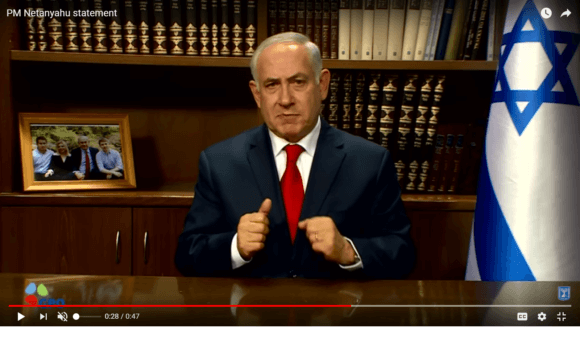
Netanyahu celebrates Trump's speech decertifying the Iran deal, Oct. 13, 2017.

In theory, a dispute between Saudi Arabia and Iran over an awful civil war in Yemen should have nothing to do with Israel.
In fact, Tel Aviv is a major factor stoking a growing crisis that threatens to explode into an even wider war, and trigger a global economic slowdown.
Mainstream U.S. media accounts have bogged down in futile efforts to definitively assess responsibility for the audacious drone attacks that damaged Saudi oil facilities on September 14, sending plumes of smoke up into space. The U.S. press is less rigorous about looking into the Israeli connection to the crisis. Today’s lead article in the New York Times about the risk of “war with Iran” did not mention Israel or Benjamin Netanyahu a single time. Neither did a major report in the Washington Post.
First, Israel has been itself complicit in the terrible civil war in Yemen, in which at least 100,000 people have died, the world’s largest cholera epidemic has broken out, and millions more are threatened with starvation. The Israeli newspaper Haaretz back in February reported that:
Israeli cyber companies, gun traders, terror-warfare instructors and even paid hitmen operated by an Israeli-owned company are partners to the war in Yemen.
But Israel is even more deeply involved in the larger regional crisis, and Benjamin Netanyahu will not be satisfied until the U.S. actually attacks Iran. Israel has zero concern for the Iranian theocratic regime’s repression of human rights; Tel Aviv has excellent relations with General Sisi in Egypt, and its budding alliance with Saudi Arabia’s murderous Crown Prince Mohammed is further proof that it has no trouble working with regional neighbors who have bloody hands. Israel hates (and fears) Iran only because Tehran supports the two strongest armed forces in the region still resisting it: Hezbollah to the north in Lebanon, and Hamas in Gaza.
Bizarre personal dynamics complicate the scene:
  •  Donald Trump wants millions to pay for his re-election campaign, and pro-Israel mega-donor Sheldon Adelson has provided them. In return, Adelson imposed arch-hawk, invade-Iran-yesterday John Bolton as Trump’s national security adviser — until Bolton challenged Trump and got fired.
  •  Trump himself does seem hesitant to go to war, because he recognizes it will damage his re-election chances.
  •  At the same time, Trump and his family slavishly admire Crown Prince Mohammed and the Saudi royals, almost certainly because the Trumps have gotten large sums of money to cement that admiration. And just like Israel, Prince Mohammed definitely wants the U.S. to attack Iran.
  • These contradictory pressures surely explain Trump’s vacillating behavior over the past few days as the crisis continues.
None of this is reported clearly in the mainstream American media. 

Sunday, December 15, 2019

Donald Trump and Israel: When Does a ‘Passionate Attachment’ Threaten National Security?

Philip GIRALDI

In his Farewell Address, of 1796 America’s first president George Washington famously warned his fellow citizens that “…a passionate attachment of one nation for another produces a variety of evils. Sympathy for the favorite nation, facilitating the illusion of an imaginary common interest in cases where no real common interest exists, and infusing into one the enmities of the other, betrays the former into a participation in the quarrels and wars of the latter without adequate inducement or justification.”
In today’s United States, there is no more “passionate attachment” than that which exists with Israel. The tie that binds is assiduously cultivated by the media and the politically ambitious, so much so that the Jewish state is frequently referred to hyperbolically as America’s best friend and closest ally. But Israel, with its own regional interests driving its policies, is in reality neither a friend nor an ally.
Politicians mired in the past like Nancy Pelosi, Joe Biden and Chuck Schumer can see no light between Israel and the United States. Pelosi has declared astonishingly that “I have said to people when they ask me if this Capitol crumbled to the ground, the one thing that would remain is our commitment to our aid…and I don’t even call it aid…our cooperation with Israel. That’s fundamental to who we are.” Biden has repeatedly denounced any reduction in the ridiculously high level of military assistance given to Israel to convince it to modify its behavior as “bizarre,” while Schumer has identified himself as the Jewish state’s “shomer” or guardian in the US Senate.
Many members of the Democratic Party base are no longer enchanted by Israel and one would like to know what politicians like Biden and Pelosi really think about the Jewish state, but it is unlikely that that will ever be revealed. It is nevertheless clear that the adhesion to Israel by Democrats has been far overshadowed by the constant pandering to the Jewish state that has been the hallmark of the current administration of Donald J. Trump. To be sure, the musical chairs line-up of neo-conservatives that has included John Bolton, Mike Pence and Mike Pompeo has been unstinting in its praise of the malignant Israeli Prime Minister Benjamin Netanyahu, but it is the president himself who has raised the level of adoration to heights previously not observed coming out of the White House.
Donald Trump has overturned long standing foreign policy positions to favor Israel even more than has been the case hitherto. He withdrew from the nuclear pact with Iran, has moved the US Embassy from Tel Aviv to Jerusalem, has recognized Israel’s annexation of the Golan Heights, has declared the illegal settlements on the West Bank “not illegal,” has cut off funding to the Palestinians and the United Nations and is sending signals that he will approve further moves by the Jewish state to annex much of the remaining Palestinian territory. Along the way, his Ambassador to Israel David Friedman has been making excuses for Israeli shooting of unarmed demonstrators and the everyday brutality inflicted on the hapless Palestinians.
Worse might even be coming, as Secretary of State Pompeo and Netanyahu have recently been discussing a formal defense pact which would obligate the United States to intervene on the side of Israel if it were to go to war, even if the war were initiated by the Jewish state. As Israel is now reportedly considering the value of a possible pre-emptive nuclear strike on Iran, the stakes could not be higher.
But as bad as all that is, nothing outdoes the speech delivered by Trump in Florida last Saturday in front of the Israeli American Council (IAC) National Summit. IAC is a basically right-wing group funded largely by Las Vegas casino multi-billionaire Sheldon Adelson, who is also a close adviser to the president on the Middle East. Its annual gathering included 4,000 mostly well-heeled Israelis and American Jews who cheered and periodically chanted “four more years!” as the president was speaking.
Trump spoke for 45 minutes, most of which consisted of preening over how much he has done for Israel. But he also discussed Jews in America, saying that “We have to get the people of our country, of this country, to love Israel more, I have to tell you that. We have to do it. We have to get them to love Israel more. Because you have Jewish people that are great people — they don’t love Israel enough.” He also said that his audience should be supporting him and not voting for Elizabeth Warren, whom he called “Pocahontas,” saying “You’re not going to vote for the wealth tax…Let’s take 100 percent of your wealth away.”
There was considerable pushback almost immediately coming from Jewish groups and prominent individuals who saw Trump’s words as classic borderline anti-Semitic tropes. Trump, who often speaks to Jewish audiences in the second person, saying “you” rather than “we,” clearly sees the Jewish attachment to Israel as normal and acceptable, but there is an implicit second message about potential disloyalty to the United States. In August he said that American Jews who vote for Democrats show “either a total lack of knowledge or great disloyalty.”
And Trump also is not reluctant to link Jews with money, a generally taboo subject that he has raised before, most particularly when he was campaigning and he told an audience of Jewish Republicans that “you’re not going to support me because I don’t want your money. You want to control your politicians, that’s fine.” And, of course, the irony is that everyone who has not been asleep knows very well that the Israel Lobby in the US and Europe is indeed all about money. Money buys access to power.
For someone who has spent much of his life around Jews in the New York business world, Donald Trump is remarkably ignorant of their political culture. To be sure there is a group of oligarch billionaires that includes Adelson, Paul Singer, Ron Lauder and Bernard Marcus who are politically conservative and fund Trump as well as other Republicans. They do so not because Trump is good for the United States but because he is a gift to Israel and can easily be bought or persuaded.
But most Jews, while supporting the existence of Israel, do not exactly see things quite that way and many Jews of a liberal persuasion want to see a secure Israel that will deliver justice for the Palestinians. Plus, Trump’s authoritarianism and denigratory, abrasive style offend many Jews, so the president will not be getting many Jewish votes no matter what he does. His approval rating is 29% among Jewish voters nationwide, according to a Gallup poll while only 17% of Jews voted Republican in 2017. And one would have thought even the narcissistic president might have noticed the large number of Jewish witnesses, “experts” and congressmen who seem to be “out to get him” in the impeachment hearings.
Beyond that, Trump’s constant exaltation of the Israelis and of Jews in general as something like a gift to humanity should offend all other Americans. The president is elected to represent the interests of all Americans, not just a wealthy and powerful ethno-religious minority that is able and willing to give him a great deal of money to run his political campaigns. It is unthinkable that a national politician should mount his bully pulpit to praise interminably any specific ethnic group, and so it should be. It is offensive and completely unacceptable, particularly as in this case it is a favor bought that brings with it grave damage to genuine US interests and could easily lead to a major war in which Americans will die.
Nevertheless, the painful issue of who is loyal to what is genuine, particularly when a dedicated and powerful group affiliated with a foreign country is able to game the system to get what it wants. We are all supposed to be Americans first. In her comment on the Trump speech, conservative pundit Ann Coulter maintained that the president didn’t go far enough in impugning the loyalty of some Jews to Israel, writing, “Could we start slowly by getting them to like America?”

Friday, December 13, 2019

Haniyeh’s foreign tour: Between Egyptian approval and the expected agenda

Finally, after many attempts, Egypt has agreed to allowing the head of the Hamas Political Bureau, Ismail Haniyeh, to leave its lands, after holding talks with its senior security officials. They have allowed Haniyeh to carry out a regional tour, including Turkey, Malaysia, Qatar, Lebanon, and possibly Iran, among other countries. This comes despite the fact that Egypt has refused, more than once, to allow him to take this tour, fearing his visit to Iran due to the Saudi and Israeli pressures on Egypt.
The following lines discuss Haniyeh’s new tour around the region, what he will discuss, his agenda and files – the truce with Israel and the Palestinian elections – and why Egypt has allowed him to conduct his tour this time, after having refused many times before. I will also discuss which countries he will visit, how the tour affects the strengthening of Hamas’s relations with Egypt and the region’s countries, the accuracy of the information regarding Haniyeh living abroad for many months, as well as the truth behind Egypt’s request for him not to visit Iran, due to the pressure from Israel and Saudi Arabia.
On 2 December, Haniyeh left the Gaza Strip to Egypt, on a visit that was supposed to last a few days, to hold extensive discussions with Egyptian intelligence on the future of the security in Gaza, to stop the Israeli attacks against Palestinians, on holding Palestinian elections, achieving reconciliation and ending the division.
It was surprising that Haniyeh ended his intensive dialogue with Egyptian officials, including the intelligence minister, Abbas Kamel, heading to Cairo International Airport to start a regional and international tour, instead of the Rafah crossing back to Gaza, as was customary in his many visits to Egypt over the past years. It was most surprising due to the fact that in recent years, Hamas has made several formal requests to Egypt to allow Haniyeh to execute this tour, but the requests were not granted.
This current tour by Haniyeh may be of exceptional importance because, since his election as head of the Hamas Political Bureau in May 2017, he has not made any foreign tours, with his visits being limited only to Egypt . These visits took place in September 2017, February 2018, May 2018 and February 2019, during which he discussed easing the suffering of the besieged Gaza Strip and their bilateral relations. However, his last tour before leading Hamas lasted five months, between September 2016 and January 2017, and included Egypt, Saudi Arabia and Qatar.
From time to time, Hamas circles have disclosed that Haniyeh would conduct a foreign tour including Arab and Muslim countries, such as Qatar, Egypt, Turkey, Iran and Algeria, alongside Lebanon, Kuwait, Mauritania, Malaysia, Indonesia and Morocco, but at the last minute, the tour did not take place. Russian deputy foreign minister, Mikhail Bogdanov, even announced in late December 2018, that Haniyeh would visit Moscow in January 2019, in response to their invitation, but the visit did not occur due to the Egyptian veto.
In the past, Hamas has not given a clear and specific explanation for the repeated postponements of Haniyeh’s tours, and it has not accused anyone of preventing it. This is so as not to strain relations with any party, especially Egypt, because the movement seeks to restore its regional relations. Therefore, it favoured silent diplomacy with these parties to facilitate Haniyeh’s tours, which were postponed several times, despite the importance of these tours, whether to arrange the movement’s files, to meet its branches abroad or to hold meetings with other factions in a number of Arab and Muslim countries.
I worked tirelessly to obtain reactions from Hamas regarding the repeated Egyptian rejection of Haniyeh’s departure to regional and international tours, and the reason for this recent approval. However, the movement’s leaders and speakers have expressed clear reservations about giving a convincing explanation. This leads to employing our own diligence to attempt to identify the reasons behind Haniyeh’s tours not taking place.
The Israeli escalation against Gaza, from time to time, is a primary reason for Haniyeh’s desire to remain in Gaza and to follow its developments. A second reason is the security situation in Sinai, and the inability to secure a safe exit route from Gaza to Egypt. While the third reason is related to the internal conditions of some countries that have postponed, not cancelled, the visits for some time. A fourth reason is Egypt’s stalling to give Hamas the final approval.
There have been increasing Palestinian predictions that Cairo’s prevention of Haniyeh from organising a regional, and perhaps international tour for over two years, lies in the fact that it is not an Egyptian decision. There are beliefs that these are Israeli, American and Saudi decisions, as all of these parties are relying on Egypt to restrict Haniyeh’s movements and limit him to Gaza because his visits to Qatar, Iran, and Turkey harm Israel. Meanwhile, keeping Hamas leaders abroad and distributing them among several countries, gives them ease of movement, rather than their concentration in Gaza, and it gives Egypt the right to place a veto on the travel of its leaders.
Preventing Haniyeh from his regional tour aims to restrict Hamas from strengthening its legitimacy in front of the region and the international community, while the Arab states, with Israeli-American agreement, put pressure on Hamas and suffocate it by boycotting it, politically and diplomatically. They also pressure other countries to prevent them from meeting with Hamas, with the exception of a few countries that have deviated from the US. There has also been major diplomatic efforts made by the Palestinian Authority to prevent Haniyeh from visiting some countries, such as Russia, for example.
The repeated postponement of Haniyeh’s tour represents a model for making Hamas, again, forcibly pay the price for Arab disputes. Every country is seeking to make the movement close to it, and far from its opponents, despite Hamas’s rejection of this political action, because it does not want to be in anyone’s pocket.
It is increasingly clear that Hamas is paying these prices just by looking at Haniyeh’s expected agenda, in the event that he can organise his foreign tour. The tour includes Qatar and Turkey first, who share poor relations with Egypt and near-complete estrangement. This may allow Egypt to justify their prevention of Haniyeh’s tour, because their control of major Palestinian issues, such as the international national reconciliation or the relationship with Israel, gives them strong cards of influence, both regionally and internationally.
Consequently, denying Haniyeh access to these capitals, makes Hamas, at least in Cairo’s view, immune to any regional external pressures that disturb the Egyptian political track of the Palestinian cause. This is despite the fact that Hamas continuously asserts that it has its own policy, and that it is not affected by intimidation nor pressure from any country.
People come out in support of Egypt's efforts to end divisions and support Palestinian reconciliation on 25 September 2017. [Moahmmed Asad/Middle East Monitor]
People come out in support of Egypt’s efforts to end divisions and support the Palestinian reconciliation on 25 September 2017. [Moahmmed Asad/Middle East Monitor]
Egypt’s recent approval of Haniyeh’s foreign tour, after continuous refusal and rejection, does not hide its desire to seek to impose its guidance on Hamas, determining who it visits and who it boycotts. This did not happen with the other countries that the movement has dealt with, such as Jordan, Syria and Qatar.
Today, after Haniyeh’s tour commenced, Hamas hopes it results in an improvement of its regional relations, developing friendly ties with allied countries and mending the tension and estrangement with other countries. The movement wants its leader to visit certain countries to obtain financial support and closer political relations, although countries influencing Egypt, such as Saudi Arabia and Israel, have a firm hostility with the countries that Haniyeh intends to visit, and they do not want to give them a card to interfere in the Palestinian cause, by meeting with the leader of Hamas. They are seeking to prevent him from visiting these countries.
In this round, which has just begun, we are hearing frequent news that the Egyptian approval of Haniyeh’s foreign tour came after stipulation that he should not visit Iran, in particular. This is a significant request in the political relations between the parties, and does not imply wise diplomacy. However, it is clear that the Egyptian request is accompanied by Israeli and Saudi’s insistence to deny Tehran any foothold in the Palestinian arena, that may be strengthened by Haniyeh’s supposed meetings with Tehran’s leaders, who are locked in an invisible struggle with Riyadh and Tel Aviv.
It is still unknown whether Haniyeh will respond to the supposed Egyptian request, because it hurts the independence of the movement’s decision, and may negatively affect its relationship with its most important ally, Iran, if he does not visit it. This is especially true if he visits a number of other countries in the region, and refrains from visiting Iran, rendering Hamas’s position very difficult. Its decision will be sensitive and probably costly either way, whether it responds to Egypt’s request or chooses to ignore it.
In the same context, it does not seem that Haniyeh will appear to be hasty to return from his foreign tour. Predictions from inside Hamas are that he will remain abroad for several months, to conduct internal discussions with the movement, for foreign discussions with friends and allies and accomplish some of the leadership tasks that only he can complete.
Perhaps this issue, again, indicates the suitability that part of the Hamas leadership remains outside of the Palestinian territories, away from the siege and restrictions of movement – something that the current Hamas leadership may not have paid attention to when it placed all its political and military leaders in the Gaza Strip. This has put the movement, and its leaders, under the mercy of the Egyptian decision-maker, which allows Hamas to travel when relations are good, but when there is tension, it closes the Rafah crossing until further notice.

Thursday, December 12, 2019

First Global Conference on Israeli Apartheid

Israel’s continued occupation of Palestinian territory, as well as the efforts that Israel goes to to impose second-class citizen status on Palestinian citizens and inhabitants of the occupied West Bank prompted the “First Global Conference on Israeli Apartheid” to take place in Istanbul, Turkey, last weekend.
Inaugurating the conference, President of the Union of Non-Governmental Organisations in the Islamic World (UNIW), Ali Kurk reiterated the Western governments’ overwhelming support for Israel’s apartheid system and the country as a whole, and stated: “International law has become meaningless now the law of the strong rules.”
Retired general of the Turkish armed forces who was appointed Chief Political Adviser to Turkish President Recep Tayyip Erdogan in 2016, Adnan Tanriverdi, said Jerusalem was particularly under threat of becoming a purely Jewish city as a result of Israel’s policy of evacuating Palestinian homes in occupied East Jerusalem and then either allowing Jewish settlers to occupy them or destroying them.

Jewish exclusivity

Former Executive Secretary of the United Nations Economic and Social Commission for Western Asia (ESCWA), Rima Khalaf, said Israel is “the only country in the world to confer full citizenship based on inherited religion.” She also linked the Israeli apartheid system to the racial Darwinism that was prevalent throughout the 19th and 20th centuries in Europe, which fostered an ideology of racial and ethnic supremacy that is the root cause of apartheid.
Archbishop of the Greek Orthodox Church in Jerusalem, Atallah Hanna, added: “Israeli occupiers want Muslims and Christians to be racist to each other,” but that will not work as “we share a common Palestinian identity.”
Activists, politicians and supporters of the Palestinian cause gather in Istanbul for the' First Global Conference on Israeli Apartheid' on 29 November 2019 [Middle East Monitor]
Greek Orthodox Church in Jerusalem, at the ‘ First Global Conference on Israeli Apartheid’ in Istanbul, Turkey on 29 November 2019 [Middle East Monitor]
He warned that Israel is carrying out a gradual ethnic cleansing campaign in Jerusalem in an effort to turn it into a purely Jewish city. The Christian population of the holy city has been decreasing over the years, he added, making up only one per cent of the population now. The solution, he said, is for both Christians and Muslims to join forces as they are both being insulted and oppressed by the Israeli occupation.
They want to evacuate Jerusalem and spread their colonial rule…We say to them: we will not leave, we will stay and protect our land.
Former United Nations human rights investigator Richard Falk said Israel is continuing the legacy of European-style colonialism by shifting entire demographics on the ground. This Zionist project “was unfolding at a time when colonisation was collapsing,” and that colonial legacy did not simply end in 1967 but is continuing to this day with its allies such as the US providing “unconditional” support.
This policy of demographic change makes the two-state solution defunct and no longer a viable solution, Falk added. It is “a ghost-solution or a zombie-solution” which refuses to die, which Israel holds onto due to the fact that if it renounces that concept then it will effectively renounce the very legitimacy of a separate and autonomous Jewish state. This reality of Israel’s established population plan, international political manipulation, and US support makes for a “dystopian outcome which rests on violence and apartheid”.
The unreliability of the two-state solution has long been espoused by many among both the pro-Palestine and pro-Israel communities, with some calling for a one-state solution instead, in which Palestinians have an equal status as Israelis and apartheid is abolished, while others call for a more Jewish identity and supremacy in the state of Israel.
Activists, politicians and supporters of the Palestinian cause gather in Istanbul for the' First Global Conference on Israeli Apartheid' on 29 November 2019 [Middle East Monitor]
Activists, politicians and supporters of the Palestinian cause gather in Istanbul for the’ First Global Conference on Israeli Apartheid’ on 29 November 2019 [Middle East Monitor]
Palestinians need to have a clear vision of how to navigate through their predicament, former Arab member of the Israeli Knesset (parliament) Haneen Zoabi said. She stressed that Palestinians – whether in the West Bank or in Israel – will not be liberated and apartheid will not be destroyed by going to the courts and asking for help.
Israel’s monopoly in the court system and its apartheid policies will not enable such endeavours to succeed, she explained. But the failures of such attempts have woken Palestinians up and encouraged them to be more active.
The conference was hugely effective in shedding light on the extent of the Israeli apartheid system and its suppression of the Palestinian people, with a variety of well-experienced and knowledgeable speakers, intellectuals, academics and figures at the forefront of it. A plethora of statistics and research were efficient in propagating the continued plight of Palestinians living under occupation and the numerous unspeakable violations of human rights and international law that the state of Israel has committed.
What the conference failed to do, however, was provide clear and direct solutions to the issue of the Israeli apartheid as a whole. This is not entirely blameworthy on the conference itself – the crisis of the Israeli-Palestinian “conflict” is not an easy one to find solutions for – but apart from Tanriverdi’s call for a united military force in the Muslim world, recommendations on how to pressure Israel using international law, frequent references to toppling of apartheid in South Africa and the Boycott, Divestment and Sanctions (BDS) movement, a clear and united solution was sorely lacking.
The final communique on the conference, UNIW included the five primary guidelines which are to be observed in its aim to form the Global Coalition against Israeli Apartheid:
  1. The Coalition shall be open to all individuals and organizations committed to the principles of justice, equality, and dignity for all;
  2. The goal of the Coalition is to contribute to and expedite the dismantlement of the Israeli apartheid regime imposed on the Palestinian people, in the framework of achieving equality, dignity, and justice for all;
  3. The Coalition shall use all legal means possible towards that end;
  4. The Coalition shall act as a forum and support network allowing its members to maximize the impact of their work in their respective fields, 4 including research, awareness raising, legal action, and activities of boycott, divestment and sanctions (BDS),with a view to combatting Israeli apartheid;
  5. In all its initiatives and activities, the Coalition shall adhere to the principles set forth in international law.


The Israel Lobby’s Hidden Hand in the Theft of Iraqi and Syrian Oil

Agha HUSSAIN, Whitney WEBB
“We want to bring our soldiers home. But we did leave soldiers because we’re keeping the oil,” President Trump stated on November 3, before adding, “I like oil. We’re keeping the oil.”
Though he had promised a withdrawal of U.S. troops from their illegal occupation of Syria, Trump shocked many with his blunt admission that troops were being left behind to prevent Syrian oil resources from being developed by the Syrian government and, instead, kept in the hands of whomever the U.S. deemed fit to control them, in this case, the U.S.-backed Kurdish-majority militia known as the Syrian Democratic Forces (SDF).
Though Trump himself received all of the credit — and the scorn — for this controversial new policy, what has been left out of the media coverage is the fact that key players in the U.S.’ pro-Israel lobby played a major role in its creation with the purpose of selling Syrian oil to the state of Israel. While recent developments in the Syrian conflict may have hindered such a plan from becoming reality, it nonetheless offers a telling example of the covert role often played by the U.S.’ pro-Israel lobby in shaping key elements of U.S. foreign policy and closed-door deals with major regional implications.
Indeed, the Israel lobby-led effort to have the U.S. facilitate the sale of Syrian oil to Israel is not an isolated incident given that, just a few years ago, other individuals connected to the same pro-Israel lobby groups and Zionist neoconservatives manipulated both U.S. policy and Iraq’s Kurdish Regional Government (KRG) in order to allow Iraqi oil to be sold to Israel without the approval of the Iraqi government. These designs, not unlike those that continue to unfold in Syria, were in service to longstanding neoconservative and Zionist efforts to balkanize Iraq by strengthening the KRG and weakening Baghdad.
After the occupation of Iraq’s Nineveh Governorate by ISIS (June 2014-October 2015), the Kurdistan Regional Government (KRG) took advantage of the Iraqi military’s retreat and, amidst the chaos, illegally seized Kirkuk on June 12. Their claim to the city was supported by both the U.S. and Israel and, later, the U.S.-led coalition targeting ISIS. This gave the KRG control, not only of Iraq’s export pipeline to Turkey’s Ceyhan port, but also to Iraq’s largest oil fields.
Israel imported massive amounts of oil from the Kurds during this period, all without the consent of Baghdad. Israel was also the largest customer of oil sold by ISIS, who used Kurdish-controlled Kirkuk to sell oil in areas of Iraq and Syria under its control. To do this in ISIS-controlled territories of Iraq, the oil was sent first to the Kurdish city of Zakho near the Turkey border and then into Turkey, deceptively labeled as oil that originated from Iraqi Kurdistan. ISIS did nothing to impede the KRG’s own oil exports even though they easily could have given that the Kirkuk-Ceyhan export pipeline passed through areas that ISIS had occupied for years.
In retrospect, and following revelations from Wikileaks and new information regarding the background of relevant actors, it has been revealed that much of the covert maneuvering behind the scenes that enabled this scenario intimately involved the United States’ powerful pro-Israel lobby. Now, with a similar scenario unfolding in Syria, efforts by the U.S.’ Israel lobby to manipulate U.S. foreign policy in order to shift the flow of hydrocarbons for Israel’s benefit can instead be seen as a pattern of behavior, not an isolated incident.
“Keep the oil” for Israel
After recent shifts in the Trump administration in its Syria policy, U.S. troops have controversially been kept in Syria to “keep the oil,” with U.S. military officials subsequently claiming that doing so was “a subset of the counter-ISIS mission.” However, Secretary of Defense Mark Esper later claimed that another factor behind U.S. insistence on guarding Syrian oil fields was to prevent the extraction and subsequent sale of Syrian oil by either the Syrian government or Russia.
One key, yet often overlooked, player behind the push to prevent a full U.S. troop withdrawal in Syria in order to “keep the oil” was current U.S. ambassador to Turkey, David Satterfield. Satterfield was previously the assistant secretary of state for Near Eastern Affairs, where he yielded great influence over U.S. policy in both Iraq and Syria and worked closely with Brett McGurk, the former Deputy Assistant Secretary of State for Iraq and Iran and later special presidential envoy for the U.S.-led “anti-ISIS” coalition.
Over the course of his long diplomatic career, Satterfield has been known to the U.S. government as an Israeli intelligence asset embedded in the U.S. State Department. Indeed, Satterfield was named as a major player in what is now known as the AIPAC espionage scandal, also known as the Lawrence Franklin espionage scandal, although he was oddly never charged for his role after the intervention of his superiors at the State Department in the George W. Bush administration.
In 2005, federal prosecutors cited a U.S. government official as having illegally passed classified information to Steve Rosen, then working for AIPAC, who then passed that information to the Israeli government. That classified information included intelligence on Iran and the nature of U.S.-Israeli intelligence sharing. Subsequent media reports from the New York Times and other outlets revealed that this government official was none other than David Satterfield, who was then serving as Principal Deputy Assistant Secretary for Near East Affairs.
Charges against Rosen, as well as his co-conspirator and fellow AIPAC employee Keith Weissman, were dropped in 2009 and no charges were levied against Satterfield after State Department officials shockingly claimed that Satterfield had “acted within his authority” in leaking classified information to an individual working to advance the interests of a foreign government. Richard Armitage, a neoconservative ally with a long history of ties to CIA covert operations in the Middle East and elsewhere, has since claimed that he was one of Satterfield’s main defenders in conversations with the FBI during this time when he was serving as Deputy Secretary of State.
The other government official named in the indictment, former Pentagon official Lawrence Franklin, was not so lucky and was charged under the Espionage Act in 2006. Satterfield, instead of being censured for his role in leaking sensitive information to a foreign government, was subsequently promoted in 2006 to serve as the Coordinator for Iraq and Senior Adviser to then-Secretary of State Condoleezza Rice.
In addition to his history of leaking classified information to AIPAC, Satterfield also has a longstanding relationship with the Washington Institute for Near East Policy, a controversial spin-off of AIPAC also known by its acronym WINEP. WINEP’s website has long listed Satterfield as one of its experts and Satterfield has spoken at several WINEP events and policy forums, including several after his involvement with the AIPAC espionage scandal became public knowledge. However, despite his longstanding and controversial ties to the U.S. pro-Israel lobby, Satterfield’s current relationship with some elements of that lobby, such as the Zionist Organization of America (ZOA), is complicated at best.
While Satterfield’s role in yet another reversal of a promised withdrawal of U.S. troops from Syria has largely escaped media scrutiny, another individual with deep ties to the Israel lobby and Syrian “rebel” groups has also been ignored by the media, despite his outsized role in taking advantage of this new U.S. policy for Israel’s benefit.
US Israel Lobby secures deal with Kurds
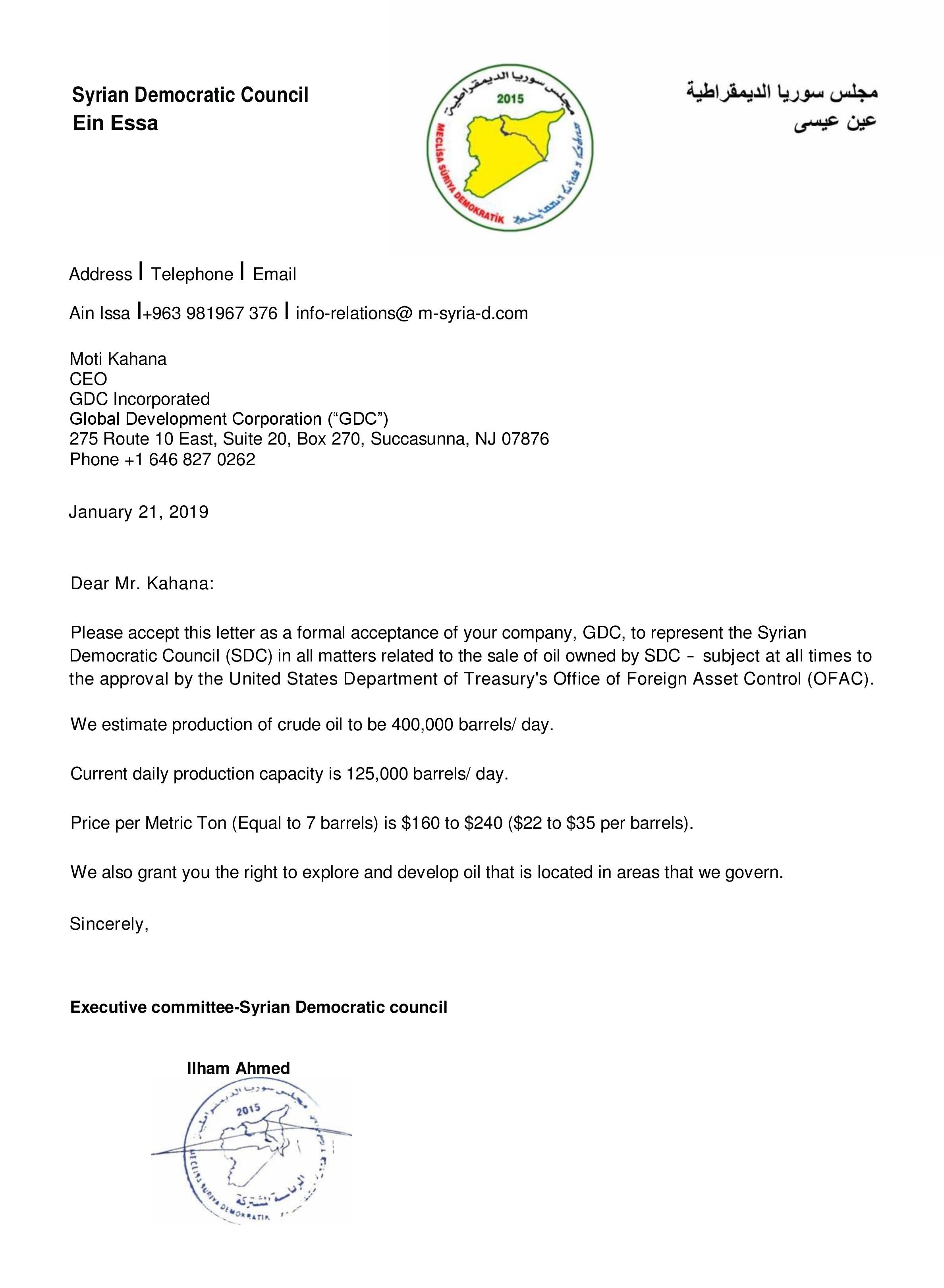
Earlier this year, well before Trump’s new Syria policy of “keeping the oil” had officially taken shape, another individual with deep ties to the U.S. Israel lobby secured a lucrative agreement with U.S.-backed Kurdish groups in Syria. An official document issued earlier this year by the Syrian Democratic Council (SDC), the political arm of the Kurdish majority and U.S.-backed Syrian Democratic Forces (SDF), a New Jersey-based company, founded and run by U.S.-Israeli dual citizen Mordechai “Motti” Kahana, was given control of the oil in territory held by the SDC.
Per the document, the SDC formally accepted the offer from Kahana’s company — Global Development Corporation (GDC) — to represent SDC in all matters pertaining to the sale of oil extracted in territory it controls and also grants GDC “the right to explore and develop oil that is located in areas we govern.”
Global Development Corporation Kurdish Oil
The SDC’s formal acceptance of Global Development Corporation’s offer to develop Syrian oil fields. Source | Al-Akhbar
The document also states that the amount of oil then being produced in SDC-controlled areas was 125,000 barrels per day and that they anticipated that this would increase to 400,000 barrels per day and that this oil is considered a foreign asset under the control of the United States by the U.S. Department of the Treasury.
After the document was made public by the Lebanese outlet Al-Akhbar, the SDC claimed that it was a forgery, even though Kahana had separately confirmed its contents and shared the letter itself to the Los Angeles Times as recently as a few weeks ago. Kahana previously attempted to distance himself from the effort and told the Israeli newspaper Israel Hayom in July that he had made the offer to the SDC as means to prevent the “Assad regime” of Syria from obtaining revenue from the sale of Syrian oil.
The Kurds currently hold 11 oil wells in an area controlled by the [Syrian] Democratic Forces. The overwhelming majority of Syrian oil is in that area. I don’t want this oil reaching Iran, or the Assad regime.”
At the time, Kahana also stated that “the moment the Trump administration gives its approval, we can begin to export this oil at fair prices.”
Given that Kahana has openly confirmed that he is representing the SDC’s oil business shortly after Trump’s adoption of the controversial “keep the oil policy,” it seems plausible that Kahana has now received the approval needed for his company to export the oil on behalf of the SDC. Several media reports have speculated that, if Kahana’s efforts go forward unimpeded, the Syrian oil will be sold to Israel.
However, considering Turkey’s aversion to engaging in any activities that may benefit the PKK-SDF – there are considerable obstacles to Kahana’s plans. While the SDF — along with assistance from U.S. troops — still controls several oil fields in Syria, experts assert that they can only realistically sell the oil to the Syrian government. Not even the Iraqi Kurds are a candidate, considering Baghdad’s firm control over the Iraq-Syria border and the KRG’s weakened state after its failed independence bid in late 2017.
Regardless, Kahana’s involvement in this affair is significant for a few reasons. First, Kahana has been a key player in the promotion and funding of radical groups in Syria and has even been caught hiring so-called “rebels” to kidnap Syrian Jews and take them to Israel against their will. It was Kahana, for instance, who financed and orchestrated the now infamous trip of the late Senator John McCain to Syria, where he met with Syrian “rebels” including Khalid al-Hamad – a “moderate” rebel who gained notoriety after a video of him eating the heart of a Syrian Army soldier went viral online. McCain had also admitted meeting with ISIS members, though it is unclear if he did so on this trip or another trip to Syria.
In addition, Kahana was also the mastermind behind the “Caesar” controversy, whereby a Syrian using the pseudonym “Caesar” was brought to the U.S. by Kahana and went on to make claims regarding torture and other crimes allegedly committed by the Assad-led government Syria, claims which were later discredited by independent analysts. He was also very involvedin Israel’s failed efforts to establish a “safe zone” in Southern Syria as a means of covertly expanding Israel’s territory from the occupied Golan Heights and into Quneitra.
Notably, Kahana has deep ties — not just to efforts to overthrow the Syrian government — but also to U.S. Israel lobby, including the Washington Institute for Near East Policy (WINEP) where Satterfield is as an expert. For instance, Kahana was a key player in a 2013 symposiumorganized by WINEP along with Syrian opposition groups intimately involved in the arming of so-called “rebels.” One of the other participants in the symposium alongside Kahana was Mouaz Moustafa, director of the “Syrian Emergency Task Force” who assisted Kahana in bringing McCain to Syria in 2013. Moustafa was listed as a WINEP expert on the organization’s website but was later mysteriously deleted.
Kahana is also intimately involved with the Israeli American Council (IAC), a pro-Israel lobby organization, as a team member of its national conference. IAC was co-founded and is chaired by Adam Milstein, a multimillionaire and convicted felon who is also on the boards of AIPAC, StandWithUs, Birthright and other prominent pro-Israel lobby organizations. One of IAC’s top donors is Sheldon Adelson, who is also the top donor to President Trump as well as the entire Republican Party.
Though the machinations of both Kahana and Satterfield to guide U.S. policy in order to manipulate the flow of Syria’s hydrocarbons for Israel’s benefit may seem shocking to some, this same tactic of pro-Israel lobbyists using the Kurds to illegally sell a country’s oil to Israel was developed a few years prior, not in Syria, but Iraq. Notably, the individuals responsible for that policy in Iraq shared connections to several of the same pro-Israel lobby organizations as both Satterfield and Kahana, suggesting that their recent efforts in Syria are not an isolated event, but a pattern.
War against ISIS is a war for oil
In an email dated June 15, 2014, James Franklin Jeffrey (former Ambassador to Iraq and Turkey and current U.S. Special Representative for Syria) revealed to Stephen Hadley, a former George Bush administration advisor then working at the government-funded United States Institute of Peace, his intent to advise the KRG in order to sustain Kirkuk’s oil production. The plan, as Jeffery described it, was to supply both the Kurdistan province with oil and allow the export of oil via Kirkuk-Ceyhan to Israel, robbing Iraq of its oil and strengthening the country’s Kurdish region along with its regional government’s bid for autonomy.
Jeffrey, whose hawkish views on Iran and Syria are well-known, mentioned that Brett McGurk, the U.S.’ main negotiator between Baghdad and the KRG, was acting as his liaison with the KRG. McGurk, who had served in various capacities in Iraq under both Bush and Obama, was then also serving Deputy Assistant Secretary of State for Iraq and Iran. A year later, he would be made the special presidential envoy for the U.S.-led “anti-ISIS” coalition and, as previously mentioned, worked closely with David Satterfield.
Jeffrey was then a private citizen not currently employed by the government and was used as a non-governmental channel in the pursuit of the plans described in the leaked emails published by WikiLeaks. Jeffrey’s behind-the-scenes activities with regards to the KRG’s oil exports were done clandestinely, largely because he was then employed by a prominent arm of the U.S.’ pro-Israel lobby.
At the time of the email, Jeffrey was serving as a distinguished fellow (2013-2018) at WINEP. As previously mentioned, WINEP is a pro-Israel foreign policy think-tank that espouses neoconservative views and was created in 1985 by researchers that had hastily left AIPAC to escape investigations against the organization that were related to some of its members conducting espionage on behalf of Israel. AIPAC, the American Israeli Public Affairs Committee, is the largest registered Israel lobbyist organization in the US (albeit registration under the Foreign Agents Registration Act would be more suitable), and, in addition to the 1985 incident that led to WINEP’s creation, has had members indicted for espionage against the U.S. on Israel’s behalf.
WINEP’s launch was funded by former President of the Jewish Federation of Los Angeles,  Barbara Weinberg, who is its founding president and constant Chairman Emerita. Nicknamed ‘Barbi’, she is the wife of the late Lawrence Weinberg who was President of AIPAC from 1976-81 and who JJ Goldberg, author of the 1997 book Jewish Power, referred to as one of a select few individuals who essentially dominated AIPAC regardless of its elected leadership. Co-founder alongside Weinberg was Martin Indyk. Indyk, U.S. Ambassador to Israel (1995-97) and Assistant Secretary of State for Near Eastern Affairs (1997-99), led the AIPAC research time that formed WINEP to escape the aforementioned investigations.
WINEP has historically received funding from donors who donate to causes of special interest for Zionism and Israel. Among its trustees are extremely prominent names in political Zionism and funders of other Israel Lobby organizations, such as Charles and Edgar Bronfman and the ChernicksIts membership remains dominated by individuals who have spent their careers promoting Israeli interests in the U.S.
WINEP has become more well-known, and arguably more controversial, in recent years after its research director famously called for false-flag attacks to trigger a U.S. war with Iran in 2012, statements well-aligned with longstanding attempts by the Israel Lobby to bring about such a war.
A worthy partner in crime
Stephen Hadley, another private citizen who Jeffrey evidently considered as a partner in his covert dealings discussed in the emails, also has his own past of involvement with Israel-specific intrigues and meddling.
During the G.W. Bush administration, Hadley tagged along with neoconservatives in their numerous creations of fake intelligence and efforts to incriminate Iraq for possessing chemical and nuclear weapons. Hadley was one of the promoters from within the U.S. government of the false claim that 9/11 hijacker Mohammed Atta met with Iraqi officials in Prague.
Hadley also worked with then-Chief of Staff to the Vice President, Lewis Libby — a neoconservative and former lawyer for the Mossad-agent and billionaire Marc Rich — to discredit a CIA investigation into claims of Iraq purchasing yellowcake uranium from Niger. That claim famously appeared in Bush’s State of the Union address in 2002.
What this particular claim had in common with the ‘Iraq meets Atta in Prague’ disinformation, and other famous lies against Iraq fabricated and circulated by the dense neocon network, was its source: Israel and pro-Israel partisans.
The distribution network of these now long-debunked claims was none other than the neoconservatives who act a veritable Israeli fifth column that has long sought to promote Israeli foreign policy objectives as being in the interest of the United States. In this, Hadley played his part by helping to ensure that the United States was railroaded into a war that had long been promoted by both Israeli and American neoconservatives, particularly Richard Perle — an advisor to WINEP — who had been promoting regime change in Iraq for Israel’s explicit benefit for decades.
In short, for covert intrigues to serve Israel that would likely be met with protest if pitched to the government for implementation as policy, Hadley’s resume was impressive.
Israeli interests pursued through covert channels
Given his employment at WINEP during this time, Jeffrey’s intent to advise the KRG to sustain Kirkuk’s oil production despite the seizure of the Baiji oil refinery by ISIS is somewhat suspect, especially since it required that 100,000 barrels per day pass through ISIS-controlled territory unimpeded.
Jeffrey’s email from June 14, therefore, demonstrated that he had foreknowledge that ISIS would not disturb the KRG as long as the Kurds redirected oil that was intended originally for Baiji to the Kirkuk-Ceyhan export pipeline, facilitating its export and later sale to Israel.
Notably, up until its liberation in mid-2015 by the Iraqi government and aligned Shia paramilitaries, ISIS kept the refinery running and, only upon their retreat, destroyed the facility.
In July 2014, the KRG began confidently supplying Kurdish areas with Kirkuk’s oil per the plan laid out by Jeffrey in the aforementioned email. Baghdad soon became aware of the arrangement and lashed out at Israel and Turkey, whose banks were used by the KRG to receive the oil revenue from Israel.
One would normally expect ISIS to be opposed to such collusion given that the KRG, while a beneficiary of the ISIS-Baghdad conflict, was not an ally of ISIS. Thus, a foreign power with strategic ties to ISIS used its close ties to the KRG and assurances that it was on-board for the oil trade, to deliver a credible guarantee that ISIS would ‘cooperate’ and that a boom in production and exports was in the cards.
This foreign power — acting as a guarantor for the ISIS-KRG understanding vis-a-vis the illegal oil economy, represented by Jeffrey and clearly not on good terms with Iraq’s government — was quite clearly Israel.
Israel established considerable financial support as well as the provision of armaments to other extremist terrorist groups active near the border between the Israeli-occupied Golan Heights and Southern Syria when war first broke out in Syria in 2011. At least four of these extremist groups were led by individuals with direct ties to Israeli intelligence. These same groups, sometimes promoted as ‘moderates’ by some media, were actively fighting Syria’s government – an enemy of Israel and ally of Iran – before ISIS existed and eagerly partnered with ISIS when it expanded its campaign into Syria.
Furthermore, Israeli officials have publicly admitted maintaining regular communication with ISIS cells in Southern Syria and have publicly expressed their desire that ISIS not be defeated in the country. In Libya, Israeli Mossad operatives have been found embedded within ISIS, suggesting that Israel has covert but definite ties with the group outside of Syria as well.
Israel has also long promoted the independence of Iraqi Kurdistan, with Israel having provided Iraq’s Kurds with weapons, training and teams of Mossad advisers as far back as the 1960s. More recently, Israel was the only state to support the KRG independence referendum in September 2017 despite its futility, hinting at the regard Israel holds for the KRG. Iraq’s government subsequently militarily defeated the KRG’s push for statehood and reclaimed Kirkuk’s oil fields with assistance from the Shia paramilitaries which were responsible for defeating ISIS in the area.
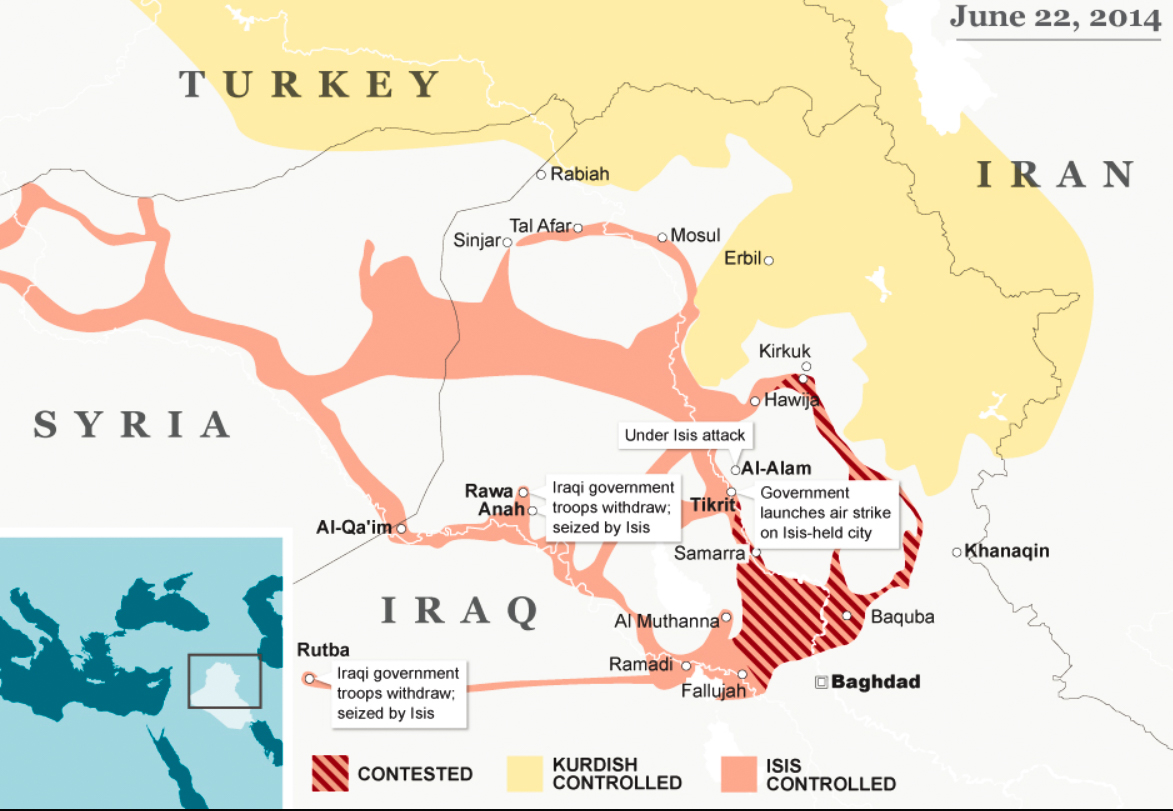
Iraq ISIS control map
A 2014 map shows the areas under ISIS and Kurdish control at the time. Source | Telegraph
This arrangement orchestrated by Jeffrey, served the long-time neoconservative-Israeli agenda of empowering the Kurds, selling Iraqi oil to Israel and weakening Iraq’s Baghdad-based government.
WINEP’s close association with AIPAC, which has spied on the U.S. on behalf of Israel several times in the past with no consequence, combined with Jeffrey’s long-time acquaintance with key U.S. figures in Iraq, such as McGurk, provided an ideal opening for Israel in Iraq. Following the implementation of Jeffrey’s plan, Israeli imports of KRG oil constituted 77 percent of Israel’s total oil imports during the KRG’s occupation of Kirkuk.
The WINEP connection to the KRG-Israel oil deal demonstrates the key role played by the U.S. pro-Israel Lobby, not only in terms of sustaining U.S. financial aid to Israel and ratcheting up tensions with Israel’s adversaries but also in facilitating the more covert aspects of U.S.-Israeli cooperation and the implementation of policies that favor Israel.
Yet the role played by the U.S. Israel lobby in this capacity, particularly in terms of orchestrating oil sale agreements for Israel’s benefit, is hardly exclusive to Iraq and can accurately be described as a repeated pattern of behavior.