Showing posts with label Angela Merkel. Show all posts

Saturday, September 28, 2019

European states have bowed to US pressure on Iran

Marco Carnelos
A recent communique from France, Germany and the UK blames Tehran for escalating tensions in the region, instead of the real culprit: Washington


German Chancellor Angela Merkel meets Iranian President Hassan Rouhani on the sidelines of the UN General Assembly in New York on 24 September (Handout/Iranian Presidency/AFP)
If an unaware observer had to get an idea of the enduring dispute between Iran and the international community by reading the joint communique that France, Germany and the UK issued on 23 September, she would have easily drawn several conclusions. 
These would include that Iran some time ago signed an international agreement to limit its nuclear programme; that the deal was unanimously ratified by the UN Security Council; that Iran subsequently began to violate it; and that instead of reconsidering its position, Iran made further provocations by attacking Saudi Arabia’s oil facilities on 14 September, sowing panic in the region and turmoil in the international energy markets.

Mistaken assumptions

Although always sceptical about a positive European role on the matter, I recently argued about its potential added value in decreasing tensions, which could come not from an alignment with the US, but only by providing a balancing role among all players. 
Scepticism proved justified. Despite recent appreciable efforts to restart dialogue, in particular by French President Emmanuel Macron, this joint declaration has everything but a balancing role. It is worth examining it word by word, to highlight some mistaken assumptions that we could have expected from the US, but not from top European players.
Dealing with the dire situation in the region only through the prism of stability ... risks sending a message that could be fatally misunderstood
The communique notes: “We, the leaders of France, Germany and the United Kingdom, recall our shared common security interests, in particular upholding the global non-proliferation regime and preserving stability in the Middle East.”
Understandable. Yet, drafted in such a way and in the current political context, this sentence gives the impression that those interests are primarily linked to the maintenance of the non-proliferation regime in the region and to the preservation of stability. 
Of course, counterproliferation is crucial, especially in volatile area such as the Middle East; yet, such a commitment would sound more credible if it addressed all countries in the region, including those that already possess nuclear weapons and have thus far refused to sign the 1968 Treaty on the Non-Proliferation of Nuclear Weapons. 

Moral zeal

Moreover, no explanation is offered for what the term “stability” should mean in the current circumstances. Are these three countries arguing that those who already possess nuclear weapons in the region are entitled to keep them, while other countries are not? If so, it would be better to have the courage to claim this openly and clearly. 
Furthermore, dealing with the dire situation in the region only through the prism of stability - rather than the promotion of peace and justice - risks sending a message that could be largely, and fatally, misunderstood.
The communique goes on to note: “We condemn in the strongest terms the attacks on oil facilities on Saudi territory … and reaffirm … our full solidarity with the Kingdom of Saudi Arabia.”
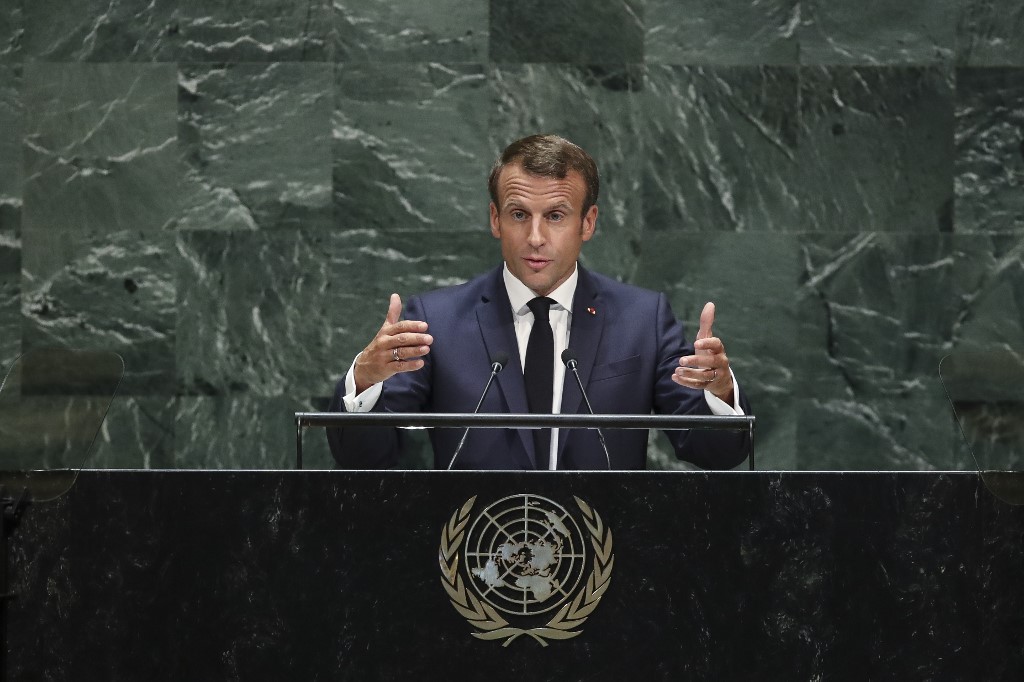
French President Emmanuel Macron addresses the UN on 24 September in New York (AFP)
Given that such attacks fortunately did not cause any human loss, this moral zeal could have been far more credible had it been manifested in an equally solemn way with regards to the many civilian casualties of the ongoing conflict in Yemen. 
“It is clear to us that Iran bears responsibility for this attack,” the statement adds. “There is no other plausible explanation.” 
Regrettably, this claim is apparently based only on reasoning, rather than strong evidence provided by reliable intelligence. Taking a sharp political position on this basis could be risky. Given recent unfortunate precedents in the region, more evidence and less assumption would have been desirable.
The Houthis have claimed responsibility for the attacks, and nothing conclusive has been presented to disprove their assertion.

Economic blockade

“These attacks may have been against Saudi Arabia but they concern all countries and increase the risk of a major conflict,” the communique states.
True. Still, the public also deserves an explanation as to why an attack on Saudi Arabia would have such dire consequences, while the ongoing attacks in Yemen, or in Syria, do not provoke the same apprehension.
This is undeniable, but to achieve a successful de-escalation in the Middle East, it is necessary to be aware of the causes of the escalation. The problems did not begin with the attacks on the Saudi oil facilities or on the tankers in the Gulf earlier this year, but with the US withdrawal from the Iran nuclear deal in May 2018 - which also violated UN Security Council Resolution 2231 - and its harsh sanctions against Iran, which amount to an economic blockade. This is an act of war, according to international law.It goes on to note: “The attacks also highlight the necessity of de-escalation in the region through sustained diplomatic efforts and engagement with all parties.”
A correct connection between causes and effects of events is crucial to deal effectively with them.

The need for balance

“We urge Iran once again to reverse its decisions to reduce compliance with the deal and to adhere fully to its commitments under it,” the communique states.
It would have been much better if this exhortation had been preceded by a similar request to the US to reverse its 2018 withdrawal from the deal. While this probably would have gone nowhere, at least it would have shown a more balanced approach, a crucial prerequisite (except for the Western world, apparently) for anybody legitimately aspiring to a mediating role.
It would be easy to expect this from UK Prime Minister Boris Johnson, but far less so from Macron and German Chancellor Angela Merkel
The joint statement also contains a bit of humour - although it’s doubtful it would be perceived as such in Tehran - when it notes that the three countries “reiterate our conviction that the time has come for Iran to accept negotiation on a long-term framework for its nuclear programme”.
For the unaware observer evoked at the beginning, Iran accepted such a negotiation years ago, reaching a positive conclusion with the 2015 nuclear deal - an agreement with which, until earlier this year, Iran had fully complied, according to the International Atomic Energy Agency.
The 23 September joint statement confirmed my original suspicion: that the UK, France and Germany have finally bowed to the US position. It would be easy to expect this from UK Prime Minister Boris Johnson, but far less so from Macron and German Chancellor Angela Merkel.
Marco Carnelos
Marco Carnelos is a former Italian diplomat. He has been assigned to Somalia, Australia and the United Nations. He has served in the foreign policy staff of three Italian prime ministers between 1995 and 2011. More recently he has been Middle East Peace Process Coordinator Special Envoy for Syria for the Italian government and, until November 2017, ambassador of Italy to Iraq.

Tuesday, September 24, 2019

Iran to Propose ‘Coalition of Hope’ in Persian Gulf

TEHRAN -- President Hassan Rouhani headed for New York on Monday to attend the UN General Assembly on a mission to win support for Iran against "cruel" pressure from the United States.

Before departing, Rouhani said his delegation was heading to the UN gathering despite Washington's reluctance to issue them U.S. visas.
Tehran and Washington have been at loggerheads since May last year when President Donald Trump abandoned a 2015 nuclear deal and subsequently began reimposing sanctions on Iran in a stated campaign of "maximum pressure".
"It is essential for us to take part in the UN General Assembly and talk at various levels," Rouhani said at Tehran's Mehrabad airport.
"The cruel actions that have been taken against the Iranian nation and also the difficult and complicated issues that our region faces with them need to be explained."
Rouhani also said Iran would put forward a Persian Gulf peace plan at the UN meeting.
Under the plan dubbed the Hormuz Peace Endeavour, or HOPE, he said, "all the coastal states of the Persian Gulf are invited to join this coalition to provide and maintain regional security".
The peace initiative, he said, is aimed at establishing long-term peace in the Persian Gulf, something he said is simply not achievable as long as outsiders are present.
"Of course, the plan that will be laid out at the United Nations won't be just about security, but rather economy and other issues, all in line with security matters."
The HOPE initiative comes against the backdrop of tensions in the Persian Gulf, where several tankers and commercial vessels have come under suspicious attacks by unknown parties while attempting to cross the strategic Strait of Hormuz.
The United States has blamed the sabotage attacks on Iran, using them as a pretext to build a coalition that would patrol the region.
The U.S. is trying to project the mission as a bid to secure the Persian Gulf, but "the Europeans argue that Washington created the problem in the first place by trying to kill off Iran’s oil exports", the New York Times wrote last month.
Iran has dismissed the allegations and called the attacks false flag operations, warning regional neighbors to watch out for plots by outsiders to destabilize the region.
Rouhani echoed that stance on Monday, saying any solution to calm tensions must come from within the region and what he called a "coalition of hope."
"We believe the solution for the region comes from inside the region and those who come from the outside can never bring peace and security," he said.
Citing America's military interventions in the Middle East as an example, Rouhani said since entering the region in 2001, the United States has failed to bring back calm to any of the countries that it has deployed forces to.
"I hope we can roll out this plan and tell the world that Iran is looking for lasting peace in the region and is willing to" discuss it with other countries with the UN involved in the process, he said of his HOPE initiative.
Rouhani also pointed to the September 14 attack on Saudi Arabia's oil facilities by Yemen's Houthi Ansarullah movement and the biased reactions that it received from Riyadh's close allies, specially the United States.
The damage from the retaliatory Yemeni attack was so vast that the kingdom lost more than half of its oil output overnight, causing global oil prices to jump.
American officials, along with their Saudi allies, have since pointed the finger at Iran without any evidence even though the Houthis have on several occasions claimed responsibility for the attack, saying it is only one of their many such strikes in retaliation for the Saudi-led war.
"The Aramco (attack) is the outcome of the aggression that Saudi Arabia, the United Arab Emirates and the Zionist regime have been leading against Yemen," Rouhani said.
"If they (the Saudis) don't initiate aggression, they (the Yemenis) won't hit back and when they do and see the response, it is hard for them to swallow" the retaliation, the Iranian president continued. "Their cruelty is justified in their own eyes."
Rouhani said this year's General Assembly was significant as it came at a time when the U.S. has hit the rock bottom against Iran after the failure of its so-called "maximum pressure" campaign of sanctions.
"We are headed to the UN while the Americans have pushed their sanctions campaign so far that they admit there is nothing left for them to sanction," the president said, noting that the failures had put Washington in a state of "absolute desperation" against Iran.
Rouhani flew to New York on Monday morning. He will deliver a speech at the 74th UN General Assembly later on Wednesday and meet with a host of foreign leaders and Iranians living in the U.S. before heading back on Thursday evening.

Thursday, August 01, 2019

Europe must feel threatened!

By Hanif Ghaffari 

U.S. President Donald Trump and  The U.S.National Security Adviser John Bolton continue to think about the breakup of the European Union and the collapse of the eurozone. Yet politicians like German Chancellor Angela Merkel and French President Emmanuel Macron still think they can get into a political and economic equation with the US president! This dangerous and inaccurate look has caused European authorities to become more and more vulnerable to harm! Many analysts of international affairs have recently had a special focus on US-EU relations.
Some signals and speeches by the President of the United States which are addressed to the European authorities indicate the full opposition of the White House to the European Union.
EU officials are well aware that during the recent European parliamentary elections, Donald Trump and his allies were the main supporters of nationalist and extremist parties in Europe. This has led to victory in some European countries such as Hungary, France, and Britain, nationalist and anti-immigration parties. The main question is how long will the European authorities' reconciliation with the Trump administration continue ?!
What is certain is that the EU is completing its own process of collapse and destruction on its own! the European officials haven’t yet understood the extent of Trump’s hostility to the existence of the United European. This is while the trade war between Trump and the European Union has entered a new phase since the beginning of 2018. Some American economic analysts believe that based on his protectionist policies, Trump will impose new and wider tariffs on the EU, China, Canada, and Mexico in the future. European officials are now faced with a president who sees "economic protectionism" as a major policy in the field of commerce, and in the future, he will try to pursue this policy even more seriously.
Undoubtedly, there will soon be more economic disputes between America and Europe. In other words, the Trade war between these two will become more intense in near future. Furthermore, countries like China and Canada will also enter this confrontation with the United States. Europe does not have much opportunity to prevent its economic and political destruction by the White House! Aren't the European authorities awake ?!

Friday, July 12, 2019

Imperial collaboration: UK, France will send forces to Syria and U.S. will bear the cost

Along with other allies, the UK and France will send forces to Syria, and the U.S. will bear the cost, says a new report in Foreign Policy.
The U.S. president Donald Trump promised to outsource fighting to allies and pay them to do it.
According to the Foreign Policy report, the UK and France are willing to heed calls from the U.S. to its allies to pick up the burden of Syria-interference.
Both the countries have a limited number of special forces in Syria.
Both the countries will commit to a troop increase of between 10 and 15 percent to allow the US to withdraw.
Between 1,000 and 2,000 U.S. troops are now stationed in northeastern Syria. The U.S. troops are supporting anti-government Kurdish fighters.
However, the U.S. plans to wind down its presence in Syria.
Germany has already rebuffed U.S. request for ground troops on Monday, citing “well known” German policy.
According to the report, The German military currently provides reconnaissance jets, a refueling aircraft, and other noncombat military assistance to the fight against the Islamic State, according to German media.
Citing confirmation by U.S. officials, the exclusive Foreign Policy report – “Britain, France Agree to Send Additional Troops to Syria” – said: Britain and France will commit to a marginal 10 to 15 percent troop increase. Other countries may send small numbers of troops as well, but in exchange, the U.S. would have to pay.
The report by Lara Seligman, staff writer at Foreign Policy, cited the U.S. official: Neither the timeframe for the deployment nor the exact number of additional troops is clear. “Overall we have been disappointed” in efforts to persuade U.S. allies to commit additional resources to the ongoing fight against the Islamic State terrorist group in Syria.
Citing another source close to related discussions with the U.S. allies, the report said:
“Italy is close to a decision on whether or not to send additional forces, and a number of Balkan and Baltic states are ‘almost certain to send handfuls of soldiers each’.
The July 9, 2019 datelined report said:
“While it is a success for the administration, the marginal increase of U.K. and French troops likely won’t completely fill the gap left when U.S. forces leave. The U.S. footprint in Syria is expected to drop from an estimated 2,000 troops to just 400; the exact number of British and French forces in the country is unknown, but the second source estimated each country currently has just 200 to 300 troops there.”
The move was seen as a return to the non-interventionist platform he touted during his election campaign, when he mused, “Why aren’t we letting ISIS go and fight Assad and then we pick up the remnants?”
The withdrawal idea was met with howls of protest from Washington hawks, and spurred then-Defense Secretary Jim Mattis to resign.
National Security Advisor John Bolton, an advocate of regime change in Syria, came out to reassure the war-hungry U.S. interests that the U.S forces would remain in Syria until the last micro-pockets of ISIS (Islamic State) were defeated and Iranian influence in Syria, a pair of conditions that could take months, or even years to meet.
Days later, Mike Pompeo, the U.S. Secretary of State, embarked on a tour of the Middle East to reassure allies that the U.S. had not, lost its mission for destruction, and would take military action in Syria again if necessary. “When America retreats, chaos follows. America will not retreat until the terror fight is over.”
Swapping the U.S. troops for other countries allows Trump to placate the Boltons and Pompeos in his cabinet, and pro-intervention lawmakers from both parties in Congress. At the same time it lets Trump turn to his base and say, “see, I brought our boys home”, just months before his re-election campaign begins in earnest.
A new report by the Institute for the Study of War said:
“The U.S. is repeating a critical mistake by deprioritizing this effort at a pivotal moment when our gains are at their most fragile. The U.S. must take immediate steps to dampen ISIS’s resurgence in Iraq and Syria, including halting and reversing America’s ongoing withdrawal from Syria.”
The U.K. and France operate covertly in Syria with their special forces in the country. So it is unlikely any increase will be publicly announced.
Alongside the United States, the U.K. and France took part in a series of air -and ship-based missile strikes against the Syrian regime in 2018 in response to the Douma chemical attack.
The Foreign Policy report said:
“The British Embassy did not return a request for comment. A spokesperson for the French Embassy said, ‘Officially France has no troop on the ground in Syria’, declining to comment further.
“But in a rare public acknowledgement, James Jeffrey, the top U.S. envoy to Syria and the counter-Islamic State coalition, recently signaled that the administration has made progress getting coalition forces to contribute additional troops.”
Britain and France have also expressed interest in contributing to Sentinel, a maritime partnership designed to enhance security for commercial ships traversing the Strait of Hormuz and other choke points, the U.S. administration official said. The State and Defense departments developed Sentinel as a response to increased Iranian aggression against oil tankers in the world’s busiest shipping lanes.”
It said:
“Most importantly, the U.S. administration is trying to convince the U.K., France, and other allies to contribute money for the Syria stabilization effort, the official said, pointing to ‘dire’ conditions at the Rukban refugee camp, where the United Nations says about 45,000 people, mostly women and children, are trapped.”
Germany rebuffs U.S.
An earlier report said:
Germany has turned down a request from the U.S. to deploy ground forces in Syria describing the proposal as inconsistent with Berlin’s “well known” policy.
James Jeffrey, U.S. Special Representative for Syria Engagement, confirmed on Sunday that he had asked the German government to provide troops to replace a portion of US forces currently stationed in Syria.
He said the request was part of U.S. preparations for an eventual U.S. military withdrawal Syria.
“When I say the government envisages to the current measures in the anti-Islamic State (military) coalition, this includes no ground troops, as is well known”, German government spokesman Steffen Seibert said during a news conference on Monday.
The response should not come as a shock to the U.S.
Germany has generally been wary of a direct military intervention in Syria.
In May of last year, Angela Merkel, the German Chancellor, assured the public that the Bundeswehr “will not participate in possible military actions.”
In an interview, Jeffrey told Defense One that he expects a “breakthrough” agreement in the coming weeks, which would include coalition forces replacing US troops as they withdraw from Syria.
Filling in for US troops in Syria will come with certain moral and legal hazards.
The U.S. forces have been operating in Syria without the consent of Damascus or UN authorization, what is tantamount to an illegal occupation.
Syria insists that the Western military presence in Syria is illegitimate, pledging to liberate “every inch” of the country from uninvited foreign troops.

Tuesday, June 11, 2019

Germany must respond to its approach

By Hanif Ghaffari

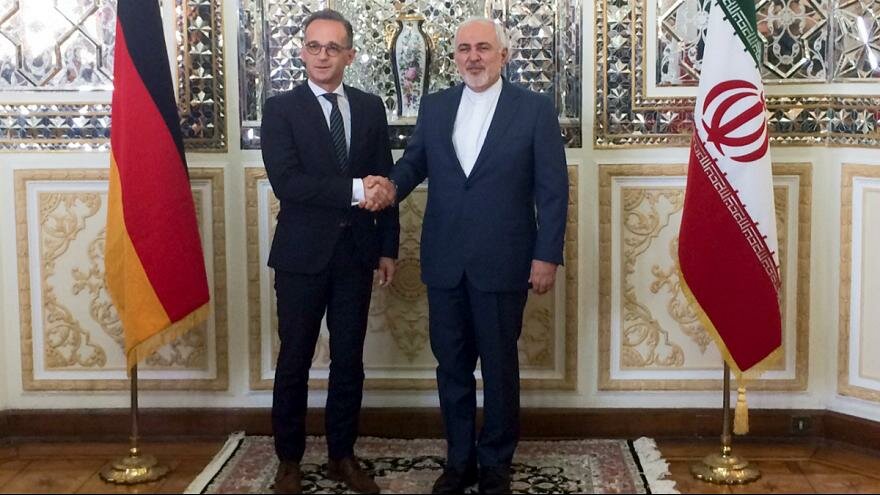
TEHRAN - A recent German Foreign Minister's recent visit to Iran can be analyzed from a variety of dimensions. Undoubtedly, Berlin as one of the three European countries signing the 2015 nuclear deal with Iran is accused of being passive to the United States and even accepting the unacceptable demands of the government of Donald Trump in Washington.
Undoubtedly, under such circumstances, Germany cannot play the role of an independent actor in the world of diplomacy! Unfortunately, Germany, along with Britain and France, held talks with the Tramp government in 2017 on a nuclear ambitions deal with Iran. Berlin has agreed to change the nuclear deal with Iran! The point is that German Chancellor Angela Merkel, like Donald Trump, is an unreliable politician.
German Foreign Minister Heiko Maasis now trying to play a mediating role for Iran and the United States! This is while Berlin must only respond to the non-compliant behavior of itself and of Europe in relation to a nuclear deal with Iran.
Over the last year, the European troika has not only done anything to revive the nuclear deal or bring any kind of benefit to the Iranian nation, but they have actually backed up U.S. by developing new plans to undermine Iran’s “missile work”, and diminish its “power in the region” as well as its “nuclear technology”.  
As stated in clauses 26 and 36 of Joint Comprehensive Plan of Action (JCPOA), if the other side fails to meet its obligations, Iran is entitled to partially or completely end its commitments as well. So, Iran’s recent decision could be analyzed both on legal and strategic terms. 
However, it seems that the strategic aspects of Iran’s decision are even more important than its legal aspects. This decision is strategically important because it stops Washington and European troika to carry out their anti-Iran scheme, a dangerous scheme that they actually started devising when Trump took the office in 2017. 
 Undoubtedly, the three countries of Germany, Britain, and France must respond to their unacceptable behavior towards Iran and their unwillingness to agree to a nuclear deal. Meanwhile, Berlin has to make a choice between "Independence in the world of diplomacy" and "affiliation with the Trump government"!

Sunday, March 17, 2019

Why calling the US a "democracy" is both false and dangerous to do

By Eric Zuesse
The US is not a democracy. It has never been, indeed. It is the biggest enemy of democracy the world has ever seen. American writer and investigative historian, Eric Zuesse, has authored an article on the issue, titled, "Why Calling the US a Democracy Is Both False and Dangerous to Do".
It’s false because it is definitely untrue, and that’s not merely because America has a higher percentage of its residents in prison than does any other nation on this planet, but also because the only scientific studies that have been done of the matter show — they prove scientifically — that the US is a dictatorship by its very wealthiest residents, against all the rest of the population. Traditionally, that’s called an “aristocracy,” not a democracy, but ever since Mussolini in the 1920s, it came to be called “fascism,” which is the successor to “feudalism” and thus is merely the modernized form of feudalism.
What used to be called by such terms as “monarchy” or “aristocracy” is thus now called “fascism” but the leopard is the same regardless of what it is labeled, and what it really is a dictatorship. Mussolini sometimes instead called fascism “corporationism” and it certainly is today’s United States Government, even if some people choose to call it ‘democracy’. It’s what the US Government has been scientifically proven to be: dictatorship, by the richest few (the controlling owners of the international corporations), against the entire public. But even worse than being only false, calling the US a ‘democracy’ is also itself extremely dangerous to the entire world, and here is why:
Every time that the US perpetrates a coup (such as it’s trying now to do against Venezuela) or a military invasion (such as it did to Iraq 2003 and Libya 2011 and Syria 2012- and to Yemen 2015-, and many others) the US regime and its propagandists call it an action ‘for humanitarian purposes’, and for regime-change ‘to bring democracy and human rights’ to that country, and it’s always lies, which wouldn’t even be believed by anyone who knows that the US itself is actually a dictatorship, which it is. So, the lie of calling the US a ‘democracy’ is actually okaying a lying dictatorship by using, for it, the term “democracy,” which this particular dictatorship chooses to refer to itself, for PR purposes.
Calling the US a ‘democracy’ is to support this government that the entire world recognizes to be the most aggressive and dangerous regime on Earth. To smear the good name of “democracy” that way, by calling the world’s most rapacious Government a ‘democracy’, is to assist in corroding that high term of praise, “democracy,” and turning it instead into an insult, which applies to what is actually the globally recognized most aggressive and dangerous nation on this planet.
The United States of America used to be a limited democracy, but now it’s no longer even that, and to call it a ‘democracy’ at all is not only false, but it encourages the world’s most dangerous and harmful regime and sets it as a model for other nations. To encourage evil by lying to say it’s not that but is instead good, is itself evil, or else rabidly ignorant and deceived; but, in any case, it is a very wrong thing to do. On March 7th the liberal US billionaire who owns Bloomberg News was so much opposed to the over-the-top, far too overtly fascist, billionaires who now control the country, so that Bloomberg News headlined “Pence Asked Merkel to Provoke Russia by Sending Warships to Crimea”, and their reporters opened:
The US leaned on German Chancellor Angela Merkel last month to conduct a naval maneuver in Russia’s backyard aimed at provoking President Vladimir Putin, according to three people familiar with the talks. At a Feb. 16 meeting at the Munich Security Conference, US Vice President Mike Pence urged Merkel to send German warships through a narrow channel between the Crimean Peninsula and mainland Russia to show Putin that Western powers won’t surrender their access to those waters, according to the officials, who spoke on condition of anonymity. The German leader refused, they said.
On March 8th, RT headlined "Caving in to the US? Brussels kills its own money laundering ‘blacklist’ after Washington criticism" and reported that the US regime objected to the EU’s European Commission including in its proposed list of 11 additional money-laundering centers four US territories, after which “the Council of the European Union, which consists of the ministers representing all 28 EU members, justified its decision to reject the document with the arguments that seemed strikingly similar to those employed by the US Treasury.”
Page 11 of the European Commission’s 36-page detailed explanation of its proposed list said: “Based on the review of additional information sources, the Commission's analysis has concluded that 11 additional jurisdictions present strategic deficiencies for the purposes of Article 9 of Directive (EU) 2015/849. Those jurisdictions are the following: Afghanistan, American Samoa, Guam, Iraq, Libya, Nigeria, Panama, Puerto Rico, Arabia, US Virgin Islands, Samoa.” The objective of the additions was to make more difficult the laundering of proceeds from crime. A legal advisory from a law firm representing US international corporations explained that “The US Treasury Department has objected to the inclusion of American Samoa, Guam, Puerto Rico and the US Virgin Islands on the grounds that the European Commission did not follow the methodology used by FATF in developing its own list of high-risk third countries, and that FATF standards apply to all US territories.”
The European Council thus accepted without question the US regime’s undocumented allegation that the US regime’s chosen methodology is more ‘transparent’ than the European Commission’s is. In a press release, the European Council justified its decision on the grounds that it “cannot support the current proposal that was not established in a transparent and resilient process that actively incentivizes affected countries to take decisive action while also respecting their right to be heard.” In short: BS. How can either the US regime, or the one in the EU, reasonably claim to be ‘transparent’? It’s ridiculous. That’s merely a relationship between the imperial nation and its vassal-states. They’re all dictatorships, they’re a hierarchy of dictatorships. But only the US dictatorship has been scientifically proven.
Anyone who opposes America’s dictatorship of the world will call the US regime what it is: a dictatorship. This cat is now out of the bag and roaming wildly, almost everywhere, trying now even for Venezuela, the Kerch Strait and the South China Sea. (Calling the South China Sea and Kerch Strait ‘disputed waters’ is like calling the surrounding waters of the US ‘disputed waters’; but only the international bully-regime is deliberately trying to “provoke” other nations in order to get them to buckle to its international dictatorship — which is the US regime, which regime Obama had called “the one indispensable nation,” meaning that all others are ‘dispensable’. It’s clearly not only Trump that’s the problem. It’s the regime, which is the dictatorship, and it outlasts any particular ruler.) The US is no democracy. It clearly is a dictatorship, by its richest. To call that a ‘democracy’, is to insult democracy itself. Maybe America’s actual rulers would therefore like that.

Friday, March 01, 2019

Trump’s Anti-Iranian Crusade Damaging US-Europe Ties: UK Pundit

TEHRAN (Tasnim) – A political analyst based in London described Donald Trump as “the most anti-Iranian American president since Ronald Reagan” and said he is damaging Washington’s relations with Europe through his hostile policies against the Islamic Republic.

“I am enthused and refreshed by Europe's opposition to Mr. Trump's approach to Iran,” Marcus Papadopoulos said in an interview with the Tasnim News Agency.
“The American president, who exhibits all of the signs of a tormentor, will not find it so easy to get his way with the Europeans and in particular with Angela Merkel,” he added.
“And Mr. Trump runs the risk of causing division within his own administration by damaging ties with European countries such as Germany which are, after all, key US allies in the world.”
Papadopoulos is a political expert and the publisher and editor of Politics First, a non-partisan publication for the UK Parliament.  He earned his MA in Modern History and his Ph.D. in Russian history from Royal Holloway, University of London.  His comments and interviews have appeared in various news outlets, including RT, Al Jazeera, Rossiya 24, TASS and RIA Novosti.
The following is the full text of the interview:
Tasnim: As you know, the Trump administration recently threatened to cut Iranian oil exports to zero, saying that countries must stop buying its oil from Nov. 4 or face financial consequences. Washington later softened its threat, saying that it would allow reduced oil flows of Iranian oil, in certain cases. Since oil is a strategic product and countries around the world always demand it, do you think that the US is able to carry out this threat at all?
Papadopoulos: Let me establish something before I answer your question: Donald Trump is the most anti-Iranian American president since Ronald Reagan, and he constitutes an existential threat to Iran.  The politicians in Washington, London, Tel Aviv and Riyadh who have been openly calling for the overthrow of the Iranian government for decades, now sense that Mr. Trump represents a once in a lifetime opportunity to achieve their goal hence why momentum appears to be building for some kind of military action to be taken against Iran, though the possibility of this materializing remains improbable for the time being, at least.  However, what is materializing is Mr. Trump's attempts to bleed Iran dry of money in the hope that this will lead to the collapse of the Iranian government.  And his approach to devastating the Iranian economy is twofold: firstly, by introducing severe economic sanctions which will affect every aspect of Iran's economy; and secondly, by cutting off all Iranian oil exports by this November, or, at least, greatly reducing them. I have no doubt, whatsoever, that Mr. Trump will use some of the most powerful sanctions at his disposal to try and ruin the significant economic progress which Iran has made in recent times.  And I also have no doubt that the American president will target Iran's oil exports, knowing very well that this is the revenue that Tehran mostly relies on.  Emboldened by the full support which Saudi Arabia and Israel have pledged to his stance on Iran, together with his own personal visceral disliking of Iran, Mr. Trump will make good on his promise to try and instigate the downfall of the Iranian authorities. 
Tasnim: Iran has threatened to block oil exports through the Strait of Hormuz, a key Persian Gulf waterway, in retaliation for US efforts to reduce Iranian oil sales to zero. Analysts say that crude oil prices could jump as high as US$250 a barrel if Iran goes through with its threat to close the strait. What do you think? In your opinion, what other measures can Iran do to counteract US pressures?
Papadopoulos: I sense that the Americans are trying to goad Iran into blocking oil exports through the Strait of Hormuz as a pretext for Washington taking some kind of decisive military action against the Iranians. My advice to the Iranian government is to not take that course of action because it would only play into the hands of the Americans.  Should military action commence against Iran by America, then the campaign will be relentless until Mr. Trump feels his objectives have been realized.  Whilst the Iranian Armed Forces and the Iranian people, in general, would put up tremendous resistance against American military aggression, they would not be able to avert the inevitable.  So, instead of Iran taking action in the Strait of Hormuz, the country should, in my opinion, look to build upon its bilateral and economic ties with Europe and increase its ties with Russia, noting how Moscow came to the aid of the Syrian government and thereby foiled the American objective of overthrowing the Syrian authorities.  The Iranians are a proud people - and rightly so, as they are the descendants of Cyrus the Great, Xerxes the Great and Darius the Great.  And I understand and sympathize with how the Iranians continue to feel aggrieved by Russia's role in the Anglo-Soviet invasion of Iran, in 1941.  However, the most important duty for all Iranians today is to preserve Iran's status as an independent, sovereign country that pursues an independent foreign policy, and if this means coming to a long-term military arrangement with Russia which would help to safeguard Iran from the clutches of America, then this should be done because Iran cannot, realistically speaking, take on the military might of an America which is intent on destroying the Iranian government. That is nothing for Iranians to be ashamed of; it is simply a reflection of realpolitik - and one that any Syrian or Serb can testify to.
Tasnim: As you know, Trump's threat is part of his walking away from the Iran nuclear deal, known as the Joint Comprehensive Plan of Action (JCPOA). He also plans to reinstate anti-Tehran sanctions from November 4. In the meantime, the European Union has put forward a package of economic measures to offset the US pullout from the JCPOA. What do you think about the EU’s role in reducing Washington’s pressures against Tehran?
Papadopoulos: I am enthused and refreshed by Europe's opposition to Mr. Trump's approach to Iran. The American president, who exhibits all of the signs of a tormentor, will not find it so easy to get his way with the Europeans and in particular with Angela Merkel. And Mr. Trump runs the risk of causing division within his own administration by damaging ties with European countries such as Germany which are, after all, key US allies in the world. I sense that some in Mr. Trump's administration feel that America's focus should be on Russia and therefore Washington should be courting its allies in Europe to counter the supposed Russian threat, instead of alienating them. Furthermore, I sense that some within Mr. Trump's government, whilst not having any affection for Iran, feel that their president is going too far with his anti-Iranian crusade. So I believe that it is possible that a limiting factor against the US' hostile agenda for Iran is Europe, together with those who are more reasonable and rational in Washington. But, that said, we must never lose sight of the fact America has, in the past, been able to use its tremendous leverage which it has in Europe to force the Europeans to go along with American measures, such as the placing of economic sanctions on Russia in 2014.  And at a time when the economic standing of Europe remains fragile, Washington could be (and probably is) reminding capitals like Berlin and Paris that they can either have an $18 trillion US market or a $400 billion Iran market.  Could Europe succumb to such an economic temptation, together with American coercive measures?  The answer is yes, it is very possible.  But then that leads to another question: How probable is it that Europe will succumb?  For the time being, Europe is showing no signs of wavering in its opposition to Mr. Trump's stance on Iran and in its support to the Iran nuclear deal. 

Tuesday, February 26, 2019

The behavioral paradox of Europe continues

By: Hanif Ghaffari

The behavioral paradox of Europe continues

TEHRAN, Feb. 25 (MNA) – The European Union has still not been able to define a clear relationship between itself and the United States.
Some European politicians like the German Chancellor, the French President and, above all, the British prime minister are trying to continue to turn Europe into a passive act in the international system. In this equation, the independence of the European Union in the world has been completely questioned.
The paradoxical approaches taken by the European authorities is definitely one of its kind! Over the past months, Angela Merkel, the German Chancellor, has repeatedly emphasized that the EU can no longer rely on the United States to secure its interests. However, the German Chancellor held secret and hidden negotiations with the U.S. government and Trump to resolve Europe's economic and security problems and crises.
 In other words, there is a significant difference between the speeches and actions of the European authorities regarding the EU's independence from Washington. 
What is really happening in Europe? Senior European officials seem to have no time finding out about the consequences of their direct play on the land of the Trump government! It seems that people like Angela Merkel and Emmanuel Macron do not pay attention to the trump's hostility to the existence and nature of the European Union! There is no doubt that the continuation of the current process in the European Union will result in no more than a fall: a subject many European analysts have warned about.
European officials have practically closed their eyes to the realities of international relations! U.S. President Donald Trump is one of the main opponents of the existing structure in Europe! He has come to this conclusion that the collapse of United Europe will provide the United States with great economic growth among its allies.
 The White House, therefore, monitors the simultaneous destruction of the Eurozone and the European Union as essential goals. This is the main reason for Trump's support for nationalist and anti-EU movements in Europe. Donald Trump has officially urged French President Emmanuel Macron to pull his country out of the EU to benefit from more U.S.-France ties!
 Also, the U.S. president has asked Theresa May, the British prime minister, to sue the European Union for making barriers in Brexit talks. Trump has gone even further, and warned Theresa May that she should choose between integrating in the European Economic structure and having economic relations with the United States! Together, these statements and stances show that Trump is working hard to achieve his main goal in Europe, which is the collapse of the European Union.
Ultimately, the only way forward for people like Angela Merkel and Emmanuel Macron is to change their behavior and political and economic strategy against the United States. If this strategy does not change, in the near future, the Europe Union will easily be broken by the United States.
 It is reaffirmed that one of the public objectives of the Trump government is the destruction of the European Union and the empowerment of nationalists in the political and executive equations of European countries. Do the European authorities understand this absolute truth?

Wednesday, February 20, 2019

Europe has not taken action to keep JCPOA

By Hnaif Ghaffari 

TEHRAN - European Union foreign policy chief Federica Mogherini recently announced that if there were no European efforts, the nuclear deal with Iran would be eliminated! It is claimed that, basically, the European Union has not yet taken a step towards maintaining a nuclear deal with Iran.
The fact is that the European Union is blamed for a nuclear deal with Iran. Donald Trump stepped at the White House in 2017. Theresa May, the British Prime Minister, was the first European official to travel to Washington to meet with the new president of the United States. During this visit, Trump informed Theresa May mind of his decision on "changing the nuclear deal".
 He emphasized that if the nuclear deal is not reviewed and redefined, the United States will no more remain as a part of it. It was during this visit and among American senators that Theresa May called the JCPOA a "controversial deal" for the first time since 2015. In this way, and indirectly, May announced her company with the United States for changing the JCPOA.
 Afterward, it was time for the French President, Emmanuel Macron to take part in the joint game of London and Washington. In July 2017, Macron assured Trump that he would do its best to include Iran's missile capability in the context of the nuclear deal, and thus limit the regional power of Iran.
 But Macron never imagined that he had practically turned to Trump's piece in his confrontation with Iran. In September 2017, and during the United Nations General Assembly meeting in New York, British and French officials were urged by the United States to attract Germany's positive stance to participate in the "West's joint effort to change the JCPOA." Angela Merkel, the German Chancellor, surrendered to her Western counterparts much earlier than expected.
 As a result, by mid-2017, talks between American and European diplomats on changing the nuclear deal entered a new phase. A deal in which diplomats from the United States, Germany, France, and Britain, worked on a common goal called "complementary" or "secondary" agreement aimed at achieving Trump's four demands.
The EU and, in particular, Germany, Britain, and France, have not taken the necessary steps to maintain a nuclear deal with Iran after eight months. Undoubtedly, people like Federica Mogherini, EU foreign policy chief, also believe in this. Now the "deceived Europe" is trying to maintain the nuclear deal with Iran. It seems that the European authorities don't intend to confess that they had been tricked by Trump right now. In this way, they're trying to keep their prestige, but they can't do it forever, and sooner or later, they will be forced to do so.
 Finally, Iran's patience on the European Union is coming to an end. The European Union continues to play its ground in the United States. This issue is never acceptable to Iran. If the European authorities take no serious action to secure Iran's rights in a nuclear deal, the possibility of our country's departure from this deal is very high.

Sunday, February 03, 2019

The battle before the United Europe

By Hanif Ghaffari


TEHRAN - The power of anti-European, anti-migration movements in the European Union is increasing day by day as a result of the financial, economic and migration crisis. Evidences suggest that the European voters’ tendency for participating in the 2019 elections for the European Parliament on 23-26 May is decreased to a great extent.
 The next European Parliament will be formed after the UK leaves the EU in March, and the numbers of MEPs will be reduced to 705 from currently 751. The remaining 27 seats is thus to be redistributed between members.
We should note that the European political perspective has undergone significant changes over the last five years.  Such shifts will be normally reflected in the next European Parliament as well, and is going to affect European policymaking.
Accordingly, dbresearch published an article written by Kevin Koerner. We read in this article; “Our calculations, based on current national polls, suggest a loss of EP seats for most centrist pro-European groups and a visible gain for anti-EU and EU (ro) sceptic alliances. Polls suggest that the Christian Democrats (EPP) would remain the largest group in the EP with 25.2% (-3.9 pp).
 Socialists and Democrats (S&D) would bear the heaviest losses (-5.9 pp) and only reach 19.1% of seats. According to our poll-based calculations, the liberal ALDE could potentially gain 10.5% to 13.5%, depending on whether French President Macron's En Marche will join the alliance. The far-right ENF could gain the most (+3.4 pp) and increase its share of seats to 8.1%. Together with the EU-sceptic EFDD (6.5%), ECR (7.1%) and other anti-EU parties, they could reach more than ¼ of seats in the next EP.”
It continues; “Strengthened EU (ro) sceptic parties would have a substantial impact on policymaking in the EU over the next five years.” Koener then argues that “Anti-EU parties might not find the broad agreement required to build a united movement in the EP; but their potential strengthening and closer collaboration would still increase the complexity in the EP, hamper voting and decision making and contribute to further tensions and disputes in an increasingly disunited Union.”
Europe’s Nationalist parties know well that in the event of the inability of the traditional European parties, including socialists, social democrats, and conservatives to revive public participation in the 2019 European Parliamentary elections, the opposition front including the opponents of the United Europe and the Eurozone will find it easier to win this political battle.
 Over the past few years, far-right movements have become active players in countries like Austria, Germany, Sweden, and France. Currently, one of the main concerns of European authorities is the impact of the European Parliamentary elections on the reorganization of the right-wing extremists in the EU member states.
 If nationalists can win European parliamentary elections, they will be able to play a major role in shaping the political future of the European countries. In this case, there is no guarantee that the traditional and pro-EU parties in countries such as Germany and France will survive.
Undoubtedly, European politicians such as the German Chancellor Angela Merkel, and the French President Emmanuel Macron, and senior European officials such as Jean-Claude Juncker, will seek to maximize public participation in the European Parliamentary election. In this way, they attempt to prevent the nationalists from standing high above others in the European Parliament. Under such circumstances, the conflict between traditional parties and anti-Euro movements in Europe is worth seeing!

Wednesday, July 25, 2018

Hibernation How Europe Can Survive the Trump Era


Explosive narcissism and vulgar capitalism: It is impossible to engage in politics with this U.S. president. Europe should resist the temptation to fixate on Donald Trump and instead pursue its own goals. That's the lesson of a deeply disorienting week.


Politicians are used to engaging in politics -- either with or in opposition to other politicians. Traditionally, the foreign policy of one nation-state or alliance is confronted by the foreign policy of another nation-state or alliance. That's the way it has been for hundreds of years. But that's not the way it is at the moment. When Donald Trump is involved, politics is not confronting politics. Rather, politics is confronting the bizarre.
There is no precedent for such a situation in the history of the West. That fact is also contributing to the difficulties of practicing politics in this day and age. Politicians, after all, frequently look to the history books for examples to follow and traditions to pursue. But in the history of democracies, the chapter on the bizarre is rather thin. Someone like Trump is a totally new beast and requires a completely novel approach to politics.
That fact can no longer be in doubt following the U.S. president's trip to Europe,including his stopovers in Brussels, London and Helsinki. It makes little sense to hope that Trump might improve. He is the way he is and politicians from other countries have to get used to it. They have to develop a specific strategy for the period during which this president is in office.
For the European Union, the appropriate strategy can be expressed in a single word: hibernation. But that isn't quite as easy as it might sound. We're not talking here about the long, restorative slumber of a bear in her cave. Hibernation in the Trump era requires a complex political concept that Brussels should pursue in lockstep with all member states to the degree possible. Should that happen, there is light at the end of the tunnel, and perhaps even before.
Trump's embarrassing behavior during his trip has two primary causes: his explosive narcissism and his adherence to an extremely vulgar form of capitalism.
In 1989, back when Trump was nothing more than a real-estate tycoon, he suddenly said during a television interview with Larry King: "Your breath is very bad, it really is. Has this ever been told to you before?" Later, Trump explained this impertinence by saying it was a demonstration of his negotiating strategy: putting people on the defensive.
Incapable of Grasping
The last week has shown that it is a concept he apparently pursues in politics as well. He sought to unsettle German Chancellor Angela Merkel by claiming that Germany is a "captive of Russia" on the eve of his meeting with her. And he did the same to British Prime Minister Theresa May, saying just before their face-to-face that her rival Boris Johnson would make a good prime minister. It is vulgar. And it is ineffective. All it does is darken the mood and make it more difficult to find common ground. That, though, is the primary goal of foreign policy -- something that Trump is apparently incapable of grasping.
Regarding narcissism: Trump is constantly employing superlatives to praise his own deeds. Whatever he does, says or thinks necessarily has to be the best, the greatest of all time. On days when he is feeling modest, he might add a qualifier like "probably." One gets the feeling that he is seeking to insulate himself from overwhelming self-doubt. And that is what makes his narcissism so explosive. When doubts arise about his self-proclaimed magnificence, he is more or less capable of anything -- including uttering sentences that many, and not just his opponents, view as treasonous.
His election victory was not nearly as dazzling as he likes to portray it. Hillary Clinton received almost 3 million more votes than he did, with Trump only becoming president due to the peculiarities of the American electoral system. Close advisers and members of his family stand under suspicion of having maintained dubious contacts with Russians during the campaign. U.S. intelligence agencies have evidence that Russian agents interfered in the campaign.