Showing posts with label Media. Show all posts

Tuesday, September 24, 2019

Reuters frustrated U.S. not striking Iran for Aramco attacks despite no evidence of Tehran’s involvement

By Alireza Hashemi

The corporate media is having the false accusations repeated until the need for Iran attack becomes consensus reality in the west.
TEHRAN- Some in the mainstream western media are lamenting why U.S. President Donald Trump is dragging its feet to march off to another open-ended military conflict in the Middle East, after days of reckless efforts to implicate Iran in the September 14 Yemeni attacks into Saudi oil installations.
The MSM outlets are repeating that Iran was behind the attack, despite the fact Iranian complacency with the Yemeni strike has not yet been publicly demonstrated.
They are following in the footsteps of U.S. Secretary of State Michael Pompeo, who has put American credibility on the line by accusing Iran of perpetrating an “act of war”.
The attack, the latest in a series of strikes into key Saudi Arabian targets this year, was launched from south-western Iran using drones and cruise missiles, according to the American narrative.
This is while the Yemeni Houthi movement has claimed responsibility for the attacks, explaining in detail how the assaults were carried out.
The strike fits a pattern of Yemeni strikes against Saudi economic infrastructure, and it follows Yemeni threats made last month.
There is no plausible reasons to believe Iran was behind the attacks, and it’s even unclear if Iran has indirectly played a role in the attacks.
Although the U.S. government and establishment media often call the Houthis a proxy of Iran, the fact is this is an independent force grown out of decades-long conflicts in Yemen.
The extent to which Iran offers support to the Yemeni forces has never been established.
Anyway, even if factual evidence does emerge that Iran has provided weapons used in the attack, there would be much less actual guilt on the part of Tehran than what the western outlets say. Why would this justify a U.S. military response?
Assemblage of junk
Surprisingly, neither the U.S. nor Saudi Arabia have so far presented a shred of credible evidence proving Iran launched the attack on Aramco.
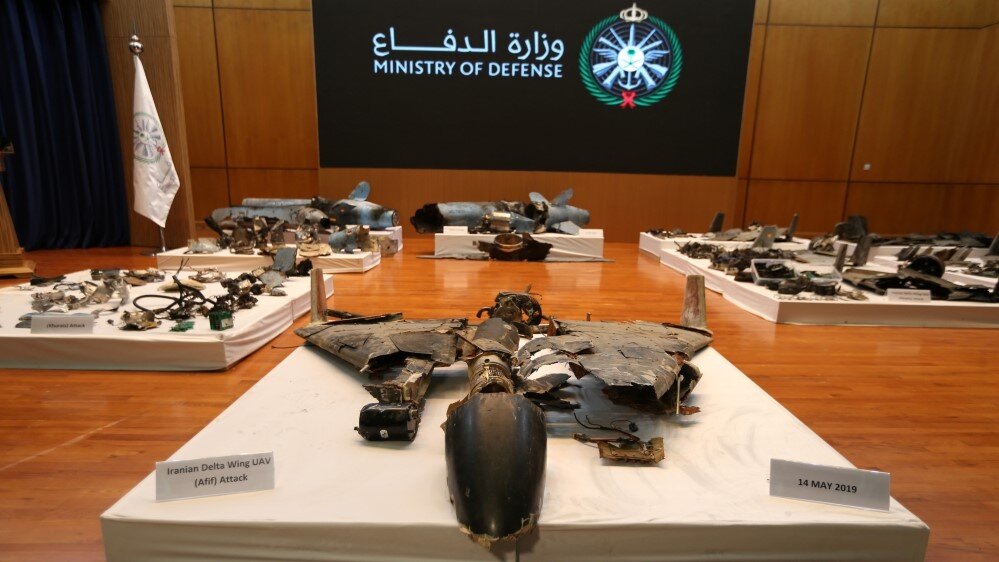
In a press conference Wednesday night, Riyadh put on display a wreckage of what it said were remnants of weapons used in the attacks
In the show, the Saudi Defense Ministry Spokesman Turki al-Maliki claimed the wreckage showed the attacks were "unquestionably sponsored" by Tehran.
But many believe the assemblage of junk were not that much-anticipated “concrete evidence” Saudi officials had vowed to provide.
Al-Maliki did not say what area the strikes were fired from, just asserting they “could not have originated in Yemen”.
Separately, Saudi Arabia's Minister of State for Foreign Affairs Adel al-Jubeir on Saturday showed he is clueless about the perpetrator of the attacks.
Al-Jubeir said Riyadh would take the appropriate steps if its investigation confirmed that the attacks were launched from Iranian soil. 
"The kingdom will take the appropriate measures based on the results of the investigation, to ensure its security and stability," al-Jubeir told a news conference.
Reuters eggs on war
However, it seems Reuters and other western outlets are bent on nudging the idea of war forward, picking up the anti-Iran narrative and running with it.  
The corporate media is having the false accusations repeated until the need for Iran attack becomes consensus reality in the west.
Of dozens of Reuters articles on the Aramco attack, almost all take Iran’s involvement in the attack for granted.
The articles generally repeat the same demonology pro-war voices offered for years to try to justify an attack on Iran.
A Friday piece, titled “United States sending troops to bolster Saudi defenses after attack”, says the US officials have told Reuters southwest Iran was the staging ground for the attack that might has been “authorized by Iran’s Supreme Leader Ayatollah Ali Khamenei.”
The article says this is “an assessment based at least in part on still-classified imagery showing Iran appearing to prepare an aerial strike”.
But the agency doesn’t explain why the evidence that reportedly justify an attack to a sovereign country are still classified.
The article also says the Pentagon’s late Friday announcement that it will send some troops to Saudi Arabia to bolster defense systems “appeared to close the door to any imminent decision to wage retaliatory strikes against Iran following the attack”.
Ouch! Isn't it too bad that the doors to “retaliatory strikes” are closed?
The title of a Saturday column says, “Saudi oil attack shows how Iran sees new Mideast game”.
This column clearly suggests Iran was behind the attack. A paragraph says,” Iran has been testing drones and supplying them to regional allies such as Hezbollah for years. This attack, however, showed significant recent progress. That the missiles were reportedly able to evade Saudi air defenses by flying behind them demonstrates striking sophistication”.
A Thursday article reads, “Saudi Arabia shows attack site damage as Iran pledges tough defense”.
This article relates a Saudi-organized tour of the damaged facilities for western reporters to Friday remarks by an Iranian official that Iran would give firm response to any U.S. military plot in the region.
This is also the case with two other articles, titled “Iran says it will destroy any aggressor” and “Iran navy commander says Iran ready to defend its marine borders”.
Both articles link pledges by Iranian commanders to defend Iranian territory, made in speeches on the occasion of the 39th anniversary of the beginning of the Iraqi invasion of Iran, to the Aramco attacks.
Striking example
Perhaps no article demonstrates the Reuters pro-war stance than a major piece released early on Wednesday.
BY ali
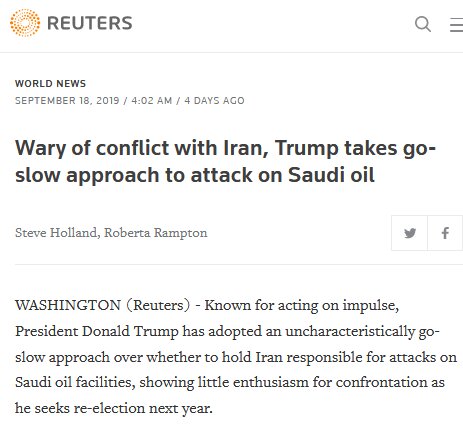
Screenshot of a Reuters article published on September 18, 2019.
In the article, published hours before Saudi Arabia held its news conference, Reuters lamented why Trump was not taking action immediately.
The title is provocative enough:” Wary of conflict with Iran, Trump takes go-slow approach to attack on Saudi oil”.
Reuters reports Trump has adopted an “uncharacteristically go-slow approach” over whether to “hold Iran responsible” for attacks on Saudi oil facilities, apparently because he “seeks re-election next year” and he is “famously skeptical of his intelligence community”.
But one can hardly conclude Trump’s approach towards the Sept. 14 attacks was “uncharacteristically go-slow”, taking into account Trump’s approach to the explosions off the coast of the UAE’s Fujairah in May, the attacks on two oil tankers in the Gulf of Oman mid- June and the shootdown of a U.S. spy drone inside Iranian territory late June.
Probably in all cases there was “no doubt” that Iran was the culprit - although even stanch allies of the U.S. wanted clear evidence - but Trump reportedly decided to back down.
The Reuters piece itself mentions Trump’s behavior towards Venezuela, reporting Trump has resisted suggestions for a “stronger focus on military planning” while a U.S.-led campaign of economic and diplomatic pressure has failed to “rescue” its people by toppling the Venezuelan government.
Reuters continues, “Trump’s stance today is in stark contrast to 2017, less than three months into his presidency, when he waited only two days before launching air strikes to punish Syrian President Bashar al-Assad’s forces for a chemical weapons attack.”
Wait a minute.  Was Trump entitled to bombard Syria as a punishment for a “chemical weapons attack”? Which global authority did sanction such attacks?
And there are no convincing proof to believe the Syrian government has ever committed chemical attacks.
CNN anchor echoes Reuters
Interestingly, a famous CNN anchor also egged on war with Iran, tweeting why Trump “balks” at military retaliation.
Trying to portray Trump’s picking of sanctions instead of airstrikes as a sign of weakness, CNN anchor Jim Sciutto replied with a carefully worded question: “does this mean the president is again balking at military retaliation?”
According to Sputnik, the purpose of Sciutto’s question is to frame Trump’s choice as between showing strength by ordering an airstrike - which seems to be the obvious decision for any red-blooded American - or weakness by “balking” at that option.
A love for war
Seemingly, the mainstream media loves it when the U.S. bombs things.
The Trump-ordered missile strike on Syria’s Shayrat Air Base in April 2017 was widely admired by the MSM.
A day after the attack, CNN’s Fareed Zakaria said he thinks Trump had just “became President of the United States", Washington Post columnist David Ignatius asserted “put more umph” back into “the credibility of American power,” and Fox News’ Jeanine Pirro claimed “We finally have a man who knows the difference between right and wrong and good and evil, and it makes us proud.”
Global Research and other respected alternative outlets have clearly demonstrated how big U.S. outlets, including the New York Times, CBS, and CNN, sold the Iraq war to the American people.
“Such was the barrage of propaganda directed at the American public that 69% believed Saddam Hussein was personally involved in the September 11 attacks. That is a significant achievement in manipulation. The poll results must have been news to the Iraqi dictator himself, a forgotten one-time American ally,” Global Research reports.
The pattern continues into other illegitimate interventions, as the liberal Guardian newspaper championed the demolition of Libya in 2011, with editorials imploring, “The quicker Muammar Gaddafi falls, the better.”
Now one can better grasp why William Arkin, one of NBC’s political commentators, quit in January. In his resignation letter, Arkin denounced the network as a “cheerleader for open and subtle threat mongering,” full of people who “accept that a state of perpetual war” is a necessity.
Trump decided to impose yet another round of sanctions to punish the people of Iran for what there is no public proof of, but MSM outlets are furious that Trump has backed away from an all-out war.
Trump can be almost certain that the day he orders air strikes, the MSM will cheer the decision as “presidential”.

Friday, August 02, 2019

Belgian globetrotters share us their new perception of Iran

By Afshin Majlesi, Mehdi Sepahvand

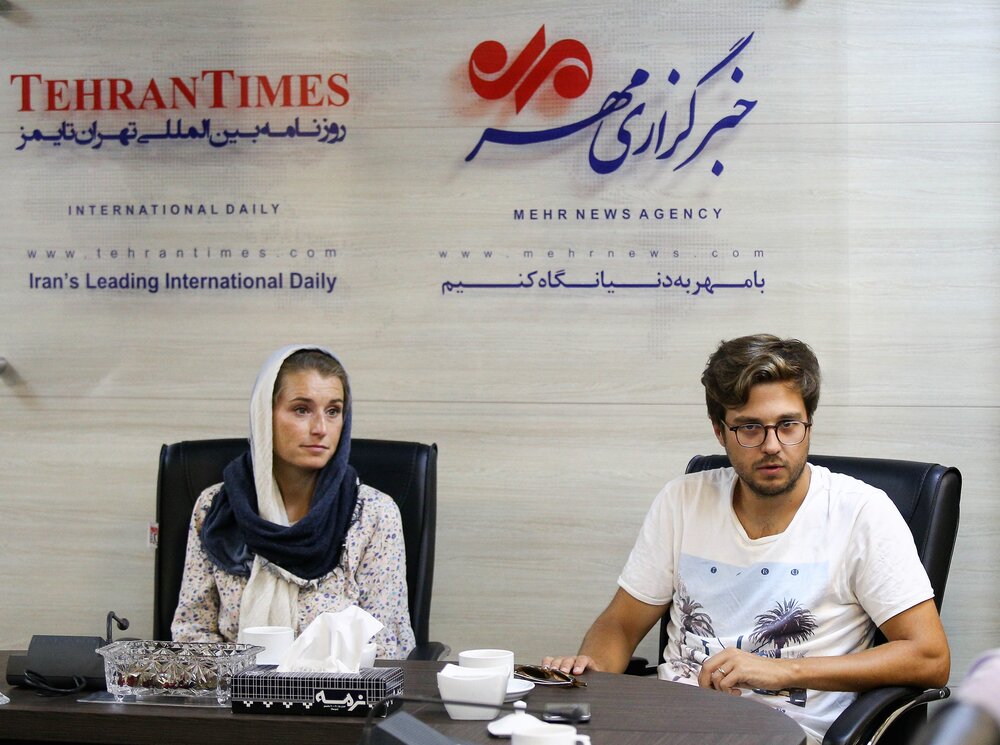
TEHRAN – Last Monday, a Belgian couple, who are on an overland journey to China, paid a visit to The Tehran Times, where they let us share their views, experiences and feelings about Iran in a cozy chat with the daily.
Ciara Reid and Lennart Gheysens in particular noted that the hospitality of Iranian people was beyond their expectations, saying “One of the reasons that we love Iran so much is the hospitality and kindness of the people.”
Western media don’t help very much to give a clear picture
“I think that is what a lot of other nationalities can take as an example and learn from it,” Ciara said.
When it came to driving in Iran, Lennart, however, didn’t give a good score, saying he had heard that Georgian people had earned a bad reputation for driving carelessly, but he thinks that the situation is even worse in Iran!
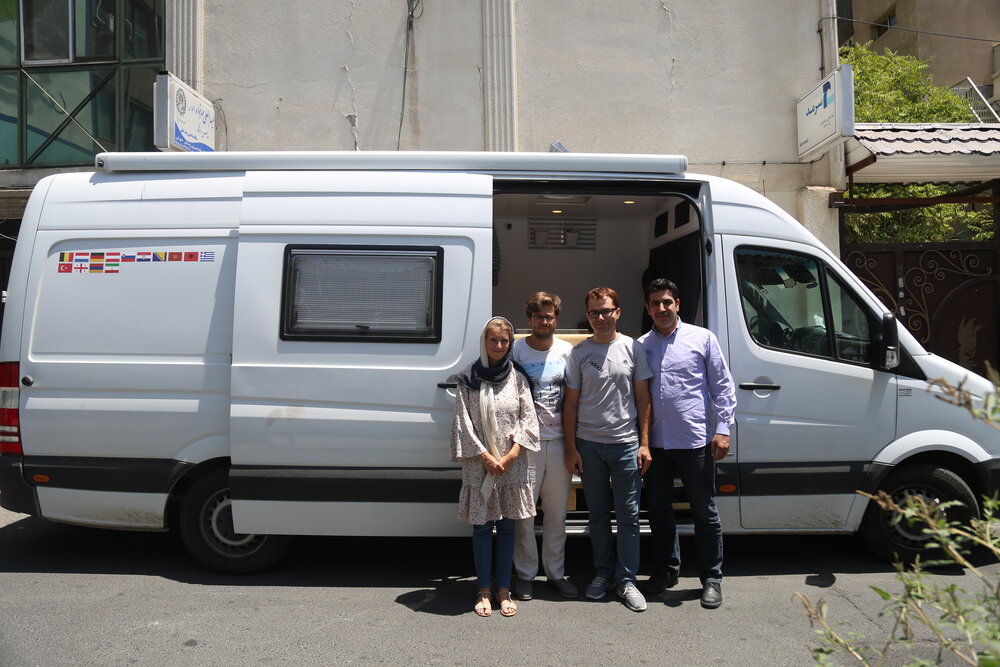
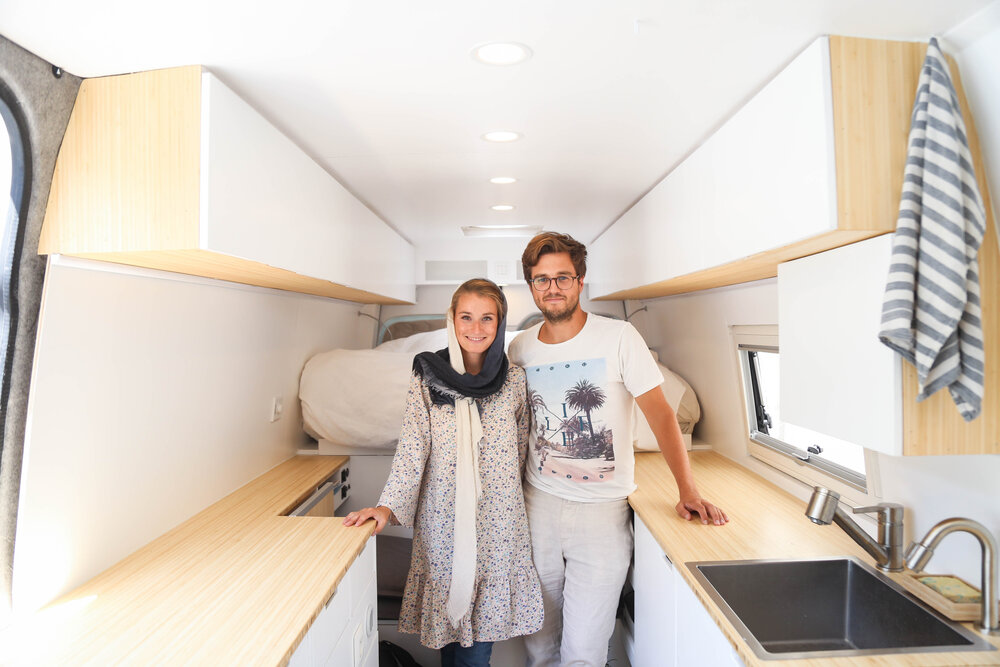
The couple also showed us various parts of their camper van, which was like a well-made miniature home equipped with almost everything including a bed, a dining table, chairs, a stove, sets of closets, cabinets, a toilet, a shower, a sink, electronic equipment and other amenities! There were powerful solar panels to charge the batteries that powered their moving home.
The transcript of the interview is given below:
Is this the first time you’re visiting Iran?
Lennart:  No, the second time. We visited in 2016 and that was only Iran that we visited [during that trip].
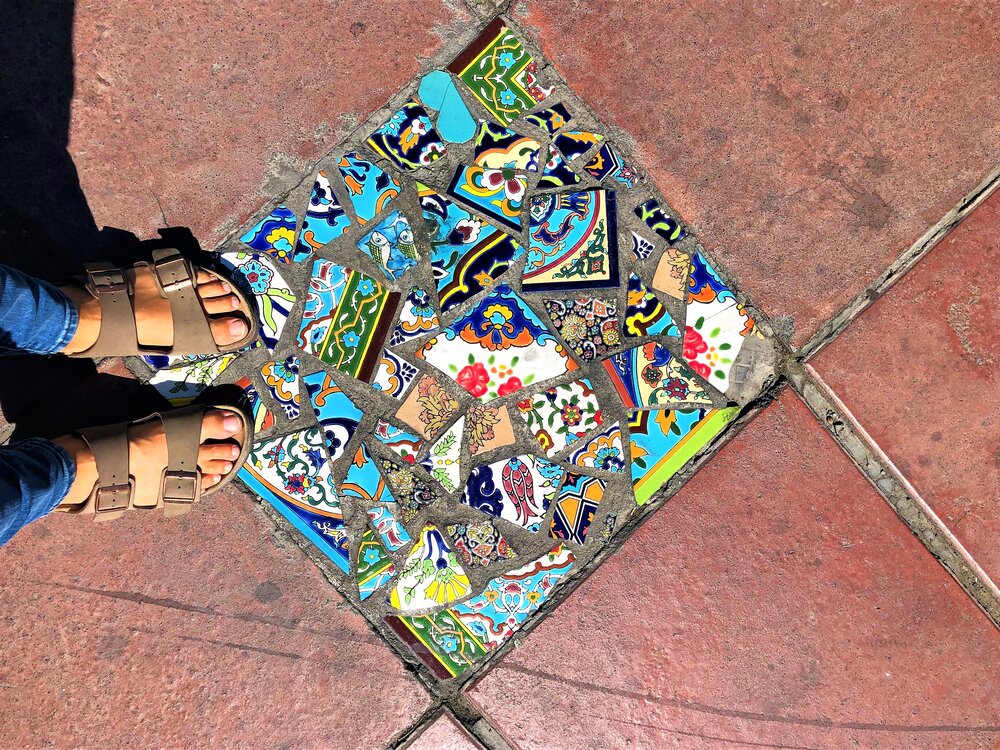
Ciara contemplates broken Iranian mosaics used to fix a missing tile (Photo: Ciara Reid, for The Tehran Times, July 29, 2019)
 
Ciara: We visited Iran in 2016 in a trip that was recommended by a friend of ours. And when we were here we really fell in love with the country. We never had that [experience] before. Everything is so beautiful and people are so friendly. And at that time we said we definitely want to go [come] back and then maybe all the different countries around Iran, maybe they’re beautiful too. And European people usually don’t get to see them so that’s why we decided to go on a trip along the Silk Road so it was really our trip in Iran in 2016 that sparked the idea of our current trip.
Please tell us more about the itinerary of your trip.
Lennart: We drove from Belgium quite fast through all the European countries like the Netherlands, Germany, Austria, Slovenia, Croatia, and Bosnia because we want to focus on the Caucasus region and then central Asia. We drove from Croatia to Albania, Montenegro, and then Greece to Turkey, where actually the real trip started for us. We started to take things slower. So we are driving from Belgium to China.
TT: Some foreign travelers say that driving in Iran resembles a video game. What do you say about that?
Lennart: Yes, it is. We had heard that Georgia is very bad [when it comes to reckless driving] but I think in Iran it’s even worse. But for us, our big car helps us to somehow avoid accidents. [Our rule is] to try to drive like a local… because in Europe, this is your lane and you cannot drive over it or whatever, but here….
If this happens in Europe, they will just leave you at the side saying it’s your own fault, no one will help you. So we told this story to people back home where a lot of people were saying us “Oh Iran is dangerous”! But for me it is one of the safest countries
TT: What about the quality of roads and highways in Iran?
Lennart: Actually, very good, I mean, for me, it’s comparable with European roads… actually the roads in Iran are quite good, they are almost flat and smooth.
TT: What’s your opinion about the Iranian hospitality?
Lennart: Well, it’s famous for a reason, because it’s true, one of the reasons that we love Iran so much is the hospitality and kindness of the people, like, the first time that we got here in 2016, we were in a taxi and the taxi driver invited us to his home and even though he couldn’t speak English, we were talking on Google Translate to each other.
Ciara and Lennart speak to The Tehran Times (Photo: Maryam Kamyab, July 29,  2019)
It was very nice to meet his wife and their toddler and a friend of whom we also met in Mashhad. We’re still friends now and we are staying with his family here in Tehran and I mean [while in Iran] everybody likes to help you.
 For example, all of a sudden we were in Tabriz and one gas station after the next said we don’t have diesel, we don’t have diesel, and we were like “Oh my God!”
You know, our car, runs on diesel -- not a lot of cars running on diesel in here, only the trucks and buses.
Ciara:  And we posted something on Instagram and said oh we’re scared, we don’t have any more diesel…. And then some Iranian people picked it up and posted their own [massages] on our Instagram page and suddenly we were like flooded with…; “Do you still need diesel?”, “You can get it there!”, …, “I can help you!”, and “We have diesel!”
And we posted something on Instagram and said oh we’re scared…. Some ten people reached out to us that we didn’t know… just out of kindness
Some ten people reached out to us that we didn’t know… just out of the kindness saying oh these are foreigners, they are in trouble, we can help!
Yes, this is a phenomenon that Iran is famous for.
Ciara:  I think that is what a lot of other nationalities can take as an example and learn from it. One time in 2016, we wanted to go to Yazd and in the bus station we went to different offices saying Yazd, Yazd, Yazd -- we were in Shiraz at that time -- and we [finally] took a wrong bus!
On the Google Map we found the bus was going all the way to the south so we asked the driver, saying Yazd? And the driver said, Bandar Abbas, Bandar Abbas! And we were like “Uh-oh!”
The driver pulled to the side, a bus full of people just stopped to the side. The driver said get out! We thought what we were going to do with our packs… we were thinking like “Oh my God! They want to leave us here on the side of the road!”
Then a man showed up. He said “Come with me, come with me!” And he drove us to a police station were there were a lot of taxies and he even paid us the taxi to get back to the bus station and we were very excited.
If this happens in Europe, they will just leave you at the side saying it’s your own fault, no one will help you. So we told this story to people back home where a lot of people were saying us “Oh Iran is dangerous”! But for me it is one of the safest countries. 
Have you selected a motto or a theme for your whole journey?
Ciara: Not really a theme but we actually want to see more of the countries along the Silk Road, so the “Silk Road” maybe our theme. We prefer to focus more on nature than cities during our journey!
We are also very amazed of the diversity of nature in Iran.
Tell us more about your portable home!
Lennart: We chose a Mercedes [camper] because it’s easy to find parts for Mercedes everywhere and because it’s also very reliable so we bought it second hand in Holland…. We removed everything from its back and started to modify everything from electricity to water and heating because I am a handy guy we did all the carpentry, installing a solar panel, air vents, curtains …. Everything!
And now, a tough question! Before your first visit Iran in 2016, you had a perception of the country, whatever it was, and after you felt the country, encountering its people, you developed another perception. How do you compare them, the first which was mainly shaped by Western media, and the one you have developed in person?
Lennart: Yeah, in the beginning for us, Iran was not very well known, just a Middle Eastern country, some said don’t go there because it’s dangerous …. So in the beginning we had a perception that it was very dangerous and also some (European) people didn’t know the difference between Iraq and Iran and the Western media don’t help very much to give a clear picture.
Ciara, Lennart and Tehran Times correspondents stand by the couple’s camper van (Photo: Maryam Kamyab, July 29,  2019)
But then some friends of ours visited Iran and we read a lot about it ourselves and yeah we saw that its people are very friendly, it is so safe and we like it so much.
Ciara: I think a funny anecdote is that we told our family and friends that we wanted to travel to Iran, everybody said “Oh you’re crazy! It’s very dangerous, you wanna get killed!”
And we said “No! It’s safe, it’s safe,” and then when we arrived in Iran we heard the bombings and attacks in Paris and an Iranian taxi driver asked where we are from and we said we are from Europe. “Europe? It’s so dangerous!” the driver said. So when we were back home in Belgium and people said “Oh, how was your trip to Iran?” we said, “Well it was actually much safer than it was in Europe!”

Sunday, March 10, 2019

Netanyahu’s political honeymoon over

By Syed Zafar Mehdi

TEHRAN _With just a month to go until general elections in Israel, Benjamin Netanyahu’s legal troubles have compounded, making his re-election bid difficult.
Israel’s attorney general Avichai Mandelblit dropped a bombshell last week and the timing was impeccable: just before Netanyahu seeks fifth term in office. The announcement, which was being anticipated for two years, has dealt a massive blow to Netanyahu, who is likely to be indicted in three separate cases of corruption.
The criminal cases include granting favors worth millions of dollars to the owner of a media outlet in lieu of favorable coverage for himself, according to reports. The charges have been numbered as Case 1000, Case 2000 and Case 4000. Natan Sachs, Director of the Center for Middle East Policy at the Brookings Institution, writing in the Atlantic said Netanyahu not only faces the personal threat of indictment on serious felonies, but his political maneuver itself is in jeopardy.
“The first polls out following the announcement show a slim lead for the center-left camp. If these results hold, Netanyahu’s path back to the prime minister’s residence on Balfour Street in Jerusalem would be blocked,” said Sachs.
Netanyahu, who heads right-wing Likud party, has served consecutive terms as the Zionist entity’s prime minister since 2009. It is apparently the first time a sitting prime minister in Israel will face criminal charges.
Although experts say that he will do everything at his command to subvert the law and declare himself ‘not guilty’, odds are heavily against him at the moment, especially with elections on April 9.
In Case 1000, Netanyahu is accused of accepting illegal gifts from a Hollywood filmmaker, totaling about $200,000, in exchange of helping him secure a U.S. visa and back a law that would give the filmmaker tax exemption if he moves back to Israel.
In Case 2000, Netanyahu faces indictment for supporting a law that would crush one newspaper (Israel Hayom) in exchange for a favorable coverage from its rival newspaper (Yediot Acharonot).
In Case 4000, Netanyahu is accused of backing looser regulation of Israel’s telecom company Bezeg in exchange for positive coverage from Walla, a news website owned by Bezeg.
As it appears, the Zionist war-monger is desperately trying to get good press at a time when he is battling serious problems at the domestic front and in the international community.
He is not only facing a hostile opposition but the judiciary and police have also announced a no-holds barred war against him, which is unprecedented in the history of the Zionist ‘illegitimate’ state.
It is a well-known fact that the Israeli media does not get along with Netanyahu, and just like his megalomaniac friend in Washington, he says the Israeli media is out to get him. Both use the term ‘fake news’ frequently for their respective media outlets.
Hence it was no surprise that Trump quickly jumped up in his defense after the news about indictment came in. “He is tough, smart, strong. He is very defensive, his military has been built up a lot,” he said.
Since the investigations kicked off at the end of 2016, Netanyahu has repeatedly and with sheer disdain attacked media for accusing him of corruption. He has even muzzled their voices.
“Hundreds of journalists have been affected directly or indirectly by Netanyahu’s moves, and Israelis have been besieged by the message that the media is the enemy rather than an instrument that protects them from tyranny,” wrote Anat Balint, media researcher at University of San Francisco, in Haaretz.
Like a typical bully with utter contempt for law, Netanyahu has often said that ‘nothing will happen – because nothing has happened’, since he has been winning elections due to manipulation and fraud.  
Following the announcement by attorney general last week, Netanyahu termed the accusations a ‘left-wing conspiracy’, attacking his political rivals who have launched a strong campaign against him.
Although Netanyahu is the first Israeli prime minister to be indicted for corruption, he is not the first one to be accused of corruption. Before him, Ehud Olmert in 2008 was forced to resign amid allegations of bribery. In 1977, Yitzhak Rabin had to resign after he was accused of holding illegal foreign bank accounts.
So, the legacy of corruption and mismanagement runs deep in Israel’s political system. While others before him quietly stepped down, Netanyahu has so far refused to back off.
What impact Netanyahu’s indictment will have on the upcoming general elections in Israel and his political future remains to be seen. While it is widely believed that he will not succumb to the pressure from judiciary and police, some of the charges are damning and can hurt him deeply.
Whether it will have any impact on the election result, we will know on April 9. But, irrespective of the poll outcome, what is certain is that Netanyahu’s political honeymoon period is over. The future looks bleak for him and for the Zionist entity.

Thursday, January 26, 2012

A Proposal to Unite Muslim World - A Union of Muslim Countries (UMC)

Bismillahi rahmani raheem,
A critic of Islam said, “Even if Islam were to sweep the entire area from South Africa to Philippines we [i.e the western powers] need not fear for they are utterly and hopelessly disunited. The Islamic world would probably turn in on itself over sectarian and national divisions before it would be a major threat to even India.” I wish it was not but I fear this is the truth. Today Muslims number 1.5 billion and counting. Oil drives the world and 3/4 of the proven oil reserves lie under Muslims feet. Islam the religion of Muslims is a potent force as it was when it first spread out of Arabia 14 centuries ago. From the Atlantic Ocean to the Pacific isles is a landmass spanning 15,000 km inhabited by Muslim majorities.
Yet how do Muslims figure in the world arena? Sad to say it’s nothing less that pathetic. The Gross Domestic Product (GDP) of ALL the Muslim countries combined is less than or equal to that of France. 15 years ago when 50,000 Muslim women are raped by Christian Serbs in Bosnia, Muslims watched as spectators. Now when country after country falls to the hands of American and other neo-colonialists Muslims look on helplessly. When Lebanon is bombed to Stone Age and Palestine is no more we heat our seats. Millions starving in Africa, many more oppressed by cruel dictators in Central Asia does not disturb the Muslim peace of mind. YaAllah! I dare say they’ll be heating their chairs even if Mecca is vaporized or millions butchered in Saudi Arabia and Iran. “The less we think about the Muslims the happier we’ll be,” seems the thought of the day.
Disunited as we are I don’t think Allah will help us if we don’t try to correct ourselves. Allah’s help comes only when we change ourselves for the better. The darkest hours are the nearest to dawn. There are ways out of this seemingly stalemate situation of the Muslim world.
Presented here is a vision to unite Muslims countries. If it can be realized there’ll be a Muslim federation or union stretching from the shores of Atlantic to the isles in the edge of the Pacific Ocean. First let’s look at the some facts.

Map of the union of Muslim countries we made for the article - "A Proposal to Unite Muslim World – A Union of Muslim Countries (UMC)" at 1MuslimNation.com

The map shows the current worldwide Muslim population distribution. The vision foreseen here is for a united union/federation of Muslim countries. Lets call it The Union of Muslim Countries or simply UMC for now, for easier reference. Here is the map of Union based on the above Muslim distribution. The countries with a Muslim majority population will belong to the Union of Muslim Countries (UMC). This is map of the intercontinental UMC.

The Union of Muslim Countries or UMC could be like the European Union, and inshaallah can be formed in phases and stages via discussions, consensus, coordination etc. The current national borders, nation governments etc. will be intact, but there will also be a federal government and parliament for the whole UMC. The people from one part of the federation, for instance a citizen of Nigeria would be able to go to Bangladesh or Malaysia without the need for a passport or other travel documents, just like within the EU. An investor from Kuwait will be able to start a business enterprise in Senegal or Pakistan as easily as he would in Kuwait. An Indonesian, Pakistani farmer will send his harvest to be sold to Moroccans and Yemenis without much hassle or import duties he presently has to pay. People within the UMC will be able to move and settle anywhere within the UMC union’s borders as if in the same country. The movement of people and goods within the union will have as much freedom as available in a country now. All people irrespective of gender, religion, nationality, caste, colour or language currently living within the UMC border will belong and be citizens of the UMC. They’ll have all the rights they enjoy now. There’s no need for Muslims living outside of the UMC federation to come and live in a UMC country, but of course if anyone wants they’ll be able to settle and obtain citizenship of any of the UMC countries be a citizen of UMC.
It’s worth remembering 60 years ago a European Union (EU) was a dream of a few enlightened people. But today it is a reality. And also Muslim countries have an advantage European nations didn’t have back then. That is, there always exists an urge in the Muslim psyche for something like a Caliphate or an intercontinental Islamic state covering the whole Muslim world. Similar proposals like these have been voiced before. That’s good. But to bear fruits, these proposal and ideas needs to reach as many people as possible. So as the first step to form a Union of Muslim Countries that can protect and act on behalf of Muslim peoples and countries interests is to spread the idea to many as possible.
Leaving things as it is or engaging in wishful thinking without action or allowing and appealing to non-Muslims Super Powers and countries to decide the fate of our Muslim people and our lands, in all likelihood leads to the devastation of both. We Muslims must decide our future and not leave it at the hands of other powerful nations. We are making a grave mistake in underestimating the abilities, resources and knowledge Allah has given us. Inshaallah if we try we can make it.
August 13th, 2006