Showing posts with label Germany. Show all posts

Saturday, December 07, 2019

Israeli minister calls for Western-Arab alliance against Iran

Israeli foreign minister, Israel Katz, called on Thursday for a Western-Arab alliance headed by the US against Iran, in order to curb its missile development and “aggression”.
This call came following a letter sent by France, Germany and the UK to UN Secretary-General Antonio Guterres, warning that “Iran’s developments of nuclear-capable ballistic missiles” violates a UN Security Council resolution endorsing the 2015 Iran nuclear deal.
Katz posted on Twitter: “The next step must be an effective military threat of a Western-Arab coalition led by the US to deter Iranian aggression. These are critical moments.”
According to the Times of Israel, Katz also tweeted: “This is the decisive moment.”
This came in the context of a meeting between Israeli prime minister, Benjamin Netanyahu, and US Secretary of State Mike Pompeo in Lisbon, where they discussed the Moroccan-Israeli relations.

Tuesday, October 22, 2019

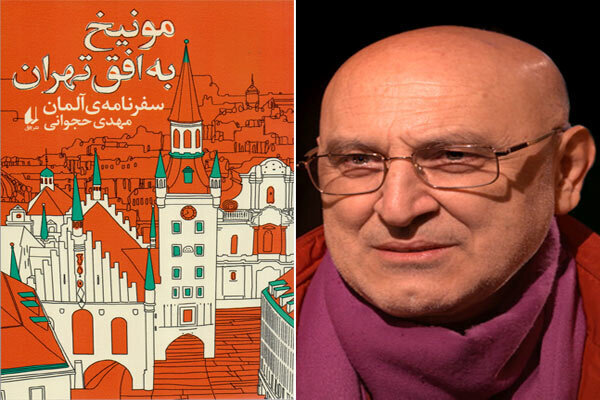
Visits to Munich on Tehran time

By: Seyyed Mostafa Mousavi Sabet

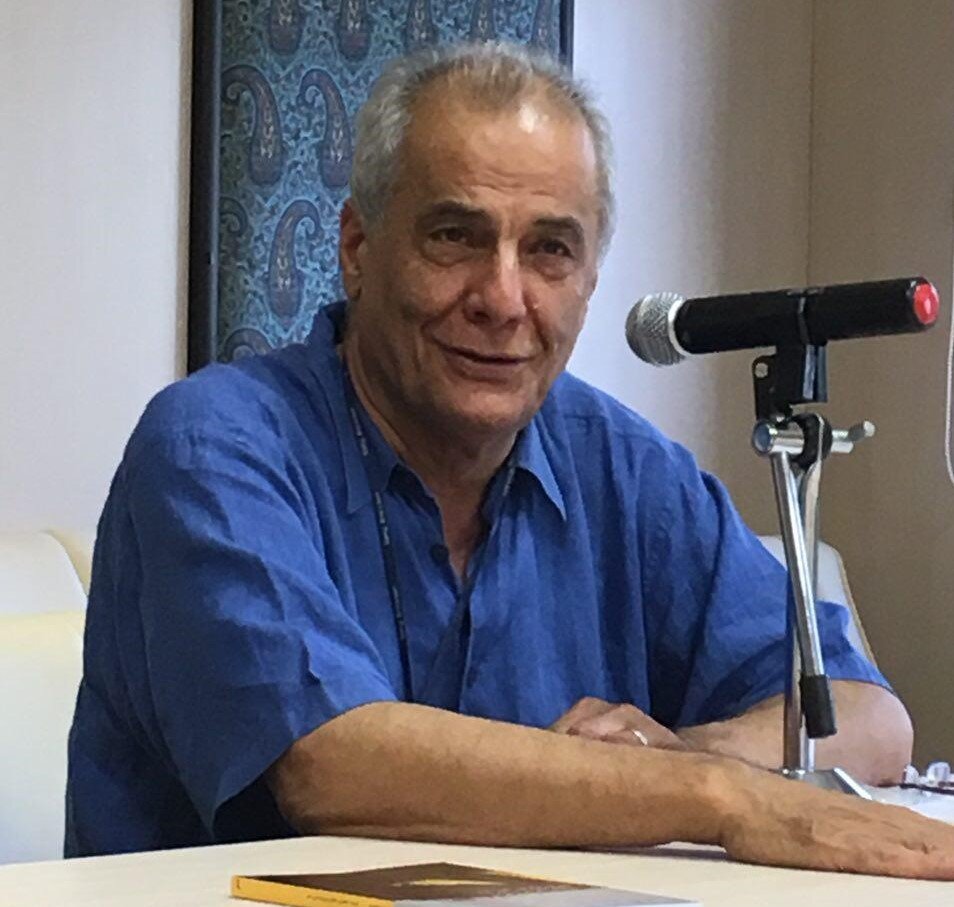
Visits to Munich on Tehran timeTEHRAN, (MNA) – The selection of Mehdi Hejvani as an Iran’s nominee for the 2020 Astrid Lindgren Memorial Award was a greater factor in causing me to increase my knowledge about his activities than his being a children’s book writer and literature expert.

In my view, reading a book by a writer can more helpful to learn more about the writer than studying an extensive résumé with dozens of pages about him/her. Writers have always hidden themselves between the lines in their books, and as such I found Hejvani’s latest book “Munich on Tehran Time”. 
The book gives an account of two trips he made to Munich in 2005 and 2008 after winning scholarships from the International Youth Library (Internationale Jugendbibliothek, IJB) in the southern German city.
The library grants the scholarship to foreign scientists with the objective of supporting research in the areas of international children’s and youth literature, illustration, and promoting scientific exchange and international co-operation.
With the above goal in mind, I accompanied Hejvani on his journey virtually by reading “Munich on Tehran Time”. In the preface to the book, he says that the impressions made during his six visits to Germany, including the abovementioned two trips, provided the motivation for writing the book. He had made the earlier trips to the country to visit the Frankfurt Book Fair and his relatives.
He writes about many topics ranging from streets and houses in Germany to Turkish expatiates and their football mania in the German city, which is home to Bayern Munich, the most successful club in German football history.
In gatherings with his library mates, he made extensive efforts to give fair and honest responses in his poor English – as he described it – to the questions about Iran. He didn’t want to undermine his homeland, but at the same time he didn’t want to give inaccurate answers to persons who know of Iran only through misinformation from the Western media.
One of the best parts of the book is the chapter explaining Hejvani’s visit to a Munich school, which was arranged by the IJB. He was assigned by the library to attend two classes at the school to elaborate on his writings, his family and answer any questions about Iran.
Taking advantage of an opportunity to promote Persian literature, Hejvani gained approval from a library official to tell the schoolchildren the story “Elephant in the Dark House” from Persian poet Molana Jalal ad-Din Rumi’s masterpiece Masnavi-ye Manavi, which has been simplified by Firuzeh Golmohammadi.
During his classroom session, Hejvani was concerned that his presentation may have failed to impress the students, but he found some comfort in a sentence from the teacher, who wrote, “There was complete silence and the children were all ears while you were talking.”
Hejvani praises Munich for its beauty, envying those citizens who enjoy the welfare, security and freedom granted in the city. He asks his readers not to misunderstand the concept of freedom, which in Iran is defined as laxity. He is also complimentary about the water consumption pattern in Germany, advising Iranians to follow this pattern. 
While Hejvani, of course, was an Iranian, he lived like a perfect German citizen over his multi-month stay in Munich. During the trip, he learned how to live and think like German, with rigorous daily work schedules, and not wasting any spare time. He went to the theater and made excursions to Germany’s natural attractions such as Garmisch Partenkirchen and Zugspitze, and was respectful of the law and other people living around him. 
Nevertheless, he still had his Iranian heart during those trips. There is an ambiance of nostalgia for Iran that permeates the whole book. He makes numerous allusions to his personal life in his homeland, sharing bittersweet memories of childhood and youth, which are reasonably interesting. This nostalgic thread that binds the book together is what led the author to choose the poignantly metaphoric title for his book.
Those scholars who win a scholarship to the IJB appear to serve as ambassadors of the library. The center also publishes articles by the scholars and makes the materials accessible to everyone.     
It is my own wish that cultural officials in Iran would recognize that our country also has the potential to offer scholarships such as these.

Wednesday, September 04, 2019

U.S. move to form coalition in Persian Gulf ‘not feasible’: Japanese professor

By Negar Asadi

TEHRAN - Hisae Nakanishi, a professor of International Relations of the Middle East at Doshisha University in Japan, believes that the United States’ move to form a maritime coalition in the Persian Gulf is “unwise and even not feasible”.
“The U.S. hopes to encircle Iran by the cooperation with those states which the U.S. considers its allies in the Middle East and by pressuring Iran. I consider this U.S. move unwise and even not feasible. So far, a limited number of the states have joined the coalition and many other states are prudent not easily expressing their desire to join,” she tells the Tehran Times in an exclusive interview.
Nakanishi says this decision by the U.S. is not isolated from a series of the Washington’s unilateral actions.  
“It started from withdrawal from the JCPOA [the official name for the 2015 nuclear deal] in May 2018.  The U.S. major objective is to increase tension in the Persian Gulf that serves for Trump’s gaining more votes for the 2020 Presidential Election,” she said.
Nakanishi also said that it is a wise decision by major countries who have refused to join the coalition, noting supporting such a coalition means supporting “illegality in international law”.
“It is a wise decision that major countries such as Japan and Germany have refrained from participating in the coalition.”
“It is wise for the major countries to have refrained from joining the coalition including Japan and Germany. The current tension in the region started from the U.S. breaching international law by abandoning the JCPOA.  Thus, participation in the coalition has a serious ramification: it would mean to support the illegality in international law,” she stated.
She added, “As Prime Minister Abe of Japan clearly stated during his visit to Iran in June and at the time of the latest G7, Japan does not hope to see conflict in the Persian Gulf and hopes that Iran plays a constructive role in securing peace in the region. Moreover, the participation of Japan’s Self Defense Army is not legally supported in Japan’s constitution. It goes without saying that Japan and Iran have historically maintained a good relationship. So, it was a natural decision for Japan not to join the coalition.”
Commenting on participation of Israel, the UK and Australia in the coalition, she said what is important for those states is to express their support for the U.S.
“As a matter of fact, it is not clear to what extent Israel will commit itself to the coalition.  It expressed to cooperate with U.S. only for collecting information.  Yet, what is important for those states is to express their support for the U.S. policy. Israel is likely to continuously fire into Lebanon’s Hezbollah. Yet, this does not mean that it deploys its military in the Persian Gulf with other coalition states. It is not new in the case of the UK and Australia.  Both UK and Australia have already played a crucial role in their intervention in Afghanistan and again in Iraq by participating in the U.S.-led coalition in their war against Saddam,” she explained.
The professor added, “What matters most is the political and military implication of the coalition formation.  The U.S. has its allied states in the Persian Gulf such as Saudi Arabia and the United Arab Emirates.  Thus, the coalition making is for the sake of the U.S. enhancing its leverage toward these countries.  On the other hand, the more tense the Persian Gulf situation gets, the more weapons and fighter jets those allied states buy from the U.S.”
“The coalition is aimed at increasing military tension (in the Persian Gulf).”
“The UK is also among other weapon sale states in the Middle East.  The coalition making actually serves such an economic interest of the U.S. These circumstances considered, the U.S. primary goal in the coalition making is to increase the military tension, not really is presuming to engage in the military act in the region at this point. Overall, the fact that not many states have joined the coalition suggests decline of the U.S. power in the Middle East,” opined the professor of Doshisha University.
The United States has called on its European and Asian allies to form a maritime force to supposedly monitor safe shipping in the Strait of Hormuz and Persian Gulf.
So far, only Britain, Australia and Bahrain have agreed to join the coalition.

Tuesday, August 13, 2019

Healthy economy is antidote to sanctions on Iran: scholar

By Negar Asadi

TEHRAN - A prominent scholar, believes that fighting corruption and building a healthy foundation for economy are catalysts to resist sanctions and external pressure on Iran.
“What is important is to adopt policies to have a foundation of a healthy economy in order to be able to counter external pressure,” Modjtaba Sadria told the Tehran Times in an interview on Thursday.
Sadria, an expert on East Asia, cited China and its resistance against the U.S. sanctions as an example.
China has adopted clear and coherent policies which resulted in a “strong foundation for national economy” and also a very “strong social base” to counter the U.S. pressure, Sadria explained.
“Between 1848 (opium war) and 1949 (Chinese revolution), a deep desire of independence grew in China. Xi Jinping [the Chinese president] has undertaken huge program of economic transformation of China in order not to depend on Chinese trade with the United States,” he explained.
He said that the U.S. pressure is not tolerated in China.
“The U.S. efforts to form alliance in the Persian Gulf is more a show of a bargaining strategy which cannot pose a threat against Iran.”Referring to China’s act in suspending purchases of U.S. agricultural products, Sadria said, “This is one of the examples of Chinese tools to retaliate the Trump administration’s show of force to China.”
China announced on Tuesday that it has suspended purchases of U.S. agricultural products in retaliation for a “serious violation” of agreements between President Xi Jinping and his counterpart Donald Trump.
Sadria said, “On the sidelines of a G20 summit in Osaka, Japan, Trump and Xi met and reached agreement on reducing sanctions by the U.S. However, Trump restored those sanctions. These actions which are unilateralism in the international relations are not tolerated by China. Trump cannot use sanctions as bargaining tools against a country which is the second largest economy in the world.”
“Today, China is a society to which you cannot show off power with the game of sanctions,” he added.
He also said that the U.S. has not any leverage to impose sanctions on other countries unilaterally and act as the “lone superpower”.
“When China takes retaliatory action against the U.S. unilateralism and pressure, it affects not only the U.S. economy, but the whole global economy,” he pointed out.
He noted that China has adopted policies in line with the growth of its national economy that the U.S. cannot harm it by imposing sanctions or exerting pressure.
Trump and Xi held a summit during the G20 in Osaka, Japan in June.
Xinhua reported that the two leaders had agreed to resume economic and trade negotiations, and that the U.S. said it would not impose any new tariffs on Chinese products.
However, Trump announced last week that the U.S. would put a new 10 percent tariff on $300 billion worth of imports from China.
China “has not ruled out import tariffs on U.S. agricultural products purchased after August 3, and related Chinese companies have suspended purchasing U.S. agricultural products,” Xinhua said.
American Farm Bureau Federation President Zippy Duvall said in a statement issued after news of China’s retaliatory measures, “China’s announcement that it will not buy any agricultural products from the United States is a body blow to thousands of farmers and ranchers who are already struggling to get by.”
‘U.S. move to form coalition in Persian Gulf is show of bargaining strategy’
Sadria also said that the U.S. move to form a maritime coalition in the Persian Gulf is a “show of bargaining strategy rather than execution of threats” and is not based on realities in the world.
“Washington is trying to apply its bargaining policies against Iran and form a coalition like it created against Iraq in 2003,” he said.
He added that under the current global economic situation major powers are in crisis, therefore the U.S. does not have the power to make them join the coalition.
“In 2003, other countries had the [financial] resources and the U.S. had the power to extract those resources in order to form a coalition against Iraq. Today, the other countries do not have the resources because they are on the edge of crisis and the U.S. is not powerful enough to extract the resources,” he opined.
He noted, “So, the U.S. efforts to form alliance in the Persian Gulf is more a show of a bargaining strategy which cannot pose a threat against Iran.”
Commenting on the UK’s participation in the U.S. Persian Gulf mission, Sadria said that Britain is in a very fragile situation and seeks to gain Washington’s support.
The U.S. has announced plans to form a Washington-led maritime force to supposedly secure the Strait of Hormuz in the Persian Gulf, which hosts considerable international oil shipments.
German Foreign Minister Heiko Maas said in a press conference on July 31 that his country “would not participate in the mission the United States plans to form.”
A German government spokeswoman also said on August 5 that Chancellor Angela Merkel and the whole German government do not see Germany taking part in a U.S-led naval mission in the Strait of Hormuz.
“The chancellor does not see a participation in a U.S-led mission in the current situation and at the current time - everyone in the German government agrees on that,” a government spokeswoman told a news conference, according to Reuters.
Madrid and Tokyo have also rejected an official request from Washington to participate in the naval coalition.
Spanish newspaper El Confidencial said on August 1, Madrid had received an official request from the United States to participate in these forces. However, the same sources said that “the Spanish government has currently no intention to participate in joint U.S.-led forces,” Middle East Monitor reported.
Japan’s Mainichi Shimbun also reported that Tokyo won’t send ships to join the U.S.-led maritime force.
The UK announced on August 5 that the Royal Navy will join the coalition.

Monday, July 22, 2019

Europe's return to the twentieth century!

By Hanif Ghaffari 

The three countries of Britain, Germany and France are not in good shape: Berlin faces a crisis of leadership and there is no prospect of the end of the Angela Merkel Chancellery.
Even though Merkel will end her Chancellery, she can no longer be considered an influential politician in the European Union and the eurozone. In France, Emmanuel Macron, after victory of  Le Pen and the French National Front (in the European Parliamentary elections), no longer has the power to revive his lost position in Paris. The UK is also thinking of leaving the European Union and how to manage the crisis. what does this show? The answer to this question is clear: Europe is going back to the twentieth century under the influence of Troika's downfall!
It's better to look at the subject a bit more realistic! The growth of extreme currents in Europe seems to have led to concerns and discontent among people such as German Chancellor Angela Merkel. This is while Berlin should not hide its role in this crisis. This social excitement has now become a "political demand" in the West. The dissatisfaction of European citizens with their governments has caused them to explicitly demand the return to the twentieth century and the time before the formation of United Europe. Obviously, in this situation, "Crossing the traditional parties" would become a general demand in the West. Under such circumstances, Merkel's and other European leaders' warnings about the return to the twentieth century and the time before the formation of United Europe simply means the inability of the Eurozone authorities in preventing the Right-extremism in the West.
On the other hand, EU foreign policy is still defined in a direct relationship with the White House and the Brussels-Washington security relations. No doubt, under such circumstances, we can not speak of an "independent Europe" in the international system. Even, While US National Security Advisor John Bolton and Trump have repeatedly expressed their opposition to the existence of the European Union and the Eurozone, Europe has not taken any steps towards independence from the United States. Now, the EU has little opportunity to save itself from falling. The truth that some European leaders have not yet understood ... 

Tuesday, July 02, 2019

Stopped Clocks: The European Union Gets War With Iran Exactly Right


Europe’s leaders have voiced broad skepticism of another intervention, leaving American hawks standing alone.
Bill WIRTZ
Regular readers of my contributions to this site may have noticed that I am in no way a fan of the European Union. Yet even with the EU, the stopped clock principle applies: they have to be right sometimes. And when Federica Mogherini, high representative of the EU for foreign affairs and security policy, said that everyone should tread carefully when it came to the attack on the oil tankers near the Strait of Hormuz, she was absolutely correct.
Mogherini stated: “We are living in crucial and delicate moments, where the most relevant attitude to take—the most responsible attitude to take—is, and we believe should be, maximum restraint, and avoiding any escalation on the military side.”
This month, one of the EU’s top advisors on security questions declared that no military intervention from the European side should take place. This echoes French President Emmanuel Macron saying that France had no place in such interventions, as well as German Chancellor Angela Merkel calling for a peaceful solution to the Iran problem. Seventy-four percent of German opposed a military intervention in Syria last year. In 2002, 71 percent of Germans opposed the war in Iraq, as did 64 percent of the French. During anti-Iraq war protests that took place on February 15, 2003, 100,000 people demonstrated in Brussels, 75,000 in Amsterdam, between 100,000 and 200,000 in Paris, between 300,000 and 500,000 in Berlin, 150,000 in Athens, 60,000 in Budapest, and well over 600,000 people in Rome.
And in the United Kingdom, more than one million showed up to protest in London. The UK’s participation in the Iraq war dragged the reputation of Prime Minister Tony Blair and his Labour Party through the mud. A subsequent inquiry made the former UK leader subject to public prosecution because the legal basis for military action was “far from satisfactory.” Blair’s involvement in Iraq has made it difficult for any party in Westminster to legitimate any war to its constituents, most of whom feel that the unholy coalition of Blair and Bush tricked them into a war they should never have been a part of. This is a major reason why the British House of Commons voted down David Cameron’s 2013 attempt to intervene militarily in Syria.
With the UK currently undergoing a leadership contest within the Conservative Party, and with Prime Minister Theresa May on her way out, it’s unlikely the hawks will take control of Westminster anytime soon. The current favorite to win the PM position is former London mayor and former foreign secretary Boris Johnson, who has yet to voice his opinion on the Iran issue. His rival, current foreign secretary Jeremy Hunt, calls for de-escalation.
That hasn’t stopped some of the usual pro-war suspects from coming out of the woodwork. Daily Telegraph columnist Con Coughlin blames the idea that the United States could be partly responsible for the recent escalation with Iran on the “European Union’s deep-rooted anti-Americanism.” In 2003, Coughlin “revealed” information claiming that Iraqi officials met with Mohamed Atta, one of the 9/11 hijackers. Newsweek reported in 2003: “U.S. officials and a leading Iraqi document expert tell Newsweek that the document is most likely a forgery—part of a thriving new trade in dubious Iraqi documents that has cropped up in the wake of the collapse of Saddam’s regime.”
Apparently we have found the British John Bolton. Just no fancy mustache.
In a January poll, 48 percent of Germans favored a withdrawal of their country’s troops from Afghanistan, with 29 percent opposing it. In 2009, almost two thirds of the French opposed the intervention in Afghanistan. In 2012, all French combat troops were withdrawn under President François Hollande. It would be hard to convince either Germany or France to participate in any military action in Iran, particularly since both countries have made it clear that they stand by the 2015 Iran nuclear deal.
Italy’s Prime Minister Giuseppe Conte, who is not known for his efforts to please his European counterparts, is an exception: he says that he is ready to take a “more rigorous” approach towards Iran. Interior Minister Matteo Salvini has even come under fire from Iranian officials after he gave interviews in the United States explaining that he was “happy that Italy has long since relaxed its relations with Iran, a country that wants to wipe out Israel in 2019 has no right to speak.” However, Italians are hardly known for following through on their statements in TV interviews. And that’s without even mentioning Italy’s military record.
So overall, in Europe, support for the hawks inside the Trump administration looks grim. Without at least a handful of European countries supporting an intervention, the United States would look like it was standing alone on the world stage, and America could once again come under fire for needless aggression. The WMD lies of the early 2000s have set the bar high for interventions based on military intelligence. And Syria has shown that without conclusive evidence, Europe isn’t about to send in the troops.

Saturday, June 15, 2019

Why should Europe get away from the White House?

TEHRAN, Jun. 15 (MNA) – Although less than a month has passed since the European Parliamentary elections, the traditional European parties are still in shock because of the failure of the election. The failure of the traditional European parties in three countries, Britain, Germany and France, shows that European authorities will have a difficult path to overcome social, political, and economic and security crises.
On the other hand, if the Nationalist parties are more likely to be at the head of the political and executive equations of the European countries, the future of the European Union and the eurozone will face a crisis. In such a situation, European countries will have to change their approach and strategy. If this action is not taken, the collapse of the European Union and the euro zone will be quite possible.
One of the issues that has led to the frustration of European citizens from this collection is the European Union's dependence on the United States. While US National Security Advisor John Bolton and Trump have repeatedly expressed their opposition to the existence of the European Union and the Eurozone, Europe has not taken any steps towards independence from the United States. European officials have made mistakes in their calculations and attitudes toward the US government. This big mistake could lead to the loss of the European Union and the Eurozone. Undoubtedly, people like the German Chancellor Angela Merkel and French President Emmanuel Macron once realized their mistake will be too late. Can European authorities be able to understand this real danger?
Many analysts of international affairs have recently had a special focus on US-EU relations! Some signals and speeches by the President of the United States which are addressed to the European authorities indicate the full opposition of the White House to the European Union. Over the past few months, there has been news about the specific talks between the President of the United States and some of the European Union’s member states. Trump called on French President “Emmanuel Macron” to leave the European Union and thus build wider bilateral relations with the United States!

Thursday, February 28, 2019

‘Indian media playing into U.S. hands by stirring tensions between India, China’

TEHRAN - The heightened tensions between India and Pakistan in the wake of recent terror attack in Indian-controlled Kashmir are increasingly becoming a threat to regional peace and stability.
Many regional countries have urged the two South Asian nuclear powers to scale down the war rhetoric and resolve the contentious issues through dialogue and talks.
China, which shares border with both the countries, has also joined the growing chorus, warning about the consequences of any military adventure on part of the two warring countries.
Although Beijing is seen close to Islamabad due to the massive China-Pakistan economic project currently underway, it has urged both New Delhi and Islamabad to avoid any military confrontation.
The deadly attack in southern Kashmir less than two weeks ago, which killed 44 members of India’s paramilitary police force, was claimed by Jaish e Mohammad (JeM), which is allegedly based in Pakistan.
Following the attack, India vowed a ‘befitting reply’ and said it will take all possible measures to ‘diplomatically isolate Pakistan’.
Over the past one week, Indian media has been replete with reports about preparations for a small-scale war. The situation in the disputed Kashmir region, which is sandwiched between the two South Asian giants, continues to be tense.
It has also reported about China’s tilt towards Pakistan because of its own scores to settle with India.
Azhar is based in Pakistan and Islamabad has refused India’s demands to extradite him. China, reports in Indian media said, has blocked India’s moves to have him designated a ‘global terrorist’ at the United Nations Security Council.
A report in Global Times, which reflects views of the Chinese government, alleged that the Indian media was “playing into the hands of the U.S. and creating tensions between India and China” in the aftermath of Kashmir attack even as the Indian government maintained strategic autonomy in its foreign policy.
The report blasted the Western media, which it alleged used the Kashmir attack to affect China’s relations with India and shift the focus from the attack itself to China.
“The United Nations has a strict set of procedures for listing terrorist organizations and individuals. India’s requirements can be understood, but India cannot be arbitrary,” the report said.
“In fact, the ‘East Turkistan Islamic Movement’ (ETIM) in China’s Xinjiang has also been listed on the UN 1267 Committee’s list of terrorist groups. China has also asked for some specific people to be listed but it cannot happen according to one’s own wishes,” said the report, translated into English.
Commenting on the escalating situation, China’s state-run daily Sina International, which also reflects the views of the government in Beijing, said the Kashmir attack “pushed lukewarm India-Pakistan ties to a new low”, leading to “tensions in South Asia” after the Wuhan Summit between PM Narendra Modi and Chinese President Xi Jinping had “helped stabilise the situation”.
“In response to this attack India wants to expand its influence. The Indian government said it had irrefutable evidence that Pakistan was involved in the attack. This can be serious. It accuses a country of participating in such an attack,” said the report.
The report said the upcoming general elections in India had forced the Modi government to adopt a tough stance on the attack. “Modi is trying every way to get re-elected. In this case, he is likely to choose a radical approach,” it said.
Any action against Jaish e Mohammad, the report stressed, will be very difficult in the absence of mutual trust between India and Pakistan.
“However, Western countries such as the United States, Britain, France, Germany and Australia all stood by the Indian side. Obviously, the West wants to pick up the India-Pakistan conflict and create something around China,” it noted.
“In response to this situation, if India makes a big fuss and launch a large-scale military operation in Kashmir, then the military conflict between India and Pakistan will reach its peak. How the situation evolves depends on the attitude of India and the political goals the Modi government wants to achieve,” the report further added.
However, the report said it will not have much bearing on India-China relations and the China-Pakistan Economic Corridor (CPEC) if the situation subsides after the initial tensions.
“China will continue to pay attention to the tension in South Asia caused by this attack. China hopes that India can make wise choices,” it said.

Thursday, February 21, 2019

55th MSC: How bigger concerns and foresight united world leaders against Washington

The annual Munich Security Conference (MSC) has once again put the relationship between the United States and its Western allies under the spotlight. The US was, as expected, at odds with its main rivals Russia and China. However, there have been clear divisions on display between the Washington and the EU. Fars news agency has more on this issue:
The U-S Vice President, representing President Donald Trump, has denounced European powers over Iran and Venezuela. Mike Pence has called on the EU to follow Washington’s lead and withdraw from the Iran nuclear deal. US Vice President Mike Pence faced an embarrassing silence while addressing American allies at Munich Security Conference.
As if to expect an applause, Pence told the audience emphatically that “I bring greetings from the 45th president of the United States of America, Donald Trump,” before pausing to see the reaction, which was nothing but silence.
The 59-year-old traveled to Germany along with House Speaker Nancy Pelosi and Senators Lindsey Graham, Christopher Coons and Sheldon Whitehouse. Pence’s visit was aimed at pursuing President Donald Trump’s “America First” policies.
"The United States expects every NATO member to put in place a credible plan to meet the 2 percent threshold. And, by 2024, we expect all our allies to invest 20 percent of defense spending on procurement," he said this at an award ceremony on Friday for the first recipients of a scholarship commemorating the late Senator John McCain, asserting that members of the North Atlantic Treaty Organization "still need to do more." The US vice president also lashed out at Russia and China before their delegates.
Pence said, “Under President Trump’s leadership, the United States has also made it clear that China must address the longstanding issues of intellectual-property theft, forced technology transfer, and other structural issues in China that have placed a burden on our economy and on economies around the world.”
The US vice president described Trump’s presidency "remarkable" and "extraordinary,” claiming that "America is stronger than ever before and America is leading on the world stage once again.” This is while European leaders are fed up with Trump's erratic rhetoric, also pursued by his vice president.
The annual Munich Security Conference (MSC), where the United States and Western allies have long forged united fronts, erupted instead into a full-scale assault on the Trump administration’s foreign policy.
European leaders, would-be Democratic challengers and even Trump’s Republican backers took the floor to rebuke his go-it-alone approach. German Chancellor Angela Merkel led the charge, though, unleashing a stinging, point-by-point takedown of the US administration’s foreign policy and tendency to treat its allies as adversaries. And she lamented that the global order “has collapsed into many tiny parts.”
It was a rare display, because the 55th MSC was all about deepening divisions between Washington and the world community, even with traditional allies over questions such as Iran and Venezuela. No wonder it offered little hope in how to deal with threats ranging from nuclear arms to climate change, as well as misgivings about Washington’s role in the world.
Here, many world leaders saw US unilateralism as a threat and did not like the “America First” message by Vice President Mike Pence or questioning the usefulness of multilateral institutions including the European Union by Secretary of State Mike Pompeo. This is a view also shared by many Europeans, as stated in a report before the Munich foreign policy gathering by the Washington-based Pew Research Center. 
True, there was no concerted response to it, except for Chancellor Merkel and a handful of others, including delegates from Iran, China and Russia. But it was a start. After all, what is wrong with calling on the isolated Trump administration to uphold the rules-based international order and global cooperation, and let go of short-termism?
Where does the US government think its foreign policy of threatening Iran, containing China, antagonizing Russia, withdrawing American troops and requiring European powers to fall into line in Syria would take the region and the world? And what is it with the calling for the European Union to recognize Venezuelan opposition leader Juan Guaido as president over Nicolas Maduro, all while going against the Venezuelan constitution?
Of course, such counterproductive pressures and threats only made world leaders and decision makers do the opposite, which is good news, but never enough. Even a divided America was on display where Pence and Democrats including his predecessor Joe Biden, offered competing visions of the trans-Atlantic relationship that could shape the world for years to come. The vision says multilateralism rather than unilateralism and dialogue rather than confrontation are what the Munich Security Conference should always be about and what the world urgently needs nowadays.
The world community is sick and tired of endless wars and crises. Worse still, new crises are emerging at an unprecedented rate while the traditional wisdom of diplomacy is being challenged by the US and its handful of allies. Never have so many issues of fundamental importance to the multilateral system been challenged by Washington like this year. Top issues like the Intermediate-range Nuclear Forces Treaty, ending the wars in Syria and Yemen, the UN approved Iran nuclear deal, and trade disputes were all mentioned or challenged in speeches.
There is a more fundamental problem too: US unilateralism, confrontation, and closure, has been revealed to the world and played more frequently than any period since the start of this century. Thanks to the Trump administration’s go-it-alone approach, the value of multilateralism, international cooperation is no longer cherished and has been put in peril.
Then again, it’s never too late to make the Munich Security Conference for what it is: a reaffirmation of rules-based international order and ties. The foreign policy gathering should never be about preferring checkbook diplomacy to hard power, or demanding that Europe sides with Washington in its disputes with Russia, China and Iran. This should be the opportunity for the EU to stake out its own vision for European security, "strategic autonomy". If the EU claims to be a global actor, then it needs to show it in action.
The same is true for the rest of international civil society. It is about time the world community came up with a clear vision of global priorities and the capabilities to back the rules-based international order rhetoric. There is no other way to face down Trump and his go-it-alone approach.

Sunday, January 20, 2019

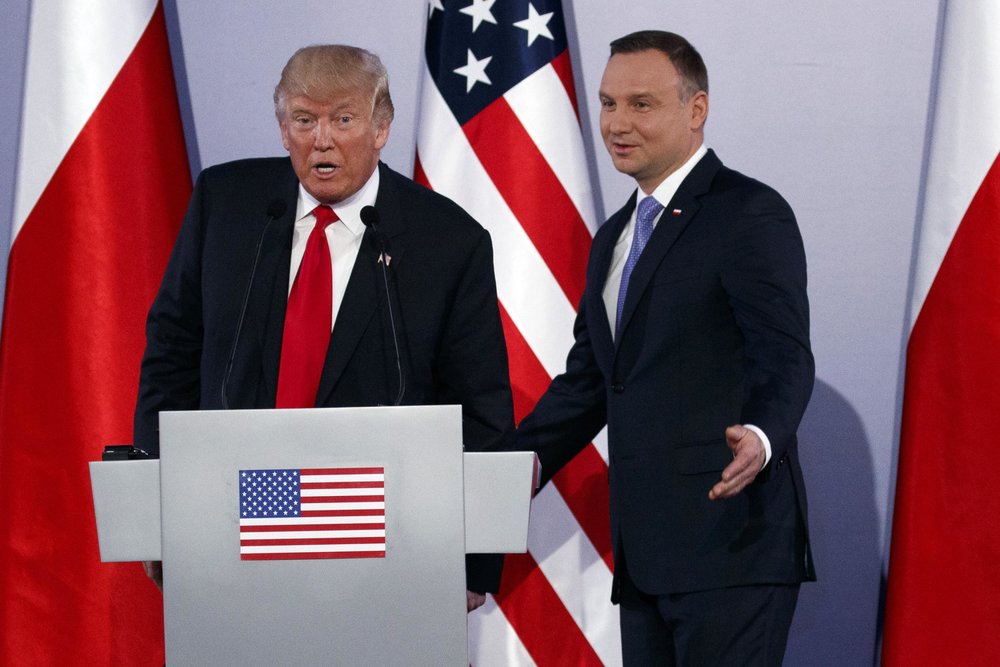
Poland is weak and submissive enough to host U.S.’ aggression against Iran and Russia: expert

By Payman Yazdani
TEHRAN - Commenting on the U.S. isolation and differences with its heavy weight European allies on Middle East, Anthony Cartalucci says that poland is the only weak and submissive european nation which is forced to host American’s aggrasion against Iran and Russia.
The U.S. State Department said in a statement on January 11 that an anti-Iran meeting will take place in Warsaw on February 13-14.
 
U.S. Secretary of State Mike Pompeo said that the meeting would focus on international cooperation on Middle East stability and peace and freedom and security in this region, and that includes an important element of making sure that Iran is not a destabilizing influence.
Many experts and officials around the world have expressed their doubt on success of the conference and have announced they will not attend the meeting.
The issue was discussed with Bangkok- based geopolitical researcher Anthony Cartalucci.
Following is the full text of the interview with him:
Q: Despite having heavyweight allies in Europe like Germany and France, why the U.S. has chosen a weak European country like Poland to host the event?
A: Washington's European allies have different ideas regarding the Middle East, especially regarding Iran - the undermining of which drives much of American foreign policy in the region. Poland has a compromised government and is easily coerced by the U.S. - it will eagerly host America's meeting and politically bolster any outcome the U.S. arrives at. Poland serves a similar, subordinate and submissive role in America's aggression toward Russia. 
Q: Iran has had a significant role in defeating ISIL and terrorist groups in the region, why the U.S. accuses Iran of destabilizing the region? How do you see the U.S.’s own role in destabilizing the region? 
A: U.S. rhetoric accusing Iran of destabilizing the region is a form of political projection aimed at diverting attention away from its central role in doing just that - destabilizing the region. By all accounts, the rise of ISIL is a direct result of U.S. military intervention in the region beginning with the illegal invasion and occupation of Iraq in 2003. Many sources including the United States' own Defense Intelligence Agency suggest the U.S. and its allies intentionally created ISIL to isolate and overthrow the Syrian government when speedy regime change failed to materialize in 2011. 
By blaming Iran for America's own destabilization of the Middle East the U.S. can politically undermine an adversary, deflect blame away from itself, and search for an additional pretext to remain involved in the region. 
Q: Will any plan to stabilize the region be successful without Iran? 
A: The U.S. does not seek to stabilize the Middle East. But if we imagine Washington did want to stabilize the region, it would be working with Russia, Syria, and Iran as well as with the Arabian monarchies to create a balance of power within which cooperation and healthy competition could take the place of the deadly and protracted conflict we see today. The fact is Iran has significant influence in the Middle East - which makes sense since it is a large Middle Eastern nation. That the U.S. refuses to recognize this or work with Iran helps to further understand the true source of what undermines the region's stability.    
Q: How successful do you see the conference?
A: The fact that the United States was forced to hold the conference in Warsaw - because Poland is the only nation weak and submissive enough to host such an event - already bodes poorly for the U.S. and whatever it hopes to accomplish with the conference. The conference is allegedly aimed at discussing the need to confront Iranian "extremism," which the U.S. ironically has spent years fighting by sponsoring terrorist organizations appearing on the U.S. State Department's own foreign terrorist organization lists.
The conference has been described by the Iranian government as an "anti-Iranian circus." Honestly, I think there is no better way to describe it.     
Q: UNSC is responsible for the peace and security of the world, why is the U.S. trying to lead the international community out of the legal framework of the UNSC?
A: Like any outlaw - be it an individual or a nation's government - when laws do not suit them they walk around them. The United Nations and its charter are clearly an obstruction to U.S. ambitions around the globe - including in the Middle East regarding Iran. The fact that the U.S. must not only do this outside the United Nations but also - now - outside allied circles it has depended on for decades - points to Washington's growing isolation upon the global stage. 

Thursday, November 22, 2018

Trump-launched second Cold War would lead to fiasco for US

Trump-launched second Cold War would lead to fiasco for US

By Hossein Ziaee*

The widening gap between the world powers on the two sides of the Atlantic Ocean has, at present, become noticeable more than ever.
This claim was backed up by the sensational and rousing speech by French President Emmanuel Macron in the German federal parliament (the Bundestag), his reemphasis on forming a united European army and the necessity of standing against US unilateral policies and, more importantly, German Chancellor Angela Merkel voicing strong support for him and his remarks.
This came as addressing a trade conference in Paris last week, French Finance Minister Bruno Le Maire warned that the world currently faced a new Cold War over trade triggered by tensions between China and the US, describing as perilous Washington’s trade policies toward Beijing.
“The real risk now is that we enter into a Cold War between China and the United States,” said Le Maire, “in which all countries, including Europe, come out losing. This open trade war will be economic suicide for the whole world. It is quite simply stupid.”
On the other hand, speaking at the Asia-Pacific Economic Cooperation (APEC) summit last week, Chinese President Xi Jinping harshly lambasted egocentric US economic policies, calling on the world to unite against it.

In addition, Moscow is on its toes to react duly in the face of Washington’s belligerent policies following the US’ threat of a unilateral withdrawal from the 1987 Intermediate-range Nuclear Forces Treaty (INF) with Russia — dating from the Cold War, that has kept nuclear missiles out of Europe for three decades — and the plan by the North Atlantic Treaty Organization (NATO) to deploy more US nuclear weapons in Europe.
Apparently, the growing differences between Europe and the US on the one hand, and an increase in Washington’s hostilities toward Beijing and Moscow, on the other, are inevitably laying the groundwork for a second Cold War.
In fact, the international community is currently witnessing attempts by Donald Trump to shape his latest political behavior in the international arena: An ongoing effort to launch a second Cold War.
This new round of Cold War has already been started by the US with the Trump administration adopting the populistic and nationalistic “America First” policy, declaring a trade war on all its trade partners, resorting to sanctions towards countries that are against its strategies, deploying more nuclear weapons in Europe and pulling the US out of the INF.
There are, however, a number of differences between the first and second Cold Wars:
  • While the first Cold War was based on a bipolar and ideological and military confrontation, the second one is being launched in a globalized and multipolar atmosphere characterized by economic domination-seeking efforts.
  • During the first Cold War, the US had the upper hand and global support. However, in the second one, it has turned into an isolated member of the international community, failing to receive any international support.
  • The most important feature of the present Cold War is that a united Europe has lined up against the US, putting up a global front characterized by multilateralism in the face of US unilateralism.
  • China, a military power and the world’s second largest economy, along with Russia, is capable of dealing severe military and economic blows to the US in a second Cold War.
  • The second Cold War launched by the US is, in essence, aimed at compelling other states to pay ransom to Washington, depriving the Trump administration of any international credit.
  • In the present Cold War, unlike the previous one, the US is no longer a global superpower and sees its political influence over the international community waning.

A report issued by the US National Defense Strategy Commission, whose board members are appointed by the House and Senate Armed Services committees, claimed Washington would be at risk of losing a major war with either key rivals, Russia and China.
The extent of the growing US unilateralism has led Europe to shift focus from Washington to the East.
Apparently, unlike the first one, the probable outcome of the second Cold War for the US would be nothing but a fiasco for the country.
* Hossein Ziaee is a freelance Iranian journalist.

Saturday, November 03, 2018

West and Saudi's Petro Dollars

By Mohammad Ghaderi 
TEHRAN - Although Western countries have condemned the murder of Jamal Khashoggi by Mohammad bin Salman, they are simultaneously trying to cover the unimaginable crime of the Saudis. 
Khashoggi, the Saudi Arabian journalist and author, entered the Saudi Arabian consulate in Istanbul on 2 October 2018, but did not leave the building. Amid news reports claiming that he had been killed and dismembered inside, an inspection of the consulate, by Saudi Arabian and Turkish officials, took place on 15 October. Initially the Saudi Arabian government denied the death, claiming Khashoggi had left the consulate alive, but on 20 October admitted that Khashoggi was killed inside the consulate, claiming he had been strangled to death after a fight had broken out. This was later contradicted when, on 25 October, Saudi Arabia's attorney general stated that the murder was premeditated.
Although Western governments tried to show that they're severely against  this brutal act by bin Salman, sending signals about Saudi petrodollars by countries such as Germany, Britain and France have once again uncovered the true face of the European troika in the international system. Britain and France (along with the United States of America), as the three permanent members of the Security Council, who have veto power due to the unfair structure of the world today, prefer their "commercial interests" to any other factor, including the lives of innocent people. However, this time it's no more about Western governments; people all around the world raised to protest the murder of Jamal Khashoggi.
No doubt, in this equation, Theresa May, Merkel, and Macron are no more than mere losers, and even Saudis' billions of petrodollars can't stop this process. Here are some points that should be accordingly taken into consideration:
The projection of the European authorities towards the murder of Khashoggi is quite noticeable. For example, as the Spiegel and other German sources reported, German Chancellor Angela Merkel announced that she'll stop exporting arms to Riyadh until all the aspects of Jamal Khashoggi case is brightened. Although the German Chancellor may think that such a move is considered as a kind of humanitarian and anti-dictatorial gesture, but we're not to forget that Saudi Arabia has bought 416 million euros of military equipment from Germany since the beginning of 2018. According to existing evidences, after Algeria, Saudi Arabia is the second largest importer of weapons from Germany.
The next point is about the way West reacts to the Khashoggi case. Western authorities, such as Trump, have apparently condemned the kidnapping and murder of Saudi journalist Jamal Khashoggi by bin Salman and his men, while on the other hand, they has been repeatedly emphasizing their strong financial ties with Saudi Arabia! In other words, the European troika and even some other members of the European Union have shown that they lack the will to deal with the case of khashoggi's murder. The soft reaction of Western officials to the case of Jamal Khoshoggi once again challenged the selective and instrumental approach of human rights claimants to this issue. Meanwhile, governments and security officials in the West are using all their capabilities to prevent their citizens from "knowing more" about this case. The fact is that the governments of the United States and France have used both their public and secret diplomacy capabilities to prevent the murder of Khashoggi by Saudi Crown Prince from turning into a hot topic among their citizens.
Given that the "Saudi exoneration" project is no longer possible regarding his brutal murder and dismembering, the European troika has moved towards the project of "Managing Western Public Opinion" through adopting democratic gestures. However, this won't change the West's fundamental policy in support of Al Saud's crimes.
European players, especially the three countries of Germany, Britain and France, have spent a lot on organizing their "operational", "political" and "media" approach in the international system. But the power of the independent media, and the disclosures made by independent journalists on such cases, prevent the realization of this "hideous game." At the moment, those like Macron, Merkel and Theresa May should be held accountable for their coordination with Saudi Arabia in the killing of innocent people in Yemen, especially Yemeni children. Today, people around the world are carefully following the case of Jamal Khashoggi, and such public awareness is certainly not a good news for Western partners of Riyadh and supporters of Saudi Arabia's crimes in the West Asia region.