Showing posts with label Emmanuel Macron. Show all posts

Monday, December 09, 2019

High Time for NATO’s End for the Sake of Global Peace

By: Kayhan Int’l 
It would indeed be a sigh of relief for all mankind and the modern world’s quest for peace and co-existence, if one of the most brutal and war-mongering military alliances in history, finally ends its unwarranted existence.
The recent summit in the British capital London, where heads of member states of the North Atlantic Treaty Organisation (NATO) met to dispute with each other, is a firm indication that death is nigh for seventy years of militarism by western imperialist powers and their terrorizing of the Free World.
France’s President Emmanuel Macron has rightly called NATO "Brain Dead” and although the quixotic US President Donald Trump tried to oppose this apt description by contradicting his own phrase of the election days as "NATO is obsolete”, the fast approaching end cannot be long put off.
Trump, a criminal without the least doubt, would like to use NATO for his extra-territorial ambitions against China’s growing global influence, and possibly against North Korea, and in the Persian Gulf. Most NATO states, however, have refused his bidding.
Founded in 1949 by the US and 11 other western countries on the pretext of curbing the rise of communism/socialism that was sweeping across post World War 2 Europe, NATO was a white elephant from its beginning.
It could not deter the communist east of Europe, led by the Soviet Union, to set up the Warsaw Pact six years later in 1955. Through these two military alliances the world unfortunately became a battleground of the so-called ‘Cold War’, while NATO and Warsaw Pact never actually clashed with each other, because of the balance of terror of their huge nuclear and other unconventional arsenals.
They, however, used proxies to test the efficiency of their weapons and in the process destabilized countries.
In 1991, on the threshold of the disintegration of the Soviet Union, two years after collapse of the Berlin Wall and removal of the so-called ‘Iron Curtain’, the Warsaw Pact was disbanded, thanks to the peace promoting policies of President Mikhail Gorbachev, the last leader of the USSR.
If there was honesty in the leaders of the West, or if there were any statesmen in the US, Britain, France, and Germany, of the calibre of Gorbachev, they could have reciprocated the goodwill by announcing the end of NATO, since there was now no need for this military alliance to exist.
This did not happen. On the contrary NATO, in violation of its promise to Moscow following the end of cold war, expanded and pushed towards the east, growing from its original 12 members to 29 member countries at present.
North Macedonia is set to join next year, while NATO has expanded far beyond the North Atlantic, entering into partnership with Colombia in 2017 on the Pacific coast of South America, while Trump is advocating full membership for Brazil.
In the Muslim World, the US would love to see NATO forge alliances with the illegal Zionist regime against the Palestinian people’s struggle for statehood, as well as with the reactionary regimes, such as Saudi Arabia, for terrorizing the bid for democratic self-rule by the long-suppressed Arab people of West Asia and North Africa.   
In other words, Washington wants NATO to serve as a handy tool against the Islamic resurgence and against the resistance forces and governments, inspired by the Islamic Republic of Iran to unite the Ummah on the platform of independence from the neo-colonialists.
It is worth recalling that in 1992, a year after the disbanding of Warsaw Pact, NATO interfered in Bosnia-Herzegovina with some 60,000 troops on the pretext of serving as ‘peace-keepers’ but actually to prevent the emergence of a sovereign European Muslim state by tacitly enabling the Serbs to massacre tens of thousands of Muslims.
As a matter of fact, NATO has a bloody history of bombing civilians and committing war crimes. In 1999, NATO engaged in military operations without UN approval in Yugoslavia. Its illegal airstrikes during the Kosovo War left hundreds – if not thousands – of civilians dead.
In 2001, thousands of kilometers away from the North Atlantic, NATO teamed up with the US in invading and occupying distant Afghanistan, where it is still bogged down with no exit in sight.
In 2003 NATO joined Washington’s invasion of Iraq, and cannot absolve itself of partnering the US in the killing of, whether directly or indirectly, over 1.5 million Muslims, in addition to the displacement of millions of others.
In 2011, NATO forces illegally invaded Libya to remove and kill its leader Mo’ammer Qadhafi, thereby creating a failed state that continues to be wracked by civil war, with Libyan Muslims killing each other for no reason and rhyme.
In the same year, some NATO member states, Britain and France, involved themselves militarily against the legal government of President Bashar al-Assad, as part of efforts to support the macabrely murderous terrorists streaming in through NATO member Turkey from different parts of the world.
Moreover, as millions of people fled their destroyed towns and cities, rather than take responsibility for these refugees, NATO states have turned back desperate migrants on the Mediterranean Sea, letting thousands die.
To sum up, NATO is the cause of the new arms race with Russia, including upgrading of nuclear arsenals. Therefore, the sooner it is disbanded the better for world peace and stability, since a relic of the cold war shouldn’t be reconfigured to prolong the US domination of Europe, or to pick up fights with Russia, China, and the Resistant Front of the Muslim World, or to launch suicidal space wars.

Wednesday, December 04, 2019

NATO at zero point!

By Hanif Ghafari

The NATO summit in London shows clearly that the North Atlantic Treaty is in a serious crisis for its survival. In recent days, Western analysts have analyzed and evaluated various aspects of the tensions and challenges among NATO members. The majority of NATO members are European countries.
The reality is that the crises facing the United States and NATO members will not end soon. At least until the arrival of Trump at the White House, these concerns will remain. On the other hand, the foreseeable future of the president of the United States will face Western actors with serious dilemmas.
U.S. President Donald Trump continues to insist on increasing NATO defense spending. On the other hand, French President Emanuel Macron's recent remarks about NATO's brain death show that some European NATO members are also aware of the White House's negative approach to the North Atlantic Treaty.
Relations between Russia and NATO are now in the worst condition after the Cold War. "Mikhail Gorbachev", the last Soviet President, had warned about the re-start of Cold War between the White House and the Kremlin before. But now Russian officials believe that the constant and extensive conflicts between Moscow and the West lead them too much more complicated conditions than that of the Cold Wartime.
The recent NATO summit in London will not only bring the North Atlantic Treaty Organization closer together, but it will also strengthen the existing crises between the US and Europe.
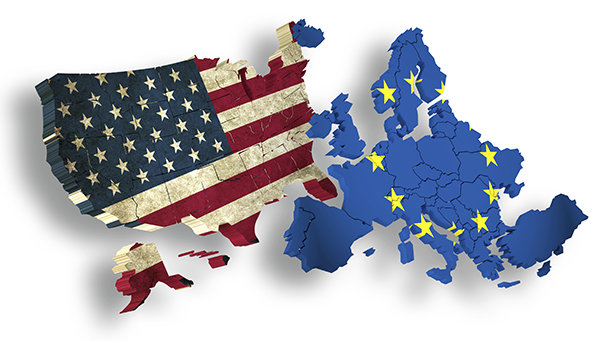
Finally that One of the issues that has led to the frustration of European citizens from this collection is the European Union's dependence on the United States. While U.S. former  National Security Advisor John Bolton and Trump have repeatedly expressed their opposition to the existence of the European Union and the Eurozone, Europe has not taken any steps towards independence from the United States. European officials have made mistakes in their calculations and attitudes toward the US government. This big mistake could lead to the loss of the European Union and the Eurozone. Undoubtedly, people like the German Chancellor Angela Merkel and French President Emmanuel Macron once realized their mistake will be too late. Can European authorities be able to understand this real danger?

Tuesday, November 26, 2019

Will NATO follow the same way as the Warsaw Pact?

By Hamid Bayati

French President Emmanuel Macron criticized NATO on November 7, calling the current situation of the organization a “brain death”. Macron’s remarks once again led to heated debates regarding a possible collapse of NATO.
In an interview with the Economist, the French president criticized lack of coordination in NATO as well as the “unpredictability” of U.S. behavior.
Senior U.S. officials have taken similar approach toward NATO. On November 10, Robert O'Brien, the U.S. national security adviser, said, “I think the cracks of that have formed in the alliance are because we have members of the alliance that aren't paying their fair share, that aren't spending money on defense.”
During meetings with European officials and also at NATO summits, Trump and other senior U.S. political and military officials have repeatedly called for greater share of NATO costs by Europe. The U.S. has asked Europeans to increase their military budget to 2% of their GDP.
After taking power, Trump called NATO an obsolete organization that incur significant costs on the U.S. and said he would not support the alliance.
In addition, the United States, in line with Trump’s unilateral approach, does not consider any role or importance for its European allies in significant security and military decisions by NATO. Many NATO members have noticed Trump's negative attitude toward the alliance.
NATO formed in 1949, shortly after the Soviet Union tested its first atomic bomb. In the beginning, 12 countries joined NATO, including Belgium, Canada, Denmark, France, Iceland, Italy, Luxembourg, the Netherlands, Norway, Portugal, Britain, and the United States. The number of countries joined NATO gradually increased to 29.  
A collapse of the U.S.-European military alliance, the intensification of disputes among NATO members regarding the recent Turkish offensive into Syria, and President Recep Tayyip Erdogan’s purchase of Russian S-400 system, which rivals the U.S.–European military system, are the factors that have caused current chaos in NATO and may accelerate NATO fragmentation just like the Warsaw pact.
Crisis within NATO is headed for more intensification and its collapse seems almost definite.  One of the best evidences in this regard is the joining of two NATO members to the maritime coalition that the U.S. claims has formed to support safe shipping in the Persian Gulf.

Saturday, September 28, 2019

European states have bowed to US pressure on Iran

Marco Carnelos
A recent communique from France, Germany and the UK blames Tehran for escalating tensions in the region, instead of the real culprit: Washington


German Chancellor Angela Merkel meets Iranian President Hassan Rouhani on the sidelines of the UN General Assembly in New York on 24 September (Handout/Iranian Presidency/AFP)
If an unaware observer had to get an idea of the enduring dispute between Iran and the international community by reading the joint communique that France, Germany and the UK issued on 23 September, she would have easily drawn several conclusions. 
These would include that Iran some time ago signed an international agreement to limit its nuclear programme; that the deal was unanimously ratified by the UN Security Council; that Iran subsequently began to violate it; and that instead of reconsidering its position, Iran made further provocations by attacking Saudi Arabia’s oil facilities on 14 September, sowing panic in the region and turmoil in the international energy markets.

Mistaken assumptions

Although always sceptical about a positive European role on the matter, I recently argued about its potential added value in decreasing tensions, which could come not from an alignment with the US, but only by providing a balancing role among all players. 
Scepticism proved justified. Despite recent appreciable efforts to restart dialogue, in particular by French President Emmanuel Macron, this joint declaration has everything but a balancing role. It is worth examining it word by word, to highlight some mistaken assumptions that we could have expected from the US, but not from top European players.
Dealing with the dire situation in the region only through the prism of stability ... risks sending a message that could be fatally misunderstood
The communique notes: “We, the leaders of France, Germany and the United Kingdom, recall our shared common security interests, in particular upholding the global non-proliferation regime and preserving stability in the Middle East.”
Understandable. Yet, drafted in such a way and in the current political context, this sentence gives the impression that those interests are primarily linked to the maintenance of the non-proliferation regime in the region and to the preservation of stability. 
Of course, counterproliferation is crucial, especially in volatile area such as the Middle East; yet, such a commitment would sound more credible if it addressed all countries in the region, including those that already possess nuclear weapons and have thus far refused to sign the 1968 Treaty on the Non-Proliferation of Nuclear Weapons

Moral zeal

Moreover, no explanation is offered for what the term “stability” should mean in the current circumstances. Are these three countries arguing that those who already possess nuclear weapons in the region are entitled to keep them, while other countries are not? If so, it would be better to have the courage to claim this openly and clearly. 
Furthermore, dealing with the dire situation in the region only through the prism of stability - rather than the promotion of peace and justice - risks sending a message that could be largely, and fatally, misunderstood.
The communique goes on to note: “We condemn in the strongest terms the attacks on oil facilities on Saudi territory … and reaffirm … our full solidarity with the Kingdom of Saudi Arabia.”
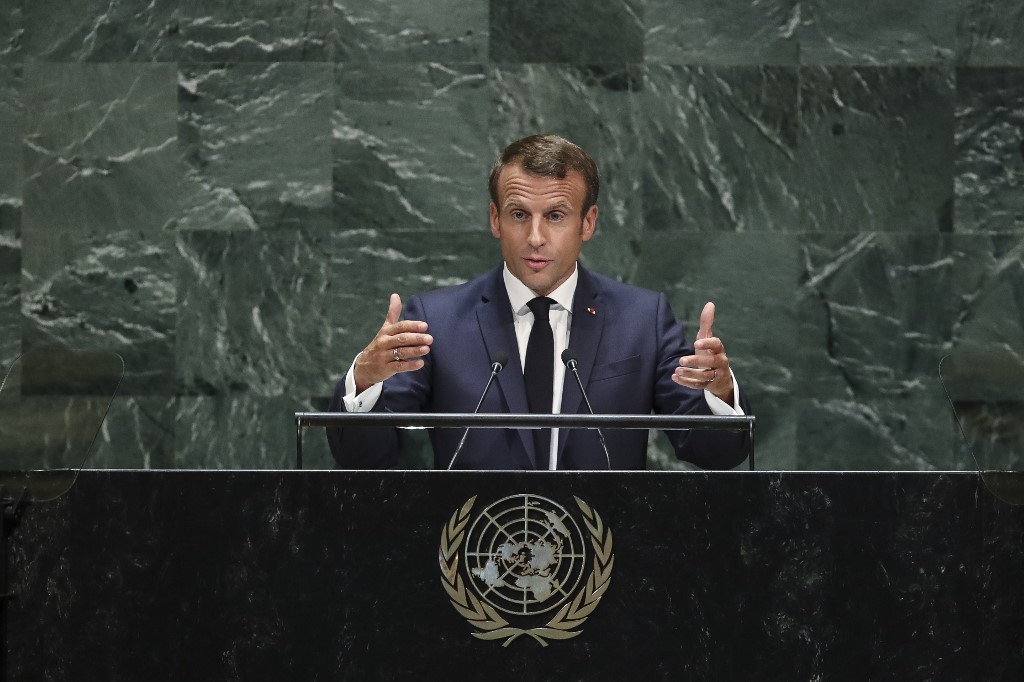
French President Emmanuel Macron addresses the UN on 24 September in New York (AFP)
Given that such attacks fortunately did not cause any human loss, this moral zeal could have been far more credible had it been manifested in an equally solemn way with regards to the many civilian casualties of the ongoing conflict in Yemen. 
“It is clear to us that Iran bears responsibility for this attack,” the statement adds. “There is no other plausible explanation.” 
Regrettably, this claim is apparently based only on reasoning, rather than strong evidence provided by reliable intelligence. Taking a sharp political position on this basis could be risky. Given recent unfortunate precedents in the region, more evidence and less assumption would have been desirable.
The Houthis have claimed responsibility for the attacks, and nothing conclusive has been presented to disprove their assertion.

Economic blockade

“These attacks may have been against Saudi Arabia but they concern all countries and increase the risk of a major conflict,” the communique states.
True. Still, the public also deserves an explanation as to why an attack on Saudi Arabia would have such dire consequences, while the ongoing attacks in Yemen, or in Syria, do not provoke the same apprehension.
This is undeniable, but to achieve a successful de-escalation in the Middle East, it is necessary to be aware of the causes of the escalation. The problems did not begin with the attacks on the Saudi oil facilities or on the tankers in the Gulf earlier this year, but with the US withdrawal from the Iran nuclear deal in May 2018 - which also violated UN Security Council Resolution 2231 - and its harsh sanctions against Iran, which amount to an economic blockade. This is an act of war, according to international law.It goes on to note: “The attacks also highlight the necessity of de-escalation in the region through sustained diplomatic efforts and engagement with all parties.”
A correct connection between causes and effects of events is crucial to deal effectively with them.

The need for balance

“We urge Iran once again to reverse its decisions to reduce compliance with the deal and to adhere fully to its commitments under it,” the communique states.
It would have been much better if this exhortation had been preceded by a similar request to the US to reverse its 2018 withdrawal from the deal. While this probably would have gone nowhere, at least it would have shown a more balanced approach, a crucial prerequisite (except for the Western world, apparently) for anybody legitimately aspiring to a mediating role.
It would be easy to expect this from UK Prime Minister Boris Johnson, but far less so from Macron and German Chancellor Angela Merkel
The joint statement also contains a bit of humour - although it’s doubtful it would be perceived as such in Tehran - when it notes that the three countries “reiterate our conviction that the time has come for Iran to accept negotiation on a long-term framework for its nuclear programme”.
For the unaware observer evoked at the beginning, Iran accepted such a negotiation years ago, reaching a positive conclusion with the 2015 nuclear deal - an agreement with which, until earlier this year, Iran had fully complied, according to the International Atomic Energy Agency.
The 23 September joint statement confirmed my original suspicion: that the UK, France and Germany have finally bowed to the US position. It would be easy to expect this from UK Prime Minister Boris Johnson, but far less so from Macron and German Chancellor Angela Merkel.
Marco Carnelos
Marco Carnelos is a former Italian diplomat. He has been assigned to Somalia, Australia and the United Nations. He has served in the foreign policy staff of three Italian prime ministers between 1995 and 2011. More recently he has been Middle East Peace Process Coordinator Special Envoy for Syria for the Italian government and, until November 2017, ambassador of Italy to Iraq.

Tuesday, September 24, 2019

Iran to Propose ‘Coalition of Hope’ in Persian Gulf

TEHRAN -- President Hassan Rouhani headed for New York on Monday to attend the UN General Assembly on a mission to win support for Iran against "cruel" pressure from the United States.

Before departing, Rouhani said his delegation was heading to the UN gathering despite Washington's reluctance to issue them U.S. visas.
Tehran and Washington have been at loggerheads since May last year when President Donald Trump abandoned a 2015 nuclear deal and subsequently began reimposing sanctions on Iran in a stated campaign of "maximum pressure".
"It is essential for us to take part in the UN General Assembly and talk at various levels," Rouhani said at Tehran's Mehrabad airport.
"The cruel actions that have been taken against the Iranian nation and also the difficult and complicated issues that our region faces with them need to be explained."
Rouhani also said Iran would put forward a Persian Gulf peace plan at the UN meeting.
Under the plan dubbed the Hormuz Peace Endeavour, or HOPE, he said, "all the coastal states of the Persian Gulf are invited to join this coalition to provide and maintain regional security".
The peace initiative, he said, is aimed at establishing long-term peace in the Persian Gulf, something he said is simply not achievable as long as outsiders are present.
"Of course, the plan that will be laid out at the United Nations won't be just about security, but rather economy and other issues, all in line with security matters."
The HOPE initiative comes against the backdrop of tensions in the Persian Gulf, where several tankers and commercial vessels have come under suspicious attacks by unknown parties while attempting to cross the strategic Strait of Hormuz.
The United States has blamed the sabotage attacks on Iran, using them as a pretext to build a coalition that would patrol the region.
The U.S. is trying to project the mission as a bid to secure the Persian Gulf, but "the Europeans argue that Washington created the problem in the first place by trying to kill off Iran’s oil exports", the New York Times wrote last month.
Iran has dismissed the allegations and called the attacks false flag operations, warning regional neighbors to watch out for plots by outsiders to destabilize the region.
Rouhani echoed that stance on Monday, saying any solution to calm tensions must come from within the region and what he called a "coalition of hope."
"We believe the solution for the region comes from inside the region and those who come from the outside can never bring peace and security," he said.
Citing America's military interventions in the Middle East as an example, Rouhani said since entering the region in 2001, the United States has failed to bring back calm to any of the countries that it has deployed forces to.
"I hope we can roll out this plan and tell the world that Iran is looking for lasting peace in the region and is willing to" discuss it with other countries with the UN involved in the process, he said of his HOPE initiative.
Rouhani also pointed to the September 14 attack on Saudi Arabia's oil facilities by Yemen's Houthi Ansarullah movement and the biased reactions that it received from Riyadh's close allies, specially the United States.
The damage from the retaliatory Yemeni attack was so vast that the kingdom lost more than half of its oil output overnight, causing global oil prices to jump.
American officials, along with their Saudi allies, have since pointed the finger at Iran without any evidence even though the Houthis have on several occasions claimed responsibility for the attack, saying it is only one of their many such strikes in retaliation for the Saudi-led war.
"The Aramco (attack) is the outcome of the aggression that Saudi Arabia, the United Arab Emirates and the Zionist regime have been leading against Yemen," Rouhani said.
"If they (the Saudis) don't initiate aggression, they (the Yemenis) won't hit back and when they do and see the response, it is hard for them to swallow" the retaliation, the Iranian president continued. "Their cruelty is justified in their own eyes."
Rouhani said this year's General Assembly was significant as it came at a time when the U.S. has hit the rock bottom against Iran after the failure of its so-called "maximum pressure" campaign of sanctions.
"We are headed to the UN while the Americans have pushed their sanctions campaign so far that they admit there is nothing left for them to sanction," the president said, noting that the failures had put Washington in a state of "absolute desperation" against Iran.
Rouhani flew to New York on Monday morning. He will deliver a speech at the 74th UN General Assembly later on Wednesday and meet with a host of foreign leaders and Iranians living in the U.S. before heading back on Thursday evening.

Tuesday, September 03, 2019

Now Or Never For Trump-Rouhani Meeting

by Robert Czulda
Recent actions against the safety of tankers in the Persian Gulf have once more destabilized this subregion and have heightened the anxiety of numerous commentators. Both attacks on infrastructure and the capture of tankers show that the situation has become extremely serious. Further escalation could unintentionally turn into an open confrontation. Another war in the Persian Gulf—especially with a large and important country like Iran—would have global consequences, since the Strait of Hormuz is the world’s vital oil artery. According to available data, roughly 21 million barrels of oil left this narrow chokepoint every day in 2018.
Both the United States and Iran are well aware of the stakes of any direct confrontation. Donald Trump and his aides surely know that an open war with Iran would be a disaster that would bury his chances of re-election next year. Iran also cannot afford a war or any disruptions in the Persian Gulf. According to official data, 93% of Iran’s trade goes through the Strait of Hormuz. Decision-makers in Tehran must also be aware that continuing their confrontational approach will not produce desirable results. Logic suggests that for both parties, it is time to consider a change in strategy.
The recent rhetoric from both Iran and the U.S. shows a desire to demonstrate strength and determination, as well as reluctance to surrender in the face of pressure. President Donald Trump wanted to demonstrate his power and domination over a rival in order to strengthen his position for future interactions. This is a negotiation strategy that is typical of aggressive and risky businessmen, and Trump is undoubtedly one of them. At the same time, Iranian President Hassan Rouhani is aware of his domestic opposition. Were he to show any weakness in the face of U.S. pressure, it would undoubtedly strengthen Iranian conservatives, who favor a strong stance against the United States and in general are against direct talks with Washington. Moreover, resistance is part of Iran’s strategic culture, and Rouhani’s strong approach was in keeping with that principle. In other words, what we have seen in recent weeks was mainly theatre meant for the public—not only the international community, but also the Iranian and U.S. publics. 
Although according to press reports, the arrival of Iranian Foreign Minister Mohammad Javad Zarif to the G7 Summit in France was a surprise, it is difficult to imagine that the United States was entirely unaware of French President Emmanuel Macron’s intention to invite him. Trump himself has suggested that he knew Zarif was coming. It is significant that President Trump seemed to change his approach toward Iran during the G7, announcing that he is ready to meet with Rouhani and even suggesting that he would not oppose a European proposal to offer Iran a short-term credit line.
Such a sudden change in his attitude toward Iran may seem surprising, but this variability is part of Trump’s presidency. Before he met with North Korean leader Kim Jong-un, he had threatened North Korea several times with a war and even deployed U.S. aircraft carriers near the Korean Peninsula. This is a typical bad cop/good cop strategy, but in this version Trump interchangeably plays both roles. That he’s applied the same strategy to Iran should therefore not be surprising at all. Most likely, Tehran is aware of Trump’s intentions. Otherwise it would not have recently withdrawn its S-300 long-range air-defense system from the Persian Gulf to Central Iran.
After the recent phase of tension in the Persian Gulf, there will now hopefully be a phase of relaxation. This is the moment to start diplomatic efforts and try to organize a meeting between Trump and Rouhani. The window of opportunity is shrinking. President Trump cannot afford a war with Iran while a new agreement with Tehran—even if basic and interim—would be welcomed by the U.S. public, which will choose a new president in November 2020. If there is any moment when Trump would be ready to make some concessions, from a position of strength, it is right now. Iran’s strategy of waiting to see whether a new, Democratic administration would be willing to re-enter the 2015 nuclear deal is a risky one, as Trump has a high chance of being re-elected. Moreover, the Iranian economy cannot wait that long. Tehran seems desperate and is reportedly ready to accept permission to export 700,000 bpd of oil and receive payment in cash, with hopes of reaching 1.5 million bpd. However, this will not happen without a green light from the United States, so if Iran wants to sell oil, it will have to make an agreement with Washington.
Rouhani and Zarif also cannot wait, because next year Iran will hold new parliamentary elections. Without any deal, so-called reformists are very likely to lose some of their power. This is the last good moment for Rouhani and his camp to start negotiations. A new, interim deal, which would give Iran a chance to sell some oil, would be very helpful if the reformists want to remain in power or at least limit their losses in 2020. Iranian hardliners are more assertive and anti-Western, and they are not keen to have any new agreement with the West.
Is a meeting between Rouhani and Trump likely in the near future? Probably not. But as long as it is possible, everything should be done to make it a reality. Both Rouhani and Trump have signaled their willingness to attend such meeting. France could serve as a broker. Of course, there are some serious challenges that cannot be easily ignored. Rouhani said that the United States must first lift the sanctions it has imposed on Iran. Keeping in mind Trump’s often erratic behavior, we cannot rule out the possibility that, in order to make the Iranians more eager to attend such a meeting, he might agree to temporarily suspend some sanctions and provisionally allow the Iranians to sell some of their oil. It is a possibility worth exploring. If Iranian conservatives win next year’s elections and if Trump is re-elected, the window of opportunity for talks will close. It is now or never.
Robert Czulda is an assistant professor at the University of Lodz, Poland and a former visiting professor at Islamic Azad University in Iran, the University of Maryland (Fulbright Senior Award) and National Cheng-chi University in Taiwan. He is the author of Iran 1925 – 2014: From Reza Shah to Rouhani.

Can Macron’s Iran Initiative Succeed?


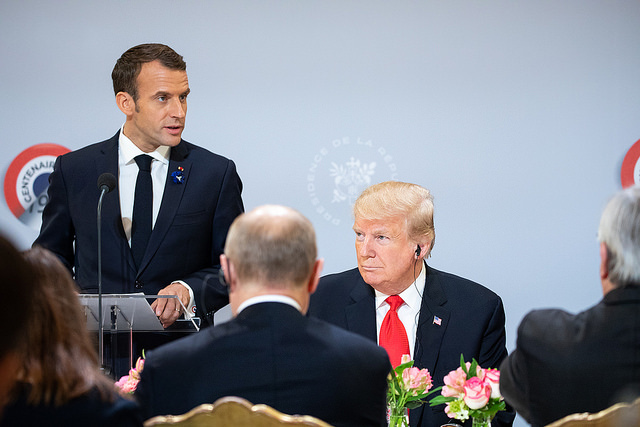
Emmanuel Macron and Donald Trump (White House via Flickr)
by Nader Entessar and Kaveh L. Afrasiabi
In the aftermath of the G7 summit, which was marked by the surprise appearance of Iranian Foreign Minister Mohammad Javad Zarif, the obvious and exceedingly important question is whether President Emmanuel Macron’s (rather bold) Iran diplomacy can succeed. Pronouncements by both Macron and his foreign policy team make it clear that the principal objectives of this diplomacy are threefold: to defuse and de-escalate the growing tensions in the Persian Gulf, to prevent the resumption of the Iran nuclear crisis, and to reach a new understanding between Tehran and Washington by facilitating a near future summit involving the U.S. and Iranian presidents.
Both Donald Trump and Hassan Rouhani are due to attend the UN General Assembly in September, and the momentum Macron’s efforts have built toward a possible meeting in New York may yield positive results. At the moment, both sides have engaged in the art of “mixed signaling.” Rouhani has made the lifting of U.S. sanctions a prerequisite for a face-to-face meeting, and Zarif has cast doubt on the possibility of a meeting while, at the same time, suggesting that—with sufficient preparatory groundwork—some ice in the glacier of U.S. hostility toward Iran could be broken in the near term. Along these lines, an Iranian delegation is heading to Paris to explore “diplomatic progress,” and Rouhani’s chief of staff Mahmoud Vaezi has stated that the recent talks with France relate to Iran’s rights, the 2015 nuclear accord, and reducing the harm caused by U.S. sanctions. Reacting to Rouhani’s stated condition, U.S. National Security Advisor John Bolton has countered with a U.S. prerequisite for lifting sanctions on Iran—namely, Iran’s willingness to enter into a new deal with the U.S. covering both nuclear and non-nuclear issues.
Clearly, neither side will consent to the demands of the other ahead of direct negotiations, as to do so would be tantamount to putting the cart before the horse. Rather, the aim should be to negotiate without any preconditions and strive for a meaningful breakthrough by resorting to the parameters of creative and flexible diplomacy. The advantage of Macron’s intervention is that he has the solid backing of other major European powers and has increasingly managed to gain Iran’s trust as well as Trump’s interest, which is a welcome departure from merely two months ago when Trump criticized Macron for sending the wrong signals to Iran.
Trump’s turnabout at the G7 summit, on the other hand, is attributable to the U.S. failure to build an international coalition against Iran. This has allowed Iran to move closer to Russia in response to U.S. pressure by, among other things, planning for a joint military exercise with Russia in the Persian Gulf, traditionally U.S. turf, in the near future. Unless the Trump administration relents on its “maximum pressure” campaign against Iran, the present trend for a greater strategic symbiosis between Tehran and Moscow will continue, which would represent a setback for vital U.S. interests in the Middle East. Not only that, Iran holds leverage in that it can threaten the safety of oil tankers passing through the Strait of Hormuz, in addition to the threats posed by its protégé forces throughout the region, which act as deterrent shields from the perspective of Iran’s national security. Perhaps Iran’s biggest leverage is the threat that it may further reduceits compliance with the 2015 nuclear agreement, which has raised proliferation fears in the West.
Notwithstanding the balance of threats and counter-threats by both sides, the U.S. and Iran could be poised to negotiate along the lines proposed by the French government—that is, a moratorium on U.S. oil sanctions in exchange for Iran’s compliance with its JCPOA obligations, followed by direct negotiations for the sake of a meaningful thaw in U.S.-Iran relations. Undoubtedly, such negotiations would entail regional issues like the war in Yemen, which has been the subject of rounds of discussion between Iran and Europe so far, now including the participation of Houthi officials. The U.S., which has hinted at interest in negotiating with the Houthis, could conceivably join these talks and thus further narrow the current divide with Europe over Iran. To his credit, Macron—who has angered some Washington hawks by embracing Zarif, in defiance of the recent U.S. move to sanction Zarif in order to discredit him—has apparently succeeded to some extent in persuading Trump that he can reach a modus vivendi with the current Iranian leadership, who have proved their resilience over the past four decades. As a result, Trump has toned down his incendiary rhetoric on Iran and openly endorsed Macron’s Iran initiative, which holds the promise of a slow, but hopefully steady, ‘Europeanization’ of Trump’s (hitherto confrontational) Iran policy.
However, concerned about a US-Iran rapprochement, Israel has been deliberately upping the ante against Iran and its supporters throughout the Middle East, inciting violence that could act as a circuit breaker and set back the cause of peace between Tehran and Washington. Tel Aviv can trump Macron’s initiatives by fueling the fires of a war with Iran, which would inevitably engulf U.S. forces stationed in Iraq and the Gulf region. It is unclear at this stage whether the Trump administration has the wherewithal to rein in Israeli Prime Minister Benjamin Netanyahu, who is up for re-election and content to see a sustained U.S. pressure campaign on Iran. Europe as a whole has little leverage on Israel, and it is unlikely that Macron and other European leaders can influence Israel to alter its anti-Iran policy.
Trump himself, beholden to major campaign contributions by wealthy Jewish donors, is unlikely to risk a rupture with Israel, given his re-election priorities. However, if push comes to shove and Trump has to pick a side between Macron/persuasive diplomacy and Netanyahu/coercive diplomacy, he will likely opt for the latter instead of the former. At the same time, Trump’s stated war-weariness and intention to end costly U.S. wars means that there are (structural) limits to how far Israel and its supporters in Washington can steer the White House toward confrontation with Iran, which adds to the viability of Macron’s initiative. European leaders also have some leverage on Trump in that, should he reject diplomatic engagement with Iran, Europe could proceed with plans to bypass U.S. sanctions on Iran through the financial mechanism known as INSTEX. According to reports, Macron has proposed extending a $15 billion line of credit to Iran via INSTEX. Trump has signaled some support for that idea, but would likely oppose any additional European steps to mitigate the impact of the sanctions regime.
Looking ahead, Macron’s nuanced intervention has increased the likelihood of a Trump-Rouhani summit that would suit the needs and priorities of both leaders. In addressing such a dangerous international crisis, Macron has filled an important vacuum of leadership. As we stated in our New York Times article last September, there is a historic necessity for a Trump-Rouhani talk, which will hopefully transpire within the coming weeks. In order to make that happen, it will require urgent confidence-building steps by both sides.
Nader Entessar is professor emeritus of political science at the University of South Alabama. Kaveh L. Afrasiabi is a political scientist specializing in Iran’s foreign policy. They are coauthors of Iran Nuclear Negotiations: Accord and Détente since the Geneva Agreement of 2013 (Rowman & Littlefield, 2015), Iran Nuclear Accord and the Remaking of the Middle East (Rowman & Littlefield), and Trump and Iran: From Containment to Confrontation (Lexington Books, 2019).

Saturday, August 31, 2019

The costs of European integration to the White House

By Mohammad Ghaderi

In one of his most recent statements, French President Emmanuel Macron has announced the end of US and Western hegemony in the international system. The remarks come as the EU and eurozone are also facing a severe crisis of leadership.
Macron has warned Western nations against the “strategic mistake” of alienating Russia – but in doing so, he seeks a bigger role for himself in international politics.
“We are living the end of Western hegemony,” Macron told diplomats , after hosting the G7 meeting in the city of Biarritz on France’s Atlantic coast over the weekend. He named the rise of Beijing and Moscow as signs of a shift on the world scene.
The reality is that the European Union and the eurozone, on the one hand, acknowledge the end of Western hegemony, and in particular the United States, and on the other hand, continue to be dominated by Washington. The EU's inactivity towards Europe has led to anger and frustration among citizens.
The EU and the eurozone have a very uncertain future. In other words, America and Europe can no longer speak of international domination.
In such a situation, people like the French President and German Chancellor are worried about the future of the eurozone and the European Union. This concern increases over time. The occurrence of a variety of security, political, economic and social crises has created many challenges in the European Union and the eurozone.
The emergence of these challenges has led to a sharp decline in the popularity of traditional parties in Europe. In such a way, nationalist parties have been able to increase their popularity with the public. Which side are the European Union and the eurozone really heading to?
ill the future of Europe finally be clear these are the questions that concern the mentally ill, such as Merkel and Macron?
Ultimately, the more Europe delays  in moving away from the United States, the more it will pay. It is as if European officials have not yet understood it. There is a long gap between the recent remarks of the French President and the EU's practical approach.

Monday, August 26, 2019

Iran is wooing and winning sympathizers, the U.S. is not

By Martin Love

NORTH CAROLINA - France’s Macron allegedly want to defuse tensions between Iran and hostile Westerners and maybe even Zionists at the upcoming G-7 meeting, but this Frank, Macron, cannot even effectively address protests on the streets of Paris and elsewhere in France except with police violence, so one cannot expect much, and anyway, it seems that many “leaders” cannot or won’t say what the U.S. and its Military Industrial Complex are really all about, and neither can the Western mainstream media.
 The U.S. has become a country that literally thrives, if it thrives at all, on war plans or a war ongoing, somewhere, anywhere. There is no particular idea or ideology or forward, productive vision behind any of this, and in fact what “thriving” the U.S. has enjoyed since the last recession in 2008-09, which has mostly been relative to other countries, looks to be reversed soon.
Because no amount of bullying can win the day when one is losing friends hand over fist, which is exactly what is happening because of the Trump Administration. And on top of this mess of bad policies is one overriding fact about the U.S. monetary and financial system: it is unsustainable and may be dying. (And never forget it was Trump who, campaigning for the Presidency, vowed he would put an end to deficit spending, but now trillion-dollar deficits this and every fiscal year ahead are baked in the cake.
For the first time in thousands of years interest rates across all the major economies are plunging to zero or going negative, and in the case of the U.S., there really is no good alternative. Why? Because a normalization of interest rates, which would mark a healthy system, would mean that paying interest to bond holders (given all the debt) would crowd out virtually most all other expenditures starting with sacred items to the U.S. public like Medicare and Social Security and ultimately moving on even to the roughly trillion-dollar budget for the Pentagon and “defense”.
 Yet some Western economists think they have an answer to this which, described simply, involves conjuring or printing fiat “money” out of thin air, otherwise known this past decade as “Quantitative Easing” or “QE”, which has not resulted in a particularly robust U.S. economy.
Voodoo economists believe the U.S. and the E.U. can get away with money printing to solve fiscal problems and stimulate demand when historically it has never worked for long. Weimar Germany in the 1920s is one stark example where it did not work and where first there was some deflation and then runaway inflation and impoverishment. And the canary in the coal mine? Precious metals which have just begun a historic ascent. The wisest of minds have suggested that gold could be priced at $10,000 an ounce or more in coming years, which would mark the utter debasement and evisceration of fiat currencies against what has been real “money” for 4000 years.
Against the possible impossibility of further future U.S. overreach and imperialism bolstered by a financial system that appears to be disintegrating, Trump and minions continue to ratchet up threats and sanctions and tariffs against its major trading partners like China and against alleged enemies like Iran, perhaps imagining that at some point the world (China, Iran, etc.) is just going to cave to petulant U.S. demands and do its bidding.
This has to be the gravest mistake of a notion the U.S. has ever imagined. And amidst this madness is the further madness of Trump crowing about comments that he has become the “King of the Jews”, the “best President for Israel in the history of the world”, that he is the “Chosen One” – and all the while telling American Jews that vote Democratic (as a majority of American Jews have always done) they are “disloyal” Americans…and reaping scorn even from many powerful, established Jews/Zionists inside the U.S.
At bottom here? The Trump Administration seems to be going berserk and Trump himself seems to be almost insane. And it’s no secret that aside from cutting corporate and other taxes, especially for the wealthy, and sanctioning other countries wildly, Trump has been primarily Zionist-centric such that his foreign policies are beginning to look like a massive train wreck.
The U.S. has been deploying military force or the threat of it to gain influence and wealth for decades, but longer term this merely creates effective opposition to the so-called “empire” and not merely in the Middle East but globally. Iranians at this point can probably rest easy that the U.S. will not (or cannot) attack Iran militarily, because the result would likely be a regional war (at least) that would spell the end of the American presence through much of the region and collapse the Emirates and Saudi Arabia, too. An attack would also likely result in a global economic disaster as oil and natural gas prices would soar. Thus, one must ask, what good has been all the bluster and sanctions of the Trump gang? What good for the U.S.? So far, no good at all.
And to boot we have the fine spectacle of Iran’s Foreign Minister Javad Zarif carefully and studiously traveling the world and presenting Iran’s case for more accord and wisdom. It is a complete shame Trump failed to appoint wise counselors to his team and cannot do the same. No doubt Iran’s patience may be wearing thin, but it sure has been a quietly effective posture so far that is winning sympathizers steadily.

Thursday, August 01, 2019

Europe must feel threatened!

By Hanif Ghaffari 

U.S. President Donald Trump and  The U.S.National Security Adviser John Bolton continue to think about the breakup of the European Union and the collapse of the eurozone. Yet politicians like German Chancellor Angela Merkel and French President Emmanuel Macron still think they can get into a political and economic equation with the US president! This dangerous and inaccurate look has caused European authorities to become more and more vulnerable to harm! Many analysts of international affairs have recently had a special focus on US-EU relations.
Some signals and speeches by the President of the United States which are addressed to the European authorities indicate the full opposition of the White House to the European Union.
EU officials are well aware that during the recent European parliamentary elections, Donald Trump and his allies were the main supporters of nationalist and extremist parties in Europe. This has led to victory in some European countries such as Hungary, France, and Britain, nationalist and anti-immigration parties. The main question is how long will the European authorities' reconciliation with the Trump administration continue ?!
What is certain is that the EU is completing its own process of collapse and destruction on its own! the European officials haven’t yet understood the extent of Trump’s hostility to the existence of the United European. This is while the trade war between Trump and the European Union has entered a new phase since the beginning of 2018. Some American economic analysts believe that based on his protectionist policies, Trump will impose new and wider tariffs on the EU, China, Canada, and Mexico in the future. European officials are now faced with a president who sees "economic protectionism" as a major policy in the field of commerce, and in the future, he will try to pursue this policy even more seriously.
Undoubtedly, there will soon be more economic disputes between America and Europe. In other words, the Trade war between these two will become more intense in near future. Furthermore, countries like China and Canada will also enter this confrontation with the United States. Europe does not have much opportunity to prevent its economic and political destruction by the White House! Aren't the European authorities awake ?!

Monday, July 22, 2019

Europe's return to the twentieth century!

By Hanif Ghaffari 

The three countries of Britain, Germany and France are not in good shape: Berlin faces a crisis of leadership and there is no prospect of the end of the Angela Merkel Chancellery.
Even though Merkel will end her Chancellery, she can no longer be considered an influential politician in the European Union and the eurozone. In France, Emmanuel Macron, after victory of  Le Pen and the French National Front (in the European Parliamentary elections), no longer has the power to revive his lost position in Paris. The UK is also thinking of leaving the European Union and how to manage the crisis. what does this show? The answer to this question is clear: Europe is going back to the twentieth century under the influence of Troika's downfall!
It's better to look at the subject a bit more realistic! The growth of extreme currents in Europe seems to have led to concerns and discontent among people such as German Chancellor Angela Merkel. This is while Berlin should not hide its role in this crisis. This social excitement has now become a "political demand" in the West. The dissatisfaction of European citizens with their governments has caused them to explicitly demand the return to the twentieth century and the time before the formation of United Europe. Obviously, in this situation, "Crossing the traditional parties" would become a general demand in the West. Under such circumstances, Merkel's and other European leaders' warnings about the return to the twentieth century and the time before the formation of United Europe simply means the inability of the Eurozone authorities in preventing the Right-extremism in the West.
On the other hand, EU foreign policy is still defined in a direct relationship with the White House and the Brussels-Washington security relations. No doubt, under such circumstances, we can not speak of an "independent Europe" in the international system. Even, While US National Security Advisor John Bolton and Trump have repeatedly expressed their opposition to the existence of the European Union and the Eurozone, Europe has not taken any steps towards independence from the United States. Now, the EU has little opportunity to save itself from falling. The truth that some European leaders have not yet understood ... 

Wednesday, July 17, 2019

Trump Murdered the Iran Deal—And Europe Isn’t Too Happy About It

The U.S. behavior regarding such international agreements, Macron said, was "insane."


by
When Donald Trump campaigned for the U.S. presidency in 2016, he would frequently attack the JCPOA as Obama’s folly. (Photo: Nicholas Kamm/AFP/Getty Images)
Europe did not want Trump and the United States to walk out of the Obama-era Joint Comprehensive Plan of Action (JCPOA).

JCPOA was the deal negotiated with great effort by Iran and the P5+1 (China, France, Germany, Russia, the UK, and the U.S.) and signed in 2015. At the time, Europe had substantially lost access to three of its main sources of energy—Russia, Libya, and Iran. Desperation for Iranian oil drove the European pressure on the administration of U.S. President Barack Obama to come on board the JCPOA. The U.S. was forced, kicking and screaming, into the agreement.

Iran signed the deal even though Iran’s government disagreed with its premise. The deal implied that Iran had a nuclear weapons program, which it did not have, and that the agreement would constrain it from building a nuclear weapons arsenal, which it has pledged never to have. Threats of war by the United States and its regional partners (namely, Saudi Arabia and Israel) and terrible sanctions had raised the threat level in West Asia. It was to prevent war and to undo the sanctions that Iran came to the table.

As the ink on the deal dried, Europe began to make purchases of Iranian oil. Before the European Union joined the U.S. in its sanctions regime in 2012, the EU countries bought a third of Iran’s oil output. After the deal, Iran’s oil ministry hastened to increase shipments to Europe—although lack of storage facilities and problems with payments hindered the swift increase in oil sales. During 2017, Iran shipped 720,000 barrels per day to Europe. European oil firms (France’s Total, Greece’s Hellenic Petroleum, the Netherlands’ Royal Dutch Shell, Italy’s Eni and Saras, as well as Spain’s Repsol) rushed to re-enter the Iranian oil and natural gas market.

Trump Blames Obama

When Donald Trump campaigned for the U.S. presidency in 2016, he would frequently attack the JCPOA as Obama’s folly. It was the “dumbest” deal, he said in Virginia in September 2016, pointing his finger at Obama and at Hillary Clinton for having signed it. The deal, he said, represents the “highest level of incompetence.”

Trump thought that it was the Obama administration that had initiated the deal, and that U.S. withdrawal from it would once more isolate Iran. But this was a misreading of the 2015 JCPOA, which was pushed not only by Europe but also by Russia and China. U.S. withdrawal from the deal would not be welcomed in Europe or in Asia. This is what Trump did not understand.

Even the closest U.S. ally in Europe—the United Kingdom—had grave reservations about Trump’s policy. UK Ambassador to the U.S. Sir Kim Darroch wrote to the UK Foreign Minister Boris Johnson in 2018 about Trump’s policy regarding Iran. Trump wanted to leave the deal, Darroch wrote in a secret memorandum that has now been leaked, to “spite Obama.” The killing of the Iran deal, Darroch wrote in a secret memorandum, was an act of “diplomatic vandalism.”

France and Germany, key signatories of the deal, openly said that the JCPOA was fundamental for regional stability. What they meant was that their oil companies and their oil-dependent civilization required Iranian oil. It was, for them, a practical matter. French President Emmanuel Macron spent three days in Washington, D.C., in April 2018 trying to hammer out the architecture for a new deal—but this failed. The U.S. behavior regarding such international agreements, Macron said, was “insane.”

The Way Ahead

France, Germany, and the UK—the so-called E3—met on July 14 to discuss the fate of the nuclear deal. This date is significant. The JCPOA was signed on July 14, 2015. Now, four years later, these three countries had a discussion and released a joint statement. In the statement, the E3 said that the JCPOA should not be allowed to collapse. “The risks are such that it is necessary for all stakeholders to pause, and consider the possible consequences of their actions,” the E3 said.

They meant the United States of America. It was asked to pause. It stands isolated.
For the past year, these three European countries have worked to develop an alternative payment mechanism that would protect European firms from U.S. sanctions on Iran. This mechanism is known as the Instrument in Support of Trade Exchanges, or INSTEX. The mechanism is designed to allow Iran to export oil in exchange for food, medicine, medical devices, and other necessary goods. There is a shadow here of the UN’s Oil-for-Food Program that was developed in the 1990s to allow Iraq to export its oil.

Josep Borrell, the likely next foreign policy chief of the European Union, said this week, “We will do what we can to guarantee that there is no economic embargo against Iran and that European companies can continue working there.” He said that Spain would likely join France, Germany, and the UK in the INSTEX system. “It is very difficult” to develop INSTEX, he cautioned, “because U.S. laws apply in an extraterritorial manner, in a way that we don’t recognize.”

Abbas Mousavi, a spokesperson for Iran’s Foreign Ministry, said that his country hoped that Europe would take “practical, effective, and responsible steps” to implement the JCPOA.

Iranian Diplomacy

While the E3 countries met to discuss Europe’s reaction to the U.S. withdrawal on July 14, Iran’s President Hassan Rouhani addressed a session in North Khorasan province. In these remarks, Rouhani said that Iran is “always ready for negotiation.” Iran, he said, urges the U.S. to “abandon bullying.”

Rouhani’s foreign minister—Javad Zarif—arrived at the United Nations in New York to urge once more the implementation of the JCPOA. Zarif will then go to Venezuela, Nicaragua, and Bolivia to shore up a new bloc of 25 countries opposed to U.S. unilateral sanctions.

An Iranian diplomat jokingly wondered if the E3—France, Germany, and the UK—would join this bloc of 25 states.


Vijay Prashad
Vijay Prashad is the Director of Tricontinental: Institute for Social Research and Chief Editor of LeftWord Books. He is a Writing Fellow and Chief Correspondent at Globetrotter, a project of the Independent Media Institute. He writes regularly for The Hindu, Frontline, Newsclick, and BirGün.