Showing posts with label U.S.. Show all posts

Sunday, December 15, 2019

As the Islamophobia index increases: On being Muslim in America

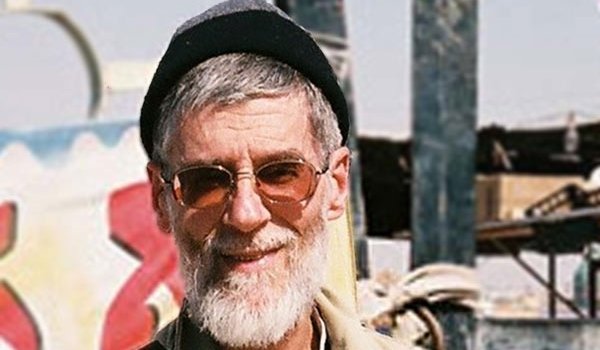
By Yuram Abdullah Weiler
“I think the real question is not whether America is afraid of Islam (and its adherents) but whether Muslims should be afraid of the US and Americans especially in this post-9 /11 world.” —Attorney Diana Mae Cabili
Being Muslim in America carries the risk of being reviled, insulted, discriminated against, humiliated publicly or, worse yet, physically attacked. Despite having been a part of the American landscape since 1501, Muslims have faced discrimination, suspicion and hatred bordering on public hysteria, especially since the 9/11 attacks. With the ascendancy of Donald Trump and his virulent anti-Muslim diatribes, the prospect of a McCarthy-era-like internment of Muslims in the United States does not appear to be off the table given current policy trends.
Make no mistake about it; Islamophobia in the U.S. not only is on the rise but also is condoned public policy. The Institute for Social Policy and Understanding (ISPU) with support from the Bridge Initiative of the Alwaleed Center for Muslim-Christian Understanding at Georgetown University has developed the National Index of Islamophobia based on responses to various survey questions designed to uncover the deep-seated beliefs of respondents in five particular anti-Muslim stereotypes, which regrettably are often utilized by U.S. political leaders during campaigns to gain voter support. 
These five anti-Muslim stereotypes are that most Muslims living in the United States: are more prone to violence than other people; discriminate against women; are hostile to the United States; are less civilized than other people, and are partially responsible for acts of violence carried out by other Muslims. These five stereotypes are linked to constituent support for policies, enacted by government officials, which discriminate specifically against Muslims, such as the surveillance of mosques, racial profiling and heightened security scrutiny of Muslims at airports.
Here in the quiet border community of Las Cruces, New Mexico, people seem to be generally tolerant and supportive of Muslims. Perhaps this is because Hispanic Americans are five times as likely to hold positive views of Islam and Muslims as negative views.  Ironically, the only place where I have been even questioned aggressively about my Shi'a Islamic faith and connection to the Islamic Republic has been at the local mosque. But Las Cruces appears to be an exception to a general U.S. trend towards increasing Islamophobia. Over one quarter of Americans surveyed in a recent poll conducted by the ISPU endorsed negative stereotypes of Muslims and Islam. In fact, White Evangelicals are twice as likely to hold negative views of Muslims as positive ones.
As a Muslim living in the United States, I, too, have been discriminated against. Past employers have made it difficult for me to do salaat at the proper times, and have even suggested that I do the prayer in a filthy janitor’s closet so as not to bother or distract other employees. I have been threatened with loss of employment for exhibiting support for the oppressed Palestinians, who have been the perpetual targets of Israeli violence. I have been reprimanded for speaking out against possible U.S. military action against Iran.  I have been told that I should be shot for simply wearing a small flag of the Islamic Republic of Iran on my jacket. All this and more has taken place in the alleged bastion of human rights and religious freedom known as the United States of America.
However, I am not alone. Seventy-five percent of my brothers and sisters in Islam believe there is a great deal of discrimination against Muslims in the United States. Nearly the same number of Muslims is worried by the actions of the current U.S. president, and do not feel Islam is considered to be part of mainstream American society. About half feel that being Muslim in America has become more difficult and have themselves personally experienced an act of discrimination. Yet in spite of their Islamophobic environment, nearly nine out of ten Muslims in America claim to be proud to be Muslim and, astoundingly, proud to be American.  I myself, while proud to be a Muslim, do not profess membership in the latter group, seventy percent of whom still hold fast to the American dream.
Unfortunately, Islamophobia seems to be a commonality uniting a number of disparate hate groups in the United States. The Southern Poverty Law Center, a forerunner in confronting racial, ethnic and religious hatred, has identified 33 Islamophobic groups operating openly on Facebook, all of which engage in anti-Muslim imagery and promote Islamophobic stereotypes to attract members.  Some of these hate groups actually have avoided being screened out for hate speech and Islamophobic content by claiming to be educational forums. For example, the group “Infidels United for Truth” claims to be “for the education and sharing of information globally about the dangers of Radical Terrorism and how it is affecting all of the world.”
Professor of computer science at Elon University Megan Squire has done preliminary research on Islamophobia and has found it to be a common thread among hate groups. Squire’s findings indicate that those groups holding anti-Muslim and anti-immigrant views do have significant common membership. Moreover, analysis of the data shows that “anti-Muslim ideologies, in particular, can serve as a bridge between mostly disconnected communities, such as between anti-government and white nationalist communities.”
Yet the categorization of Islamophobia as merely “anti-Muslim” animosity overlooks the systemic racism inherent in the Orientalist world view that permeates and, in fact, predates the creation of the United States. Concerning this danger professor of law at the University of Detroit Mercy Khaled A. Beydoun warns, “To reduce Islamophobia to ‘anti-Muslim animus’ and nothing more overlooks its expansion and penetration into American culture, news, media, law, and political parlance.” As clearly evidenced by the “Muslim ban,” the Trump regime has endorsed Islamophobia as state policy, which legitimatizes anti-Muslim stereotypes widely held by private U.S. citizens. 
To see the systemic nature of Islamophobia in the United States, it is only necessary to note that Muslims are viewed as a “racial and socioeconomic monolith.”  In other words, Americans tend to view Muslims as a race, just like Blacks, Native Peoples, or Japanese, and given the endemic nature of racism in the U.S., we see that Islamophobia is another virulent strain of racism. The IPSU concurs, noting that “Islamophobia is just one branch on a bigger tree of bigotry.”
Continuing with the IPSU’s tree metaphor, we can understand that merely loping off the branch of Islamophobia does next to nothing to cut down the tree of American racism that nourishes its growth.   Fertilized by Facebook and other social media, the ugly branch of Islamophobia, after pruning, will not only sprout anew but also more vigorously than before. The same holds for another branch sprouting from the same tree, Iranophobia.
As far as Facebook is concerned, it is no exaggeration to call it fertilizer for the tree of bigotry, as can be seen by the central role played by Zuckerberg’s social media platform in the genocide of the Rohingya Muslims of Myanmar. According to Marzuki Darusman, chairman of the U.N. Independent International Fact-Finding Mission on Myanmar, Facebook has “substantively contributed to the level of acrimony and dissension and conflict, if you will, within the public.” U.N. Myanmar investigator Yanghee Lee, concurring, noted, “I’m afraid that Facebook has now turned into a beast, and not what it originally intended.” Similarly, Equality Labs, a South Asian community technology organization, found that most hate speech violations on Facebook India are Islamophobic, and 93 percent remain posted.
Given that Islamophobia and Iranophobia are both flourishing branches on this mammoth tree of systemic American bigotry, it is self-evident that the tree itself must be felled and the stump of residual racism uprooted. Muslims should not be afraid of the United States and Americans, as Ms. Cabili has suggested in the epigram. Instead, we Muslims must carefully sharpen the Ax(is) of Resistance, uniting in our Islamic Revolution to cut down the tree of bigotry once and for all.

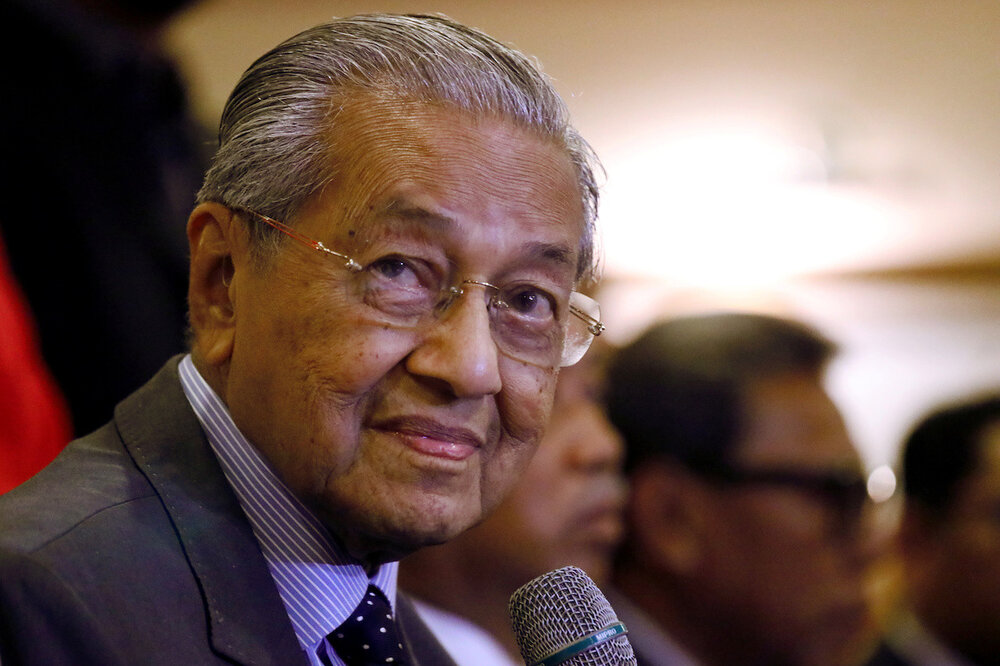
Malaysian PM calls U.S. sanctions on Iran a ‘form of dictatorship’

Malaysian Prime Minister Mahathir Mohamad has said that Washington’s sanctions against Iran are a “form of dictatorship”.
“We don’t believe in applying sanctions to force countries to accept certain ideologies and to change governments. It is not only the particular country that will suffer, but all the trading partners also will suffer economically. In a way, it is a form of dictatorship. A dictatorship that is worse than that in a country, it is international,” he told Aljazeera in an interview published on Sunday.
He added that Malaysia lost out on a big market when the U.S. applied sanctions against Iran.
He also discussed the state of the global economy and its interconnectedness. He argued the U.S. is leading the world in the wrong direction when it comes to multilateralism.
“Becoming very nationalist is good. But not at the expense of other people. Every country should care about itself but that needing to be protective or secure doesn’t mean confronting others. It’s better if we learn to work together,” he said. 
“We were going a long way towards multilateralism. But now nationalism seems to affect many countries,” he added.
According to Reuters, Mahathir said during a speech at the Doha Forum on Saturday that the U.S. sanctions on Iran violate the United Nations charter and international law.
“Malaysia does not support the reimposition of the unilateral sanctions by the U.S. against Iran,” he said.
“Such sanctions clearly violate the United Nations charter and international law; sanctions can only be applied by the United Nations in accordance with the charter,” he added.
U.S. President Donald Trump quit the 2015 nuclear deal in May 2018 and introduced the harshest ever sanctions on Iran as part of the “maximum pressure” campaign against Iran.

Tuesday, December 10, 2019

A search for counters to U.S. imperialism is necessary and hard

By Martin Love

Few often learn anything until it is too late, and even then they may not learn much that matters except in a context of a disaster that probably could have been avoided. The reference here is to the relatively comfortable and well off, say the mid to upper levels of a shrinking middle class in a society such as the U.S. has.
Walk around the campus of the university here in central North Carolina and there is a wealth of entertainments like sports teams and presentations and parties of all kinds aside from classes and study. Idyllic it can appear. Everyone seems to act, at least, just like their forebears on campus seemed to act say 50 years ago, at the height of the U.S. war on Vietnam. Except for one thing:
On campuses back then there existed student protests and occasional rage over the Vietnam War – not so much on campuses in the relatively conservative southern states, but for sure on campuses like Harvard and Columbia in the northeast of the U.S. where students are notably brighter and more often concerned about U.S. directions. Today? It is depressing. There has been very little protestive demand about anything but something fairly inane such as the removal of a 100-year-old life-sized bronze statue of a Confederate soldier during the Civil War of the mid 19th century.
Why were students demanding the removal of the statue? Because it implied a time when slavery was supported in the Southern states of the U.S. and some students lately did not want anything on campus that signified the past existence of “racism” and slavery 200 years ago. It apparently is “cool” to have SOME conscience about something appalling, at least about something that was long ago and is not really going to upset or diminish the criminality of current Washington warmongers. Students today are relatively boring compared to students half a century ago and part of the reason is that there is no forced “draft” into the military as there was for decades up until the early 1970s when it was suspended.  Young Americans back then, if drafted and most young men were, could be sent to die in Vietnam or elsewhere. Over 55,000 Americans did die in the rice paddies of Southeast Asia – a sacrifice for absolutely nothing of any merit.
Then the warmongers and profiteers in Washington after the Vietnam debacle figured they could get away with advancing the imperialist and militarist agenda even more if soldiers, fodder really, were just volunteers. Recruits nowadays are often relatively poor, not especially smart, not often reliable college material, starved for money and reliable advancement potential and even sometimes healthcare. It’s a huge scam. The suicide rate among U.S. soldiers has never been higher: they don’t have a clue what they are fighting for overseas except for platitudes drilled into them in boot camp, even as they are in fact fighting for wealthy oligarchs and powerful U.S. corporations and banks and their owners and corrupted politicians and profits, profits they will rarely if ever themselves enjoy.
America’s probably fatal disease, long centered in and emanating from Washington, seems to be primarily greed and a broad lack of understanding, appreciation, and magnanimity towards other cultures, like the Islamic world’s, and other people in other nations. This altogether is surely reflected in rampant U.S. imperialism and the apparent desire to dominate and exploit others. And there are many thoughtful Americans who fervently want change but who lack the power to summon it except, possibly, through the vote and the election of better representation in Washington. But real democracy has been cancelled by an entrenched class of powerful people, Republicans or Democrats, whose hands are on the levers of power for their own benefit and maintenance. In sum, whether the U.S. government can change before it sets itself and the world on fire may be impossible. The real question is what can countries under sanction or attack by imperialism do not only to influence radical change in the West, but also to avoid further U.S. attacks whether by war or by sanctions. One obvious mandate is to try to erect effective defensive arrangements – alliances or military preparedness – that might obviate the progression of U.S. imperialism as it has existed particularly in this century.
One idea that may be useful in this regard for countries like Iran is to lower “defensiveness” (if not actual, latent and necessary defenses) and try to set examples of better ways to contend with and defuse foreign challenges and enmity. Ayatollah Khamenei recently hinted at this when he suggested or invoked the notion of “Islamic mercy” -- a powerful idea in its own right and expressed by Khamenei in the context of how to deal with the protesters and dissidents within Iran who expressed themselves during the recent disturbances over the gas price hikes. One must wonder to what extent it may be possible for Iran’s leaders to extend the concept or practice of Islamic mercy and magnanimity towards the Islamic Republic’s enemies, even if this should involve relatively straightforward measures such as unilaterally pardoning and releasing foreign prisoners, as has been done recently and from time to time, or by reducing the vocalization at least of (defensive) threats to countries like the U.S. or its allies, particularly the Zionists and the Saudis who are not respected most everywhere.
It may be worth further study to discern exactly what might be the most effective balance between the expression of Iran’s defensive actualities and implied military counter measures against Iran’s enemies, and an Iranian/Islamic posture of mercy and forgiveness that includes an expressed desire for building accord with hostiles like the Trump Administration. Iran under attack by sanctions, for example, has already proven, since the U.S. withdrew from the JCPOA and erected the sanctions, to be patient and counter-responses have been measured and thoughtful.
Some responses by Iran to date have involved steps to ramp up very marginally the country’s efforts to develop further its extant nuclear expertise. But what, for example, if Iran’s leaders halted the expansions, which are implied if not real threats to Iran’s enemies, and declared unequivocally and unilaterally that it was going to maintain its nuclear activities solely within the broader confines of the JCPOA even if the other JCPOA signatories still remain dilatory about honoring their own promises to Iran under the original terms of the deal. Would this not help at least to obviate actual military aggressions against Iran, because any military attack on Iran – which the Trumpists have tried to justify at the behest of the Zionists mostly, would be a disaster for Iran and in fact the entire world. Most all of humanity is entirely against more war in the Middle East and especially war on Iran.
The question here is whether, with most of the world already cognizant of the unfairness and aggressive nature of America’s and its allies’ actions, whether even more mercy and magnanimity (which Khamenei has hinted at internally) might act as a way literally to further SHAME the U.S. in the world’s opinion with the chance that this shaming may produce dividends by somehow forcing the U.S. eventually to reduce its bellicose posturing and begin to seek real accord and reduced tensions with Iran. In any event, Iran has correctly sought the elimination of sanctions and a U.S. recommitment to the JCPOA. What, exactly, can Iran do best to defuse and reduce U.S. imperialism pushed by literally craven “leaders” in Washington, which has to be the most tiresome and unproductive thing the alleged superpower pushes? Perhaps the search for answers is in vain, but maybe not.
The U.S. has spent (and wasted) an estimated seven trillion dollars in the so-called War(s) on Terror, a misnomer if ever there was one. It has been nothing but an expression of a destructive imperialism that has not benefitted humanity at all, and that includes no benefits whatsoever for most Americans, too, including college kids in North Carolina, at a time when humanity MUST begin to tackle together threats, environmental and otherwise, to the species as a whole.

Sunday, December 08, 2019

Released professor Massoud Soleimani: ‘U.S. jailors told other inmates I was a terrorist’

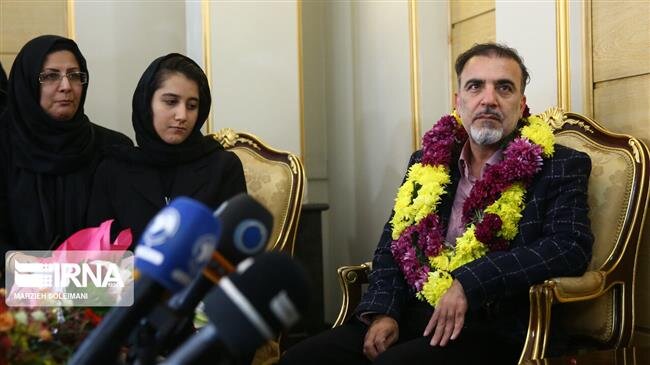
TEHRAN – Iranian scientist Massoud Soleimani, who returned home on Saturday after a prisoner swap between Tehran and Washington, says during his detention, the U.S. jail wardens told other prisoners that he was a terrorist with a mission to carry out bombings in the United States.
“U.S. authorities in the jail had told prisoners that I was a terrorist who wanted to carry out bombings in America,” Press TV quoted Soleimani as saying upon arrival at Tehran’s Mehrabad airport on Saturday night.  
“They had made such false statements so that other prisoners would not come close to me and keep away from me,” he said.
“After a while, the inmates would tell me, ‘you do not look like a terrorist and a bomber, what these guys are saying’ and I would tell them I don’t know what they are saying,” the Iranian scientist added.
Masoud Soleimani, a 49-year-old stem cell scientist, left Iran on sabbatical last year, but was arrested upon arrival in Chicago and transferred to prison in Atlanta, Georgia for unspecified reasons.
The United States released him in a prisoner exchange, after which Soleimani flew along with Foreign Minister Mohammad Javad Zarif from Zurich to Tehran on Saturday.
The prisoner exchange happened through mediation efforts by Switzerland. 
On Saturday, Iran also freed an American graduate student who had been imprisoned in Tehran for more than three years on charges of being a spy.
Xiyue Wang was flown in a Swiss government airplane from Tehran to Zurich, where he was met by Brian H. Hook, the U.S. State Department’s special representative for Iran, according to two senior United States officials.
Zarif said he was happy that Soleimani and Xiyue are joining their families. 
“Glad that Professor Massoud Soleimani and Mr. Xiyue Wang will be joining their families shortly. Many thanks to all engaged, particularly the Swiss government,” Zarif tweeted on Saturday.
The White House confirmed the prisoner swap early on Saturday as well with a statement from President Trump, at a moment of high tensions between Tehran and Washington.
Trump has imposed the harshest ever sanctions against Iran since he pulled the United States out of the 2015 Iran nuclear deal. 
Trump’s administration has even threatened to penalize any country or company that does business with Iran. 
Under the nuclear accord, officially called the Joint Comprehensive Plan of Action (JCPOA), Iran agreed to put limits on its nuclear activities in exchange for termination of economic and financial sanctions.
In a tweet on Saturday, Trump thanked Iran “on a very fair negotiation.”
“See, we can make a deal together!” he wrote.
The U.S. president also bashed his predecessor, Barack Obama, saying the released American student was taken during the Obama administration.
“Taken during the Obama Administration (despite $150 Billion gift), returned during the Trump Administration,” Trump wrote.
Trump has been very critical of Obama’s Iran policy.
Observers say he enjoyed killing the JCPOA because it was Obama’s major foreign policy success.
In another tweet on Saturday, Trump claimed, “The United States will not rest until we bring every American wrongfully detained in Iran and around the world back home to their loved ones!”
Since assuming office, Trump’s anti-Iran rhetoric and actions have intensified tension between Tehran and Washington. His policies have also escalated regional tensions, especially in the Persian Gulf.
In reaction to Trump’s strategy of “maximum pressure”, which includes illegal sanctions, Iran has said it is adopting “maximum resistance”.

Friday, December 06, 2019

Diplomat says Iran’s priority is protecting independence

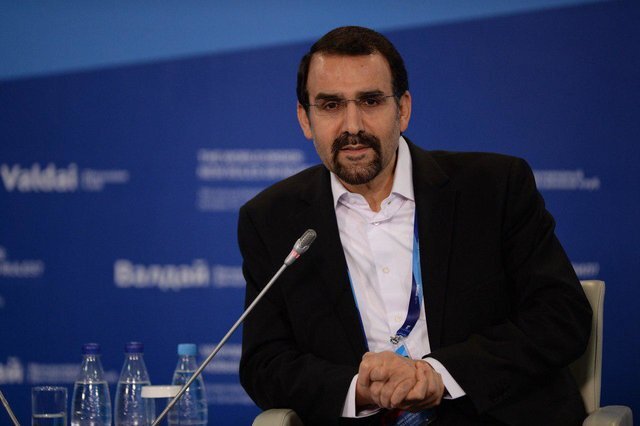
TEHRAN - Iranian Ambassador to Russia Mehdi Sanaei said on Friday that relying on domestic capacities and protecting independence are Iran’s priorities.
“In this situation, protecting independence and power of the foreign policy and also relying on domestic economy and capacities are Iran’s important priorities,” Sanaei said in a press conference in Moscow.
Iran’s top diplomat in Moscow also said it was “natural” that Iran decided to reduce its commitments to the JCPOA, the official name for the 2015 nuclear deal. 
Iran has started to partially reduce its commitments to the JCPOA in response to the United States which abandoned the landmark deal in May 2018 and reinstituted sanctions.
And, since April 2019, the Trump administration has gone beyond the pre-JCPOA sanctions to impose measures that would reduce Iran’s oil export income “to zero.” U.S. secondary sanctions now apply to virtually every civilian sector of Iran’s economy.
“The United States violated the JCPOA and the Europeans do not take enough actions to preserve the deal. So, how do you think Iran should behave?” the ambassador asked.
So far, the Atomic Energy Organization of Iran (AEOI) has taken four steps to cut back commitments in accordance with paragraph 36 of the JCPOA which “allows one side, under certain circumstances, to stop complying with the deal if the other side is out of compliance.”
Top officials in Tehran have repeatedly said if the European Union shields Iran’s economy from the sanctions effect the country will reverse its decision.
Under the JCPOA, Iran promised to put limits on its nuclear activities in exchange for termination of economic and financial sanctions.
On May 8, exactly one year after the U.S. abandoned the deal, Tehran announced that its “strategic patience” is over and began to partially reduce its commitments to the agreement at bi-monthly intervals.
In the first stage, Iran announced that it will not limit its stockpile of the nuclear fuel to 300 kilograms allowed under the deal. On that date (May 8) Iran’s Supreme National Security Council (SNSC) said if the remaining parties to the JCPOA, especially Europeans, devise a mechanism to protect Iran from the sanctions’ effect in the two-month deadline it will reverse its decision.
But since European parties missed the deadline, on July 7 Iran announced that it has started enriching uranium to a higher purity than the 3.67%, thereby starting the second step.
Again, as Europe missed the second 60-day deadline, Iran moved to take the third step, removing a ban on nuclear research and development (R&D).
In the latest step, which started on November 6, Iran began injecting uranium gas into 1,044 centrifuges at the Fordow nuclear site. It was done at the presence of inspectors from the International Atomic Energy Agency (IAEA).
Deputy Foreign Minister for Political Affairs Abbas Araqchi said on Monday that no one can question Iran for deciding to scale down its commitments to the JCPOA.
In a panel discussion in Tokyo, he said that Iran’s action in reducing nuclear commitments does not mean quitting the JCPOA.
“The current situation is the result of the United States’ withdrawal from the JCPOA and the only solution to it is removal of sanctions and return to diplomacy,” the top diplomat noted.

Wednesday, December 04, 2019

NATO at zero point!

By Hanif Ghafari

The NATO summit in London shows clearly that the North Atlantic Treaty is in a serious crisis for its survival. In recent days, Western analysts have analyzed and evaluated various aspects of the tensions and challenges among NATO members. The majority of NATO members are European countries.
The reality is that the crises facing the United States and NATO members will not end soon. At least until the arrival of Trump at the White House, these concerns will remain. On the other hand, the foreseeable future of the president of the United States will face Western actors with serious dilemmas.
U.S. President Donald Trump continues to insist on increasing NATO defense spending. On the other hand, French President Emanuel Macron's recent remarks about NATO's brain death show that some European NATO members are also aware of the White House's negative approach to the North Atlantic Treaty.
Relations between Russia and NATO are now in the worst condition after the Cold War. "Mikhail Gorbachev", the last Soviet President, had warned about the re-start of Cold War between the White House and the Kremlin before. But now Russian officials believe that the constant and extensive conflicts between Moscow and the West lead them too much more complicated conditions than that of the Cold Wartime.
The recent NATO summit in London will not only bring the North Atlantic Treaty Organization closer together, but it will also strengthen the existing crises between the US and Europe.
Finally that One of the issues that has led to the frustration of European citizens from this collection is the European Union's dependence on the United States. While U.S. former  National Security Advisor John Bolton and Trump have repeatedly expressed their opposition to the existence of the European Union and the Eurozone, Europe has not taken any steps towards independence from the United States. European officials have made mistakes in their calculations and attitudes toward the US government. This big mistake could lead to the loss of the European Union and the Eurozone. Undoubtedly, people like the German Chancellor Angela Merkel and French President Emmanuel Macron once realized their mistake will be too late. Can European authorities be able to understand this real danger?

Will Riyadh end its invasion into Yemen?

By Farzad Farhadi

TEHRAN – A military coalition, led by Saudi Arabia, the UAE and the U.S., has launched a war against Yemen since March 26, 2015. The war has so far failed to meet its desired goals.
Along with the news about the Yemen war, borrowing a loan from banks around the world by Saudi Arabia has attracted the attention of observers.
In January 2018, Reuters quoted the Saudi debt management office as saying that Riyadh has asked banks for proposals to refinance its $10 billion international syndicated loan and to help the sovereign raise funds through other means.
The office said the refinancing of the loan, which was raised in 2016, will include a repricing of the facility and the extension of its maturity to 2023 from 2021.
The Saudi war against Yemen has caused a lot of military, political and economic pressure on Riyadh. According to media reports, due to the war, Saudi Arabia has lost all of its cash and non-cash reserves.
A way to take Riyadh out of Yemen quagmire
Saudi Arabia has been caught in the military, political and economic quagmire of the Yemen war. The war, which Mohammad bin Salman did not expect to last more than three years, has been raging for nearly five years and putting unbearable pressure on the Saudi economy. That is why Riyadh is looking for a way to take itself out of the trouble. Mahdi al-Mashat, chief of the Houthi political office, put forward the solution that the Saudis needed.
 
On September 20, al-Mashat announced a conditional ceasefire, calling on the coalition to halt the war and seize the opportunity of ceasefire. 
According to military experts, the Yemeni conditional peace plan was presented at a time when Yemen was at the height of its power, the most important proof of which was the strikes on the Aramco oil facilities. 
The strikes were so severe that prompted various reactions internationally.
 
The important point of the plan is that it was presented by the Supreme Political Council, which is currently the most powerful organization in Yemen.
The Saudis slowly seized the opportunity to get out of the Yemen deadlock. In the meanwhile, Muscat became a place for two sides involved in the war to reach an agreement.
Muscat, a host with a positive and effective role
Officials from both Yemen and Saudi Arabia told the Associated Press on November 13 that both sides are holding indirect, behind-the-scenes talks to end the devastating five-year war in Yemen.
The news agency said the negotiations are taking place with Oman, a Persian Gulf Arab country that borders both Yemen and Saudi Arabia, as mediator. 
It said Oman has positioned itself as a quiet mediator in the past and in a possible sign the back-channel talks could be stepping up, Saudi Deputy Defense Minister Prince Khalid bin Salman arrived in Muscat on November 11.
It said the current talks focus on interim goals, such as re-opening Yemen’s main international airport in Sanaa, shut down by the Saudi-led coalition in 2016. According to AP, also under discussion is a buffer zone along the Yemen-Saudi border in areas under Houthi control.
However, the best solution for Saudi Arabia and the UAE is to take a serious step to stop the war. The release of 200 Yemeni captives by Saudi Arabia and the arrival of 128 of them is a promising move by Riyadh, which, if continued, can prepare the ground for ending war and easing Yemenis’ pain.

Tuesday, November 26, 2019

Some important points about recent unrest in Iran

* By Mohammad Ghaderi
It is not possible to trace recent events without considering the key factors influencing them.
Following the U.S. withdrawal from the JCPOA and re-imposition of economic sanctions on Iran in May 2018, Trump and his security team, who have adopted extremist approaches, expected that the Islamic Republic would surrender and would collapse within a few months.  
Since May 2018 that Iran has let its guard down and adopted “active resistance” policy against U.S. “maximum pressure” campaign, the scene of confrontation between Iran, the United States and its regional and extra-regional allies completely changed in favor of Iran.
The course of events in favor of Iran was so pervasive that even the most radical U.S. think tanks were forced to admit the failure of the maximum pressure strategy against Tehran.
 When Trump failed to make Iran give up, contrary to his regional allies’ opinion, tried to reach Iran to gain reputation, but his plan did not work out due to Iran’s rejection. 
Trump’s unstable political situation on the eve of the 2020 election along with his unpredictable behavior, caused joint Israeli-Western-Arab think tanks put a plan against Iran on its agenda. The costly plan, with its complicated design, aims to create insecurity inside Iran. It uses the fourth generation, warfare model. 
Recently, there have been reports that some countries have launched a joint plan to make Iran insecure and unstable. By studying the information provided by a neighboring country’s intelligence agencies and also through investigating Ruohollah Zam, such an event was expected to happen. 
Reforming gasoline prices seemed inevitable and predictable. The reform prepared the ground for the enemies to launch a war against the Iranian nation under the pretext of “the right to protest”.
Gasoline price hike and concerns over rising costs of goods and services, which are unbearable for the majority of people, led to a natural, acceptable and peaceful reaction by the people of different classes of society. But, Iran’s foes exploited people’s legitimate demands and completely derailed them. 
According to initial intelligence calculations and assumptions, the plan of creating “insecurity from inside” was expected to be launched in late 2019 or early 2020. Due to the intelligence blows dealt to some opposition groups over the past few months coupled with increased public dissatisfaction over gasoline price, the enemy decided to carry out the plan earlier.
The economic, security, military and media aspects of the recent war against the Iranian nation strongly confirm the idea that the recent violent incidents in various cities were preplanned. 
The U.S. has imposed economic sanctions on Iran to frustrate and infuriate people and then has accused the government of being incompetent to deal with the sanctions’ consequences. 
The next step in conducting the plan was to train and organize riot groups and spread them to some parts of the country, where protests were likely to be formed against the government.
The media outlets that fueled the recent riots had the mission to lead and magnify the unrest and portray it as a public move to create human rights sensitivities in the world. 
The rioters were focused on cities around the capital rather than Tehran because these places are more vulnerable to unrest. The rioters were also trying to create insecurity in important energy and economic centers such as Bandar Mahshahr, Imam Khomeini Port, Bushehr, Asaluyeh along with refineries and power plants. The move shows that the rioters intended to create a complete deflation in the country. They also sought to overthrow the government by undermining critical infrastructure and disrupting the export and import process. 
In this context, the plan to attack military and police stations was carried out with the aim of increasing the number of victims and finding access to weapons. 
Although many riot groups were already equipped with illicit weapons, efforts to obtain weapons owned by the armed forces would increase fatalities. 
On the other hand, arresting Rouhollah Zam, the admin of Amadnews Telegram Channel also affected the failure of the recent riot. During the unrest, the channel was not able to launch psychological warfare and lead the rioters. 
One of the important issues that need to be considered in dealing with the recent crisis is the role and function of the Internet.
Since the daily life of most Iranian people is dependent on the internet, the foes assumed that Iran would either not block the internet to prevent further discontent or it would face widespread protests and enormous economic damages. 
However, with the internet shutdown, the National Information Network (NIN) was able to meet people’s minimum needs in various aspects. 
Of course, some alternative communication ways were also provided for the agitators, which effectively led to the identification of many elements of the unrest by the intelligence agencies.
On the other hand, the remarks by Leader of the Islamic Revolution who prompted the real protesters to separate their way from the rioters, public protests against the rioters, arrest of some ringleaders as well as the internet shutdown helped end the crisis within 48 hours. 
The quiet and hasty return of Abraham Lincoln aircraft carrier to the Persian Gulf is also one of the interesting events that indicates foes’ hope for the success of the hostile plan. 
* Author: Mohammad Ghaderi , Tehran Times editor in chief 

Wednesday, November 20, 2019

Iran urges intl. community to make U.S., Israel to agree to nuclear free zone Middle East

TEHRAN - Majid Takht-Ravanchi, Iran’s ambassador to the United Nations, said on Monday that the international community must compel the United States and the Zionist regime of Israel to fulfil their commitments in establishing a WMD-free zone in the Middle East.
“The international community must make the United States and Israel behave responsibly and fulfil nuclear commitments,” Takht-Ravanchi said in a statement read at the Conference on the Establishment of a Middle East Zone Free of Nuclear Weapons and Other Weapons of Mass Destruction.
The conference, underway in New York, began on November 18 and will last until November 22. 
The president-designate of the first session is Ambassador Sima Bahous of Jordan.
Israel is the only country in the Middle East which has nuclear weapons. Being supported by the United States, it has been blocking all efforts by the United Nations and the international community to make the region a WMD-free zone.
Takht-Ravanchi said that the main obstacles are the weapons of mass destruction held by Israel, which is supported by the U.S., and the unwillingness of the U.S. to engage in the conference.
Elsewhere, he noted that Iran welcomes a Middle East without weapons of mass destruction.
He added that this policy of Iran has roots in “Islamic teachings”, “wise calculations”, “national interests” and “bitter experience of Saddam’s chemical attacks on Iran.”
Saddam Hussein, who was ruling Iraq until March 2003, used chemical weapons against Iranian forces and civilians during the war that he launched against Iran in September 1980 and lasted until the summer of 1988.
Takht-Ravanchi noted that a refusal by the U.S. and Israel to participate in the conference shows they seek a failure of the conference.
According to Press TV, a few days ago, the U.S. announced it would not participate in the conference “because of Israel,” according to Mikhail Ulyanov, Russia’s permanent representative to international organizations in Vienna.
“The Americans refused to take part because Israel refuses to participate,” said Mikhail Ulyanov.
NHK also reported that Israel and the United States were absent from the conference.
Egypt proposed in 1974 the establishment of a Middle East zone free of nuclear weapons and other weapons of mass destruction. The idea saw no progress for over four decades because of the conflict between Israel and the Arab countries.
But the UN General Assembly decided last year to seek to realize the idea.
At Monday's meeting, UN Secretary-General Antonio Guterres said that such a zone can put a permanent end to the possibility of nuclear conflict in the region.
Saudi Arabia and other countries condemned Israel.
Observers say the absence of Israel and the U.S. highlight the difficulties in realizing the initiative.
The UN chief said the zone would have significance beyond the region. 
“I therefore hope this Conference will serve as the start of an inclusive process in which all the States of the region can participate,” Guterres said. 
Mark Fitzpatrick, an associate fellow and former executive director at the International Institute for Strategic Studies (IISS), wrote in a commentary in May 2019 that if world leaders backed some achievable arms-control initiatives in the Middle East, genuine progress could be made toward establishing a WMD-free zone in the region. 
The Middle East-focused meeting marks the first session of a conference that will be held annually until a legally binding treaty for the nuclear-free zone is agreed, according to news.un.org. 
The UN chief hoped participants will be inspired by the example set by Latin America and the Caribbean, where the first zone was proposed in the aftermath of the Cuban Missile Crisis in October 1962. 
“Despite the tensions and politics of the Cold War, countries of the region persevered and in 1967 established a flexible and durable arrangement, which has served as a model for all such successive zones,” he said. 
“Let us be guided by their experience – and those of other regions – as we advance in all of our efforts across the disarmament agenda.” 

Why countries are reluctant to join U.S.-led maritime coalition

*By Mohammad Ghaderi

TEHRAN - The U.S.-led naval coalition to protect shipping in the Persian Gulf formally was launched in Bahrain on Thursday. But the notable point is that countries have not welcomed this plan. Only a few countries with ineffective naval power have joined the coalition.
On July 2019, the U.S. proposed a coalition plan to protect shipping in the Persian Gulf. Mike Pompeo, the U.S. secretary of state, invited U.S. allies such as Britain, France, Germany, Japan, South Korea, and Australia to join the coalition. Although the U.S. has persuaded its allies on various occasions and even applied pressure on them to join the coalition, it was not warmly welcomed. In August, Britain joined the U.S. military coalition in the wake of a conflict with Iran over oil tanker seizures first in Gibraltar and later in the Strait of Hormuz.
Later the Zionist regime and Australia joined the coalition. 
Launch of the U.S.-led marine coalition
The coalition, which reportedly aims to “protect shipping in the Persian Gulf”, was launched on Thursday. The U.S. stated that through the coalition it intends to safeguard region’s oil supply against possible threats. Bahrain, which hosts the U.S. Fifth Fleet, has joined the coalition along with the UEA and Saudi Arabia.
 James Malloy, commander of the U.S. Naval Forces Central Command, has claimed that the goal of the coalition is defensive. Malloy said the coalition will last as long as necessary. 
Some European countries, including France, has not joined the coalition to avoid escalating tensions in the region. Japan has decided to dispatch its naval forces to the Strait of Hormuz independently, rather than joining the coalition.  It is said that Japan made this decision because it has an amicable relationship with Iran and does not like to be seen as an important country and power in the U.S.-led coalition. 
In this regard, the London-based Raialyoum wrote that the announcement of formal launch of the U.S.-led maritime coalition to protect shipping in the Persian Gulf with the participation of only 6 countries reminds the old Arab proverb saying “the mountain was in labor but gave birth to a mouse”. Raialyoum added the limited number of countries joining the coalition reveals that the U.S. influence has been reducing not only in the Persian Gulf region but also all around the world. It seems that the current and former U.S. administrations cannot any longer form coalitions like the ones that launched wars in Iraq, Libya, or Afghanistan with the participation of 30 or 60 countries. 
The Arab world digital news and opinion website said that it is noteworthy that three Persian Gulf states namely Kuwait, Oman, and Qatar are absent in the coalition. They have refused to join the coalition not because they have taken a neutral stance toward U.S. controversial measures against Iran, but because they do not trust the U.S. and its current government. The source added that the U.S. government has adopted rash policies that can lead to regional and probably international war; furthermore, the coalition can be an element of “tension” not a guarantee for defense and stability. 
Raialyoum stated that we do not believe these six countries – Britain, Saudi Arabia, the UAE, Bahrain, Australia, and Albania – will be able to protect shipping in the Persian Gulf because most of them, except the U.S. and Britain, do not have effective naval power. 
However, the marine coalition is a dramatic and hypocritical show and the U.S. is trying to milk the three states of Saudi Arabia, the UAE, and Bahrain. By its presence, the U.S. only disturbs the region’s security. Washington only takes care of its interests.
The security in the Middle East and the Persian Gulf will only be achieved through the reconciliation between regional countries since they are neighbors and they cannot change their geography. The intervention of countries outside the region will only make the situation more complicated.
* Author: Mohammad Ghaderi , Tehran Times editor in chief 

Monday, November 18, 2019

When the U.S. smells out oil in Lebanon: New destination for oil robbery

*By Mohammad Ghaderi

A review of the protests and political upheavals in Lebanon coupled with a pretension by officials in Washington that the U.S. is concerned about the situation in Lebanon send important messages.
Developments in Lebanon appear to have entered a new phase, especially as the Lebanese Energy and Water Minister Neda Boustani has announced the start of drilling the country’s first oil well in the waters off the coast of Beirut later this year.
The oil well is to be drilled in the Mediterranean 30 kilometers from the Lebanese capital in the north. About a year and a half ago, Lebanon awarded its first offshore gas and oil exploration and production agreements to a consortium of France’s Total, Italy’s Eni and Russia’s Novatek for two blocks out of ten.
Ten oil blocks have been identified in the coastal waters of Lebanon with an area about 18,000 km2.
The Americans, who have shown that the smell of oil drives them to the oil-rich countries, these days pretend that they are really concerned about the situation in Lebanon and its people. Mike Pompeo, the U.S. secretary of state, has recently claimed that “the Iraqi and Lebanese people want their countries back” from Iran.
The pretension of concern by the U.S. over the situation in Lebanon, in the light of Boustani’s announcement, has led various Lebanese groups, especially Hezbollah, to feel the danger very well. Hezbollah Executive Council Deputy Chief Sheikh Ali Da’mush has warned that the U.S. and its allies are seeking to undermine the political system in Lebanon and restructure it in their own favor. The U.S. wants a government comes to power which would be under its own control and implement Washington’s plans. For example, it wants Lebanon agree to demarcation of borders based on Israel’s wishes, grant projects for oil and gas extractions to U.S. companies, permanently house the displaced Palestinian people, and target the axis of resistance and its missile power.
In addition to the United States, the Zionist regime is also happy with the unrest because Israel has disputes with Lebanon over common borders as well as oil and gas resources. Such an uprising provides the opportunity for Tel Aviv to plunder Lebanese natural resources.
The Zionist regime which is violating the Lebanese land, airspace and territorial waters frequently will take advantage of the protests in the country while Lebanese officials are doing their utmost to improve and calm the situation. Consequently, the officials will not be able to pay attention to regional issues, which is a matter that Hezbollah has repeatedly warned about.
Undoubtedly, one cannot have a positive view of sudden unrest in oil-rich countries in the Middle East under the shadow of U.S. intervention. History has shown that oil-rich countries have always suffered from domestic tensions and crises so that Western powers, that usually lead the riots, can easily plunder their oil resources. 
In any case, it seems that after Syria, the U.S. has specified Lebanon as its next destination for oil robbery, and U.S. officials are expected to make specific comments on the developments in the country in future days.
* Author: Mohammad Ghaderi, Tehran Times editor in chief 

Sunday, November 17, 2019

White House-Ak Saray relations: From close friendship to conflict of interests

By Hossein Amiri

Relations between the U.S. Turkey have strained since the failed July 2016 coup in Turkey. Now, the most important reasons for the tension is Washington's strong opposition to Turkey's plan to buy S-400 missile system from Russia and Turkish military invasion into northern Syria.
Although Turkish President Recep Tayyip Erdogan's visit to the U.S. on November 13 was intended to resolve the two countries' disputes and open a new horizon in economic and trade relations, differences still remain. 
Though after the meeting at the White House, Trump made some pledges, including increasing trade ties to $100 billion, it takes a long time to fulfill these promises.
Contrary to such pledges, the Pentagon announced that it had replaced all F-35 fighter parts made by Turkey.
While the Turkish and U.S. leaders were meeting, F-35 production program executive Lt. Gen. Eric Fick said at a congressional hearing that Turkey would be completely phased out until March.
At the moment the U.S. has narrowed the number of parts down from 1,000 to 12.
Undersecretary of Defense for Acquisition and Sustainment Ellen Lord affirmed to Rep. Donald Norcross, D-N.J., that as of Wednesday, Turkey’s exit from the program was not expected to cause any F-35 production delays.
The U.S. government believes Ankara's move to buy S-400 missile system from Russia is not in line with NATO policies. Washington also sees Turkey’s decision as a threat to U.S. F-35 fighters. However, Ankara has announced that it will go ahead with its decision to buy the missile system.
Erdogan said it is not a right policy to ask Ankara to deprive itself of the Russian S-400 missile defense system.
Erdogan's remarks came in response to some reports that Trump had requested Turkey to cancel the purchase of S-400 system, a defense system that has been deployed in some parts of Turkey since July 2019.
But after Trump and Erdogan's meeting, the Turkish president claimed that the U.S. president had a positive view on buying the missile system.
Though Trump may seek to strike a deal with Erdogan on the S-400 missile system and F-35 fighter aircraft, based on his own businessmen approach, Ankara's military intervention in northern Syria and its insistence on buying the S-400 system are at odds with Washington. For this reason, the House of Representatives has passed two resolutions against Turkey.
On October 30, the House approved a resolution against Turkey recognizing the Ottoman massacre of Armenians in 1915. 305 representatives voted in favor of the resolution, with only three opposing it. It also passed another resolution calling on Trump to impose sanctions on Turkey over military operations in northern Syria. The resolution was also adopted by 403 votes in favor and 16 against, a move that rose Turkey's anger.
After Erdogan's meeting with Trump, attended by some Congress representatives, senior Republican Senator Lindsey Graham and chairman of the Senate Judiciary Committee vetoed the resolution recognizing the massacre of Armenians by the Ottoman Empire. 
Earlier, Senate Majority Leader Robert Menendez had called for the resolution to be approved. Lindsey Graham noted that he had listened to Erdogan's speech at the White House and criticized a House resolution that recognized the Armenian genocide. 
Menendez argued that "U.S. policy must be unanimous and honest in the face of human rights violations, crimes against humanity, ethnic cleansing, and genocide" and sent it to the Senate for approval.
There is a difference between the White House and Congress in how to deal with Turkey. Also, there is a difference between Republicans and Democrats despite Trump's promises to Erdogan.