Showing posts with label sanctions. Show all posts

Tuesday, November 12, 2019

US sanctions on Iran killing innocent people

 Vijay Prashad
The administration of Donald Trump in its blind policy of economic terrorism against Iran has sanctioned such basic needs as medicine and food.
The following is an article in this regard published by ‘Globetrotter’ and titled:
“US sanctions on Iran killing innocent people”.
The writer is Vijay Prashad, an Indian historian, editor and journalist, who is the chief correspondent at Globetrotter, a project of the Independent Media Institute. He has written more than 20 books, including “The Darker Nations: A People’s History of the Third World”.
In late October, Human Rights Watch (HRW) released a short report with a sharp title: “Maximum Pressure: US Economic Sanctions Harm Iranians’ Right to Health.” In November 2018, the US renewed its unilateral sanctions against Iran, and included “secondary sanctions” on non-US entities. These secondary sanctions choked off Iran’s ability to buy commercially many products, including crucial medical supplies.
“The consequences of redoubled US sanctions,” writes HRW, “pose a serious threat to Iranians’ right to health and access to essential medicines – and has almost certainly contributed to documented shortages – ranging from a lack of critical drugs for epilepsy patients to limited chemotherapy medications for Iranians with cancer.”
Human Rights Watch is not the first to document this serious situation. Unilateral US sanctions under then-president Barack Obama had already badly damaged the health of Iranians.
Over the course of the past several years, the medical journal The Lancet has run a series of important studies of the deteriorating health conditions in Iran as a result of the unilateral US sanctions. This August, five doctors based in the United States and Iran wrote a powerful editorial in The Lancet, which pointed out that Iran’s system of universal health coverage has been damaged by the sanctions, and that Iran is at “a high risk of moving towards a severe situation for the provision of health services with a potentially substantive impact on mortality and morbidity.”
A year ago, Dr Seyyed Ali Reza Marandi, the president of Iran’s Academy of Medical Sciences, wrote one of many letters to the UN secretary general. He pointed out that patients who require organ transplants and who have cancer are being “deliberately denied medicine and medical equipment.”
There has been no public answer to these letters.
The evidence is undeniable. The US sanctions are damaging Iran’s health infrastructure and are leading to deaths and suffering. Last year, the United Nations’ special rapporteur on the negative impact of the unilateral coercive measures, Idriss Jazairy, concluded from a look at the sanctions regime, “The current system creates doubt and ambiguity which makes it all but impossible for Iran to import these urgently needed humanitarian goods. This ambiguity causes a ‘chilling effect’ which is likely to lead to silent deaths in hospitals as medicines run out, while the international media fail to notice.”
The US government has used every mechanism possible to suffocate Iran. It has used its Specially Designated Global Terrorist (SDGT) facility, its Specially Designated Nationals and Blocked Persons (SDN) list, and its Financial Crimes Enforcement Network (FinCEN) to tighten its grip on the Iranian economy. Human Rights Watch reiterated what humanitarian agencies have been saying over this past year, which is that banks refuse to allow their services to be used to transfer money even for humanitarian reasons.
The United States is welcome to trade or not to trade with any country that it wishes, but the stranglehold that it has on the financial system means that its direct and secondary sanctions prevent other countries from making trading decisions.
In August, Jan Egeland, the head of the Norwegian Refugee Council, which works with Afghan refugees in Iran, said, “We have now, for a full year, tried to find banks that are able and willing to transfer money from donors.” Egeland is not naive. He was the UN’s undersecretary general for humanitarian affairs and emergency relief from 2003 to 2006.
Squeezing the banks has allowed the US government to wreak havoc on Iran’s ability to import food and medicines, impacting the human rights of Iranians. There is ample evidence that the US is not merely intent on hurting the government, but in fact has a strategy to attack the Iranian people.
The HRW report is called “Maximum Pressure” for a reason. This is the phrase associated with the policy of President Donald Trump and his erstwhile national security adviser John Bolton toward Tehran that led to the illegal US withdrawal from the Iran nuclear deal (the Joint Comprehensive Plan of Action, or JCPOA) and the reinstatement of harsh sanctions. As the US put these sanctions on Iran in November 2018, US Treasury Secretary Steven Mnuchin said, “The maximum pressure exerted by the United States is only going to mount from here.” This is, as HRW notes, “a recipe for collective punishment.”
Universal health care has been a basic policy orientation of the Iranian government. The program received focus in 1985 with the establishment of the National Health Network, and then over the next several decades – hampered by lack of resources – the rural and urban Family Physician programs. By all indications, the health-care system in Iran has been sharply hit by the sanctions, mainly since they have made it impossible to import key materials (such as bandages for epidermolysis bullosa and drugs to reduce inflammations such as tumor necrosis, a factor that inflicts those who had been struck by chemical weapons used by Iraq against Iran, and supplied by Western Europe and the United States).
Iran has over the past century developed a high-quality indigenous pharmaceutical industry, now rooted in the public-sector Social Security Investment Company. Until the past few years, Iran had been able to produce a wide range of drugs, but even here there has been attrition, since several of these production lines rely on imports of key components of the drugs.
Recently, Venezuela’s minister for science and technology, Gabriela JimĂ©nez, was in Tehran to buy medical equipment, including a hundred dialysis machines. This tells us two things: first, that Iran continues to produce medical equipment and pharmaceutical drugs despite the sanctions; and second, that these two countries that are being hit hard by the West’s hybrid war have had to turn to each other for trade. Venezuela’s medical system has been hit harder than that of Iran – last year, the Venezuelan Pharmaceutical Federation reported that it was suffering from an 85% shortage of essential medicines.
It is a measure of the fortitude of Iran that despite these unilateral US sanctions, it has been able to maintain production of medical equipment and drugs.
Nonetheless, the Human Rights Watch report should be seen as an alarm. The United Nations has repeatedly said that sanctions are not a humane policy and must no longer be allowed to be part of the arsenal of the powerful nations. Exceptions for medicines and food are routinely argued for.
The United States claims that it does not use sanctions to hurt people in Venezuela. Even if this is merely rhetoric, no such softening has occurred for Iran. The US has not issued any such guidance toward its policy on Iran. Rather, it has tightened these dangerous sanctions as part of its hybrid war against Iran.

Tuesday, October 22, 2019

Zarif says multilateralism has become a necessity

Unilateralism is “dangerous” and “doomed to failure”, Iranian FM notes
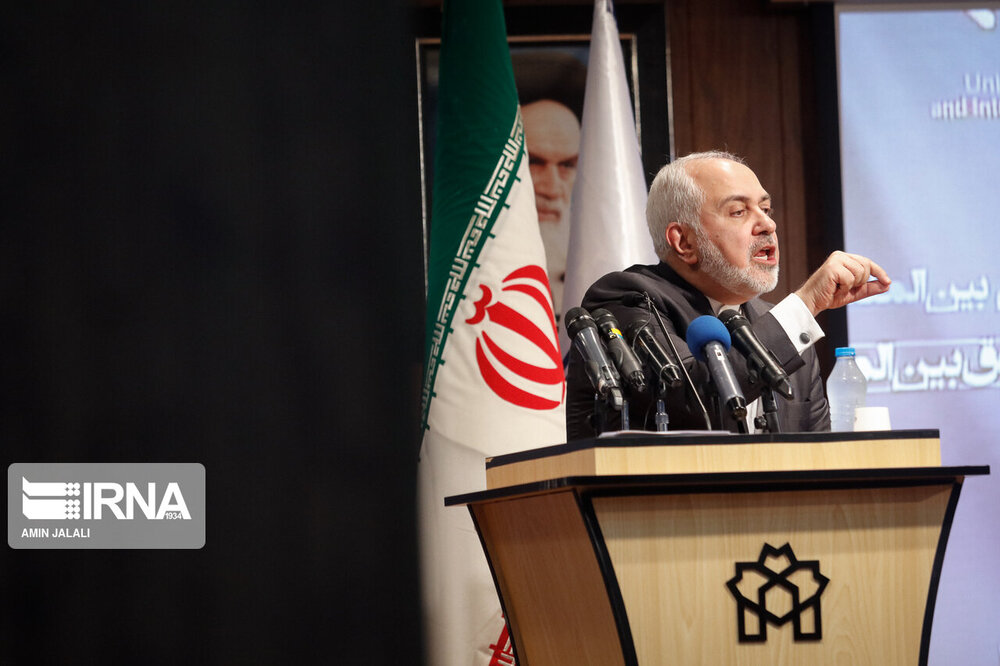
TEHRAN – Iranian Foreign Minister Mohammad Javad Zarif said on Monday that multilateralism has become a necessity in the world.
“In today’s world, the West cannot take all decisions for the international developments,” he said during a speech at a conference at Allameh Tabataba’i University.
He added, “Governments have come to the conclusion that they can neither solve their problems by themselves nor can they prevent others’ transgressive actions. So, they adopted multilateralism.”
Zarif also noted, “Governments cannot decide for the world unilaterally, because they have lost their monopoly over the international decision making.”
Zarif said that unilateralism is “dangerous” and “doomed to failure”.
‘No one can trust signature of the United States’
Zarif also said that no one can trust the signature of the United States, citing Washington’s withdrawal from international agreements, including the 2015 nuclear deal, as examples.
“The United States is following unilateralism without respecting the importance of international law. So, no one can trust the United States’ signature,” the chief diplomat remarked.
He said many countries that follow Washington’s policies have no choice because of the United States’ power. However, he added, countries have been starting to downgrade their relations with the U.S.
Pointing to the European Union’s special financial mechanism for trade with Iran, known as INSTEX, Zarif said the Europeans are trying to distance themselves from their ally.
“INSTEX may not have much value for us, however, the important point is that it has been for a year that the United States’ close allies are escaping from their biggest military ally through their slow and unacceptable methods (in implementing INSTEX). It means that the players do not accept to be under control of just one player who acts unpredictably and violates international law,” Zarif pointed out.
INSTEX – the Instrument in Support of Trade Exchanges - is a European special purpose vehicle aimed at facilitating legitimate trade between Europe and Iran.
The EU announced on June 28 that its special financial mechanism for trade with Iran, known as INSTEX, has gone into effect. However, Iran says the mechanism is far short of Iran’s expectation.
‘United States is addicted to sanctions’
Zarif also said that the U.S. is addicted to unilateral sanctions.
He said sanction is an instrument that an “individual, society or country uses to make others respect regulation” but the United States is using sanctions to “impose its own policies”.

Tuesday, October 15, 2019

Spark your wanderlust: how influencers can help?

By Afshin Majlesi

In the current fast-paced realm of advertising and marketing, travel influencers have changed the whole game as they have succeeded to materialize a totally new and self-directed channels to reach audiences in a more authentic and personal way, even influencing to shape their wanderlusts.
We can say that the Instagram has backtracked old-school manners of travel advertising campaigns. Well-traveled influencers induce their avid followers to win sparking their wanderlusts by the means of the photo-sharing platform that enables sharing of wonderful moments and wandering adventures of their journeys.
Many believe that the Instagram has drastically changed the way people, especially the youth, travel, and it’s undoubtedly not all for the better. The trend, however, has its own harms, for instance, it may lead to overtourism, a relativity new term that you may cannot look it up in many dictionaries.
That’s why Iran’s tourism ministry has started to make the best use of new technologies in order to portray a true image of the country based on what travelers and influencers perceive during their visits to the country.
But, how does it work for Iran? It’s noteworthy to remind that Iran has been under U.S. sanctions and its anti-Iran propaganda for around four decades. Some Western media outlets have long tried to portray Iran’s global image as unsafe, unwelcoming and so on.
As an example, some of their messages carry themes from U.S. State Department’s travel advisory against Iran, which since 1979, warns about “the risk of kidnapping, arrest and detention of U.S. citizens.”
On the contrary, when you refer to people who have visited the country or even you read their travelogues on Iran, you usually perceive that Iranians are described as warm, friendly and eager to show off their country to foreigners. Moreover, almost all international tour operators and travel agents have the same attitude towards the country and its people.
The 2019 Travel Risk Map, which shows the risk level around the world, puts Iran among countries with “insignificant risk”, a category where the UK, Denmark, Switzerland, Norway, and Finland are placed in.
Tourism minister Ali-Asghar Mounesan said on Thursday that the ministry supports certain the Instagram influencers to travel to the country.
“Instagram influencers’ trips to Iran are backed by the Ministry of Cultural Heritage, Tourism and Handicrafts and, in the advertising arena, we do a lot of work to fight Iranophobia and introduce the true face of Iran,” Mounesan said.
“One of the areas [in travel & tourism advertising] is to bring famous figures to Iran, get the country known to them in terms of its rich culture, beautiful natural landscapes and historical monuments…this is part of programs to introduce the country that we will definitely continue.”
With over one billion active monthly users, it seems reasonable that the Instagram has enough power to set new trends on traveling to a country that boasts hospitable people and some of the world’s oldest cultural monuments such as bazaars, museums, mosques, bridges, bathhouses, madrasas, gardens, rich natural, rural landscapes and 22 UNESCO World Heritage sites to name a few.

Monday, October 14, 2019

Europe's pretext for evading Iran's demands

By Hmaid Bayati


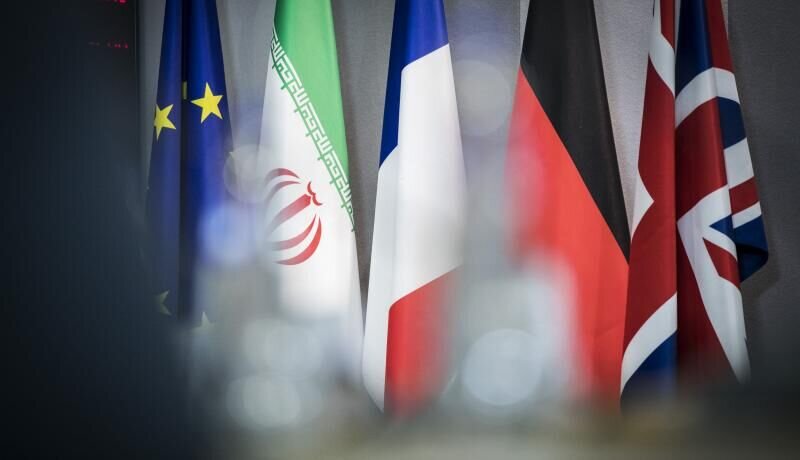
TEHRAN - The opportunity to save the JCPOA (the nuclear deal concluded between Iran and the 5+1 group in 2015) is narrowing down, but the European signatories of the international deal, known as EU3 (Britain, France and Germany), are not daring enough to counter the U.S. and accept the expenses of their resistance against Washington’s illegal withdrawal from the JCPOA.
The European countries are evading their responsibility to fulfill their commitments under the pretext that companies are private, claiming that due to the companies’ non-governmental status they are not able to force them to trade with or invest in Iran.
Based on evidence, the EU3 can grant legal guarantee to their companies to protect them against the U.S. sanctions. 
Shireen Hunter, a professor of Georgetown University, has said, “The current laws are not very effective in countering American sanctions. Moreover, the real issue is that Europe does not want to escalate confrontation with America for the sake of Iran.” 
The European countries’ refusal to fulfill their commitments to the nuclear deal is mostly different from their resistance approach against the U.S. pressure in 1996 when Washington imposed sanctions against Cuba without companionship of its European partners. In 1996, the European nations managed to resist against the U.S. via ratifying new laws. Now there is a question whether Europe is currently able to resist against the U.S. pressure and unilateralism as they did in case of Cuba?
Professor Hunter says, “Iran issue is more complicated than Cuba because it is linked to other Middle East -related issues. Europe has very little economic relations with Cuba. Moreover, America was not so keen in getting European cooperation regarding Cuba than it has been vis a vis Iran. The main issue is that Europe does not want to endanger its economic interests in America for Iran's sake.”
Bloomberg news network’s analyst Janothan Tirone also believes that the European Union’s reactions towards the U.S. measures against Iran and the JCPOA is mostly summarized in political gestures, holding meetings and issuing statements in support of the nuclear deal. The analyst says Europe has been very slow in applying policies to decrease the U.S. sanction pressure on Iran. 
He further said last summer Europe unveiled a new version of blocking law to counter the U.S. secondary sanctions. 
The blocking law approach allows the European companies to lodge complaint before the European courts and demand compensation if they face the U.S. sanctions for their trade with Iran. But the said blocking law approach has not thus far been implemented.
The EU still lacks a united policy to turn rhetoric to applicable policies. In the meantime, deep engagement of the European and U.S. economies means that European politicians do not want to face severe reaction from European companies which do not want to choose one at the cost of the U.S. market.   
At the end, it should be mentioned that the European countries’ action over preliminary nuclear deal in 2003 and also over the JCPOA testifies their disloyalty to their promises. The European signatories of the JCPOA have not thus far done any acceptable measure to convince Iran to stay in the deal. Now, instead of pressing Brussels to protect the JCPOA as an important international deal, Paris has given a one-month time to Iran to agree with French President Emmanuel Macron’s plan to save the deal. 
Measures adopted by both the EU and the U.S. since May 2018, when Donald Trump withdrew Washington from the JCPOA, have proved that Tehran must never rely on the Western side’s promises and that Brussels must shoulder its responsibility to convince Iran to remain in the deal.

Friday, October 11, 2019

Sanctioning Away Free Speech: Americans Meet With Iranians at Their Peril

Philip GIRALDI

The issue of the United States waging what seems to be a global war by way of sanctions rarely surfaces in the western media. The argument being made by the White House is that sanctions are capable of putting maximum pressure on a rogue regime without the necessity of having to go to war and actually kill people, but the reality is that while economic warfare may seem to be more benign than bombing and shooting the reality is that thousands of people die anyway, whether through starvation or inability to obtain medicines. It is often noted that 500,000 Iraqi children died in the 1990s due to sanctions imposed by the Bill Clinton White House and current estimates of deaths in Syria, Iran and Venezuela number in the tens of thousands.
And meanwhile the regimes that are under siege through sanctions do not, in fact, capitulate to American demands even when they are feeling considerable pain. Cuba has been sanctioned by Washington since 1960 and nothing has been accomplished, apart from providing an excuse for the regime to tighten its control over the people. Indeed, one might argue that free trade and travel would have likely succeeded in democratizing Cuba much more quickly than threats coupled with a policy of economic and political isolation.
Apart from their ineffectiveness, the dark side of sanctions is what they do to third parties who get caught up in the conflict. America’s recently imposed total ban on Iranian petroleum exports comes with secondary sanctions that can be initiated on any country that buys the oil, alienating Washington’s few remaining friends and creating universal concern regarding the United States’ long-term intentions. Indeed, the United States was a country that prior to the “Global war on terror” was generally liked and respected, but today it is widely regarded as the most dangerous threat to peace in the world. This shift in perception is due to the actual wars that the US has started as well as the sanctions regime which has as its objective regime change of governments that it disapproves of.
Another aspect to sanctions that is somewhat invisible is the impact that government action has had on what are regarded as the constitutional rights of American citizens. Max Blumenthal has written an interesting article on a recent application of sanctions that has affected a group of citizens who were seeking to attend a conference in Beirut Lebanon.
Blumenthal describes how the attempt to criminalize any participation in a conference sponsored by the Iranian NGO New Horizon as a “significant escalation in the Trump administration’s strategy of ‘maximum pressure’ to bring about regime change in Iran.” A number of Americans who had intended to speak or otherwise participate in the conference were approached in advance by FBI agents, evidently acting under orders from Sigal Mandelker, Treasury Under Secretary for Terrorism and Financial Intelligence. The Agents warned that any participants in the conference might be subject to arrest upon return to the US because New Horizon is under sanctions. One of those who was approached by the Bureau explained that “They’re interpreting the regulations to say that even if you associate with someone who has been sanctioned, you are subject to fines and imprisonment. I haven’t seen anything in the regulations that allows that, but they’ve set the bar so low that anyone can be designated.”
The New Horizon Conference is an annual event organized by Iranian TV host and filmmaker Nader Talebzadeh and his wife, Zeina Mehanna. New Horizon was placed under financial sanctions earlier this year by the Treasury Department’s Office of Foreign Assets Control (OFAC). [Full disclosure: the author attended and spoke at the conference in Mashhad last year]
US government interest in New Horizon conferences appeared to begin in 2014, after the Jewish Anti-Defamation league (ADL) called that year’s meeting an “anti-Semitic gathering” that “included US and international anti-Semites, Holocaust deniers and anti-war activists.”
Potential participants in the Beirut conference made strenuous efforts to find out just what the consequences might be if they were to attend the event, but the Treasury Department refused to be drawn into a debate over restrictions that were arguably unconstitutional. Lawyers who were consulted warned that any notice from the FBI that someone might be arrested should be interpreted as meaning that someone will be arrested. Other sources in the government suggested privately that the Trump Administration would be delighted if it could make an example of some Americans who were soft on Iran.
Now that the conference has been concluded without any significant American presence, there has been some clarification of how the sanctions might be applied. Responding to a query by a potential participant, an OFAC employee explained that “transaction” and “dealing in transactions,” as those terms are used by OFAC, are broadly construed to include not only monetary dealings or exchanges, but also “providing any sort of service” and “non-monetary service,” including giving a presentation at a conference. Any person engaging in that activity could be subject to legal consequences because the Treasury Department and OFAC have broad latitude to take action against persons who violate its rules or guidelines, and that a range of factors are taken into consideration when deciding to take action against any specific person or for any specific violation.
When asked whether dealing with non-sanctioned Iranian organizations might also be construed negatively, the OFAC employee observed that there could or might be consequences. That’s because Iran (along with North Korea and a few other countries) is a “comprehensively sanctioned” country, meaning that anything having to do with “supporting it” is sanctionable.
Exactly how speaking at any Iranian sponsored event is damaging to American interests remains unclear, in spite of the “clarification” provided by OFAC, but the real damage is to those US citizens who choose to travel to countries that are at odds with Washington to offer a different perspective on what Americans actually think. And there is also considerable value in those travelers returning to the United States to share with fellow citizens perceptions of how foreigners regard US foreign policy, insofar as anything describable as a policy actually exists. In truth, the sanctions regime with its steady diet of punishment has now entered a new phase, as Blumenthal observed, where White House aggression overseas is now blowing back, eroding the protections afforded by the Bill of Rights in an act of self-destruction that is both unnecessary and incomprehensible.

Wednesday, October 09, 2019

US sanctions don’t work

From Iran to Russia and the DPRK, US administrations have long relied on sanctions and threats as a preferred weapon against these countries.
However, it is America's allies that are increasingly feeling the pressure, for divisions hurt shared interests. No wonder a US administration watchdog like the Government Accountability Office (GAO) concludes that Washington's favorite economic power tool has been so overused it's becoming ineffective and counterproductive.
The following is an article in this regard by staff writers of Iran’s English language website of Fars news agency under the heading: “US sanctions don’t work.”
The US government departments involved in enforcing economic sanctions against other countries say they do not know whether the coercive measures actually work.
According to a new report by the Government Accountability Office (GAO), "The Departments of State, Commerce, and the Treasury have assessed sanctions' impacts - for example, on a targeted country's economy or trade. But they haven't determined whether sanctions really work - nor are the agencies required to do so."
Tell that to US President Donald Trump, who continues to take part in the lie, water it down and make it logical. Although the damning report by the GAO outweighs Trump's world, he continues to use sanctions and blockades as a key part of his foreign policy aggression in a bid to force concessions in negotiations with Washington. This is while his sanctions on nations and a record number of targeted sanctions on individuals and entities have failed to fulfill US policy goals.
It hardly matters where you look. Washington's unilateral sanctions have become more like an impediment than a tool in the case of Iran. Authorized under a variety of statutes and executive orders, they have had knock-on effects. Trump's "maximum pressure" campaign has destabilized West Asia, and Tehran says it will only hold talks with Washington within the framework of the 2015 nuclear deal if sanctions are lifted first. This has brought the US into a dispute with European allies France, Germany and Britain, who stayed in the nuclear agreement with Tehran after Trump walked out and imposed unilateral sanctions.
Regarding the Democratic People's Republic of Korea, the GAO's report is showing a new road to the Trump White House, favoring cooperation and rapprochement with Pyongyang. It is the US government that's still throwing stones at the DPRK by refusing to fully commit itself to international law and diplomacy. If Trump wants respect, it goes both ways. For this to happen, he has to stop upping the ante and lying to himself. If he is serious about security in the Korean Peninsula, Pyongyang is the best ally America could ever hope for in the region. The proliferation of sanctions laws is not the way forward.
The US financial system is the engine of European trade. Prohibitive and restrictive sanctions drive European business to foreign markets and, in doing so, shapes new alliances between friends and foes. Tensions created by US sanctions against Russia over Crimea have divided allies in Europe. For instance, French Foreign Minister Jean-Yves Le Drian says although the conflict in Eastern Ukraine remains unresolved, the time has come to work towards reducing the distrust between Russia and Europe, "who ought to be partners on a strategic and economic level".
It is yet another evidence that Trump's sanctions policy on a wide basis has been a failure. A similar report by the Cato Institute and the Center for a New American Security substantiates that. It has equally dismissed the effectiveness of sanctions and blockades. The institute has called sanctions against Russia and Iran an outright failure whose ripple effects are harming Western economic and geopolitical interests. Then again, if the new report by the GAO is any indication when it comes to alleged enemies, the peace-haters won't stop with Iran, the DPRK and Russia. They pour money into the further rebuilding of the military-industrial complex. They name a new enemy at any moment and as often as they wish, irrespective of repercussions.
This approach has almost never contributed to create a real change, let alone lead to peace and security. Washington's economic wars and oppressive tactics have generated and will continue to generate a great deal of resentment on the world stage. Given the rotting security situation in the world, it is still in the best interests of Washington to converge on diplomatic solutions and work with target countries and allies on regional and security matters. It is the only high aim that would make the headlines on page one.
From Iran to Russia and the DPRK, US administrations have long relied on sanctions and threats as a preferred weapon against these countries. However, it is America's allies that are increasingly feeling the pressure, for divisions hurt shared interests. No wonder a government watchdog like the GAO concludes that Washington's favorite economic power tool has been so overused it's becoming ineffective and counterproductive.
This is probably why many European governments say Washington should go for other means in dealing with alleged adversaries and not blunt policy tools. Brussels has urged US lawmakers to coordinate their actions with European partners, as Washington expands the policy of economic pressure against Iran, Russia and the DPRK. The EU warns that coercive measures and senseless wickedness undermine transatlantic unity and have international backlash.
Regardless, the effectiveness of Washington's indiscriminate sanctions and unilateral measures is now very much in doubt. According to the GAO's report, burdensome sanctions may have satisfied a thirst for retribution, but failed to coerce changes in policies or practices of governments in Tehran, Moscow and Pyongyang. They haven't stopped Iran from expanding its defense program and influence in West Asia. They haven't dislodged DPRK's leaders or forced a rollback of their nuclear and missile programs. For all the use of economic coercion and saber-rattling, Russia has stood its ground and is not changing policy over Ukraine.
Moreover, the United States’ sanctions regime has forced Iran to strengthen financial and economic ties with Russia and other Eurasian nations. The US economic warfare has forced the two neighbors to trade in local currencies by connecting their financial messaging services to handle two-way banking transactions. 
According to the Governor of the Central Bank of Iran, Abdolnasser Hemmati, and the Russian Presidential Aide, Yury Ushakov, banks in both countries are now connected through the Russian SPFS and the Iranian SEPAM. They are using this new system as an alternative to payments through SWIFT (Society for Worldwide Interbank Financial Telecommunication) to protect themselves from Washington's sanctions.
SPFS (System for Transfer of Financial Messages) is a Russian equivalent of the SWIFT financial transfer system, introduced by the Central Bank of Russia to ensure intermittent financial services. SEPAM (a Persian acronym) is a platform through which inter-bank transactions are conducted electronically. It is now officially connected to the Russian banking system through SPFS.
This was all expected. Tehran will join the Russia-led free-trade zone, the Eurasian Economic Union (EAEU), next month. Russia’s alternative to SWIFT will help expand trade exchanges between Iran and EAEU member states, using Armenian dram, Belarusian ruble, Kazakhstani tenge, Kyrgyzstani som, Russian ruble, and Iranian rial.
Washington’s unilateralism is forcing China, Turkey, Iraq and a host of other nations to also resurrect the same currency exchange system. US unilateralism approach has even pushed Moscow and Beijing to use their currencies in settlements. Trade in rubles and yuans is the priority and eventually both will turn from a convertible currency into a reserve currency. The two economic powers are implementing the currency swap agreement to boost trade and eliminate dependence on the dollar. They have stressed their support for trade with Iran and opposition to US unilateral and secondary sanctions.
Same way, delegates from Iran, China, Russia and the European Union have publicly proposed a banking mechanism that would allow the exchange of European goods for Iranian crude oil through Russian territory. Turkey is also discussing with Iran ways to maintain trade relations through similar banking mechanisms.
These mechanisms and trade in local currencies have a common aim: To ditch the US dollar and protect banks and bank-rollers from secondary sanctions the Trump administration has threatened against countries and entities that dare to purchase oil from Iran.
That the Trump administration has forced nations to adopt new or old economic strategies shows the continuing isolation of the US and unilateral policies. The Trump administration’s measures are bringing many countries together with a common goal of bypassing what, especially in the case of Iran, are unilateral sanctions. They know that if Washington is allowed to try and use its dollar to punish Iran, soon they will be next. That’s why these nations are refusing to side with Washington and scrap the nuclear deal.
As things stand, the new system of payment between Iran and Russia and trade in local currencies are here to stay. The two neighbors have begun enjoying their new-found partnership, and even if one day the US lifts its sanctions and returns to the nuclear deal, the mechanisms won’t die out. 
At regional and local levels, these mechanisms are efficient. Both Iran and Russia want what the other has to offer, and they don’t want to rely upon the dollar. They have now proven that trade in local currencies works. They are officially circumventing unilateral and secondary sanctions imposed by the US, and it is much safer to bilaterally trade in local currencies instead of taking the dollar risk.
This is not a short-lived project, in part because the global economy is still exposed to Washington’s unilateral and wrong foreign policy practices, but more because unilateral sanctions against Iran are also against the United Nations Charter, have no international support, and were imposed after President Trump walked out of the 2015 nuclear deal that had been endorsed by the UN Security Council.
Little wonder the European Union is also working out strategies to save the nuclear deal and continue trade with Iran through the so-called Special Purpose Vehicle or INSTEX. They are unwilling to take orders from Washington as with whom they are allowed to do trade. Soon, they will also cut reliance on the US dollar to avoid sanctions targeting their direct payments and bilateral trade with Iran.

Wednesday, October 02, 2019

Iran will continue reducing nuclear commitments: Leader

Ayatollah Khamenei says U.S. policy of maximum pressure has failed 

TEHRAN - Leader of the Islamic Revolution Ayatollah Seyyed Ali Khamenei said on Wednesday that Iran will continue to reduce commitments under the 2015 nuclear deal, known as the Joint Comprehensive Plan of Action.
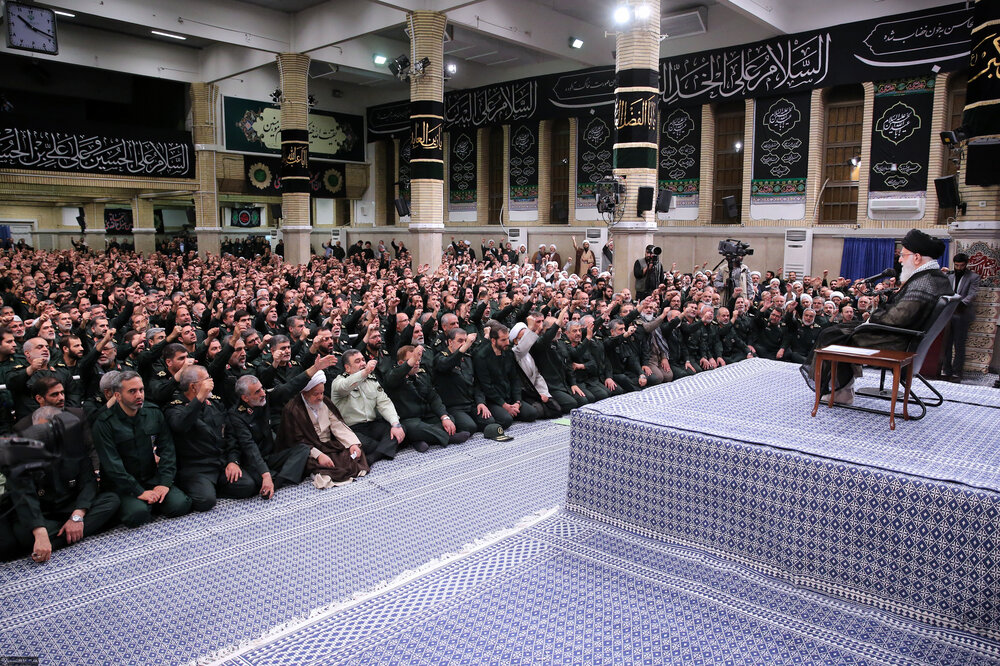
“Reducing nuclear commitments, for which the Atomic Energy Organization is responsible, should continue seriously and precisely as it was announced by the government till it reaches favorable result and it will definitely reach the result,” Ayatollah Khamenei said during a meeting with the High Council of the Commanders of the Islamic Revolutionary Guard Corps.
The Leader also said the United States’ policy of “maximum pressure” against Iran has ended in failure.
“They imagined Iran would be forced to show flexibility if they applied policy of maximum pressure. With the help of God, they understand that the maximum pressure has caused problems for themselves,” the Leader stated.
The Leader describes sanctions on Iran’s oil sale as a “short term problem”.Referring to President Hassan Rouhani’s visit to the annual UN summit in New York last week, the Leader said, “Recently, they (the U.S.) made unfruitful efforts with the help of their European friends to form a symbolic show of Iran’s surrender and to make the Iranian president to meet with them. However, Iran will continue reducing nuclear commitments seriously and determinedly till reaching favorable result.”
U.S. President Donald Trump, who quit the nuclear deal in May 2018 and imposed the harshest ever sanctions on Tehran, has been repeatedly calling for dialogue with Iran.
On May 8, exactly one year after the U.S. abandoned the deal, Tehran began to partially reduce its commitments to the agreement at bi-monthly intervals.
In the first stage, Iran announced that it will not limit its stockpile of the nuclear fuel to 300 kilograms allowed under the deal. However, on that date (May 8) Iran’s Supreme National Security Council (SNSC) said if the remaining parties to the JCPOA, especially Europeans, devise a mechanism to protect it from the sanctions effect in the two-month deadline it will reverse its decision. 
But since European parties missed the deadline, on July 7 Iran announced that it has started enriching uranium to a higher purity than the 3.67%, thereby starting the second step.
As Europe missed the second 60-day deadline, Iran moved to take the third step, removing ban on nuclear research and development (R&D).
In a letter on September 5, Foreign Minister Mohammad Javad Zarif notified European Union foreign policy chief Federica Mogherini about Iran’s third step.
‘Relying on domestic capabilities is solution to problems’
Ayatollah Khamenei also said that relying on domestic capabilities is solution to economic problems.
He described sanctions on Iran’s oil sale as a “short term problem”.
If proper actions is taken, the country can reach a “long-term benefit” from this “short term problem” which is non-reliance on oil revenues, the Leader remarked.

Saturday, September 28, 2019

US and EU Gang up to Demonize Iran Over Saudi Airstrikes

The European Union’s statement this week condemning Iran over the recent airstrikes on Saudi Arabia’s key oil industry sites was a tawdry piece of political cowardice. Not only tawdry, but dangerous as well.
For the EU is giving credence to Washington’s intensified attempts to demonize Iran, imposing ever-harsher economic sanctions and escalating tensions that could explode into an all-out war. Ironically, this is in spite of the EU claiming to be facilitating diplomacy to promote peace and security in the Middle East.
To be more precise, it wasn’t an EU joint statement issued at the United Nations general assembly this week. It was a statement formulated by only three members of the bloc: Britain, France and Germany. In practice, however, the biggest members of the EU were speaking on behalf of the others. (Full statement here.)
British Prime Minister Boris Johnson, French President Emmanuel Macron and German Chancellor Angela Merkel stated the following:
“We condemn in the strongest terms the attacks on oil facilities on Saudi territory on September 14, 2019 in Abqaiq and Khurais, and reaffirm in this context our full solidarity with the Kingdom of Saudi Arabia and its population. It is clear to us that Iran bears responsibility for this attack. There is no other plausible explanation. We support ongoing investigations to establish further details.”
Thus, the Europeans are repeating assertions made by the United States and Saudi Arabia by which they accuse Iran of being responsible for firing drones and cruise missiles at the vital Saudi oil installations. No credible proof has so far been presented to support such an assertion.
The European powers are engaging in a reprehensible blame game which will only embolden further Washington’s reckless aggression against Iran.
Tehran has categorically rejected all accusations that it was in some way involved in the airstrikes against Saudi Arabia. The Yemeni Houthi rebels have from the outset following the attacks claimed full responsibility.
Iran may support the Yemeni rebels and have at some time provided weapon technology, but the Houthis are capable of developing and deploying their own fire power.
By blaming Iran, the US and Europeans are giving political cover to Saudi Arabia and its nefarious role in starting and waging a genocidal war against Yemen for the past four years. It is arguably the right of the Yemenis to retaliate against Saudi Arabia in acts of self-defense. And it is in Iran’s right to support the Yemenis, just as the US, British and French support Saudi Arabia. Why should there be a double standard?
What is even more despicable is that the European trio (the so-called E3) have been massive weapons suppliers to Saudi Arabia, in particular Britain and France. The British and French (and Americans, of course) have made hundreds of millions of dollars in recent years from weaponizing the Saudi war on Yemen, even though that has led to nearly 100,000 civilian deaths. Why doesn’t the E3 issue condemnation, rather than “solidarity” to the Kingdom of Saudi Arabia, over this genocidal slaughter?
A further aspect to the joint statement issued by Britain, France and Germany is that these powers are signaling their support for US President Donald Trump’s efforts at sabotaging the international nuclear accord with Iran. That landmark deal was co-signed by the US, France, Britain, Germany, Russia and China back in July 2015.
Trump reneged on the UN-endorsed treaty when he unilaterally walked away from it in May 2018. It was typical American bad faith and backsliding whenever international agreements don’t suit their selfish interests.
Russia and China continue to support the Joint Comprehensive Plan of Action (JCPOA, as the nuclear deal is known formally as). Iran has recently begun to suspend certain commitments, such as increasing stocks of enriched uranium. The Iranian position of partial non-compliance is understandable. The US has trashed its obligations to the deal, and the Europeans have barely stepped up to the plate to implement sanctions relief for Iran, which is mandated by the JCPOA. Four years after the deal was done!
Britain, France and Germany claim to be still committed to the nuclear deal, according to a press statement by EU Foreign Affairs Commissioner Federica Mogherini at the UN this week.
But it is evident that, on the contrary, the E3 troika is instead moving to undermine the JCPOA. Blaming Iran with groundless accusations of attacking Saudi Arabia is part of the sinister shift by stealth. The day before the E3 issued their joint statement, Britain’s Boris Johnson was disparaging the nuclear as a “bad deal” and urged a renegotiation for what he sycophantically called a “Trump deal”.
Here is another weasel-worded section from the EU joint statement:
“Conscious of the importance of collective efforts to guarantee regional stability and security, we reiterate our conviction that the time has come for Iran to accept negotiation [sic] on a long-term framework for its nuclear program as well as on issues related to regional security, including its missiles program and other means of delivery… We urge Iran to engage in such a dialogue and refrain from further provocation and escalation.”
That is a clear – albeit with backhanded verbosity – attempt to pressure Iran into accepting Trump’s demand for the JCPOA to be replaced by further restrictions on Iran’s rights to pursue self-defense and normal regional and international relations. In weak-kneed fashion, the EU is augmenting Trump’s agenda of demonizing and criminalizing Iran so that it might succumb to subjugation.
Why the Europeans are acting with such cynicism is to conceal the glaring fact of their own weakness vis-a-vis Washington’s dictates and imperialist bullying. They should be admonishing the Americans for bad faith and reckless aggression; they should be condemning Saudi Arabia for a merciless slaughter in Yemen; they should be with-holding lucrative weapons sales to Saudi Arabia if they were really interested in peace; and if the Europeans really were genuine about non-proliferation and Middle Eastern stability, they should be whole-heartedly implementing the nuclear accord with Iran and providing the country the normalized economic trade that it is entitled to – just as Russia and China have done.
But no. And so to cover up their spinelessness, the Europeans are obliged to gang up with Washington to blame the victim of imperialist abuse – Iran. Such European cowardice is leading to more conflict.

Monday, September 23, 2019

The US Should Not Fight a War for Saudi Oil

Steve CHAPMAN
From Donald Trump’s comments on the attack on a Saudi oil facility, allegedly by Iran, it’s not clear whether he’s itching for a fight, leery of a fight or willing to take part in a fight if his friends in Riyadh want him to. He alternates between talking tough, waxing conciliatory and sounding as though he has no idea what to do.
But the chance of U.S. military action can never be discounted, because, well, we’re the United States and military action is our default option — under presidents of both parties. We are never short of reasons to put our forces in harm’s way.
The reason in this case would be that Iran is our enemy and stands accused of being responsible for a strike on a complex that normally puts out 5.7 million barrels of oil per day — some 5% of the world supply. We would be coming to the aid of the Saudi rulers, who buy our weapons, get along with Trump and share our hostility toward Tehran.
They would be happy to hold our coat while we punch their foe. Former Defense Secretary Robert Gates once told the French foreign minister that the Saudis would “fight the Iranians to the last American.” But why Americans should take risky actions for their sake is hard to imagine.
Saudi Arabia is not a treaty ally. Its proxy war with Iran in Yemen has nothing to do with us. When the U.S. invaded Iraq in 2003, they were unhelpful. In 2016, Trump himself said the Saudis were “the world’s biggest funders of terrorism.”
A measure of the regime’s toxic character is that, as The New York Times reported, “the Islamic State adopted official Saudi textbooks for its schools until the extremist group could publish its own books in 2015.” Saudi agents murdered a Washington Post journalist and dismembered him with a bone saw.
We have sometimes found the Saudis to be a useful partner. But just because their interests sometimes converge with ours is no reason to put American lives at risk over their troubles with Iran. The kingdom has the third-biggest military budget in the world, and its arsenal includes American-made F-15s. The Saudis can punish Iran if they choose.
It’s worth wondering why Iran would lash out like this. It is suffering under U.S. economic sanctions — which University of Michigan Middle East scholar Juan Cole describes as the most severe ever imposed on a country in peacetime. For domestic and geopolitical reasons, Iran apparently thinks it has to retaliate. Disrupting the supply of oil is a way of communicating that if they are going to suffer, others will also feel the pain.
The reason the Iranians are suffering is that Trump walked away from a deal that rolled back their nuclear program in exchange for the lifting of sanctions. He then ratcheted up the sanctions, proving to Iranians the futility of compromising with Washington.
What can we do now? Sen. Lindsey Graham, R-S.C., said, “It is now time for the U.S. to put on the table an attack on Iranian oil refineries.” Punishing an attack that reduced oil supplies by mounting an attack to reduce them even more would be a bizarre tactic. It would compound the harm allegedly done by the Iranians rather than neutralize it.
Neutralizing it would not be so hard. The Riyadh regime says it can cover any shortfall from its inventory and restore full production shortly. Even if it can’t, University of Notre Dame political scientist Rosemary Kelanic, author of the forthcoming book, “Black Gold and Blackmail: Oil and Great Power Politics,” tells me strategic petroleum reserves in the U.S. and our allies could fill the gap for nearly two years.
Any increase in prices would also stimulate output everywhere from Russia to West Texas, which would soon bring them back down. The United States, keep in mind, is now the world’s biggest producer, pumping far more than Saudi Arabia.
The overall economic fallout of this episode is likely to be mild. A war with Iran, by contrast, would have brutal economic consequences around the world, not to mention the human carnage.
Maybe Trump should have thought of that before. He abandoned the nuclear deal in the belief that he could force Iran to beg for mercy — a strategy that has only backfired. He is learning an old lesson: It’s easier to get yourself into a fight than to get yourself out of one.

The Sickness of American Foreign Policy

Eric ZUESSE

The Military-Industrial Complex runs US foreign policies. What passes for international ‘news’ reporting in the United States media was supremely represented by the instance of those ’news’ media stenographically reporting the Government’s lies about ’Saddam’s WMD’, even after it was unarguably clear that those were just blatant lies from the President and his Administration. America’s media were merely passive megaphones for the regime’s lies. Instead of disproving the regime’s lies — as they could have done if they were journalistic, instead of propagandistic, media — they merely reported the lying government’s assertions. It was like 1984 “Big Brother”; and it still is, as today’s 2019 USA. In between 2003 and now, the regime invaded Libya and Syria and Yemen, on the basis of lies that in some respects were even more blatant. The same groups of billionaires control the US ‘news’ media today as controlled the media in 2003; and they continue, in their ‘news’-media, the same stenographic ‘reporting’ — propaganda by their Government, regarding which nations are the latest targets, for the masses to hate and fear, as being our nation’s ‘enemies’. These are the lands suitable for US weapons and bombs to destroy. These ‘news’-media simply ‘justify’ what are, in fact, international war-crimes: US-and-allied invasions, of nations that never had invaded the US
There’s always the Big Lie that the hate-target is only ‘the tyrant’, and not the nation. But it’s the targeted nation that gets strangulated by America and its allies imposing ‘sanctions’ that are really economic blockades (such as against Venezuela and Iran today, but formerly against Iraq before we invaded and destroyed it); and, then, if that doesn’t bring down the targeted Government, a coup is attempted; and, then (if no coup results), paying and arming ‘rebels’ (such as Al Qaeda in Syria) to overthrow the targeted nation’s Government; and, then, missiles and bombers are used, in order to destroy the infrastructure. It’s no better now than it was then, in 2003 in Iraq, and later in Libya, Syria, and so much else. There has been no change, except in the identities of the nations for Americans to hate and fear, and overthrow. And especially under Trump, refugees are being banned to immigrate from the countries the US regime has destroyed. He’s “making America great again,” like his predecessor Obama had insisted that “The United States is and remains the one indispensable nation.” Every other nation — including Libya and Syria and Yemen — is consequently “dispensable,” in that view. America’s voters tolerate, or even respect and re-elect, such vile leaders as this. How, then, should the citizens of other countries feel about America? And yet, the 2009 Nobel Peace Prize winner Obama as President is overwhelmingly respected around the world, notwithstanding his having destroyed, or participated in destroying, Libya and Syria and Yemen, whereas as soon as the obviously uncouth Trump came into office and ever since then, Trump has been widely despised throughout the world — as all three US Presidents during this Century thus far, reasonably ought to be. The public responds more to surfaces than to reality. Thus, though the reality of Obama was overall as horrendous as the reality of Trump, the reputations of those two Presidents could hardly be more different from one another. The deeper reality of the United States is Big Brother, which was born in the United States when FDR died in 1945, and it has grown larger ever since then — and especially since 2001. America’s voters are kept ignorant of the ongoing and bipartisan ugliness of its Government’s bipartisan imperialistic (or “neoconservative”) foreign policy. After all, the motivation behind it is to ‘protect human rights’ and ‘spread democracy’ in other countries (if you can believe the liars). How ‘nice’ is that (while the bombs are dropping and the target-country is being economically strangled)? And so, the US, as policeman to the world, has become an insult to the UN that FDR had been so proud to design and establish.
The US regime’s hatreds are bipartisan because all of this hate comes actually from America’s billionaires (the masters of America’s top brands) who control America’s international corporations and who are America’s political mega-donors; and these billionaires are of two types, Republican and Democratic; and both types of American billionaires are neoconservatives — champions of US imperialism — because extending the American empire is very profitable for America’s international corporations. That’s what it’s really all about.
Here’s one example:
On 25 July 2017, the US House of Representatives voted 419 to 3 to expand America’s economic blockades against “the Governments of Iran, the Russian Federation, and North Korea”, via “Sanctions”, which are a device that has become the US regime’s typical first step toward an ultimate military invasion. They always produce suffering amongst the targeted nation’s population, and far less so against the targeted nation’s leaders. Yet sanctions and coups and invasions are done because of the US Government’s ‘humanitarian’ concern for the attacked nation’s people, and in order to install ‘democracy’ there. How can a militaristic regime function if it’s not constantly lying, like that? It can’t. That’s why it continually lies.
Iran, Russia and North Korea are the enemies authorized in this virtual declaration of war against all three nations.
This bill, which passed the House by 419 to 3, became voted 98 to 2 in the US Senate, and was then signed into law by US President Donald Trump, on 2 August 2017. It was a triple farce (and “farce” here is a euphemism for fraud). Here’s just a bit of the evidence for that:
THE CASE AGAINST IRAN
The US regime constantly refers to Iran as “the foremost state sponsor of terrorism”, which it never has been even close to being, and which phrase describes the US regime itself far more than it does Iran. But did Iran ever invade America? Of course not! However, Americans actually did become enemies of Iran when our Government overthrew Iran’s progressive and democratically elected Government, in July and August of 1953, and the US regime at that time had the full cooperation of the UK regime, and of Iran’s own mullahs, in that coup d’etat, which installed the US regime’s chosen brutal dictator, the Shah, to rule there. But did Iran ever even threaten America? No, not even threaten. The US regime constantly threatens Iran, and Iran’s Government would need to be idiots to take lightly these threats by the US regime — the same regime that had installed the brutal Shah in 1953. Yet the US regime has the nerve to continue, and even to intensify, these threats, and even to blame Iran’s suffering economy on Iran’s own Government (which America’s billionaires want to replace), instead of on America’s Government (those billionaires’ own government) and on this regime’s allies, and on the strangulating economic sanctions which this US team leads, and imposes, against Iran.
The case against Russia
The US regime overthrows governments routinely, and doesn’t just propagandize in those targeted countries so as to influence their elections; but when the Obama regime’s frame-up against Russia as having supposedly acted in collusion with Donald Trump’s campaign in 2016, as having constituted a merely possible excuse for the failure of Obama’s chosen successor to win the US Presidency, even the Special Prosecutor’s efforts to find evidence that might be able to convict Trump on such a charge after he leaves office, drew only blanks. There was no such evidence, of any such collusion, the Special Counsel Robert Mueller reluctantly admitted.
Actually, there does exist statistically overwhelming evidence to the exact contrary — that, as the definitive scientific analysis of the evidence reluctantly reported:
What is most striking about the data in this table is that Donald Trump actually slightly under-performed the model’s predictions in all three states. He did about one point worse than predicted in Michigan, about two points worse than predicted in Pennsylvania, and between two and three points worse than predicted in Wisconsin. There is no evidence here that Russian interference, to the extent that it occurred, did anything to help Trump in these three states.
In other words: the single predictive model that has a flawless record of predicting Presidential winners, and which was the only model that predicted Trump to beat Hillary in 2016, showed Trump winning the three toss-up states by slightly higher margins than he actually did win them. If there was any influence upon the electoral outcome that came from a factor (such as from Russian influence) that was not being considered in this model, then that factor ended up benefiting Hillary, not Trump. That’s the exact opposite of the Obama-engineered hypothesis, which falsely alleges that ‘Trump is Putin’s stooge’.
And, now, the Trump regime is trying to establish a convictable case against Trump’s predecessor, Obama, for having tried to frame Trump (and Russia) for Hillary’s loss in 2016. (There’s considerable evidence that Obama did try to frame Trump, and Russia’s Government, for that loss. And the US Government — even under Trump — has been trying to keep this information secret, unless and until House Democrats become serious about ‘impeaching Trump’. If they won’t try to impeach him, then he won’t try to convict Obama for treason.) (What? Democrats want Mike Pence to become President? Not really: it’s all just a show, for stupid voters in their own Party — and they obviously think that there are plenty of those. Rooting for Pence to become President is apparently very popular amongst Democratic Party voters. Perhaps many Republican Party billionaires are even hoping that those Democratic idiots will get what they want. Is this democracy in action, or just a threatened counter-coup to punish the Democratic Party’s prior coup-attempt against the Republican President?)
The case against North Korea
So, Iran didn’t ever invade America, nor did Russia. What about North Korea, then? Did North Korea ever invade America? No, neither did that alleged ‘enemy’ of America. But America did invade North Korea during the Korean War. Have you ever seen the 764-page “REPORT OF THE INTERNATIONAL SCIENTIFIC COMMISSION FOR THE INVESTIGATION OF THE FACTS CONCERNING BACTERIAL WARFARE IN KOREA AND CHINA”? It documents America’s biological warfare program against North Korea in 1952. You probably haven’t even heard about it, because the US regime managed to keep it hidden from the public until just this year, and because America’s ‘news’-media continue to blacklist its existence so as to continue the ‘justification’ for the US regime’s still-ongoing efforts to conquer North Korea. But look at it here, as soon as its 764 pages have finished loading into your computer. Now that the US regime is increasing its threats against both North Korea and China, the Governments in those countries recently released this document to the public, and thereby are challenging the US propaganda-media to allow the publics in the US and its vassal nations to see it — to see real history about this matter, not just propaganda (such as the US is the world’s champion of).
This massive historical document opens:
On the 22nd. Feb. 1952, Mr. Bak Hun-Yung, Foreign Minister of the Democratic People’s Republic of Korea, and on the 8th. March, Mr. Chou En-Lai, Foreign Minister of the People’s Republic of China, protested officially against the use of bacteriological warfare by the USA. On the 25th. Feb., Dr. Kuo Mo-Jo, President of the Chinese People’s Committee for World Peace, addressed an appeal to the World Peace Council.
At the meeting of the Executive Committee of the World Peace Council held at Oslo on the 29th. March, Dr. Kuo Mo-Jo, with the assistance of the Chinese delegates who accompanied him, and in the presence of the Korean representative, Mr. Li Ki-len, placed the members of the Committee, and other national delegates, in possession of much information concerning the phenomena in question. Dr. Kuo declared that the governments of China and (North) Korea did not consider the International Red Cross Committee sufficiently free from political influence to be capable of instituting an unbiassed enquiry in the field. This objection was later extended to the World Health Organisation, as a specialised agency of the United Nations. However, the two governments were entirely desirous of inviting an international group of impartial and independent scientists to proceed to China and to investigate personally the facts on which the allegations were based. They might or might not be connected with organisations working for peace, but they would naturally be persons known for their devotion to humanitarian causes. The group would have the mission of verifying or invalidating the allegations. After thorough discussion, the Executive Committee adopted unanimously a resolution calling for the formation of such an International Scientific Commission.
Written largely by the most prestigious British scientist of his day, this report was effectively suppressed upon its release in 1952. Published now in text-searchable format, it includes hundreds of pages of evidence about the use of US biological weapons during the Korean War, available for the first time to the general public.
Back in the early 1950s, the US conducted a furious bombing campaign during the Korean War, dropping hundreds of thousands of tons of ordnance, much of it napalm, on North Korea. The bombardment, worse than any country had received up to that point, excepting the effects on Hiroshima and Nagasaki, wiped out nearly every city in North Korea, contributing to well over a million civilian deaths. Because of the relentless bombing, the people were reduced to living in tunnels. Even the normally bellicose Gen. MacArthur claimed to find the devastation wreaked by the US to be sickening.[1]
The massive document itself authenticates numerous reports of the US flying planes over North Korea and dropping containers of fleas, clams, and other creatures, that were tested and verified as being contaminated with plague and cholera. For example, on pages 24-26 are described several such incidents. Typical was one in which “the Commission had no option but to conclude that the American air force was employing in Korea methods very similar to, if not exactly identical with, those employed to spread plague by the Japanese during the second world war.” Furthermore, one expert “gave evidence to the effect that he had urged the Kuomintang government to make known to the world the facts concerning Japanese bacterial warfare, but without success, partly, he thought, as the result of American dissuasion.” In other words: the US regime not only protected and hired ‘former’ Nazis to use against USSR, but it did the same with Japan to use against China and North Korea. This 1952 operation against North Korea was perpetrated by the regime under US President Harry S. Truman — the former Vice President who had been forced onto FDR’s final ticket by that Party’s top donors in order to get a war started against the Soviet Union and thereby keep their enormous government contracts continuing after WW II. Right after FDR died, Truman got fooled by Churchill and Eisenhower into starting the Cold War against the Soviet Union; and this 1952 international war-crime against China and North Korea was part of that.
Conclusion
Okay, then: When will US President Trump, and the 419 members of the US House, and the 98 members of the US Senate, eat crow and come clean about what they actually represent? (It’s certainly not democracy.)
Congress is very partisanly split over domestic issues, because Republican and Democratic billionaires are split about them, but America’s billionaires are united in their support for US imperialism; and, so, the members of Congress, and Presidential candidates, are, too. When do you see near 100% support in Congress for a domestic policy? Never even close to that. But for American aggressions, it’s virtual unanimity. The billionaires are solidly for aggression; and, so, their Government is, too. Virtually all politicians who are elected to national office are psychopaths. Otherwise, they’ll get nothing from the billionaires, and therefore won’t win public office.
Americans are supposed to trust such a government. Well, of course, the billionaires can trust it, because they bought it. And that’s the sickness, and slickness, of American foreign policy. It’s just a global scam, which destroys millions of people, and creates misery for hundreds of millions, all in the name of ‘defending America’, and of ‘protecting human rights’ and ‘defending democracy’, around the world.