Showing posts with label White House. Show all posts

Sunday, November 17, 2019

White House-Ak Saray relations: From close friendship to conflict of interests

By Hossein Amiri

Relations between the U.S. Turkey have strained since the failed July 2016 coup in Turkey. Now, the most important reasons for the tension is Washington's strong opposition to Turkey's plan to buy S-400 missile system from Russia and Turkish military invasion into northern Syria.
Although Turkish President Recep Tayyip Erdogan's visit to the U.S. on November 13 was intended to resolve the two countries' disputes and open a new horizon in economic and trade relations, differences still remain. 
Though after the meeting at the White House, Trump made some pledges, including increasing trade ties to $100 billion, it takes a long time to fulfill these promises.
Contrary to such pledges, the Pentagon announced that it had replaced all F-35 fighter parts made by Turkey.
While the Turkish and U.S. leaders were meeting, F-35 production program executive Lt. Gen. Eric Fick said at a congressional hearing that Turkey would be completely phased out until March.
At the moment the U.S. has narrowed the number of parts down from 1,000 to 12.
Undersecretary of Defense for Acquisition and Sustainment Ellen Lord affirmed to Rep. Donald Norcross, D-N.J., that as of Wednesday, Turkey’s exit from the program was not expected to cause any F-35 production delays.
The U.S. government believes Ankara's move to buy S-400 missile system from Russia is not in line with NATO policies. Washington also sees Turkey’s decision as a threat to U.S. F-35 fighters. However, Ankara has announced that it will go ahead with its decision to buy the missile system.
Erdogan said it is not a right policy to ask Ankara to deprive itself of the Russian S-400 missile defense system.
Erdogan's remarks came in response to some reports that Trump had requested Turkey to cancel the purchase of S-400 system, a defense system that has been deployed in some parts of Turkey since July 2019.
But after Trump and Erdogan's meeting, the Turkish president claimed that the U.S. president had a positive view on buying the missile system.
Though Trump may seek to strike a deal with Erdogan on the S-400 missile system and F-35 fighter aircraft, based on his own businessmen approach, Ankara's military intervention in northern Syria and its insistence on buying the S-400 system are at odds with Washington. For this reason, the House of Representatives has passed two resolutions against Turkey.
On October 30, the House approved a resolution against Turkey recognizing the Ottoman massacre of Armenians in 1915. 305 representatives voted in favor of the resolution, with only three opposing it. It also passed another resolution calling on Trump to impose sanctions on Turkey over military operations in northern Syria. The resolution was also adopted by 403 votes in favor and 16 against, a move that rose Turkey's anger.
After Erdogan's meeting with Trump, attended by some Congress representatives, senior Republican Senator Lindsey Graham and chairman of the Senate Judiciary Committee vetoed the resolution recognizing the massacre of Armenians by the Ottoman Empire. 
Earlier, Senate Majority Leader Robert Menendez had called for the resolution to be approved. Lindsey Graham noted that he had listened to Erdogan's speech at the White House and criticized a House resolution that recognized the Armenian genocide. 
Menendez argued that "U.S. policy must be unanimous and honest in the face of human rights violations, crimes against humanity, ethnic cleansing, and genocide" and sent it to the Senate for approval.
There is a difference between the White House and Congress in how to deal with Turkey. Also, there is a difference between Republicans and Democrats despite Trump's promises to Erdogan.

Wednesday, November 13, 2019

What are White House allies doing in East Asia ?!

By Saeed Sobhani

TEHRAN-Japan and South Korea, as two US allies in the East Asian region, do not play a positive role in resolving the crisis in the region. Undoubtedly, resolving the crises in East Asia is only possible in one way and that is the separation of Tokyo and Seoul from White House policies. This has not happened yet!
South Koreans Are Pleading for a Breakthrough in the US-North Korea Talks
As Tim Shorrok wrote in Outline, It’s not just the North Koreans who are fed up with the glacial pace of their bilateral negotiations with President Trump over nuclear weapons and long-range missiles. Many South Koreans are too. And they are starting to make their voices known. On November 5, 71 members of South Korea’s National Assembly signed on to legislation calling on the two Koreas and the United States and China to declare a formal end to the Korean War and sign a peace treaty. To many Koreans on both sides of the DMZ, that’s a necessary step to kick-start the denuclearization talks and, in the words of the bill’s sponsor, “help to usher in peace on the Korean Peninsula.”
The timing was significant. The week before, on October 31, Kim Jong-un had set off alarm bells in Washington when his military conducted another “test fire” of a short-range missile. His intent was to add pressure on Trump “to meet an end-of-year deadline for a new proposal on exchanging the regime’s nuclear weapons program for economic and political concessions,” South Korea’s Yonhap reported.
The missile test received the usual blanket coverage in the mainstream US press. It has been contemptuous of Trump’s negotiations with Kim since they began in Singapore last year and has adopted a story line pushed by the foreign policy establishment—that North Korea is rearming while Kim’s talks with Trump flounder.
“North Korea launched two more short range missiles and nobody seems to care anymore,” Josh Rogin, a hawkish commentator for The Washington Post, said in a tweet about the test. But they certainly care in South Korea, where people have lived with the threat of war for 70 years and are anxious to find a way toward permanent peace.
In the week preceding the missile test, a group of progressive activists from South Korea was in New York and Washington pleading for a change in US policy to break the deadlock so the two Koreas can move forward on their own plans for reconciliation.
Tired of the impasse in the US-North Korean talks and impatient with what they see as President Moon Jae-in’s acquiescence to US demands on maintaining sanctions, the 22 delegates, representing South Korean churches, labor unions, academia, and agriculture, spent five days on the East Coast to warn that, without US concessions on sanctions, the peace process in their country could be doomed.
“We are on the cusp of a dangerous time in which a standstill between these countries that extends into 2020 could escalate to the extremes of military action and even war between North Korea and the United States,” Pil-young Shin, the chair of the June 15 Committee for the Reunification of Korea, said in his opening remarks to an October 26 conference at the United Nations in New York (I was invited to address the conference as an independent journalist).
Unlike the US skeptics, who dominate discussion of Korea in the media and cable news, the South Korean progressives view American policy itself as the prime obstacle to progress in the Korea peace process.
“We have emphasized repeatedly that the basic problem threatening peace in the Korean Peninsula lies in the US’s long-lasting hostile policies towards [the] DPRK,” Chongbok Lee, a veteran organizer and the chair of the peace delegation, said at the UN conference, using North Korea’s formal name, the Democratic People’s Republic of Korea. That term—“hostile policy”—is also at the core of North Korea’s demands of the United States.
Lee continued: “The US must come back to the spirit of June 2018 Singapore summit and should release blockade and oppressive measures against [North] Korea, making efforts to normalize relations. As a result of such processes, we ensure that the stable peace regime, as well as denuclearization, can be achieved.” He pointed out that the June 12, 2018, declaration in Singapore by Kim and Trump “asserted a commitment to end the long hostile relations between the DPRK and the US,” adding that “the US government must devote effort into uprooting the war mechanism deeply embedded into the Korean Peninsula.”
It was Trump’s hard line on maintaining sanctions until full denuclearization, he and other South Koreans argued, that led North Korea to walk out of its last meeting with US negotiators in Sweden on October 5. Ten days later, Kim Jong-un was pictured in state media riding a white stallion in the snow to Mount Paekdu, the highest mountain on the Korean Peninsula and a symbol of North Korean nationalism, power, and invincibility. “Kim Jong-un sends a message of self-reliance and perseverance to N. Korean people,” the progressive Hankyoreh declared in its headline about the event.
But most US observers interpreted the visual, which was widely ridiculed on social media, as a sign that he’s about to take dramatic action—perhaps “bigger and badder” missile tests, suggested analyst Harry Kazianis—unless the United States meets the deadline set earlier this year. Coming from the right, The Daily Beast’s Donald Kirk predicted that Kim’s ride on Mount Paekdu was “all about projecting the image of a heroin a campaign of intimidation aimed at both the U.S. and South Korea in a climactic drive to get [Trump and Moon] to yield at last to his demands.”
That’s certainly not how the visiting Koreans see it.In their meetings with UN diplomats, US lawmakers, and peace groups in the last week of October, the delegation stressed that Trump’s refusal to lift sanctions as part of his “maximum pressure” campaign to force Kim’s immediate denuclearization has driven the North to display its conventional military might with its recent missile tests (24 launches this year, according to one observer).
Worse, they said, the sanctions have made it impossible for the two Koreas to move forward on the economic projects Kim and Moon agreed to at their own historic summit in Pyongyang in September 2018. One of the most important of those projects was the reopening of the Mount Kumgang tourism site in the North that was the focus of bitter recriminations by Chairman Kim in late October. When South Korea offered to discuss the project in face-to-face talks, the DPRK rejected the offer.
The South Korean delegation blamed US sanctions for the impasse. “We beseech our US friends: the US keeps imposing restrictions that stop the Mount Kumgang project,” Shin told a group of US Korea watchers at the Institute for Policy Studies in Washington. “We wish to work with you to overcome this obstacle.” Without warming in inter-Korean ties, he warned, the prospects for the US and South Korean agreement with North Korea on nuclear weapons grow dimmer by the day.
The sanctions have also made it difficult for badly needed humanitarian aid to flow. In a meeting with the staff of Massachusetts Senator Edward Markey, the delegation said, they discussed the possibility of exemptions on sanctions for such items as medicine and water filters.
The serious impact of sanctions on ordinary North Koreans was underscored by a report from an international panel of independent experts that was released on October 30 by Korea Peace Now!, a coalition led by Women Cross DMZ. The report was covered widely, including by The Wall Street Journal, and includes some sobering statistics.
“There is already evidence of irreparable damage,” the report states. “It is possible to estimate with reasonable certainty that there may have been more than 3,968 deaths in 2018 (with 3,193 of those being children under age 5, and 72 of them pregnant women) as a result of sanctions-related delays and funding shortfalls impacting specific UN humanitarian programs.” (A full copy of the report can be downloaded here.)
The June 15 Committee that visited the United States was formed in 2000 to support the spirit of the first-ever summit between North and South, where the Mount Kumgang project began (it was shut down in 2009 during a period of high tensions between the two sides). The committee was a key part of the broad coalition that organized the massive candlelight rallies in 2016 and 2017 that led directly to the impeachment of Park Geun-Hye and the subsequent election of President Moon in May 2017.
Since then, the South Korean progressive forces have been the backbone of popular support for President Moon. As I witnessed from Gwangju in 2017, he campaigned for the presidency pledging to restore the “Sunshine Policy” of political and economic engagement initiated in the late 1990s by his predecessors, Kim Dae-Jung—who made that first trek north in 2000—and Roh Moo-hyun. Since Moon took office, those in favor of his peace initiative are a majority; while he has slipped in popularity in recent months, most polls show that 60 percent support him on his outreach to North Korea.
But the hard-line US stance on the North has greatly troubled the Korean left and even the Moon government. They have watched with growing apprehension as the US-run United Nations Command in South Korea has blocked South Korean officials from participating in a survey of North Korea’s rail system and continued strict controls on people from the South crossing the border for discussions with their Northern counterparts. (Some of the controls are petty: One group that convened at Mount Kumgang last February was prohibited from bringing laptops or cameras with them, members of the June 15 delegation said.)
While publicly supportive of the UN Command, the Moon government has expressed reservations about its policies. On October 21, Moon’s Unification Minister, Kim Yeon-Chul, said at a National Assembly hearing that the UNC was using “inadequate legal grounds” for denying certain permits to cross the border, and said that “institutional remedies” are needed so people can cross the DMZ for nonmilitary purposes (in a rare rebuke, the UNC responded with a press statement calling such reports “inaccurate”).
South Korean progressives have also been shocked by US criticism of the Moon government’s response to its trade dispute with Japan over a Supreme Court decision that Tokyo should pay compensation to Korean victims of Japanese forced labor during World War II. Even as the June 15 delegation was in New York and Washington, a senior US official, Assistant Secretary of State for East Asian and Pacific Affairs David Stilwell, was in Seoul asking the Moon government to rejoin an intelligence-sharing arrangement with Japan it had canceled in retaliation for Japanese export sanctions.
The distance between Seoul and Washington on this issue was very clear at a conference organized by the Center for Strategic and International Studies, a military think tank that receives major funding from Japan and US arms exporters. “The country doing the most damage to itself” in the dispute “is the Republic of Korea,” said Michael Green, a CSIS senior vice president who worked on Korea issues for the George W. Bush administration. “I don’t know what the Moon government is doing with Japan. Japan is winning this tactically.”
The hostility from official Washington is so intense that Lee Su-hyeok, Moon’s new ambassador to the United States, told reporters a few days ago that South Korea’s policies toward the North are inviting criticisms that they are “pro-Pyongyang.” And Trump, whose outreach to Kim has been applauded by the South Korean left, has raised the stakes himself by demanding a five-fold increase in Seoul’s financial support for US forces in Korea.
According to a recent book by an aide to former secretary of defense James Mattis, Trump called South Korea a “major abuser” of the United States and characterized the alliance as a “losing deal.” He allegedly added that if Seoul “paid us $60 billion a year to keep our troops overseas, then it’s an okay deal.” The statements have sparked some protests in South Korea. On October 18, a group of progressive university students used ladders to enter the grounds of the residence of US Ambassador Harry Harris and denounced the 500 percent increase in costs for the bases (“Leave this soil, Harris,” their banner read).
On the issue of US forces in the country, South Korea’s progressive forces seem to reflect mainstream thinking. While recent polls have shown that most South Koreans support a military alliance with the United States, there is considerable ambiguity about the future of US bases in the South and sharp disagreement with the US demands that Seoul increase its payments. Last January, for example, the Korean firm Realmeter found that nearly 60 percent of Koreans opposed paying a greater share of the costs for US bases, as Trump has demanded, while 52 percent were against the idea “even if” it means the United States scales down its forces or withdraws from the peninsula. Trump’s recent statements, too, sparked anger from many South Koreans. “I hope against hope that Americans will get over with the Trumpian diversion and put things back to where they were,” Oh Young-jin, an editor with the centrist Korea Times, wrote in a commentary titled “Why Trump hates Koreans.”
The Trump administration also came under criticism after a Pentagon official suggested—during talks about returning wartime operational control of US-Korean forces to Seoul—that the South Korean military should become an auxiliary force for the United States in such places as the Middle East. “Reports that we may have to send our troops to overseas areas of conflict determined to be a threat by the United States after the Opcon transfer are not true,” a spokesperson for the defense ministry told reporters.
Back in Washington, members of the June 15 group explained that the differences over sanctions underscore the need to redefine the meaning of the US-South Korean alliance, which was formalized in 1954.
“We need to move from a hierarchical to a more equal relationship,” Lee, the chairman of the delegation, said. “Until the alliance is transformed, inter-Korean movement will be limited.” Moreover, “so long as the United States maintains a hierarchical alliance over South Korea, North Korea will not change its relationship” with the US government, he pointed out.
Their solution, he continued, is to “achieve South Korea’s sovereign voice within the US-South Korean alliance so South Korea can advocate for itself on the Korean peninsula.”
That’s a tall order for Trump, who is mired in an impeachment investigation and totally unpredictable in foreign affairs. But it also presents some rethinking by the Democrats, whose senior leadership (including House Speaker Nancy Pelosi) has disparaged Moon’s negotiations with the “tyrant” (Joe Biden’s words) Kim Jong-un and, like CSIS, openly sided with Japan in the dispute over World War II compensation.So what might happen over the next year before the US elections? Trump, ever optimistic and desperately seeking a foreign policy win to offset his blunders, continues to predict success on the denuclearization front with Kim Jong-un; but he adds that he’s in “no rush” to get a deal completed.
The DPRK leadership seems to see it that way, too. Even after fierce criticism of the US position by lower-level officials, Kim seems to believe Trump will pull it off. Trump and Kim still have a “special” relationship, but “Washington political circles and DPRK policy makers of the U.S. administration are hostile to the DPRK for no reason, preoccupied with the Cold War mentality and ideological prejudice,” Kim Kye-gwan, a top adviser to Chairman Kim, wrote in a commentary carried by the state wire service KCNA. “There is a will, there is a way. We want to see how wisely the U.S. will pass the end of the year.”
Since then, Trump has appointed Stephen Biegun, his nuclear envoy to the DPRK, to the number-two position in the State Department, deputy secretary, where he will “keep his North Korea portfolio,” CNN reported on October 31. He has been busy with a schedule that has included, surprisingly, reaching out to humanitarian and peace groups focused on North Korea. Last week, for example, he met with Christine Ahn, the founder of Women Cross DMZ, along with members of the campaign Korea Peace Now, for the second time.
(Reached in Geneva, Ahn confirmed the meeting with Biegun and said “he was in good spirits.”) And in a sign that US and Korean pleas for a peace agreement are being heard, Alex Wong, the deputy special representative for North Korea, told a Washington audience on Tuesday that the state of war on the Korean Peninsula “should not and cannot be permanent.”
Meanwhile, the Moon government has been sending its own signals that it wants North Korea back in the talks with the United States. In contrast to the American concern about the DPRK’s October 31 missile test, Chung Eui-Yong, President Moon’s national security director, downplayed the danger to South Korea last week. “I don’t think the missile capabilities the North is developing now are a grave threat to our national security,” he told the National Assembly, noting that the South’s military budget is much larger than that of North Korea and that the South Korean military also tests short-range missiles (the government’s stance drew sharp criticism from conservatives). On November 4, Moon’s intelligence director, Suh Hoon, sounded another note of optimism, telling lawmakers that US and North Korean negotiators are expected to hold another round of bilateral talks “no later than early December.”
In a sign of pre-negotiation flexibility, the US and South Korean militaries have agreed to skip an upcoming combined air exercise called “Vigilant Ace” that in 2017 mobilized around 270 US and Korean aircraft, including advanced F-22s and F-35s, to demonstrate their joint capabilities against the DPRK. Instead, they will hold separate drills, as they did in 2018. The decision reflects a bilateral effort “to support ongoing diplomacy for the denuclearization of North Korea,” Yonhap reported.
Suspension of these exercises—as well as a peace treaty to end the Korean War—were also key demands of the South Korean peace delegation that came here. As one of the delegates said after his meetings on Capitol Hill on sanctions, “small steps at a time.”

Saturday, September 28, 2019

President Trump, Please End the American Era in the Middle East

Because people like Bret Stephens would keep sacrificing our men and women for a regional Pax Americana that never was.
Andrew J. BACEVICH
Reflecting on the latest Iran war scare, New York Times columnist and über-hawk Bret Stephens worries that “we may be witnessing the beginning of the end of the American era in the Middle East.” If so, then faster, please.
What is this “American era” to which Stephens refers? If the phrase implies some approximation of U.S. dominion or control, then no such era has ever existed. For several decades now, the United States has been engaged in attempting to establish some form of regional Pax Americana. That effort has failed irretrievably and at enormous cost to the United States and to others. What we have endured is an era of ineffectual American meddling.
Yet Stephens is by no means ready to throw in the towel. His confidence in the efficacy of U.S. military might remains undiminished. Disturbed by President Trump’s timid response to a series of recent provocations attributed to Iran, the most recent being a September 14 attack on Saudi oil facilities, Stephens urges retaliation. While not spelling out the scale of the punitive action he favors, he expresses confidence that a “limited military reprisal” will almost certainly “re-establish deterrence with Tehran.”
He does not explain the basis for his confidence, which remains defiantly intact despite the myriad failures, disappointments, and never-saw-it-coming surprises that the United States has experienced in the Middle East going as far back as the Iranian Revolution of 1979. Yet Stephens and other proponents of attacking Iran (with regime change in Tehran the tacit goal) have conveniently short memories.
Now Stephens and others of his ilk are keen to open up a new front on this open-ended military campaign. Arguing with all the assurance that they showed when fingering Saddam Hussein as the source of all evil, they would have us believe that, once spanked, Iran will behave, with the “America era in the Middle East” magically restored.
This is, to put it mildly, wishful thinking, as President Trump himself appears to appreciate. Now our president is many things, but he is not a sophisticated thinker. His own grasp of history appears to be quite limited. He possesses few if any principles from which to formulate a coherent approach to policy. Convinced of his own genius, he doesn’t take advice. Yet at some gut level, Trump has a deep—and commendable—aversion to war. In contrast to Stephens, he appears to believe that engaging in long, drawn-out armed conflicts is inherently undesirable.
One imagines that from Trump’s perspective, it’s like a business venture that turns sour. You cut your losses and move on, ideally sticking some other sap with the bill.
No doubt reinforcing this inclination is Trump’s determination to win election to a second term. The fact is that this president has not delivered on his campaign promise to end our endless wars. Nor has he achieved any significant foreign policy successes, unless you count withdrawing from the Iran nuclear deal and instigating a trade war with China (which I don’t). The last thing Trump needs politically is to start another shooting war to go along with the several he inherited.
So the president has no wish to lurch into another morass in the Middle East. However pure or impure his motives, let us acknowledge that this qualifies as a rare and welcome bit of good sense emanating from the Oval Office.
Sadly, however, neither Trump nor anyone in his administration seems to have the capacity to devise an actual alternative to the fantasy of creating an “American era in the Middle East.” Thus far at least, the administration’s response to this crisis has amounted to a little more of the same—more sanctions, more U.S. troops deployed to the region—but not nearly enough to make any meaningful difference. As is so often the case, instead of a meaningful policy, Trump offers a gesture.
Devising a real alternative would require this admission: in the Middle East, the military power of the United States has played a large part in exacerbating problems rather than contributing to their solution. With few exceptions, members of the establishment, Bret Stephens among them, lack the gumption to make such an admission.
The beginning of wisdom lies in acknowledging that the overriding U.S. interest in the Middle East is to restore stability. Period. It is not to pick winners. Stability requires not more war but less, nudging rivals such as Iran and Saudi Arabia—neither qualifying as “friends” of the United States—to realize that they too will benefit from reducing the level of violence. No doubt this qualifies as an enormous challenge, requiring patience and diplomatic sophistication. But to quote an old adage, perhaps it’s time to give peace a chance. And should Tehran and Riyadh disregard such peacemaking efforts and opt for war, well, it is not incumbent upon the United States to underwrite their folly.
How likely is it that Trump will aggressively pursue peace in the Middle East? Not very. Yet should he do so, the era of American meddling in the Middle East just might yield to an actually existing era of mutual coexistence. Talk about a legacy.

Saturday, September 14, 2019

Bolton Gone: Improved Peace Prospects?

The departure of John Bolton as US National Security Adviser is a good step towards decreasing international tensions by the Trump administration. But a lot more is needed from President Donald Trump to indicate a serious pivot to normalizing relations with Russia, Iran and others.
When Trump gave Bolton his marching orders earlier this week, the president said he “strongly disagreed” with his erstwhile security adviser over a range of foreign policy issues. Trump had also expressed frustration with Bolton’s incorrigible militarist tendencies.
There is no doubt Bolton was an odious figure in the White House cabinet. One of our SCF authors, Martin Sieff, wrote this excoriating commentary on Bolton’s nefarious record of warmongering dating as far back as the launching of US wars in Afghanistan in 2001 and Iraq in 2003, when the mustachioed maverick served then as a chief neocon ideologue in the GW Bush administration.
One wonders why Trump brought such a war hawk into his administration when he appointed Bolton as NSA in April 2018. Perhaps, as another of our writers, Robert Bridge, surmised in a separate commentary this week, Trump was using hardliner Bolton as a foil to deflect opponents from within the Washington establishment who have been trying to undermine the president as “soft on foreign enemies”. A ruse by Trump of keeping “your enemies close”, it is averred.
Bolton certainly did his best to hamper Trump’s seeming attempts at scaling back US foreign military interventions. He opposed the plan to withdraw American troops from Syria. The reckless Bolton also wound up a policy of aggression and regime change against Venezuela, which Trump has latterly seemed to grow wary of as a futile debacle.
In regard to Russia, Bolton carried heaps of Cold War baggage which made Trump’s declared intentions of normalizing relations with Moscow more difficult.
The shameless warmonger Bolton openly advocated for regime change in Iran, which seemed to contradict Trump’s oft-stated position of not seeking regime change in Tehran, despite the president’s own animosity towards Iran.
The former NSA also opposed any attempt by Trump to engage in detente with North Korean leader Kim Jong-un. Reportedly, it was Bolton who derailed the incipient efforts at opening up dialogue with Pyongyang.
It is also thought that Bolton used his influence to impede Trump’s recent bid to host Taliban leaders at Camp David earlier this month which was aimed at trust-building for a proposed peace deal to withdraw US troops from that country after nearly 18 years of disastrous war.
That said, however, President Trump has not shown himself to be exactly a dovish figure. He has overseen countless sanctions being imposed on Russia, the abandoning of the Intermediate-range Nuclear Forces treaty, and ongoing military support for the anti-Russia regime in Kiev.
Too, it was Trump who ordered the US collapse of the 2015 international nuclear accord with Iran in May 2018 and the re-imposition of harsh sanctions on Tehran. So, it would be misplaced to paint Bolton as the sole malign actor in the White House. Trump is personally responsible for aggravating tensions with Iran, as well as with Russia, Venezuela and others.
Nevertheless, it is to be welcomed that an inveterate war hawk like Bolton no longer has the president’s ear. Perhaps Trump can be freer to act on his instincts as a pragmatic deal-maker. One thing that the president deserves credit for is his unconventional style of engaging with nations and leaders who are designated as foes of America.
Russia this week gave a reserved response to the sacking of Bolton. The Kremlin said it would make assessments of a positive change in US policy based on actions, not mere announcements, such as the firing of Bolton. Time will tell.
It seems significant that immediately after Bolton was relieved of his post, Trump hinted to reporters that he was considering lifting sanctions off Iran if such a move persuaded Iranian President Hassan Rouhani to hold a face-to-face meeting with Trump at the United Nations general assembly in New York later this month.
Iran has repeatedly stated categorically that there will be no talks with Trump unless his administration revokes sanctions and returns to abiding by the nuclear accord. If there is a serious pivot to normal diplomacy by the White House, then what Trump does about sanctions on Iran will be a litmus test.
The same can be said about US sanctions on Russia. If Trump is earnest about a genuine reset in bilateral relations, then he must get rid of the raft of sanctions that Washington has piled on Moscow since the 2014 Ukraine crisis amid the many spurious allegations leveled against Russia.
Bolton banished is but a small step towards a more diplomatically engaged US administration. But it would be unwise to expect the departure of this one figure as being a portent for progress and a more peaceful policy emerging in Washington.
The Washington establishment, the deep state and the bipartisan War Party, with its entrenched Cold War ideology, seems to have an endemic sway over policy which may thwart Trump’s efforts to direct a less belligerent US.
To illustrate the twisted nature of the US establishment, one only had to read the way sections of the American corporate-controlled media lamented the departure of Bolton. The New York Times, which is a dutiful conduit for deep state intelligence and the foreign policy establishment, actually bemoaned the ouster of Bolton, calling him a “voice of restraint”.
The NY Times commented, with approval, on how Bolton “objected to attempts to pursue diplomatic avenues with players considered American enemies. And he angered Trump with a last-minute battle against a peace agreement with the Taliban… whether it was inviting the Taliban to Camp David or cooperating with Russia, he [Bolton] was the national security adviser who said no.”
In another piece this week, the NY Times commented, again approvingly of Bolton: “Mr Bolton strongly opposed detente with Iran, and his unceremonious ouster has reignited concerns among some Republicans [and Democrats] in Congress about the White House’s declining projection of American military power around the world.”
Can you believe it? The so-called US “newspaper of record” is somehow valorizing an out-and-out warmonger in the form of Bolton, and appears to be advocating “projection of American military power around the world”. The latter phrase being but an Orwellian euphemism for imperialism and war.
The sobering conclusion is that Bolton’s departure hardly heralds a new beginning of diplomacy and engagement by Trump, if we assume to give this president the benefit of doubt for good intentions. Bolton may be gone, but there are formidable political forces in the US establishment which will work to ensure Trump’s room for maneuver remains heavily compressed. The Cold War ideology is so ingrained in Washington, it is much bigger than just one man, whether that is the vile personage of Bolton or the more flexible Trump.

Tuesday, September 03, 2019

Will Bolton be fired before 2020?

By Hanif Ghaffari
John Bolton, U.S. national security adviser, is more isolated than ever at the White House. He has now become a major symbol of Washington's defeat in the international system. In recent days, some media have been reporting the possibility of the removal of US National Security Adviser John Bolton.
Accordingly, Donald Trump is likely to oust Bolton by year 2020. The popularity of Trump's foreign policy with American citizens has also fallen sharply. Some Trump supporters are deeply concerned about the US government's foreign policy becoming a weakness for the president in next year's presidential election.
 Sources aware of Bolton's possible resignation before the start of 2020. Trump is well aware that if he wants to use the issue of Bolton's dismissal for his own electoral purposes and to attract independent voters, he must do so before the end of 2019, otherwise Trump's action would be ineffective.
John Bolton, US National Security Advisor, continues to promote war and terror and violence in his foreign policy. Bolton's title is basically tied to crime, war, and terror. Many American analysts say the National Security Adviser to the Trump government has become the symbol of the White House's failure in the international system. In George W. Bush's presidency, people like Dick Cheney and John Bolton have become the messengers of the White House's defeat in the world. This time Bolton has also become a messenger for defeating Trump and the US in the world.
U.S. media has recently pointed to Bolton's extreme isolation in the United States. Senior US officials have told the Washington Post that Bolton's opposition to the diplomatic effort in Afghanistan has sparked outrage from US President Donald Trump. Bolton's current position at the White House is largely similar to that of General McMaster (former Trump national security adviser) in recent weeks. McMaster was also at that time virtually excluded from Trump's major foreign policy decisions.- Bolton will soon become the main victim of the deal behind the Republican and Trump leaders. This is the worst fate that can await the US National Security Adviser.

Saturday, August 31, 2019

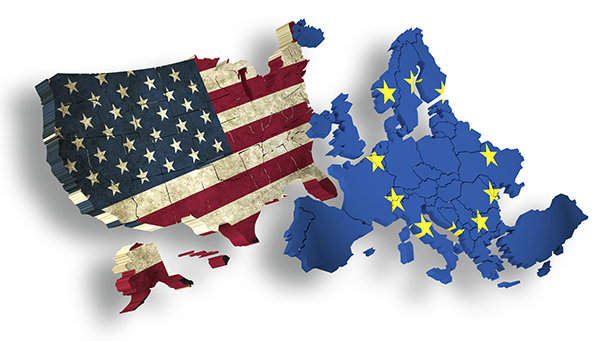
The costs of European integration to the White House

By Mohammad Ghaderi

In one of his most recent statements, French President Emmanuel Macron has announced the end of US and Western hegemony in the international system. The remarks come as the EU and eurozone are also facing a severe crisis of leadership.
Macron has warned Western nations against the “strategic mistake” of alienating Russia – but in doing so, he seeks a bigger role for himself in international politics.
“We are living the end of Western hegemony,” Macron told diplomats , after hosting the G7 meeting in the city of Biarritz on France’s Atlantic coast over the weekend. He named the rise of Beijing and Moscow as signs of a shift on the world scene.
The reality is that the European Union and the eurozone, on the one hand, acknowledge the end of Western hegemony, and in particular the United States, and on the other hand, continue to be dominated by Washington. The EU's inactivity towards Europe has led to anger and frustration among citizens.
The EU and the eurozone have a very uncertain future. In other words, America and Europe can no longer speak of international domination.
In such a situation, people like the French President and German Chancellor are worried about the future of the eurozone and the European Union. This concern increases over time. The occurrence of a variety of security, political, economic and social crises has created many challenges in the European Union and the eurozone.
The emergence of these challenges has led to a sharp decline in the popularity of traditional parties in Europe. In such a way, nationalist parties have been able to increase their popularity with the public. Which side are the European Union and the eurozone really heading to?
ill the future of Europe finally be clear these are the questions that concern the mentally ill, such as Merkel and Macron?
Ultimately, the more Europe delays  in moving away from the United States, the more it will pay. It is as if European officials have not yet understood it. There is a long gap between the recent remarks of the French President and the EU's practical approach.

Saturday, August 10, 2019

Washington’s Utterly Failed Diplomacy


There seems no longer any attempt, or semblance, of seeking diplomacy by Washington. Sanctions and aggression are wielded with reckless abandon. Russia, China, and even America’s own supposed European allies are subject to sanctions by Washington in a high-handed dismissal of any mutual dialogue to resolve alleged grievances.
US President Donald Trump has evolved a certain shrill maximalist attitude in international relations. It can be coined thus: my way or no way.
One recent example is the imposition of sanctions on Iran’s Foreign Minister Mohammad Javad Zarif. That indicates the US cutting off any possibility of a negotiated de-escalation of tensions in the Persian Gulf.
Iran’s Zarif revealed this week that when he was on a diplomatic visit to the US last month he was told by officials that he was expected at the White House for a meeting with President Trump. If Zarif baulked at the “offer” then he would be put on a sanctions list, he was allegedly informed. The Iranian top diplomat declined under the circumstances of apparent coercion, only to find that he was indeed later slapped with sanctions. What kind of American diplomacy is that? Sounds like a mafia-type offer not to refuse.
This heavy-handed approach to “diplomacy” suggests that there is in fact no diplomacy emanating from Washington. President Trump tweeted last week that his administration was “running out of options” in dealing with Iran over mounting tensions in the Persian Gulf. It seems the White House is “offering” faux attempts for negotiation, while all the while mounting military options to strike at Iran.
Another example of failed diplomacy is the resignation this week of US ambassador to Russia, John Huntsman. He quit his post partly out of frustration over the futility of his diplomatic duty to facilitate bilateral dialogue with Moscow. Huntsman’s job became untenable due to the manic anti-Russian animus now embedded in Washington, whereby any attempted dialogue would be portrayed as some kind of “treasonous act”.
Still another example of US repudiation of diplomacy is Trump’s executive order this week to impose a total trade embargo on Venezuela. The South American country is effectively being starved into submission to accept Washington’s demand that elected President Nicolas Maduro stand down, according to US dictate, in order to allow a US-backed dubious opposition politician take the reins of power in Caracas.
These examples, among many more, demonstrate that Washington has no intention of seeking diplomatic discourse with other nations, and is fully intent on issuing dictates – or else; in order to achieve its geopolitical aims.
The appalling and dangerous thing is that Washington is operating on a basis of zero-sum ultimatum. The premises for its dictates are invariably unsubstantiated or irrational. Russia is treated like a pariah state over outlandish allegations of interference in US elections; Iran is treated like a pariah state over hollow claims about Iranian aggression; Venezuela is treated like a pariah state over allegations against an elected president. China is vilified over claims it is a “currency manipulator”. Europe is allegedly “taking advantage” of US trade terms. And so on, and so on. It is tyranny run amok.
The standard of international law and norms of diplomacy are being trashed in the most willful and wanton ways, purely on the basis of American whim and self-serving agenda for domination.
This is an extremely dangerous global situation whereby American political bias, and irrational bias to boot, is being made the standard instead of principles of international law and sovereignty of nations. There is absolutely no diplomacy. Only the writ of American demands for obeisance to Washington’s irrational dictate to satisfy its demands for hegemony.
There seems no other way to describe the present global lawlessness of American presumed power and self-righteousness other than to call it a form of rogue-state fascism on steroids.
When diplomacy, negotiations, dialogue and respect for sovereignty are so utterly disrespected by Washington – whose only response is sanctions and military aggression – then we should know that the present description of American power is not hyperbole. It is a lamentable description of reality whereby American diplomacy is no longer extant. It is becoming way past the possibility of conducting normal relations with this paranoid, lawless rogue regime. A nuclear rogue state, too, capable of destroying the planet on a whim or paranoid rush to its sick brain.
Can American citizens rein in such an errant, irrational regime? Time will tell. But one thing seems for sure, world peace is continually endangered by the regime in Washington which is operating in its own realm of fantasy and criminal megalomania.
Of course US diplomacy is an utter failure. Because in the twisted warmongering megalomania of Washington, diplomacy seems to have become totally irrelevant. Is that not fascism?

Friday, July 05, 2019

Trump’s Historic North Korea Visit Belied by Iran Aggression

The enigma of President Trump was on full display this past week from his confounding, divergent approaches towards North Korea and Iran. The American president is appealing to one through cordial dialogue for nuclear disarmament, while at the same time threatening the other with bellicose rhetoric over non-existent weapons.
Such anomalous logic by the American leader could make a strong argument for why nations that find themselves on the wrong side of Washington should arm themselves with nukes. It would appear that having weapons of mass destruction is a sensible insurance policy to ward off American aggression.
But it also raises questions about how reliable or genuine is this White House’s foreign policy.
At the superficial level of optics, it was an historic visit when Trump stepped over the demilitarized zone last Sunday and shook hands with North Korean leader Kim Jong-Un. It was the first time a sitting US president has ever set foot in the Democratic People’s Republic of Korea since the 1950-53 war. The meeting was apparently cordial and both men held private talks for about an hour before Trump returned to South Korean territory.
US Secretary of State Mike Pompeo, who accompanied Trump, later said that partial progress was made towards negotiating a deal for North Korea’s eventual nuclear disarmament. A previous meeting in Hanoi earlier this year had faltered.
However, skeptics again pointed out the lack of detailed modalities for how such a disarmament process would be achieved, or what the US was prepared to do in return about lifting its harsh sanctions off Pyongyang.
By contrast, only days later, Trump issued further military threats against Iran after Tehran announced that it was going to suspend its compliance with the 2015 international nuclear accord by increasing its enrichment levels of fissile uranium. That step by Iran does not necessarily mean it is planning to develop nuclear weapons. Tehran has repeatedly said it has no intention. The enriched uranium-235 isotope can also be used for many beneficial civilian applications, including for energy, scientific research and medicine.
Iran says it is compelled to suspend the nuclear accord because the Trump administration walked away from it last year and because the European powers have failed to uphold their obligations to normalize economic trade with Tehran. The unravelling of the treaty is regrettable because that deal was internationally acclaimed to be a diplomatic success for nuclear non-proliferation. The Trump administration’s abrogation of the accord – based on flimsy claims that Iran is secretly intent on building nuclear weapons – does not stand up to independent expert scrutiny or international consensus.
So, here we have Trump taking a softly, softly approach to North Korea and apparently pulling out all the diplomatic stops for mutual engagement, yet towards Iran he is trashing a multilateral UN-backed safeguard against nuclear weapons proliferation.
That raises misgivings about this president’s credibility and reliability. If he can tear up an international treaty with Iran – seemingly on a whim – how can Trump be trusted to honor any future deal with North Korea?
Some former US officials and American media decried Trump’s “historic” visit to North Korea as nothing more than a “PR stunt” and “photo-op” for the purpose of flattering an insatiable habit for self-aggrandizement.
Certainly his contradictory attitude and logic towards Iran would indicate that Trump has an incoherent, if not disingenuous, foreign policy on the matter.
What if North Korea’s Kim Jong-Un insists that the US side must lift sanctions in a reciprocal way if it were to decommission its nuclear arsenal? Will Trump take the hump and revert to his earlier bellicose stance towards “Little Rocket Man”? For there seems to be a dearth of principle or consistency in what this president says or does.
Apart from re-election photo-ops, there is also a suspicion that Trump could be using engagement with North Korea as a lever against his bigger geopolitical prize, China. By appearing to appease China’s long-time ally in Pyongyang, Trump may be calculating such a move would undermine Beijing’s sway in East Asia.
More widely, Trump’s erratic “policies” – perhaps that is too serious a word to describe his impetuous conduct – raises questions for other nations, in particular China and Russia.
How much can Trump be trusted or relied upon over matters of trade disputes and arms controls when his words and actions are contradicted so glaringly by American military buildup and strategic aggression towards both China and Russia?
If Trump were seriously committed to dialogue and peaceful nuclear disarmament, he should be lifting sanctions off both North Korea and Iran and respecting international norms of diplomatic engagement.
His administration would also not be walking away from the Intermediate-Range Nuclear Forces (INF) treaty with Russia while maintaining provocative economic sanctions on Moscow. Trump’s apparently amiable greeting to Russian President Putin at the recent G20 summit in Japan does not carry much weight for a substantive normalization of bilateral relations between the US and Russia. Personal expression of bonhomie is one thing. Meaningful political change is quite another.
All in all, Trump’s “historic” engagement with North Korea is not convincing that this president has the political integrity to succeed in his stated desire for peace on the Korean Peninsula, or elsewhere. His reckless aggression towards Iran is a major proof of that.

Wednesday, July 03, 2019

Monsters Walk the Earth. Why These Three Countries Are the Real Troika of Evil

Philip GIRALDI


There are monsters among us. Every day I read about an American “plan” to either invade some place new or to otherwise inflict pain to convince a “non-compliant” foreign government how to behave. Last week it was Iran but next week it could just as easily again be Lebanon, Syria or Venezuela. Or even Russia or China, both of whom are seen as “threats” even though American soldiers, sailors and marines sit on their borders and not vice versa. The United States is perhaps unique in the history of the world in that it sees threats everywhere even though it is not, in fact, threatened by anyone.
Just as often, one learns about a new atrocity by Israelis inflicted on the defenseless Arabs just because they have the power to do so. Last Friday in Gaza the Israeli army shot and killed four unarmed demonstrators and injured 300 more while the Jewish state’s police invaded a Palestinian orphanage school in occupied Jerusalem and shut it down because the students were celebrating a “Yes to peace, no to war” poetry festival. Peace is not in the Israeli authorized curriculum.
And then there are the Saudis, publicly chopping the heads off of 37 “dissidents” in a mass display of barbarity, and also murdering and dismembering a hapless journalist. And let’s not forget the bombing and deliberate starving of hundreds of thousands innocent civilians in Yemen.
It is truly a troika of evil, an expression favored by US National Security Advisor John Bolton, though he was applying it to Cuba, Venezuela and Nicaragua, all “socialist” nations currently on Washington’s “hit list.” Americans, Saudis and Israelis have become monsters in the eyes of the rest of the world even if in their own minds they are endowed with special privilege due to their being “Exceptional,” “Chosen by God” or “Guardians of Mecca and Medina.” All three countries share a dishonest sense of entitlement that supports the fiction that their oppressive and often illegal behavior is somehow perfectly legitimate.
To be sure not all Americans, Saudis or Israelis are individually monsters. Many are decent people who are appalled by what their respective governments are doing. Saudi citizens live under a despotism and have little to say about their government, but there is a formidable though fragmented peace movement in slightly less totalitarian Israel and in the United States there is growing anti-war sentiment. The discomfort in America is driven by a sense that the post 9/11 conflicts have only embroiled the country more deeply in wars that have no exit and no end. Unfortunately, the peace movement in Israel will never have any real power while the anti-war activists in America are leaderless and disorganized, waiting for someone to step up and take charge.
The current foreign policy debate centers around what Washington’s next moves in the Middle East might be. The decision-making will inevitably involve the US and its “close allies” Israel and Saudi Arabia, which should not surprise anyone. While it is clear that President Donald Trump ordered an attack on Iran before canceling the action at the last minute, exactly how that played out continues to be unclear. One theory, promoted by the president himself, is that the attack would have been disproportionate, killing possibly hundreds of Iranian military personnel in exchange for one admittedly very expensive surveillance drone. Killing the Iranians would have guaranteed an immediate escalation by Iran, which has both the will and the capability to hit high value targets in and around the Persian Gulf region, a factor that may also have figured into the presidential calculus.
Trump’s cancelation of the attack immediately produced cries of rage from the usual neoconservative chickenhawk crowd in Washington as well as a more subdued reiteration of the Israeli and Saudi demands that Iran be punished, though both are also concerned that a massive Iranian retaliation would hit them hard. They are both hoping that Washington’s immensely powerful strategic armaments will succeed in knocking Iran out quickly and decisively, but they have also both learned not to completely trust the White House.
To assuage the beast, the president has initiated a package of “major” new sanctions on Iran which will no doubt hurt the Iranian people while not changing government decision making one iota. There has also been a leak of a story relating to US cyber-attacks on Iranian military and infrastructure targets, yet another attempt to act aggressive to mitigate the sounds being emitted by the neocon chorus.
To understand the stop-and-go behavior by Trump requires application of the Occam’s Razor principle, i.e. that the simplest explanation is most likely correct. For some odd reason, Donald Trump wants to be reelected president in 2020 in spite of the fact that he appears to be uncomfortable in office. A quick, successful war would enhance his chances for a second term, which is probably what Pompeo promised, but any military action that is not immediately decisive would hurt his prospects, quite possibly inflicting fatal damage. Trump apparently had an intercession by Fox news analyst Tucker Carlson, who may have explained that reality to him shortly before he decided to cancel the attack. Tucker is, for what it’s worth, a highly respected critic coming from the political right who is skeptical of wars of choice, democracy building and the global liberal order.
The truth is that all of American foreign policy during the upcoming year will be designed to pander to certain constituencies that will be crucial to the 2020 presidential election. One can bank on even more concessions being granted to Israel and its murderous thug prime minister Benjamin Netanyahu to bring in Jewish votes and, more importantly, money. John Bolton was already in Israel getting his marching orders from Netanyahu on the weekend and Pence was effusive in his praise of Israel when he spoke at the meeting in Orlando earlier in the week launching the Trump 2020 campaign, so the game is already afoot. It is an interesting process to observe how Jewish oligarchs like Sheldon Adelson contribute tens of millions of dollars to the politicians who then in turn give the Jewish state taxpayer generated tens of billions of dollars in return. Bribing corrupt politicians is one of the best investments that one can make in today’s America.
Trump will also go easy on Saudi Arabia because he wants to sell them billions of dollars’ worth of weapons which will make the key constituency of the Military Industrial Complex (MIC) happy. And he will continue to exert “maximum pressure” on Iran and Venezuela to show how tough he can be for his Make America Great audience, though avoiding war if he possibly can just in case any of the hapless victims tries to fight back and embarrass him.
So, there it is folks. War with Iran is for the moment on hold, but tune in again next week as the collective White House memory span runs to only three or four days. By next week we Americans might be at war with Mongolia.

Monday, June 24, 2019

Political and military defeat of the White House against Iran

By Mohammad Ghaderi

TEHRAN - The Iranian Revolutionary Guard Corps declared that it had stuck down the RQ-4 Global Hawk over Iranian airspace. Also Commander of the IRGC Major General Hossein Salami stressed that the move should alert Washington officials to stay away. The incident sent "a clear message" to the U.S. and other enemies that Iran will show a firm and crushing response to any aggression, Salami stated.
Under such circumstances, the President of the United States has basically lost his control over the situation. This is one of the main reasons for Trump's insistence on holding direct talks with Iran at any time and without preconditions.
The fact is that one of Trump's main goals of economic confrontation with Iran was to put the Islamic Republic of Iran under constant pressure. However, it seems that Trump has made a terrible mistake in this regard! It should not be forgotten that the Islamic Republic of Iran can prevent the widespread impact of these sanctions on its economy through crisis management and effective consultation with other international players.
The fact is that the only reason for the crisis has been the departure of the United States from an international agreement. On the other hand, Donald Trump's government has imposed sanctions against Iran, which has shown little commitment to international treaties. 
Donald Trump is currently being addressed as a suspect and political offender in the United States! The president of the United States has become the symbol of Washington's complete defeat against Tehran. Perhaps the day that Donald Trump had left the nuclear deal with Iran, he never imagined that he would reach such a point!
Without a doubt, the trump cannot blame the people in this complex equation, such as John Bolton and Mike Pompeo! Trump is the main culprit for the complete failure of the United States against Iran. On the other hand, the Islamic Republic of Iran has shown that it stands against all of the U.S. conspiracies with its full potential.

Sunday, June 23, 2019

Political and military defeat of the White House against Iran

By Mohammad Ghaderi

TEHRAN - The Iranian Revolutionary Guard Corps declared that it had stuck down the RQ-4 Global Hawk over Iranian airspace. Also Commander of the IRGC Major General Hossein Salami stressed that the move should alert Washington officials to stay away. The incident sent "a clear message" to the U.S. and other enemies that Iran will show a firm and crushing response to any aggression, Salami stated.
Under such circumstances, the President of the United States has basically lost his control over the situation. This is one of the main reasons for Trump's insistence on holding direct talks with Iran at any time and without preconditions.
The fact is that one of Trump's main goals of economic confrontation with Iran was to put the Islamic Republic of Iran under constant pressure. However, it seems that Trump has made a terrible mistake in this regard! It should not be forgotten that the Islamic Republic of Iran can prevent the widespread impact of these sanctions on its economy through crisis management and effective consultation with other international players.
The fact is that the only reason for the crisis has been the departure of the United States from an international agreement. On the other hand, Donald Trump's government has imposed sanctions against Iran, which has shown little commitment to international treaties. 
Donald Trump is currently being addressed as a suspect and political offender in the United States! The president of the United States has become the symbol of Washington's complete defeat against Tehran. Perhaps the day that Donald Trump had left the nuclear deal with Iran, he never imagined that he would reach such a point!
Without a doubt, the trump cannot blame the people in this complex equation, such as John Bolton and Mike Pompeo! Trump is the main culprit for the complete failure of the United States against Iran. On the other hand, the Islamic Republic of Iran has shown that it stands against all of the U.S. conspiracies with its full potential.