
By Martin Cohen
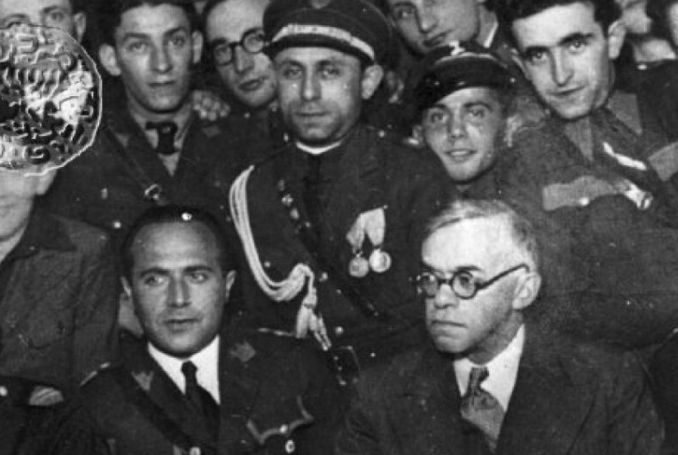 Vladimir Jabotinsky (right) with members of Betar, a Revisionist Zionist youth movement established in Latvia in 1923 under his leadership.
Like Jabotinsky, Israelis are convinced that their security and interests are best served not by democratic values, far less by consensus, but only by military force.
Too often the debate about Palestine is dictated by Israel. One form this takes, and has done since 1948, is creating “facts on the ground” reinforced by carrying out appalling crimes. Naturally, sites like the Palestine Chronicle end up devoting a lot of space to, well, “chronicling” what is going on – a role that is doubly important given the complicity and failures of the mainstream media. Yet, even as Palestine’s supporters and defenders try to show the world what is going on, they – we – may actually reinforce Israel’s control of the narrative and, along with it, perpetuate certain myths and lies.
Here are three such myths that often escape challenge. Israel is not a “Jewish state” and does not represent the Jewish people. Secondly, it is not a democracy, and it neither respects nor recognizes universal rights, far less international law. And finally, the values it does encapsulate are so extreme that it seems almost impossible to discuss them within the limits of conventional political discourse. The modern state of Israel is what you get if you cross Italian Fascism, with its emphasis on military power and national symbols, with Old Testament religion, with its traditions of pitiless cruelty and destruction.
Forget Zionism. Indeed, forget religion because Israel is not actually a religious entity at all. Of its three key philosophical influences, Theodore Herzl, Ze’ev Jabotinsky and Carl Schmitt, none were motivated or indeed interested in religion. Israel is a European project state placed almost by chance in the Middle East.
Similarly, the Israeli-British historian Ilan Pappé has noted that, particularly in the Trump years, the key support for Israel in the United States comes not from the Jewish community, but from Fundamentalist Christians. Even as many Jewish Americans, particularly of the younger generation, disassociate themselves from Israel, today, people like Mike Huckabee, Jerry Falwell and John Hagee proclaim that “they support Israel because of their Christianity”. For such people, Israel is all the better because it does not represent Jewish values.
We should be clear, because the founders of the state of Israel were clear, that Israel is supposed to be a new kind of state – not only departing from Jewish tradition but opposed to it.
Start with Ze’ev Jabotinsky (born Vladimir Zhabotinsky), the Jewish militia leader that Ben-Gurion, Israel’s first Prime Minister, famously dubbed “Vladimir Hitler.”
Jabotinsky was, like many of Israel’s founders, from Eastern Europe, in his case, from Ukraine. However, it was in Mussolini’s Italy, where his wealthy parents sent him to for three years to study for a law degree, that he found what he called “a spiritual homeland”. “All my views on nationalism, the state, and society were developed during those years under Italian influence,” Jabotinsky would later write in his autobiography.
Mussolini expressly speaks of his support for Zionism in general and Jabotinsky in particular: During a private conversation with Nahum Goldman, founder of the World Jewish Congress, in November 1934, Mussolini advises: “For Zionism to succeed, you need to have a Jewish State with a Jewish flag, and Jewish language. The person who understands that is your fascist, Jabotinsky.” He allowed Jabotinsky to set up a training base north of Rome, from where British forces in Palestine were attacked.
Jabotinsky is probably the most important influence on Israel’s development into the pariah state we see today. Jabotinsky enthusiastically drew from Mussolini as an aspiration the idea of creating a new race. This was to be called ‘the Hebrews’, and to be proud and independent, a thing of “masculine beauty”. He contrasted his new race with the European Jews around him at the start of the Twentieth century, whom he called Yids, and characterized as ugly, sickly, and easily frightened. In language that even echoes the later Nazi talk of the true Aryan male, he paints a picture of the ideal ‘Hebrew’.
“Because the Yid is ugly, sickly, and lacks handsomeness, we shall endow the ideal image of the Hebrew with masculine beauty, stature, massive shoulders, vigorous movements, bright colors, and shades of color. The Yid is frightened and downtrodden; the Hebrew ought to be proud and independent. The Yid is disgusting to all; the Hebrew should charm all. The Yid has accepted submission; the Hebrew ought to know how to command. The Yid likes to hide with bated breath from the eyes of strangers; the Hebrew, with brazenness and greatness, should march ahead to the entire world, look them straight and deep in their eyes and hoist his banner: “I am a Hebrew!”
Jabotinsky is not an historical curiosity. On the contrary, in Israel, he exerts a very real influence. Likud, Israel’s dominant political force, radicalized Jabotinsky’s teachings and wrote balancing elements within his ideas out of the official version. Today, Israel’s Prime Minister, Benjamin Netanyahu, claims Jabotinsky as his inspiration and guide. Jabotinsky’s talk of an “Iron Wall” is frequently quoted, or rather, misquoted, along with prescriptions for slaughter.
Similarly, religiously-motivated West Bank settlers use Jabotinsky in their campaigns, even though the Russian had at best an indifference, at worst a disdain, for religion, associating it with Jewish weakness and inertia. They live out his thought that: “If we should all be educated people and learn to plow the land and to build houses and be able to speak Hebrew and know our whole national literature… and not know how to shoot, then there is no hope”.
So too, Israel’s leaders follow Jabotinsky in seeing military power as the crucial “Iron Wall” behind which the new – not Jewish – but “Hebrew” state would be built and secured. What they don’t remember, however, is that Jabotinsky envisioned a shared state between Jews and Arabs. They don’t quote from Jabotinsky’s 1940 book, The Jewish War Front, wherein he proposes that “both Jews and Arabs share equal collective autonomous rights as well”. Or that “In every Cabinet where the Prime Minister is a Jew, the vice-premiership shall be offered to an Arab, and vice-versa.” Even as Jabotinsky asserted that Jews were entitled to a share of the land, he stated explicitly that this did not mean expulsion of the Arabs, a strategy he ruled out as not only “utterly impossible” but unethical.
The point is that the Hebrew state has taken on a form that even its most extreme founders would be appalled by.
In 1977, that devout follower of Jabotinsky, Menachem Begin, led the Likud to victory and established it as the dominant force in Israeli politics. Begin had not only been leader of the Jabotinsky-inspired paramilitary group Irgun but had counted Jabotinsky as his teacher and mentor as a youth in Poland. But then, in 1992, Yitzhak Rabin, the leader of Labor, was elected as Prime Minister. With Israel now emerging as both a military and economic force , fuelled by the new high-tech sector, Rabin wanted to move beyond the ‘Iron Wall’ mentality, as he knew that the country was no longer facing the threat of destruction from its neighbors. Rabin also saw that the younger generation of Israelis wanted to integrate into the global economy, and resolving the Arab- Israeli conflict, he believed, would help Israel integrate into the global order.
In 1993, it was Rabin who negotiated the Oslo Accords, a peace deal with Palestinian leader Yasser Arafat. The two men shook hands in a symbol of the reconciliation of the Arab- Israeli conflict. The agreement created a Palestinian authority in the West Bank and the Gaza Strip, as part of the pathway to the long-term goal of creating two countries, Israel and a Palestinian state, that would peacefully coexist.
But 1993 was also the year that Benjamin Netanyahu became the leader of the Likud Party. Netanyahu saw the Oslo peace process as the sort of territorial compromise Jabotinsky had warned about. Instead of such political agreements, he echoed Jabotinsky in proposing instead only the overwhelming use of force. Eran Kaplan, Professor of Israel Studies at San Francisco University, has commented: “The massive and wantonly destructive war that Netanyahu has led against Hamas and Gaza since that date is (Jabotinsky’s) Iron Wall in its most elemental manifestation… a signal that no territorial compromise with the Arabs over historical Palestine is possible.”
Today, Netanyahu and his government formally oppose the establishment of a Palestinian state, openly support the expansion of illegal Jewish settlement in the occupied Palestinian territories, and even to annex the West Bank, all while introducing additional laws infringing on the rights of the native Palestinian minority in the Jewish State.
At a 2017 memorial service for Jabotinsky, Netanyahu said: “I have Jabotinsky’s works on my shelf, and I read them often.” He reminded his audience he even kept the Zionist leader’s sword in his office.
The reality is that today, in Israel, Jabotinsky is proudly held up as one of the founding fathers of the modern Zionist movement, even as only one part of his ideas is being followed – the militaristic part. Mind you, modern Israel follows Jabotinsky in dismissing international diplomacy and agreements. Both see themselves as following only their own rules. Jabotinsky writes: “We hold that Zionism is moral and just. And since it is moral and just, justice must be done, no matter whether Joseph or Simon or Ivan or Achmet agree with it or not. There is no other morality.”
Political debate still swirls around the true nature of Zionism. It is a meaningless term, a philosophical jargon that means many different things from an airy-fairy story of a hill in Palestine to the military plans of Jabotinsky. In the UK, the ruling Labour Party has just severed links with the Green Party over a motion passed by the Greens that “Zionism is racism”. How the supporters of genocide must cluck with pleasure as two varieties of its British critics fall out over a word! The arguments so conveniently hide the reality and important fact that Israeli policy is racist, to use a term that seems totally inadequate to sum up the barely disguised horror of everyday reality.
We should avoid the term. Israel is not racist because it is Zionist; it is racist because of its fundamental constitution and practical policies. Land is designated as Jewish, housing is reserved for Jews, crucially, citizenship is reserved for Jews. Palestinians living in the Occupied Territories who have applied to something called the Conversion Authority to be Jewish are refused – because of their ethnicity. (Although, apparently, one exception has been made over the last eighty years.) Jews living in the Occupied Territories have the vote – but Palestinians do not. Far from being radical, politicians who denounce “Zionism” are letting Israel off the hook. This is a state that is an affront to the universal values supposedly espoused by the United Nations that brought it into being.
This is a state that is not the product of a romantic religious adherence to a hill called Zion in Palestine but the cold calculation of hard-nosed thinkers like Jabotinsky, Theodore Herzl and Carl Schmitt.
Take Herzl, called the Father of the modern Israel. Herzl, as I say, was not religious and happily considered alternative locations for the Jewish state in Africa and South America. It is revealing too, that, in terms of its boundaries, the plan preferred by Theodore Herzl does not match Israel today but rather asserts that the boundaries should extend from “the Brook of Egypt to the Euphrates”.
Or consider the Nazi Jurist, Carl Schmitt. His ideas were part of the political background when Israel’s founders were creating the state. They also resonate because Israel considers itself to be permanently facing existential threats – and so everything is justified. In a state of war, normal values are reversed. Right becomes wrong, and wrong becomes right. Killing is celebrated. It is why today Israel is a nuclear-armed state lavishly equipped and backed by the world’s leading military superpower – the United States – and the Palestinians are refugees.
Nonetheless, I think that of them all, Jabotinsky’s influence is the most malign. He is emphatically a creature of his time who venerates force and violence and uses the language of Social Darwinism – the idea that the ‘strongest’ individuals, groups, or nations must outcompete the ‘weaker’ ones – and he did so even as this very concept was taking on the ugly shape of Nazism with its racial hierarchies and military expansionism.
Jabotinsky’s militarism is too good a fit with Israeli politics, rooted in the conviction, ever since its foundation, that the state is a shield against “eternal enemies”. Historians might (but rarely do) protest in vain that this was also one of the key ideas of Heinrich Himmler, head of the ruthless and cruel SS – the ‘political soldiers’ of the Nazi Party – from 1929 until 1945, as well as presiding over a vast ideological and bureaucratic empire. The other Nazi ideas that took root in Israel were the need to create race consciousness, and the need for ‘lebensraum’, and thus expansion, settlements, and ethnic cleansing.
Today, within Israel, Ze’ev Jabotinsky is a national hero, his name on more streets than anyone else. Netanyahu boasts of having his sword on his desk! The country follows his military and political playbook. No matter that Jabotinsky was an unambiguous fascist, an ally of Mussolini’s. Indeed, all the better if Jabotinsky founded the “Jewish Legion”, many of the soldiers of which carried out the ethnic cleansing of the 1948 Nakba – or catastrophe.
Like Jabotinsky, Israelis are convinced that their security and interests are best served not by democratic values, far less by consensus, but only by military force. We see this narrative playing out now, as the Israeli political parties reconfigure themselves. It is the narrative that led to the Nakba, the destruction of South Lebanon, and finally to Gaza. And it is the same dark path traced by Mussolini almost a century ago.

– Martin Cohen is a philosopher who specializes in practical ethics including being a visiting researcher at the European Parliament. He has campaigned on this issue for over thirty years and is currently working on a book arguing for a one-state solution based on universal human rights. His latest book, The Ah-Moment: Exploring Philosophical Ideas through Jokes and Puzzles, takes a look at the subversive, political role of humour. He contributed this article to the Palestine Chronicle.

No comments:
Post a Comment