Thursday, November 30, 2023

NATO’s Ambiguous Mission in Iraq New Plan for Socio-Cultural Influence

Strategic Council Online - Interview: An international relations professor said that although NATO’s training mission for the Iraqi police forces is carried out in line with preventing ISIS from regaining power, in fact, NATO has decided to develop the scope of its mission in Iraq, noted: NATO, and the United States at its head, is looking for influence in the social body of Arab countries, especially Iraq, to advance its targets while shaping the intellectual formation and organizing the police body against the Resistance.

In an interview with the website of the Strategic Council on Foreign Relations, Dr. Davood Ahmadzadeh stated that the foreign ministers of the NATO member countries have decided in a conference to expand the missions of that organization in Iraq and also train the military officers, the sailors and the local police of that country. Although it has been said that this measure is aimed at preventing ISIS from regaining power, NATO has decided to expand the scope of its mission in Iraq and enter the profound social and cultural layers of that country. Previously, NATO members had agreed to strengthen and expand their presence in Iraq at the Wales Summit in 2014, the Warsaw Summit in 2016, and the Brussels Summit in 2017 and 2018.

He added: NATO’s initial mission in 2018 was to advise the defense and security officials in the Ministry of Defense, then they cooperated with the Office of the National Security Adviser and the Joint Operations Center of the Prime Minister’s Office, and now with the expansion of the scope of their activity they work with the Ministry of the Interior and the Organization of Federal Police. The Federal Police is one of Iraq’s four active combat organizations, along with the army, the Iraqi Popular Mobilization Forces (Al-Hashd al-Shaabi), and the Special Counter-Terrorism Unit.

The university professor, saying that NATO has announced in its training to Iraqi forces that it is considering increasing their attention to environmental changes and ways to reduce the effects of such changes, referred to the criticisms of political groups and members of the Iraqi parliament regarding the increase in the presence and role of foreign military forces in that country and continued: They emphasize that Iraq does not need the presence of foreign forces in its territory, because it has security forces, the army and Hashd al-Shaabi, which are capable of controlling the security and stability of the country and fighting terrorism.

Emphasizing that the United States is looking for an excuse to increase the role of its military and security forces in Iraq, Ahmadzadeh added: Every time NATO proposes a new direction for its activities in Iraq. In this situation, there are uncertainties about NATO’s primary mission in Iraq.

He stated that in the past months, the Iraqi security authorities have been trying to entrust the security case of the cities to the police and transfer the army and Hashd al-Shaabi forces to the barracks outside the city; this action is in line with the agreements of the Iraqi political groups in the form of the “government administration” coalition during the formation of Mohammed Shia’ Al Sudani’s government and reminded: Last year, the Ministry of the Interior and Police took over the security files of many provinces.

The expert on West Asia affairs called the US strategy the cause of internal disputes in that country and said: Americans are looking for intervention and a new type of occupation in Iraq, but the Resistance groups, as the guarantor of Iraq’s security, have repeatedly warned against the consequences of continued US occupation. He adds that some Iraqi media had written that American officials in recent negotiations with the Iraqi side had demanded the dissolution of Hashd al-Shaabi in exchange for handing over advanced weapons to the Iraqi army.

Saying that the US is seeking to weaken the Resistance Front while weakening Arab-Iranian convergence, he noted that NATO is now trying to play a serious role in training police forces in Iraq. This is while we are witnessing the West’s efforts to deal with the Axis of Resistance, especially identifying the prominent figures of Hamas and Islamic Jihad and their capacities in the region by employing the police of the countries, training them, and expanding their intelligence domination.

The analyst of West Asia affairs added: French President Macron stated This strategy in the past weeks in a joint press conference with Netanyahu. In fact, NATO, led by the United States, is seeking to influence the social body of Arab countries, especially Iraq, to advance its targets while shaping intellectual formation and organizing the police body against the Resistance.

Ahmadzadeh, while explaining the view of Western countries on Iraq and the political geography of that country in terms of history, reminded that after the overthrow of the Baath regime and the promotion of the position of Shiites in Iraq and the close relations that were formed with Iran due to cultural, political and historical issues, the US tried to prevent this expansion of relations and closeness with Iran. Now, it is trying to advance its general strategies in Iraq by strengthening its social and cultural influence.

He emphasized that the US is looking for targeted political and security influence in Iraq to deal with the Resistance movements. In contrast, the Resistance groups in Iraq have repeatedly condemned the American occupation and targeted its military bases. He said: Under such circumstances, NATO and especially the French are trying to form stronger relations with the central government of Iraq by making promises, including economic aid and increasing cooperation in the security and military fields. By training the Iraqi police forces, they are trying to create a gap between the effective forces in Iraq by making the police stronger against other armed forces in that country.

The university professor stated that this plan is pursued to create an internal gap in Iraq and sow discord between Iraq and Iran, and added: If the influence of foreign powers in Iraq decreases, there is no need to train and expand their security relations with Iraq. No matter how much ethnic, tribal, and religious differences in Iraq and the gap between the sovereignty and the popular forces and the Axis of Resistance and the government will increase, the possibility of the presence of destructive forces against Iraq’s national interests, foreign forces, and NATO will increase.

US Forces Living on Borrowed Time Syria and Iraq

By: Kayhan Int’l
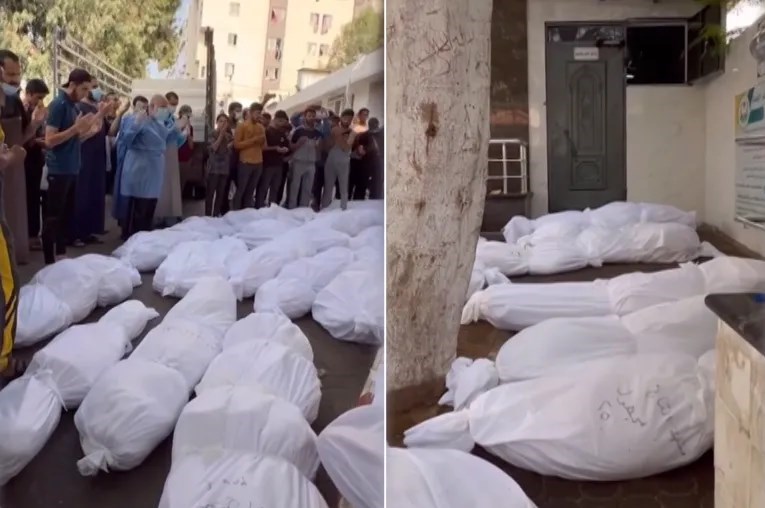
In the Pentagon and in the State Department a fierce behind-the-scenes debate is raging on the wisdom of military presence in Iraq and Syria, especially after the criminal involvement of the US in Israel’s war crimes in Gaza and the massacre of over 15,000 civilians (mostly children and women) on President Joe Biden’s green light for the genocide by refusing ceasefire demands by officials and public rallies.
There is a growing fear that in view of the Zionist entity’s unabated aerial attacks on Syria, sooner or later the unwanted American soldiers will be targeted with more powerful projectiles and return home in body bags, even if they were to brutally respond to the attacks of the Resistance Forces.
The US might think of itself as a militarily powerful country but it is powerless in averting the death of its soldiers and destruction of its bases where its means of defence, though impenetrable on paper (like Israel’s so-called iron dome), turn out to be tin-coated paper vis-à-vis the resolve, the technique and the precision of the missiles and drones of their adversaries.
There is deep resentment, both in Syria and Iraq, against the US military presence and blatant American complicity in Israel’s mass massacre of the innocents in Gaza. 
The Syrian government has time and again complained to the UN that the US has no right to station soldiers on its soil in violation of its sovereignty and in open support of terrorists trying to dismember the country.
Damascus has also notified the World Body of the stealing of millions of barrels daily of its crude oil in broad daylight by the US occupation forces and their sharing of intelligence with Israel for attacks on industrial and military sites, as well as on trade convoys transiting the Syrian-Iraqi border.
In Iraq, the anger and hatred of the US is all pervasive, in view of the almost two million people killed directly and indirectly during the American invasion and occupation of the country in 2003 for almost a decade.
The Iraqi people and their representatives, the Popular Mobilization Units (PMU), also point to the dropping of crates of weapons for Takfiri terrorists by US aircraft while claiming to fly sorties against them.
The Iraqis have dismissed the claim that the US forces are on a mission to train army personnel. By referring to the Iraqi parliament’s unanimous verdict in early January 2020, following the dastardly terrorist attack on Baghdad Airport that claimed the life of the icons of anti-terrorism, Iran’s Qassem Soleimani and Iraq’s Abu Mahdi al-Muhandis, they are demanding the closure of all American bases.
In Washington, some level-headed US officials say there is no purpose for the American soldiers to linger any longer in Syria and Iraq, where they were targeted by the local militias during the Israel’s Biden-directed war crimes in Gaza.
They add that though the attacks have ceased over the past few days in respect to the temporary truce in Palestine, once Israel resumes its bombing, the US bases in both Syria and Iraq will be exposed to more lethal attacks and this time not mere injury but the death of American armed forces.
Once this happens, the other US bases in the so-called friendly states of the Persian Gulf and Jordan, will also be liable to long range attacks with untold and humiliating consequences for Washington. 

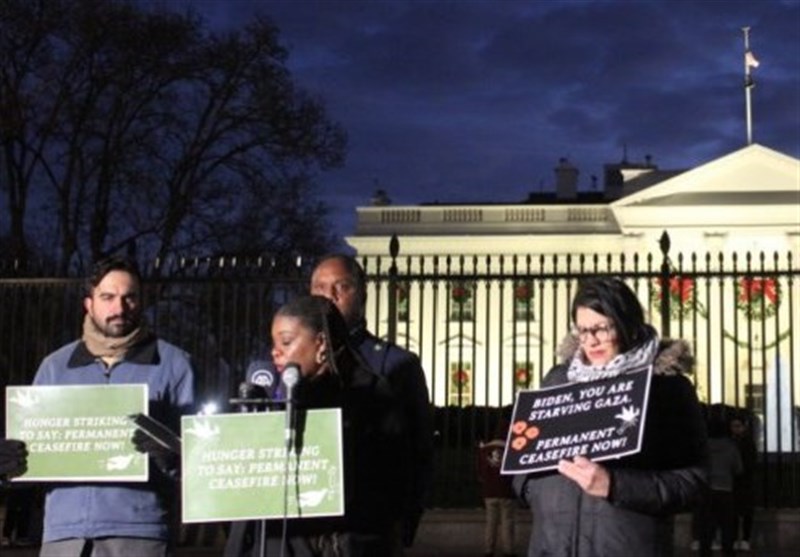
US Lawmakers Attend Vigil Calling for Ceasefire in Gaza

US Lawmakers Attend Vigil Calling for Ceasefire in Gaza

TEHRAN (Tasnim) – A number of US Congress members attended a vigil held by activists in Washington, DC, to call for a ceasefire in Gaza.

 Advocates urging a ceasefire in the Palestinian coastal enclave were often interrupted by their own tears as they gathered outside the White House and read the names of Palestinians killed in the war.

Several speakers, including Congresswoman Rashida Tlaib and actors Cynthia Nixon and Denee Benton, took turns reading from a long list of names on Wednesday evening. But they barely got through a fraction of the more than 15,000 Palestinians killed in Israeli attacks.

Activists warned that the list of the dead would only grow if the current truce is allowed to expire and a permanent ceasefire is not secured.

The vigil – attended by Tlaib and other progressive Congress members – was organized by activists, state lawmakers and artists, who are hunger striking in Washington, DC, in support of a ceasefire in Gaza.

Tlaib and her colleagues gathered to show support for the hunger strikers and warned that the war in Gaza must end, stressing that a temporary pause in fighting was not sufficient.

“How many more lives will be enough? How many more children need to be killed? How many more families have to be traumatized and torn apart? There is nothing humanitarian, my friends, about giving innocent civilians a few days of rest before they are bombed again,” Tlaib said.

She called on US President Joe Biden to listen to people calling for a ceasefire, which is backed by most Americans and an overwhelming majority of Democrats, according to public opinion polls.

Tlaib, who is the only Palestinian American member of Congress, hit out at the White House for calling lawmakers who demanded a ceasefire early in the war “repugnant”.

“The bombing of innocent civilians and children is repugnant and disgraceful. The refusal to support a ceasefire and an end to violence and the killing is repugnant and disgraceful. Our president calling on Congress to fund more bombs that are being dropped on innocent civilians is repugnant and disgraceful,” Tlaib said.

Biden is seeking more than $14bn in additional funding for Israel to support the war on Gaza, on top of the $3.8bn that Israel receives from the US annually.

Tlaib underscored that leading human rights groups and Pope Francis have called for a ceasefire, stressing that the demand is not controversial.

Congresswoman Cori Bush, who introduced a resolution in the House of Representatives last month demanding a ceasefire, echoed Tlaib’s remarks, highlighting that the campaign to demand a ceasefire is making progress.

“Our movement is working. They feel our energy in the White House. They hear our demands. They see us marching in the streets. They are watching the polls,” Bush said.

The congresswoman noted that when she first introduced a resolution on October 16, the measure had just 13 cosponsors. Now more than 40 lawmakers in the House and the Senate have called for a ceasefire in Gaza.

“It’s clear that our constituents and people all around the world want a ceasefire,” Bush said.

Biden sparked speculations on Tuesday with a social media post that could be interpreted as a call for Israel to wind down the war, suggesting that the violence would boost support for the Palestinian resistance movement Hamas.

But White House national security spokesperson John Kirby was quick to reemphasize US support for Israel’s war effort later that day, suggesting that the country has a “responsibility” to eliminate Hamas.

The war on Gaza began on October 7 after Hamas launched Operation Al-Aqsa Storm in occupied territories.

The Palestinian resistance group said the assault was in response to Israel’s illegal settlement expansion in the occupied West Bank, mistreatment of Palestinian prisoners and incursions at Al-Aqsa mosque.

Israel responded with a relentless bombing campaign that has turned into one of the deadliest conflicts for children in modern history. It also launched a ground invasion into parts of the besieged Gaza Strip and severely restricted the entry of food, water, fuel and medicine into the Palestinian territory.

The war has displaced more than one million Palestinians inside Gaza.

The nearly unprecedented scale of the violence has prompted United Nations experts to warn that Palestinians are at a “grave risk of genocide”.

The Biden administration voiced unwavering support for Israel early on, backing its objective of destroying Hamas. But after seven weeks of fighting in Gaza, Israel seems to remain far from achieving that goal.

Last week, an agreement, brokered by Qatar, the US and Egypt, was reached to temporarily halt the fighting to allow for the release of Israeli captives held by Hamas in exchange for Palestinian prisoners and the ramping up of humanitarian aid into Gaza.

The truce was extended for two days, and again on Thursday.

Outside the White House on Wednesday, Congressman Jamaal Bowman said calling for a ceasefire was about reaching for our shared humanity.

“We’ve all read about genocides. We have all read about mass murders. I cannot believe I’m living through one. And I cannot believe I’m living through one, and the US government is condoning it, and being complicit. Shame,” he said, according to Al Jazeera.

For his part, Congressman Jonathan Jackson said “too many” innocent people are suffering in the war.

“We have seen too much bloodshed, and we stand here with a sense of moral outrage with our courage and our conviction,” Jackson said.

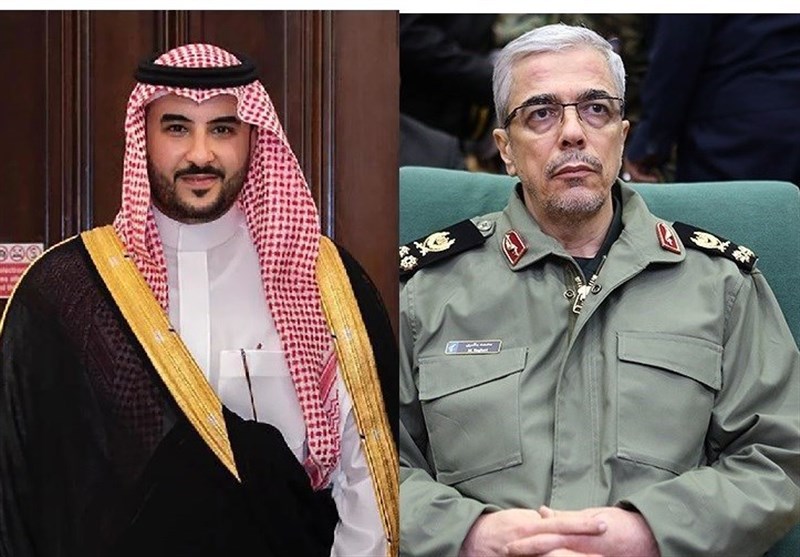
Iran, Saudi Arabia Discuss Promotion of Military Ties

Iran, Saudi Arabia Discuss Promotion of Military Ties

TEHRAN (Tasnim) – Top military officials from Iran and Saudi Arabia weighed plans to expand military relations between the two Muslim countries.

 Chief of Staff of the Iranian Armed Forces Major General Mohammad Hossein Baqeri and Defense Minister of Saudi Arabia Khalid bin Salman Al Saud talked about a range of issues in a telephone conversation on Thursday.

General Baqeri expressed the Iranian Armed Forces’ readiness to enhance military relations with Saudi Arabia.

He also hailed the growing friendly ties between Tehran and Riyadh, praising the kingdom for hosting a recent extraordinary summit of the Organization of Islamic Cooperation (OIC) about the Gaza crisis.

For his part, the Saudi defense minister welcomed the promotion of cooperation between the military forces of the two nations.

The two sides also discussed the pressing issues of the Muslim world.

After intensive negotiations hosted by China, Iran and Saudi Arabia clinched a deal on March 10 to restore diplomatic relations and reopen embassies and missions after seven years of estrangement.

The two regional heavyweights have underscored the need to respect each other’s national sovereignty and refrain from interfering in the internal affairs of one another.

In June, Iranian Navy Commander Rear Admiral Shahram Irani unveiled plans for the formation a new naval coalition in the northern parts of the Indian Ocean by a number of regional countries, including Iran and Saudi Arabia.

Later, in August, Defense Ministry officials of the two states reached an agreement on exchanging military attachés.

‘Israel to Lose West’s Support If It Continues Unethical, Inhuman Policies’

‘Israel to Lose West’s Support If It Continues Unethical, Inhuman Policies’

TEHRAN (Tasnim) – Israel is going to lose the West’s support if it fails to change its “unethical and inhuman” military tactics, the father of a British student killed by Israeli soldiers warned.

 Anthony Hurndall, whose 22-year-old son was killed by Israeli snipers in 2004, denounced Israel’s “fundamentally unethical and inhuman attitudes,” in an interview with The Times published on Wednesday.

Tom Hurndall, who was a photography student, a volunteer for the International Solidarity Movement (ISM), and an activist against the Israeli occupation of the Palestinian territories, was shot in the head by an Israeli sniper in the Gaza Strip in April 2003 and lost his life in January 2004 after spending some nine months in a coma.

He was shot when he was assisting Palestinian children caught in the crossfire in the impoverished Palestinian enclave.

Soroka Hospital’s medical staff initially claimed that the critical injuries to his head were caused by a baseball bat but an investigation later revealed that the staff had removed bullet fragments from Tom’s brain before making up the baseball bat story.

When the fabricated account was refuted, Tel Aviv claimed that the young photographer was allegedly carrying a weapon and was a gunman. 

“The investigation further revealed that, as standard practice,” the Israeli military “routinely falsely misrepresent civilians and children as militants, or as armed, and fabricate accounts of events as a pretext for their killing,” Hurndall, who is director of the Center for Justice, told The Times.

“These claims appear similar to the claims that” the Israeli military is “currently making to justify their bombing, missile and other attacks on civilian targets and hospitals in Gaza. It was the view of those in diplomatic circles, expressed to us at the time, that” the Israeli military “appeared to consider themselves immune from accountability and free to misrepresent innocent civilians as legitimate military targets and to target them, as a form of intimidation or collective punishment,” he added, Press TV reported.

Hurndall denounced the narrative portrayed by the media and the governments in the West as “one-sided” that ignores the facts.

“If Israel does not change fundamentally unethical and inhuman attitudes and policies and stop committing war crimes, it will build up even greater resistance from the Palestinian people and lose the sympathy and support of the West,” he stressed.

Israel launched the war on Gaza on October 7 after the Palestinian resistance movement Hamas waged the surprise Operation Al-Aqsa Storm against the occupying entity in response to the Israeli regime's decades-long campaign of bloodletting and devastation against Palestinians.

According to the Gaza-based health ministry, over 15,000 Palestinians, including more than 6,000 children, were killed in Israeli strikes, during the 49 days of war. Many more dead are feared to be under the rubble.

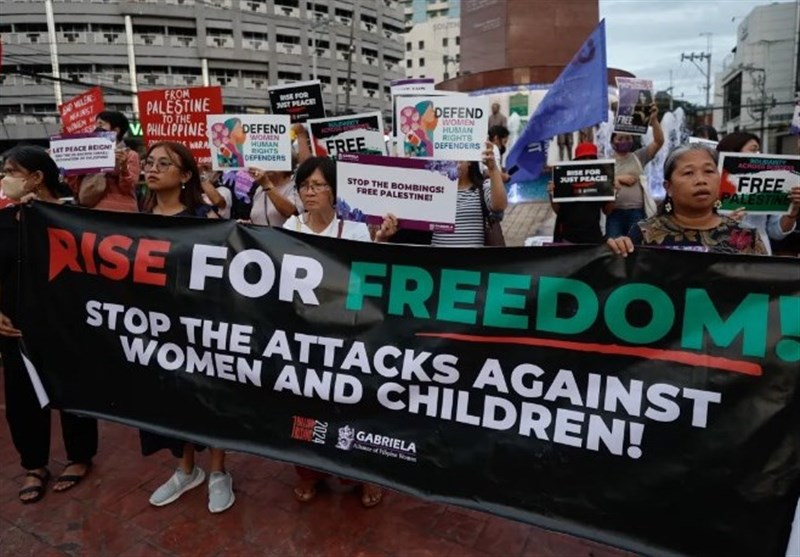
Rallies Held across World in Solidarity with Palestinians

Rallies Held across World in Solidarity with Palestinians

TEHRAN (Tasnim) – Demonstrations were held around the world on the International Day of Solidarity with the Palestinian People Wednesday, condemning Israel’s war on Gaza and calling for a permanent ceasefire.

 Protests were held on Wednesday in Manila, Tunis, Tehran, Karachi, Beirut, Harare, Tokyo, Stockholm, London, Johannesburg, Quezon City, Milan and elsewhere.

The International Day of Solidarity with the Palestinian People is observed on November 29 each year to mark the anniversary of Resolution 181, when the UN General Assembly on this day in 1947 adopted a resolution to partition Palestine into two states.

Israel launched a brutal aggression against the Gaza Strip after the Palestinian resistance group Hamas launched the Al-Aqsa Storm operation in occupied territories on October 7.

The aerial and ground offensive on the tiny coastal enclave has since killed some 15,000 people, including 6,150 children and 4,000 women, according to Palestinian health authorities.

On Thursday, mediator Qatar said Israel and Hamas had agreed to extend a fragile truce that started on November 24 for another day.

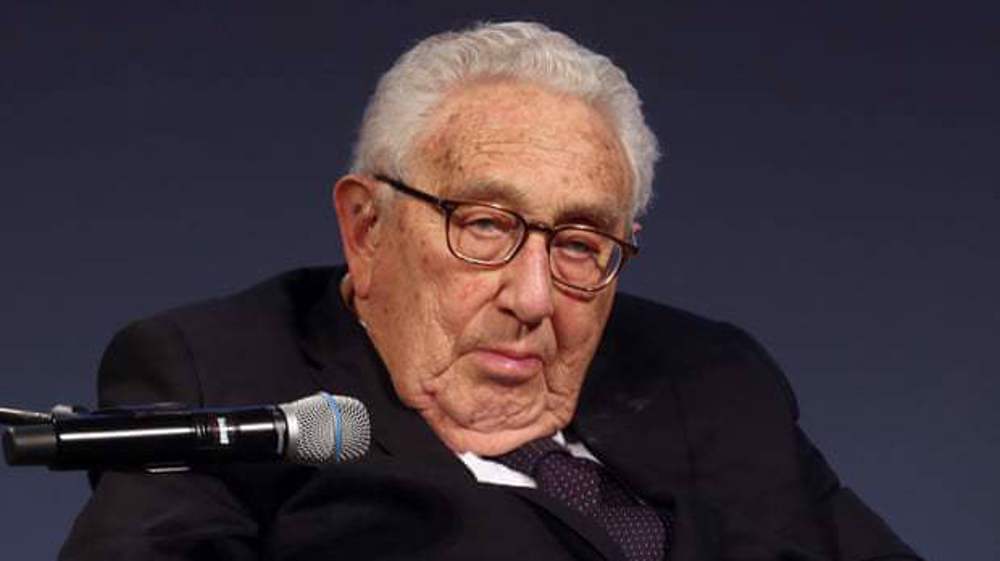
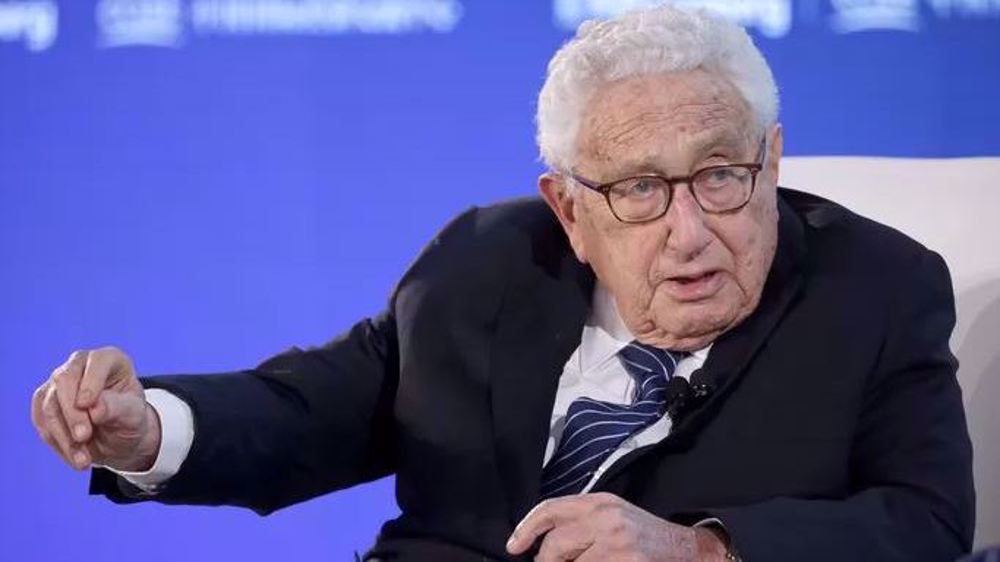
Henry Kissinger dead at 100: A warmonger who changed the world for worse

Former US Secretary of State Henry Kissinger attends a luncheon at the US State Department in Washington, DC, on December 1, 2022. (Photo by AFP)
Henry Kissinger, an influential and controversial figure in US foreign policy for decades, has died at the age of 100. Known for his unapologetic promotion of raw American power during the Cold War, Kissinger left an indelible mark not only on US foreign policy but on global politics as a whole.

The polarizing foreign policy figure, who served as secretary of state and national security advisor under presidents Richard Nixon and Gerald Ford, died on Wednesday at his home in Connecticut, according to a statement from his consulting firm, Kissinger Associates.

Having escaped Nazi Germany with his family in 1938, Kissinger later became a prominent political scientist and geopolitical consultant, and worked his way through the corridors of power in Washington.

The German-born Jewish refugee was notorious for his “realpolitik” approach to foreign policy, considering the legitimacy of international order as being premised on the agreement of the great powers, and ignoring morality as irrelevant.

Not surprisingly, Kissinger’s legacy is marred by controversial decisions and actions.

He is responsible for the ruthless campaign of carpet bombing in Cambodia from 1969 to 1973, which resulted in the deaths of between 150,000 and half a million Cambodians.

The purpose of the covert tactical bombing campaign in Cambodia was Washington’s desire, following Kissinger's advice to Nixon to “Hit them!”, to defeat both the South Vietnamese National Liberation Front and North Vietnam.

Kissinger warns of US-China ‘cold war’ with global repercussions

Notorious for his involvement in secret operations, Kissinger was the architect of a plan to potentially use nuclear weapons against North Vietnam in 1969 as part of an operation called Duck Hook.

Critics, including British author Christopher Hitchens, have accused him of war crimes and crimes against humanity.

In his book “The Trial of Henry Kissinger”, Hitchens argues convincingly that Kissinger deserved prosecution “for war crimes, for crimes against humanity, and for offenses against common or customary or international law, including conspiracy to commit murder, kidnap, and torture.”

In their 1976 book - “The Final Days” - Washington Post reporters Bob Woodward and Carl Bernstein revealed that when the idea of bombing North Vietnam was raised again, Kissinger “expressed enthusiasm at the size of the bomb craters.”

Kissinger had also personally supervised the schedules of the bombing runs and the allocation of planes from one area to the other.

“It's wave after wave of planes. You see, they can't see the B-52 and they dropped a million pounds of bombs,” Kissinger told Nixon after the April 1972 bombing of North Vietnam’s port city of Haiphong, as he tried to reassure the president that the strategy was working.

“I bet you we will have had more planes over there in one day than [former president Lyndon] Johnson had in a month... Each plane can carry about 10 times the load [a] World War II plane could carry,” Kissinger further said.

US suffers from domestic division, international disorder: Kissinger

In 1973, a Pentagon report stated that “Henry A. Kissinger approved each of the 3,875 Cambodia bombing raids in 1969 and 1970” -- the most secretive phase of the bombing -- “as well as the methods for keeping them out of the newspapers.”

As for the Middle East, Kissinger, who was still seen as influential on the world stage until the last days of his life, helped turn Israel into a major US ally during the Nixon and Ford years, arming the occupying entity to the teeth during the 1973 war in order “to prevent an Arab victory”, and ensuring the perpetuation of Israeli colonization of Palestinian lands for decades to come. 

He also crusaded against Palestinians for at least two decades, particularly by demonizing the Palestine Liberation Organization (PLO) and hampering the settlement of the Palestinian issue.

Kissinger’s horrifying record, among other horrible moves, included his support for former Pakistani President Yahya Khan’s genocidal campaign against East Pakistan (Bangladesh) in 1971 and his endorsement of the Indonesian dictator Suharto’s genocidal war on the people of East Timor in 1975, in which a third of the population was killed.

Kissinger once famously said, “To be an enemy of the US is dangerous, but to be a friend is fatal,” referring to the US government's unfair and unsincere behavior even with its friends.