Friday, December 01, 2023

Al-Aqsa Storm, Defeat of Misconceptions of Arab States about Normalization

Strategic Council Online - Interview: An expert on Israeli affairs, saying that the blow the Zionist regime has received from the “Al-Aqsa Storm” operation severely shattered the notion that the regime is an immutable reality that must be dealt with in the region noted: The crimes committed by the Zionist regime in Gaza will remain in the minds of the people of Islamic countries for a long time and will be a serious challenge for normalization.

In an interview with the website of the Strategic Council on Foreign Relations, Dr. Mehdi Ashna emphasized that one of the most important consequences of the Al-Aqsa Storm operation was its impact on the “Abraham Accords” and especially on the prospect of Saudi Arabia normalizing relations with the Zionist regime and added: Before the operation, the US and Saudi Arabia were conducting negotiations to normalize relations with the Zionist regime. The US objective was to conclude a security-defense agreement with Saudi Arabia, both to prevent this country from approaching China and to advance the normalization of ties between the Israeli regime and Saudi Arabia to strengthen its control over regional developments.

He added: With this operation, the negotiations have been suspended, and the bipolar atmosphere created due to the war does not allow the normalization process to proceed. In addition, the relations of the Zionist regime with countries that have normalized their relations, such as Bahrain and Jordan, have been severely endangered. In fact, a serious blow has been dealt to the normalization process, the result of which has been the suspension of negotiations between Saudi Arabia, the United States, and the Zionist regime for normalization.

Saying that the normalization project does not seem to be successful in the short term, the expert on the Zionist regime’s affairs further remarked: The Biden administration had opened a particular account on the dialogue between Saudi Arabia and the Zionist regime and viewed normalization of their relations as a progress for the acceptance of the Zionist regime in the region, a blow to Iran’s influence in the region and achievement to present in the US presidential election, and with this operation, none of those demands can be realized.

Ashna stated that the Arab countries’ approach to the normalization of relations with the Zionist regime was the result of several assumptions which, by carrying out the operations, the wrongness of those assumptions became apparent, and explained: The first misconception was that the Zionist regime would be ready to solve the two states problem with an interactive approach and give the Palestinians a part of their rights. But now, the falseness of such a misconception has been proven that the interactive approach of the Arab countries can help provide the rights of the Palestinians and adopt a flexible approach towards them by the Zionist regime.

He considered the second perception of the Arab countries that led to the movement towards the normalization of relations with Israel as the perception of its invincibility and the necessity of coming to terms with Israel as an existing reality and continued: They thought that not only should they come to terms with this reality, but also it can even be relied on for security. Some Arab countries suggested that Iran is a significant threat and they can unite with the Israeli regime to deal with it. Operation Al-Aqsa Storm also broke down this idea.

The expert on the Zionist regime’s affairs recalled: The progress of the normalization process was, to a great extent, based on this understanding of the strength and deterrence of the Zionist regime, and now this perception has been damaged and has reduced the motivation for normalization to some extent. Returning to the normalization process requires that the feeling of invincibility and the Arab countries’ perception of the strength and deterrence of the Zionist regime be restored, which does not seem possible in the short term.

Saying that the Arab countries also thought that by advancing the normalization process, they would get the definite political-security support of the United States, Ashna said: The operation showed that such support is nothing more than a mirage, and even if it is real, it is not clear how effective it is for them. The future of this war will make it clear that the value of the political-security support of the United States is so much that those countries will sacrifice the rights and interests of the Palestinians for it or not. Of course, so far, the field reality has shown that the political-security support of the United States will not be very beneficial for the Arab countries.

He added: Another misconception of the Arab countries was that the issue of Palestine has lost its importance and sensitivity in the eyes of the public opinion of the Arab and Islamic world, and if they normalize relations with the Zionist regime, nothing will happen. Al-Aqsa Storm showed that this is a false idea. The high volume of war crimes and crimes against humanity committed by the Zionist regime in Gaza, which was caused by the regime’s inability to restore its deterrence credibility, strongly aroused public opinion and clarified the wrongness of this notion. In such a way, paying attention to public opinion has become a serious factor in the calculations of countries following the normalization process, especially Saudi Arabia.

Ashna pointed out the intensification of the anti-Western atmosphere, especially in Islamic societies, and the opposition to the normalization process and stated: Although the final situation depends to a great extent on the course of the war, the misconceptions will not change in the short term. If the Zionist regime is possibly able to eliminate the political and military power of Hamas and Islamic Jihad in Gaza, give control of Gaza to Palestinian Authority, and sign a unilateral agreement with the Palestinian compromise movement with the support and pressure of the US, disarm Palestine and make it in a limited territory, it is possible that some Arab countries, under the influence of this heavy blow inflicted by the Zionist regime and the US on Palestine, will join this agreement out of desperation and try to advance the process of normalization, although the reality on the ground will not allow this process to go ahead.

According to Ashna, the United States now has this scenario in mind that it can find a solution for the Palestinian issue by eliminating the resistance groups, and with the normalization issue, it can implement geopolitical plans, including the new Arab-Mediterranean Corridor (Arab-Med), and to solve its security challenges, it now sees the opportunity ripe to eliminate Hamas to ensure the realization of its geopolitical plans for several decades by unilaterally compromising with some Palestinian groups. But in addition to the fact that the realities on the ground will not allow such measures and the Zionist regime is not able to eliminate the resistance in Gaza, other resistance groups will not allow this either.

'Serious doubts' Israel complies with international law: Pedro Sanchez

News Desk - The Cradle 

The Spanish PM has repeated calls for the EU to recognize a Palestinian state

Spanish Prime Minister Pedro Sanchez says he has major doubts regarding Israel's commitment to abide by international law in its siege of the Gaza Strip.

"The footage we are seeing and the growing numbers of children dying, I have serious doubt [Israel] is complying with international humanitarian law," Sanchez remarked during an interview with Spanish state-run broadcaster TVE on 29 November.

The premier added that Israel's military approach to Gaza “is not acceptable” and again called on the EU to recognize a Palestinian state.

“It is obvious that we must find a political solution to put an end to this crisis, and this solution requires, in my opinion, the recognition of the Palestinian state,” he said.

Last week, Sanchez condemned Israel for the "indiscriminate killing of innocent civilians, including thousands of young boys and girls" in the Gaza Strip. He stressed that "violence will lead to more violence" during his visit to the Rafah crossing on the Egyptian side.

On 24 November, Israel's government summoned the Spanish Prime Minister and Belgium ambassador over their calls for a ceasefire and criticism of the ethnic cleansing of Gaza.

Israeli Foreign Minister Eli Cohen claimed the foreign delegates were invited to Tel Aviv to engage in a "harsh rebuke conversation" over their criticism of Israel, claiming that their rhetoric was “giving support to terrorism.”

Organizing Immigration Issue, Cause of Escalation of Divergence in EU

Strategic Council Online - Interview: An expert on European affairs stated that the European Union is faced with the challenge of conflict in some different opinions and policies among member countries, which can affect the overall approach to immigration in Europe. She noted that when the member states follow different paths, the principle of solidarity and cooperation of the Union is distorted and can challenge the unity of the Union.

Farnaz Eskandari, in an interview with the website of the Strategic Council on Foreign Relations, said since the Syrian crisis migration, as a permanent debate in the European Union, has created differences in the attitudes and political orientations of the member states, adding: The migration crisis has opened a space for the players pessimistic about Europe in order to use it as an issue for politicization and securitization. The pessimistic discourse of Europe considers the migration crisis as a threat to national, economic, cultural, and internal security. In this regard, new security measures, such as border control and discourse that uses anti-immigration themes, can be seen in many member states.

Saying that Hungary, in opposition to the migration policy of the European Union, has raised the discourse of security as the main issue, she added: The prime minister of Hungary, at the European Union meeting regarding the amendment of the asylum laws of the Union, made an apparent connection between terrorist acts and immigration and said he would resist Brussels’ plan to share responsibility across the bloc for hosting asylum seekers or share the costs, and that those who support immigration also support terrorism. His remarks came after the recent deadly attacks in Belgium and France by two extremists who had their asylum applications rejected.

While referring to Poland’s warnings about the start of a new wave of illegal immigration due to Israel’s war in Gaza, the expert on European affairs said Hungarian Prime Minister Viktor Orban is considered one of the hardline figures in the European Union due to his government’s firm stance against immigration. Supporting nationalistic approaches, he has consistently opposed the EU’s approach to the influx of asylum seekers and migrants, especially since the migration crisis of 2015. His government has implemented strict border control measures, including constructing fences along Hungary’s borders to prevent immigrants from entering, and believes that each member state should have the right to determine its immigration policies based on its national interests and security concerns.

Eskandari says that economic disparities among member states, differences in political ideologies, and national interests have fueled disagreements on political issues, not only immigration. And added: When member states follow different paths, the union’s principle of solidarity and cooperation is distorted and can challenge the unity of the Union.

Emphasizing that the divergence between the policies of the European Union and Hungary in the field of immigration includes different dimensions, she explained: The European Union emphasizes cultural diversity and integration as a positive feature and considers immigration as an opportunity to enrich societies, but Hungary prioritizes preservation of its national identity, which leads to a more cautious approach to immigration to maintain cultural homogeneity. The European Union often sees immigration as a solution to demographic challenges, contributing to economic growth through a diverse and dynamic workforce. However, Hungary is concerned about potential pressures on resources and job competition, leading to a preference for controlled immigration to reduce economic pressures.

The expert on European affairs, referring to the security considerations of Hungary and, at the same time, Europe, which supports the comprehensive measures of screening and integration of immigrants, said: The European Union has mentioned a single approach to immigration as part of its broader vision for common policies, but by prioritizing national sovereignty, Hungary seeks autonomy to implement immigration policies that are more in line with its specific conditions and preferences. In this situation, the European Union faces the challenge of conflict in different opinions and policies among the member states, which can affect the overall approach to immigration. Still, in Hungary, domestic considerations, public sentiment, and the need to address specific national concerns play an important role in shaping immigration policies.

At the same time, Eskandari recalled that the leader of Hungary, one of Europe’s most prominent far-right politicians, has been isolated on the European scene for a long time. Orbán has angered the members of the European Union and NATO because of his positive approach towards Russia and not agreeing to Sweden joining the military alliance. To such an extent, Poland described Orbán’s policy towards Russia as “too toxic” that “nearly everyone wanted to stay away from him.”

Saying that the biggest supporters of Hungary these days are not Europeans but American right-wingers, she continued: Trump recently praised the Hungarian Prime Minister as “one of the strongest leaders anywhere in the world”! But such tactics and tough language that worked for Mr. Trump in the United States have not worked so well in Europe, where political success often depends on forming coalitions in national assemblies and the European Parliament in Brussels, and have reduced his influence.

The expert on European affairs described Orbán’s Fidesz Party as isolated and primarily alone on the European scene and said: During the European migration crisis in 2015, Hungary worked hard to strengthen Europe’s external borders. But Orbán expressed his proposals, which are now widely accepted in European capitals as a correct policy, in harsh and racist language that all but the most extreme far-right groups outside Hungary have kept their distance from him and that Slovakia is the only country now keeping pace with Mr. Orbán.

Eskandari said that Orbán believes that the European Union is no longer fulfilling either of his two promises, that is to say, prosperity and peace, and added: On key issues such as immigration, gender, and national independence, Hungary will remain on the same positions as long as Fidesz is in government. According to the latest polls, the prime minister’s party has a three-quarters majority. Orbán has repeatedly emphasized that Hungary wants to stay in the European Union. Any other option for this small, landlocked country deeply intertwined with the European Union would be tantamount to economic suicide. In his speech in 2022, Orbán also said that he does not expect the Union to adopt Hungary’s immigration policy, or their policy on foreign affairs and Hungarian minorities, beyond their borders and promote them to the European level. But at the same time, they cannot ask them to adopt their policies. There is no solution other than tolerance.

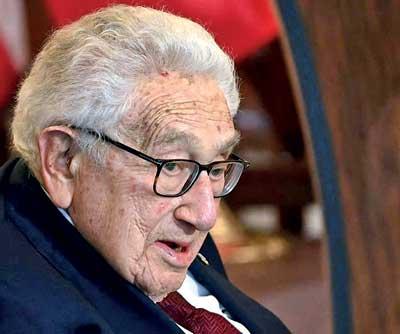
Kissinger, power politics and Israel’s war on Gaza

In Israel’s Gaza carnage and its militarism, Henry Kissinger, who passed away yesterday at the age of 100, comes alive in one form or another. 

Kissinger: An opportunity to settle problems or to gain diplomatic points knocks only once. Once such opportunities are missed, they are lost forever

Hamas’ “open act of aggression” must be met with “some penalty,” said Kissinger in a recent interview with the Brussels-based Politico, backing Israel’s war in response to Hamas fighters’ October 7 attacks.

Kissinger, however, warned of the danger of the war escalating into a region-wide conflict.
His for-and-against-war reply indicated that he remained what he was—a hawk and a pragmatist to the core. He advocated the use of force and promoted peace and negotiations, only if war failed to achieve its objective.

Israeli leaders were simply following Kissinger when they opted for war in dealing with the Palestinian resistance forces. What Israel was doing in Gaza before the temporary pause in its civilian-killing attacks was what Kissinger and the presidents under whom he served have been accused of doing in Vietnam, Cambodia, and Laos in the 1970s: relentless air attacks, carpet bombing, and thousands of civilian deaths.

He was a colossus on the world stage. In the late 1960s and throughout the 1970s, not a single day passed without people finding mention of Kissinger in newspapers and radio news bulletins. This was so not only in the United States but all over the world, including Sri Lanka. In many parts of the world, he was a household name.

In international relations faculties, one of the deeply studied figures is Kissinger. Like E.H. Carr and Hans J Morgenthau before him, he was an advocate of power-centric realpolitik. Till his death, he remained a diplomatic and foreign policy buff. He was held in awe and contempt.

One of the most controversial figures to emerge from the Cold War, German-born Kissinger, then a teen, fled Nazi Germany with his family in 1938 and went on to become the architect of American foreign policy during the Cold War. In his adopted nation, he played multiple roles and excelled in them too. He was a soldier, Harvard scholar, diplomat, and statesman whose diplomatic elan changed the course of world politics. 

Be it pushing for moves to end the Vietnam War, causing a rift between the Cold War-era communist giants, the Soviet Union and China, setting up diplomatic contacts with China through Ping-Pong diplomacy, working out strategic arms reduction treaties with the Soviets, overthrowing the democratically elected Chilean President Salvador Allende and replacing him with dictator Augusto Pinochet, or making peace between Egypt and Israel, his diplomacy has been a study in realpolitik and will continue to be so.

At times appearing to be idealist and at times aggressively promoting political realism, Kissinger was a chameleon-like pragmatist shifting from war to peace and peace to war in his attempts to advance the United States’ geopolitical interests, while he was the national security advisor, secretary of state, or even foreign policy consultant in retirement.

His idealism was seen in his view that the world was heading for catastrophe, and the task of diplomacy was to postpone it. In the same breath, he would express a realist’s view that war was almost inevitable, and the diplomat’s major task was to limit it to tolerable proportions.

Taking a leaf from 16th-century political philosopher Niccolò Machiavelli, he would advise that leaders must be pragmatic rather than idealistic; they must be secretive and flexible. Above all, they must understand that “force” is the elemental ingredient of history.

Advocating war, he once said, “Much as we deplore it, most major historical changes have been brought about to a greater or lesser degree by the threat or the use of force.”

Applying this principle to the Middle East crisis of October 1973, Kissinger, after rushing urgent military aid to Israel to avert a humiliating defeat, interpreted the situation in terms of his might-is-right policy: “I hope we get a military solution quickly, and then we can work on a diplomatic solution. You cannot have a diplomatic solution until you get a military solution.”

Kissinger believed that policymakers should be imaginative and mentally agile and should possess a keen sense of timing and the “killer instinct.” They should know, in other words, the exact location of their opponents’ political jugular vein. An opportunity to settle problems or to gain diplomatic points knocks only once. Once such opportunities are missed, they are lost forever.

He argued that the job of the US policymaker was to help the international system attain a stable state of balance. To do this, leaders must be cunning and patient. They must be able to manipulate events and people. Yes, the US presidents, under whom Kissinger served, manipulated events and people during the Vietnam War.

According to Kissinger, leaders must play the power game in total secrecy, unconstrained by parliaments that lack the temperament for diplomacy.

They must not be afraid to use force when necessary to maintain order. They must avoid ironclad rules of conduct; an occasional show of “irrationality” may be instructive. They must not shy away from duplicity or unscrupulousness, all of which are acceptable tools for statecraft. These must never burn their bridges behind them. And, if possible, they must always be charming.

That was Henry Kissinger, the diplomat, Nobel Peace Prize winner, and alleged war criminal.

If it was the Vietnam peace deal that won him the Nobel Peace Prize in 1973, on account of the same conflict, the war criminal label was slapped on him. During much of the Vietnam War, he was National Security Advisor and Secretary of State under Presidents Richard Nixon and Gerald Ford. His hawkism resulted in the deaths of hundreds of thousands of Vietnamese civilians. He promoted the bombing of Laos and Cambodia. He stood accused of destabilising Cambodia and being responsible for the rise of the Khmer Rouge, who massacred more than two million Cambodian people during their reign of terror from 1975 to 1979.

He cared less about human rights abuses as long as they served the US interest.

Then again, he was the key architect of the Middle East peace process. Capitalising on Egypt’s willingness to make peace with Israel, he brought about the 1979 Camp David Accord. This was the mother of all the Abrahamic accords that the Arab countries have signed in recent years and are about to sign under US coercion and at the expense of slow-pedalling the Palestinian cause.

For him, power is the ultimate tool that decides international relations. The world balance of power should be always in favour of the US, he insisted.

He once said, “Power is the ultimate aphrodisiac,” when asked about his dating antics with model Candice Bergen, actress Jill St. John, and others.

Kissinger, born on May 27, 1923, is no more, but his power-centric and war-first legacy continues in the US and Israel.

Iran rejects ‘baseless’ Israeli allegations over violating Chemical Weapons Convention

London, IRNA – Iran has categorically rejected allegations by the Israeli regime regarding the violation of the Chemical Weapons Convention by Tehran, saying that playing blame game does not help the regime cover up its “brutal crimes” against Palestinians over the past seven decades.

The comment was made by Iran’s Representative Reza Najafi at the 28th Session of the Conference of the States Parties that oversees the implementation of the Chemical Weapons Convention. The conference, held on Nov. 27-Dec. 1 in the Hague, is composed of representatives of all Member States of the OPCW (The Organization for the Prohibition of Chemical Weapons).

Addressing the session on Thursday, Najafi called allegations leveled by the Israeli representative baseless, saying that Iran is one of the main victims of chemical weapons.

The Iranian envoy also said that the “child-killing Israeli regime, which has not declared its stockpiles of chemical weapons, has no position to make comments about a member state that is a victim of such lethal weapons.”

Playing the blame game and leveling accusations against member states will not help the Israeli regime, which is the main cause of instability in West Asia, he added.

Int'l solidarity seminar with Palestinian nation held in Belgrade

Tehran, IRNA - On the occasion of November 29, the International Day of Solidarity with the Palestinian People, the Qods International Seminar organized by the cultural consultation of the Embassy of the Islamic Republic of Iran and in cooperation with the international movement of Eurasia in Belgrade, with the presence of speeches from Iran, Serbia and Russia was held at the press center in Belgrade held.

In this seminar, a significant number of supporters of Palestine, the representative of Serbian Archbishop Porfiry, the ambassador of Cuba, artists, media activists and NGO centers, the representative of the Palestinian embassy in Belgrade, Rashid Hasanpour; the ambassador of the Islamic Republic of Iran, and Amir Pourparshak, the cultural advisor, were present in this seminar. 

Rashid Hassanpour of the Islamic Republic of Iran and six of the authors, journalists and social activists were the speakers of this international conference.

At the beginning of this seminar, which was broadcast directly from the YouTube channel of the House of Journalists, a minute's silence was announced in honor of the victims of Palestine in the past month.

The speakers of this conference emphasized that the Palestinian conflict is not a new thing, but it started when the Israeli regime came into being, and this regime showed that it came out of NATO's kitchen by bombing people from the air and ground attack.

Every day, the Zionist army has destroyed schools, hospitals, residential areas, cut off water to people and made living conditions difficult for the residents of the Gaza Strip.

The Zionist regime has also attempted to massacre and imprison the inhabitants of the Gaza Strip through its comprehensive siege; In such a way that this area has become a prison camp.

The Zionists are also unbridled and non-stop brutalizing the Palestinian people.

Rashid Hasanpour, Ambassador of the Islamic Republic of Iran, in his speech, stated that public opinion and new technologies have made it possible for people to impose their will, and added: "The Palestinian case has been open for more than 80 years, and the government has a strong political will and international organizations are not seen to solve it."

He pointed out that this is injustice and double standards and apartheid.

Hassanpour emphasized that the only parameter that can determine the fate of the Palestinian people is the declaration of global solidarity with the Palestinian people.

It is time to change, or scrap the UN - EDITORIAL

In its sessions in February - March next year, once again the United Nations Human Rights Council (UNHRC) - the UN arm, whose mission it is to promote and protect human rights around the world - will once again rake up investigations into allegations of human rights violations in our country during its ‘war on terror’.   

The UN was set up to take effective measures for the prevention and removal of threats to peace. It is based on the principle of the sovereign equality of all its members.   
Last year the scope of the UNHCR inquiry into our country was broadened to include issues arising from the economic crisis which hit the country -O Tempora, O Mores!   

The original investigation was called by a group of countries led by Britain and included Germany, the US, Montenegro, Malawi and North Macedonia. They demanded an investigation into allegations of human rights violations in this country during its ‘war on terror’.   

Strangely, the major powers pushing for the investigation into the alleged commission of war crimes in Sri Lanka are among those countries that have committed the greatest crimes against humanity themselves.   

Yet, the UN has not flagged these crimes.   
For instance, US involvement in the war in Vietnam left around 1.4 million Vietnamese civilian casualties, including over 415,000 deaths.   

Separately several incidents occurred during the war in which civilians were deliberately targeted and killed by the US soldiers. The most prominent of them being the Huế Massacre and the Mỹ Lai Massacre.   

In addition, 18.2 million gallons of Agent Orange, were sprayed by the US military over more than 10% of South Vietnam as part of the US herbicidal warfare programme.   

Vietnam’s government claimed that 400,000 people were killed or maimed as a result of after-effects and that 500,000 children were born with birth defects.   

During the closing stages of World War II, the US nuclear bombed two Japanese cities of Hiroshima and Nagasaki. Within a space of minutes hundreds of thousands of civilian Japanese children, women and men died a most horrible death, so the US could carry out live experiments on human guinea pigs.   

To date, the UN has not commenced an investigation into either the US crimes in Vietnam or the fallout of its nuclear experiment in Hiroshima or Nagasaki. The US has also committed war crimes and assorted atrocities against civilians ranging from Cambodia to Iraq, to Afghanistan.   

We see a pattern in the atrocities -all these countries ‘happen’ to be in Asia... A pattern of racism emerges.   

Today, the State of Israel is committing genocidal attacks on Palestine. While a temporary ceasefire has been declared in Gaza to facilitate a hostage swap, Israel continues to attack Palestinians in the West Bank and other parts of Palestine.   

Since October 7 this year Israel has carpet bombed the Gaza Strip in what is described as the world’s most densely populated part of the world. Within the short space of around a month-and-a-half, the number of Palestinians killed since October 7 has risen to 14,532, including about 6,000 children, according to the government media office   

According to the World Health Organization, there were 51 attacks on health facilities in Gaza between October 7 and 17 2023, including the killing of 15 hospital workers and wounding of 27 others.   

The number of hospitalised persons and others seeking shelter at the hospitals who were killed is unknown.   

Yet, the UN Security Council has neither condemned Israeli atrocities nor called for a ceasefire. The UN has not seen it fit to demand Israel withdraw from Palestinian territories and return to internationally recognised borders.   

Figures presented by the UN Secretary-General estimate the body needs approximately USD 3.4 billion for 2023.   
Yet, while the UN prosecutes/investigates only weaker nations like Sri Lanka. It has done nothing to stop the ongoing genocide in Palestine or crimes committed by the US and the West in different parts of the world.   

A question arises, for whose benefit is the huge structure of the UN maintained? To all intent and purposes, it appears that the UN is merely an appendage to whitewash the crimes of the White ex-colonial powers.  

Editorial - Daily Mirror