Showing posts with label Japan. Show all posts

Wednesday, November 13, 2019

What are White House allies doing in East Asia ?!

By Saeed Sobhani

TEHRAN-Japan and South Korea, as two US allies in the East Asian region, do not play a positive role in resolving the crisis in the region. Undoubtedly, resolving the crises in East Asia is only possible in one way and that is the separation of Tokyo and Seoul from White House policies. This has not happened yet!
South Koreans Are Pleading for a Breakthrough in the US-North Korea Talks
As Tim Shorrok wrote in Outline, It’s not just the North Koreans who are fed up with the glacial pace of their bilateral negotiations with President Trump over nuclear weapons and long-range missiles. Many South Koreans are too. And they are starting to make their voices known. On November 5, 71 members of South Korea’s National Assembly signed on to legislation calling on the two Koreas and the United States and China to declare a formal end to the Korean War and sign a peace treaty. To many Koreans on both sides of the DMZ, that’s a necessary step to kick-start the denuclearization talks and, in the words of the bill’s sponsor, “help to usher in peace on the Korean Peninsula.”
The timing was significant. The week before, on October 31, Kim Jong-un had set off alarm bells in Washington when his military conducted another “test fire” of a short-range missile. His intent was to add pressure on Trump “to meet an end-of-year deadline for a new proposal on exchanging the regime’s nuclear weapons program for economic and political concessions,” South Korea’s Yonhap reported.
The missile test received the usual blanket coverage in the mainstream US press. It has been contemptuous of Trump’s negotiations with Kim since they began in Singapore last year and has adopted a story line pushed by the foreign policy establishment—that North Korea is rearming while Kim’s talks with Trump flounder.
“North Korea launched two more short range missiles and nobody seems to care anymore,” Josh Rogin, a hawkish commentator for The Washington Post, said in a tweet about the test. But they certainly care in South Korea, where people have lived with the threat of war for 70 years and are anxious to find a way toward permanent peace.
In the week preceding the missile test, a group of progressive activists from South Korea was in New York and Washington pleading for a change in US policy to break the deadlock so the two Koreas can move forward on their own plans for reconciliation.
Tired of the impasse in the US-North Korean talks and impatient with what they see as President Moon Jae-in’s acquiescence to US demands on maintaining sanctions, the 22 delegates, representing South Korean churches, labor unions, academia, and agriculture, spent five days on the East Coast to warn that, without US concessions on sanctions, the peace process in their country could be doomed.
“We are on the cusp of a dangerous time in which a standstill between these countries that extends into 2020 could escalate to the extremes of military action and even war between North Korea and the United States,” Pil-young Shin, the chair of the June 15 Committee for the Reunification of Korea, said in his opening remarks to an October 26 conference at the United Nations in New York (I was invited to address the conference as an independent journalist).
Unlike the US skeptics, who dominate discussion of Korea in the media and cable news, the South Korean progressives view American policy itself as the prime obstacle to progress in the Korea peace process.
“We have emphasized repeatedly that the basic problem threatening peace in the Korean Peninsula lies in the US’s long-lasting hostile policies towards [the] DPRK,” Chongbok Lee, a veteran organizer and the chair of the peace delegation, said at the UN conference, using North Korea’s formal name, the Democratic People’s Republic of Korea. That term—“hostile policy”—is also at the core of North Korea’s demands of the United States.
Lee continued: “The US must come back to the spirit of June 2018 Singapore summit and should release blockade and oppressive measures against [North] Korea, making efforts to normalize relations. As a result of such processes, we ensure that the stable peace regime, as well as denuclearization, can be achieved.” He pointed out that the June 12, 2018, declaration in Singapore by Kim and Trump “asserted a commitment to end the long hostile relations between the DPRK and the US,” adding that “the US government must devote effort into uprooting the war mechanism deeply embedded into the Korean Peninsula.”
It was Trump’s hard line on maintaining sanctions until full denuclearization, he and other South Koreans argued, that led North Korea to walk out of its last meeting with US negotiators in Sweden on October 5. Ten days later, Kim Jong-un was pictured in state media riding a white stallion in the snow to Mount Paekdu, the highest mountain on the Korean Peninsula and a symbol of North Korean nationalism, power, and invincibility. “Kim Jong-un sends a message of self-reliance and perseverance to N. Korean people,” the progressive Hankyoreh declared in its headline about the event.
But most US observers interpreted the visual, which was widely ridiculed on social media, as a sign that he’s about to take dramatic action—perhaps “bigger and badder” missile tests, suggested analyst Harry Kazianis—unless the United States meets the deadline set earlier this year. Coming from the right, The Daily Beast’s Donald Kirk predicted that Kim’s ride on Mount Paekdu was “all about projecting the image of a heroin a campaign of intimidation aimed at both the U.S. and South Korea in a climactic drive to get [Trump and Moon] to yield at last to his demands.”
That’s certainly not how the visiting Koreans see it.In their meetings with UN diplomats, US lawmakers, and peace groups in the last week of October, the delegation stressed that Trump’s refusal to lift sanctions as part of his “maximum pressure” campaign to force Kim’s immediate denuclearization has driven the North to display its conventional military might with its recent missile tests (24 launches this year, according to one observer).
Worse, they said, the sanctions have made it impossible for the two Koreas to move forward on the economic projects Kim and Moon agreed to at their own historic summit in Pyongyang in September 2018. One of the most important of those projects was the reopening of the Mount Kumgang tourism site in the North that was the focus of bitter recriminations by Chairman Kim in late October. When South Korea offered to discuss the project in face-to-face talks, the DPRK rejected the offer.
The South Korean delegation blamed US sanctions for the impasse. “We beseech our US friends: the US keeps imposing restrictions that stop the Mount Kumgang project,” Shin told a group of US Korea watchers at the Institute for Policy Studies in Washington. “We wish to work with you to overcome this obstacle.” Without warming in inter-Korean ties, he warned, the prospects for the US and South Korean agreement with North Korea on nuclear weapons grow dimmer by the day.
The sanctions have also made it difficult for badly needed humanitarian aid to flow. In a meeting with the staff of Massachusetts Senator Edward Markey, the delegation said, they discussed the possibility of exemptions on sanctions for such items as medicine and water filters.
The serious impact of sanctions on ordinary North Koreans was underscored by a report from an international panel of independent experts that was released on October 30 by Korea Peace Now!, a coalition led by Women Cross DMZ. The report was covered widely, including by The Wall Street Journal, and includes some sobering statistics.
“There is already evidence of irreparable damage,” the report states. “It is possible to estimate with reasonable certainty that there may have been more than 3,968 deaths in 2018 (with 3,193 of those being children under age 5, and 72 of them pregnant women) as a result of sanctions-related delays and funding shortfalls impacting specific UN humanitarian programs.” (A full copy of the report can be downloaded here.)
The June 15 Committee that visited the United States was formed in 2000 to support the spirit of the first-ever summit between North and South, where the Mount Kumgang project began (it was shut down in 2009 during a period of high tensions between the two sides). The committee was a key part of the broad coalition that organized the massive candlelight rallies in 2016 and 2017 that led directly to the impeachment of Park Geun-Hye and the subsequent election of President Moon in May 2017.
Since then, the South Korean progressive forces have been the backbone of popular support for President Moon. As I witnessed from Gwangju in 2017, he campaigned for the presidency pledging to restore the “Sunshine Policy” of political and economic engagement initiated in the late 1990s by his predecessors, Kim Dae-Jung—who made that first trek north in 2000—and Roh Moo-hyun. Since Moon took office, those in favor of his peace initiative are a majority; while he has slipped in popularity in recent months, most polls show that 60 percent support him on his outreach to North Korea.
But the hard-line US stance on the North has greatly troubled the Korean left and even the Moon government. They have watched with growing apprehension as the US-run United Nations Command in South Korea has blocked South Korean officials from participating in a survey of North Korea’s rail system and continued strict controls on people from the South crossing the border for discussions with their Northern counterparts. (Some of the controls are petty: One group that convened at Mount Kumgang last February was prohibited from bringing laptops or cameras with them, members of the June 15 delegation said.)
While publicly supportive of the UN Command, the Moon government has expressed reservations about its policies. On October 21, Moon’s Unification Minister, Kim Yeon-Chul, said at a National Assembly hearing that the UNC was using “inadequate legal grounds” for denying certain permits to cross the border, and said that “institutional remedies” are needed so people can cross the DMZ for nonmilitary purposes (in a rare rebuke, the UNC responded with a press statement calling such reports “inaccurate”).
South Korean progressives have also been shocked by US criticism of the Moon government’s response to its trade dispute with Japan over a Supreme Court decision that Tokyo should pay compensation to Korean victims of Japanese forced labor during World War II. Even as the June 15 delegation was in New York and Washington, a senior US official, Assistant Secretary of State for East Asian and Pacific Affairs David Stilwell, was in Seoul asking the Moon government to rejoin an intelligence-sharing arrangement with Japan it had canceled in retaliation for Japanese export sanctions.
The distance between Seoul and Washington on this issue was very clear at a conference organized by the Center for Strategic and International Studies, a military think tank that receives major funding from Japan and US arms exporters. “The country doing the most damage to itself” in the dispute “is the Republic of Korea,” said Michael Green, a CSIS senior vice president who worked on Korea issues for the George W. Bush administration. “I don’t know what the Moon government is doing with Japan. Japan is winning this tactically.”
The hostility from official Washington is so intense that Lee Su-hyeok, Moon’s new ambassador to the United States, told reporters a few days ago that South Korea’s policies toward the North are inviting criticisms that they are “pro-Pyongyang.” And Trump, whose outreach to Kim has been applauded by the South Korean left, has raised the stakes himself by demanding a five-fold increase in Seoul’s financial support for US forces in Korea.
According to a recent book by an aide to former secretary of defense James Mattis, Trump called South Korea a “major abuser” of the United States and characterized the alliance as a “losing deal.” He allegedly added that if Seoul “paid us $60 billion a year to keep our troops overseas, then it’s an okay deal.” The statements have sparked some protests in South Korea. On October 18, a group of progressive university students used ladders to enter the grounds of the residence of US Ambassador Harry Harris and denounced the 500 percent increase in costs for the bases (“Leave this soil, Harris,” their banner read).
On the issue of US forces in the country, South Korea’s progressive forces seem to reflect mainstream thinking. While recent polls have shown that most South Koreans support a military alliance with the United States, there is considerable ambiguity about the future of US bases in the South and sharp disagreement with the US demands that Seoul increase its payments. Last January, for example, the Korean firm Realmeter found that nearly 60 percent of Koreans opposed paying a greater share of the costs for US bases, as Trump has demanded, while 52 percent were against the idea “even if” it means the United States scales down its forces or withdraws from the peninsula. Trump’s recent statements, too, sparked anger from many South Koreans. “I hope against hope that Americans will get over with the Trumpian diversion and put things back to where they were,” Oh Young-jin, an editor with the centrist Korea Times, wrote in a commentary titled “Why Trump hates Koreans.”
The Trump administration also came under criticism after a Pentagon official suggested—during talks about returning wartime operational control of US-Korean forces to Seoul—that the South Korean military should become an auxiliary force for the United States in such places as the Middle East. “Reports that we may have to send our troops to overseas areas of conflict determined to be a threat by the United States after the Opcon transfer are not true,” a spokesperson for the defense ministry told reporters.
Back in Washington, members of the June 15 group explained that the differences over sanctions underscore the need to redefine the meaning of the US-South Korean alliance, which was formalized in 1954.
“We need to move from a hierarchical to a more equal relationship,” Lee, the chairman of the delegation, said. “Until the alliance is transformed, inter-Korean movement will be limited.” Moreover, “so long as the United States maintains a hierarchical alliance over South Korea, North Korea will not change its relationship” with the US government, he pointed out.
Their solution, he continued, is to “achieve South Korea’s sovereign voice within the US-South Korean alliance so South Korea can advocate for itself on the Korean peninsula.”
That’s a tall order for Trump, who is mired in an impeachment investigation and totally unpredictable in foreign affairs. But it also presents some rethinking by the Democrats, whose senior leadership (including House Speaker Nancy Pelosi) has disparaged Moon’s negotiations with the “tyrant” (Joe Biden’s words) Kim Jong-un and, like CSIS, openly sided with Japan in the dispute over World War II compensation.So what might happen over the next year before the US elections? Trump, ever optimistic and desperately seeking a foreign policy win to offset his blunders, continues to predict success on the denuclearization front with Kim Jong-un; but he adds that he’s in “no rush” to get a deal completed.
The DPRK leadership seems to see it that way, too. Even after fierce criticism of the US position by lower-level officials, Kim seems to believe Trump will pull it off. Trump and Kim still have a “special” relationship, but “Washington political circles and DPRK policy makers of the U.S. administration are hostile to the DPRK for no reason, preoccupied with the Cold War mentality and ideological prejudice,” Kim Kye-gwan, a top adviser to Chairman Kim, wrote in a commentary carried by the state wire service KCNA. “There is a will, there is a way. We want to see how wisely the U.S. will pass the end of the year.”
Since then, Trump has appointed Stephen Biegun, his nuclear envoy to the DPRK, to the number-two position in the State Department, deputy secretary, where he will “keep his North Korea portfolio,” CNN reported on October 31. He has been busy with a schedule that has included, surprisingly, reaching out to humanitarian and peace groups focused on North Korea. Last week, for example, he met with Christine Ahn, the founder of Women Cross DMZ, along with members of the campaign Korea Peace Now, for the second time.
(Reached in Geneva, Ahn confirmed the meeting with Biegun and said “he was in good spirits.”) And in a sign that US and Korean pleas for a peace agreement are being heard, Alex Wong, the deputy special representative for North Korea, told a Washington audience on Tuesday that the state of war on the Korean Peninsula “should not and cannot be permanent.”
Meanwhile, the Moon government has been sending its own signals that it wants North Korea back in the talks with the United States. In contrast to the American concern about the DPRK’s October 31 missile test, Chung Eui-Yong, President Moon’s national security director, downplayed the danger to South Korea last week. “I don’t think the missile capabilities the North is developing now are a grave threat to our national security,” he told the National Assembly, noting that the South’s military budget is much larger than that of North Korea and that the South Korean military also tests short-range missiles (the government’s stance drew sharp criticism from conservatives). On November 4, Moon’s intelligence director, Suh Hoon, sounded another note of optimism, telling lawmakers that US and North Korean negotiators are expected to hold another round of bilateral talks “no later than early December.”
In a sign of pre-negotiation flexibility, the US and South Korean militaries have agreed to skip an upcoming combined air exercise called “Vigilant Ace” that in 2017 mobilized around 270 US and Korean aircraft, including advanced F-22s and F-35s, to demonstrate their joint capabilities against the DPRK. Instead, they will hold separate drills, as they did in 2018. The decision reflects a bilateral effort “to support ongoing diplomacy for the denuclearization of North Korea,” Yonhap reported.
Suspension of these exercises—as well as a peace treaty to end the Korean War—were also key demands of the South Korean peace delegation that came here. As one of the delegates said after his meetings on Capitol Hill on sanctions, “small steps at a time.”


Wednesday, September 04, 2019

U.S. move to form coalition in Persian Gulf ‘not feasible’: Japanese professor

By Negar Asadi

TEHRAN - Hisae Nakanishi, a professor of International Relations of the Middle East at Doshisha University in Japan, believes that the United States’ move to form a maritime coalition in the Persian Gulf is “unwise and even not feasible”.
“The U.S. hopes to encircle Iran by the cooperation with those states which the U.S. considers its allies in the Middle East and by pressuring Iran. I consider this U.S. move unwise and even not feasible. So far, a limited number of the states have joined the coalition and many other states are prudent not easily expressing their desire to join,” she tells the Tehran Times in an exclusive interview.
Nakanishi says this decision by the U.S. is not isolated from a series of the Washington’s unilateral actions.  
“It started from withdrawal from the JCPOA [the official name for the 2015 nuclear deal] in May 2018.  The U.S. major objective is to increase tension in the Persian Gulf that serves for Trump’s gaining more votes for the 2020 Presidential Election,” she said.
Nakanishi also said that it is a wise decision by major countries who have refused to join the coalition, noting supporting such a coalition means supporting “illegality in international law”.
“It is a wise decision that major countries such as Japan and Germany have refrained from participating in the coalition.”
“It is wise for the major countries to have refrained from joining the coalition including Japan and Germany. The current tension in the region started from the U.S. breaching international law by abandoning the JCPOA.  Thus, participation in the coalition has a serious ramification: it would mean to support the illegality in international law,” she stated.
She added, “As Prime Minister Abe of Japan clearly stated during his visit to Iran in June and at the time of the latest G7, Japan does not hope to see conflict in the Persian Gulf and hopes that Iran plays a constructive role in securing peace in the region. Moreover, the participation of Japan’s Self Defense Army is not legally supported in Japan’s constitution. It goes without saying that Japan and Iran have historically maintained a good relationship. So, it was a natural decision for Japan not to join the coalition.”
Commenting on participation of Israel, the UK and Australia in the coalition, she said what is important for those states is to express their support for the U.S.
“As a matter of fact, it is not clear to what extent Israel will commit itself to the coalition.  It expressed to cooperate with U.S. only for collecting information.  Yet, what is important for those states is to express their support for the U.S. policy. Israel is likely to continuously fire into Lebanon’s Hezbollah. Yet, this does not mean that it deploys its military in the Persian Gulf with other coalition states. It is not new in the case of the UK and Australia.  Both UK and Australia have already played a crucial role in their intervention in Afghanistan and again in Iraq by participating in the U.S.-led coalition in their war against Saddam,” she explained.
The professor added, “What matters most is the political and military implication of the coalition formation.  The U.S. has its allied states in the Persian Gulf such as Saudi Arabia and the United Arab Emirates.  Thus, the coalition making is for the sake of the U.S. enhancing its leverage toward these countries.  On the other hand, the more tense the Persian Gulf situation gets, the more weapons and fighter jets those allied states buy from the U.S.”
“The coalition is aimed at increasing military tension (in the Persian Gulf).”
“The UK is also among other weapon sale states in the Middle East.  The coalition making actually serves such an economic interest of the U.S. These circumstances considered, the U.S. primary goal in the coalition making is to increase the military tension, not really is presuming to engage in the military act in the region at this point. Overall, the fact that not many states have joined the coalition suggests decline of the U.S. power in the Middle East,” opined the professor of Doshisha University.
The United States has called on its European and Asian allies to form a maritime force to supposedly monitor safe shipping in the Strait of Hormuz and Persian Gulf.
So far, only Britain, Australia and Bahrain have agreed to join the coalition.

Saturday, August 17, 2019

Kashmir: The Fight for the High Ground Has Started

Wayne MADSEN

India’s unilateral abrogation of the autonomous status of Kashmir, previously guaranteed by the Indian Constitution, is but a first step toward nations around the world taking steps to seize higher altitude land as global warming and sea-level rise increasingly cascade in intensity. Warming oceans, melting permafrost, glaciers, and ice sheets are rapidly affecting sea levels, especially during high tides.
Around the world, dormant and low intensity rival claims to contested territory in mountainous regions, from the Himalayan Range to the western Golan Heights in the Middle East and the territory of the Kurdistan Regional Government to southern Sakhalin Island, have been spurred on by current and projected rise in sea levels.
Governments are beginning to contemplate the movement of urban populations living at or slightly above sea level to more secure and sustainable higher altitude zones. Nowhere has this been more evident than in the region of Jammu and Kashmir, which sits at the western end of the Himalayan Mountains and for which there are territorial claims by India, Pakistan, China, and a Kashmiri independence movement. India views Kashmir as a future home for climate change refugees from coastal metropolitan areas like Mumbai, Kolkata, Chennai, Ghaziabad, Surat, and Faridabad. Annual monsoon rains are resulting in more intensive flooding in these urban areas.
Other than the political dimensions stemming from Indian Prime Minister Narendra Modi’s abrogation of Article 370 of the Constitution, which granted special autonomous rights to the state of Jammu and Kashmir, the action also scraps the provision that had banned land sales in the state to non-residents of Kashmir. The majority Muslim population of Kashmir now fears that there will be a rush to buy land by wealthy Hindus, especially from Indian cities threatened by increased flooding.
The blitzkrieg swiftness by which Modi altered Jammu and Kashmir’s status from an autonomous state to the bifurcated “union territories” of Jammu and Kashmir and Ladakh has observers on the subcontinent and beyond convinced that a major land grab is now imminent for the western Himalayan region. By executive fiat, Modi ordered additional Indian troops into the former state, supplementing the half-million Indian armed forces personnel already stationed in Kashmir. Indian forces imposed a draconian curfew in Kashmir and all telecommunications, including landlines, were severed with the outside world. Religious pilgrims and tourists were ordered to leave Kashmir immediately with Indian Air Force planes flying many stunned visitors out of the area. More than 500 Kashmiri political and religious leaders, including three former chief ministers of the now-abolished government in Kashmir, were arrested by Indian security forces.
Pakistan suspended the Friendship Express train service with India. In addition, Indian and Pakistani border troops exchanged fire along the volatile border, known as the “Line of Control,” in the Rajouri sector. Pakistan also announced the expulsion of the Indian High Commissioner in Islamabad and a suspension of trade with India.
There are current fears that Modi will next move to abrogate Article 371 of the Constitution and eliminate the special status of the mountainous states of Nagaland, Sikkim, Assam, Manipur, Sikkim, Mizoram, and Arunachal Pradesh in the eastern Himalayas, which would result in the lifting current restrictions on the sale of land to outsiders. The governments of the Himalayan nations of Nepal and Bhutan are increasingly suspicious about the wider territorial ambitions of Modi, a right-wing Hindu nationalist, on the future independence of their countries.
Modi’s actions are generally similar to China’s moves in Tibet and Sinkiang, where there is a policy of populating the regions with ethnic Han Chinese from the densely populated coastal areas of eastern China. The increasing acquisition of land for Han-populated residential areas comes at the expense of Buddhist ethnic Tibetans and Turkic-speaking Muslim Uighurs in Sinkiang.
There is evidence that given the closer ties between India and Israel that Modi’s move on Kashmir was encouraged by Israel. Kashmir has become a favorite destination for Israeli tourists and Israel Defense Force mountain warfare trainees. Moreover, Trump’s recent unilateral recognition of Syria’s Golan Heights and Jerusalem as Israeli sovereign territory sent a clear green light to Modi that, as far as Washington is concerned, he could officially absorb Kashmir into India without raising even an eyebrow in Washington.
What makes matters worse with the land grab for Kashmir is that India is officially laying claim to other parts of Kashmir currently occupied by Pakistan and China. Pakistan controls “Free Jammu and Kashmir, known as “Azad Kashmir,” along with Gilgit-Baltistan. China controls Aksai Chin, which is administered as part of Hotan County in the restive Xinjiang Autonomous Region. Presenting a recipe for disaster, three nuclear-armed nations brandish competing claims to prized high altitude territory that is suitable for the relocation of displaced climate refugees from coastal urban areas. The possibility for the first exchange of nuclear weapons between nuclear-armed states has risen exponentially with Modi’s move. India and Pakistan have fought several large and smaller wars over Kashmir since 1947 and the possibility that another conventional armed skirmish could go nuclear should not be underestimated.
The reaction of Pakistan and China to India’s move has been predictably inflammatory. The Chinese Foreign Ministry reiterated that India’s absorption of Ladakh involves “Chinese land.” Pakistan officially views India’s abrogation of Kashmir’s special status within the Indian Union as “illegal.” Pakistan also stated that it would “exercise all possible options” in reaction to India’s move.
The wars for fresh water supplies and higher altitude territory has commenced. Israel’s absorption of the Golan Heights and its proximity to the fresh water Sea of Galilee is an insurance policy for the eventual resettlement of climate refugees from inundated portions of Tel Aviv and Haifa.
Iraq is reinforcing its sovereignty claims to the mountainous territory currently government by the Kurdistan Regional Government in northern Iraq. Sea level increases are already affecting Basra, which sits along the marshy Shatt al-Arab river. The city is also ready experiencing seawater intrusion into the Shatt al-Arab, which has resulted in unsuitable water for drinking and crops. A shift in the population of the largely Shi’a population of the area northward to mountainous areas is not a question of if but when.
Japan has recently been flexing its muscles over its former territories in the Kurile Islands and South Sakhalin, which are currently part of the Russian Federation. As sea-level increases and parts of Tokyo, Osaka-Kobe, and other major coastal cities in Japan become uninhabitable, the mountainous areas of what Japan calls its “Northern Territories” will become increasingly coveted, setting the stage for a further increase in tensions in the already volatile northeastern Asia.
Argentina’s and Chile’s shared freshwater-abundant and highly arable Patagonia region is attracting wealthy land purchasers from around the world – including the United States, Israel, France, Italy, Denmark, the United Kingdom, and increasingly, climate change threatened Netherlands and Dubai. This land rush is taking place even as the Patagonian icefields are melting. The joke in Argentina is that the foreigners are buying up what has been described as the extremely remote “end of the world” for the actual “end of the world.” The same is true of an increasingly habitable Greenland, which has recently attracted prospective investors from China.
Wars were once fought over natural resources, ideology, and religion. Today, the old rule book as been superseded. It is now a fight for survival and the countries that conquer the higher altitude regions with livable climates and natural resources will remain after over-populated coastal areas succumb to oceanic deluges.

Tuesday, August 13, 2019

Healthy economy is antidote to sanctions on Iran: scholar

By Negar Asadi

TEHRAN - A prominent scholar, believes that fighting corruption and building a healthy foundation for economy are catalysts to resist sanctions and external pressure on Iran.
“What is important is to adopt policies to have a foundation of a healthy economy in order to be able to counter external pressure,” Modjtaba Sadria told the Tehran Times in an interview on Thursday.
Sadria, an expert on East Asia, cited China and its resistance against the U.S. sanctions as an example.
China has adopted clear and coherent policies which resulted in a “strong foundation for national economy” and also a very “strong social base” to counter the U.S. pressure, Sadria explained.
“Between 1848 (opium war) and 1949 (Chinese revolution), a deep desire of independence grew in China. Xi Jinping [the Chinese president] has undertaken huge program of economic transformation of China in order not to depend on Chinese trade with the United States,” he explained.
He said that the U.S. pressure is not tolerated in China.
“The U.S. efforts to form alliance in the Persian Gulf is more a show of a bargaining strategy which cannot pose a threat against Iran.”Referring to China’s act in suspending purchases of U.S. agricultural products, Sadria said, “This is one of the examples of Chinese tools to retaliate the Trump administration’s show of force to China.”
China announced on Tuesday that it has suspended purchases of U.S. agricultural products in retaliation for a “serious violation” of agreements between President Xi Jinping and his counterpart Donald Trump.
Sadria said, “On the sidelines of a G20 summit in Osaka, Japan, Trump and Xi met and reached agreement on reducing sanctions by the U.S. However, Trump restored those sanctions. These actions which are unilateralism in the international relations are not tolerated by China. Trump cannot use sanctions as bargaining tools against a country which is the second largest economy in the world.”
“Today, China is a society to which you cannot show off power with the game of sanctions,” he added.
He also said that the U.S. has not any leverage to impose sanctions on other countries unilaterally and act as the “lone superpower”.
“When China takes retaliatory action against the U.S. unilateralism and pressure, it affects not only the U.S. economy, but the whole global economy,” he pointed out.
He noted that China has adopted policies in line with the growth of its national economy that the U.S. cannot harm it by imposing sanctions or exerting pressure.
Trump and Xi held a summit during the G20 in Osaka, Japan in June.
Xinhua reported that the two leaders had agreed to resume economic and trade negotiations, and that the U.S. said it would not impose any new tariffs on Chinese products.
However, Trump announced last week that the U.S. would put a new 10 percent tariff on $300 billion worth of imports from China.
China “has not ruled out import tariffs on U.S. agricultural products purchased after August 3, and related Chinese companies have suspended purchasing U.S. agricultural products,” Xinhua said.
American Farm Bureau Federation President Zippy Duvall said in a statement issued after news of China’s retaliatory measures, “China’s announcement that it will not buy any agricultural products from the United States is a body blow to thousands of farmers and ranchers who are already struggling to get by.”
‘U.S. move to form coalition in Persian Gulf is show of bargaining strategy’
Sadria also said that the U.S. move to form a maritime coalition in the Persian Gulf is a “show of bargaining strategy rather than execution of threats” and is not based on realities in the world.
“Washington is trying to apply its bargaining policies against Iran and form a coalition like it created against Iraq in 2003,” he said.
He added that under the current global economic situation major powers are in crisis, therefore the U.S. does not have the power to make them join the coalition.
“In 2003, other countries had the [financial] resources and the U.S. had the power to extract those resources in order to form a coalition against Iraq. Today, the other countries do not have the resources because they are on the edge of crisis and the U.S. is not powerful enough to extract the resources,” he opined.
He noted, “So, the U.S. efforts to form alliance in the Persian Gulf is more a show of a bargaining strategy which cannot pose a threat against Iran.”
Commenting on the UK’s participation in the U.S. Persian Gulf mission, Sadria said that Britain is in a very fragile situation and seeks to gain Washington’s support.
The U.S. has announced plans to form a Washington-led maritime force to supposedly secure the Strait of Hormuz in the Persian Gulf, which hosts considerable international oil shipments.
German Foreign Minister Heiko Maas said in a press conference on July 31 that his country “would not participate in the mission the United States plans to form.”
A German government spokeswoman also said on August 5 that Chancellor Angela Merkel and the whole German government do not see Germany taking part in a U.S-led naval mission in the Strait of Hormuz.
“The chancellor does not see a participation in a U.S-led mission in the current situation and at the current time - everyone in the German government agrees on that,” a government spokeswoman told a news conference, according to Reuters.
Madrid and Tokyo have also rejected an official request from Washington to participate in the naval coalition.
Spanish newspaper El Confidencial said on August 1, Madrid had received an official request from the United States to participate in these forces. However, the same sources said that “the Spanish government has currently no intention to participate in joint U.S.-led forces,” Middle East Monitor reported.
Japan’s Mainichi Shimbun also reported that Tokyo won’t send ships to join the U.S.-led maritime force.
The UK announced on August 5 that the Royal Navy will join the coalition.

Monday, August 05, 2019

Hiroshima, city of ashes

Revisiting American war crimes: This week 74 years ago (1945), during WWII, the US became the first and last country to ever use nuclear bombs on another country (Japan). 


Thursday, June 20, 2019

Trump admin aims to kill historic talks and strangle Iran with evidence-free accusations

By Ben Norton


Since entering office, the Donald Trump administration has been itching for a war on Iran. And it may have found an excuse to justify an escalation of military aggression — or at least kill independent international attempts at diplomacy with Tehran.
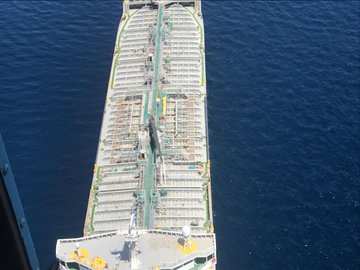
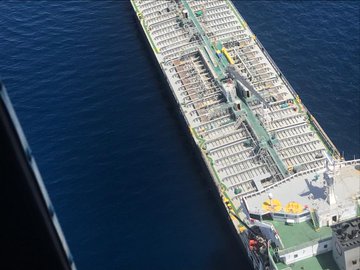
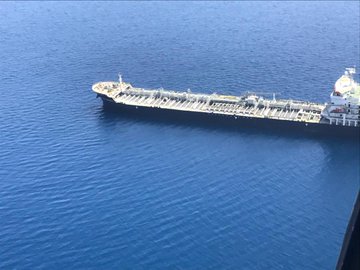
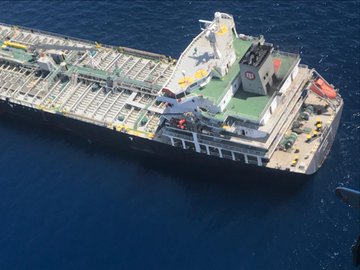
On the morning of Thursday, June 13, two oil tankers were allegedly attacked in the Gulf of Oman, just off the coast of Iran. The US government immediately blamed Iran for the incident, without providing any evidence.
The vessels happened to be en route to Japan at precisely the same time that Japanese Prime Minister Shinzo Abe was in Tehran. The first Japanese leader to visit Iran since its revolution 40 years ago, Abe was holding a historic meeting with Ayatollah Ali Khamenei when the incident took place.
This coincidence did not escape Iran’s foreign minister, Javad Zarif, who said, “Suspicious doesn’t begin to describe what likely transpired this morning,” and reiterated a call for regional dialogue and cooperation.
Prominent Iran expert Trita Parsi noted that the timing of the suspicious attacks suggests that there is fear in Washington that efforts at Iran-Japan diplomacy might succeed in softening the de facto US-led economic blockade of Tehran.
Since Trump illegally sabotaged the international Iran nuclear deal (known officially as the JCPOA) in May 2018, the US government has striven to isolate Iran and suffocate its economy by preventing the country from exporting oil, importing food and medicine, and trading with foreign nations.
The Trump administration has even threatened close ally Japan, the world’s fourth-largest consumer of oil, with secondary sanctions, forcing the country to halt Iranian oil imports.
Concerns that the Trump administration has been fretting about a potential Iranian diplomatic breakthrough with Japan were validated by the US response.
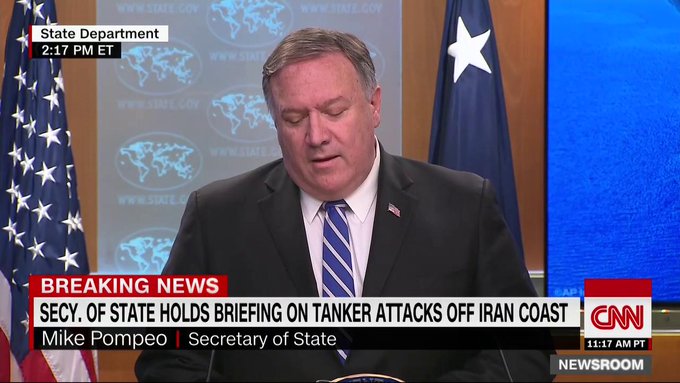
Secretary of State and former CIA director Mike Pompeoimmediately pointed the finger at Tehran, calling the alleged attacks “a threat to international peace and security, a blatant assault on the freedom of navigation, and an unacceptable escalation of tension by Iran.”
Saudi Arabia and its regime media went into overdrive amplifying the Trump administration’s accusations against Iran.
Many Western corporate media outlets, too, lazily echoed the US government’s unsubstantiated claims. The New York Times, for example, published a breaking piece headlined, “Pompeo Says Intelligence Points to Iran in Tanker Attack in Gulf of Oman.”
The Times did concede, however, that “Pompeo did not present any evidence to back up the assessment of Iran’s involvement.”
And several mainstream media outlets actually diverged from their traditional pro-war stances and expressed cautious skepticism about the secretary of state’s unproven accusations.
Surprisingly, CNN, NPR, and The Independent stressed that Pompeo provided no evidence for his claims.
Iran’s Press TV outlet published video of what it said were crew members of one of the tankers who had been saved by an Iranian rescue team.
The Iranian government-backed channel accused the Trump administration of exploiting incidents like this “to wage war.”
Press TV also tweeted photos of one of the tankers hours after the alleged attack, noting that the vessel was unharmed and the fire had been put out.
These facts nevertheless did not stop notorious war hawks and neoconservatives from beating the drum of war.
Fanatical anti-Muslim activist Brigitte Gabriel bizarrely described the incident as “an attack on the United States.”
Neoconservative commentator Michael Weiss, who has spent the past eight years pushing for regime change in Syria, implied the alleged attacks were proof that Iran is a “threat.”
Neoconservative Senator Marco Rubio, who has spent the past five months heavily lobbying for US military intervention in Venezuela, quickly turned his attention to Iran. He pointed the finger at the IRGC’s Quds Force, without citing any evidence.
Rubio also berated skeptics, insisting it would not “make sense” for any other actor to carry out the alleged attacks.
The US government has previously blamed Iran for alleged attacks on oil tankers, again without providing any evidence. In May, two Saudi vessels were attacked, and the Trump administration immediately accused Tehran — but in reality this attack was mostly likely carried out by Yemen’s Houthi movement, which governs northern Yemen and has been fighting a defensive war against US-backed Saudi and Emirati forces since March 2015.
Many observers noted how the Trump administration’s unsubstantiated accusations against Iran are eerily reminiscent of the 1964 Gulf of Tonkin incident, in which the US government and a compliant corporate press sold lies to the public to justify a war of aggression on Vietnam.
It is certainly possible that Washington could exploit these supposed attacks to justify a war on Iran. But it is just as likely that the Trump administration could hope to use this incident to try to pressure Japan to halt its historic negotiations with Tehran.
Donald Trump unilaterally withdrew from the JCPOA in May 2018, blatantly violating a UN Security Council resolution and sabotaging an international deal that had been negotiated by China, Russia, Britain, France, Germany, and the European Union.
The far-right president has also surrounded himself with anti-Iran hawks, including Pompeo and neoconservative national security adviser John Bolton, who has spent years lobbying for war on Iran.
Trump has made it clear that his goal is to pressure Iran to renegotiate a nuclear deal with the United States, and is using a “maximum pressure” campaign to force Tehran to submit to Washington’s diktat.
On June 13, Ayatollah Khamenei reiterated that he rejected Trump’s offer to discuss a new agreement, stating, “I do not consider Trump as a person worth exchanging any message with.”
In the meantime, longtime US proxy Saudi Arabia stands to benefit from the escalating aggression. Oil prices immediately spiked in response to the alleged attacks on the tankers, enriching oil producers such as the viciously anti-Iran Saudi monarchy.