Showing posts with label Venezuela. Show all posts

Tuesday, November 26, 2019

Media Wonder: Why Can’t Venezuela Be More Like Bolivia?

JOSHUA CHODaily Beast photo illustration of Latin American leftist leaders

Reuters: Maduro's military stands in the way of a Bolivia repeat in Venezuela
For Reuters (11/11/19), the failure of “Maduro’s” military to launch a coup “stands in the way” of regime change in Venezuela.
Reuters’ report, “Maduro’s Military Stands in the Way of a Bolivia Repeat in Venezuela” (11/11/19), noted that “Venezuelan opposition leaders looking to oust their country’s socialist government” can “take some hope” from the “resignation of its leftist ally in Bolivia, Evo Morales.” There’s just one problem:
But one key factor makes the Bolivia playbook a difficult one to carry out against Venezuelan President Nicolas Maduro: Venezuela’s armed forces have consistently refused to take the side of protesters as Bolivia’s military did on Sunday.
Reuters’ Brian Ellsworth and Vivian Sequera complained that “Venezuela’s barracks have stood by the ruling Socialist Party,” despite a “crippling economic meltdown,” “waves of major protests” and “broad condemnation of Maduro’s 2018 re-election that was widely described as fraudulent.” (Despite such descriptions, which are indeed widespread, there is no reason to question whether President Nicolás Maduro won the May 2018 election, which was largely boycotted by the opposition.)
Reuters lamented that the unpopular US-backed Juan Guaidó’s unconstitutional efforts to “court the armed forces have not been enough to sway their allegiance to Maduro,” despite his being “recognized by more than 50 countries as Venezuela’s legitimate president.” (Note that this means that approximately 75% of the world’s countries don’t recognize Guaido, who lacks UN recognition.) The implication is that the Venezuelan military should stage a coup, just as the Bolivian military did when the armed forces commander William Kaliman
called on Morales to step aside, giving momentum to street protestors alleging fraud at an October presidential election that Morales was judged to have narrowly won.
Morales’ run for the presidency was approved by the Bolivian Supreme Court (whose judges are elected, rather than appointed as in the US), and, as was predicted in pre-election polling, Morales “narrowly won” the October 2019 election by more than 10 percentage points, which is why he did not face a runoff election. The Center for Economic and Policy Research found that there’s no evidence discrediting the legitimacy of Morales’ reelection. Only one US president in the past 50 years—Ronald Reagan in 1984—has won the popular vote by more than 10 percentage points.
Reuters: The Maduro mystery: Why the armed forces still stand by Venezuela’s beleaguered president
Reuters (7/28/19) ponders the “mystery” of why Venezuela’s military hasn’t overthrown the elected government.
But Reuters has a history of lamenting that Venezuela’s military is more loyal to its democratically elected government than the US empire. In another report pondering why the Venezuelan military remains loyal to Maduro and the Socialist Party, Reuters (7/28/19) complained that the Socialists took steps to prevent another coup like the one that temporarily removed Hugo Chávez from power before he was restored by popular support. The piece by Brian Ellsworth and Mayela Armas also criticized the Venezuelan military for assisting in public works programs like refurbishing schools, filling potholes, planting vegetables and clearing garbage; apparently a proper military spends its time preparing to invade other countries.
Reuters (8/22/19) has also presented Venezuelan efforts to prevent a military coup, such as removing disloyal officers, as sinister Cuban-inspired “repression” that has “cowed” the military. “Opposition pleas for a military rebellion have gone unheeded,” as reporter Angus Berwick lamented.
The Daily Beast’s report  “Evo Morales Is Out. Is Nicolás Maduro Next?” (11/13/19) likewise bemoaned the lack of a “domino effect” that would bring a Bolivian-style coup to Venezuela. The Beast’s Eduard Freisler acknowledged:
In Bolivia, it was largely the Bolivian army that forced Evo Morales out. This was the strategy that Venezuelan opposition leader Juan Guaidó tried in order to force Maduro out. But the young leader, who in late January proclaimed himself the interim president here, has never managed to sway the powerful and affluent generals to his side and away from Maduro.
The Daily Beast described Morales as “one of several presidents in Latin America who have claimed to represent the masses in their countries…sometimes helping to raise them from poverty, sometimes plunging them back into it.” The role of US sanctions in punishing the economies of countries that stray from Washington’s agenda was, of course, never mentioned in either of these reports (FAIR.org5/6/19)—as the Beast complained that “concerted economic and political pressure from the United States couldn’t shake” elected left-wing governments in Venezuela, Bolivia and Nicaragua. Neither do these reports mention CEPR’s relevant findings that recognition of Guaidó as Venezuela’s “legitimate president” effectively functions as a devastating oil embargo on the country.
Daily Beast: Venezuela: When a Coup Is Not a Coup, What the Hell Do You Do?
After a “classic military coup” failed to materialize in Venezuela, the Daily Beast (5/2/19)wondered, “How many more disappointments can the Venezuelan people stand?”
Like Reuters, the Daily Beast also has a history of mourning the improbability of the Venezuelan people and military’s supporting a US-backed coup. An earlier piece by Christopher Dickey (Daily Beast5/2/19) mourned the failure of Guaidó to convince the military to overthrow Venezuela’s government, claiming, that “a classic military coup, a quick and decisive golpe de Estado, would have been welcomed by many, and probably most, after years of suffering under Maduro.” Dickey also asserted that “no doubt some Venezuelans would welcome US military intervention,” though he thought that was unlikely. “How many more disappointments can the Venezuelan people stand?” he concluded.
It’s not accidental that both outlets downplayed the fact that a US-supported coup had occurred in Bolivia by acting as if only defiant left-wing governments in Latin America deem what happened in Bolivia to be a coup. Reuters (11/11/19) cited “leftist governments saying [Morales] was victim of a coup,” while the Beast (11/13/19) reported that “Chavista party members…termed Morales’ demise a coup,” even though both reports openly acknowledge, and indeed celebrate, the Bolivian military’s role in forcing Morales out (FAIR.org11/11/19). Section 508 of the Foreign Assistance Act requires that the US must cut off aid to any country “whose duly elected head of government is deposed by military coup or decree.”
FAIR has documented how corporate media consistently criticize the success of left-wing political agendas pursued abroad in countries like Venezuela and Bolivia—in defiance of US imperialism—because they are afraid of the threat of a good example (FAIR.org2/8/19). That might be why corporate media are wondering why Venezuela can’t be more like Bolivia in calling for a repeat coup there—which they won’t call a coup, of course.

Wednesday, November 20, 2019

Bolivia – A Color Revolution – or a New Surge for Latin American Independence?

By Peter Koenig
"Information Clearing House" - Like Túpac Katari, indigenous Aymara leader more than 200 years ago, confronting the Spaniards, Evo Morales was betrayed and ‘dismembered’ by his own people, recruited and paid by the agents of the most destructive, nefarious and murderous dark elite that governs and has governed for over two hundred years our planet, the United States of America. With their worthless fiat-Ponzi-pyramid money, the made-out-of-thin-air US dollar, they create poverty throughout the globe, then buy off the weak and poor to plot against the very leaders that have worked for years to improve their social conditions.
It’s become a classic. It’s being called a Color Revolution, and it’s been taking place on all Continents. The list of victim-countries includes, but is not exhaustive – Colombia, Honduras, Argentina, Paraguay, Ecuador, Chile, Brazil, in some ways also Uruguay (the current left-leaning government is powerless and has to remain so, otherwise it will be “changed”… that’s the name of the game) – and now also Bolivia. – Then there are Georgia, Ukraine, Iraq, South Sudan, Libya, Afghanistan, Indonesia; and the lawless rulers of the universe are attempting to “regime change” North Korea, Syria, Iran, Venezuela, Cuba, Nicaragua – and on a larger scale China and Russia (I just returned from China – where the Government and people are fully aware what Washington’s intentions are behind every move they make).
In Africa, Africom, the US military Africa Command, buys off almost every corrupt African leader put in place by Africa’s former and new European colonialists, so they may continue sucking the riches out of Africa. These African leaders backed by Africom keep the African population in check, so they will not stand up. In case they won’t quite manage, “they” created the fear-squad called, Boko Haram, an off-spring of ISIS / IS – the Islamic State, created by the same creator, the CIA, Pentagon and NATO. The latter represents the European US-puppet allies; they keep raping Africa and reaping the benefits of her plentiful natural resources, and foremost, make sure that Africans stay subdued and quiet. Those who don’t may easily be “disappeared”. It’s Arica. But, have “they” noticed, Africa is moving, is gradually waking up?
And yes, not to forget, the “developed” and industrialized Europe, where sophisticated “regime change” over the years has subdued a largely well-off population, numbed and made apathetic by endless pro-capitalist propaganda and consumerism – Germany, UK, Netherlands, Denmark, Sweden, France, Italy, Spain – look what they have done to Greece! – Greece has become a red-flag warning for every EU nation that may dare to step out of US-dictated lockstep, of what might happen to them.
The list goes on with Eastern European EU countries, mostly former Soviet republics or Soviet satellites. They are EU members thanks to the UK, Washington’s mole in the EU, or as I like to call it – the European non-union – no Constitution, no solidarity, no common vision. They are all fiercely anti-Russia and most are also anti-Europe, but are made to – and love to eat and drink from the bowl of the EU-handouts, compliments of EU taxpayers. That’s about the state of the affairs we are in. There is, of course, much more coercion going on, but you get the picture. US interference is endless, merciless, reckless, without scruples and deadly.
Bolivia is just the latest victim. The process of Color Revolution is always more or less the same – a long preparation period. The coup d’état against Evo has been under preparation for years. It began already before Evo was first elected, when Washington realized that after the Bolivian people’s purging of two of Washington’s imposed “stooges” Presidents, in 2003 and 2005, Bolivia needed a respite. But the empire never gives up. That is a golden rule written in their unofficial Constitution, the PNAC (Plan for a New American Century), the writing of which has begun just after WWII, is regularly adjusted and updated, even name-changed (from Pax Americana to PNAC), but is still very much alive and ticking.
The coup against Evo Morales’ Government is not only because Washington does not tolerate any socialist government, and least in its “backyard”, but also – and maybe foremost – because of Bolivia’s riches in natural resources, gas, oil, a long list of minerals and metals – and lithium, the use of which is expected to triple over the next ten years, as it is used in electric cars and batteries. And as we know from the rapidly growing Green Movement, the future is out of hydrocarbon-driven into electric cars. No matter how the electricity is produced and how much environmental damage is done in producing the new flag, but still individual ‘mobility’. As neoliberal economists would say, “that’s just an externality”.

What he has achieved in his almost 14 years of Presidency is just remarkable – more than significant reductions of poverty, unemployment, analphabetism, increase in health indicators, in national reserves, in minimum wages, pension benefits, affordable housing – in general wellbeing, or as Evo calls it, “living well”.The first of the two US-imposed Presidents at the turn of the century, was Gonzalo Sánchez de Lozada, also called “Goni”, who privatized Bolivia’s rich hydrocarbon resources to foreign, mostly US, petro-corporations for a pittance. He was “elected” in 2002 against the indigenous, Aymara candidate, Evo Morales. When Goni was disposed of in a bloody people’s coup (about 60 dead) in 2003, he was replaced by his Vice-President, Carlos Mesa, the very key opponent of Evo’s, in the 20 October 2019 elections – who, following the same line of Goni’s privatization policies, was also overthrown by the Bolivian people in 2005. This led to a new election late in 2005 – and that’s when Evo finally won by a landslide and started his Presidency in January 2006.
That’s when Washington decided to step back for a while – and regroup, to hit again in an appropriate moment. This moment was the election three weeks ago. Preparation for the coup intensified a few months before, when Bolivia’s Vice-President, Álvaro Marcelo García Linera, told the media that every day there were reports that US Embassy agents were interfering in the country’s internal and local affairs.
The manipulated election in 2002 is recorded in an outstanding film, “Our Brand is Crisis”, a 2005 American documentary by Rachel Boynton on American political campaign marketing tactics in Bolivia by Greenberg Carville Shrum (GCS) – James Carville was previously President Clinton’s personal assistant – the documentary.
Then, like today, the coup was orchestrated by the CIA via the “legitimate” body of the Organization of American States (OAS). The US Ambassador to the OAS openly boasts paying 60% of OAS’ budget – “so, better don’t mess with us”.
Less than a week before the October 20 election, Carlos Mesa was trailing Evo Morales with 22 against 38 points. Under normal circumstances it’s is virtually impossible that in a few days a candidate picks up that much of a difference. The election result was Mesa 37% and Morales 47% which would give Morales a first-round win, as the winning candidate needs a margin of ten points. However, already before the final tally was in, the OAS, the US and the usual puppets, the European Union, complained about election ‘irregularities’ – when the only irregularities were manufactured in the first place, namely the drastic increase in Mesa’s percentage from 22 to 37 points.
Evo declared himself the winner on 20 October, followed immediately by violent anti-Evo riots throughout the country, but mostly in the oil-rich Santa Cruz area – home of Bolivia’s oligarchs and elite. The protests lasted for about three weeks during which at least three people died, when last Sunday, November 10, Evo was “suggested” by the military brass, supported by the OAS (US) to step down with his entire entourage, or else. He resigned, because he wanted the riots to stop and his countrymen to continue living in peace. But violence hasn’t stopped, to the contrary, the opposition has become fiercer in their racist attacks on indigenous people, targeting them with live ammunition. The dead toll as of today has reached at least 20.
President Morales asked for, and was granted political asylum in Mexico. The Vice-President, Alvaro Linera, and most of Morales’ cabinet members followed him to Mexico. The President of the Senate, Ms. Adriana Salvatierra, also of the MAS party, according to the Constitution, would have been the legitimate interim-President. But she was also forced to resign, and so were Victor Borda, the leader of the Chamber, and Rubén Medinaceli, First Vice President of the Senate. They all had to resign. In total some 20 high-ranking officials of Evo’s Government took refuge in the Mexican Embassy in La Paz, before they flew to Mexico.
Evo has since said he wants to return to Bolivia, to be there for the millions of his supporters. Yes, still a sizable majority of Bolivians support Evo and his Movement towards Socialism (MAS). There is a mass of peaceful unarmed Evo supporting demonstrators, growing every day. They are being brutally beaten by US trained and “bought” police and military forces. Indeed, the commander of Bolivia’s armed forces, Williams Kaliman, served in earlier days as a military attaché at the Bolivian Embassy in Washington. During that time he was secretly ‘recruited’ to be trained by what then was called the School of the Americas, and which is now the Western Hemisphere Institute for Security Cooperation, located at Fort Benning near Columbus, Georgia. Apparently Kaliman was not the only one of high-ranking Bolivian military and police officers having been subjected to this torturer and coup plotter training.
On Tuesday, 12 November, an extraordinary session of both chambers (Deputies and Senate) of the Plurinational Legislative Assembly (Parliament) was convened, to officially accept President Morales’ resignation, but the representatives of the Movement to Socialism (MAS), which are the majority in both chambers, did not attend because they were told by the opposition that their safety and that of their families could not be guaranteed. As a consequence, Parliament had suspended its session due to the lack of quorum.
Nevertheless, Jeanine Añez, an opposition senator, declared herself interim-President, and even though her nomination is illegal and unconstitutional, the Constitutional Court confirmed the legality of the transfer of power. But who could blame the judges of the Constitutional Court? They want to be on the right side of the fence, now that the Americans are soon expected to rule the country. Ms. Añez is from the right-wing Social Democrat Movement (not to confuse with MAS = movement towards socialism), and she is known to be fiercely anti-Morales. If her coronation looks and sounds like the one of Juan Guaidó in Venezuela, it is because her self-nomination is like Juan Guido’s, a US-supported farce. Washington has immediately recognized Ms. Jeanine Añez as (interim) President of Bolivia. She, as well as Carlos Mesa, have been groomed to become the next Bolivian leaders, when new elections are held – probably sometime in January 2020. Especially, Carlos Mesa is well known as a US-supporter from his earlier failed stint at the Bolivian Presidency (2003 – 2005).
Earlier, Jeanine Añez, tweeted, “I dream of a Bolivia free of satanic indigenous rites, the city is not for the Indians who should stay in the highlands or the Chaco”. That says it all, where Bolivia is headed, unless – unless another people’s revolution will stop this nefarious course. Ms. Añez apparently has since removed the tweet.
One of the internal drivers of the ‘golpe’ is Luis Fernando Camacho, a far-right multi-millionaire, from the Santa Cruz region, where the US have supported and encouraged separatism. Camacho, a religious bible fanatic, received support from Colombia, Brazil and the Venezuelan opposition – and, of course, he is the US henchman to lead the ‘coup’ internally.
As Max Blumenthal from “The Grayzone” reports,
“When Luis Fernando Camacho stormed into Bolivia’s abandoned presidential palace in the hours after President Evo Morales's sudden November 10 resignation, he revealed to the world a side of the country that stood at stark odds with the plurinational spirit its deposed socialist and Indigenous leader had put forward. – With a Bible in one hand and a national flag in the other, Camacho bowed his head in prayer above the presidential seal, fulfilling his vow to purge his country’s Native heritage from government and “return God to the burned palace.” Camacho added “Pachamama will never return to the palace,” referring to the Andean Mother Earth spirit. “Bolivia belongs to Christ.”
Still, there is hope. Bolivians are known to be sturdy and staunch defenders of their rights. They have proven that best in the overthrow of two foreign-imposed successive Presidents in 2003 and 2005, “Goni” and Carlos Mesa respectively. They brought their Aymaran Evo Morales to power in 2006, by an internationally observed, fully democratic election.
There are other signs in Latin America that things are no longer the way they used to be for decades. Latin Americans are sick and tired of their status of US backyard citizens. There is movement in Brazil, where Lula was just released from Prison, against the will of Brazil’s fascist also foreign, i.e. US-imposed, Jair Bolsonaro. Granted, Lula’s release from prison is temporary, but with the massive people’s support he musters, it will be difficult for Bolsonaro to put him back in prison – and preserve his Presidency.
Social upheavals in Chile for justice and equality, against a racist Pinochet era Constitution, violently oppressed by President Piñera’s police and military forces, have lasted for weeks and will not stop before a new Constitution is drafted, in which the protesters demands are largely integrated. That too is a sign for an awakening of the people. And the enduring resistance against North America’s aggression by Venezuela, Cuba and Nicaragua, are all positive vibes for Bolivia – not to be trampled over.


Peter Koenig is an economist and geopolitical analyst. He is also a water resources and environmental specialist. He worked for over 30 years with the World Bank and the World Health Organization around the world in the fields of environment and water. He lectures at universities in the US, Europe and South America. He writes regularly for Global Research; ICH; RT; Sputnik; PressTV; The 21st Century; Greanville Post; Defend Democracy Press, TeleSUR; The Saker Blog, the New Eastern Outlook (NEO); and other internet sites. He is the author of Implosion – An Economic Thriller about War, Environmental Destruction and Corporate Greed – fiction based on facts and on 30 years of World Bank experience around the globe. He is also a co-author of The World Order and Revolution! – Essays from the Resistance

Sunday, November 17, 2019

West attempts to repeat the Bolivian coup in Venezuela

By Mohammad Ghaderi

After the coup by the Bolivian military against the president, Western media outlets are trying to incite the Venezuelan army against Maduro by praising this event and comparing it to the developments in Venezuela.
The resignation of Evo Morales from Bolivia’s presidency following the military threat, is considered a victory for Western countries, especially those that are trying to maintain Latin America as their colony.
Since Western countries cannot withstand figures like Hugo Chaves, Morales, Luiz Inácio Lula da Silva and the Castro brothers they stir up security problems in countries with leftist leaders to topple their governments.
Therefore, now that the anti-colonial president of Bolivia has stepped down due to military threats and the recent protests in the country, the West is praising these events to befool other countries, especially Venezuela, and show them the way.
In a report on Tuesday, Reuters compared the developments in Bolivia and Venezuela and wrote, “one key factor makes the Bolivia playbook a difficult one to carry out against Venezuelan President Nicolas Maduro: Venezuela’s armed forces have consistently refused to take the side of protesters as Bolivia’s military did on Sunday.”
Reuters also tried, with a subtle tune, to persuade the Venezuelan army to follow the Bolivian military.
In addition to Western media, officials in these countries have also praised the Bolivian coup. For example, U.S. President Donald Trump in response to Bolivia’s developments claimed, "These events send a strong signal to the illegitimate regimes in Venezuela and Nicaragua that democracy and the will of the people will always prevail." He also issued a statement in which he hailed Morales' departure as moving towards a "completely democratic, prosperous, and free Western Hemisphere."
 The U.S. is architect of Bolivian developments
In addition to Trump’s remarks, Washington urged Bolivian legislature to hold a meeting to formally accept Morales’ resignation and began the civilian process of power transition to fill the current political vacuum.
A senior U.S. State Department official also said Washington does not consider Morales' departure to be a coup, as Morales himself and the Mexican government have alleged. It was instead the result of protests that showed the Bolivian people "have had enough of a government ignoring the will of its voters".
The European Union
In response to the Bolivian developments, the EU called for all parties involved in the current political tensions to exercise “restraint” and “responsibility”.
"I would like to express clearly our wish that all parties in the country exercise restraint and responsibility and lead the country peacefully and quietly to new, credible elections that let the people of Bolivia express their democratic will," EU foreign policy chief Federica Mogherini said on Monday.
“If we are asked to send one and if the conditions are right, definitely we will do our best to send an Electoral Observation Mission,” she said at the press conference following the Foreign Affairs Council.
 Venezuela is the next target
The U.S. has been seeking for years to overthrow the Venezuelan government and to put into power the political currents which are in line with Washington. These efforts by the U.S. have entered a new phase as Venezuela’s opposition leader Juan Guaido entered the scene. By calling himself president, Guaido has started to fulfill U.S. goals.
After Guaido’s action, 50 countries, mostly Western, backed him, but their backing did not succeed as majority of the people and the Venezuelan army continued to support Maduro.
Of course, a few months ago, when John Bolton was still in the White House, a semi-coup was conducted against Maduro. But since the coup did not succeed it led to disagreements between Trump and Bolton.
Now that the coup was carried out in Bolivia, the West seems to have found a new motive and intend to bring this wave to Venezuela.
Whether or not these efforts will work against Venezuela needs to be discussed, but what is obvious is that as long as leftist and anti-colonial leaders are in power in Latin American countries, events such as protests, unrest and coup (like the ones in Bolivia and Venezuela) and financial allegations (like the one against Lula de Silva in Brazil) are tools that can be used to bring pro-Western figures to power.

Consequences of the Trump coup in Bolivia

By Hanif Ghaffari

The recent US government coup in Bolivia will have severe consequences for Washington and its allies. This coup will not only weaken socialism and anti-imperialism in Central America and South America, but will also strengthen the opposition of the United States in Latin America.
The presence of White House opponents in the governments of Venezuela, Cuba, and Nicaragua has led White House officials to officially name them the "Triangle of Evil" and to refrain from any direct confrontation with these governments and their people. Trump's continued effort to overthrow Maduro's government in Caracas is an indication of this fact. However, the recent victory of Bolivia's Evo Morales and the victory of Fernandez, an anti-American left-wing candidate in Argentina's general election, shocked the White House. . These were indicative of Trump's total failure to deal with anti-imperialist currents in Latin America. The US president, who has been contemplating the collapse of the Cuban, Venezuelan and Nicaraguan governments since his inauguration, has not only achieved this goal but has witnessed the spread of American opposition in other countries. He did a stupid act and designed and executed a coup in Bolivia.
The President of the United States knows very well how expensive his recent move to Bolivia will be for Washington, yet Trump has shown that he always makes the worst decisions at the White House!
Anti-imperialist currents are rooted in Latin America. Leaders such as Castro, Che Guevara, Ortega, Hugo Chavez, and Morales have maintained anti-imperialism through their actions over the years and decades and past decades.
Undoubtedly, American fascism will not eventually open up to the citizens of the countries in the region. In the very near future, institutionalized socialism in Bolivia will overturn American fascism and end the life of this deterrent, dangerous Western thinking. It must be remembered that today the confrontation with US domination is not limited to countries such as Venezuela, Cuba and Nicaragua and anti-American currents are intensely active in countries such as Chile, Ecuador, Peru, Argentina, and Bolivia. Trump's recent move in Bolivia will further awaken these currents to Washington and its allies.

Thursday, October 24, 2019

Time for the US to Taste its Own Bitter Medicine

By: Kayhan Int’l  

A wave of public protests is rocking different parts of the world these days. The hotspots seem to be Hong Kong (China), Santiago (Chile), Lima (Peru), Sucre (Bolivia), Caracas (Venezuela) and Beirut (Lebanon).

It is obvious that most of these demonstrations, especially in Hong Kong, Venezuela, and now Bolivia, cannot be called mass protests, and are being fueled by the U.S., whose agents are inciting a section of unsuspecting people to indulge in violence and vandalism in a bid to disturb the peace of countries which the Americans do no like.

Certainly, it is the right of citizens to demand their rights, albeit in a peaceful way. Usually, when the government promises to look into the problems and agrees to grant concessions the people disperse, as happened earlier this month in Iraq, when the joint American-Saudi-Israeli bid to mar the atmosphere of the country in order to disrupt the grand annual Arba’een multimillion and multinational gathering in Karbala, miserably failed.

On Monday, Lebanese Prime Minister Sa’d al-Hariri announced a package of reforms, and promised a 50-percent reduction in the salaries of current and former officials and $3.3 billion in contributions from banks to achieve a near zero deficit for the 2020 budget.

Even though these promises seem to be reasonable, protestors in Beirut seem to be slowly turning violent and chanting ath-Thawra, ath-Thawra (revolution, revolution) – oblivious of the fact that this is too great a demand that is not achievable and will only lead to chaos, since "Thawra” requires every section of the population to rise in unison against injustice under a popular leader with a clear view of the system that would replace the existing one, as happened in Iran in 1979.

Here the questions arise: Why are these protests taking place? Is there any common links or connections or better to say any common hidden hands behind these protests?

Western media claims that people are taking to the streets due to the corruption present in the administration of the said countries. In the case of Venezuela and Bolivia no one can deny the fact that Washington is involved, and has put all its efforts to bring its poodles to power.

But what about the protests in other countries?

The answers are clear. The reason the Americans (in case of Latin America), Britain (in case of Hong Kong) and the Saudis (Iraq and now Lebanon being the latest cases) are fanning the flames of violence through the social media networks in a bid to overthrow of the democratically-elected governments and to replace by some demagogue who would slavishly serve their vested interests.

The plotters should know that their devilish plans against humanity will badly backfire, and in many cases the plotters will become victims of their own conspiracies.

This is evident in the events slowly unfolding in the US, where social groups and other organizations are calling for civil disobedience in a country which likes to call itself protector of democracy, but which brutally tramples human rights, as is clear by its mistreatment of migrants, and discrimination, to the extent of killing, of Afro-American citizens.

Now with the misrule the quixotic US president has unleashed and is trying to avoid impeachment through illegal means at his disposal, who knows Washington, Chicago, California, or New York mighty be hit by massive protests against the administration.

Donald Trump’s presidency began with the biggest protest in US history, and its first two years were marked by a series of high-profile demonstrations.

The impeachment inquiry has reached the stage when uncovering of further facts which the realtor has tried to hide since becoming the Chief Executive, will finally expose him as a criminal unworthy to continue his tenure in the White House.

A sitting president who threatens civil war to destabilize his own country for his personal gains, when he fully knows civil war is not possible and any public protests in his favour or against him, will destabilize the American society, is indeed a national enemy.

It is worth recalling that on the day after Trump’s inauguration, some four million Americans took to the streets in an organized manner against his call for scrapping of Obamacare, and this led to debates. In the end, the Republicans could not resist and Obamacare survived.

So, maybe it is time for the US citizens, in order to save what are called American values as per the vision of Founding Fathers, to take the street en masse to remove from office a president who could well be called an imposter.

Tuesday, September 24, 2019

Iranian viewpoint: US’ strategy to play major role in global energy market

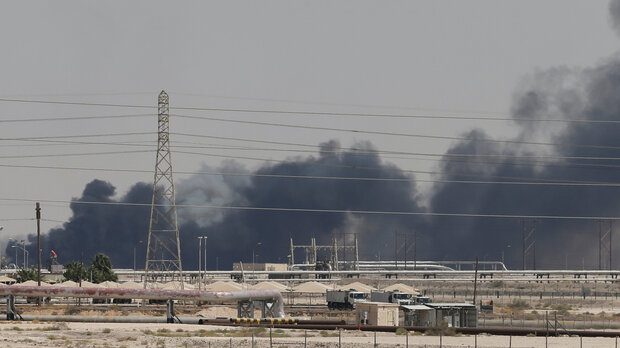
TEHRAN, (MNA) – Enjoying the world’s major shale oil reserves and thanks to its technological power the United States has become independent from the Persian Gulf and the Middle East oil and is positioning itself to play a major role in world energy market.
Former US President Barak Obama’s strategy of “pivot to east” which was based on the above mentioned fact is now confirmed by Donald Trump after recent drone attack on Saudi Aramco oil installations.
Despite the US independence of the Persian Gulf energy, the country will not close its eyes on controlling the energy routes in the region to keep pressure on rivals like China.
A report by Rystad Energy shows that production of shale oil in the US has changed the country to enjoy the biggest oil reserves in the world. (264 billion barrels). 50 percent of the US oil reserve is shale oil. The report says the US shale oil production is going to exceed 14.5 million barrel a day.
In 2012 the US Department of Energy announced that production of shale oil would have been economical if the price of the oil had been above 54 dollar for a barrel, but World Energy agency findings showed that the price for each barrel of oil should be over 60$ if the shale oil production is going to be economically justified.
Development of shale oil production has paved the way for Washington to use it as a political tool against other major oil producers in the world to materialize its geopolitical goals. Sanctioning of major oil producing countries and creating tensions in oil rich regions like Persian Gulf by the US in recent years all can be interpreted in line with the US efforts to position itself as a major player in world energy market.
Reuters in a September 2019 report revealed that overall exports of crude and refined products by state-run oil company Petroleos de Venezuela (PDVSA) and its joint ventures declined to some 770,000 barrels per day (bpd) from 992,565 bpd in July and 1.13 million bpd in June, according to revised data. It is noteworthy that the countries oil production was 2 million and 373 thousand barrels a day in 2016.
Iran’s oil production has also decreased some 1.5 to 2 million barrels a day during the last 10 years due to the US sanctions.
Washington is also trying to reduce the Russia’s share of global oil market by slapping sanctions against the country and threatening its European consumers.
The US’ green light to Saudi Arabia to attack Yemen which led the country to a quagmire can also be interpreted in line with the US efforts to grab its ally’s share of oil market to materialize its geopolitical goals. A couple of days ago Yemeni’s retaliatory drone attack on Saudi Aramco oil plant forced Saudi Arabia to cut half of its oil production and immediately the US announced Washington is ready to replace Saudi oil in the world market. In the long term this can result in grabbing of Saudi share of market by the US.
By sanctioning oil producing countries and creating tensions in oil rich regions the US is pursuing its geopolitical goals:
First, by disrupting existing major exporters including Saudi Arabia, Venezuela, Iran and Russia and raising prices, the US is able to make its own exports more competitive. Second, grabbing share of other producers by tools of sanction and disturbing their oil export. Third, containing and keeping pressure on rivals like China, EU and Japan by creating tensions in Persian Gulf which their economies are heavily dependent on the oil coming from the region. Fourth, creating a lucrative market for the US military industry and weapons by adding to tensions in the Persian Gulf region. Saudi Arabia has been the world biggest weapon importer in 2018. Fifth, keeping pressure on Persian Gulf nondemocratic kingdoms who are reluctant to join the US proposed naval security mission in Strait of Hormuz.

Friday, September 20, 2019

Maduro: Trump Has Obsessive Hatred Against Latin Americans

Venezuela’s President Nicolas Maduro (L) and Ecuador’s former President Rafael Correa (R) in Caracas, Venezuela, Sep. 19, 2019.

Venezuela’s President Nicolas Maduro (L) and Ecuador’s former President Rafael Correa (R) in Caracas, Venezuela, Sep. 19, 2019. 

"Despite all imperial aggressions, we are standing still and ready to resume the path of growth", President Nicolas Maduro to Rafeal Correa in a recent interview on RT.

In the new season of his RT TV show, Ecuador’s former President Rafael Correaon Thursday interviewed Venezuela’s President Nicolas Maduro at the Miraflores Palace in Caracas, where both critically addressed the complex realities the Bolivarian Revolution is currently facing.

In order to highlight the effects of the U.S.-led economic aggression, President Maduro recalled that from the beginning of President Hugo Chavez's administration in 1999 up to 2015, “we had annual revenues of US$50 billion from oil sales. Now we only receive US$4 billion.”During their one-hour conversation, those leaders of the contemporary Latin American politics talked about the economic and social situation of Venezuela, which, as Correa said, is "victim of a disinformation campaign" whereby political opposition tries to get benefit from problems that have been "clearly caused by the so-called 'sanctions' which are actually illegal aggressions against sovereign countries."
Maduro also mentioned that the death of Commander Hugo Chavez in March 2013 meant a "very big blow" for his country because "internal enemies, but especially the U.S. imperial power, began to design tactics to replace Chavismo."
During the presidency of Donald Trump, over the last two years, "the war with Washington has had a devastating effect on our social stability and people's lives," the United Socialist Party of Venezuela (PSUV) leader said.
"Venezuela cannot either open or close international bank accounts. It cannot pay for any type of product. In addition, we are now being threatened with a complete naval blockade."
In his talk with Correa, the Bolivarian president once again denounced that the U.S. government actions imply many financial costs to the Venezuelans. "They have confiscated and robbed us of almost US$30 billion," Maduro said and explained that Venezuela is living "an economy of resistance."
In order to tackle this situation, his administration has established priority policies, one of which is food and medicine production. This goal is "at the center" of those priorities so as to be able to supply the population.
"Venezuela has no sanctions, it has aggressions," Maduro said and added "Trump has kind of AN obsessive hatred against Latin American peoples, refugees, immigrants; he has a special hatred against the Venezuelan people and our history."
"I compare [what happens now] with the Hitler era, with that same vision that Hitler imposed against the Jews before the war," he stressed.
Based on the challenges it faces at the current ​​​​​​​historical moment, the Venezuelan government is laying the long-term foundations to overcome the country's traditional dependence on oil revenues.
"I have defined 16 'development drivers' on the basis of our country's economic, industrial and technological realities," Maduro said and recalled that transforming a natural resources-based growth model, which has been in place for the last 100 years, is a difficult task.
Nevertheless,, "despite all imperial aggressions, we are standing still and ready to resume the path towards growth", President Maduro said.​​​​​​​

"Imagine a country which cannot sell oil, its main product; even if it could sell it and obtain some foreign currency, it cannot buy anything because it cannot use the international financial system," the Ecuadorean politician said.For his part, in order to illustrate what is happening in Venezuelans' everyday live, former President Correa asked the audience to imagine what it means to live under siege.
“That is what they have done to Venezuela. And, in their eagerness to sanction a government without having the right to do so, they are sanctioning the whole population," Correa stressed.​​​​​​​
Before finishing the interview, Correa invited President Maduro to describe in his own words the Venezuelan political system.
"In Venezuela, they tell us, there is no democracy and you are a 'usurper'," Correa said provocatively.
"Over 20 years of revolution, we have had 25 elections for president, governors and mayors," Maduro replied and, with a hint of irony, he said that it would be "a strange dictatorship."
Then the Venezuelan president recalled that the Chavista movement has beaten the opposition in 23 out of those 25 elections.
Rafael Correa concluded his program by reiterating his support for Nicolas Maduro and the Venezuelan people.
"Intellectual honesty does not mean being neutral, which is impossible. Intellectual honesty means trying to keep objectivity, despite the partiality we all have and our ideological inclinations."

Tuesday, September 10, 2019

Donald Trump Fires National Security Advisor John Bolton

John Bolton has been one of the leading voices for regime change and interventions around the world for decades. 

U.S. President Donald Trump announced Tuesday that he has fired his National Security Advisor John Bolton, saying that he has "disagreed with many of his suggestions."

"I informed John Bolton last night that his services are no longer needed at the White House. I disagreed strongly with many of his suggestions, as did others in the Administration, and therefore....," Trump said in a tweet Tuesday morning. Bolton has been a leading voice for regime change and U.S. interventionist policies in Venezuela, Iran, Cuba and other countries around the world over policies that do not fit within U.S. interests. 
Bolton, who took up the post in April 2018, replacing H.R. McMaster, had sometimes been at odds with Secretary of State Mike Pompeo, one of Trump's main loyalists.
Offering a different version of events than Trump, Bolton tweeted, "I offered to resign last night and President Trump said, "Let's talk about it tomorrow."
Trump had sometimes joked about Bolton's image as a warmonger, reportedly saying in one Oval Office meeting that "John has never seen a war he doesn't like."
In January, during a televised address, the words “5,000 soldiers in Colombia," were seen scrawled across a notebook  "carelessly" carried by Bolton. Within a few days, several planes, including one C17A cargo plane Globemaster - used for military transport - and one Boeing 737, landed on the outskirts of Bogota at Air Command Military Transport (Catam) airport. 
Bolton, a conservative, is a strong proponent of unilateral U.S. foreign policy and a notorious war hawk who has shown himself to be remarkably boorish and tactless for a diplomat.
Bolton worked under Ronald Reagan and was the former United Nations ambassador under George W. Bush, though he expressed contempt for the organization, as he famously said, “there is no U.N. There is an international community that occasionally can be led by the only real power left in the world, and that’s the United States, when it suits our interests.”
Bolton has advocated for the U.S. to pull out of the Iranian Nuclear Deal, which the country did shortly after Bolton was appointed earlier this year. He has also referred to Palestine as a “so-called state,” saying that it does not meet the requirements for a legitimate nation.
His view of democratically elected, progressive governments in Latin America --  specifically Cuba, Nicaragua, and Venezuela, which he’s referred to as a "troika of tyranny" -- is very much in line with his unilateral, U.S. supremacy worldview.
However, Bolton has praised Brazil’s far-right president-elect Jair Bolsonaro, who has also been an outspoken supporter of the Chilean dictatorship of Pinochet, saying his election was a "positive sign" for the region.