Showing posts with label Italy. Show all posts

Wednesday, December 11, 2019

Foreign tour operators, travel marketers astonished by safe, modern Iran

TEHRAN – International tour operators and travel marketers, who have recently made a familiarization tour across Iran, are astonished by seeing a country that is far more safe and modern than that they previously thought.
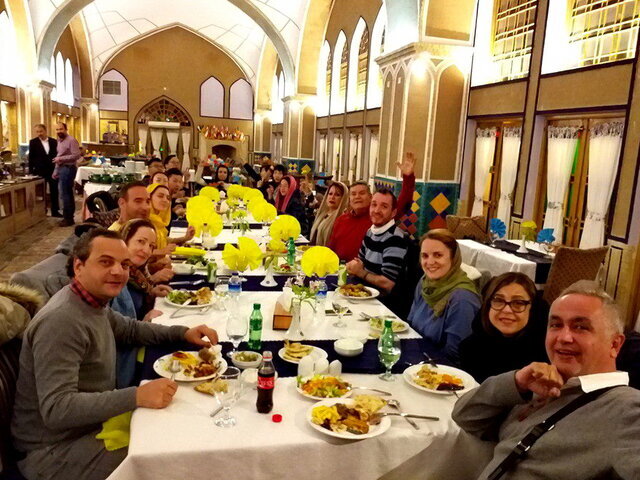
A weeklong Famtrip organized by an Iranian tour operator brought 17 travelers from Spain, Portugal, Italy, Turkey, Peru and China.
“Iran is more modern, cleaner and even quieter than what the media picture,” ISNA quoted one of the travelers as saying on Monday.
Julian, the representative a Spanish travel agency, reminded recent remonstrations in Iran to saying that protests are not unusual in the world as Spain, France and even Lebanon have experienced protests.
“We all continue life and the tourists are still coming.”
Joao, who presides over a Portuguese travel agency, said to ISNA, “I am in Iran, and my clients are surprised that I have traveled to such a country. They constantly ask me about the safety in here. I have sent some videos from the [Iranian] streets and people to show that everything is safe but they hardly believed that.”
Saeid Fekri, organizer of the Famtrip, noted that 30 people were initially invited to take part in the event, but some of them preferred to exercise caution and postponed their trips, so that 17 people took part in the Famtrip ultimately.
“From the hotels to the restaurants, Iran was beyond the group’s expectations. They did not think Iran to only have a modern city or a single modern hotel.”
Almost everything was incredible for them. Even about news of the unrest that they had heard, they asked where this was happening in such a way that everything is so calm now, Fekri explained.  
“This seemed even strange to their clients how managers of travel agencies could go to Iran under so-called circumstance.”
Deputy tourism minister Vali Teymouri said in October, “We need a good image of Iran to be displayed by the world media, thus, we would pursue any method perceived to be easy or less costly in compliance with the Islamic Republic of Iran’s regulations.”
“We do our best to create a good image of Iran in the minds of the world people,” he noted.
The 2019 Travel Risk Map, which shows the risk level around the world, puts Iran among countries with “insignificant risk”, a category where the UK, Denmark, Switzerland, Norway, and Finland are placed in.
Some 6.7 million foreign nationals have visited the country since the beginning of the current Iranian calendar year, Mojtaba Karimi, who presides over Foreign Ministry’s visa and passport department, was quoted by IRNA as saying on December 4.
Iran welcomed some 7.8 million foreign nationals last year, achieving 52.5 percent increase year on year. According to the World Travel & Tourism Council, Iraq was the main source of tourism for Iran in 2018, constituting 24% of all inbound visitors. Azerbaijan with (17%), Turkey (8%), Pakistan (4%) and Bahrain (2%) constituted other major sources while the remaining 46% came from the rest of the world.
The Islamic Republic expects to reap a bonanza from its numerous tourist spots, including 22 ones that have been placed on the UNESCO World Heritage list.

Sunday, December 01, 2019

Iran proposes a world day for ancient civilizations

TEHRAN – Iranian tourism minister on Friday proposed a world day for ancient civilizations as he was addressing the third ministerial meeting of the Ancient Civilizations Forum in Beijing, China.
“Importance and influence of ancient civilizations over the modern world is so great that I believe it should be marked each year as the world day of ancient civilizations,” CHTN quoted Ali-Asghar Mounesan as saying on Friday.
Chaired by the Chinese Minister of Culture and Tourism Luo Shugang, the forum was also attended by ministers from India, Iraq, Egypt, Armenia, Italy, Bolivia, Peru and Greece, as well as a community of international tourism and cultural heritage officials and experts.
“This forum lays a ground for exchanging our views and ideas. And today, I am going to take this opportunity to share my views on [how to make the best] use of cultural heritage for realization of cultural diplomacy. As we all acknowledge, cultural heritage, tourism, and crafts in today’s challenging world are [considered as] important tools for promoting and consolidating peace between [various] nations and communities.”
The Iranian minister explained how ancient civilizations, which abstained from wars and respected for human values, could ultimately ensure peace and security.
“The history testifies that human beings have always faced challenges of their times. [However], both the emergence and ways of dealing with each challenge has been repeated more or less in all historical periods and in all over the world.”
Mounesan added that though, sometimes, some societies have overruled each other’s rights and challenged their own and others’ peace and security, the true victory was achieved by those societies and nations who abstained from militancy and respected for human values.
“Some [of ancient societies and nations] could ensure peace and security and overcome the spirit of hegemony by the means of [practicing mutual] understanding and cultural interaction.”
Mounesan emphasized that in today world “we” are still witnessing differences of opinion and conflicts of interest.
“Devoting attention to cultural and civilizational commonalities can bring countries closer together and bridge gaps between them. So, in my opinion, the world today needs, most of all, cultural closeness, empathy, discourse, and consultation; ones that ancient societies were also benefited from in the past.”
He said that considering cultural heritage from this perspective would be a right solution because it could linking present generations - especially young people to the dignity and identity they have in common, and it can also play an important role in bringing nations together.
Ancient Civilizations Forum at a glance
The formation and evolution of ancient civilizations and their great achievements, ranging from architecture, philosophy and mathematics to medicine and astronomy, just to name a few, laid the foundation for the modern world as we experience it today.
The heirs of ancient civilizations have an obligation, indeed a mission, to preserve and develop this legacy for the benefit of humanity. This is especially important in a period of rapid changes and great uncertainties when international cooperation for global problems like climate change and growing inequalities is of paramount importance.
The aim of the conference was to discuss the importance of setting up an Ancient Civilization Forum, examine best practices of inter-cultural dialogue, describe initiatives and propose joint actions mainly in the fields of academic and scientific research, cultural diplomacy, cyberspace and the new media with an eye on growth and human-centric development.
The main areas of interest according to the Forum are: the impact of ancient civilizations on the modern era; civilization as a soft and smart power; and civilization as an agent of economic growth.

Saturday, November 16, 2019

How Western media bias allows Israel to getaway with murder in Gaza

Ramzy Baroud
An Israeli attack on Gaza was imminent, and not because of any provocations by Palestinian groups in the besieged, impoverished Gaza Strip. The Israeli military escalation was foreseeable because it factors neatly in Israel’s contentious political scene. The war was not a question of “if”, but “when”.
The answer came on November 12, when the Israeli military launched a major strike against Gaza, killing an Islamic Jihad Commander, Bahaa Abu al-Ata, along with his wife Asma.
More strikes followed, targeting what the Israeli military described as Islamic Jihad installations. However, the identities of the victims, along with damning social media footage, pictures, and eyewitness accounts indicate that civilians and civilian infrastructure were bombed and destroyed as well.
As of November 14, when a truce was announced, 32 Palestinians have been killed and over 80 wounded in the Israeli aggression.
What truly frustrates any meaningful discussion on the horrific situation in Gaza is the feeble response, whether by international organisations that exist with the sole purpose of ensuring world peace or by Western mainstream media, that ceaselessly celebrates its own accuracy and impartiality.
A most disappointing response to the Israeli violence was offered by Nickolay Mladenov, the United Nations Special Coordinator for the Middle East Peace Process.
Mladenov, whose job should have long been deemed pointless considering that no “peace process” actually exists, expressed his “concern” about the “ongoing and serious escalation between Palestinian Islamic Jihad and Israel”.
Not only Mladenov’s statement creates a moral equivalence between an occupying power, which instigated the war in the first place, and a small group of a few hundred armed men, it is also dishonest.
“The indiscriminate launching of rockets and mortars against population centres is absolutely unacceptable and must stop immediately,” Mladenov elaborated, putting great emphasis on the fact that, “there can be no justification for any attacks against civilians”.
A destroyed house seen in Gaza, after Israeli airstrikes hit the building in Khan Yunis, Gaza on November 13, 2019 [Ali Jadallah / Anadolu Agency]
Shockingly, Mladenov was referring to Israeli, not Palestinian civilians. At the time that his statement was released to the media, there were already dozens of Palestinian civilians that had been killed and wounded, while Israeli media reports spoke of few Israelis who had been treated for “anxiety”.
The European Union did not fare any better. The EU parroted the same American knee-jerk response by condemning “the barrage of rocket attacks reaching deep into Israel”.
“The firing of rockets on civilian populations is totally unacceptable and must immediately stop,” a statement by the European bloc read.
Is it not possible that Mladenov and top EU foreign policymakers do not truly comprehend the political context of the latest Israeli onslaught  –  that embattled Israeli Prime Minister Benjamin Netanyahu is using military escalation as a way of fortifying his weakening grip on power.
Considering this, what is one to make of the poor media coverage, the inept analyses and the absence of balanced reports in major Western news media?
In a report published by the BBC on November 13, the British broadcaster referred to “cross-border violence between Israel and militants in Gaza”.
But Gaza is not an independent country and, per international law, it is still under Israeli occupation. Israel declared Gaza a “hostile territory” in September 2007, arbitrarily establishing a “border” between it and the besieged Palestinian territory. For some reason, the BBC finds this designation acceptable.
CNN, on the other hand, reported on November 13 that “Israel’s military campaign against Islamic Jihad” is entering its second day, while emphasizing the UN condemnation of the rocket attacks.
CNN, like most of its American mainstream counterparts, reports on Israeli military campaigns as a part and parcel of some imagined “war on terror”. Therefore, analyzing the language of US mainstream media with the purpose of underlining and emphasizing its failures and biases, is a useless exercise.
Sadly, US bias regarding Palestine has extended to mainstream media in European countries that were, to some degree, fairer, if not somewhat sympathetic, with the Palestinian peoples’ situation.
El Mundo of Spain, for example, spoke of a number of Palestinians – making sure to emphasize that they were “mostly militants”, – who “died” as opposed to “were killed” by the Israeli military.
“The escalation followed the death of Gaza’s armed branch leader,” El Mundo reported, failing once more to pinpoint the culprits in these seemingly mysterious deaths.
La Repubblica, which is perceived in Italy as a “leftist” outlet, sounded more like a rightwing Israeli newspaper, in its description of the events that led to the death and wounding of many Palestinians. The Italian newspaper used a fabricated timeline that only exists in the mind of Israeli military and decision-makers.
“Violence continued. Several rockets were thrown towards Israel by Gaza’s Islamic Jihad (militants), breaking the brief truce, according to (rightwing Israeli newspaper) The Jerusalem Post and to the Israeli army”.
It remains unclear what “truce” La Repubblica was referring to.
France’s Le Monde followed suit, reporting the same deceptive and cliched Israeli lines and emphasizing statements by the Israeli military and government. Interestingly, the death and wounding of many Palestinians in Gaza did not deserve a place on the French newspaper’s homepage. Instead, it chose to highlight a comparatively irrelevant news item where Israel denounced the labeling of illegal settlement products as “discriminatory”.
Maybe, one could have excused these across-the-board journalistic and moral failings if it were not for the fact that the Gaza story has been one of the most covered news topics anywhere in the world for over a decade.
It is obvious that the West’s “newspapers of record” have maintained their blindspot on fairly reporting on Gaza and intentionally kept the truth from their readers for many years so as not to offend the sensibilities of the Israeli government and its powerful allies and lobbies.
While one cannot help but bemoan the death of good journalism in the West, it is also important to acknowledge with much appreciation the courage and sacrifices of Gaza’s young journalists and bloggers who, at times, are targeted and killed by the Israeli army for conveying the truth on the plight of the besieged but tenacious Strip.

Wednesday, July 17, 2019

Haftar's ally UAE calls for peace in Libya

Haftar's ally UAE calls for peace in Libya

TEHRAN, Jul. 17 (MNA) – Interestingly the United Arab Emirates has called for peace in Libya while it has been supporting Khalifa Haftar and other terrorist groups in the country.
The United Arab Emirates Foreign Minister Sheikh Abdullah bin Zayed Al Nahyan has met the UN envoy to Libya, Ghassan Salame in Abu Dhabi to discuss ways to end the fighting in Libya.
Sheikh Abdullah praised the role played by the UN in Libya and interestingly called for putting an end to the humanitarian plight there and combating extremist and terrorist groups and armed militias and disarming them.
While the UAE has always supported Haftar. According to a 2017 UN report, the Persian Gulf Arab state has provided eastern-based Libyan National Army (LNA) with military and logistical support.
The UN report issued in June 2017 said Haftar’s forces had received aircraft and military vehicles from the UAE, which also built up an air base at Al Khadim, allowing the LNA, which is allied to a parallel government based in the eastern city of Benghazi, to gain air superiority by 2016.
Along with this meeting, France, Britain, Egypt, the UAE, the US and Italy have called for an immediate end of hostilities in Tripoli.
In a joint statement issued on Tuesday, the six countries “expressed concern” about ongoing hostilities in Tripoli, call for an immediate de-escalation and halt to the current fighting, and urge the prompt return to the UN-mediated political process.
"There can be no military solution in Libya," the statement said.
"Persistent violence has claimed nearly 1,100 lives, displaced more than 100,000, and fueled a growing humanitarian emergency," it added.
Libya has been suffering from unrest since 2011, when its long-time leader Muammar Gaddafi was overthrown and killed. Since then the country has been divided between two rival governments, with an elected parliament governing the country's east, and the UN- and EU-backed GNA ruling in the western part of the country.
Military commander Khalifa Haftar's Libya National Army (LNA) has been battling rival militias since April in a bid to wrestle control of Tripoli from Libya's internationally recognized Government of National Accord (GNA).

Tuesday, July 02, 2019

Stopped Clocks: The European Union Gets War With Iran Exactly Right


Europe’s leaders have voiced broad skepticism of another intervention, leaving American hawks standing alone.
Bill WIRTZ
Regular readers of my contributions to this site may have noticed that I am in no way a fan of the European Union. Yet even with the EU, the stopped clock principle applies: they have to be right sometimes. And when Federica Mogherini, high representative of the EU for foreign affairs and security policy, said that everyone should tread carefully when it came to the attack on the oil tankers near the Strait of Hormuz, she was absolutely correct.
Mogherini stated: “We are living in crucial and delicate moments, where the most relevant attitude to take—the most responsible attitude to take—is, and we believe should be, maximum restraint, and avoiding any escalation on the military side.”
This month, one of the EU’s top advisors on security questions declared that no military intervention from the European side should take place. This echoes French President Emmanuel Macron saying that France had no place in such interventions, as well as German Chancellor Angela Merkel calling for a peaceful solution to the Iran problem. Seventy-four percent of German opposed a military intervention in Syria last year. In 2002, 71 percent of Germans opposed the war in Iraq, as did 64 percent of the French. During anti-Iraq war protests that took place on February 15, 2003, 100,000 people demonstrated in Brussels, 75,000 in Amsterdam, between 100,000 and 200,000 in Paris, between 300,000 and 500,000 in Berlin, 150,000 in Athens, 60,000 in Budapest, and well over 600,000 people in Rome.
And in the United Kingdom, more than one million showed up to protest in London. The UK’s participation in the Iraq war dragged the reputation of Prime Minister Tony Blair and his Labour Party through the mud. A subsequent inquiry made the former UK leader subject to public prosecution because the legal basis for military action was “far from satisfactory.” Blair’s involvement in Iraq has made it difficult for any party in Westminster to legitimate any war to its constituents, most of whom feel that the unholy coalition of Blair and Bush tricked them into a war they should never have been a part of. This is a major reason why the British House of Commons voted down David Cameron’s 2013 attempt to intervene militarily in Syria.
With the UK currently undergoing a leadership contest within the Conservative Party, and with Prime Minister Theresa May on her way out, it’s unlikely the hawks will take control of Westminster anytime soon. The current favorite to win the PM position is former London mayor and former foreign secretary Boris Johnson, who has yet to voice his opinion on the Iran issue. His rival, current foreign secretary Jeremy Hunt, calls for de-escalation.
That hasn’t stopped some of the usual pro-war suspects from coming out of the woodwork. Daily Telegraph columnist Con Coughlin blames the idea that the United States could be partly responsible for the recent escalation with Iran on the “European Union’s deep-rooted anti-Americanism.” In 2003, Coughlin “revealed” information claiming that Iraqi officials met with Mohamed Atta, one of the 9/11 hijackers. Newsweek reported in 2003: “U.S. officials and a leading Iraqi document expert tell Newsweek that the document is most likely a forgery—part of a thriving new trade in dubious Iraqi documents that has cropped up in the wake of the collapse of Saddam’s regime.”
Apparently we have found the British John Bolton. Just no fancy mustache.
In a January poll, 48 percent of Germans favored a withdrawal of their country’s troops from Afghanistan, with 29 percent opposing it. In 2009, almost two thirds of the French opposed the intervention in Afghanistan. In 2012, all French combat troops were withdrawn under President François Hollande. It would be hard to convince either Germany or France to participate in any military action in Iran, particularly since both countries have made it clear that they stand by the 2015 Iran nuclear deal.
Italy’s Prime Minister Giuseppe Conte, who is not known for his efforts to please his European counterparts, is an exception: he says that he is ready to take a “more rigorous” approach towards Iran. Interior Minister Matteo Salvini has even come under fire from Iranian officials after he gave interviews in the United States explaining that he was “happy that Italy has long since relaxed its relations with Iran, a country that wants to wipe out Israel in 2019 has no right to speak.” However, Italians are hardly known for following through on their statements in TV interviews. And that’s without even mentioning Italy’s military record.
So overall, in Europe, support for the hawks inside the Trump administration looks grim. Without at least a handful of European countries supporting an intervention, the United States would look like it was standing alone on the world stage, and America could once again come under fire for needless aggression. The WMD lies of the early 2000s have set the bar high for interventions based on military intelligence. And Syria has shown that without conclusive evidence, Europe isn’t about to send in the troops.

Sunday, April 28, 2019

Tiziana Buccico says impressed with book fair thronged with visitors

Tehran, April 28, IRNA – Deputy representative of an Italian private publisher, Brioschi Editore, said on Sunday that she is immensely 'impressed' by the great number of visitors in Tehran International Book Fair.

Tiziana Buccico, deputy representative of Brioschi Editore, made the impression in an exclusive interview with IRNA.

Brioschi Editore has published a prominent novel 'Suvashun' by Simin Daneshvar, the famous Iranian author.

About the book, Ms Buccico said: 'I love so much the story,' because it is first 'story of a woman, not a wife.' 

Asked if she knows about the Iranian poets, she replied that she is familiar with Shahnameh, a long epic written by the prominent Persian poet Ferdowsi who most believe has played an influential role in surviving Persian language.

'Rumi (Mollana) is special for me,' she added when talking about the 13th-century Persian poet who is the writer of Masnavi-ye-Ma'navi.

Asked about her presence in the Tehran International Book Fair, she said she has been attending the cultural event for five years.

Ms Buccico also talked of the close culture of Italian and Iranian people have.

She described the Iranian people as 'good and friendly'.

At the end of her remarks, Ms Buccico said she has invited Italians and other tourists to visit Iran to get familiarized with 'real Iran.'

The 32nd Tehran International Book Fair kicked off in the Iranian capital on April 23.

Reportedly, 2,400 domestic publishers with 30,000 book titles and about 800 foreign publishers with 137,000 titles are showcasing their latest publications for 12 days.

Monday, December 24, 2018

Europe stuck in crises

By Hanif Ghaffari
Protests are still going on in France. France's protests has reached other countries such as Italy, Spain, Belgium, the Netherlands and Hungary, and this has doubled the concerns of European authorities over EU's future. The combination of security, political, social and economic crises in the European Union (as a united block) will affect all the 28 member states.
Meanwhile, the silence of European leaders such as German Chancellor Angela Merkel in the face of recent unrests, indicate that they're seriously worried about the future of the European Union and the Eurozone. At any rate, determining the relevance between recent protests in France and current and future changes in the united Europe has become one of the main concerns of analysts of the European and international affairs.
Meanwhile, some European politicians are trying to analyze the France protests as an infrastructural and skin-deep objection. However, the kind of slogans that the yellow vests are using against the capitalist system, and the generalization of protests to other parts of Europe, suggest that this phenomenon can't be regarded as a transitory, infrastructural and shallow crisis. On the contrary, it's obvious that the ongoing protests in France have a fundamental and basilar nature.
Another argument that should be taken into consideration in this regard is the analysis of the "action" and "reaction" of the French protesters and statesmen. It's not without a reason that in spite of Macron's withdrawal before the yellow vests protests (for three times), the demonstrations are still continued in France. It should be noted that in the first days of their presence in the streets of Paris and other cities, the yellow vests were merely a "protesting" population with some determined demand. But in a short time they became the "symbol of structural change in France" and even "the symbol of change in the European Union." If the protest of the yellow vests was only at the surface level, it would have to be stopped by the early withdrawal of Macron from his previous positions. Also, the use of "yellow vests" as a symbol indicate that the current protests target the ruling system in France.
Another point here is about the addresses of yellow vests protests. These addressees can't be limited to the French authorities! Even at the domestic level, the addresses of the demonstrators are not merely Macron and his administration, but other parties and groups, both socialist and conservative are included. In recent decades, especially after the formation of EU, these political parties were incapable of digesting the people's demands. Therefore, the yellow vests protest can't be limited to a simple protest against a right-wing or left-wing party. And at a greater level, the addressees of French protesters are the men in power in the united Europe; those who, since 2007, and through setting austerity policies, have made it difficult for the French and European citizens, and thus prepared the ground for continuous and extensive protests.
Third, we should pay attention to the flow of the protests in Europe. In 2007, when the economic crisis broke out in Europe, we saw that the protests primarily began in countries such as Greece and Spain. In other words, protests began to take place in weak and vulnerable countries in the Eurozone, and then it spread to other countries. However, at that time, countries such as France and Germany were not involved in the crisis and there were few protests. Today, we see that protests have begun in France, which is considered the second largest economic power in the Eurozone and is one of the leaders of the European Union. But the rallies didn't stop in France and other countries were involved. Obviously, curbing these protests is far more difficult than in 2007, and the range of protests is also wider than that time. Even if the yellow vests rallies stop in France, the opposition of the French citizens towards the EU leaders will remain strong. This opposition will show itself in the European Parliamentary elections in 2019, or in national and local elections in the EU member states. In any case, the EU has faced the worst crisis over its popularity in its history, a crisis that the European authorities are incapable of solving.