Showing posts with label Xi Jinping. Show all posts

Monday, October 07, 2019

The world in the shadow of regional hegemons/ how does china beat the U.S.?

By Maryam Khormaee


TEHRAN - Celebrating the 70th anniversary of the founding of China is an opportunity for Trump to learn that more than a slogan needed to revive a country’s majesty.
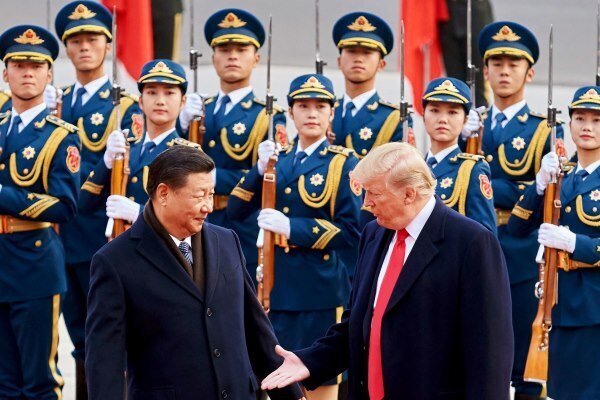
Chinese President Xi Jinping will attend the military event called “the mother of all parades” on Tuesday this week. It is the celebration of the 70th anniversary of the founding of the People’s Republic of China and is a powerful representation of the President’s desire to revive the country’s glory in the field of world’s leadership. 
The magnificent parade, attended by 15,000 military forces, more than 160 planes, and 580 defense systems from 59 military units, is being held while Donald Trump obsesses about such ceremonies, but he will be busy fighting with domestic adversary, with the hope to get rid of “Ukraingate” scandal. 
While the Democrats do not allow Trump to repeat the slogan of “make America great again”, Xi, with the help of military authority and political unity of the state, is showing everybody that he is eager to revive China’s majesty and form the future of the world.
Just a week ago, Foreign Minister of China Wang Yi said that the country is seeking a strategic role to represent an international order emphasizing national interests and preventing foreign influence. 
Wang also pointed to the historic milestone in strategic collaboration with Russia, which is not a good news for Americans who see the alliance of Washington and international partners as a mean to compete with China. 
China and the world in the new era
Two days ago, on the eve of the great parade, the State Council Information Office of China released a detailed report titled “China and the world in the new era” to describe the major approaches of the country’s foreign policy.
What is most emphasized in this document is the focus on China’s development without being a threat to others.
  The economic growth of China has also been defined as an opportunity for the whole world, and it has been claimed that it will not seek supremacy over others.
In the released document by the Chinese State Council information Office, imitating Western countries’ development is rejected.
What is remarkable in the detailed document is Beijing’s emphasize on peaceful development of China without seeking hegemony, expansionism or creation of influence. 
The document referred to China as “the most important stability factor and the power source of global economy”. A country that its development is a model for developing countries. 
In the document, China has stated its desired model in international relations as a new model based on mutual respect, equality, justice, and bilateral cooperation. 
These are positive points that the audience will learn from newly released document. More delicate and thoughtful look on the form of words will lead us to a different direction that makes it possible to predict the confrontation of China and the U.S., as another claimant of universal order. 
Differences with Washington and partners
In a part of the document, China introduces itself as the world’s largest “developing” country, while less than two weeks ago, Australian Prime Minister Scott Morrison named China as a “developed” country and claimed that the rules of World Trade Organization need to be changed to accommodate China’s new position as a developed economy. 
According to the WTO, referring to China as a new developed economy points to a fundamental difference with Beijing’s self-called position as a developing economy - a position that benefits from exclusive privileges such as longer deadlines to fulfill agreed promises.  
These conditions accompany Australia with a campaign, running by U.S. President Donald Trump, to remove China as a developing economy. On April 7, 2018, Trump wrote in a Twitter message that China is a “great economic power” but has received “enormous benefits and privileges” especially from the U.S.
In another part of “China and the world in the new era “document, the entry of the country into WTO on 2001 is considered as a starting point for greater engagement in international economy and commercial cooperation. The U.S. President assailed Beijing in a speech at the 74th meeting of the UN General Assembly held last week, and said, ”the WTO should be reformed. China did not applied the WTO reformations. Globalism and past leaders have prevented U.S. national resources from being considered, so I imposed $500 billion tariffs on Chinese goods, and I hope that we can reach an agreement with China that benefits both parties.” 
We can read in another part of the document that: China seeks fair development, and as the largest developing country in the world, helps small countries passing this stage without any political consideration. U.S. officials claim it is China’s method that makes you indebted, then plunders your national resources. They also state that the idea of “a belt and road” by China has lots of consequences, and is in line with the country’s interests. Americans say that the idea of “a belt and road” does not provide countries with proper loans or international aid, but rather they make a loan based on free market rules with high interest rate. Borrower countries have to work with Chinese companies and use their equipment and workforce to build their ports and railways.
 The collapse of American hegemony in the shadow of peace
In the document, China use sarcasm in case of the U.S. without mentioning its name, and calls into question its supremacy over the universal order. As a part of this report, China brags that it has never launched a war in the past 70 years, and has not even occupied an inch of a single country. Meanwhile, the U.S. has destroyed countries from Vietnam to Afghanistan over these years. 
At the same time, Beijing assured that it is not seeking to be hegemon, and these accusations fuel the fear from China. So, how Beijing will end the U.S. control over the world? 
Maybe the answer should be sought in the speech of Xi on June 15, 2019. On the sidelines of the fifth Conference on Interaction and Confidence-Building Measures in Asia (CICA), held in Dushanbe, Tajikistan, the Chinese president called for a regional security structure with Asian features to achieve common security.  
In this regard, Xi asked Asian countries and their partners to form a common, comprehensive and sustainable security viewpoint, and pursue a regional security structure with Asian features to reach collective security in Asia. 
The comment by Xi, which is limited to Asia, reveals the prospect of Chinese solution for challenging the U.S.
Xi’s remarks is the realization of the prediction of the founder of the constructivism theory Nicholas Onuf. He once said, “I do not believe that we are currently in a modern universal order”. The modern order emphasized by the U.S. is just rhetoric. I believe “regional orders” will emerge instead of universal order. The dominant of the influence of these regional orders will be at various “hegemonic” levels. But some of these levels will be more influenced or less by possible universal hegemonic order. Thus, the relative power of the U.S. in military and economy terms is reducing. This remarkable decrease in power will negatively affect the notion of the country’s position in the world. 
It should not be imagined that the U.S. cannot compete with China, and as it is clearly affirmed in “China and the world in new era” document, Beijing is facing some challenges that Washington will properly take advantage of them. Population aging, slow economic growth, Hong Kong’s protests, and Taiwan separatism are some of these challenges. Washington and London’s support for protests in Hong Kong, and U.S. insistence on providing Taiwan with arms indicate the U.S. determination to undermine Chinese unity by challenging the fundamental principle of “united China”.      
  •   

    Tuesday, August 13, 2019

    Healthy economy is antidote to sanctions on Iran: scholar

    By Negar Asadi

    TEHRAN - A prominent scholar, believes that fighting corruption and building a healthy foundation for economy are catalysts to resist sanctions and external pressure on Iran.
    “What is important is to adopt policies to have a foundation of a healthy economy in order to be able to counter external pressure,” Modjtaba Sadria told the Tehran Times in an interview on Thursday.
    Sadria, an expert on East Asia, cited China and its resistance against the U.S. sanctions as an example.
    China has adopted clear and coherent policies which resulted in a “strong foundation for national economy” and also a very “strong social base” to counter the U.S. pressure, Sadria explained.
    “Between 1848 (opium war) and 1949 (Chinese revolution), a deep desire of independence grew in China. Xi Jinping [the Chinese president] has undertaken huge program of economic transformation of China in order not to depend on Chinese trade with the United States,” he explained.
    He said that the U.S. pressure is not tolerated in China.
    “The U.S. efforts to form alliance in the Persian Gulf is more a show of a bargaining strategy which cannot pose a threat against Iran.”Referring to China’s act in suspending purchases of U.S. agricultural products, Sadria said, “This is one of the examples of Chinese tools to retaliate the Trump administration’s show of force to China.”
    China announced on Tuesday that it has suspended purchases of U.S. agricultural products in retaliation for a “serious violation” of agreements between President Xi Jinping and his counterpart Donald Trump.
    Sadria said, “On the sidelines of a G20 summit in Osaka, Japan, Trump and Xi met and reached agreement on reducing sanctions by the U.S. However, Trump restored those sanctions. These actions which are unilateralism in the international relations are not tolerated by China. Trump cannot use sanctions as bargaining tools against a country which is the second largest economy in the world.”
    “Today, China is a society to which you cannot show off power with the game of sanctions,” he added.
    He also said that the U.S. has not any leverage to impose sanctions on other countries unilaterally and act as the “lone superpower”.
    “When China takes retaliatory action against the U.S. unilateralism and pressure, it affects not only the U.S. economy, but the whole global economy,” he pointed out.
    He noted that China has adopted policies in line with the growth of its national economy that the U.S. cannot harm it by imposing sanctions or exerting pressure.
    Trump and Xi held a summit during the G20 in Osaka, Japan in June.
    Xinhua reported that the two leaders had agreed to resume economic and trade negotiations, and that the U.S. said it would not impose any new tariffs on Chinese products.
    However, Trump announced last week that the U.S. would put a new 10 percent tariff on $300 billion worth of imports from China.
    China “has not ruled out import tariffs on U.S. agricultural products purchased after August 3, and related Chinese companies have suspended purchasing U.S. agricultural products,” Xinhua said.
    American Farm Bureau Federation President Zippy Duvall said in a statement issued after news of China’s retaliatory measures, “China’s announcement that it will not buy any agricultural products from the United States is a body blow to thousands of farmers and ranchers who are already struggling to get by.”
    ‘U.S. move to form coalition in Persian Gulf is show of bargaining strategy’
    Sadria also said that the U.S. move to form a maritime coalition in the Persian Gulf is a “show of bargaining strategy rather than execution of threats” and is not based on realities in the world.
    “Washington is trying to apply its bargaining policies against Iran and form a coalition like it created against Iraq in 2003,” he said.
    He added that under the current global economic situation major powers are in crisis, therefore the U.S. does not have the power to make them join the coalition.
    “In 2003, other countries had the [financial] resources and the U.S. had the power to extract those resources in order to form a coalition against Iraq. Today, the other countries do not have the resources because they are on the edge of crisis and the U.S. is not powerful enough to extract the resources,” he opined.
    He noted, “So, the U.S. efforts to form alliance in the Persian Gulf is more a show of a bargaining strategy which cannot pose a threat against Iran.”
    Commenting on the UK’s participation in the U.S. Persian Gulf mission, Sadria said that Britain is in a very fragile situation and seeks to gain Washington’s support.
    The U.S. has announced plans to form a Washington-led maritime force to supposedly secure the Strait of Hormuz in the Persian Gulf, which hosts considerable international oil shipments.
    German Foreign Minister Heiko Maas said in a press conference on July 31 that his country “would not participate in the mission the United States plans to form.”
    A German government spokeswoman also said on August 5 that Chancellor Angela Merkel and the whole German government do not see Germany taking part in a U.S-led naval mission in the Strait of Hormuz.
    “The chancellor does not see a participation in a U.S-led mission in the current situation and at the current time - everyone in the German government agrees on that,” a government spokeswoman told a news conference, according to Reuters.
    Madrid and Tokyo have also rejected an official request from Washington to participate in the naval coalition.
    Spanish newspaper El Confidencial said on August 1, Madrid had received an official request from the United States to participate in these forces. However, the same sources said that “the Spanish government has currently no intention to participate in joint U.S.-led forces,” Middle East Monitor reported.
    Japan’s Mainichi Shimbun also reported that Tokyo won’t send ships to join the U.S.-led maritime force.
    The UK announced on August 5 that the Royal Navy will join the coalition.

    Monday, April 29, 2019

    BRF shows China’s open-mindedness

    The Second Belt and Road Forum for International Cooperation (BRF) ended Saturday in Beijing. Leaders who attended the forum signed a joint communiqué and reached several achievements. The forum further expanded the influence of the Belt and Road Initiative (BRI) and boosted people's confidence in this cooperation mechanism.
    The openness of the BRF has impressed the world. As the one who proposed the BRI, Chinese President Xi Jinping put forward high-quality Belt and Road construction, emphasized the cooperation will be open, green and clean, and will strengthen international rules synergy. These are inherent requirements of the BRI construction and also responses to some Western countries' concerns.
    People's Bank of China Governor Yi Gang said the BRI's investment and financing decisions must fully consider a country's overall debt capacity, and improve the coordination between investment and financing to ensure debt is sustainable.
    The BRI is a rapidly developing new initiative. It has attracted discussions in the world. But the US and some Western countries made biased comments, some with ill intentions. China proposed the initiative, but stayed calm and focused on improving the BRI's mechanism together with cooperative countries. China's broad mind matches the great cause of the BRI.
    The BRI is an expanding friendly circle with no adversaries. Two former US cabinet members released a report called "The Higher Road: Forging a US Strategy for the Global Infrastructure Challenge." It is a good thing if the US really supports global infrastructure. 
    But the purpose of the report seems to be to build US leadership in infrastructure and exclude China's influence. The two former cabinet members advocated "the higher road," but it seems like a zero-sum geopolitical road.
    China's foreign investment has never ignored the principle of being green and clean. It also took recipient countries' debt capacity into consideration. But since some countries expressed concerns, the BRF placed the corresponding improvements in a prominent position. In contrast with the open-mindedness of China, the US' unilateralism has increased.
    The America First policy has disturbed most global multilateral cooperation platforms. Thus, the BRI may be more attractive because countries only have the goodwill of reciprocity within the framework. All countries want to develop, and the BRI can help in mutual development.
    BRI cooperation will be more prosperous with higher quality in the future. It is open to regions and countries as well as good ideas and rules. Proposed by China, the BRI belongs to humankind. These are not empty words.
    (Source: Global Times )

    Monday, February 18, 2019

    Mahathir Confirms Malaysia’s Commitment to Belt and Road

    Written by Adam Garrie 


    Veteran Malaysian Prime Minister Mahathir Mohamad has confirmed that he shall lead his country’s delegation at April’s Belt and Road Summit in China. When commenting no the inaccurate claims that he is pivoting Malaysia away from its Chinese partner, Mahathir stated:
    “We find that China is now the biggest trading partner for Malaysia. It is also a big investor in Malaysia. Our policy is of course to retain and improve the relationship between Malaysia and China”.
    This further affirms the deep and broad relationship between Malaysia and China, one which has both a modern and ancient foundation.

    Long before the Federation of Malaya gained independence from the British Empire in 1957, the territories comprising modern Malaysia had a long, fruitful and peaceful relationship with multiple Chinese states. In keeping with China’s friendly trading ties with the majority of south east Asian sovereign entities throughout the centuries, Malaysia’s predecessor states enjoyed cordial relations with China on the basis of mutually beneficial trade.In the early 15th century, the Malacca Sultanate which included Peninsular Malaysia, Singapore and a portion of Sumatra in modern Indonesia, signed an important security pact with China’s Ming Dynasty. According to the protection agreement, the Ming provided full military protection to the Malacca Sultanate. During Portugal’s invasion of Malacca in the early 16th century, it was Ming forces that fought against the European colonial power and for a time succeeded in holding off the first of many European subjugations of the territories that would become Malaysia.
    Earlier this year, Malaysia’s veteran Prime Minister, the 93 year old Mahathir Mohamad spoke of this long history of friendship with China and explained how this forms the basis of warm relations in 2019. Mahathir stated:
    “They asked me, how do you feel about China? I told them Malaysia has been maintaining ties with China. We have bilateral trade and we have been friendly to China”.
    He continued,
    “There are many Chinese in our country, but China has never colonised us. Who should we be fearful of? China or Europe?
    Many Chinese nationals know me. They see me as China’s good friend”.
    The Malaysian Prime Minister then turned to an issue of contemporary China-Malaysia cooperation that has been widely misrepresented ever since Mahathir returned to a leadership position in 2018. About these matters, he stated:
    “Just because the Malaysian government asked to review the East Coast Rail Link (ECRL) and cancel the Sabah and Malacca natural gas pipe project, then I am seen as unfriendly?
    The Chinese government is aware that we are facing serious financial issues. I told them that we can’t afford (those projects). This is not whether we want it or not. These are bad projects in the first place and we can’t afford them”.
    It is well known that the ECRL  (which is set to go forward but on a smaller and more manageable scale) was one of the many bloated vanity projects instigated by Mahathir’s notoriously corrupt predecessor Najib Razak. In cancelling the ECRL as initially conceived along with the gas projects in Sabah and Malacca, Mahathir was showing no malice towards China, but was instead trying to reign in the fiscally irresponsible policies of Najib. This became especially important as global financial trends exerted pressure on many emerging markets throughout 2018.
    While projects in which China participates are always aimed at creating win-win outcomes for all partners, it is also true that China approaches its partners not with a patronising colonial style suspicion, but from a businesslike position of mutual respect. Therefore, if a partner nation of China seeks to use Chinese expertise to build something extravagant, it is not China’s duty to meddle in the sovereign decision making processes of another nation. It is likewise not China’s business to police corruption outside of China’s borders. That is of course the job of individual nations and this is what Mahathir’s coalition was elected to do for Malaysia.
    Beyond this is the dangerous and defamatory “debt trap” myth regarding Belt and Road connectivity projects. Mahathir’s statement likewise dispels this myth by explaining that the decisions his government took in respect of ECRL and the gas projects were internal responses to the poor foresight of the previous government, as well as being more holistic responses to overall geo-economic trends.
    The “debt-trap” myth is flawed not only in terms of the fact that it is based on exceptions which prove the rule that most Chinese projects throughout Asia and Africa result in win-win outcomes for both parties, but the myth is also flawed in the sense that it fails to grasp real world realities beyond the ideological and purely theoretical. In life like in geopolitics there is no such thing as a free lunch. While China is more generous in terms of loans, investments and cash injections than most other wealthy nations, it is not in any nation’s interest to rebuild entire continents without getting anything in return.
    In this sense, China is engaging in normal business practices that are international standards when it comes to expecting to be paid back on loans that it readily gives to nations aspiring to further develop their economies and infrastructure and does so at levels that are history making in terms of their forward thinking generosity. Of course, instead of offering loans and other investment schemes or otherwise giving away money for free, China could simply come to a foreign state, build infrastructure and keep 100% of the profits from such projects forever more. This however would totally exclude China’s partner nations from the project and would amount to little more than soft imperialism.
    Instead, China seeks to cultivate win-win partnerships by including the partner nation in question at all stages of a joint project. In this sense, China is willing to share the benefits and the responsibilities as is normal in a genuine partnership of any kind. Implicit in such relationships is the reality that every now and then one side will negate some of its responsibilities. In the over-hyped case of Sri Lanka, the government simply bit off more than it could chew and in agreeing to take over Hambantota port, Beijing actually saved Colombo both money and grief.
    While Sri Lanka clearly did not think ahead before signing the final agreements regarding Hambantota, the fact is that the port is there and being run by Chinese operations means that it is nevertheless still bringing added value to the Sri Lankan economy. Even if for example China took operational control/ownership of Zambia’s international airport (as totally false rumours claimed in 2018), China would still be working towards making Zambia’s airport more functional and attractive. It goes without saying that having a functional and attractive airport brings added value to any economy irrespective of who owns the airport. This is for example true of England’s Heathrow airport which is operated by a company originating in Spain.
    The fact of the matter is whether a Chinese project in a foreign nation goes well (as such things typically do) or whether they require some sort of reassessment as many kinds of projects throughout the world do, China is always blamed by those sowing Sinophobic narratives when in reality China is engaging in normal business practices yet tends to be hated by those infected with a zero-sum mentality because China tends to have a larger success record in foreign infrastructure projects than do rivals including the US and India.
    Another problem that arises is that when nations take a step back from deals with China to reconsider – something Sri Lanka clearly did not do though it very well could have done – China absolutely gets the blame here too from those who see the world through a zero-sum prism. When  Mahathir Mohamad looked to suspend some of the vanity projects that his corrupt predecessor Najib Razak agreed to begin building with Chinese companies, he was, according to some hyper-Sinophobic media outlets “Standing up to China”. In reality he was simply revising business deals the way the new head of a private company would do so with a partner company after taking over from a failed predecessor. There was no anti-China malice in Mahathir’s revisions of deals – just normal business practices. This has now been explicitly clarified by Mahathir.
    When understood holistically, it becomes clear that Sinophobic governments and media outlets tend to blame China no matter what it does, even when Beijing works to secure bespoke deals on a win-win model with any willing and able partner. The fact that China requires partners to exercise joint responsibility in exchange for sharing in the joint success of a project is in fact the opposite of exploitation – it is geo-economic empowerment. Ironically, those who criticise China the most are those whose records of partnerships with developing nations have been the most historically scandalous.
    Of course, Malaysia still has many internal issues to address in respect of affirmative action policies which discriminate against the country’s Han Chinese minority, but this issue which is central to the internal development of Malaysia must not be conflated with Malaysia’s trading relations with the People’s Republic of China.
    In this sense, Mahathir has offered an unequivocal reassurance that healthy trading relations between the people of Malaysia and China will continue, just as they had done for centuries prior to the reckless imperialist conquests of Malaysia by Portugal, The Netherlands and finally the Britain.
    Mahathir’s attendance of this year’s Belt and Road Summit will add to the deep and historically routed ties between the two countries on a win-win basis.