Showing posts with label Foreign Minister Mohammad Javad Zarif. Show all posts

Monday, October 21, 2019

UAE releases $700m of Iranian funds

Iran's Foreign Minister Mohammad Javad Zarif [left] seen with UAE's Foreign Minister Sheikh Abdullah bin Zayed Al Nahyan [File photo]
The UAE has released $700 million in previously frozen funds to Iran, in a bid to improve relations between the two countries. A member of the parliament in Tehran hailed the move yesterday.
“The Emiratis have… understood that Western countries and Saudi Arabia cannot provide the [UAE] with security in the current circumstances,” Akbar Torki MP told Iranian media. “Financial relations with Iran have improved and some Iranian exchange offices in Dubai have resumed activity.”
The move is a surprise at a time when the Arab Gulf States generally perceive Iran to be a growing threat in the region, particularly due to its increasing military influence through the Shia militias it controls and funds in the Levant. Iran also supports the Shia Houthi militia in Yemen, which the UAE has until recently been fighting as a member of the Saudi-led coalition. The UAE has now more or less withdrawn from the latter and advocates a political solution.
The Arabian Gulf, particularly the strategic Strait of Hormuz, has been the subject of much tension over the past few months following Iran’s seizure of European ships and oil tankers in the summer and its shooting down of a US drone in the area. More recently, Iran is thought by many to have been behind the attack on a Saudi Aramco oil facility in in September, which hit global oil supplies by five per cent.
The unrest stems from America’s unilateral withdrawal from the 2015 nuclear deal with Iran and Washington’s re-imposition of sanctions on the country, which has resulted in increasingly tense relations between the Islamic Republic and the US and EU. In response, the US has deployed a further 3,000 troops to Saudi Arabia to monitor the Iranian threat.
Historically, the UAE, like its neighbours Qatar and Bahrain, has had links and trade with Iran despite the hegemonic threat that it is seen to pose. This step to unfreeze Iran’s assets within the UAE, therefore, suggests that the government in Abu Dhabi is looking to improve relations with the Islamic Republic and reduce tension in the Gulf, not least to avoid the possibility of direct military conflict.

Tuesday, September 03, 2019

Can Macron’s Iran Initiative Succeed?


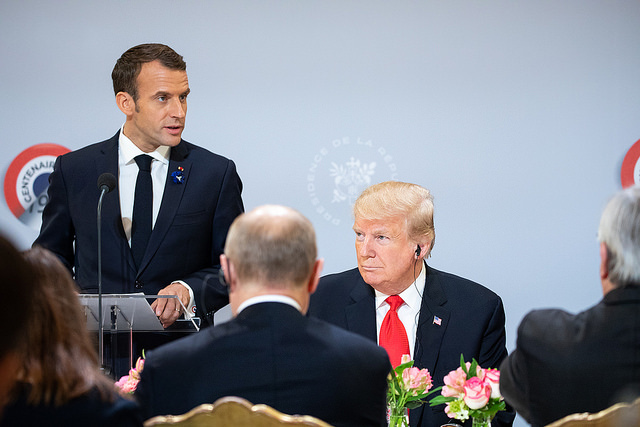
Emmanuel Macron and Donald Trump (White House via Flickr)
by Nader Entessar and Kaveh L. Afrasiabi
In the aftermath of the G7 summit, which was marked by the surprise appearance of Iranian Foreign Minister Mohammad Javad Zarif, the obvious and exceedingly important question is whether President Emmanuel Macron’s (rather bold) Iran diplomacy can succeed. Pronouncements by both Macron and his foreign policy team make it clear that the principal objectives of this diplomacy are threefold: to defuse and de-escalate the growing tensions in the Persian Gulf, to prevent the resumption of the Iran nuclear crisis, and to reach a new understanding between Tehran and Washington by facilitating a near future summit involving the U.S. and Iranian presidents.
Both Donald Trump and Hassan Rouhani are due to attend the UN General Assembly in September, and the momentum Macron’s efforts have built toward a possible meeting in New York may yield positive results. At the moment, both sides have engaged in the art of “mixed signaling.” Rouhani has made the lifting of U.S. sanctions a prerequisite for a face-to-face meeting, and Zarif has cast doubt on the possibility of a meeting while, at the same time, suggesting that—with sufficient preparatory groundwork—some ice in the glacier of U.S. hostility toward Iran could be broken in the near term. Along these lines, an Iranian delegation is heading to Paris to explore “diplomatic progress,” and Rouhani’s chief of staff Mahmoud Vaezi has stated that the recent talks with France relate to Iran’s rights, the 2015 nuclear accord, and reducing the harm caused by U.S. sanctions. Reacting to Rouhani’s stated condition, U.S. National Security Advisor John Bolton has countered with a U.S. prerequisite for lifting sanctions on Iran—namely, Iran’s willingness to enter into a new deal with the U.S. covering both nuclear and non-nuclear issues.
Clearly, neither side will consent to the demands of the other ahead of direct negotiations, as to do so would be tantamount to putting the cart before the horse. Rather, the aim should be to negotiate without any preconditions and strive for a meaningful breakthrough by resorting to the parameters of creative and flexible diplomacy. The advantage of Macron’s intervention is that he has the solid backing of other major European powers and has increasingly managed to gain Iran’s trust as well as Trump’s interest, which is a welcome departure from merely two months ago when Trump criticized Macron for sending the wrong signals to Iran.
Trump’s turnabout at the G7 summit, on the other hand, is attributable to the U.S. failure to build an international coalition against Iran. This has allowed Iran to move closer to Russia in response to U.S. pressure by, among other things, planning for a joint military exercise with Russia in the Persian Gulf, traditionally U.S. turf, in the near future. Unless the Trump administration relents on its “maximum pressure” campaign against Iran, the present trend for a greater strategic symbiosis between Tehran and Moscow will continue, which would represent a setback for vital U.S. interests in the Middle East. Not only that, Iran holds leverage in that it can threaten the safety of oil tankers passing through the Strait of Hormuz, in addition to the threats posed by its protégé forces throughout the region, which act as deterrent shields from the perspective of Iran’s national security. Perhaps Iran’s biggest leverage is the threat that it may further reduceits compliance with the 2015 nuclear agreement, which has raised proliferation fears in the West.
Notwithstanding the balance of threats and counter-threats by both sides, the U.S. and Iran could be poised to negotiate along the lines proposed by the French government—that is, a moratorium on U.S. oil sanctions in exchange for Iran’s compliance with its JCPOA obligations, followed by direct negotiations for the sake of a meaningful thaw in U.S.-Iran relations. Undoubtedly, such negotiations would entail regional issues like the war in Yemen, which has been the subject of rounds of discussion between Iran and Europe so far, now including the participation of Houthi officials. The U.S., which has hinted at interest in negotiating with the Houthis, could conceivably join these talks and thus further narrow the current divide with Europe over Iran. To his credit, Macron—who has angered some Washington hawks by embracing Zarif, in defiance of the recent U.S. move to sanction Zarif in order to discredit him—has apparently succeeded to some extent in persuading Trump that he can reach a modus vivendi with the current Iranian leadership, who have proved their resilience over the past four decades. As a result, Trump has toned down his incendiary rhetoric on Iran and openly endorsed Macron’s Iran initiative, which holds the promise of a slow, but hopefully steady, ‘Europeanization’ of Trump’s (hitherto confrontational) Iran policy.
However, concerned about a US-Iran rapprochement, Israel has been deliberately upping the ante against Iran and its supporters throughout the Middle East, inciting violence that could act as a circuit breaker and set back the cause of peace between Tehran and Washington. Tel Aviv can trump Macron’s initiatives by fueling the fires of a war with Iran, which would inevitably engulf U.S. forces stationed in Iraq and the Gulf region. It is unclear at this stage whether the Trump administration has the wherewithal to rein in Israeli Prime Minister Benjamin Netanyahu, who is up for re-election and content to see a sustained U.S. pressure campaign on Iran. Europe as a whole has little leverage on Israel, and it is unlikely that Macron and other European leaders can influence Israel to alter its anti-Iran policy.
Trump himself, beholden to major campaign contributions by wealthy Jewish donors, is unlikely to risk a rupture with Israel, given his re-election priorities. However, if push comes to shove and Trump has to pick a side between Macron/persuasive diplomacy and Netanyahu/coercive diplomacy, he will likely opt for the latter instead of the former. At the same time, Trump’s stated war-weariness and intention to end costly U.S. wars means that there are (structural) limits to how far Israel and its supporters in Washington can steer the White House toward confrontation with Iran, which adds to the viability of Macron’s initiative. European leaders also have some leverage on Trump in that, should he reject diplomatic engagement with Iran, Europe could proceed with plans to bypass U.S. sanctions on Iran through the financial mechanism known as INSTEX. According to reports, Macron has proposed extending a $15 billion line of credit to Iran via INSTEX. Trump has signaled some support for that idea, but would likely oppose any additional European steps to mitigate the impact of the sanctions regime.
Looking ahead, Macron’s nuanced intervention has increased the likelihood of a Trump-Rouhani summit that would suit the needs and priorities of both leaders. In addressing such a dangerous international crisis, Macron has filled an important vacuum of leadership. As we stated in our New York Times article last September, there is a historic necessity for a Trump-Rouhani talk, which will hopefully transpire within the coming weeks. In order to make that happen, it will require urgent confidence-building steps by both sides.
Nader Entessar is professor emeritus of political science at the University of South Alabama. Kaveh L. Afrasiabi is a political scientist specializing in Iran’s foreign policy. They are coauthors of Iran Nuclear Negotiations: Accord and Détente since the Geneva Agreement of 2013 (Rowman & Littlefield, 2015), Iran Nuclear Accord and the Remaking of the Middle East (Rowman & Littlefield), and Trump and Iran: From Containment to Confrontation (Lexington Books, 2019).

Thursday, July 18, 2019

FM: Iranian nation exposed to US brutal economic terrorism

FM: Iranian nation exposed to US brutal economic terrorism

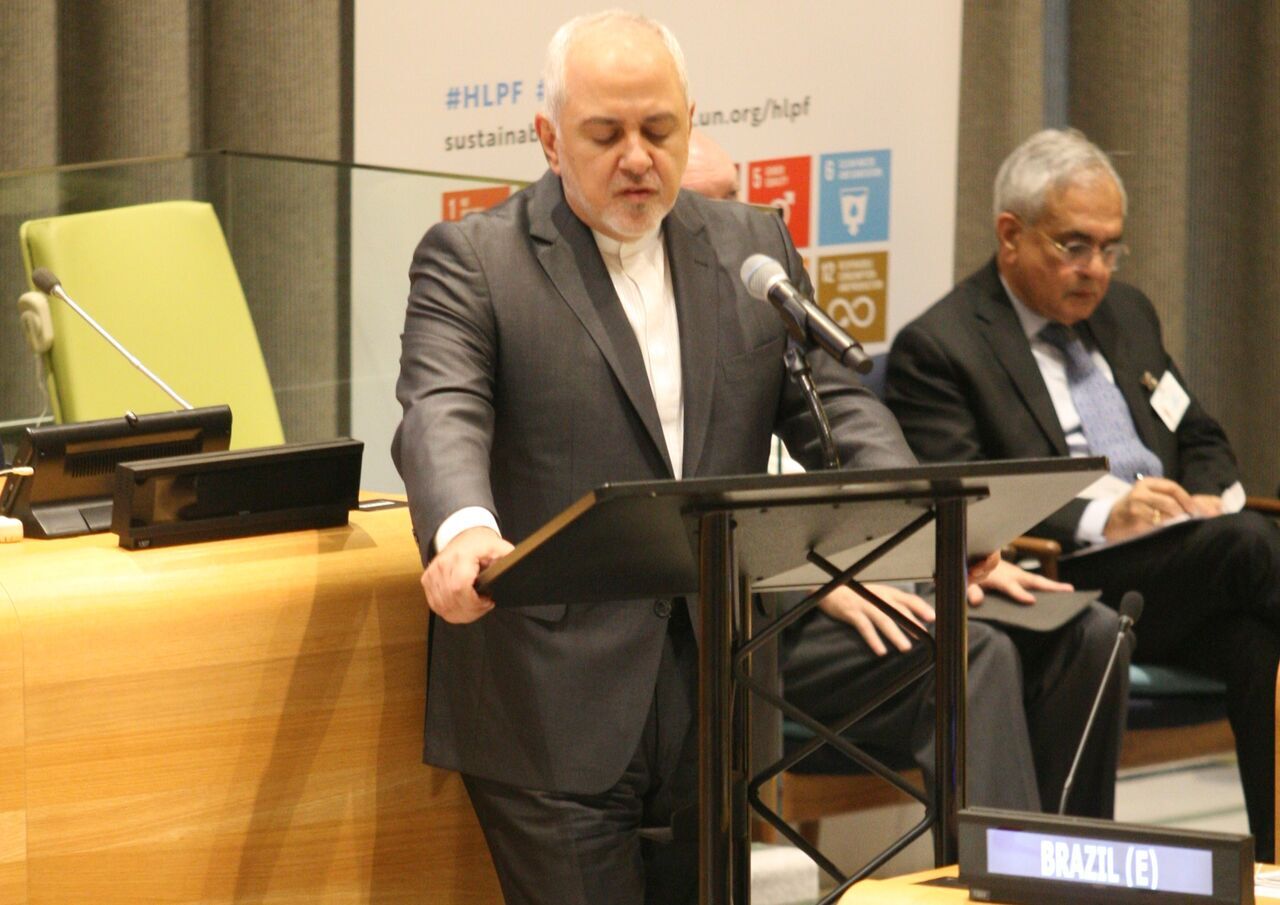
New York, July 17, IRNA – Foreign Minister Mohammad Javad Zarif said on Wednesday that Iranian people are subject to the most cruel form of economic terrorism--deliberately targeting innocent civilians to achieve illegitimate political objectives.
Addressing the Ministerial Meeting of the High-level Political Forum on Sustainable Development, he added, "The unlawful extraterritorial economic sanctions imposed on Iran by the United States in violation of Security Council resolution 2231 represent the greatest threat to the achievement of sustainable development goals of Iran and many of our neighbors."
Full text of Zarif's statements reads as follows:
"In the name of Allah, the Compassionate, the Merciful
Madam President,
As we address this year’s HLPF theme of "empowering people and ensuring inclusiveness and equality", we note that Secretary General’s report indicates sluggish progress in many areas, and underlines that “the most vulnerable people and countries continue to suffer the most and that the global response thus far has not been ambitious enough”. We agree with the Secretary-General that "inequality between and within countries is disturbingly high" and that "development is not sustainable if it is not fair and inclusive."
Failure so far can be attributed to the failure of the developed world in keeping their side of the bargain, including those related to transfer of technology, capacity building, and financial assistance.
Madam President,
In spite of huge impediments caused by unlawful unilateral sanctions, the Islamic Republic of Iran has made significant progress in people’s empowerment and equality, working on the basis of Its own principles and national priorities: 27% of faculty members, 50% of college students, and 37% of medical doctors are currently women. At the decision-making level, there has been a 60% increase in appointments in a bid to ensure our goal that by 2020, 30% of national decision makers are women.
In the implementation of our national “Comprehensive Low-Carbon Plan”, we surpassed our intended mitigation of greenhouse gas emission of 4% lower than BAU.
Ending illiteracy and providing free public education has approached its full realization, and the literacy rate among Iranians is now at 97% of the population. An average of 15% of household expenditure is now spent on education.
Effective training for the socially harmed and disadvantaged groups, as well as for rural and nomad communities and prisoners, is now being offered.  Educational opportunities have been extended to migrants and refugees, and currently 400,000 Afghan students are registered at local schools in Iran.
We in Iran face serious challenges in these efforts, challenges that include natural disasters, land degradation, desertification, and water scarcity. Regional threats and insecurity caused by foreign-sponsored terrorism, extremism and violence, hamper our efforts. Our people are also subjected to the most brutal form of “economic terrorism”--deliberately targeting innocent civilians to achieve illegitimate political objectives. The unlawful extraterritorial economic sanctions imposed on Iran by the United States in violation of Security Council resolution 2231 represent the greatest threat to the achievement of sustainable development goals of Iran and many of our neighbors.
 Madam President
A renewed commitment to multilateralism and global solidarity is urgently needed. This should also entail, among others, the developed world re-visiting its commitment to help create an enabling environment for sustained economic growth and sustainable development of all countries, regions, and ultimately the planet as a whole.
I thank you for your attention."