
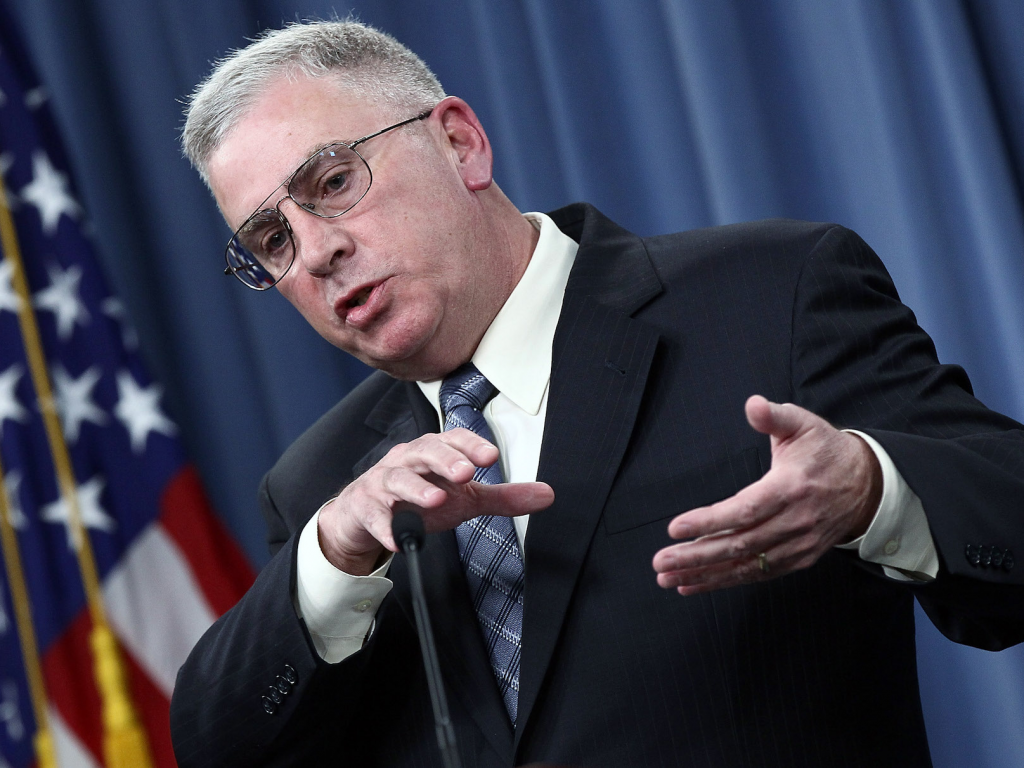
What does President Trump’s recent nomination of retired Army General John Abizaid to become the next U.S. ambassador to Saudi Arabia signify? Next to nothing — and arguably quite a lot.
Abizaid’s proposed appointment is both a non-event and an opportunity not to be wasted. It means next to nothing in this sense: while once upon a time, American diplomats abroad wielded real clout — Benjamin Franklin and John Quincy Adams offer prominent examples — that time is long past. Should he receive Senate confirmation, Ambassador Abizaid will not actually shape U.S. policy toward Saudi Arabia. At most, he will convey policy, while keeping officials back in Washington apprised regarding conditions in the Kingdom. “Conditions” in this context will mean the opinions, attitudes, whims, and mood of one particular individual: Mohammed bin Salman. MBS, as he is known, is the Saudi crown prince and the Kingdom’s de facto absolute ruler. By no means incidentally, he is also that country’s assassin-in-chief as well as the perpetrator of atrocities in a vicious war that he launched in neighboring Yemen in 2015.
Implicit in Abizaid’s job description will be a requirement to cozy up to MBS. “Cozy up” in this context implies finding ways to befriend, influence, and seduce; that is, seeking to replicate in Riyadh the achievements in Washington of Prince Bandar bin Sultan, who from 1983 to 2005 served as Saudi ambassador to the United States.
With plenty of money to spread around, Bandar charmed — which in this context means suborned — the Washington establishment, while ingratiating himself with successive presidents and various other power brokers. With his fondness for nicknames, George W. Bush dubbed him “Bandar Bush,” informally designating the Saudi prince a member of his own dynastic clan.
After 9/11, the Saudi envoy made the most of those connections, deflecting attention away from the role Saudis had played in the events of that day while fingering Saddam Hussein’s Iraq as the true font of Islamist terrorism. Bush came around to endorsing Bandar’s view — although he may not have needed much urging. So while Bandar may not rank alongside the likes of Vice President Dick Cheney, Secretary of Defense Donald Rumsfeld, and Deputy Secretary of Defense Paul Wolfowitz among the architects of the ensuing Iraq War, he certainly deserves honorable mention.
That Abizaid will come anywhere close to replicating Bandar’s notable (or nefarious) achievements seems unlikely. For starters, at age 67, he may not want to spend the next 20 years or so in the Saudi capital, Riyadh, sucking up to the Kingdom’s royals. At least as significantly, he lacks Bandar’s bankroll. However much dough Abizaid may have raked in via his consulting firmsince leaving the Army a decade ago, it doesn’t qualify as real money in Saudi circles, where a billion dollars is a mere rounding error. The mega-rich do not sell themselves cheaply, unless perhaps your surname is Trump.
So the substantive implications of Abizaid’s appointment for U.S.-Saudi relations will likely be negligible. Trump’s son-in-law Jared Kushner will undoubtedly continue to wield greater influence over MBS than Ambassador Abizaid — or at least will fancy that he is doing so.
Long (and Wrong) War
In another sense, however, Abizaid’s appointment to this post (vacant since Donald Trump became president) could mean quite a lot. It offers an ideal opportunity to take stock of the “Long War.”
Now that phrase “Long War” is one that presidents, national security advisors, defense secretaries, and their minions assiduously avoid. Yet, in military circles, it long ago superseded the Global War on Terrorism as an umbrella term describing what U.S. forces have been doing across the Greater Middle East all these many years.
Already by 2005, for example, hawkish analysts employed by a conservative Washington think tank were marketing their recipe for Winning the Long War. And that was just for starters. For more than a decade now, the Long War Journal has been offering authoritative analysis of U.S. military operations across the Greater Middle East and Africa. In the meantime, West Point’s Combating Terrorism Center churns out monographs with titles like Fighting the Long War. Always quick to recognize another golden goose of government contracts, the RAND Corporation weighed in with Unfolding the Future of the Long War. After publishing a lengthy essay in the New York Times Magazine called “My Long War,” correspondent Dexter Filkins went a step further and titled his book The Forever War. (And for creative types, Voices from the Long War invites Iraq and Afghan War vets to reflect on their experiences before a theatrical audience.)
But where, you might wonder, did that dour phrase originate? As it happens, General Abizaid himself coined it back in 2004 when he was still an active duty four-star and head of U.S. Central Command, the regional headquarters principally charged with waging that conflict. In other words, just a year after the U.S. invaded Iraq and President George W. Bush posed under a White House-produced “Mission Accomplished” banner, with administration officials and their neoconservative boosters looking forward to many more “Iraqi Freedom”-style victories to come, the senior officer presiding over that war went on record to indicate that victory wasn’t going to happen anytime soon. Oops.
And so it has come to pass. The Long War has now lasted twice as long as the average length of marriages in the United States, with no end in sight. Whether intuitively or after careful study, General Abizaid had divined something important indeed.
Crucially, however, his critique went beyond the question of duration. Abizaid also departed from the administration’s line in describing the actual nature of the problem at hand. “Terrorists” per se were not the enemy, he insisted at the time. The issue was much bigger than any one organization such as al-Qaeda. The real threat facing the United States came from what he called “Salafist jihadists,” radicalized Sunni Muslims committed by whatever means necessary to propagating a strict and puritanical form of Islam around the world. To promote their cause, Salafists eagerly embraced violence.
Back in 2004, when Abizaid was venturing heretical thoughts, the United States had gotten itself all tangled up in a nasty scuffle in Iraq. A year earlier, the U.S. had invaded that country to overthrow Saddam Hussein. Now the Iraqi dictator was indubitably a bad actor. At least some of the charges that George W. Bush and his subordinates, amplified by a neoconservative chorus, lodged against him were true. Yet Saddam was the inverse of a Salafist.
Indeed, even before plunging into Iraq, looking beyond an expected easy win over Saddam, George W. Bush had identified Iran as a key member of an “Axis of Evil” and implicitly next in line for liberation. Sixteen years later, members of the Trump administration still hanker to have it out with the ayatollahs governing Shiite-majority Iran. Yet, as was the case with Saddam, those ayatollahs are anything but Salafists.
Now, it’s worth noting that Abizaid was not some dime-a-dozen four-star. He speaks Arabic, won a fellowship to study in Jordan, and earned a graduate degree in Middle East Studies at Harvard. If the post-9/11 American officer corps had in its ranks an equivalent of Lawrence of Arabia, he was it, even if without T.E. Lawrence’s (or Peter O’Toole’s) charisma and flair for self-promotion. Nonetheless, with Abizaid suggesting, in effect, that the Iraq War was “the wrong war at the wrong place at the wrong time against the wrong enemy,” just about no one in Washington was willing to listen.
That once-familiar quotation dates from 1951, when General Omar Bradley warned against extending the then-ongoing Korean War into China. Bradley’s counsel carried considerable weight — and limiting the scope of the Korean War made it possible to end that conflict in 1953.
Abizaid’s counsel turned out to carry next to no weight at all. So the Long War just keeps getting longer, even as its strategic rationale becomes ever more difficult to discern.
The Real Enemy
Posit, for the sake of discussion, that back in 2004 Abizaid was onto something — as indeed he was. Who then, in this Long War of ours, is our adversary? Who is in league with those Salafi jihadists? Who underwrites their cause?
The answer to those questions is not exactly a mystery. It’s the Saudi royal family. Were it not for Saudi Arabia’s role in promoting militant Salafism over the course of several decades, it would pose no bigger problem than Cliven Bundy’s bickering with the Bureau of Land Management.
To put it another way, while the Long War has found U.S. troops fighting the wrong enemy for years on end in places like Iraq and Afghanistan, the nexus of the problem remains Saudi Arabia. The Saudis have provided billions to fund madrassas and mosques, spreading Salafism to the far reaches of the Islamic world. Next to oil, violent jihadism is Saudi Arabia’s principal export. Indeed, the former funds the latter.
Those Saudi efforts have borne fruit of a poisonous character. Recall that Osama bin Laden was a Saudi. So, too, were 15 of the 19 hijackers on September 11, 2001. These facts are not incidental, even if — to expand on Donald Rumsfeld’s famous typology of known knowns, known unknowns, and unknown unknowns — Washington treats them as knowns we prefer to pretend we don’t know.
So from the outset, in the conflict that the United States dates from September 2001, our ostensible ally has been the principal source of the problem. In the Long War, Saudi Arabia represents what military theorists like to call the center of gravity, defined as “the source of power that provides moral or physical strength, freedom of action, or will to act” to the enemy. When it comes to Salafist jihadism, Saudi Arabia fits that definition to a T.
So there is more than a little poetic justice — or is it irony? — in General Abizaid’s proposed posting to Riyadh. The one senior military officer who early on demonstrated an inkling of understanding of the Long War’s true nature now prepares to take up an assignment in what is, in essence, the very center of the enemy’s camp. It’s as if President Lincoln had dispatched Ulysses S. Grant to Richmond, Virginia, in 1864 as his liaison to Jefferson Davis.
Which brings us to the opportunity referred to at the outset of this essay. The opportunity is not Abizaid’s. He can look forward to a frustrating and probably pointless assignment. Yet Trump’s nomination of Abizaid presents an opportunity to the U.S. senators charged with approving his appointment. While we can take it for granted that Abizaid will be confirmed, the processof confirmation offers the Senate, and especially members of the Senate Foreign Relations Committee, a chance to take stock of this Long War of ours and, in particular, to assess how Saudi Arabia fits into the struggle.
Who better to reflect on these matters than John Abizaid? Imagine the questions:
General, can you describe this Long War of ours? What is its nature? What is it all about?
Are we winning? How can we tell?
How much longer should Americans expect it to last?
What are we up against? Give us a sense of the enemy’s intentions, capabilities, and prospects.
With MBS in charge, is Saudi Arabia part of the solution or part of the problem?
Take all the time you need, sir. Be candid. We’re interested in your opinion.
After the embarrassment of the Kavanaugh confirmation hearings, the Senate is badly in need of refurbishing its reputation. The Abizaid nomination provides a ready-made chance to do just that. Let’s see if the “world’s greatest deliberative body” rises to the occasion. Just don’t hold your breath.
Andrew Bacevich is a regular contributor to TomDispatch. His new book is Twilight of the American Century, published by the University of Notre Dame Press.
