Showing posts with label Javad Heirannia. Show all posts

Monday, December 09, 2019

No agreement among Permanent Members that Iran is not complying with resolution 2231: Finaud

No agreement among Permanent Members that Iran is not complying with resolution 2231: Finaud

TEHRAN, (MNA) – Marc Finaud, a senior member of Geneva Centre for Security Policy, says that in the Middle East, several countries have wide-ranging missile capabilities that are the result of threat perceptions often fueled by the others’ arms build-ups.
Former Senior Resident Fellow at the United Nations Institute for Disarmament Research (UNIDIR) adds “This is why the only effective way of dealing with that issue is a regional framework.”
A senior member of Geneva Centre for Security Policy also says that “there is no agreement among the Permanent Members that Iran is not complying with resolution 2231.”
Finaud adds that “The E3 letter raises an important issue but it is bound to fail if it only seeks to pressure Iran and does not offer an opportunity to discuss the matter on a regional basis.”
Following is the full text of the interview:
The British, German and French ambassadors, in a letter circulated on Wednesday, called on UN Secretary-General Antonio Guterres to inform the Security Council in his next report that Iran’s missile program was “inconsistent” with a UN resolution that had endorsed the nuclear deal reached between Iran and six world powers (UN Security Council Resolution 2231). The claim is that some of Iran's missiles do not comply with the resolution, while the resolution “calls on” Iran not to work on missiles "designed to carry nuclear warheads". What is your assessment of this letter? And is it possible to vote against Iran at the Security Council meeting?
The provisions related to Iran’s ballistic missile program are part of the UN Security Council resolution endorsing the JCPOA but are not part of the JCPOA itself. The Security Council could theoretically discuss and adopt a resolution on those missile provisions, but in fact, there is no agreement among the Permanent Members that Iran is not complying with resolution 2231. The E3 letter raises an important issue but it is bound to fail if it only seeks to pressure Iran and does not offer an opportunity to discuss the matter on a regional basis.
This was Europe's action while Europe had already threatened Iran to investigate the trigger mechanism. Why, besides threatening to investigate the trigger mechanism, have they also raised the Iranian missile issue?
This initiative seems intended to push Iran to accept a broader scope of negotiation beyond its nuclear program in the hope of achieving a new deal that could be accepted by the United States. But it is unlikely to succeed unless Iran can derive some benefits from such a broader agreement.
These two actions of Europe while Europe failed to fulfill its obligations to Iran and the reduction of its obligations by Iran was also a reaction to the passivity of European countries. What is your assessment?
The problem obviously comes from the US withdrawal from the JCPOA in violation of the agreement itself and Security Council resolution 2231. Iran’s decisions to reduce the implementation of its commitments are consistent with the spirit of the JCPOA, based on reciprocity, if not with its letter. But it also increases the risk of collapse of the whole agreement. The Europeans did try to reduce the impact of American sanctions on Iran, but their efforts are restricted by bureaucracy and their limited influence on European companies which are deterred to trade with Iran by US sanctions.
Resolution 2231 uses the term “calls on” which does not have a legal requirement. Accordingly, while on the basis of arguments put forward by Europe, Iran has models of missiles capable of carrying nuclear warheads, but there are no legal entities for the legal review of countries' missile programs. This means that there is no international organization for recognizing the country's missile capabilities and its aims include defensive, offensive or capable of carrying a nuclear warhead. What is your assessment?
It is indeed regrettable that the international arms control framework on missiles is very weak: it only consists of the MTCR export control regime and The Hague Code of Conduct, a voluntary set of transparency- and confidence-building measures. In the case of the Middle East, means of delivery of weapons of mass destruction are part of the mandate of a WMD-free Zone, but discussions of this project have not made much progress so far.
Iran does not have a Continental missile and its missile range is eventually 2,000 kilometers. However, Israel has both a nuclear bomb and missiles that have far more missiles than Iranian missiles, and Saudi Arabia has a new, more advanced, missile program. Regarding this why Iran have no right to have a missile balance? If Iran is asked to limit its missile program, so should countries around Iran. What is your assessment?
Indeed, in the Middle East, several countries have wide-ranging missile capabilities that are the result of threat perceptions often fueled by the others’ arms build-ups. This is why the only effective way of dealing with that issue is a regional framework. With other experts, my organization has made proposals for a series of measures (such as limits on range and payload and ban on transfers) that could be adopted by the key regional states as one of the first steps towards the establishment of a WMD-free zone.
Interview by Javad Heirannia

Tuesday, September 24, 2019

Iranian viewpoint: US’ strategy to play major role in global energy market

TEHRAN, (MNA) – Enjoying the world’s major shale oil reserves and thanks to its technological power the United States has become independent from the Persian Gulf and the Middle East oil and is positioning itself to play a major role in world energy market.
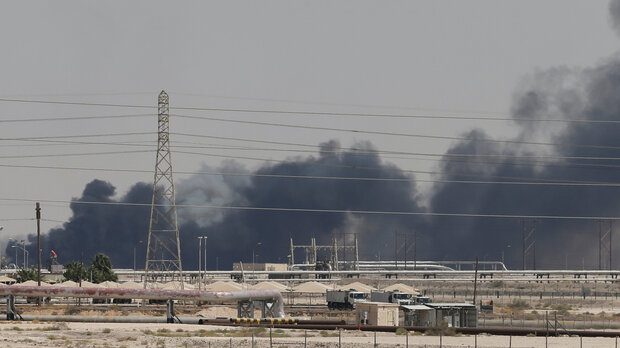
Former US President Barak Obama’s strategy of “pivot to east” which was based on the above mentioned fact is now confirmed by Donald Trump after recent drone attack on Saudi Aramco oil installations.
Despite the US independence of the Persian Gulf energy, the country will not close its eyes on controlling the energy routes in the region to keep pressure on rivals like China.
A report by Rystad Energy shows that production of shale oil in the US has changed the country to enjoy the biggest oil reserves in the world. (264 billion barrels). 50 percent of the US oil reserve is shale oil. The report says the US shale oil production is going to exceed 14.5 million barrel a day.
In 2012 the US Department of Energy announced that production of shale oil would have been economical if the price of the oil had been above 54 dollar for a barrel, but World Energy agency findings showed that the price for each barrel of oil should be over 60$ if the shale oil production is going to be economically justified.
Development of shale oil production has paved the way for Washington to use it as a political tool against other major oil producers in the world to materialize its geopolitical goals. Sanctioning of major oil producing countries and creating tensions in oil rich regions like Persian Gulf by the US in recent years all can be interpreted in line with the US efforts to position itself as a major player in world energy market.
Reuters in a September 2019 report revealed that overall exports of crude and refined products by state-run oil company Petroleos de Venezuela (PDVSA) and its joint ventures declined to some 770,000 barrels per day (bpd) from 992,565 bpd in July and 1.13 million bpd in June, according to revised data. It is noteworthy that the countries oil production was 2 million and 373 thousand barrels a day in 2016.
Iran’s oil production has also decreased some 1.5 to 2 million barrels a day during the last 10 years due to the US sanctions.
Washington is also trying to reduce the Russia’s share of global oil market by slapping sanctions against the country and threatening its European consumers.
The US’ green light to Saudi Arabia to attack Yemen which led the country to a quagmire can also be interpreted in line with the US efforts to grab its ally’s share of oil market to materialize its geopolitical goals. A couple of days ago Yemeni’s retaliatory drone attack on Saudi Aramco oil plant forced Saudi Arabia to cut half of its oil production and immediately the US announced Washington is ready to replace Saudi oil in the world market. In the long term this can result in grabbing of Saudi share of market by the US.
By sanctioning oil producing countries and creating tensions in oil rich regions the US is pursuing its geopolitical goals:
First, by disrupting existing major exporters including Saudi Arabia, Venezuela, Iran and Russia and raising prices, the US is able to make its own exports more competitive. Second, grabbing share of other producers by tools of sanction and disturbing their oil export. Third, containing and keeping pressure on rivals like China, EU and Japan by creating tensions in Persian Gulf which their economies are heavily dependent on the oil coming from the region. Fourth, creating a lucrative market for the US military industry and weapons by adding to tensions in the Persian Gulf region. Saudi Arabia has been the world biggest weapon importer in 2018. Fifth, keeping pressure on Persian Gulf nondemocratic kingdoms who are reluctant to join the US proposed naval security mission in Strait of Hormuz.

Sunday, January 13, 2019

Reasons behind the eventual withdrawal of Kuwait from PGCC

By Javad Heirannia 
TEHRAN - After several years since the beginning of Syria crisis, the Persian Gulf Arab states are changing their policies towards this county, and following the move of UAE and Bahrain, Kuwait will soon expand its relations with Syria.
Along with this policy change, the Arab leaders of Persian Gulf countries are warming up their ties with Israel. 
The Arab-Israel relations get closer but Kuwait does not agree with this policy and intends to maintain its foreign policy outside Israeli influence, but it’s possible as a result Kuwait might be separated from the PGCC.
In this regard, it should be noted that the Persian Gulf Cooperation Council was an organization that was set up in 1981 to control Iran and was attempting to take steps to control Iraq, too.
Alongside these issues, the international and regional powers’ role in influencing these countries also reflects the lack of trust between the PGCC countries. For instance, while Qatar hosts a Turkish military base, this is seen as a threat to Saudi Arabia, the UAE and Bahrain.
A recent international summit was held in Doha, Qatar, by high-profile figures, while earlier the Persian Gulf Cooperation Council summit in Riyadh took place with the absence of Qatar, Oman and the UAE’s leaders. 
By holding this important summit and gathering outstanding international figures from Iran, Turkey and Russia, Qatar has shown that it could be more widely recognized in the international arena despite the hostile actions of the Persian Gulf Arabs states with the Doha blockade.
On December 12, 2019, Riyadh hosted the first Arab-African conference of foreign ministers of six countries bordering the Red Sea and the Gulf of Aden, a strategic area vital to global shipping.
During the summit an agreement was made on the establishment of a legal regime for the Red Sea and the Gulf of Aden. The objective of the Red Sea and Gulf of Aden regime was to support world trade, international shipping lanes, regional stability and the investment and development of the member states. The plan, proposed by the King of Saudi Arabia, will be implemented in pursuit of security and stability in the region.
The Saudi Ministry of Foreign Affairs announced on December 12 that Saudi Arabia agreed to establish a Red Sea regulatory regime aimed at strengthening security and investment in the Red Sea bordering countries.
According to the statement, the seven countries are Saudi Arabia, Egypt, Sudan, Djibouti, Yemen, Somalia, and Jordan. 
The conference also features a new Saudi-led regional bloc that shows the Persian Gulf Cooperation Council's failure.
Regarding the normalization of relations with Tel Aviv and the “deal of the century”, we are also seeing disagreements among members of the Council. Kuwait is one of the countries that disagrees with the policy of normalization of relations with Israel by some member states of PGCC. Kuwait has never wanted to be dominated by the Saudis. We also see a sharpening of the country's disagreements with Saudi Arabia over joint oil fields, too.
This disagreement is over the Neutral Zone, and area of about 5,700 square kilometers. Its dividing line begins north of Khafji oil field  and runs straight to the west.
Kuwait disagrees with the resumption of oil extraction from the neutral zone without its recognition, and calls for its control as a Kuwaiti-dominated area.
Kuwait has discovered that Saudi Arabia is not a true friend of the Persian Gulf states, but an interventionist in the Persian Gulf states' internal affairs.
Kuwait knows that the deal Saudi Arabia and its allies, the Emirates and Bahrain made with Qatar may repeat with Kuwait and Oman. In fact, what caused Qatar not to invade Saudi Arabia, Bahrain and the UAE was the resistance and meddling of Kuwait and Oman.
Accordingly, Kuwait seeks to strike a balance between the three countries. Although Kuwait has military and security ties with the U.S., it well knows that the U.S. is constantly threatening regional security. No one has forgotten what Trump said about  Saudi Arabia, : “You might not be there for two weeks without us”.

Wednesday, September 05, 2018

European army is much closer to aspiration than reality: Jenkins

By Javad Heirannia


TEHRAN - Peter Jenkins, former UK Ambassador to the IAEA and UN says that “In theory, Europe is perfectly capable of forming a treaty-based collective security organisation from which the United States and Canada (and maybe the United Kingdom) are excluded.”
Former associate fellow of the Geneva Centre for Security Policy also adds that “It is doubtful whether that is what France and Germany are aiming to achieve in the near to medium future, and doubtful whether at this stage pan-European political will for that could be mobilised.”
He adds that “European army is much closer to being an aspiration than a reality.”
Following is the full text of the interview:
Q: How do you evaluate “speeches of Macron, President of French about that Europe should no longer rely on America In terms of security“?
A: I think this is an important statement because it came only a few days after a call for a more independent Europe from Germany’s Foreign Minister, and some 15 months after a similar call from Chancellor Angela Merkel at a public meeting in Munich. Historically (by which I mean since the Second World War) France has championed a more independent European defense policy and Germany has reacted cautiously, reluctant to take any step that might affect the U.S. commitment, under Article 5 of the 1949 North Atlantic Treaty, to come to Europe’s defense in case of need. Now, it seems, France and Germany are becoming like-minded on this crucial question.
Q: With the arrival of the Trump to the White House and his criticism of the European countries regarding NATO's share, Europe had begun its efforts to form a joint European army. According to Macron’s speeches, it seam formation of a joint European army take more seriousness. What is your opinion?
A: Back in the 1980s, if memory serves, Germany acquiesced in a French proposal to form a Franco-German brigade, based near Strasbourg. That initiative was rich in symbolism but of little practical significance. Now the talk is of a joint European army. I think this has more to do with Franco-German perceptions that the United States is becoming a more erratic ally, less trustworthy than for most of the last 70 years, more prone to making huge foreign policy misjudgements, than with Trump kicking up a fuss about the inadequacy of European contributions to NATO defense.  I suspect, however, that at this stage a European army is much closer to being an aspiration than a reality.
Q: Is Europe essentially capable of being independent of America in terms of security? If so, what will be the future of NATO?
A: In theory, yes, Europe is perfectly capable of forming a treaty-based collective security organisation from which the United States and Canada (and maybe the United Kingdom) are excluded. But it is doubtful whether that is what France and Germany are aiming to achieve in the near to medium future, and doubtful whether at this stage pan-European political will for that could be mobilised. It is more likely that for the foreseeable future NATO will co-exist alongside the development of a more pronounced and more practically effective EU defense identity.
I referred just now to the United Kingdom. Historically the UK has been opposed to greater European integration in the defence sector, for fear of jeopardising NATO. This is likely to remain the UK position for the foreseeable future, not least because of very close ties between UK and US military and intelligence services, although a Labour government led by Jeremy Corbyn would sympathise with what Macron, Maas and Merkel have been saying about Europe and implying about the United States. But, if the UK withdraws from the EU, France and Germany will find it easy to ignore British views, and probably will.
Q: Some analysts have interpreted Macron's speeches as a new Western order. Will the West enter a new era of order and independence from the United States?
A: That is the direction in which France and Germany seem to want to travel. They are starting to imagine a world in which Europe can no longer rely on or cooperate with the United States to the extent that has been the norm since 1945, and must therefore acquire the capacity to be an independent pole in a multipolar international order. But this will not come about overnight. It will take many years.
Q: Macron also said that Russia should also be involved in European security issues. How do you assess this position?
A: That, too, is very significant. During the Cold War, especially when General De Gaulle was president of the French Republic, France tended to be less fearful of, and less hostile towards the Soviet Union than the United States and other NATO members. General De Gaulle used to talk of a Europe stretching from the Atlantic to the Urals. Since 2007 this historic tendency seems to have been in conflict with an un-Gaullist Atlanticism, and even with a certain neoconservatism imported from the United States. Now Macron seems to be reviving the Gaullist perspective and contemplating a European security framework that would indeed stretch to the Urals. Defense cooperation with Russia and mutual respect for European and Russian interests would replace unperceptive threat assessments, demonization of Russia’s leaders, and insensitivity to Russian interests.  But winning European support for this vision will not be easy. Poland and the Baltic states in particular prefer to see Russia as an ever-present threat to their territorial integrity or even survival. It will take a lot to convince them to look on Russia as a potential partner.    

EU help to Iran is not serious: Hunter

By Javad Heirannia


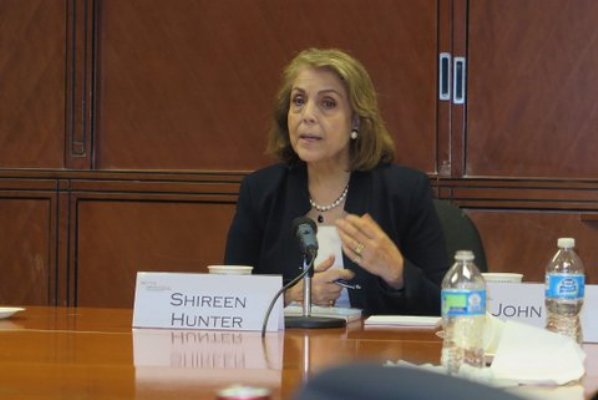
TEHRAN - Shireen Tahmaasb Hunter, a professor of political science at Georgetown University, tells the Tehran Times that that “Europe wants to keep Iran committed to JCPOA, and thus makes some vague promises, but it is not willing to give Iran serious help.”
“It was recently reported that the EU will offer 18million euros for some projects in Iran. This is not serious,” Hunter tells the Tehran Times.

She adds the Europe does not want to escalate confrontation with America for the sake of Iran.

Following is the text the interview:

Q: Some argue that the European Union laws does not have an effect to protect Iran against the impact of U.S. sanctions. In other words, the law is a new version of the "Blocking Statute" that the European Union approved in 1996 to protect Cuba against U.S. sanctions. In your opinion, how much this law is effectiveness to protect Iran against U.S. sanctions?
A: The current laws are not very effective in countering American sanctions. Moreover, the real issue is that Europe does not want to escalate confrontation with America for the sake of Iran. Economic relations between U.S. and Europe are very extensive and any gain with Iran cannot compensate for the loss of U.S. markets. I believe Europe is using the Iran issue to discredit Trump and increase its own bargaining power in matters more important for Europe. Iran is becoming a tool in Europe's hands in confrontation with Trump.
Q: Previously, in 1996, without the Europe support, America put sanction on Cuba, and Europe did not accept these sanctions. Nowadays Is Europe still able to resist U.S. sanctions against Iran?
A: Iran issue is more complicated than Cuba because it is linked to other Middle East -related issues. Europe has very little economic relations with Cuba. Moreover, America was not so keen in getting European cooperation regarding Cuba than it has been vis a vis Iran. The main issue is that Europe does not want to endanger its economic interests in America for Iran's sake.
Q: In Europe, economic companies have the right to choose and freedom, and the EU also does not want to restrict this freedom. Does the EU can push the companies to work with Iran? How the EU can force the companies to cooperate with Iran?
A: European countries can encourage their companies to invest in some countries, but they cannot force them. Moreover, given the current conditions, European governments are not themselves interested in seriously helping Iran. It was recently reported that the EU will offer 18million euros for some projects in Iran. This is not serious. Europe wants to keep Iran committed to JCPOA, and thus makes some vague promises, but it is not willing to give Iran serious help. This is because Europe, too, is unhappy with many aspects of Iran's foreign policy behavior. The fact is that Iran's options are very limited. If it exits JCPOA, it could face military attack or more severe sanctions and other economic pressures.

Monday, September 03, 2018

Europe able to resist U.S. sanctions on Iran, but unwilling to do: Chomsky

By Javad Heirannia


TEHRAN – Noam Chomsky asserts that Europe is able to resist U.S. sanctions on Iran, but will probably be unwilling to do so.
In an exclusive and yet short interview with the Tehran Times, the renowned U.S. academic also says Europe is unlikely to confront with a “very dangerous U.S.”

Following is the text of Tehran Times’ interview with Chomsky:

Q: Some argue that the European Union law cannot protect Iran against the impact of U.S. sanctions. In other words, the law is a new version of the "Blocking Statute" that the European Union approved in 1996 to protect Cuba against U.S. sanctions. In your opinion, how much this law is effective to protect Iran against U.S. sanctions?
A: It could be effective if the EU were willing to employ it, but that would mean a direct confrontation with a very dangerous U.S., which Europe is unlikely to be willing to pursue.
Q: Previously, in 1996, without the European support, the U.S. put sanctions on Cuba. Is Europe now able to resist U.S. sanctions against Iran?
A: It’s not at all clear that Europe did not accept the Cuba sanctions in practice, whatever they may have said in words.  Europe is able to resist U.S. sanctions, but will probably be unwilling to do so.
Q: In Europe companies have the right to choose where to do business activities, and Europe also does not want to restrict their freedom. Does the EU can push the companies to work with Iran? How the EU can force the companies to cooperate with Iran?
A: Probably not, but the situation is unlikely to arise.