
By Palestine Chronicle Staff
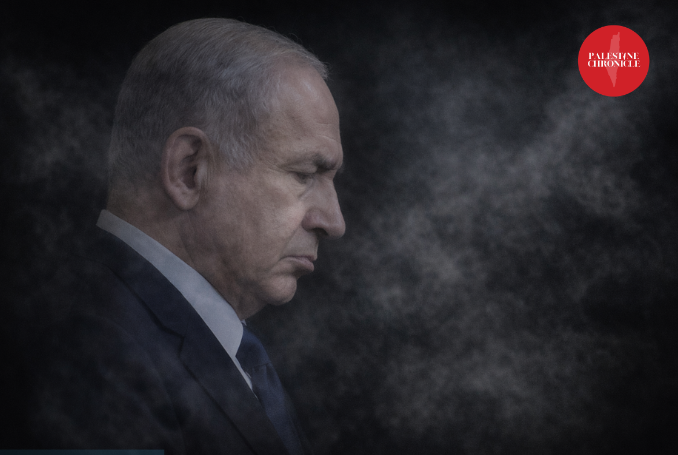 Netanyahu faces mounting criticism over a strategy that his critics say has failed to deliver strategic gains on any front. (Photo Illustration: Palestine Chronicle)
The announcement of a US-Iran agreement triggered an extraordinary backlash in Israel, with critics accusing Netanyahu of presiding over a historic strategic defeat.
Key Developments
- Opposition leader Yair Golan described Netanyahu as “the father of Israel’s greatest strategic failure.”
- Former Defense Minister Benny Gantz called the agreement a “strategic failure” that could burden Israel for years.
- National Security Minister Itamar Ben-Gvir rejected the deal and insisted Israel was not bound by its terms.
- Finance Minister Bezalel Smotrich described the agreement as “bad for Israel.”
- Pro-Netanyahu media figures criticized Trump, his advisers, and the negotiation process itself.
- The US-Iran agreement unleashed a wave of criticism across Israel’s political and media landscape.
While many opponents attacked the deal itself, others used the moment to accuse Prime Minister Benjamin Netanyahu of mismanaging relations with Washington and presiding over a major strategic setback.
Though Netanyahu has yet to issue a comprehensive public response to the agreement, politicians from across the Israeli political spectrum, alongside commentators closely associated with his government, reacted with alarm, anger, and accusations of strategic failure.
‘Greatest Strategic Failure’
Among the harshest critics was Yair Golan, head of Israel’s Democrats Party, who described the agreement as evidence of years of failed policy under Netanyahu.
“Israeli citizens are waking up to an agreement between the United States and Iran made over Israel’s head,” Golan wrote on X.
He accused Netanyahu of projecting a false image of security while leaving Israel strategically weakened.
“Netanyahu is the man who, for years, sold the public a false image of ‘Mr. Security,’ and in reality became the father of Israel’s greatest strategic failure in its history,” Golan said.
According to Golan, Netanyahu’s promised “total victory” ended with Israel’s adversaries stronger and Israel’s deterrence weakened.
He concluded that replacing Netanyahu was no longer merely a political issue but “an existential security imperative.”
‘A Strategic Failure’
Former Defense Minister Benny Gantz echoed those sentiments.
The leader of the Blue and White Party described the agreement as a strategic setback that would force Israel into years of diplomatic, military, and legal struggles.
“The emerging agreement with Iran appears to be a strategic failure,” Gantz wrote, warning against any arrangement that could restrict Israel’s operations in Lebanon or require withdrawals that, in his view, would endanger northern settlers.
His remarks reflected a broader concern among Israeli political figures that Lebanon has become a central component of the agreement and that international pressure may grow for Israel to alter its military posture there.
Ben-Gvir and Smotrich Reject the Deal
National Security Minister Itamar Ben-Gvir issued one of the strongest rejections of the agreement.
“Israel is not subject to the United States, and we are an independent and sovereign nation,” he wrote on X.
Ben-Gvir insisted that Israel was not a party to the agreement and therefore not bound by its provisions.
He also rejected any suggestion of withdrawing from areas occupied during the war and reiterated calls for the dismantling of Hezbollah.
Finance Minister Bezalel Smotrich similarly condemned the agreement, describing it as “bad for Israel and for the entire free world.”
Smotrich argued that Israel would have to continue efforts to weaken Iran independently and prevent Tehran from obtaining nuclear capabilities.
Netanyahu’s Allies Turn on Trump
The reaction was not limited to politicians. Some of the most striking criticism came from media figures traditionally aligned with Netanyahu and the Israeli right, several of whom directed their anger not at Tehran but at Trump and members of his inner circle.
Yinon Magal, a prominent presenter on Channel 14 and one of the country’s most influential pro-Netanyahu commentators, argued that Trump had emerged weakened from the negotiations.
Magal criticized Vice President JD Vance and accused advisers including Jared Kushner and Steve Witkoff of helping shape a diplomatic process that ignored Israeli interests.
“We’re left alone,” Magal wrote.
‘To Be America’s Friend Is Fatal’
Other commentators echoed similar sentiments. Channel 14 commentator Shimon Riklin argued that Trump’s handling of the negotiations risked weakening American influence.
Political analyst Amit Segal invoked one of the most famous quotations associated with former US Secretary of State Henry Kissinger.
“It may be dangerous to be America’s enemy, but to be America’s friend is fatal,” Segal wrote.
The quote quickly circulated across Israeli political and media circles, becoming one of the defining reactions to the agreement.
Growing Strains
The backlash also highlighted signs of a widening gap between Washington and Tel Aviv.
According to reports cited by Al Mayadeen, Netanyahu has privately blamed several figures close to Trump—including Kushner and Witkoff—for contributing to disagreements between the US and Israeli leaderships over Iran and regional policy.
Reports from NBC News and CNN suggest Netanyahu is now seeking an urgent meeting with Trump following the G7 summit amid growing concern over the implications of the agreement.
(Israeli Media, AA, X, CNN, PC, AL Mayadeen)

No comments:
Post a Comment