
By Robert Inlakesh
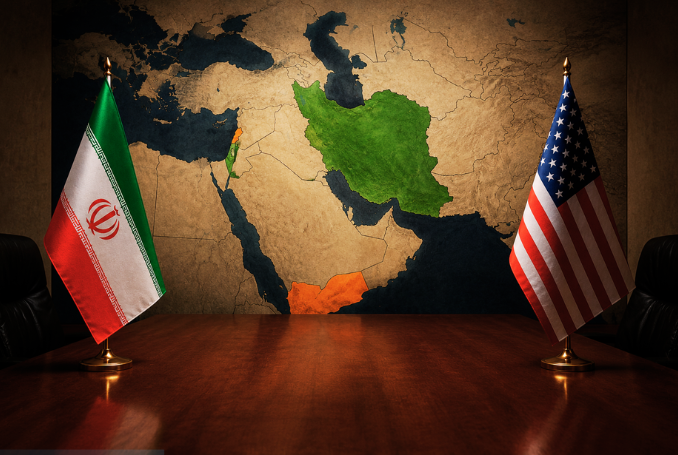 A closer look at the agreement that could reshape the Middle East. (Image Design: PC)
If this deal is going to work, it will ultimately be the best possible result for the US and its Gulf allies, but will spell a resounding and historic victory for Iran.
The recently announced Memorandum of Understanding (MoU) is both an indication of historic US failure while also containing various seemingly ambiguous clauses that don’t necessarily represent a victory for Iran in the long run, as the conflict could indeed return.
Without accessing the full text of the Iran-US MoU, we have been able to get a glimpse into what has been put on the table and can at least grasp how this preliminary deal aims to unfold. The fine details appear to be in dispute, assuming that the MoU actually hashes out these details in anything beyond vague understandings, but that does not impact our ability to read the bigger picture.
After two months of deadlock in the Iran-US negotiations, with full-scale conflict almost renewed last week, the US President suddenly announced that a deal had been reached and that the war was over. At that time, the final details were being hashed out, but it was clear that significant bridges had been gapped through mediators during the course of tit-for-tat warfare throughout the week.
Read Then the Israelis decided the following morning to violate Iran’s newly imposed red line; they bombed the southern suburbs of Beirut. Iran’s Islamic Revolutionary Guard Corps (IRGC) vowed to respond, but before they could – so the publicly revealed narrative goes – the Trump administration rushed to the table with brand-new concessions and managed to close a deal. Ultimately, after having been promised a full ceasefire in Lebanon, the Iranians agreed not to strike Israel in retaliation for their attack.
An Extension of a Temporary Ceasefire
Trump’s decision to suddenly promise the Iranians most of what they have been demanding came suddenly and at a questionable time. The global economy was heading towards a real breaking point, the US President’s approval rating was on the floor, and he was clearly running out of time.
From the perspective of a US imperialist, the Iran war has represented an enormous strategic miscalculation, and ending the war is clearly in Washington’s interests. However, the Israel Lobby and Zionists within the Trump administration itself appear to oppose ending the war without dealing any serious blow to the Islamic Republic.
There are therefore three likely scenarios under which the Trump administration decided to go through with ceding to Iranian demands:
- The Trump administration has sidelined Israel and decided that it is not worth continuing to pursue its regime change war against Iran.
- This is an ongoing good-cop bad-cop strategy designed to trick the Iranians and buy time before a future attack.
- Stuck without a coherent plan, the Trump administration has decided to offset the economic fallout from the conflict by reaching a partial agreement that will open the Strait of Hormuz, at least temporarily, to delay further conflict.
Only time will tell which of the three reasons was the true motivator behind reaching this MoU. Regardless of the reasons, the agreement is supposed to begin on Friday and last 60 days in total, playing out in phases, the first of which will open the Strait of Hormuz. The biggest challenge ahead is getting the Israelis to apply with perhaps the most important clause, that the war ends on all fronts, including Lebanon.
If the Israelis do not withdraw from Lebanese territory, then the deal will go nowhere. It is possible that the Israelis will pledge to fulfill a phased drawdown inside southern Lebanon, but have stressed it will remain inside its “buffer zone”. The exact strategy they used as far back as 1982, which led to a full occupation of southern Lebanon at the time.
On the face of things, the deal is a total admission of US defeat, but if it were to be fully implemented, it would mean the strategic defeat of Israel and that its “seven-front war” fought since October 7, 2023, has been a flat-out failure.
Iran will not charge a “toll” in the Strait of Hormuz; instead, it will charge a fee. There is indeed a legal distinction between the two, but the outcome is the same: the Iranians will become rich off of controlling the Strait of Hormuz.
Again, assuming the deal goes through, the Iranians will get access to a $300 billion reconstruction fund, have all sanctions lifted, sell oil freely for the first time in decades and get its assets unfrozen. On top of this, all its allied fronts would get a ceasefire agreement that ends Israel’s expansionist attacks.
Beyond this, the outcomes translate to a dominant Iran that will enjoy an enormous amount of influence over the Arab Gulf States and will likely attract an enormous amount of investment from them too. Militarily, they will be the top regional power, with the ability to lock down the global economy at the flick of a switch.
The newfound position of dominance would destroy not only the “Greater Israel Project,” perhaps for good, but would further the isolation of the Zionist entity. All in all, this is the exact opposite of what the Israelis hoped to achieve by launching their war of aggression. Neither side can claim to have totally defeated the other’s military; both landed enormous blows, but at the end of the day, the Iranians had all the important cards and are still able to play more if need be.
So, on paper, this is actually a major victory for Iran. But as we have seen from past examples – i.e., the Gaza ceasefire and Iran-US temporary ceasefire earlier this year – things don’t exactly play out how they are set out to, especially when you are dealing with Trump and Israeli PM Benjamin Netanyahu.
As of now, there is actually no deal that ends the war between the US-Israeli alliance and Iran; instead, there is a 60-day ceasefire period during which each side will commit to de-escalatory steps so that negotiations can proceed without continued hostilities.
It is a massive win for the global economy, but in reality, what has happened is that we have reached a more structured version of the temporary ceasefire that was implemented on April 8.
The Iran-US temporary ceasefire was initially supposed to open the Strait of Hormuz and achieve a cessation of hostilities on all fronts, until Israel ordered strikes on Beirut that killed around 300 civilians in 10 minutes. Iran’s initial list of its 10 points was quickly publicly disregarded by the Trump administration, which meant that the Strait continued to be closed.
Although the two-week ceasefire was initially extended, what ended up happening was that it technically ended, but remained partially in place. The Memorandum of Understanding simply means we now have a more formal version of the initial temporary ceasefire agreement. Even if you follow the statements coming from officials in Tehran, including Iranian President Masoud Pezeshkian, they state that there is not yet a deal to end the war, but that they are working towards one.
If this deal is going to work, it will ultimately be the best possible result for the US and its Gulf allies, but will spell a resounding and historic victory for Iran, while the Israelis will taste an enormous defeat. From there, the next major challenge will be what the Israelis choose to do in Gaza and whether the Iranians actually choose to intervene on behalf of this front, because the only way the Israelis can manage to achieve a return to the pathway towards renewing their attacks on Iran is through the Gaza front.
In order for this to work out positively, it will take courage from the Trump administration, which will have to put Israel in its place. Whether that is even conceivable is doubtful, given the US President’s current track record.

– Robert Inlakesh is a journalist, writer, and documentary filmmaker. He focuses on the Middle East, specializing in Palestine. He contributed this article to The Palestine Chronicle.

No comments:
Post a Comment