Showing posts with label NOAM CHOMSKY. Show all posts

Tuesday, May 28, 2019

From BRI to Clash of Civilization: Beijing conference refutes Huntington

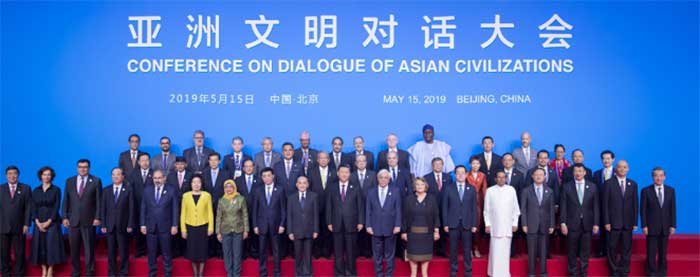
China hosted a two-day Conference on Dialogue of Asian Civilizations (CDAC), to boost exchanges and mutual learning among Asian civilizations. The CDAC theme was “Exchanges and Mutual Learning among Asian Civilizations and A Community with A Shared Future.”
It brought together more than 2,000 government officials and representatives of various circles from 47 Asian countries and other nations outside the region.
Among those attending were: King of Cambodia Norodom Sihamoni, Greek President Prokopis Pavlopoulos, Singapore President Halimah Yacob, Sri Lankan President Maithripala Sirisena and Armenian Prime Minister Nikol Pashinyan.
In his inaugural address, the President of China, Xi Jinping, underlined that this Conference  “creates a new platform for civilizations in Asia and beyond to engage in dialogue and exchanges on an equal footing to facilitate mutual learning”.
President Xi highlighted the importance of the interactions in Asia, as these interactions between civilizations “have enriched each other and written an epic development”. He elaborated also:
“Our forefathers in Asia have long engaged in inter-civilizational exchanges and mutual learning; the ancient trade routes notably the Silk Road, the tea road and the spice road brought silk, tea, porcelain, spices, paintings and sculpture to all corners of Asia, and they have witnessed inter-civilizational dialogue in the form of trade and cultural interflow.”
“No civilization is superior over others. The thought that one’s own race and civilization are superior and the inclination to remold or replace other civilizations are just stupid,” the Chinese leader said adding:
“All civilizations are rooted in their unique cultural environment. Each embodies the wisdom and vision of a country or nation, and each is valuable for being uniquely its own. Civilizations only vary from each other, just as human beings are different only in terms of skin color and the language used. No civilization is superior over others. The thought that one’s own race and civilization are superior and the inclination to remold or replace other civilizations are just stupid. To act them out will only bring catastrophic consequences…. What we need is to respect each other as equals and say no to hubris and prejudice.”
Pehaps Xi was alluding to Huntington’s theory of Clash of Civilizations. In 1992, American political scientist Samuel P. Huntington proposed the hypothesis of the Clash of Civilizations that people’s cultural and religious identities will be the primary source of conflict in the post-Cold War world. Huntington later expanded his thesis in a 1996 book The Clash of Civilizations and the Remaking of World Order.
Huntington argued: “It is my hypothesis that the fundamental source of conflict in this new world will not be primarily ideological or primarily economic. The great divisions among humankind and the dominating source of conflict will be cultural. Nation states will remain the most powerful actors in world affairs, but the principal conflicts of global politics will occur between nations and groups of different civilizations. The clash of civilizations will dominate global politics. The fault lines between civilizations will be the battle lines of the future.”
In short, Huntington suggests that in the future the central axis of world politics tends to be the conflict between Western and non-Western civilizations. Huntington divided the world into the “major civilizations” in his thesis as such:
Western civilization comprising the United States and Canada, Western and Central Europe, Australia and Oceania; Latin American, Includes Central America, South America; The Orthodox world of the former Soviet Union; The Eastern world is the mix of the Buddhist, Chinese, Hindu, and Japonic civilizations; The Muslim world of the Greater Middle East, (the Islamic civilization) and The civilization of Sub-Saharan Africa located in southern Africa, Middle Africa.
Huntington’s hypothesis was criticized by various academic writers. They challenged his claims empirically, historically, logically, or ideologically.
Edward Said
Edward Said, the late University Professor of English and Comparative Literature at Columbia University,  issued a response to Huntington’s thesis in his 2001 article, “The Clash of Ignorance”. Said argues that Huntington’s categorization of the world’s fixed “civilizations” omits the dynamic interdependency and interaction of culture. Edward Said (2004) also argues that the clash of civilizations thesis is an example of “the purest invidious racism, a sort of parody of Hitlerian science directed today against Arabs and Muslims” (p. 293).
According to Edward Said “Huntington is an ideologist, someone who wants to make “civilizations” and “identities” into what they are not: shut-down, sealed-off entities that have been purged of the myriad currents and countercurrents that animate human history, and that over centuries have made it possible for that history not only to contain wars of religion and imperial conquest but also to be one of exchange, cross-fertilization and sharing.
“This far less visible history is ignored in the rush to highlight the ludicrously compressed and constricted warfare that “the clash of civilizations” argues is the reality. When he published his book by the same title in 1996, Huntington tried to give his argument a little more subtlety and many, many more footnotes; all he did, however, was confuse himself and demonstrate what a clumsy writer and inelegant thinker he was.
“These are tense times, but it is better to think in terms of powerful and powerless communities, the secular politics of reason and ignorance, and universal principles of justice and injustice, than to wander off in search of vast abstractions that may give momentary satisfaction but little self-knowledge or informed analysis. “The Clash of Civilizations” thesis is a gimmick like “The War of the Worlds,” better for reinforcing defensive self-pride than for critical understanding of the bewildering interdependence of our time.”
Noam Chomsky
Noam Chomsky called it just being a new justification for the United States “for any atrocities that they wanted to carry out”, which was required after the Cold War as the Soviet Union was no longer a viable threat.
“We have to support oppressive states, like Saudi Arabia and others, to make sure that they guarantee that the profits from oil (it’s not so much the oil as the profits from oil) flow to the people who deserve it: rich western energy corporations or the US Treasury Department or Bechtel Construction, and so on. So that’s why we need a huge military budget. Other than that, the story is the same,” Chomsky said in a lecture delivered at the Delhi School of Economics on November 5, 2001.
He went on to say: “What does this have to do with Huntington? Well, he’s a respected intellectual. He can’t say this. He can’t say, look, the method by which the rich run the world is exactly the same as before, and the major confrontation remains what it has always been: small concentrated sectors of wealth and power versus everybody else. You can’t say that. And in fact if you look at those passages on the clash of civilizations, he says that in the future the conflict will not be on economic grounds. So let’s put that out of our minds. You can’t think about rich powers and corporations exploiting people, that can’t be the conflict. It’s got to be something else. So it will be the ‘clash of civilizations’ – the western civilization and Islam and Confucianism.”
Jochen Hipplier
Jochen Hipplier, author of The Next Threat: Western Perception of Islam, has said: By caricaturing different cultures, by arbitrarily and willfully misrepresenting Islamic societies we grant ourselves absolution. Others are fanatical, we are not. Other are irrational, we are not.  Furthermore, it is clearly very important for us in the West to feel superior and to see Western culture as the ‘best’ and ‘most progressive.
The term civilization is usually used in the singular to mean Western civilization which since the eighteenth century has been in the West as the civilization that has set about to destroy and obliterate systematically all other civilizations including the Islamic.
To borrow from Hippler: In a certain sense you could call Huntington’s argument ‘culturally racist’. The Muslims (or Chinese) are different from us and therefore dangerous. Unlike in classic racism, this difference is not generically but culturally-based. There is such a gulf between their values and ways of thinking and ours that understanding or cross-pollination is almost unthinkable. Only military solutions can promise result.
Hippler further elaborates this point very convincingly: Huntington’s image of Islam (or of other Asian cultures) is hardly original. It follows the current stereotypes and clichés of popular literature and some of the media. Yet he manages brilliantly to embellish these repeated fears pseudo-scientifically and elevate them ideologically. His success is in making the old clichés acceptable in foreign policy debate. For Huntington, Islam is ideologically hostile and anti-Western. It is also a military threat in itself due to Chinese (Confucian) arms supplies. Islam is bloody, with a long warring tradition against the West. (The fact that Muslims have often been the victims rather than the perpetrators of violence from Bosnia to India hardly troubles him.)
According to Stephen M. Walt, The Clash of Civilizations is also strangely silent about Israel, which has been a central concern for U.S. foreign policy since its founding in 1948. During the Cold War, U.S. support for Israel could be justified on both ideological and strategic grounds. From a cultural perspective, however, the basis for close ties between Israel and the “West” is unclear. Israel is not a member of the West (at least not by Huntington’s criteria) and is probably becoming less “Western” as religious fundamentalism becomes more salient and as the Sephardic population becomes more influential. His silence on this issue may reflect an awareness that making this conclusion explicit would not enhance the appeal of the book, or Israel may simply be an anomaly that lies outside of his framework. In either case, however, the issue reveals a further limitation of the civilizational paradigm. [Building Up New Bogeyman by Stephen M. Walt- Foreign Policy, Spring 1997]
Abdus Sattar Ghazali is the Chief Editor of the Journal of America (www.journalofamerica.net) 

Wednesday, April 24, 2019

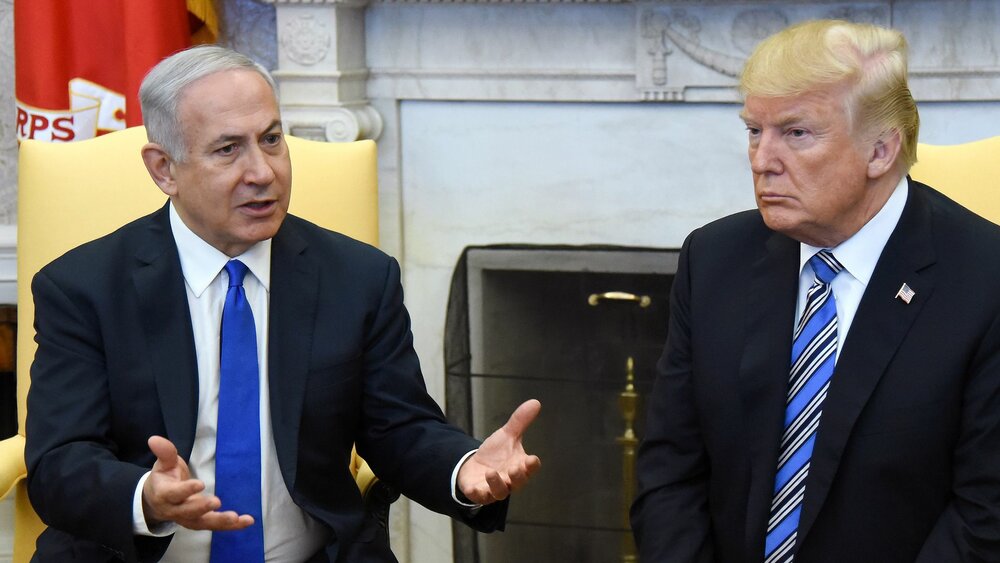
Chomsky: Trump radically interfered with Israel’s election to help re-elect Netanyahu

Israel Prime Minister Benjamin Netanyahu is headed to a record fifth term in office after narrowing defeating former military chief Benny Gantz. In a discussion with Democracy Now!’s Amy Goodman, Noam Chomsky talks about how President Trump directly interfered with the Israel election by repeatedly helping Netanyahu, from moving the U.S. Embassy to Jerusalem to recognizing Israel’s sovereignty over the Golan Heights in defiance of international law.
AMY GOODMAN: Noam, what about what’s happened in Israel, Prime Minister Netanyahu winning a record fifth term? Right before the election, he announces that he will annex illegal Israeli settlements in the occupied West Bank. Last month, Trump officially recognized Israeli sovereignty over the Golan Heights.
NOAM CHOMSKY: Well, first of all, if Benny Gantz had been elected instead of Netanyahu, the difference would not be very great. The difference between the two candidates is not substantial in terms of policy. Netanyahu—here’s another example of the extraterritorial reach of the United States. Netanyahu is somewhat more extreme. The United States desperately wanted him to be elected. And the Trump administration has been giving gift after gift to Netanyahu to try to get him elected. It was enough to carry him over the roughly 50/50—close to 50/50 election.
One of them, of course, was to move the embassy to Jerusalem, in violation of not only international law, but even Security Council resolutions that the U.S. had participated in. A very dramatic change.
A second, equally dramatic, was to authorize Israeli annexation of the Golan Heights. The Syrian Golan Heights are, under international law, occupied territory. Israel—every major institution, every relevant institution, Security Council, International Court of Justice, all agree on this. Israel did formally annex the Golan Heights. But the Security Council, U.N. Security Council, with the U.S. participating, declared that null and void. OK? Trump unilaterally reversed it—another gift to Netanyahu, saying, try to demonstrate to the Israeli public that, with U.S. backing, he can get anything they want.
The last was Trump’s latest, just before the election, his declaration that, if elected, he would annex parts of the West Bank. That was with tacit U.S. authorization.
These are strong measures that were taken to interfere radically with a foreign election. Have you heard something about how terrible it is to interfere in foreign elections? I think maybe that you noticed that somewhere. Here, it’s done radically. It’s considered fine. But exactly what are the actual consequences of that in terms of the way policy has been evolving? Fact of the matter is, not much.
So, take the annexation of the Golan Heights. In fact, it was declared null and void by the Security Council. It was condemned by the International Court of Justice. But did anybody do anything about it? Has any move been made to prevent Israel’s development of the Golan Heights, establishment of settlements, enterprises, development of ski resorts on Mount Hermon? Anything? No, nobody lifted a finger. And nobody lifted a finger for a simple reason: The U.S. won’tallow it. Nobody says that, but that’s the fact. Well, now it’s formally authorized, instead of just happening.
Take Netanyahu’s proposal to annex parts of the West Bank. That’s been going on for 50 years, literally. Right after the ’67 war, both political parties, both major groupings in Israel—the former Labor-based party, the Likud-based conglomerate—they have slightly different policies, but essentially they have been carrying out a development program in the West Bank which is geared towards the goal, the very clear goal, of creating what will be a kind of Greater Israel, in which Israel will take over whatever is of value in the West Bank, leave the Palestinian population concentrations—like in Nablus and Tulkarm—leave them isolated. In the rest of the region, there are maybe 150 or so little Palestinian enclaves, more or less surrounded by checkpoints, often separated from their fields, able to survive, but barely.
Meanwhile, Jewish settlements are developed. Cities have been constructed—a major city, Ma’ale Adumim, constructed mostly under Clinton, incidentally, under the Clinton years, east of Jerusalem. The road to it essentially bisects the West Bank. Further ones up north. Jerusalem itself is maybe five times the size of what it ever was historically. All of these are linked by highly developed infrastructure projects. You can take a trip. You can—this is basically creating pleasant suburbs of Tel Aviv and Jerusalem in the West Bank. You can travel from Ma’ale Adumim to Tel Aviv on a big highway, restricted to Israelis and tourists, not Palestinians, more easily than you can get from the South Shore to Boston—never seeing an Arab.
All of this has been steadily developed, year after year, with tacit U.S. support. U.S. provides the diplomatic support, a lot of the economic support, the military aid. And meanwhile, the government says, “We don’t like it. Stop doing it,” but providing the means for it. Well, the only difference in Netanyahu’s statement with Trump’s tacit backing is, “I’m going to go ahead and annex it, annex all of this, instead of just developing it, subject to eventual annexation.” These are the real things that have been happening.
Now, the Netanyahu victory, as I mentioned before, solidifies an alliance that is being—that has been developed, that’s been—parts of it have been kind of undercover for years, not formal, but functioning, now coming into the open, of the most reactionary Arab states—primarily Saudi Arabia, one of the most reactionary states in the world; Egypt, under the Sisi dictatorship, the worst dictatorship in Egypt’s history; the United Arab Emirates, similar; Israel, right in the center of it. It’s part of the international right-wing alliance system, the international reactionary, ultranationalist alliance system that’s taking shape with the U.S. leadership, a kind of a new global system that’s developing. South America, under Bolsonaro, is another part of it.
AMY GOODMAN: And yet, in the United States, there’s this growing awareness. For example, the Democratic-Republican vote against Saudi Arabia-UAE’s war in Yemen, fueled by the United States. Does that give you hope?
NOAM CHOMSKY: That’s a very interesting development. That’s actually Bernie Sanders. It’s what—and notice—and it is a very important development, but let’s notice what happened. The Saudi-United Arab Emirate war in Yemen has been a hideous atrocity. There’s probably—nobody knows—maybe 60,000, 70,000 people killed, half the population barely surviving. The U.N. describes it as the worst humanitarian disaster in the world. It’s a real monstrosity. It’s been going on year after year, using—Saudi Arabia, UAE are using U.S. weapons—secondarily, British weapons—U.S. intelligence support, U.S. intelligence directly working closely with the Saudis to target bombing and so on and so forth. All of this has been happening with no protest.
Then came the Khashoggi killing, brutal killing of a journalist for The Washington Post. That caused outrage. OK? It should have, but, you know, that’s not the reason why the Yemen war should have suddenly had the spotlight shined on it. But it was. Then Bernie Sanders came along, with a couple of others, and initiated the legislation, which put some crimps in the direct U.S. support for the war. Which is significant, but we should put it in the context of what in fact happened. And I think we can be pretty confident that the Trump-Pompeo-Bolton triumvirate will find a way around it and keep the war going—unless the public seriously protests.
Now, there is something else that’s worth paying attention to. The support for Israeli expansionism, repression, the whole alliance that’s developing, that support has shifted in the United States from the more liberal sectors—roughly, the Democratic Party—to the far right. Not very long ago, support for Israel was based passionately in the liberal sectors of the population. It was a Democratic issue. It isn’t anymore. In fact, if you look in the polls, people who identify themselves as Democrats by now tend to support Palestinian rights more than Israel. That’s a dramatic change. Support for Israel now is in the most reactionary parts of the population: evangelical Christians, ultranationalists. Basically, it’s a far-right issue. Among younger people, this is even more the case.
I mean, I can see it myself, just in my own personal experience. Up until about maybe 10 or 15 years ago, if I was giving a talk at a university on Israel-Palestine, even my own university, MIT, I had to have police protection, literally. Police would try to prevent the meeting from being broken up. They wouldn’t let me walk to my car alone. I had to be accompanied by police. Meetings were broken up. Nobody was objecting to any this. It was happening all the time. That’s changed totally. And it’s a very significant change. I think that sooner or later—I hope sooner—this may lead to a shift in U.S. policy.
There are some very simple moves that could be made in U.S. policy that would change the situation in the Middle East dramatically. So, for example, one simple proposal is that the United States government should live up to U.S. law. That doesn’t sound too dramatic. The United States has laws, like the so-called Leahy Law, Patrick Leahy Law, which requires that no military aid can be given to any military organization that is involved in systematic human rights abuses. Well, the Israeli army is involved in massive human rights abuses. If the U.S. were to live up to U.S. law, we would cut off aid to the IDF, the Israeli army. That step alone would have a major effect, not just the material aid, but the symbolic meaning of it. And it’s quite possible that with the shift of public opinion, especially among younger people, there might come a point when there will be a call for the United States to follow its own laws. OK? Again, not a very dramatic appeal. And it wouldn’t even be breaking new ground.
(Source: democracynow.org) 

Sunday, March 24, 2019

Iran-End of Year (2)

Failure of enemy's different plots
The increase of Iran's power for the past 40 years has infuriated and bewildered the American officials more than anything else. That's why they have exerted their utmost to destroy or at least make problems for the Islamic Republic through a variety of plots.
The previous Iranian year was a sensitive and fateful juncture in the course of the US's plots against the Iranian nation and the Iranian nation's resistance in face of these plots. The notable part of the American plot against Iran was focused on forging anti-Iran coalitions. In view of this, Donald Trump, to draw the attention of the Ale Saud and other Arab regimes, tried to forge allegations against Iran in a bid to gather their petrodollars on the one hand and somehow divide works within the new US security plan.
According to some media, Trump, like a dealer, applies Iranophobia to blackmail Arab regimes and plunge them in sectarian wars. Abdul Bari Atwan, noted Arab analyst, believes that main aim of this coalition is not to declare war against Iran but usage of the spurious allegation of "great danger of Iran" with the purpose of normalization of ties between Arab regimes and the usurper Zionist regime. It is also aimed at pillaging the remainder of the riches of the Persian Gulf littoral sates to secure the infrastructural projects of the US which Trump had promised in his presidential campaigns.
New York Times wrote that there are big hurdles on the way of formation of such a coalition. It added the Arab officials and analysts say that, due to intricacy of ties among the regional countries, it will be difficult in practice to cooperate closely in the direction of anti-Iran goals. This American daily, referring to the restoration of sanctions within 6 months after the withdrawal of Trump from the Iran nuclear deal, added that the US officials will face problem in coordination of anti-Iran policies and pushing them beyond economic sanctions.
Marwan Mu'ashsher of Carnegie Endowment and the former Jordanian foreign minister said, "If we speak of coordination in certain domains, such a measure is already being done; but if the aim is to create a military coalition or an Arab NATO, I think it will lead nowhere." According to Stockholm International Peace Research Institute (SIPRI), the Saudi regime, with 87 billion dollars ranked among the three countries in 2015 which have the highest military expenses; while Iran's military expenses are just a fraction of this exorbitant amount and even less than UAE, Turkey and the Zionist regime. The American officials have to admit the fact that they have once more made a mistake in their calculations about Iran. The US officials, both past and present, have done whatever they could to hit Iran; but they should know that whoever behaves aggressively towards the Iranian nation it will definitely be to his own detriment.
Ayatollah Khamenei, referring to Trump's hollow remarks, said, "The overblown remarks of the American president is not a new issue as the Islamic system has faced various conspiracies; but the ill-wishers of the Iranian nation have failed to do a damn thing."
Dear listeners, the fact of the matter is that the different pressures exerted by the US and its allies against the Islamic Republic of Iran have all backfired and the Islamic Republic has turned into a role model for the Islamic freedom-seeking nations and movements. This spirit and culture of resistance has become a nightmare for the US, the Zionist regime and their partners-in-crime.
Although they resort to every possible means to conceal realities under rhetoric and fake claims of Iran's interference in the region, they cannot conceal their weakness as they have failed to belittle the Islamic Revolution in the eyes of the oppressed and downtrodden throughout the world. The noted American theorist and linguist, Noam Chomsky, said that as long as Iran remains independent and doesn't bow to the American hegemony, the US enmities and hostilities will continue. The Islamic Republic of Iran is not acceptable for the US because it doesn’t ignore its independence.
The Global Arrogance, led by the United States, prioritized confrontation with the Islamic Revolution since its inception. It continues hatching plots to topple the Islamic Republic system or at least put hurdles on the way of Iran's advancement in various domains. In the closing days of the past Iranian year, a farcical show was held in Warsaw upon the dictates of the US with the presence of anti-Iran elements from a handful of countries. The confab was a fiasco for the United States and its accomplices. The main problem for the US is that Iran's powerful presence in the region has hindered the way of American dominance and doesn't let the triangle of the US-Zionist regime and Saudi regime to reach their sinister goals. Ayatollah Khamenei said, "The presence in the region and the Islamic Republic's support for the nations are our strategic depth and no wise government ignores these power-creating factors."
As the Leader stressed, according to the divine law, there is no doubt in the defeat of the enemy and the fate of the current American president won't be better than his predecessors like Bush and Reagan and he will be lost in history like them.

Monday, September 03, 2018

Europe able to resist U.S. sanctions on Iran, but unwilling to do: Chomsky

By Javad Heirannia


TEHRAN – Noam Chomsky asserts that Europe is able to resist U.S. sanctions on Iran, but will probably be unwilling to do so.
In an exclusive and yet short interview with the Tehran Times, the renowned U.S. academic also says Europe is unlikely to confront with a “very dangerous U.S.”

Following is the text of Tehran Times’ interview with Chomsky:

Q: Some argue that the European Union law cannot protect Iran against the impact of U.S. sanctions. In other words, the law is a new version of the "Blocking Statute" that the European Union approved in 1996 to protect Cuba against U.S. sanctions. In your opinion, how much this law is effective to protect Iran against U.S. sanctions?
A: It could be effective if the EU were willing to employ it, but that would mean a direct confrontation with a very dangerous U.S., which Europe is unlikely to be willing to pursue.
Q: Previously, in 1996, without the European support, the U.S. put sanctions on Cuba. Is Europe now able to resist U.S. sanctions against Iran?
A: It’s not at all clear that Europe did not accept the Cuba sanctions in practice, whatever they may have said in words.  Europe is able to resist U.S. sanctions, but will probably be unwilling to do so.
Q: In Europe companies have the right to choose where to do business activities, and Europe also does not want to restrict their freedom. Does the EU can push the companies to work with Iran? How the EU can force the companies to cooperate with Iran?
A: Probably not, but the situation is unlikely to arise.

Sunday, August 19, 2018

Noam Chomsky: Hopes and Anxieties in the Age of Trump

By Saul Isaacson 


Noam Chomsky offers insights on issues ranging from Iran to Latin America and the risk of nuclear war under Trump.

For over half a century, Noam Chomsky, celebrated linguist and current Laureate Professor of Linguistics and Agnese Nelms Haury Chair at the University of Arizona, has provided intellectual and moral leadership to critics of American foreign policy. In the interview below, conducted in his office at the University of Arizona on August 7, 2018, Chomsky discusses the American obsession with Iran, and why the Trump administration seems ready for a confrontation. He also addresses the disappointing trends in two Latin American nations, Venezuela and Nicaragua. Above all, Chomsky expresses his concerns over nuclear weapons, especially in the unpredictable hands of Donald Trump. Reprinted below is the entire text of the interview
In the larger sense, do you believe that there is still a reservoir of untapped anti-Semitism in the United States?
It’s not even untapped. Take the strongest supporters of Israel, the Christian evangelicals. That’s the most anti-Semitic group in history. I mean, even Hitler didn’t say that all Jews should go to eternal perdition. Can you be any more anti-Semitic than that?
But what about mainstream American society? Less so?
I mean, it was true up until, I’d say, about mid-1950s. So, I was a student at Harvard in the 1950s. I mean, you could cut the anti-Semitism with a knife. It wasn’t—one of the reasons MIT became a great institution is because people like Norbert Wiener couldn’t get jobs at Harvard, literally. Paul Samuelson, Bob Solow, so they came down to the engineering school down the street. Didn’t care. But, so there was plenty of it. But it’s pretty much—I mean, it could easily—it could be an upsurge. These things are always right below the surface. But right now, I think there isn’t much, except for groups like Christian evangelicals or white nationalists, you know, they don’t like anybody.
Can you see Democrats taking a less pugnacious stance toward Iran in 2020? It seems that they’re showing a little bit less sympathy for Israel’s treatment of the Palestinians. Perhaps that will be replicated in other places in the Middle East, like Iran. Is there any hope for that?
That’s really hard to predict. I mean, the hatred of Iran is such a deep-seated part of modern American culture. To eradicate it is going to be very hard. I mean—take this morning’s New York Times. It’s pretty interesting, take a look at the lead story. It’s about Trump canceling, you know, the withdrawal of the—reinstituting the sanctions against Iran. And the headline says, and then the story says that Trump thinks that reinstituting sanctions will cut back Iran’s weapons production and cut down the—their repression inside Iran, and stop their meddling in the Middle East. I mean, first of all, does Trump think that? Probably not. Is there any truth to it? There isn’t a particle of truth to any of it. The most repressive countries in the Middle East are the ones we support. By comparison to Saudi Arabia, Iran looks like Norway, you know. As far as violence in the Middle East is concerned, the Saudi Arabian [and] UAE actions in Yemen, which we’re supporting, are much worse than anything. But here’s the—here’s the framework of discussion, you know. To break through that kind of, you know, just presuppositions, they don’t even say it, it’s just the presupposition …
Is it about—merely about hegemony? How do you explain the virulent disgust and hatred for Iran?
It’s very simple: in 1979 Iran moved towards independence. And worse than that, they overthrew the U.S.-imposed tyrant who had been ruling the country and U.S. interests. They’re not going to forget that. In fact, immediately right after the Iranian revolution, the U.S. began supporting the Iraqi invasion of Iran, which was devastating. Iraq was using chemical weapons, was killing hundreds of thousands of people, it was supported all the way through. In fact, at the very end it won the war for Iraq by closing the Persian Gulf to Iran.
So, could you say we’ve already had a war with Iran by way of the Iran-Iraq war?
…we didn’t really go to war with Iran because they’re not dumb enough to send troops to Iran. They’re pretty dumb, but not that dumb. What they’ll do, if they feel like it, is bomb from a distance, you know, missiles from the gulf, which could be pretty awful.
Speaking of bombs and missiles, I recently read The Doomsday Machine by Daniel Ellsberg. I found it riveting.
It’s a very important book.
Yeah. And he [Ellsberg] talks about key transition points and what is acceptable barbarism in war. He starts with the traditional notion that soldiers kill only soldiers, and then the bombing of civilians, and the way “Bomber” Harris worked it down to a science, and then the incineration of cities was the next step, and then the atomic bomb, and the savagery of Curtis LeMay; it’s really a beautifully-written book, very moving. But it made me think about Trump. Are we at another one of those key pivotal moments [featuring] a president with a trigger finger, and more and more nations with nuclear weapons?
Well, you know, Trump is a deviation from standard political history. He doesn’t give a shit about geostrategic issues. He doesn’t care what the hell he’s doing. If he smashes up the international economy, fine. If he throws out NATO, who cares? The only thing he cares about is himself, literally, and everything he’s doing follows from just the recognition that he’s a narcissistic megalomaniac who wants to make sure that, you know, he’s on top. He wins everything. And he has to keep his base under control. And he’s very good at it. He knows exactly what buttons to push to keep angry people—angry for good reasons, for the most part—to keep them sort of following him. He’s shafting them at every turn. Just take a look at wages. Since he’s come in, real wages have declined. They were actually starting to rise under Obama, and they’re starting to decline. But he’s keeping them in line. And the way he does it, by just doing one crazed thing after another, which looks as though he’s defending us. And they’re passionate. They revere him. So, you take a look—and on nuclear weapons, actually he’s got the best position of any politician in the country. He’s saying, we should reduce tensions with Russia. And he’s making moves to allow the Koreans to move slowly towards denuclearization, and it’s perfect. And that’s what everyone, including the Democrats, is denouncing him for.
Do you think those gestures are sincere?
No, of course not. Nothing is sincere. But, you know, it’s like a clock that nobody wound. It’s right twice a day. So, these are the—they should be praising him for that and supporting it, but instead, the liberals are so insane that they’re attacking him for the few things he’s doing which makes sense. Of course, we should reduce tensions with Russia. Of course, we should allow Korea to move towards denuclearization in a sensible way. I mean, try to find one liberal commentator or political leader who’s supporting him on that. I mean, the person—the one person who’s supporting him on that is the nuttiest guy in congress, Ron Paul. I mean, it’s crazy.
Do you think Trump is more likely to use tactical nuclear weapons than other presidents?
Well, I think the danger with Trump and nuclear weapons is something else. If this Mueller investigation ever comes up with something, which I doubt very much, but if it comes up with something that implicates Trump, everybody’s in trouble because he’s going to react like a maniac. Might try to start a war in the United States. He might start nuking people. He might do anything. Anything that goes after him personally is very dangerous. So, again, I think the liberals are out of their minds on this. What they want to do is implicate Trump, you know, threaten to impeach him, at which point he could go crazy. And he has a lot of power. Maybe the military wouldn’t follow his orders, who knows, but they might, you know.

Thursday, August 02, 2018

Israel's intervention in US elections more than Russia's: Chomsky


Tehran, July 31, IRNA - US activist and world-renowned linguist Noam Chomsky accused the Zionist regime of “brazenly” interfering elections in a way that vastly outweighs any efforts that may have been carried out by Russia, wrote Independent website.
Israel's intervention in US elections more than Russia's: Chomsky
“If you’re interested in foreign interference in our elections, whatever the Russians may have done barely counts or weighs in the balance as compared with what another state does, openly, brazenly and with enormous support,” Chomsky said.
In comments in which he accused much of the media of concentrating on stories he considered marginal and ignoring issues such as the “existential threat” of climate change, the 89-year-old linguist said in much of the world, the US media’s focus with Russia’s alleged interference in the 2016 was 'a joke'.
Speaking to Democracy Now, Chomsky said, “Israeli intervention in US elections vastly overwhelms anything the Russians may have done, I mean, even to the point where the prime minister of Israel, Netanyahu, goes directly to Congress, without even informing the president, and speaks to Congress, with overwhelming applause, to try to undermine the president’s policies - what happened with Obama and Netanyahu in 2015.”
In March 2015, at the invitation of then Republican House Speaker John Boehner, and assisted by Israel’s Ambassador to the US, Ron Dermer, Israeli Prime Minister Benjamin Netanyahu addressed the joint houses of Congress about the yet to be signed Iran nuclear deal, wrote Independent.
Netanyahu made clear his opposition to the deal in a speech to Congress; more than 50 Democrats boycotted the speech.
Chomsky added that Putin had never made such a speech to Congress, which political observers said was unique in the way a foreign leader so acidly attacked the policy of the US government.
“And that’s just a tiny bit of this overwhelming influence.”
The power of the pro-Israel lobby has long been a contentious issue in Washington; in 2007, John Mearsheimer and Stephen Walt, published The Israel Lobby and US Foreign Policy, which described the lobby as “loose coalition of individuals and organizations who actively work to steer US foreign policy in a pro-Israel direction”.
The coalition includes groups such as the powerful American Israel Public Affairs Committee (AIPAC) a US-based pro-Israel lobbying group this year has spent $1.75 million to promote pro-Israel policies.
“Of all Trump’s policies, the one that is the most dangerous and destructive, in fact poses an existential threat, is his policies on climate change, on global warming,” Chomsky said.

Thursday, July 26, 2018

Let’s talk about terrorism perpetuated by America

By Syed Zafar Mehdi


“There are two ways to approach the study of terrorism,” notes Noam Chomsky in ‘Western State Terrorism’. “One may adopt a literal approach or a propagandistic approach, construing the concept of terrorism as a weapon to be exploited in the service of some system of power. It comes as no surprise that the propagandistic approach is adopted by governments generally, and by their instruments in totalitarian states.”
The ominous threat of ‘international terrorism’ does not come from some teeny-weeny, ruthless jihadist cluster, but from the Western nuclear powers that form the core of the NATO alliance, and keep issuing vile threats against countries that don’t subscribe to their warped worldview.
Just a few days ago, the madman in the White House, in an incoherent bluster, threatened the Islamic Republic of Iran, while responding to a tweet of Iranian President Hassan Rouhani. “Never, ever threaten the U.S. again or you will suffer consequences the likes of which few throughout history have ever suffered before,” Trump tweeted to Rouhani, who had earlier politely advised the former not to “play with the lion’s tail”. Iranian foreign minister Javad Zarif shot back, saying the Iranians have heard such “bluster” for 40 years, and still been around for millennia and seen fall of empires. Trump knew he had used the wrong card, because terrorism and war crimes are associated with the U.S., not Iran.
Perhaps Trump and his cohorts need lessons in history, to be reminded of the horrific crimes his country has committed across the world throughout history. The history of U.S. imperialism is replete with stories of unilateral belligerent military strikes, gory massacres and socio-cultural aggression. At the receiving end have mostly been those who refused to pledge allegiance to the American hegemony.
This blatant chauvinism and sinister desire to inflict suffering on others is best explained by these words of American writer Andre Vltchek. “West has always behaved as if it had an inherited, but undefined, right to profit from the misery of the rest of the world. In many cases, the conquered nations had to give up their own culture, their religions, even their languages, and convert to our set of beliefs and values that we defined as ‘civilized’.”
Let’s briefly recap some of the crimes the U.S. war machinery has been directly or indirectly complicit in. Guatemala Civil War that continued from 1960 to 1996 was bitterly fought between the government of Guatemala and various rebel groups, mostly the ethnic Mayans. The government of Guatemala committed worst human rights abuses and engineered genocide of Mayan population of Guatemala, resulting in the killing and enforced disappearance of about 200,000 people – mostly civilians, with the tacit support of CIA.

Direct or indirect support for death squads has been an integral part of CIA operations. CIA’s death squad operations in Vietnam War, which dominated 30 long years of Vietnam's history from 1940s to 1970s, led to killing of over 35,000 people. More than 20,000 Vietnamese were killed during the CIA-guided Operation Phoenix intended to weed out communist 'agents' from South Vietnam.
The U.S. role in the violent overthrow of the democratically-elected Popular Unity government of Salvador in 1980s resulted in 70,000 deaths and mass human rights violations. To crush the rebels, the U.S. equipped and trained an army which kidnapped and disappeared more than 30,000 people, and presided over large-scale massacres of thousands of old people, women and children.
In a review of book ‘Nixon, Kissinger, and Allende: US Involvement in the 1973 coup in Chile’ by Lubna Qureishi, Howard Doughty makes a pertinent observation. “The United States and its allies have an unseemly history of hostility to democracy abroad that seems to conflict with their expressed political principles and their stated purpose in engaging in military and diplomatic action abroad. Not only in Latin America, but in Africa, Asia and occasionally in Europe, it has openly and clandestinely supported dictatorships.
The U.S. government’s cozy relationship with Israel is no secret. It has overtly and covertly backed Tel Aviv in occupying Palestinian territories, in blatant breach of international laws and UN resolutions. Veteran Middle East reporter Robert Fisk, in an article published in Independent in April 2001, drew parallels between Israel and the apartheid regime of South Africa.
In Cuba, America's record is again terrible. It has been involved in attempted assassinations of state heads, bombings, military invasions, crippling sanctions et al. Even after half a century, economic blockade remains in force. The country has been designated a terrorist state, figuring prominently on the State Department's list of ‘State Sponsors of Terrorism’.

Washington's support for the Contra terrorists in Nicaragua between 1981 and 1990 is one of the most shameful open secrets. By acknowledging the link between the U.S. government and the contras, the terrorist activities that the contras engaged in and the recognition by the International Court of Justice, it is clearly evident that the U.S. engaged in state-sponsored terrorism in its response to the Nicaraguan revolution. Noam Chomsky writes in ‘Western State Terrorism’: “The guiding principle, it appears, is that the U.S. is a lawless terrorist state and this is right and just, whatever the world may think, whatever international institutions may declare.”
On March 8, 1985, in an assassination bid on Sheikh Mohammed Fazlullah by CIA, a powerful car bomb exploded outside a Beirut mosque in Lebanon, leaving 81 civilians dead. Celebrated investigative reporter Bob Woodward stated that CIA director William Casey had admitted personal culpability in the attack while he lay on his deathbed, which he said was carried out with funding from Saudi Arabia.
In December 1989, almost 27,000 U.S. soldiers invaded a small Central American country of Panama to arrest General Manuel Noriega, a CIA asset-turned-rebel. In the ‘Operation Just Cause’, bombs rained down on three neighborhoods - Colon, San Miguelito and El Chorillo. El Chorillo was burnt to the ground and got a new nickname – ‘Little Hiroshima’. According to the conservative estimate, between 2,000 and 6,000 people were killed in the events that unfolded.
Congo has been through violent times since its independence. Many observers and activists trace it to the murder of Patrice Lumumba, the first prime minister of independent Congo, which was apparently done at the behest by the then U.S. President Eisenhower.
In Haiti, the U.S. backed the Duvalier family dictatorship for 30 years, during which the CIA worked closely with death squads, executioners, and drug traffickers. The father-son duo’s three decades at helm was marked by brutally crushing dissent with the assistance of secret police and the Haitian army.
The 1983 invasion of Grenada was the first major American military assault since Vietnam War. The news was blocked as the U.S. government didn't want the world to witness the great superpower bashing up a small island nation and murdering its civilians. Why did the United States invade Grenada? “Many believe that Grenada was seen as a bad example for other poor Caribbean states,” opines Stephen Zunes, author of Tinderbox: U.S. Middle East Policy and the Roots of Terrorism. “Its foreign policy was not subservient to the American government and it was not open to having its economy dominated by U.S. corporate interests.”
In Greece, America supported a coup against an elected leader George Papandreou, which followed the years of murder, torture, and fear in the late 1960s. The tyranny of a fascist-military junta had backing of United States and NATO from 1967 to 1974. As per the rough estimates, around 10,000 workers, students, political leaders and social activists were imprisoned and brutally tortured.
In Cambodia, the U.S. resorted to carpet bombing to overthrow President Prince Sihanauk, who was replaced by Pol Pot and Khmer Rouge and that led to millions of civilian casualties between mid-1950s and 1970s.
So, it should be pretty clear which the breeding ground of terrorism is. Dr Mahboob A Khawaja, who specializes in global security, peace and conflict resolution, wrote on Global Research website: “The U.S. neo-conservative gang helped to rob the mankind of its human heritage. The perception of ‘radical Islam’ was invented and enhanced by the ‘fear’ of terrorism as if Arabs and Muslims were born in the eye of the storm and terrorism was an exclusive domain of the Islamic religious tenets.”
The myth of the “outside enemy” and the threat of “Islamic terrorists” is the cornerstone of the U.S. administration’s military doctrine, used as a pretext to invade Afghanistan and Iraq, writes Michel Chossudovsky, author of ‘The Globalisation of Poverty’. And, consider the fact that in the name of fighting their enemies, the U.S. government had directly been supporting Al Qaeda and other terrorist groups for the decade before 9/11 happened.
A majority of high-ranking security experts agree that waging war in the Middle East has weakened U.S. national security and increased the threat of terrorism. A top military interrogator remarked that torture by American military of innocent Iraqis is one of the main reasons that foreign fighters started fighting against Americans in Iraq and other countries. And, it is a well-known fact that there was no presence of Al-Qaeda or ISIS in Iraq and Syria until U.S. invaded Iraq and later Afghanistan.
Marjorie Cohn, a widely-known professor of international law, in an article written in November 2001 maintained that the bombings of Afghanistan by the United States and the United Kingdom were illegal. Afghanistan did not attack the United States. Indeed, the 19 men charged with the crime were not Afghans. There were reports indicating that the United States had made the decision to invade Afghanistan two months before the 9/11 attacks.
Twelve years down the line, the foreign military troops are still stationed in Afghanistan, hundreds of billion dollars have been spent, and at least 31,000 people in Afghanistan (civilians, insurgents, Afghan military forces, and others) have been killed in America’s longest war.
Now, America’s involvement in Yemen and Syria has again raised many eyebrows. In Yemen, Washington has extended full support to Riyadh’s war crimes and in Syria, America has been supporting foreign mercenaries, resulting in incalculable death and destruction.
Talking of Iran, more than a decade after U.S. invaded the country, it’s still not clear why they did it. It’s a fact, even acknowledged by the Western media that the war for Iraq was a war for oil. Stephen Zunes, professor of politics at the University of San Francisco, believes that even more than a decade after Iraq debacle, U.S. has not learnt its lessons. “Despite all this, some of the same politicians in Washington who pushed us into war a decade ago are trying to do so again. This time, with Iran,” says Zunes. “Once again, then, we have a bipartisan group of senators pressing for war against an oil-rich Middle Eastern nation, exaggerating the alleged threat, refusing to consider the consequences of war, and dismissing the caution of experts.”
Back in 1953, a joint British-American operation toppled the democratic government chosen by the Iranian parliament, and installed their loyal dictator. “The coup restored the Shah to absolute power, initiating a period of 25 years of repression and torture, while the oil industry was restored to foreign ownership, with the US and Britain each getting 40 percent.” Again, the shadowy forces are working overtime to nail Iran, employing war rhetoric, brinkmanship, sabre-rattling. But, Iran stands firm, ready to defeat all the sinister designs.

Wednesday, April 12, 2017

Why Does U.S. Consider Iran the Greatest Threat to Peace, When Rest of World Agrees It’s the U.S.?

Over the first 75 days of the Trump administration, the White House has taken multiple steps to escalate the possibility of a U.S. war with Iran. Trump included Iran on both his first and second Muslim travel bans. As a candidate, Trump also threatened to dismantle the landmark Iran nuclear agreement. For more on U.S.-Iranian relations, we speak with world-renowned political dissident, linguist and author Noam Chomsky. JUAN GONZÁLEZ: I wanted to ask you another question that came in, from Melbourne, Australia, Aaron Bryla. He said, "Defense Secretary James Mattis this week described Iran as the greatest threat to the United States. My question: Why does the U.S. insist on setting the potential grounds for war with Iran?" NOAM CHOMSKY: That’s been going on for years. Right through the Obama years, Iran was regarded as the greatest threat to world peace. And that’s repeated over and over. "All options are open," Obama’s phrase, meaning, if we want to use nuclear weapons, we can, because of this terrible danger to peace. Actually, we have—there’s a few interesting comments that should be made about this. One is, there also is something called world opinion. What does the world think is the greatest threat to world peace? Well, we know that, from U.S.-run polls, Gallup polls: United States. Nobody even close, far ahead of any other threat. Pakistan, second, much lower. Iran, hardly mentioned. Why is Iran regarded here as the greatest threat to world peace? Well, we have an authoritative answer to that from the intelligence community, which provides regular assessments to Congress on the global strategic situation. And a couple of years ago, their report—of course, they always discuss Iran. And the reports are pretty consistent. They say Iran has very low military spending, even by the standards of the region, much lower than Saudi Arabia, Israel, others. Its strategy is defensive. They want to deter attacks long enough for diplomacy to be entertained. The conclusion, intelligence conclusion—this is a couple years ago—is: If they are developing nuclear weapons, which we don’t know, but if they are, it would be part of their deterrent strategy. Now, why is the United States and Israel even more so concerned about a deterrent? Who’s concerned about a deterrent? Those who want to use force. Those who want to be free to use force are deeply concerned about a potential deterrent. So, yes, Iran is the greatest threat to world peace, might deter our use of force.