
By Palestine Chronicle Staff
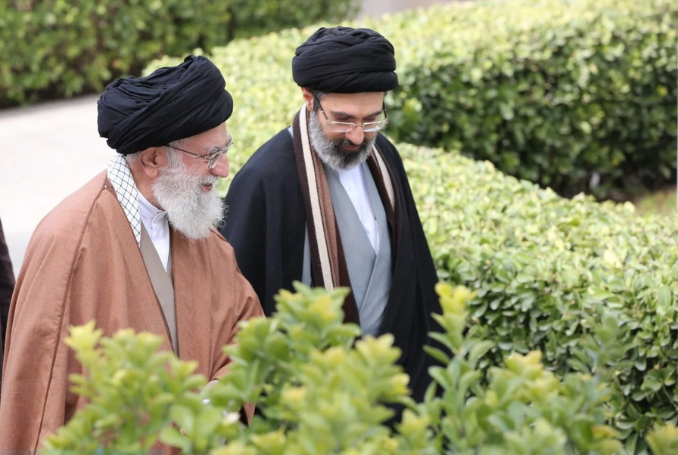 A photograph released for the first time by Iranian media shows Mojtaba Khamenei alongside his father, former Iranian leader Ali Khamenei. (Photo: Iranian media)
Mojtaba Khamenei said Iran defeated attempts to weaken the country, reaffirming support for resistance and opposition to Israel.
Key Developments
- Khamenei said Iran thwarted enemy efforts to undermine public resilience and create divisions within the country.
- He described Israel as a military outpost created by hegemonic powers and vowed Iran would not alter its position.
- The Iranian leader praised the Resistance Front and called for national unity in the face of continued pressure.
Iranian leader Mojtaba Khamenei issued a wide-ranging message on Wednesday marking the 37th anniversary of the death of Imam Ruhollah Khomeini.
In his message, he praised the resilience of the Iranian people, reaffirmed support for the Resistance Front, and declared that Tehran would not retreat from its position toward Israel.
In remarks carried by Iranian media, Khamenei portrayed Iran as having emerged stronger from recent challenges, arguing that attempts to weaken the country’s internal cohesion and political system had failed.
The message was delivered on the anniversary of Khomeini’s death, a date that remains one of the most significant commemorations in the Islamic Republic’s political calendar.
Khamenei described the occasion as an opportunity to reflect on Khomeini’s legacy and what he called the continuing relevance of the revolutionary path established by the founder of the Islamic Republic.
“We Foiled the Enemy’s Plots”
A central theme of Khamenei’s message was what he described as the failure of efforts to destabilize Iran from within.
“We were able to thwart the enemy’s plots,” he said, arguing that opponents of the Islamic Republic sought to break the resolve of the Iranian people and generate internal divisions.
According to Khamenei, the objective of Iran’s adversaries was not only military pressure but also a broader campaign aimed at weakening public confidence and social cohesion.
He said hostile forces had attempted to create discord among Iranians and undermine the country’s ability to withstand external pressure.
“The enemy wanted to undermine the steadfastness of the people in Iran and wanted to sow discord inside Iran,” he stated.
Khamenei further warned that efforts to spread pessimism, frustration, or distrust among the population ultimately serve the interests of those carrying out aggression against the country.
He argued that any attempt to generate hopelessness among Iranians effectively assists the country’s enemies and undermines national resilience.
Psychological and Political Warfare
The Iranian leader devoted significant attention to what he described as a “composite war” being waged against Iran.
According to Khamenei, adversaries have increasingly relied on psychological, media, political, and economic pressure rather than solely military confrontation.
He said the enemy’s strategy has focused on weakening public resilience while simultaneously creating confusion among policymakers and state institutions.
“The enemy has focused its deceit on a composite war against the flexibility and resilience of the people,” he said.
Khamenei argued that this strategy seeks to produce errors in political calculations and weaken national unity, but maintained that Iran has successfully resisted such efforts.
His remarks reflected longstanding Iranian claims that foreign powers employ information campaigns, sanctions, and political pressure alongside military threats to challenge the Islamic Republic.
Position on Israel
Khamenei also reiterated Iran’s longstanding opposition to Israel, framing the issue within a broader confrontation with what he called the global “system of domination.”
“The hegemonic system created a military base called Israel,” he said.
He added that Iran would not retreat from its position toward Israel regardless of regional developments or international pressure.
According to Khamenei, the same powers that support Israel oppose the existence of a strong and independent Iran in the region.
“The system of domination that created Israel does not accept the existence of a strong Iran on the fragile geographical borders of Greater Israel,” he said.
His remarks echoed longstanding positions expressed by Iranian leaders, who frequently characterize Israel as a strategic project backed by Western powers.
Pride in the Resistance Front
Khamenei repeatedly highlighted what he described as the central role of the Resistance Front in shaping regional politics and strengthening Iran’s position.
He argued that support for resistance movements remains a source of pride for many Iranians.
“The Iranian people today are proud to belong to the Resistance Front because of what Imam Khomeini and Imam Khamenei achieved,” he said.
According to Khamenei, the revolutionary leadership of both Imam Khomeini and former Iranian leader Ali Khamenei helped awaken and mobilize capabilities that already existed within Iranian society.
He credited the two leaders with identifying and nurturing the country’s political, social, and ideological strengths.
“The Great Imam Khomeini and the great martyr Imam Khamenei discovered and revived these capacities and readiness among the Iranian people,” he said.
Continued Mobilization
Khamenei also referenced the deaths of senior Iranian leaders and resistance figures, saying public support for their legacy remains strong.
He claimed that months after the recent conflict, Iranians continue to participate actively in political life while demanding accountability for those responsible for the killing of their leaders.
“After more than three months, the Iranian people remain present in the field with enthusiasm, demanding revenge for the blood of their martyred leader and all martyrs,” he said.
The remarks suggest that memories of recent confrontations continue to play a significant role in official Iranian political discourse.
Legacy of Imam Khomeini
A substantial portion of Khamenei’s message focused on Imam Khomeini himself.
He described the late leader as a figure whose influence transformed Iran at a time when, according to Khamenei, the country was experiencing political repression, dependency, and foreign domination.
Khamenei asked how one individual was able to awaken a nation and mobilize millions of people first during the revolutionary struggle and later during moments of national mourning.
He recalled the massive public gatherings that greeted Khomeini upon his return to Iran in 1979 and the similarly large crowds that attended his funeral in 1989.
According to Khamenei, understanding Khomeini’s vision remains essential for understanding Iran’s future path.
(Al Mayadeen, Middle East Observer – Telegram, Iranian Media, PC)

No comments:
Post a Comment