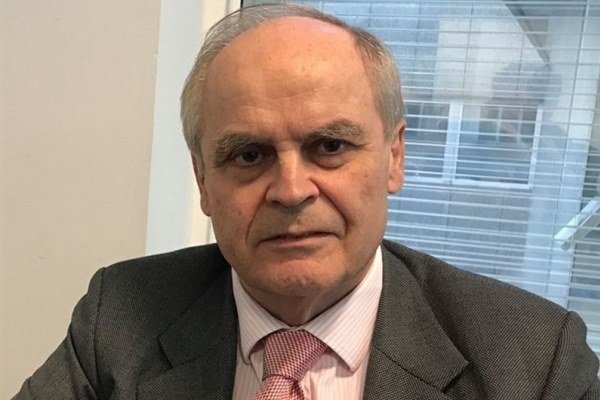
Showing posts with label Peter Jenkins. Show all posts

Wednesday, December 11, 2019

Israel, should be considered when discussing Iran's missile program: Jenkins

By Javad Heirannia

TEHRAN – Peter Jenkins, former UK Ambassador to the IAEA and UN, says that Israel has a significant missile program while Saudi Arabia has acquired a significant quantity of missiles from foreign suppliers and is reported to have embarked on an indigenous program.
A former associate fellow of the Geneva Centre for Security Policy also adds that “Both possess missiles of ranges in excess of 2000 km, unlike Iran.”
He adds that “These facts should be seen as of crucial relevance to any discussion of Iran’s missile program.”
Following is the full text of the interview:
Q: The British, German and French ambassadors, in a letter circulated on Wednesday, called on U.N. Secretary-General Antonio Guterres to inform the Security Council in his next report that Iran’s missile program was “inconsistent” with a U.N. resolution that had endorsed the nuclear deal reached between Iran and six world powers)UN Security Council Resolution 2231(. The claim is that some of Iran's missiles do not comply with the resolution, while the resolution “calls on” Iran not to work on missiles "designed to carry nuclear warheads". What is your assessment of this letter? And is it possible to vote against Iran at the Security Council meeting?
A: The European claim that aspects of Iran’s missile program are inconsistent with UNSC Res 2231 is not new. We have heard it on more than one past occasion. It rests on paragraph 3 of Annex B of that resolution. In this paragraph, Iran is called upon not to undertake any activity related to ballistic missiles designed to be capable of delivering nuclear weapons. I say “aspects of” because I assume – I do not know – that the Europeans recognize that only some of the missiles in Iran’s inventory or under development would be capable of delivering nuclear weapons. 
Is such a claim watertight? No, it’s a controversial claim because of the word “designed”. That word enables Iranian representatives to assert that none of the missiles in Iran’s inventory or under development has been designed to be a nuclear delivery vehicle, and it places a burden of proof on the Europeans that they are likely to be unable to sustain.
Why have the Europeans chosen to resurface the claim at this point, by writing to the UN Secretary-General? I assume there is a connection between this move and Iran’s policy of progressive non-performance of the 2015 nuclear agreement known as the JCPOA. I assume that the Europeans are seeking to put diplomatic pressure on Iran as a counter to the diplomatic pressure that Iran has been putting on Europe by threatening the survival of the JCPOA. 
If that is their tactic, will it be effective? Alas, it seems more likely that Iran will dismiss the European claim as unfounded and will continue to move progressively towards killing off the JCPOA. I say “alas” because, as I have told you in the past, I believe the policy of progressive non-performance to be both unwise and unfair: it amounts to punishing Europe to no constructive effect for injustices which the United States has committed and which Iran has prevented Europe from mitigating. 
   
Q: These two actions of Europe while Europe failed to fulfill its obligations to Iran and the reduction of its obligations by Iran was also a reaction to the passivity of European countries. What is your assessment?
 
A: I do not think there are objective grounds for ascribing passivity to European policy over the 22 months that have passed since President Trump first declared war on the JCPOA. The Europeans have tried repeatedly to persuade Trump that the JCPOA is a precious component of the global nuclear non-proliferation regime. They have consistently opposed Trump’s policy of subjecting Iran to “maximum pressure”, which they see to be both unjust and incapable of contributing to global peace and security. They have set up the trading facilitation mechanism known as INSTEX. President Macron of France has sought to create a basis for the resumption of European purchases of Iranian oil, but has been denied cooperation by President Rouhani.   
 
Q: Resolution 2231 uses the term “calls on” which does not have a legal requirement. Accordingly, while on the basis of arguments put forward by Europe, Iran has models of missiles capable of carrying nuclear warheads, but there are no legal entities for the legal review of countries' missile programs. This means that there is no international organization for recognizing the country's missile capabilities and its aims include defensive, offensive or capable of carrying a nuclear warhead. What is your assessment?
 
A: You are right that UNSC Res 2231 does not impose on Iran a legally-binding obligation to refrain from developing a certain type of missile.  You are also right that there is no international agreement that Iran is violating by developing and holding a range of missile types. This explains why Europe is reduced to claiming that Iran’s missile program is “inconsistent” with 2231 and to making debatable assertions about the intention behind the characteristics of some of Iran’s missiles.
 
Q: Iran does not have a Continental missile and its missile range is eventually 2,000 kilometers. However, Israel has both a nuclear bomb and missiles that have far more missiles than Iranian missiles, and Saudi Arabia has a new, more advanced, missile program. Regarding this why Iran has no right to have a missile balance? If Iran is asked to limit its missile program, so should countries around Iran. What is your assessment?
 
A: Again, you are right: Israel has a significant missile program while Saudi Arabia has acquired a significant quantity of missiles from foreign suppliers and is reported to have embarked on an indigenous program. Both possess missiles of ranges in excess of 2000 km, unlike Iran (although Iran has developed a “space launch vehicle” that could be modified to deliver payloads over a longer distance than 2000 km). These facts should be seen as of crucial relevance to any discussion of Iran’s missile program. To my mind they lead to at least two conclusions: it is reasonable for Iran to seek to deter the use of missiles against Iran by acquiring a capability to retaliate, and only a regional approach to controlling missile proliferation has any chance of obtaining Iranian assent.
You mention that Israel possesses nuclear weapons. This too is a fact. It would not justify the Iranian acquisition of nuclear weapons since “two wrongs do not make a right”. But it does justify Iran’s possession of an effective anti-Israeli deterrent in the form of missiles.

Monday, December 09, 2019

Israeli-Saudi missile program should be consider when discussing Iran's missile program: Jenkins

Israeli-Saudi missile program should be consider when discussing Iran's missile program: Jenkins


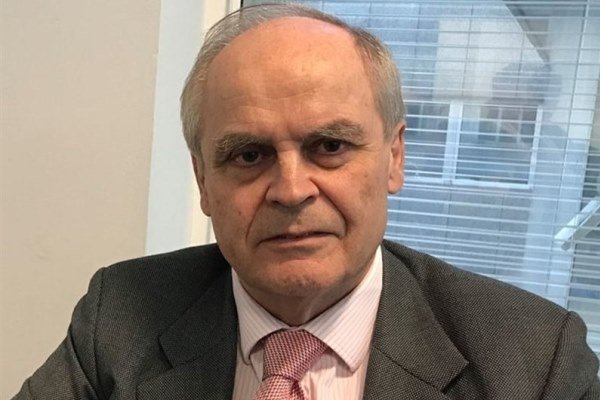
TEHRAN, (MNA) –Peter Jenkins, former UK Ambassador to the IAEA and UN, says that Israel has a significant missile program while Saudi Arabia has acquired a significant quantity of missiles from foreign suppliers and is reported to have embarked on an indigenous program.
A former associate fellow of the Geneva Centre for Security Policy also adds that “Both possess missiles of ranges in excess of 2000 km, unlike Iran.”
He adds that “These facts should be seen as of crucial relevance to any discussion of Iran’s missile program.”
Following is the full text of the interview:
The British, German and French ambassadors, in a letter circulated on Wednesday, called on U.N. Secretary-General Antonio Guterres to inform the Security Council in his next report that Iran’s missile program was “inconsistent” with a U.N. resolution that had endorsed the nuclear deal reached between Iran and six world powers)UN Security Council Resolution 2231(. The claim is that some of Iran's missiles do not comply with the resolution, while the resolution “calls on” Iran not to work on missiles "designed to carry nuclear warheads". What is your assessment of this letter? And is it possible to vote against Iran at the Security Council meeting?
The European claim that aspects of Iran’s missile program are inconsistent with UNSC Res 2231 is not new. We have heard it on more than one past occasion. It rests on paragraph 3 of Annex B of that resolution. In this paragraph, Iran is called upon not to undertake any activity related to ballistic missiles designed to be capable of delivering nuclear weapons. I say “aspects of” because I assume – I do not know – that the Europeans recognize that only some of the missiles in Iran’s inventory or under development would be capable of delivering nuclear weapons. 
Is such a claim watertight? No, it’s a controversial claim because of the word “designed”. That word enables Iranian representatives to assert that none of the missiles in Iran’s inventory or under development has been designed to be a nuclear delivery vehicle, and it places a burden of proof on the Europeans that they are likely to be unable to sustain.
Why have the Europeans chosen to resurface the claim at this point, by writing to the UN Secretary General? I assume there is a connection between this move and Iran’s policy of progressive non-performance of the 2015 nuclear agreement known as the JCPOA. I assume that the Europeans are seeking to put diplomatic pressure on Iran as a counter to the diplomatic pressure that Iran has been putting on Europe by threatening the survival of the JCPOA. 
If that is their tactic, will it be effective? Alas, it seems more likely that Iran will dismiss the European claim as unfounded and will continue to move progressively towards killing off the JCPOA. I say “alas” because, as I have told you in the past, I believe the policy of progressive non-performance to be both unwise and unfair: it amounts to punishing Europe to no constructive effect for injustices which the United States has committed and which Iran has prevented Europe from mitigating.    
 
These two actions of Europe while Europe failed to fulfill its obligations to Iran and the reduction of its obligations by Iran was also a reaction to the passivity of European countries. What is your assessment?
 
I do not think there are objective grounds for ascribing passivity to European policy over the 22 months that have passed since President Trump first declared war on the JCPOA. The Europeans have tried repeatedly to persuade Trump that the JCPOA is a precious component of the global nuclear non-proliferation regime. They have consistently opposed Trump’s policy of subjecting Iran to “maximum pressure”, which they see to be both unjust and incapable of contributing to global peace and security. They have set up the trading facilitation mechanism known as INSTEX. President Macron of France has sought to create a basis for the resumption of European purchases of Iranian oil, but has been denied cooperation by President Rouhani.   
 
Resolution 2231 uses the term “calls on” which does not have a legal requirement. Accordingly, while on the basis of arguments put forward by Europe, Iran has models of missiles capable of carrying nuclear warheads, but there are no legal entities for the legal review of countries' missile programs. This means that there is no international organization for recognizing the country's missile capabilities and its aims include defensive, offensive or capable of carrying a nuclear warhead. What is your assessment?
 
You are right that UNSC Res 2231 does not impose on Iran a legally-binding obligation to refrain from developing a certain type of missile.  You are also right that there is no international agreement that Iran is violating by developing and holding a range of missile types. This explains why Europe is reduced to claiming that Iran’s missile program is “inconsistent” with 2231 and to making debatable assertions about the intention behind the characteristics of some of Iran’s missiles.
 
Iran does not have a Continental missile and its missile range is eventually 2,000 kilometers. However, Israel has both a nuclear bomb and missiles that have far more missiles than Iranian missiles, and Saudi Arabia has a new, more advanced, missile program. Regarding this why Iran has no right to have a missile balance? If Iran is asked to limit its missile program, so should countries around Iran. What is your assessment?
 
Again, you are right: Israel has a significant missile program while Saudi Arabia has acquired a significant quantity of missiles from foreign suppliers and is reported to have embarked on an indigenous program. Both possess missiles of ranges in excess of 2000 km, unlike Iran (although Iran has developed a “space launch vehicle” that could be modified to deliver payloads over a longer distance than 2000 km). These facts should be seen as of crucial relevance to any discussion of Iran’s missile program. To my mind they lead to at least two conclusions: it is reasonable for Iran to seek to deter the use of missiles against Iran by acquiring a capability to retaliate, and only a regional approach to controlling missile proliferation has any chance of obtaining Iranian assent.
You mention that Israel possesses nuclear weapons. This too is a fact. It would not justify the Iranian acquisition of nuclear weapons since “two wrongs do not make a right”. But it does justify Iran’s possession of an effective anti-Israeli deterrent in the form of missiles.
Interview by Javad Heirannia

Thursday, April 04, 2019

UK's Ex-IAEA Envoy: Trump's Claimed Non-Proliferation Concerns for Discarding JCPOA Just Nonsense

TEHRAN (FNA)- The United Kingdom's former Ambassador to the International Atomic Energy Agency (IAEA) and the UN Peter Jenkins says US President Donald Trump is either intellectually incapable of appreciating the value of the nuclear deal with Iran or has dropped the JCPOA for the sake of personal considerations.
Speaking in an exclusive interview with FNA, Peter Jenkins said Trump's alleged nuclear non-proliferation motive for withdrawing from the Joint Comprehensive Plan of Action (JCPOA) "was and continues to be nonsense".

"What President Trump demonstrated in May 2018 was either that he is intellectually incapable of understanding what the rest of the world understands or that political and personal considerations matter more to him than upholding and preserving international standards," he added.

Following is the full text of the interview, where Trump's plan for transferring nuclear technology to Saudi Arabia alongside his alleged concerns about Iran's nuclear program has come under discussion with Mr. Jenkins:

Q: Democrats express concern that the Trump administration's plan to allow the Saudi regime access "sensitive US nuclear technology" could enable Riyadh "to produce nuclear weapons and further contribute to the proliferation of nuclear arms throughout an already unstable Middle East." How do you evaluate such concerns?

A: One needs to distinguish between different aspects of the nuclear electricity-generation cycle. Saudi acquisition of light water-moderated reactors (LWRs) for electricity production would not in itself allow Saudi Arabia to produce nuclear weapons. Four such reactors are under construction in the United Arab Emirates (UAE) and no one believes that their acquisition will enable the UAE to produce nuclear weapons. What would justify such a fear would be the sale to Saudi-Arabia (KSA) of technology that could be used to extract plutonium from spent fuel (reprocessing technology) (although LWR spent fuel is less rich in plutonium than spent fuel from heavy water-moderated reactors, like the reactor once planned for construction at Arak in Iran). Even more risky would be the sale to KSA of the technology needed to produce the low-enriched uranium that LWRs burn (uranium enrichment technology). This technology can be used, subject only to the rearrangement of centrifuge cascades, to produce the highly enriched uranium that forms the core of one type of nuclear weapon.

If the sale of reactors to KSA goes through, prudence should require that the sale be accompanied not only by appropriate IAEA safeguards provisions but also by a contractual understanding that KSA will rely on the reactor supplier for reactor fuel, and will return all spent fuel to the supplier.

Q: Do you believe that the Trump administration would allow Saudi Arabia to enrich uranium and reprocessing of plutonium by itself?

A: I think it unlikely that the Trump administration will attempt to persuade the US Congress to allow it to sell uranium or reprocessing technology to KSA. One needs to keep in mind the extraordinary influence over U.S. decision-making currently possessed by the government of Israel. It is hard to conceive of Israel viewing KSA acquisition of enrichment or reprocessing technology as anything less than a threat to Israeli security interests. It is much more likely that Israel will bend every sinew to limit any U.S. sale of nuclear technology to KSA to LWRs.

Of course one needs to have in mind that relations between Israel and KSA are currently much warmer than they have ever been. One has to consider the possibility that KSA leaders will try to persuade Israeli leaders that they would have nothing to fear from KSA acquisition of enrichment and/or reprocessing technology. But the love that binds these two rogue states is not blind. Israeli leaders are still capable of realising that their affair may not last and that the day may come when Saudi hearts are once more cold towards Israel. 

Q: In May 2018, Trump withdrew the US from the Iran nuclear agreement for Nuclear Non-Proliferation concerns, while transferring the sensitive US nuclear technology could eventually end up in the acquisition and production of nuclear weapons by Saudi Arabia and trigger nuclear arms race in the Middle East. How could one explain these paradoxical moves?

A: President Trump may have claimed some kind of nuclear non-proliferation motive for withdrawing from the JCPOA, and thereby placing the United States in breach of UN Security Council resolution 2231. But any such claim was and continues to be nonsense. All the other parties to the JCPOA, and an overwhelming number of UN members, see the JCPOA as an agreement that was drawn up to allay concerns about Iran’s commitment to the Nuclear Non-Proliferation Treaty (NPT) and to allow the IAEA to verify that Iran is in full compliance with its NPT obligations. So what President Trump demonstrated in May 2018 was either that he is intellectually incapable of understanding what the rest of the world understands or that political and personal considerations matter more to him than upholding and preserving international standards.

That explains why he might be tempted to sell his KSA friends whatever they want – especially if they are prepared to pay premium prices. However, my guess is that in the end his other close friends, the Israelis, exerting influence directly on administration experts and indirectly through the U.S. Congress, many of whose members rely on pro-Israeli campaign funding, will see to it that this nuclear proliferation risk is averted.

Wednesday, September 05, 2018

European army is much closer to aspiration than reality: Jenkins

By Javad Heirannia


TEHRAN - Peter Jenkins, former UK Ambassador to the IAEA and UN says that “In theory, Europe is perfectly capable of forming a treaty-based collective security organisation from which the United States and Canada (and maybe the United Kingdom) are excluded.”
Former associate fellow of the Geneva Centre for Security Policy also adds that “It is doubtful whether that is what France and Germany are aiming to achieve in the near to medium future, and doubtful whether at this stage pan-European political will for that could be mobilised.”
He adds that “European army is much closer to being an aspiration than a reality.”
Following is the full text of the interview:
Q: How do you evaluate “speeches of Macron, President of French about that Europe should no longer rely on America In terms of security“?
A: I think this is an important statement because it came only a few days after a call for a more independent Europe from Germany’s Foreign Minister, and some 15 months after a similar call from Chancellor Angela Merkel at a public meeting in Munich. Historically (by which I mean since the Second World War) France has championed a more independent European defense policy and Germany has reacted cautiously, reluctant to take any step that might affect the U.S. commitment, under Article 5 of the 1949 North Atlantic Treaty, to come to Europe’s defense in case of need. Now, it seems, France and Germany are becoming like-minded on this crucial question.
Q: With the arrival of the Trump to the White House and his criticism of the European countries regarding NATO's share, Europe had begun its efforts to form a joint European army. According to Macron’s speeches, it seam formation of a joint European army take more seriousness. What is your opinion?
A: Back in the 1980s, if memory serves, Germany acquiesced in a French proposal to form a Franco-German brigade, based near Strasbourg. That initiative was rich in symbolism but of little practical significance. Now the talk is of a joint European army. I think this has more to do with Franco-German perceptions that the United States is becoming a more erratic ally, less trustworthy than for most of the last 70 years, more prone to making huge foreign policy misjudgements, than with Trump kicking up a fuss about the inadequacy of European contributions to NATO defense.  I suspect, however, that at this stage a European army is much closer to being an aspiration than a reality.
Q: Is Europe essentially capable of being independent of America in terms of security? If so, what will be the future of NATO?
A: In theory, yes, Europe is perfectly capable of forming a treaty-based collective security organisation from which the United States and Canada (and maybe the United Kingdom) are excluded. But it is doubtful whether that is what France and Germany are aiming to achieve in the near to medium future, and doubtful whether at this stage pan-European political will for that could be mobilised. It is more likely that for the foreseeable future NATO will co-exist alongside the development of a more pronounced and more practically effective EU defense identity.
I referred just now to the United Kingdom. Historically the UK has been opposed to greater European integration in the defence sector, for fear of jeopardising NATO. This is likely to remain the UK position for the foreseeable future, not least because of very close ties between UK and US military and intelligence services, although a Labour government led by Jeremy Corbyn would sympathise with what Macron, Maas and Merkel have been saying about Europe and implying about the United States. But, if the UK withdraws from the EU, France and Germany will find it easy to ignore British views, and probably will.
Q: Some analysts have interpreted Macron's speeches as a new Western order. Will the West enter a new era of order and independence from the United States?
A: That is the direction in which France and Germany seem to want to travel. They are starting to imagine a world in which Europe can no longer rely on or cooperate with the United States to the extent that has been the norm since 1945, and must therefore acquire the capacity to be an independent pole in a multipolar international order. But this will not come about overnight. It will take many years.
Q: Macron also said that Russia should also be involved in European security issues. How do you assess this position?
A: That, too, is very significant. During the Cold War, especially when General De Gaulle was president of the French Republic, France tended to be less fearful of, and less hostile towards the Soviet Union than the United States and other NATO members. General De Gaulle used to talk of a Europe stretching from the Atlantic to the Urals. Since 2007 this historic tendency seems to have been in conflict with an un-Gaullist Atlanticism, and even with a certain neoconservatism imported from the United States. Now Macron seems to be reviving the Gaullist perspective and contemplating a European security framework that would indeed stretch to the Urals. Defense cooperation with Russia and mutual respect for European and Russian interests would replace unperceptive threat assessments, demonization of Russia’s leaders, and insensitivity to Russian interests.  But winning European support for this vision will not be easy. Poland and the Baltic states in particular prefer to see Russia as an ever-present threat to their territorial integrity or even survival. It will take a lot to convince them to look on Russia as a potential partner.