Showing posts with label United Nations. Show all posts

Wednesday, December 11, 2019

Israel, should be considered when discussing Iran's missile program: Jenkins

By Javad Heirannia

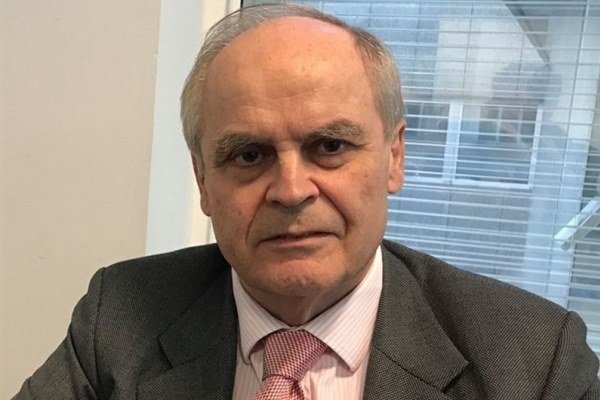
TEHRAN – Peter Jenkins, former UK Ambassador to the IAEA and UN, says that Israel has a significant missile program while Saudi Arabia has acquired a significant quantity of missiles from foreign suppliers and is reported to have embarked on an indigenous program.
A former associate fellow of the Geneva Centre for Security Policy also adds that “Both possess missiles of ranges in excess of 2000 km, unlike Iran.”
He adds that “These facts should be seen as of crucial relevance to any discussion of Iran’s missile program.”
Following is the full text of the interview:
Q: The British, German and French ambassadors, in a letter circulated on Wednesday, called on U.N. Secretary-General Antonio Guterres to inform the Security Council in his next report that Iran’s missile program was “inconsistent” with a U.N. resolution that had endorsed the nuclear deal reached between Iran and six world powers)UN Security Council Resolution 2231(. The claim is that some of Iran's missiles do not comply with the resolution, while the resolution “calls on” Iran not to work on missiles "designed to carry nuclear warheads". What is your assessment of this letter? And is it possible to vote against Iran at the Security Council meeting?
A: The European claim that aspects of Iran’s missile program are inconsistent with UNSC Res 2231 is not new. We have heard it on more than one past occasion. It rests on paragraph 3 of Annex B of that resolution. In this paragraph, Iran is called upon not to undertake any activity related to ballistic missiles designed to be capable of delivering nuclear weapons. I say “aspects of” because I assume – I do not know – that the Europeans recognize that only some of the missiles in Iran’s inventory or under development would be capable of delivering nuclear weapons. 
Is such a claim watertight? No, it’s a controversial claim because of the word “designed”. That word enables Iranian representatives to assert that none of the missiles in Iran’s inventory or under development has been designed to be a nuclear delivery vehicle, and it places a burden of proof on the Europeans that they are likely to be unable to sustain.
Why have the Europeans chosen to resurface the claim at this point, by writing to the UN Secretary-General? I assume there is a connection between this move and Iran’s policy of progressive non-performance of the 2015 nuclear agreement known as the JCPOA. I assume that the Europeans are seeking to put diplomatic pressure on Iran as a counter to the diplomatic pressure that Iran has been putting on Europe by threatening the survival of the JCPOA. 
If that is their tactic, will it be effective? Alas, it seems more likely that Iran will dismiss the European claim as unfounded and will continue to move progressively towards killing off the JCPOA. I say “alas” because, as I have told you in the past, I believe the policy of progressive non-performance to be both unwise and unfair: it amounts to punishing Europe to no constructive effect for injustices which the United States has committed and which Iran has prevented Europe from mitigating. 
   
Q: These two actions of Europe while Europe failed to fulfill its obligations to Iran and the reduction of its obligations by Iran was also a reaction to the passivity of European countries. What is your assessment?
 
A: I do not think there are objective grounds for ascribing passivity to European policy over the 22 months that have passed since President Trump first declared war on the JCPOA. The Europeans have tried repeatedly to persuade Trump that the JCPOA is a precious component of the global nuclear non-proliferation regime. They have consistently opposed Trump’s policy of subjecting Iran to “maximum pressure”, which they see to be both unjust and incapable of contributing to global peace and security. They have set up the trading facilitation mechanism known as INSTEX. President Macron of France has sought to create a basis for the resumption of European purchases of Iranian oil, but has been denied cooperation by President Rouhani.   
 
Q: Resolution 2231 uses the term “calls on” which does not have a legal requirement. Accordingly, while on the basis of arguments put forward by Europe, Iran has models of missiles capable of carrying nuclear warheads, but there are no legal entities for the legal review of countries' missile programs. This means that there is no international organization for recognizing the country's missile capabilities and its aims include defensive, offensive or capable of carrying a nuclear warhead. What is your assessment?
 
A: You are right that UNSC Res 2231 does not impose on Iran a legally-binding obligation to refrain from developing a certain type of missile.  You are also right that there is no international agreement that Iran is violating by developing and holding a range of missile types. This explains why Europe is reduced to claiming that Iran’s missile program is “inconsistent” with 2231 and to making debatable assertions about the intention behind the characteristics of some of Iran’s missiles.
 
Q: Iran does not have a Continental missile and its missile range is eventually 2,000 kilometers. However, Israel has both a nuclear bomb and missiles that have far more missiles than Iranian missiles, and Saudi Arabia has a new, more advanced, missile program. Regarding this why Iran has no right to have a missile balance? If Iran is asked to limit its missile program, so should countries around Iran. What is your assessment?
 
A: Again, you are right: Israel has a significant missile program while Saudi Arabia has acquired a significant quantity of missiles from foreign suppliers and is reported to have embarked on an indigenous program. Both possess missiles of ranges in excess of 2000 km, unlike Iran (although Iran has developed a “space launch vehicle” that could be modified to deliver payloads over a longer distance than 2000 km). These facts should be seen as of crucial relevance to any discussion of Iran’s missile program. To my mind they lead to at least two conclusions: it is reasonable for Iran to seek to deter the use of missiles against Iran by acquiring a capability to retaliate, and only a regional approach to controlling missile proliferation has any chance of obtaining Iranian assent.
You mention that Israel possesses nuclear weapons. This too is a fact. It would not justify the Iranian acquisition of nuclear weapons since “two wrongs do not make a right”. But it does justify Iran’s possession of an effective anti-Israeli deterrent in the form of missiles.


Monday, December 09, 2019

No agreement among Permanent Members that Iran is not complying with resolution 2231: Finaud

No agreement among Permanent Members that Iran is not complying with resolution 2231: Finaud

TEHRAN, (MNA) – Marc Finaud, a senior member of Geneva Centre for Security Policy, says that in the Middle East, several countries have wide-ranging missile capabilities that are the result of threat perceptions often fueled by the others’ arms build-ups.
Former Senior Resident Fellow at the United Nations Institute for Disarmament Research (UNIDIR) adds “This is why the only effective way of dealing with that issue is a regional framework.”
A senior member of Geneva Centre for Security Policy also says that “there is no agreement among the Permanent Members that Iran is not complying with resolution 2231.”
Finaud adds that “The E3 letter raises an important issue but it is bound to fail if it only seeks to pressure Iran and does not offer an opportunity to discuss the matter on a regional basis.”
Following is the full text of the interview:
The British, German and French ambassadors, in a letter circulated on Wednesday, called on UN Secretary-General Antonio Guterres to inform the Security Council in his next report that Iran’s missile program was “inconsistent” with a UN resolution that had endorsed the nuclear deal reached between Iran and six world powers (UN Security Council Resolution 2231). The claim is that some of Iran's missiles do not comply with the resolution, while the resolution “calls on” Iran not to work on missiles "designed to carry nuclear warheads". What is your assessment of this letter? And is it possible to vote against Iran at the Security Council meeting?
The provisions related to Iran’s ballistic missile program are part of the UN Security Council resolution endorsing the JCPOA but are not part of the JCPOA itself. The Security Council could theoretically discuss and adopt a resolution on those missile provisions, but in fact, there is no agreement among the Permanent Members that Iran is not complying with resolution 2231. The E3 letter raises an important issue but it is bound to fail if it only seeks to pressure Iran and does not offer an opportunity to discuss the matter on a regional basis.
This was Europe's action while Europe had already threatened Iran to investigate the trigger mechanism. Why, besides threatening to investigate the trigger mechanism, have they also raised the Iranian missile issue?
This initiative seems intended to push Iran to accept a broader scope of negotiation beyond its nuclear program in the hope of achieving a new deal that could be accepted by the United States. But it is unlikely to succeed unless Iran can derive some benefits from such a broader agreement.
These two actions of Europe while Europe failed to fulfill its obligations to Iran and the reduction of its obligations by Iran was also a reaction to the passivity of European countries. What is your assessment?
The problem obviously comes from the US withdrawal from the JCPOA in violation of the agreement itself and Security Council resolution 2231. Iran’s decisions to reduce the implementation of its commitments are consistent with the spirit of the JCPOA, based on reciprocity, if not with its letter. But it also increases the risk of collapse of the whole agreement. The Europeans did try to reduce the impact of American sanctions on Iran, but their efforts are restricted by bureaucracy and their limited influence on European companies which are deterred to trade with Iran by US sanctions.
Resolution 2231 uses the term “calls on” which does not have a legal requirement. Accordingly, while on the basis of arguments put forward by Europe, Iran has models of missiles capable of carrying nuclear warheads, but there are no legal entities for the legal review of countries' missile programs. This means that there is no international organization for recognizing the country's missile capabilities and its aims include defensive, offensive or capable of carrying a nuclear warhead. What is your assessment?
It is indeed regrettable that the international arms control framework on missiles is very weak: it only consists of the MTCR export control regime and The Hague Code of Conduct, a voluntary set of transparency- and confidence-building measures. In the case of the Middle East, means of delivery of weapons of mass destruction are part of the mandate of a WMD-free Zone, but discussions of this project have not made much progress so far.
Iran does not have a Continental missile and its missile range is eventually 2,000 kilometers. However, Israel has both a nuclear bomb and missiles that have far more missiles than Iranian missiles, and Saudi Arabia has a new, more advanced, missile program. Regarding this why Iran have no right to have a missile balance? If Iran is asked to limit its missile program, so should countries around Iran. What is your assessment?
Indeed, in the Middle East, several countries have wide-ranging missile capabilities that are the result of threat perceptions often fueled by the others’ arms build-ups. This is why the only effective way of dealing with that issue is a regional framework. With other experts, my organization has made proposals for a series of measures (such as limits on range and payload and ban on transfers) that could be adopted by the key regional states as one of the first steps towards the establishment of a WMD-free zone.
Interview by Javad Heirannia

Sunday, December 01, 2019

Yemen: Urgent need to end genocide and ensure justice done

By Yusuf Abdullahi

NIGERIA/ KADUNA - In the name of Allah Who states "And think not that Allah is unaware of what the wrongdoers do. He only gives them respite till the day on which the eyes will fixedly stare" Q14:42
May the peace and blessings of Allah be upon His chosen servant, our master Muhammad and his purified progeny.
This article was written at the onset of 2019 by Allah's mercy, when I extended a good will message to all, with more prayers and greater optimism to end the world's incessant crises responsible for chaos and bloodshed. It is unfortunate that those responsible for these atrocities are hell-bent on their heinous acts, hence a reminder and the need for international community to act!
"If JESUS were among us today, he would not spare even a single moment to fight the leaders of despotism and global arrogance". This was part of the statement of the leader of the Islamic revolution in Iran, Ayatollah Sayyid Khamne'i in relation to the oppressed people of Yemen. He also said "... in Yemen, the Saudi regime is committing the crimes. But their accomplice in crime is the US"  
No doubt, Yemen attracts global attention being the worst artificially created humanitarian crisis. Despite the fact that these atrocities against the poor Yemeni people have not stopped, but some positive developments were recorded looking at the level of condemnations and withdrawals from arms deals with the butcher kingdom after the merciless murder of dissident journalist, Jamal Khashoggi. 
With defiant stance against Donald Trump, the US Senate has recently passed a resolution calling on Washington to stop its support for the Saudi-led military campaign in Yemen, during a session in Washington DC. With the world's clear knowledge of the long-existing master-servant relation between US and Saudi Arabia, the development is very encouraging. Last year, for example, Trump has announced a $110bn weapons deal with Riyadh, which he officially visited after he was sworn in. Earlier on, nothing positive came out from several negotiations organized by Gulf Cooperation Council (GCC) initiative and implementation mechanism since 23 November 2011 in Riyadh with various groups for peace and stability. The situation worsened with escalation of military confrontations in early 2015. Most noticeably, the UN Security Council resolution 2216 of 2015, requested the Secretary-General to intensify efforts and liaise with all parties to achieve the stated goals. However, with the biased Saudi-led coalition aggression against the poorest country in the region, the situation has turned to worst humanitarian crises ever witnessed in history. In the four years of continuous aggression, tens of thousands of Yemenis lost their lives besides of higher number of civilian casualties and wanton destruction of public and private infrastructures worth billions of dollars! Evidently, being the largest world's humanitarian crises, more than 75% of the total population are in need of aid and protection, significant % absolutely has food insecurity and more than 3 million people displaced. 
The worst humanitarian crises
Over the years, countries and organizations that value human life call for end to continued Saudi-led, American-backed strikes against Yemen. The Islamic Republic of Iran and Amnesty International stand distinct on this issue. The figures vary as to death toll due to direct and indirect effect of the aggression. Some non-governmental organizations put the number between 60 to 100,000, while the UN put it at N10,000.  A recent release by Oxfam, an international confederation of 20 NGO's working with partners in over 90 countries to end injustice, it described Yemen as "raged by the over three years pogrom, killing thousands, and leading to world's biggest humanitarian crises, with many considering Saudi Crown Prince, Muhammad bin Salman, the architect. It certified that a civilian is killed every three hours, calling on the United States, Britain, and the other European States to suspend arms sales to Saudi Arabia. One civilian has been killed every three hours in fighting in Yemen since the beginning in August with many more people succumbing to disease and hunger".
The aid group cited data collected by the Civilian Impact Monitoring Project linked to the United Nations global protection clusters that 575 civilians were killed between August 1 and October 15, including 136 children. Therefore, it called on the UK, US and other governments to suspend arms sales to the Saudis because of their disregard for civilian lives in the war in Yemen. Yemen conflict sees one of the deadliest months, 450 civilians were killed in the first nine days of August as the conflict between government forces and Houthis escalated. Saudi Arabia leads a pro-government military alliance that has battled Yemen's Iran-backed Houthis since 2015, pushing the impoverished country to the brink of famine. The UN categorizes Yemen as the world's worst humanitarian crisis, warning on Tuesday that 14 million people now face a serious threat of famine!"  However, with the murder of Jamal Khashoggi, the Washington Post columnist and Saudi critic in the kingdom's consulate, Western nations were advised to suspend arms deals with Saudi. Germany has positively responded pending the outcome of the investigation against the brutal murder. America, which is the largest arms supplier refuses in view of huge financial gains and disregard for human lives. According to the United Nations, more than 10,000 people have been killed since 2015 which the rights and aid groups believe is by far higher. 
On many occasions, concerned individuals and organizations condemned atrocities on the poorest Arab nation by the richest in the Middle-east. The IHRC at the forefront held and influenced such events in London, Geneva, and Indonesia, just as the Islamic Movement stood for the same in Kano and Zaria, Nigeria.  Generally speaking, the rationale behind the campaign was to express solidarity with Yemen as a sovereign nation and to create the much needed public awareness on the urgent need to cease the aggression and quest for justice. The enemies always disseminate misinformation to blackmail Islam and incite Muslims against themselves in the name of Shi'ah/Sunnah. This is what they propagate on the Yemeni crises accusing Iran which is part of the region of supporting Houthis that it denied.  At the same time, Western powers, above all America went the region mingling with their popular allies trading their deadly weapons/consultancy in the name of peacekeeping! Although every Muslim could be likened to one jurisprudential school or the other, the unfortunate crises should be objectively studied.  Muslims must condemn tyranny at all times and places. The issue is not Shi'ah/Sunna or Iran/Saudi but a problem needing judicious attention.  I will briefly conclude from two angles. 
Has the UN any relevance in crises?
The goals behind creation of UN are well designed, judicious and achievable; to maintain international peace and security, and to that end; to take effective collective measures for the prevention and removal of threats to the peace, and for the suppression of acts of aggression or other breaches of the peace, and to bring about by peaceful means, and in conformity with the principles of justice and international law, adjustment or settlement of international disputes or situations which might lead to a breach of the peace. (Chapter 1: Purposes and principles - article 1). We don't need to go any further looking at the principal. The question is what purpose does the UN serve on this planet full of oppression, chaos, and bloodshed? In fact, it is high time to run a cost-benefit analysis on the existence or otherwise of the toothless body looking at the colossal amount it consumes from the nation's revenues that could otherwise be used for human and infrastructural development. To be frank and sincere, the UN lacks the moral role to play in the actualization of the most important goals for which it was apparently created. Then, of what relevance is it?   
The Muslim-Ummah must be resolute
Allah states “You are the best community raised for the good of mankind. You enjoin what is good and forbid what is wrong, and you believe in Allah” Q3:110. He also states in Q49.  With this exalted position, we may ask, why can't the Muslims reconcile themselves in the event of any crisis? What is the role of Muslim scholars and intellectuals regarding the situation? Could the massacre in Yemen be regarded as a war between Muslims? We strongly appreciate the moral role of Iran and Amnesty International in this direction. 
In a public event to raise awareness in Iran, Brigadier General Salami said: "If we support Palestine, give moral support to Yemeni people, voice concern for Iraqis and Syrians, and think about Afghanistan, this attitude has been taken from the deep philosophy of Islam"  ... today we have gathered to announce our support for the Yemeni people. What has happened in the Islamic world during the past one hundred years, is due to the United States, the United Kingdom, and Saudi-Arabia, and this is the catastrophic geometry of the Islamic world" 

Wednesday, November 20, 2019

UN report on Israeli settlements speaks the truth – but the world refuses to listen

Hamas is not spared criticism: the Islamist militia in charge of Gaza stands accused of ‘beatings, arbitrary arrest and detentions, and torture and ill treatment’ of hundreds of Palestinian protesters. But the opposition to Lynk is not down to his even-handedness

By Robert Fisk

November 19, 2019 "Information Clearing House" - He’s a very tall man with bright eyes and a broad smile, and he holds out a great paw when he greets you. But Michael Lynk is no gentle giant.
He may teach human rights law at the Western University in London, Ontario, but as the UN’s special rapporteur on human rights in the occupied West Bank and Gaza, he has to endure the fury of Israel and its acolytes abroad – not least in his native Canada – and, two years ago, even the enmity of his own country’s foreign minister.
In his latest UN report, he reminds readers that the creation of Israel’s “civilian settlements” in occupied territory is a breach of the Fourth Geneva Convention and a “war crime” under the Rome Statute. So you can see why the 67-year old Lynk, a labour lawyer by training, has been having a tough time since his appointment to the voluntary, unpaid UN post three years ago.
When Lynk was appointed special rapporteur, Stephane Dion, then Justin Trudeau’s foreign minister, spotted that UN Watch, a pro-Israeli lobby, had called Lynk “antisemitic” – the usual slur for anyone who criticises the actions of the Israeli government – and suggested that he be forced to resign. Dion soon lost his foreign minister’s job and his career went downhill.
Lynk’s went in the other direction. He became a gadfly to all who stand accused of breaking international law in the Middle EastHamas is certainly not spared in his report; he accuses the Islamist militia in charge of Gaza of “beatings, arbitrary arrest and detentions, and torture and ill treatment” of hundreds of Palestinian protestors. But the opposition to him wasn’t about his even-handedness.
Dion took these shoddy arguments [from UN Watch] and used them to re-tweet his opposition to my appointment,” Lynk told me. “I would have thought a former academic would have looked at my writings before saying this – but I guess he was just the ‘politician Dion’. I always find it surprising that someone could be deemed radical for insisting on the functioning of international law.”
Lynk rather disingenuously told me he’s just “a stodgy absent-minded law professor with two kids” – which may or may not be true – but in his report, he is far from stodgy in his attacks on the decades of Israeli occupation.
Try this paragraph, for example: “No occupation in the modern world has been conducted with the international community so alert to its many grave breaches of international law, so knowledgeable about the [Israeli] occupiers’ obvious and well-signalled intent to annex and establish permanent sovereignty, so well-informed about the scale of suffering and dispossession endured by the protected [Palestinian] population under occupation, and yet so unwilling to act upon the overwhelming evidence before it…”

The Israeli government has not even replied to Lynk’s requests to visit the Palestinian lands occupied since 1967 – most of his first hand-witness accounts are acquired in Amman or via video-conference between Jordan and Gaza – but he concentrates not so much on the wilful suppression of the Palestinians but on the moral question of accountability.Reading this and subsequent paragraphs in his 23-page report, it’s clear that Lynk not only writes the truth; even more dangerously, he knows how to write. Eloquence is only rarely discovered in the UN’s house of cards.

Here he is, for example, on Israel’s failure to account for its exercise of power: “The enemies of accountability are impunity and exceptionalism,” he writes, “…Those who maintain that they are exempt from the directions of our international legal and diplomatic order not only defy the rule of law, but they also fail the test of political realism. For no country can sustain for long its standing and influence among the community of nations if it asserts special arguments forbidden to others … Impunity anywhere is a danger to justice everywhere.”
Israel, Lynk adds, “has rightly assessed that the international community – particularly the western industrial nations – has lacked the political will to compel an end to its impunity.” He even quotes the Israeli journalist Gideon Levy, who wrote that “no country is as dependent on the support of the international community as Israel, yet Israel allows itself to defy the world as few dare”.
What Lynk calls the “occu-annexation” of Palestinian territories is “endlessly sustainable without decisive international intervention”. He suggests – and here is the nub of the matter – that the world should “take the necessary steps to collectively construct a list of effective countermeasures … Should the [Israeli] occupying power remain unmoved”, the range of “targeted countermeasures would be escalated.”
This sounds to me very like sanctions; the ghost of the boycott, divestment and sanctions movement hovers over these words, although Lynk makes no reference to it. The real message of his report, however, seems quite clear: this impunity must end.
But we all know that the Lynks of this world, and the old UN donkey, will have no effect on the Trumps and the Kushners and their fantasy “deal of the century” which impoverishes the Palestinians into compliance and destroys any last hope of self-determination.
There will be no Palestinian state. And if Trump is re-elected next year, Israel may indeed claim ownership of all the land between Jerusalem and the Jordan River, and that will be the end of “Palestine”.

It might also – if this is an apartheid state with no votes for the Palestinians – be the end of a “democratic” Israel too.

Fascists R Us: Trump and Pompeo’s Deny That Israeli Squatting on Palestinian Land Is Illegal

A combination of US Evangelical lawlessness and white supremacy with incessant lobbying by the Zionist far right has finally put the United States in the position of supporting the policies of the Axis in World War II.

Pompeo has become Mussolini, in the same way that Israeli prime minister Binyamin Netanyahu long since had. (Photo: Guardian Screenshot)
Pompeo has become Mussolini, in the same way that Israeli prime minister Benyamin Netanyahu long since had. (Photo: Guardian Screenshot) 
Secretary of State Mike Pompeo announced Monday that the US no longer considers Israeli squatter settlements on Palestinian land to be illegal.
A combination of US Evangelical lawlessness and white supremacy with incessant lobbying by the Zionist far right has finally put the United States in the position of supporting the policies of the Axis in World War II.
That is the historical meaning of Pompeo’s position.
In 1940, Italy’s Mussolini (the idol of Steve Bannon, Trump’s former White House chief strategist) grabbed Nice from France. Mussolini intended to permanently annex this territory, and had designs on the port city of Marseilles, as well.
Given that the whole creation of the international-law category of war crimes with the Geneva Conventions was in part intended to ensure that never again could the Jewish people be genocided, it is a supreme and ugly irony that no one has done more to undermine and destroy international law concerning occupied populations than the State of Israel.
Do you think that is right, that Mussolini could just march into France and gobble up part of it? What kind of world would it be if Mussolinis were constantly stealing other people’s territory?
When Mussolini was defeated (and shot to death by a leftist partisan in 1945), the non-Fascist countries created the United Nations and enacted the Geneva Conventions to try to stop Mussolini-like behavior in the future.
The United Nations Charter forbids any country to acquire the territory of others by military force. It is illegal for Italy to march into France and just take Nice for itself.
Mussolini’s imperialism did not stop at the shores of the Mediterranean. In 1911 Italy had launched a war of aggression on Libya and made it a colony. But it wasn’t enough to rule the lives of Libyans with a fascist iron fist and to steal their resources. Beginning in 1938 and continuing into WW II, Mussolini began sending Italians in to Occupied Libya.
"A project initiated by Libya’s governor, Italo Balbo, brought the first 20,000 settlers — the “Ventimila” – to Libya in a single convoy in October 1938. More settlers followed in 1939, and by 1940 there were approximately 110,000 Italians in Libya, constituting about 12 percent of the total population.[8]
Plans envisioned an Italian colony of 500,000 settlers by the 1960s: so, the Italians would be 2/3 of the population in coastal Libya by then. Libya’s best land was allocated to the settlers to be brought under productive cultivation, primarily in olive groves.”
After World War II, not only was aggressively annexing your neighbor’s land made illegal but so too was flooding your own population into an Occupied territory to deprive locals of the fruits of their own resources and grab them for the metropole.
The Fourth Geneva Convention of 1949 governs the treatment of populations in Occupied territories during wartime, and it forbids transplanting people from the Occupying Power’s population into the subjected region. Remember, the United Nations Charter envisages that at the cessation of hostilities, the Occupier would have to give back the territory. It cannot be annexed.
The Fourth Geneva Convention of 1949 on the treatment of populations in occupied territories contains these prohibitions:
Art. 31 Prohibition of coercion
Art. 32 Prohibition of corporal punishment, torture, etc.
Art. 33 Individual responsibility, collective penalties, pillage, reprisals
Art. 34 Hostages
Israel is in extensive violation of all of these provisions.
Article 49, Fourth Geneva Convention, says, “The Occupying Power shall not deport or transfer parts of its own civilian population in the territory it occupies.”
So here’s the thing. There isn’t any difference in this regard between the Israeli government and Mussolini. Just as Mussolini invaded and annexed Nice and Corsica, the Israelis invaded Gaza and the West Bank in 1967, at a time when the civilian Palestinian population was not militarized and not directly involved in the Egyptian-Jordanian-Syrian war with Israel. Israel has annexed large tracts of the Palestinian West Bank.
And it has flooded some 600,000 squatters into Palestine (not to mention all the squatters around Jerusalem on annexed territory), just as Mussolini sent all those Italians into Libya. This is just naked aggression and colonialism.
Israelis like to take the 1947 UN General Assembly partition plan for British Mandate Palestine as their charter of legitimacy, even though the UNGA does not have any legal authority to decide such things. But even so, that plan did not award the West Bank and Gaza to Israel, and that denial was implicit in the 1949 Armistice among the belligerents.
Given that the whole creation of the international-law category of war crimes with the Geneva Conventions was in part intended to ensure that never again could the Jewish people be genocided, it is a supreme and ugly irony that no one has done more to undermine and destroy international law concerning occupied populations than the State of Israel.
So what Pompeo said is that the French who lost their lives fighting Mussolini’s invasion were on the wrong side of history, and that the United States now ex post facto regrets George W. Patton’s assault on Italy and US backing for Libyan independence.
The official policy of the United States is now that it is all right to annex neighbors’ land and to settle it with your own squatters.
Pompeo has become Mussolini, in the same way that Israeli prime minister Benyamin Netanyahu long since had.
Ezra Pound began his Pisan Canto LXXIV lamenting the death of “Ben” Mussolini, hung by his heels. The US military wanted to execute him for his active support of Italian Fascism. In turn, it was the aggressive militarism and severe human rights abuses of the fascist Italian state that provoked that animus.
I know what Gen. Patton and Gen. Omar Bradley and Gen. Ike Eisenhower thought of Mussolini. I know what they would think of Pompeo running up the white flag of surrender to Fascist policy.
We have met the Fascists and they are us.
Juan Cole
Juan Cole teaches Middle Eastern and South Asian history at the University of Michigan. His new book, The New Arabs: How the Millennial Generation Is Changing the Middle East (Simon and Schuster), will officially be published July 1st. He is also the author of Engaging the Muslim World and Napoleon's Egypt: Invading the Middle East (both Palgrave Macmillan). He has appeared widely on television, radio and on op-ed pages as a commentator on Middle East affairs, and has a regular column at Salon.com. He has written, edited, or translated 14 books and has authored 60 journal articles.

'Naked Violation' of Human Rights: Global Condemnation Over New US Position on Israeli Occupation

"The American government's decision to jettison international law and to legitimise the illegal Israeli settlements is probably the very last nail in the coffin of the two-state solution."

by
International voices condemned the U.S. decision to no longer consider the Israeli settlements in Palestine a war crime.
International voices condemned the U.S. decision to no longer consider the Israeli settlements in Palestine a war crime. (Photo:  rpb1001/flickr/cc)
A worldwide chorus of condemnation continued Tuesday over the U.S. decision to no longer ofiicially consider Israeli settlements in the occupied West Bank illegal.
Michael Lynk, U.N. Special Rapporteur for the situation of human rights in the Palestinian territory, said the decision was "not a step towards peace or justice in the Israeli-Palestinian conflict."
"The American government's decision to jettison international law and to legitimise the illegal Israeli settlements is probably the very last nail in the coffin of the two-state solution," said Lynk. "This would meet the international definition of apartheid."
As Common Dreams reported Monday, Secretary of State Mike Pompeo justified his announcement that the U.S. would no longer consider the settlements illegal with a claim that "calling the establishment of civilian settlements inconsistent with international law has not advanced the cause of peace."
Sen. Bernie Sanders (I-Vt.) replied to the announcement Monday afternoon saying the move was the result of President Donald Trump "pandering to his extremist base."
In a statement, Amnesty International USA advocacy director for the Middle East and North Africa, Philippe Nassif said that Monday's "announcement does not and will not change the law which is crystal clear: the construction and maintenance of settlements in the Occupied West Bank, including East Jerusalem, breaches international law and amounts to war crimes."
"It does however place the Palestinians in the occupied West Bank, including East Jerusalem, at increased risk by giving Israel the green light to continue with its settlement building and expansion policy which sit at the heart of human rights crisis in the area," added Nassif.
International outcry over the decision focused on the illegality of the settlements and the U.S. taking a firm stand in a conflict toward which the superpower claims to wish to solve.
A spokesman for the U.N.'s human rights office (OHCHR), according to Al-Jazeera, said that it "shares the U.N. long standing position on the issue that Israeli settlements are in breach of international law."
Meanwhile, the foreign minister of Jordan, Ayman Safadi, warned that the move by the Trump administration will have "dangerous consequences" and a negative impact on an already struggling peace process.
"Pompeo's fictional statement changes nothing," tweeted Human Rights Watch executive director Kenneth Roth. "Trump can't wipe away with this announcement decades of established international law that Israel's settlements are a war crime."
In a statement, the Center for Constitutional Rights condemned the U.S. decision.
"This is a naked violation of basic international human rights and humanitarian law," the advocacy group said. "The military theft and occupation of Palestinian land is a war crime—as measured by norms established in Nuremburg to prevent again the horrors of German occupation of other European states—as well as a crime against humanity; it is part of a systematic project to erase Palestinians, legally and physically."
European Union foreign policy chief Federica Mogherini said in a statement that the E.U. still believes the settlements are illegal.
"The E.U. calls on Israel to end all settlement activity, in line with its obligations as an occupying power," said Mogherini.
Palestinian officials decried the decision and sharply criticized the notion that the U.S. could by decree legitimatize the settlements. 
"The United States is neither qualified nor is authorized to negate international legitimacy resolutions, and it has no right to give any legitimacy to Israeli settlement," Palestinian Authority President Mahmoud Abbas spokesperson Nabil Abu Rudeina told the BBC.
Palestinian chief negotiator Saeb Erekat, in a statement, said that the settlements were war crimes. 
"Israeli colonial settlements in the occupied Palestinian territories, including East Jerusalem, are not only illegal under international law, they are war crimes," said Erekat. "And the statement of Mr. Pompeo, the secretary of state of the United States, is absolutely rejected and must be condemned."

Friday, November 08, 2019

Iran, Cuba paying the price for resistance against US colonialist policies: UN envoy

Iran, Cuba paying the price for resistance against US colonialist policies: UN envoyTEHRAN, (MNA) – Iran’s Deputy Permanent Representative to the UN on Thu. censured the US unilateral embargoes and coercive sanctions against independent states such as Iran and Cuba, stressing his country's resolve to offset the US unlawful measures.

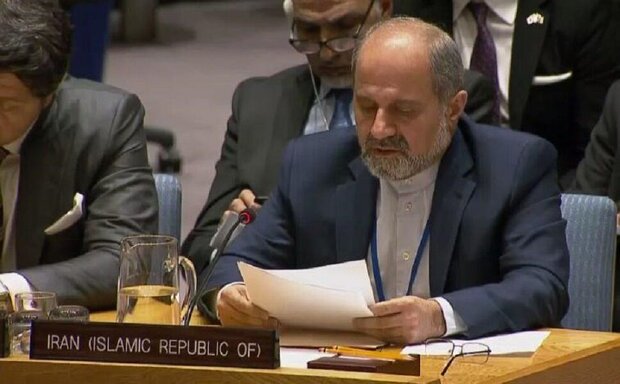
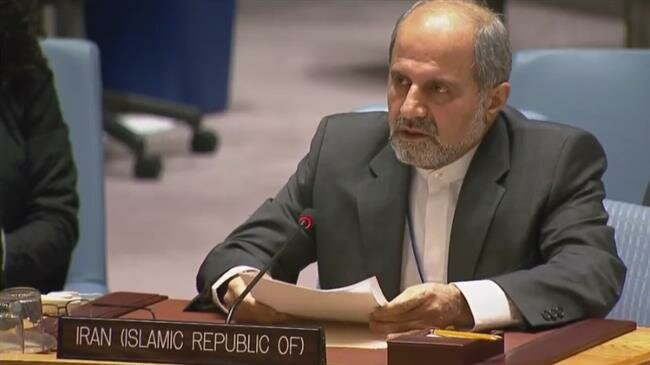
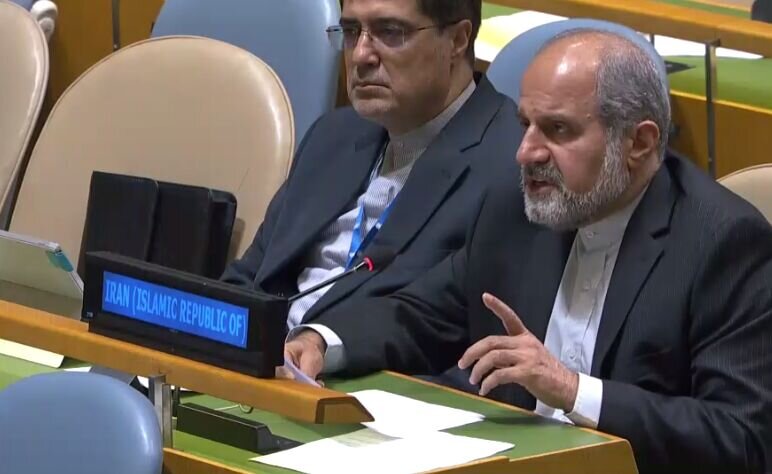
Iran’s Deputy Permanent Representative to the United Nations, Es'hagh Al Habib made the remarks on Thursday in his address to the UN General Assembly focusing on "Necessity of ending the economic, commercial and financial embargo imposed by the United States of America against Cuba".
Full text of the statement reads as follows:
"Mr. President,
At the outset, I wish to take this opportunity to offer our warm welcome to Mr. Bruno Eduardo Rodríguez Parrilla, the Foreign Minister of Cuba.
My delegation associates itself with the statements delivered yesterday by the representatives of Palestine, Azerbaijan and Uganda, on behalf of Group of 77 and China, the Movement of Non-Aligned Countries as well as Organization of Islamic Conference. However, I would also like to add the following remarks in my national capacity.
Today, we are witnessing that the expansionist and arrogant approach of a certain Government presents the greatest threat and challenge to the world peace and security. The growing resort to unilateral coercive measures is one of the clear symptoms of unilateralism coupled with an interventionist, flawed and short-sighted foreign policy.
Among others, unilateral embargoes and coercive sanctions, as a means to achieving national policy objectives, have a seriously adverse impact on the promotion of peace at the regional and international levels. They are fundamental impediments to establishing not only a peaceful and prosperous world but also a just and equitable international order which is a vital prerequisite for sustainable development.
The inhumane sanctions and blockade imposed by the United States against Cuba for almost six decades is the most unjust and prolonged system of unilateral sanctions applied against any country. These aggressive measures constitute a gross violation of the norms and principles underpinning the international relations order. No Cuban citizen or sector of the economy has been immune from the negative effects of this unilateral policy which hinders the development that every country is entitled to construct in a sovereign manner.
In the past year, tightening of the blockade has continued to be the central pivot of US government policy towards Cuba, with ever more notable effects in its extraterritorial application. 
Regretfully, we have observed that the US Department of State has on different occasions expanded the “Restricted List of Cuban Entities”, to the blockade regulations, which caused considerable damage to the country’s economy because of its effects of intimidating the international business community.
In fact, the US has been addicted to imposing unilateral sanctions when it comes to states that do not submit to or follow its contradictory and expansionist policies. In reality, Iran and Cuba are paying the price for their resistance and insistence on their independence from the United States’ colonialist policies. Iran has experienced the US unlawful sanctions since the triumph of the Islamic Revolution 40 years ago.
Within the last four decades, the US has imposed unilateral coercive measures on the Iranian people at an increasing rate to the extent that the current US Administration, defiant of the established norms, has even targeted importation of medicine and medical equipment. Thus, patients, women and children, refugees, poor and those in vulnerable situations have become the prime target of the US genocidal economic terrorism--against all principles of international law.
The US Administration wants the world to believe that it is concerned about the Iranian people. Yet the very first sanctions it reimposed have cancelled licenses for sales of more than 200 passenger jets under absurd pretexts, endangering ordinary Iranians. US hypocrisy knows no bounds.
The economic war that the United States has initiated under the rubric of putting “Maximum Pressure” through imposing new sanctions, not only targets the Iranian public but also has harmful repercussions for the peoples of other countries, and has disrupted the state of global trade.
The message of today’s meeting is a reaffirmation of the fact that the time for interventionist policies and interference in the farthest reaches of the world is long over.
Mr. President,
Iran will keep working with its partners to create a new environment in which self-respecting nations can pursue their own interests and international obligations. We will continue to work to offset unlawful US sanctions and irrevocably eliminate the destabilizing phenomenon of the US extraterritorial application of domestic legislation.
The world needs to find solutions against such destructive interventions and unilateralism.
Iran strongly believes in cooperating with friendly countries, including Cuba to address this challenge prudently and will not allow the US Administration, which has stripped the US foreign policy of any principles, to achieve its illegitimate objectives.

Saturday, November 02, 2019

Death toll in Saudi war on Yemen hits 100,000: Report

The Saudi-led war on Yemen has killed more than 100,000 people since 2015, a US-based database project that tracks violence has said.
The Armed Conflict Location and Event Data Project (ACLED) made the announcement in a report published on Thursday, saying that the figure included 12,000 civilian deaths in directly targeted attacks.
The report said 20,000 people had been killed this year, making it the second deadliest year of the war behind 2018.
The non-governmental organization also said April was the most lethal month so far this year, with over 2,500 reported killed, compared to approximately 1,700 in September.
“The third quarter of 2019 had the lowest number of reported fatalities since the end of 2017, but the number of civilian casualties rose from the previous quarter,” ACLED said.
The most violent provinces were Ta'izz, Hudaydah and Jawf, with more than 10,000 people reported killed in each of the regions since 2015.
ACLED said direct targeting by the Saudi-led coalition and its allies had been responsible for more than 8,000 civilian deaths over the past four and a half years.
The data covers everything from airstrikes, shelling and ground battles between various forces to bombings and violence at protests. However, their numbers do not include those who have died in the humanitarian disasters caused by the war, particularly starvation.
Saudi Arabia and a number of its regional allies launched a devastating campaign against Yemen in March 2015, with the goal of bringing the government of former president Abd Rabbuh Mansur Hadi back to power and crushing the Ansarullah movement.
In the relentless campaign, Saudi-led airstrikes have hit schools, hospitals and wedding parties and killed thousands of Yemeni civilians.
The war has also taken a heavy toll on the country’s infrastructure, destroying hospitals, schools, and factories. The UN says over 24 million Yemenis are in dire need of humanitarian aid, including 10 million suffering from extreme levels of hunger.
The United States and the United Kingdom are the main supporters of Saudi Arabia in the war, providing the kingdom with billions of dollars in arms sales, training, logistical support and targeting assistance for airstrikes.
(Source: Press TV)

Wednesday, October 09, 2019

U.S. sanctions jeopardizing global trade system: envoy

TEHRAN – Iran’s deputy ambassador to the UN, Es’haq Al-e Habib, says Washington’s illegal sanctions have endangered the international trade system, calling on the international community to break its silence over what he called an “unprecedented threat”.
Addressing a meeting of the Second Committee of the UN General Assembly held in New York on Monday, Al-e Habib said it is undeniable that commitment to multilateral cooperation as a basis for global treaties and agreements is currently under unprecedented and growing pressure.
“Sanction-based policies have made multilateral financial and trade system very inefficient, and now it is upon the international community to guarantee that the financing of development is not taken hostage by certain countries through unilateral coercive measures,” he added, Press TV reported.
“The illegal and illegitimate coercive and unilateral measures of the U.S., including its unprecedented and unjustifiable sanctions against certain developing countries, Iran in particular, amid the international community’s silence have increased in an unprecedented way and threaten the foundations of multilateralism,” Al-e Habib said.
Tensions between Tehran and Washington have risen since last year when President Donald Trump abruptly withdrew the United States from the 2015 nuclear deal and attempted to put “maximum pressure” on the Islamic Republic.
On May 8, exactly one year after the U.S. abandoned the deal, Tehran began to partially reduce its commitments to the agreement at bi-monthly intervals.
In the first stage, Iran announced that it will not limit its stockpile of the nuclear fuel to 300 kilograms allowed under the deal. However, on that date (May 8) Iran’s Supreme National Security Council (SNSC) said if the remaining parties to the JCPOA, especially Europeans, devise a mechanism to protect it from the sanctions effect in the two-month deadline it will reverse its decision. 
But since European parties missed the deadline, on July 7 Iran announced that it has started enriching uranium to a higher purity than the 3.67%, thereby starting the second step.
As Europe missed the second 60-day deadline, Iran moved to take the third step, removing ban on nuclear research and development (R&D).
In a letter on September 5, Iranian Foreign Minister Mohammad Javad Zarif notified European Union foreign policy chief Federica Mogherini about Iran’s third step.
In his Monday speech, Al-e Habib also criticized the World Trade Organization (WTO) for blocking Iran’s membership for two decades because of the political pressures of certain member states, saying that unilateral behaviors are currently targeting the WTO, jeopardizing the entire trade system of the world.
Iran, the largest economy not yet member of the WTO, has been requesting to join the organization since 1995, and was admitted to it as an observer in 2005, but sanctions began to hit Tehran afterwards and certain countries – especially the U.S. – opposed its membership.

Sunday, September 29, 2019

Diplomat calls Saudi Arabia a fountain of extremism and terrorism

TEHRAN – Es’haq Al-e- Habib, the Iranian deputy ambassador to the UN, said on Friday that the Saudi regime is a “source of terrorism and extremism”.
His comments came as response to Saudi Foreign Minister Ibrahim Abdulaziz al-Assaf’s Friday remarks in the 74th session of the United Nations General Assembly in which he leveled terrorism charges against Iran and calling for further financial pressure on the country.
“It was Saudi Arabia and not Iran which provided billions of dollars worth of arms to the Daesh Takfiri terrorist group and affiliated terrorists in Syria,” Press TV quoted Al-e- Habib as saying.
He said that Saudi “despots” cannot go on forever making accusations against Iran as a cover for failures stemming from their “primitive medieval dogmas”.  
The diplomat added that Saudi Arabia’s “destructive” policies should not be overlooked despite the regime’s tendency to blame others for its mistakes.
Al-e Habib further pointed to the high number of Saudi nationals among the main operatives committing the September 11 terrorist attacks in the United States, adding that the Saudi regime has turned into a hotbed for “radicalism,” with many terrorist leaders being known to have studied in Saudi-backed schools.
At least 15 of the 19 hijackers who flew passenger planes into the World Trade Center on that occasion came from Saudi Arabia. There are also numerous official reports that suggest the attackers were funded by some Saudi royals.