
By Palestine Chronicle Staff
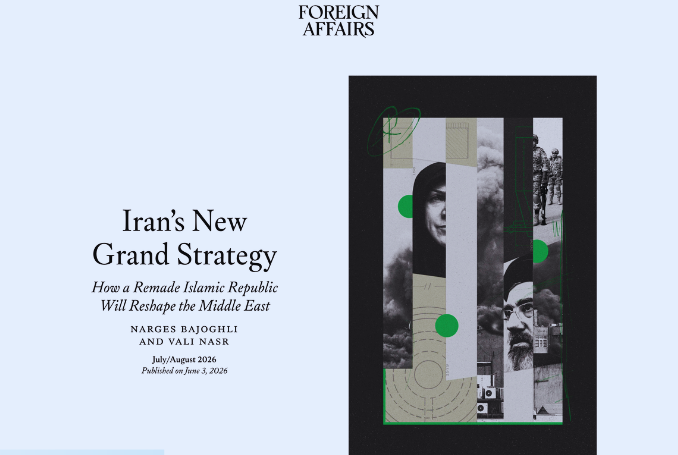 A major Foreign Affairs analysis argues that war transformed Iran, accelerating political change while strengthening state resilience and nationalism. (Photo: Screen grab)
A major Foreign Affairs analysis argues that war transformed Iran, accelerating political change while strengthening state resilience and nationalism.
Key Takeaways
- Foreign Affairs argues that the war accelerated a historic generational transition within Iran’s political and military leadership.
- The analysis contends that nationalism is increasingly replacing revolutionary ideology as the foundation of state legitimacy.
- According to the authors, Tehran emerged from the conflict convinced it had altered the regional balance of power.
From Revolution to Statecraft
A major analysis published in Foreign Affairs argues that the US-Israeli military aggression on Iran has produced consequences dramatically different from those envisioned by Washington.
Rather than triggering the collapse of the Islamic Republic, the war accelerated the emergence of what the authors describe as “a new Iran, one that will reshape the Middle East and influence the course of geopolitics for years to come.”
The article challenges assumptions that years of sanctions, economic hardship and domestic unrest had left the Iranian state on the verge of collapse.
While acknowledging the devastating impact of military strikes and economic warfare, the authors argue that “the war’s initial aim—to deliver a death blow to the Islamic Republic—has proved unattainable.”
Instead, the authors contend that the pressures of war forced Iran to adapt politically, militarily and institutionally with unprecedented speed, creating a political order that differs substantially from the one that entered the conflict.
At the heart of the Foreign Affairs analysis is the argument that Iran is undergoing its most significant generational transition since the 1979 Revolution.
According to the report, Western observers have focused excessively on prominent figures while overlooking a deeper transformation taking place throughout the state’s military and civilian institutions.
The decisive shift, they argue, is the rise of a generation of officials who “know nothing but postrevolutionary Iran” and whose outlook is increasingly rooted in statecraft rather than revolutionary ideology.
“The new generation has separated revolution from statecraft,” the authors write.
Unlike the founders of the Islamic Republic, who were shaped by opposition to the Shah and anti-imperialist struggle, the emerging leadership is described as “pragmatic, hardened nationalists operating with a clear-eyed assessment of Iran’s capabilities and vulnerabilities.”
The distinction, the article argues, is profound: “They are not defending a revolution. They are administering a state.”
The analysis contends that this new generation lacks the ideological insecurity that characterized many revolutionary leaders. Rather than seeking to prove the legitimacy of the Islamic Republic, they govern from the assumption that its legitimacy is already established.
“The insecurity that marked the founding generation—the constant need to prove that the revolution was real, its claims serious, the old elite truly defeated—is largely absent.”
As a result, the article argues, the emerging leadership increasingly prioritizes national interests, strategic patience and institutional resilience over revolutionary rhetoric.
The War that Changed the State
The analysis further argues that the June 2025 war became a turning point that triggered a sweeping process of institutional adaptation.
According to the authors, Iranian universities, research centers, military institutions and government agencies undertook an extensive review of lessons learned from previous confrontations.
“More institutional change took place in those eight months than in the previous ten years combined,” the analysis argues.
The article describes a broad effort to decentralize decision-making, restructure military planning and overhaul state institutions responsible for communications, economic management and public messaging.
The result, according to the authors, was the emergence of a more resilient state apparatus capable of functioning under sustained military pressure.
The analysis argues that this transformation became evident during the conflict itself. Iran’s military, the authors contend, applied lessons from previous wars by dispersing missile assets, decentralizing command structures and adapting its methods of warfare.
“The Iranian military had learned not just to absorb punishment but also to win strategic advantage by frustrating its adversaries’ war aims,” it says.
More importantly, however, the authors argue that the state’s greatest achievement was political rather than military, since “the state survived decapitation.”
Even after the loss of senior leaders and sustained bombardment, the political system remained intact. Rather than generating chaos, the article contends, wartime pressures accelerated institutional cohesion and reinforced the authority of the emerging leadership.
“The war has been a crucible, forging a new iteration of the Islamic Republic and the first major generational shift since its founding.”
Nationalism, Society and a New Regional Order
Perhaps the most striking section of the Foreign Affairs essay concerns the relationship between the Iranian state and society.
Before the war, many analysts expected economic grievances, political frustrations and social tensions to erupt into large-scale opposition. Instead, the authors argue, foreign military intervention generated a powerful nationalist response:
“Contrary to American and Israeli expectations, the war has not sparked street demonstrations.”
Rather than mobilizing against the government, the article argues that many Iranians rallied around the state during the conflict and that the “Iranian society mobilized not against the state but alongside it.”
The authors emphasize that this does not mean longstanding grievances have disappeared. However, they argue that wartime conditions fundamentally altered the political environment in which those grievances were expressed.
Iranian philosopher and dissident Mohammad Mehdi Ardebili is quoted in the article as stating that “in this moment in time, the Islamic Republic and Iran are one and the same. If the Islamic Republic falls, Iran falls.”
The analysis also points to evidence that many Iranians viewed the state’s wartime performance differently from its peacetime governance.
“Besides the bombs, it didn’t feel like we were at war,” one Tehran resident told the authors. “If the Islamic Republic can always manage society this efficiently, we wouldn’t have the number of complaints we usually have about them.”
This nationalist shift, according to the article, extends beyond domestic politics.
The authors argue that Tehran emerged from the war convinced that it had altered the strategic landscape of the Middle East: “Tehran regards the resulting stalemate as a new balance of power.”
A key element of that assessment is Iran’s approach to the Strait of Hormuz. The article argues that Iranian leaders increasingly view control over the strategic waterway as a source of leverage and deterrence.
One Iranian analyst quoted by the authors summarized the shift bluntly: “Sanctions relief is not important for us anymore because we know it won’t come, and even if it comes, it won’t be long-lasting. We’re not making the same mistakes as before. Now managing Hormuz is the key.”
A New Islamic Republic
The Foreign Affairs analysis ultimately argues that the Islamic Republic emerging from the war differs fundamentally from the one that entered it.
The authors contend that legitimacy is increasingly being rooted not in revolutionary ideology but in national defense, state competence and institutional resilience.
“What is now on offer is a nationalist-technocratic bargain, in which state legitimacy rests on a demonstrated ability to defend the country and rebuild it,” they wrote.
That transformation is perhaps best captured by one of the article’s most striking conclusions: “The test of political fealty is no longer ‘Are you Islamic enough?’ but ‘Are you Iranian enough?'”
“The republic born of the U.S.-Israeli wars is defined less by ideology than by nationalism, less by revolution than by statecraft, less by clerical charisma than by the confidence and technocratic ethos of a new officer class.”
Far from producing the collapse many anticipated, the article concludes, the war may have accelerated the emergence of a new political order—one that sees itself not as weakened by conflict, but empowered by survival.
According to the authors, that conviction is now shaping both Iran’s domestic transformation and its vision for the future of the Middle East.
(PC, Foreign Affairs)

No comments:
Post a Comment