In the current fast-paced realm of advertising and marketing, travel influencers have changed the whole game as they have succeeded to materialize a totally new and self-directed channels to reach audiences in a more authentic and personal way, even influencing to shape their wanderlusts.
We can say that the Instagram has backtracked old-school manners of travel advertising campaigns. Well-traveled influencers induce their avid followers to win sparking their wanderlusts by the means of the photo-sharing platform that enables sharing of wonderful moments and wandering adventures of their journeys.
Many believe that the Instagram has drastically changed the way people, especially the youth, travel, and it’s undoubtedly not all for the better. The trend, however, has its own harms, for instance, it may lead to overtourism, a relativity new term that you may cannot look it up in many dictionaries.
That’s why Iran’s tourism ministry has started to make the best use of new technologies in order to portray a true image of the country based on what travelers and influencers perceive during their visits to the country.
But, how does it work for Iran? It’s noteworthy to remind that Iran has been under U.S. sanctions and its anti-Iran propaganda for around four decades. Some Western media outlets have long tried to portray Iran’s global image as unsafe, unwelcoming and so on.
As an example, some of their messages carry themes from U.S. State Department’s travel advisory against Iran, which since 1979, warns about “the risk of kidnapping, arrest and detention of U.S. citizens.”
On the contrary, when you refer to people who have visited the country or even you read their travelogues on Iran, you usually perceive that Iranians are described as warm, friendly and eager to show off their country to foreigners. Moreover, almost all international tour operators and travel agents have the same attitude towards the country and its people.
The 2019 Travel Risk Map, which shows the risk level around the world, puts Iran among countries with “insignificant risk”, a category where the UK, Denmark, Switzerland, Norway, and Finland are placed in.
Tourism minister Ali-Asghar Mounesan said on Thursday that the ministry supports certain the Instagram influencers to travel to the country.
“Instagram influencers’ trips to Iran are backed by the Ministry of Cultural Heritage, Tourism and Handicrafts and, in the advertising arena, we do a lot of work to fight Iranophobia and introduce the true face of Iran,” Mounesan said.
“One of the areas [in travel & tourism advertising] is to bring famous figures to Iran, get the country known to them in terms of its rich culture, beautiful natural landscapes and historical monuments…this is part of programs to introduce the country that we will definitely continue.”
With over one billion active monthly users, it seems reasonable that the Instagram has enough power to set new trends on traveling to a country that boasts hospitable people and some of the world’s oldest cultural monuments such as bazaars, museums, mosques, bridges, bathhouses, madrasas, gardens, rich natural, rural landscapes and 22 UNESCO World Heritage sites to name a few.
Tehran, IRNA – Iran ranks the second fastest-growing country in terms of attracting foreign tourists, with 49% growth after Ecuador, according to a new report from the World Tourism Organization.
Iran, which hosted a total of 4.867 million foreign tourists in 2017, in 2018 with a grow of 49.9% hosted 7.295 million foreign tourists and reached the 2nd rank in the world's fastest growing tourism, Ecuador is the fastest-growing country with 51% among the countries of the world in attracting tourists.
Ecuador in South America has increased its number of tourists from 1.6 million to 2.6 million in the period from 2017 to 2018.
The increase in the world's fastest-growing tourism in Iran from 2017 to 2018 that earlier, in the period of 2016 to 2017 Iran's tourism growth was -1.5 %.
Iran's tourism revenue for the year 2010 is reported at $ 2.438 billion, according to the report.
Minister of Cultural Heritage, Tourism and Handicrafts Ali Asghar Mounesan says that naming September 27 as International Tourism Day and marking a week with this name in our country indicates the importance of this growing industry on a national and international scale. Last year, the momentum of the Iranian tourism has been driven to the track of global standards about tourism industry.
Recently, Ali Asghar Mounesan in his note in Shargh Daily said that at such times each year, a variety of special programs are being held around the world to focus on tourism and its advantages and challenges to reaffirm the unparalleled role of tourism industry in the global economy and its impacts on sustainable development of the countries.
The Government of the Islamic Republic of Iran has realized the importance of this industry and gave preference to the natural and historical capacities and attractions of our country over the last few years.
Despite unilateral US sanctions and efforts for Iranophobia, Iran's tourism growth has accelerated over the past two years, and the movement of the Iranian tourism industry has fallen on the right track in accordance with the global standards.
Minister of Cultural Heritage, Tourism and Handicrafts Ali Asghar Mounesan said on Saturday that last year some seven to eight million tourists visited Iran ignoring a very tough economic sanctions while four million tourists have come to Iran since the beginning of the current Iranian year.
Since 1980, the United Nations World Tourism Organization has celebrated World Tourism Day on September 27.
According to the statistics of the International Tourism Organization, the share of Iran's tourism sector in 2017 was $ 11.8 billion of GDP, Mounesan said at the World Tourism Day Conference in Zahedan.
He added that $ 21 billion investment is required to achieve the objectives set for the Iranian tourism industry.
He said tourism industry plays an important role in creating jobs, adding that one out of every five jobs in the world is related to tourism.
Tourism in the country can create job opportunities which is now serving as a breakthrough for the Iranian economy helping our officials to employ the youth, the minister said.
The corporate media is having the false accusations repeated until the need for Iran attack becomes consensus reality in the west.
TEHRAN- Some in the mainstream western media are lamenting why U.S. President Donald Trump is dragging its feet to march off to another open-ended military conflict in the Middle East, after days of reckless efforts to implicate Iran in the September 14 Yemeni attacks into Saudi oil installations.
The MSM outlets are repeating that Iran was behind the attack, despite the fact Iranian complacency with the Yemeni strike has not yet been publicly demonstrated.
They are following in the footsteps of U.S. Secretary of State Michael Pompeo, who has put American credibility on the line by accusing Iran of perpetrating an “act of war”.
The attack, the latest in a series of strikes into key Saudi Arabian targets this year, was launched from south-western Iran using drones and cruise missiles, according to the American narrative.
This is while the Yemeni Houthi movement has claimed responsibility for the attacks, explaining in detail how the assaults were carried out.
The strike fits a pattern of Yemeni strikes against Saudi economic infrastructure, and it follows Yemeni threats made last month.
There is no plausible reasons to believe Iran was behind the attacks, and it’s even unclear if Iran has indirectly played a role in the attacks.
Although the U.S. government and establishment media often call the Houthis a proxy of Iran, the fact is this is an independent force grown out of decades-long conflicts in Yemen.
The extent to which Iran offers support to the Yemeni forces has never been established.
Anyway, even if factual evidence does emerge that Iran has provided weapons used in the attack, there would be much less actual guilt on the part of Tehran than what the western outlets say. Why would this justify a U.S. military response?
Assemblage of junk
Surprisingly, neither the U.S. nor Saudi Arabia have so far presented a shred of credible evidence proving Iran launched the attack on Aramco.
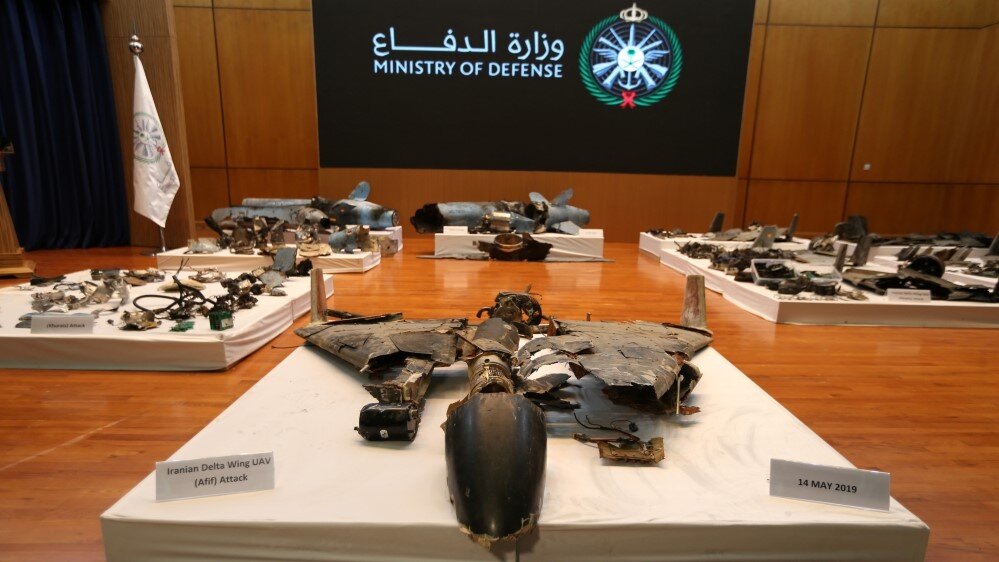
In a press conference Wednesday night, Riyadh put on display a wreckage of what it said were remnants of weapons used in the attacks
In the show, the Saudi Defense Ministry Spokesman Turki al-Maliki claimed the wreckage showed the attacks were "unquestionably sponsored" by Tehran.
But many believe the assemblage of junk were not that much-anticipated “concrete evidence” Saudi officials had vowed to provide.
Al-Maliki did not say what area the strikes were fired from, just asserting they “could not have originated in Yemen”.
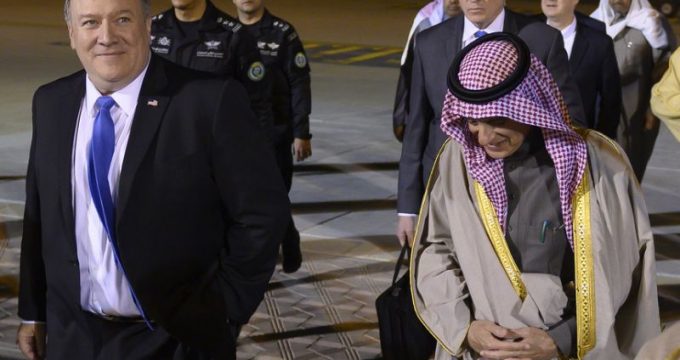
Separately, Saudi Arabia's Minister of State for Foreign Affairs Adel al-Jubeir on Saturday showed he is clueless about the perpetrator of the attacks.
Al-Jubeir said Riyadh would take the appropriate steps if its investigation confirmed that the attacks were launched from Iranian soil.
"The kingdom will take the appropriate measures based on the results of the investigation, to ensure its security and stability," al-Jubeir told a news conference.
Reuters eggs on war
However, it seems Reuters and other western outlets are bent on nudging the idea of war forward, picking up the anti-Iran narrative and running with it.
The corporate media is having the false accusations repeated until the need for Iran attack becomes consensus reality in the west.
Of dozens of Reuters articles on the Aramco attack, almost all take Iran’s involvement in the attack for granted.
The articles generally repeat the same demonology pro-war voices offered for years to try to justify an attack on Iran.
A Friday piece, titled “United States sending troops to bolster Saudi defenses after attack”, says the US officials have told Reuters southwest Iran was the staging ground for the attack that might has been “authorized by Iran’s Supreme Leader Ayatollah Ali Khamenei.”
The article says this is “an assessment based at least in part on still-classified imagery showing Iran appearing to prepare an aerial strike”.
But the agency doesn’t explain why the evidence that reportedly justify an attack to a sovereign country are still classified.
The article also says the Pentagon’s late Friday announcement that it will send some troops to Saudi Arabia to bolster defense systems “appeared to close the door to any imminent decision to wage retaliatory strikes against Iran following the attack”.
Ouch! Isn't it too bad that the doors to “retaliatory strikes” are closed?
The title of a Saturday column says, “Saudi oil attack shows how Iran sees new Mideast game”.
This column clearly suggests Iran was behind the attack. A paragraph says,” Iran has been testing drones and supplying them to regional allies such as Hezbollah for years. This attack, however, showed significant recent progress. That the missiles were reportedly able to evade Saudi air defenses by flying behind them demonstrates striking sophistication”.
A Thursday article reads, “Saudi Arabia shows attack site damage as Iran pledges tough defense”.
This article relates a Saudi-organized tour of the damaged facilities for western reporters to Friday remarks by an Iranian official that Iran would give firm response to any U.S. military plot in the region.
This is also the case with two otherarticles, titled “Iran says it will destroy any aggressor” and “Iran navy commander says Iran ready to defend its marine borders”.
Both articles link pledges by Iranian commanders to defend Iranian territory, made in speeches on the occasion of the 39th anniversary of the beginning of the Iraqi invasion of Iran, to the Aramco attacks.
Striking example
Perhaps no article demonstrates the Reuters pro-war stance than a major piece released early on Wednesday.
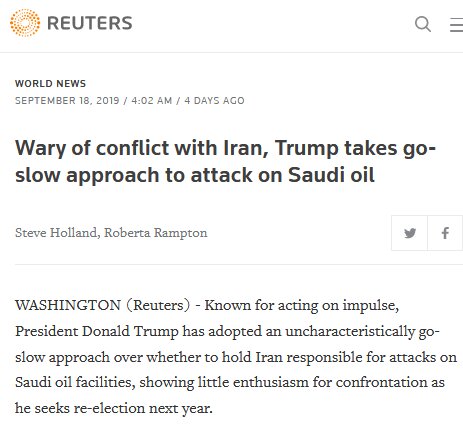
Screenshot of a Reuters article published on September 18, 2019.
In the article, published hours before Saudi Arabia held its news conference, Reuters lamented why Trump was not taking action immediately.
The title is provocative enough:” Wary of conflict with Iran, Trump takes go-slow approach to attack on Saudi oil”.
Reuters reports Trump has adopted an “uncharacteristically go-slow approach” over whether to “hold Iran responsible” for attacks on Saudi oil facilities, apparently because he “seeks re-election next year” and he is “famously skeptical of his intelligence community”.
But one can hardly conclude Trump’s approach towards the Sept. 14 attacks was “uncharacteristically go-slow”, taking into account Trump’s approach to the explosions off the coast of the UAE’s Fujairah in May, the attacks on two oil tankers in the Gulf of Oman mid- June and the shootdown of a U.S. spy drone inside Iranian territory late June.
Probably in all cases there was “no doubt” that Iran was the culprit - although even stanch allies of the U.S. wanted clear evidence - but Trump reportedly decided to back down.
The Reuters piece itself mentions Trump’s behavior towards Venezuela, reporting Trump has resisted suggestions for a “stronger focus on military planning” while a U.S.-led campaign of economic and diplomatic pressure has failed to “rescue” its people by toppling the Venezuelan government.
Reuters continues, “Trump’s stance today is in stark contrast to 2017, less than three months into his presidency, when he waited only two days before launching air strikes to punish Syrian President Bashar al-Assad’s forces for a chemical weapons attack.”
Wait a minute. Was Trump entitled to bombard Syria as a punishment for a “chemical weapons attack”? Which global authority did sanction such attacks?
And there are no convincing proof to believe the Syrian government has ever committed chemical attacks.
CNN anchor echoes Reuters
Interestingly, a famous CNN anchor also egged on war with Iran, tweeting why Trump “balks” at military retaliation.
Trying to portray Trump’s picking of sanctions instead of airstrikes as a sign of weakness, CNN anchor Jim Sciutto replied with a carefully worded question: “does this mean the president is again balking at military retaliation?”
According to Sputnik, the purpose of Sciutto’s question is to frame Trump’s choice as between showing strength by ordering an airstrike - which seems to be the obvious decision for any red-blooded American - or weakness by “balking” at that option.
A love for war
Seemingly, the mainstream media loves it when the U.S. bombs things.
The Trump-ordered missile strike on Syria’s Shayrat Air Base in April 2017 was widely admired by the MSM.
A day after the attack, CNN’s Fareed Zakaria said he thinks Trump had just “became President of the United States", Washington Post columnist David Ignatius asserted “put more umph” back into “the credibility of American power,” and Fox News’ Jeanine Pirro claimed “We finally have a man who knows the difference between right and wrong and good and evil, and it makes us proud.”
Global Research and other respected alternative outlets have clearly demonstrated how big U.S. outlets, including the New York Times, CBS, and CNN, sold the Iraq war to the American people.
“Such was the barrage of propaganda directed at the American public that 69% believed Saddam Hussein was personally involved in the September 11 attacks. That is a significant achievement in manipulation. The poll results must have been news to the Iraqi dictator himself, a forgotten one-time American ally,” Global Research reports.
The pattern continues into other illegitimate interventions, as the liberal Guardian newspaper championed the demolition of Libya in 2011, with editorials imploring, “The quicker Muammar Gaddafi falls, the better.”
Now one can better grasp why William Arkin, one of NBC’s political commentators, quit in January. In his resignation letter, Arkin denounced the network as a “cheerleader for open and subtle threat mongering,” full of people who “accept that a state of perpetual war” is a necessity.
Trump decided to impose yet another round of sanctions to punish the people of Iran for what there is no public proof of, but MSM outlets are furious that Trump has backed away from an all-out war.
Trump can be almost certain that the day he orders air strikes, the MSM will cheer the decision as “presidential”.
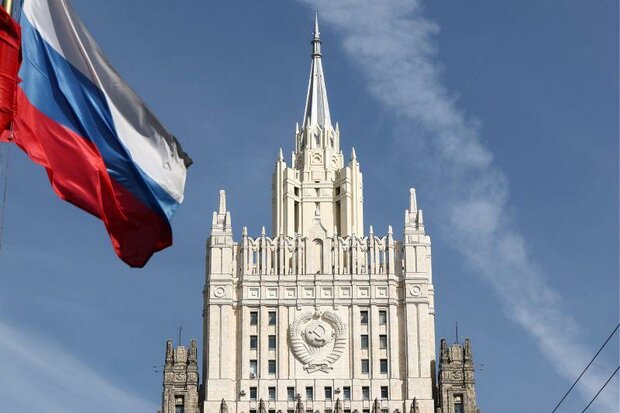
TEHRAN, Jun.15 (MNA) – Voicing concerns over tensions in the Sea of Oman, the Russian foreign ministry on Fri. warned against “deliberate efforts to whip up tensions, which are largely encouraged by the United States’ Iranophobic policy.”
"First of all, we would like to thank the Iranian authorities for assistance in rescuing eleven Russian mariners, crewmembers of one of the tankers (Front Altair)," the Russian foreign ministry was quoted by Tass news agency as saying in a statement on Friday. "All of them were promptly evacuated from the burning vessel and taken to the port of Jask."
"Moscow resolutely condemns the attacks whoever might be behind them," the ministry stressed. "We think it necessary to refrain from quick conclusions. It is inadmissible to place responsibility for the incident on anyone until a thorough and unbiased international investigation is over."
"We are worried over the tensions in the Gulf of Oman. We take note of deliberate efforts to whip up tensions, which are largely encouraged by the United States’ Iranophobic policy," the ministry noted. "We call on all the parties to show restraint."
The ministry once again emphasized that there is no alternative to dialogue to prevent further degradation of the situation in the region.
On Thursday morning, two oil tankers – one sailing under a Panama flag and owned by Japan and another bearing the Marshall Islands’ ensign owned by Norwegian Frontline – were hit by yet unspecified accidents in the Sea of Oman. Iranian rescuers rushed to the assistance, transferring all of their 44 crew members to Iran's southern shores.
Following the attack, US Secretary of State Mike Pompeo rushed to accuse Iran of carrying out the attacks without providing any evidence to back up his accusation.
In a statement on Thursday, the Iranian mission to the UN strongly rejected the “unfounded” US claims, warning of "another Iranophobic campaign" being waged by Washington and its allies.
Meanwhile, a UN Security Council held on Thursday to address the incident concluded with no results, despite the US efforts to pin the blame on Iran.
Tehran, April 6, IRNA - White House's efforts to put pressure on Tehran and Iran's isolation in 2018 did not succeed politically and just created economic problems for the Iranian people.
The White House's efforts to put pressure on Tehran and continue isolating Iran has failed politically since May 8, 2018 when the US left the Join Comprehensive Plan of Action (JCPOA).
As expected, after the American presidential election in 2016 and Donald Trump's entry into the White House, the relations between Tehran and Washington turned into darkness exponentially. The US’ withdrawal from the JCPOA as one of the most important achievements between Iran and the six world powers was the beginning of an increase in tensions between the two countries as well as the creation and deepening of the rift between the US and its longtime allies.
The report will review the most important issues between Iran and the US last year as well as the projects that the White House has managed to oppose Tehran.
** Increasing rift with Trump denial of JCPOA
In spite of the frequent opposition to Trump with JCPOA, however, he had to extend the suspension of Iran's nuclear sanctions three times, so that by imposing a series of changes in the cabinet, the platform was paved to exit the agreement. Among those changes were the use of John Bolton as senior White House adviser and selecting Mike Pomoeo as Secretary of State to replace Rex W. Tillerson.
On such occasions, Trump officially announced on 8 May that the country unilaterally abandoned the nuclear agreement with Iran; 'an agreement that had been the worst deal for the US over history'. Trump's decision was welcomed by the Israeli and Saudi officials and a few of Iran's enemies and rivals. In turn, other members of the agreement and international influential actors and bodies condemned the US measure and demanded that the US must return to an agreement that had been negotiated for more than a decade to achieve it.
Sanctions against Iran began in two phases as the US withdrew from the JCPOA. In the first round, the sanctions were enacted by Trump on June 5. The American president while signing sanctions decree against Iran, called the goal to 'import maximum economic pressure' on Iran. In this stage, sanctions hit the dollar, rial, gold and precious metals, as well as auto industry and aircraft sales to Iran.
The second round of sanctions, which began on November 4, included the oil industry, banking, navigation, insurance services and the Iranian energy sector. In the second round of sanctions known as 'secondary sanctions', individual and companies on the Iranian side of the deal were also included in the sanctions, while the United States was offering exemptions for eight countries.
** Policy of bringing to zero level export to threat of closing the Strait of Hormuz
To bring to zero level the oil exports, was the most important goal of the Trump team last year which White House officials had repeatedly pointed to it in their positions. The creation of a new entity within the State Department's structure entitled 'Iran Action Group' led by Brian Hook was in this regard to pave the way for the resumption of Iranian oil and banking sanctions.
Hook said on Monday, October 16, in Luxemburg that the goal of the government of Donald Trump, was to cut off Iran's oil exports as quickly as possible, adding that we are working with countries that reduce their imports to make sure that this is happening. Also, the head of Iran's action group on trips to countries close to the United States tried to align them with US policies, which despite the fact that Iran's exports reduced Iran's oil by about half, but the granting of US exemption for eight countries of Japan, India, South Korea, China, Turkey, Taiwan, Italy, and Greece have been a failure for the White House in pursuit of zeroing Iran's oil exports.
Of course, in retreat of the US from this project, the positions of the officials of our country affected the withdrawal of the United States. For example, President Hassan Rouhani on Tuesday, December 4, in a speech in Shahroud which was broadcast live on Iran television, said, 'The US will know that we will sell our oil. It cannot stop Iranian oil exports. If the US wants to stop Iranian oil exports, oil will not be exported from the Persian Gulf.' In response to the White House tactic on zeroing Iran's oil exports, the president added that the Strait of Hormuz was to be closed to oil tankers of other states.
** Tactic of squeezing Iran from Security Council
Due to its veto power, the US is always benefiting from the United Nations Security Council to advance its policies, a trend that continued in the past year, but because of Trump’s exit of JCPOA and the US unilateralism, the White House's unusual way went nowhere.
Last year, the United States, regard of Iran, typically pursued two topics of missile and regional movements of Iran through the Council. Despite the convergence between America and Europe on the above issues, they could not restrict Tehran. Even at a meeting of UN Security Council members in December 4 behind closed doors to address the issue of Iran's missile program, it did not end the issuance of a statement, let alone a resolution.
A few days before the meeting, the US Secretary of State announced a new missile test in Iran and assessed the tested missile with nuclear capability, which is considered a violation of Security Council Resolution 2231. Earlier, Brian Hook, the United States' special envoy on Iran, said during an interview with Reuters on Iran's missile program, stated that Europe should sanction Iran's missile program, adding, 'We want to see the adoption of sanctions by the European Union against the institutions and personalities that facilitate the testing and development of Iran's missile program. Such punitive measures usually include the prohibition of travel and the blocking of assets and the prevention of the financing of such weapons programs.'
** Failure of winning consensus against Iran
In addition to the propaganda shows and moves that were taken last year by White House officials, Trump and his team, with Middle Eastern tours and an international summit, tried to isolate Iran. On the 8th of January last year, Pompeo traveled to eight countries in the Middle East, along with trips that Trump made to establish coalition against Tehran in the region, including Jordan, Egypt, the Emirates, Bahrain, Qatar, Saudi Arabia, Oman and Kuwait.
As expected, during this eight-day visit, Pompeo's political propaganda turned around Iranophobia, and the US Secretary of State was trying to make Iran a destabilizing element of the region and to act as a unifying force.
Hence, he unveiled an international conference that was held in Poland on February 13-14, and was called the Warsaw Summit, which, although officials from nearly 60 countries were present, but influential international actors, including members of JCPOA dismissed Trump’s invitation.
The EU Troika officials, and especially Federica Mogherini, were among the great absentee. At the same time, representatives of countries such as Iran, Turkey, Russia, China, etc. did not take part in the summit, so that Trump’ consensus making project was collapsed at the first stage.
Alwaght – On Tuesday, the US Secretary of State Mike Pompeo ended his 8-day regional visit starting from Jordan without traveling to Kuwait, the Arab country also on his schedule to visit.
During the visit, the top US diplomat did his best to bring the Arab allies of Washington under an alliance to help implement Washington’s anti-Iranian policies.
He also transferred to the Arab capitals a set of US demands surrounding the Palestinian cause and also the largely shrouded-in-mystery “deal of the century”, designed by Trump’s administration.
Easing the concerns of the allies and assuring them of continued protection even after the US troops’ withdrawal from Syria was another issue that drove the American Secretary of State’s visit.
Pompeo also pushed for the ease of tensions hitting the (Persian) Gulf Cooperation Council since 2017 when Saudi Arabia and three of its allies– Egypt, the UAE, and Bahrain– severed ties with Qatar and imposed a blockade on the small Arab emirate.
But did he achieve what he travel for? What does it mean for him to cut short his trip to the region?
Failing to build consensus amid deepening intra-Arab gaps
The Secretary of State had two aims behind his push to develop a consensus: To speed up the process of diplomatic normalization between the Arab states and the Israeli regime and to transfer the duty of protection of the American interests in the region to the regional allies through founding a NATO-style Arab force, also formally called by the Americans as Middle East Strategic Alliance (MESA), to realize Trump’s election promise of cutting the US military spending and making the allies pay for their own security under the “America first” policy.
However, Pompeo failed to materialize his anti-Iranian agenda as Washington’s regional allies are hit by division and tensions with no prospects of a stop. For example, Saudi Arabia is with an open dispute with Qatar and a cleavage of views with Kuwait. Also, there is an atmosphere of distrust between Qatar, Egypt, and the UAE. The Intra-Arab divorce of view made it impossible for Pompeo to raise an anti-Tehran Arab unity represented by an Arab army.
In fact, the complexity in the relations of the West Asian countries effectively reflects its shadow on the adoption of an approach helping the US-eyed anti-Iranian policy. That is not everything in US list of failures. The Americans also faced problems implementing reinstated economic sanctions against the Islamic Republic.
The only outcome of Pompeo visit could be the announcement of a plan to hold a largely staged, Iranophobic conference on February 13 and 14 co-hosted by the US and Poland in the Polish capital of Warsaw. The scheduled meeting is seen by the analysts as mirroring the defeat of Pompeo’s trip in reaching what the diplomat traveled to the Arab allies for. To put it differently, what he could not achieve in his trip is sought to be achieved through mid-February event. To hide the genuine nature of the conference, the US accentuated the international face of it and said it will discuss security and peace in West Asia region.
But none of the European allies of Washington, mainly Paris, London, Berlin, and Brussels approved to host the meeting, an issue signaling differences of the US and its closest allies about the West Asia policy. The US and Europe are at odds over a set of regional cases including Palestine, the Trump plan to move US forces out of Syria, and Iran nuclear deal and reinstatement of the embargo on Tehran.
What do the polls say?
Recently, Zogby polling institute, one of the top international polling organizations and a key advisory partner to the US Senate Select Committee on Intelligence, has conducted a poll in eight West Asian countries, concluding that a majority of the public opinion disagree with the US policies in the region. The poll suggests that a majority of regional people, excluding Saudi Arabia and the UAE’s, do not really approve of the US policies. The institute says it is noteworthy to say that the US popularity in Egypt and Iraq is very small. The institute adds that the invasion of Iraq and occupation of it are the key issues behind the unpopularity of the US in the region. It continues that a top issue for the people in subject countries is the end of Palestine occupation.
Both in Egypt where Pompeo recently made an address, and Iraq, which also hosted Pompeo, 90 percent of the population do not have a positive view of the US, the poll finds. 61 percent of the Egyptian poll participants said they opposed tough sanctions on Iran or US support to Arab bloc in the face of Tehran. Joan Cool, a West Asia expert at Michigan State University, in his book Common Dreams addresses the issue. He argues that he was surprised by the views on the so-called grand alliance against Iran and the low degree of support to it.
Nowadays, giving attention to the public opinion in political decisions is highly significant. The public is decisive in foundation, maturity, and competition of the political discourses. A good proof to the validity of this claim is the caution of Arab dictators who despite their openness to political normalization with the Israeli regime and driving out of agenda the Palestinian cause are rejecting to bow to the US pressures for publicized relations with Tel Aviv for the fear of backlash by their people and opposition by a majority of Muslim countries.
It is important to say that the polls very plainly talk about the US policies’ total loss in the region over the past decades. On the contrary, the public opinion support the Iran-led Axis of Resistance’s policies which seek liberating the regional nations of the yoke of Western powers, uniting the Muslim states against the Israeli violations against the Palestinians and neighbors, and effectively fighting the takfiri ideology that is aimed at sowing division among the Muslims.
Moscow, Jan 15, IRNA - A Russian expert commented that US policy in the Middle East was unsuccessful and stressed that the Warsaw anti-Iran conference would not help advance US goals and policies in the Middle East and would end without result.
The head of the Center for Middle East and Central Asia Studies and former MP of the state Duma of Russian Federation Semyon Bagdasarov said in an interview with the Islamic Republic News Agency (IRNA) on Tuesday that it was clear to anyone that US support for terrorists, especially the ISIS terrorist group, was part of the government's policy for creating chaos in the Middle East.
The Russian expert believes that some Middle Eastern leaders only follow the United States to maintain their throne and they see their security in jeopardy without Washington's support.
'The main purpose of the Warsaw conference is to advance Iranophobia plan by the United States, and Iranophobia form the centerpiece of the Middle East policy of the White House. Iran has a better position than the United States in the region, for example in Iraq Iran has a lot of influence, while Iraq was occupied 15 years ago by the US,' the expert noted.
The former Duma MP said that in Syria, the United States has not benefited from its multi-year military presence and has been forced to withdraw its troops from the country due to the multibillion-dollar cost.
Tehran, Aug 18, IRNA - US Secretary of State Mike Pompeo has now announced the creation of a new Iran 'action group' aimed at coordinating and advancing US's grand strategy against the Islamic Republic of Iran.
Trump's Iran offensive: Regime change by other names
Insisting that the purpose of US sanctions against Iran is to cause a 'change in the behavior' of Iranian government, Pompeo has tried to shield the administration from the criticism that it is seeking an unlawful 'regime change' in Iran in violation of UN Charter and international norms.
Pompeo's earlier 12-point demands from Iran, announced immediately after Trump's May exit from the Iran nuclear deal, conveys a similar impression and, subsequently, Pompeo has defended his maximalist demands from Iran, which lack any legal basis whatsoever and simply represent an arbitrary wish list on the part of US, as quite 'ordinary' when, in fact, there is nothing ordinary about a government leveling extra-legal and arbitrary demands from another government while holding the fingers on the trigger of unilateral and unlawful sanctions, reflecting the poison pills of American foreign policy.
Of course, the ruse of 'regime change' approach under the more marketable veneer of modifying Iran's 'behavior' falls by the way side when considering (a) the naked economic aggression aimed at 'crushing' Iran's economy in Pompeo's own words, (b) the US's total disregard for international norms and the UN Security Council's decision on the nuclear deal incumbent on all member states including the US, and (c) the concurrent blistering public attacks on Tehran in the strongest language, reflecting Iranophobia ran amok. Both Pompeo, and his even more hawkish co-conspirator John Bolton, aptly denounced by North Koreans who have refused to negotiate with him, are indeed strong 'regime change' advocates and, yet, refuse to acknowledge the actual US policy against Iran, among other reasons, because they are fully aware of the likely futility of their strategy against an adversary that has successfully resisted the American pressure for nearly 40 years.
This aside, to deconstruct the White House's hostile narrative on Iran, suffice to say that US is a poor candidate to act as the guardian of 'normal behavior,' in light of its own exceptional and highly dreadful history of interventionism and militarism abroad and callous disregard for international norms and principles, vividly demonstrated in its recent gambits in the Middle East, its misbehavior against a whole slew of nations such as Cuba and Nicaragua and Venezuela that hark back to the 19th century Monroe Doctrine and its license to invade under the guise of manifest destiny. Now it turns out that US's new manifest destiny is to 'normalize' its perceived adversaries by the illegitimate hammer of sanctions and threats, this while its own allies such as Saudi Arabia go unpunished while abusing human rights at home and violating the sovereignty of their neighbors and, worse, committing horrific atrocities in Yemen while aiding and arming radical salafi groups in Syria and elsewhere in the region.
Little wonder, then, that the US foreign policy is in serious trouble, with hardly any evidence of success on any front, in light of the trade wars with China and Europe, sanctions and open verbal warfare with NATO ally Turkey, and its present attempt at cajoling the rest of the world behind the 'sanctions regime' on Iran twisting the arms of allies and friends, such as India, whose brave foreign minister has openly questioned the legitimacy of US unilateral sanctions on Iran. Faced with a united front of other JCPOA signatories in defense of the nuclear deal, Pompeo faces the tall challenge of selling his illegitimate Iran policy to the rest of the world, that is still reeling by the impacts of US's 'pre-textual war' on Iraq costing trillions of dollars and heightening international terrorism. Instead of focusing on the real threat to stability, as witnessed in Afghanistan and the resurgence of ISIS terrorists in parts of Iraq today, Pompeo has singled out Iran by resorting to a systematic misrepresentation of Iran's regional behavior, which is in fact openly praised by Iran's neighbors particularly in the Caspian basin and Central Asia. Fact is that Iran has had a constructive role in regional stability and is the target of Saudi and Israeli politics of scapegoat aimed at deflecting attentions to their outrageous misbehavior decried in the international community except in the US.
Indeed, Mr. Pompeo ought to take a serious look at himself in the mirror and stop turning a blind eye to the abnormal and rogue behavior US's allies in the region that must be condemned by any stretch of rule-based imagination. With allies like these flouting international norms on a daily basis, US which is complicit in the Yemen atrocities, has no moral standing, let alone legal, to preach Iran how to behave in its own region. But, of course, the 'regime change' policy is poorly camouflaged as a more modest 'regime behavior change' is destined to fail both by virtue of its sheer illegality and the weight of history operating against Iran and exposing its true unsavory nature.
*Kaveh L. Afrasiabi is political scientist specializing in Iran’s foreign affairs. He has co-authored Iran Nuclear Accord and the Remaking of the Middle East (2018)