Showing posts with label Sea of Oman. Show all posts

Thursday, June 20, 2019

Pompeo’s plot: US stages Gulf of Tonkin revival in Gulf of Oman

By: Yuram Abdullah Weiler
Pompeo’s plot: US stages Gulf of Tonkin revival in Gulf of Oman

TEHRAN, Jun. 19 (MNA) – “It is the assessment of the United States government that Iran is responsible for the attacks that occurred in the Gulf of Oman today,” said US Secretary of State Mike Pompeo.
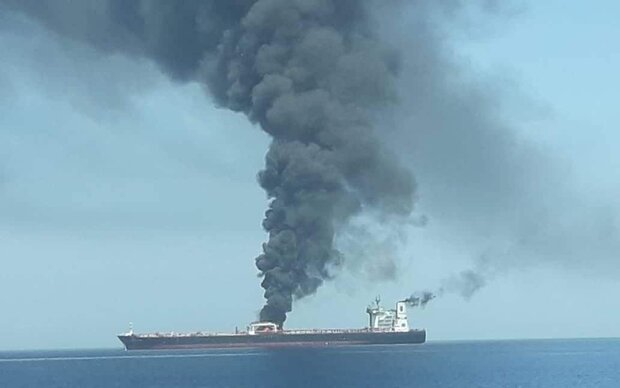
On June 6, 2019 two tankers, one Japanese and the other Norwegian, were attacked by unknown assailants in the Gulf of Oman.  The incident occurred less than a month after a series of acts of sabotage on four tankers, two Saudi, one UAE and one Norwegian, anchored off the coast of the United Arab Emirates near the port of Fujairah.
The Norwegian tanker, the Front Altair, was flying the flag of the Marshall Islands and was loaded with ethanol from Qatar, while the Japanese tanker, the Kokuka Courageous, was flying the flag of Panama and was carrying crude oil from the Saudi port of Jubail on the Persian Gulf.  The attacks, which occurred at the time of a high-level visit by Japan’s Prime Minister Shinzo Abe to Ayatollah Khamenei, may have been intended to embarrass the Islamic Republic or to thwart Japanese efforts towards the de-escalation of tension.
US Secretary of State Mike Pompeo was quick to lay the blame on the Islamic Republic of Iran, as was National Security Adviser and Iranophobe, John Bolton, who, following the first series of attacks, remarked, “There is no doubt in anybody’s mind in Washington who is responsible for this and I think it’s important that the leadership in Iran know that we know.” The perennial prevaricator on the Potomac trumpeted his concurrence in a television interview on Fox and Friends on Friday, June 14, insisting, “Iran did do it.”
Iran categorically denied Pompeo’s unsupported accusations, which were patently absurd given that the 44 sailors on the two burning tankers were rescued by an Iranian vessel that responded to their distress calls. Despite claims by the US Navy that the stricken tankers were under their purview, the Iranian rescue ship was the first to arrive on the scene of the incident and pull the tankers’ crewmembers to safety.  Furthermore, given the timing of the attacks, it would be beyond irrational for Iran to target a Japanese-owned tanker while the country’s prime minister was meeting with Iran’s Supreme Leader. Yet, Pompeo, turning logic on its head, claimed that the Iranian government had indeed “insulted Japan by attacking a Japanese-owned oil tanker just outside Iranian waters,” while simultaneously assuring Abe that it did not want war.
As if on cue, Pompeo came on stage with rhetorical escalation, declaring, “Taken as a whole, these unprovoked attacks present a clear threat to international peace and security.” Previously, the US secretary of state went so far as to suggest that Iran carried out the attacks, including the May 12 sabotage near Fujairah, “to raise the price of crude oil throughout the world.”  US Central Command officials even trotted out a grainy video, which they claimed was taken by a navy surveillance plane, of an unexploded mine attached to the hull of the Kokuka Courageous. The mine, referred to as a “limpet,” was supposedly of a type used by Iran and was similar to the explosive devices used in the previous attacks.
However, Yutaka Katada, the president of Kokuka Sangyo, the shipping line that owns the Kokuka Courageous, disagreed with the US official narrative about a limpet mine being the cause of the explosion. “I do not think there was a time bomb or an object attached to the side of the ship,” he said. “Our crew said that the ship was attacked by a flying object,” he added citing the fact that the holes caused by the explosion were well above the water line. Because of this fact, he explained, “There is zero possibility that they were torpedoes.”
Previously in May, the US had escalated tensions in the Persian Gulf by dispatching the USS Abraham Lincoln carrier strike group and a B-52 bomber task force allegedly to counter heightened threats to US forces posed by Iran. Given that Iran is literally encircled by US nuclear-capable forces, it seems utterly implausible that the Islamic Republic is the state actor posing the threat. Nevertheless, US Marine Corps Gen. Joe Dunford, the chairman of the Joint Chiefs of Staff, insisted that the deployment was not confrontational. “This is not intended to be a provocation,” he emphasized. “This is not intended to reinforce our offensive capability in the region,” even though it obviously looks like the US is preparing for a strike on Iran.
If the plot woven by Pompeo and his accomplices induces a vague but familiar feeling, perhaps it is due to the uncanny similarity with an incident in the Gulf of Tonkin in 1964, which was used by US officials to create a pretext for launching a full-scale war on Vietnam. The plot should have a familiar ring: a patrol boat from the Democratic Republic of Vietnam was reported to have attacked the USS warship Maddox without provocation in international waters, thereby justifying a severe US military response, which was announced shortly after the 11 o’clock nightly news by US president Lyndon Baines Johnson (LBJ) on August 4.  
There had been a defensive response by North Vietnamese patrol boats against ongoing CIA covert raids along the coast involving the Maddox on August 2, and intelligence reports suggested another retaliatory action was planned for August 4. However, the attack never happened. Admiral John Stockdale, who was flying an aircraft from the USS Ticonderoga, said that he saw nothing at all to indicate the North Vietnamese had made an assault on the Maddox. Yet despite the lack of clear and convincing evidence, defense secretary Robert McNamara called LBJ at 11:00 am to report that US destroyers Maddox and C. Turner Joy were under attack, convincing the US president to sign off on a retaliatory strike. 
“We're going to retaliate and we’ll make an announcement a little later in the evening, in the next hour or so and we’ll ask Congress for a resolution of war the next day to support us,” Johnson explained. By 9:15 pm, LBJ and McNamara had decided to make the public announcement of the non-attack by North Vietnam at 10 pm, so as to coincide with the commencement of an aerial assault by US warplanes on four North Vietnamese ports. However, crews were unable to load and launch the aircraft in time, forcing LBJ to delay his statement, which he finally made at 11:36 pm Eastern Time.
In his televised speech to the American people that night, LBJ announced, “Renewed hostile actions against United States ships on the high seas in the Gulf of Tonkin have today required me to take action and reply.” Still, he insisted, “Our response, for the present, will be limited and fitting. We still seek no wider war.” Two days later, the US congress passed the Gulf of Tonkin Resolution by a nearly unanimous 504 to 2 vote, allowing the US president to use military force without the constitutional constraint of seeking a congressional declaration of war. Johnson himself expressed doubts about the veracity of the reported incident a few days after the passage of the resolution, declaring that the alleged attack was nothing more than some sailors “just shooting at flying fish.”  
If Pompeo’s plot becomes a Gulf of Tonkin revival in the Gulf of Oman, who would benefit from the ensuing chaos in the Persian Gulf? Certainly the United States, since the shale oil and gas boom has made energy independence possible, thereby allowing Washington to indulge in aggressive behavior with few constraints.  The same may hold for Saudi Arabia, which, along with the US, would benefit from higher oil prices. Finally, the Zionist regime would have uncontested regional hegemony and could act with even greater impunity.
By 1969 LBJ’s response to a single alleged attack had spiraled into an all-consuming conflict: some 4.5 million tons of bombs had been dropped on Vietnam and neighboring Laos and Cambodia, killing an estimated 2 million civilians. Pompeo should carefully consider these horrific historical facts before continuing his cavalier accusations against Iran.
*******
Despite claims by the US Navy that the stricken tankers were under their purview, the Iranian rescue ship was the first to arrive on the scene of the incident and pull the tankers’ crewmembers to safety.  
************
Given the timing of the attacks, it would be beyond irrational for Iran to target a Japanese-owned tanker while the country’s prime minister was meeting with Iran’s Supreme Leader.

Saturday, June 15, 2019

Russia warns of US’ Iranophobic policy over tanker incident

Russia warns of US’ Iranophobic policy over tanker incident

TEHRAN, Jun.15 (MNA) – Voicing concerns over tensions in the Sea of Oman, the Russian foreign ministry on Fri. warned against “deliberate efforts to whip up tensions, which are largely encouraged by the United States’ Iranophobic policy.”
"First of all, we would like to thank the Iranian authorities for assistance in rescuing eleven Russian mariners, crewmembers of one of the tankers (Front Altair)," the Russian foreign ministry was quoted by Tass news agency as saying in a statement on Friday. "All of them were promptly evacuated from the burning vessel and taken to the port of Jask."
"Moscow resolutely condemns the attacks whoever might be behind them," the ministry stressed. "We think it necessary to refrain from quick conclusions. It is inadmissible to place responsibility for the incident on anyone until a thorough and unbiased international investigation is over."
"We are worried over the tensions in the Gulf of Oman. We take note of deliberate efforts to whip up tensions, which are largely encouraged by the United States’ Iranophobic policy," the ministry noted. "We call on all the parties to show restraint."
The ministry once again emphasized that there is no alternative to dialogue to prevent further degradation of the situation in the region.
On Thursday morning, two oil tankers – one sailing under a Panama flag and owned by Japan and another bearing the Marshall Islands’ ensign owned by Norwegian Frontline – were hit by yet unspecified accidents in the Sea of Oman. Iranian rescuers rushed to the assistance, transferring all of their 44 crew members to Iran's southern shores.
Following the attack, US Secretary of State Mike Pompeo rushed to accuse Iran of carrying out the attacks without providing any evidence to back up his accusation.
In a statement on Thursday, the Iranian mission to the UN strongly rejected the “unfounded” US claims, warning of "another Iranophobic campaign" being waged by Washington and its allies.
Meanwhile, a UN Security Council held on Thursday to address the incident concluded with no results, despite the US efforts to pin the blame on Iran. 

Kuwait disputes US’ anti-Iran claims on PG oil tanker attacks

Kuwait disputes US’ anti-Iran claims on PG oil tanker attacks

TEHRAN, Jun. 15 (MAN) – A close ally of Saudi Arabia and the United States, Kuwait has also implicitly disputed Washington’s accusations against Iran over the Thursday attacks on two oil tankers in the Sea of Oman, calling for an “unbiased, objective investigation” into the matter.
Two large tankers were hit by explosions in the Sea of Oman — also called the Gulf of Oman — on Thursday. The tankers were identified as the Marshal Islands-flagged Front Altair and the Panama-flagged Japanese-owned Kokuka Courageous.
Kuwait's Permanent Representative to the UN Mansour Al-Otaibi said on Thursday that the attack on tankers in the Sea of Oman is "a violation of international law," calling for an unbiased investigation into the matter, instead of jumping into hasty and baseless conclusions.
"We want a thorough investigation so that we know who stands behind this incident," he noted.
"Everybody wants an unbiased and objective investigation. However, there have been no proposals, no decisions by the UN Security Council yet on who should conduct this investigation," the diplomat said.
Member countries of the UN Security Council have also called for an investigation into the attacks on the two tankers in the Gulf of Oman, Al-Otaibi said.
"We have not discussed any evidence," Al-Otaibi stressed, while Kuwait's ally, the United States, has accused Iran of being involved in the suspicious attacks.
US Secretary of State Mike Pompeo quickly blamed Iran. President Donald Trump did the same on Friday. US military also released video footage to blame Iran for the attacks on the oil tankers; however, the claim has been disputed even by Washington's allies and Western analysts.
The US claimed the ships hit a mine planted by Iran.
The claim, however, was soon rejected by the Japanese ship's operator, whose president said on Friday its sailors on board the Kokuka Courageous saw "flying objects" just before the attack, suggesting the tanker wasn't damaged by mines.
"The crew told us something came flying at the ship, and they found a hole," President Yutaka Katada of Kokuka Sangyo told a press conference in Tokyo. "Then some crew witnessed the second shot."
Iran has strongly dismissed the US’ claims, saying the suspicious nature of the recent attacks on two oil tankers in the Sea of Oman is "not funny or ridiculous but alarming."
Less than a day after the US Central Command (CENTCOM) released the video late Thursday purportedly showing "Iranian sailors" removing a mine from the Japanese-owned Kokura Courageous' hull earlier in the day, European governments — except for Britain — have so far refused to accept the US' narrative that Tehran was to blame for the "suspicious" attacks.
They are reluctant to accept the White House’s claims at face value and do not want to provide Washington with any pretext for war.
German Foreign Minister Heiko Maas said on Friday the video is not sufficient to prove the US claim that Iran was behind the attacks.
"The video is not enough. We can understand what is being shown, sure, but to make a final assessment, this is not enough for me," Maas, who was in Iran earlier this week on an official two-day visit, told reporters in Oslo.
Nathalie Tocci, a senior adviser to European foreign policy chief Federica Mogherini also rejected the US allegations, saying, “Before we blame someone, we need credible evidence.”
Iranians are deeply rational actors, she said. And for Iran to have attacked a Japanese ship when the Japanese prime minister was in Tehran “is not an especially rational thing to do.”
Speaking on Friday, UN Secretary-General Antonio Guterres also denounced the incident, calling for in an “independent investigation” to establish those responsible for the attacks.

Thursday, April 18, 2019

Islamic Iran marks Army's Day


29th of the Iranian month of Farvardin, corresponding to April 18, is marked as the Islamic Republic of Iran's Army Day. Today, we pay a glance at the role and status of Islamic Republic of Iran's Army in relation to the stability and security of Iran and the region.
After the victory of Iran's Islamic Revolution, while the enemies, upon causing discord, were intent on undermining the security of the country and wreaking havoc, the Father of Islamic Revolution, late Imam Khomeini (God's mercy upon him), in a message, declared the necessity to safeguard the army, while issuing a historical and important instruction for protection of the unity of the army, marking the 29th of the Iranian month of Farvardin as the Army's Day.
The Islamic Republic of Iran's Army played a decisive and vital role in countering the invading enemy throughout the 8-year imposed war, displaying its significant role in maintenance of national security.
The Islamic Republic of Iran's Army has always emphasized its preparedness for defense and its deterrence power, and has always sought peace and security, believing that the military strategies in the region should aim to establish security, sustainable stability, and mutual trust.
Chairman of Iran Armed Forces General Headquarters, Major General Mohammad Baqeri, points out: "In accordance with the Islamic teachings, and the ideals of Islamic Republic of Iran, we have no intention of invading and attacking the soil of any other country; given that in our country's macro strategies, defense strategy is defined as defending the independence, territorial integrity, and national interests of the country and Iranian nation. "
Islamic Republic of Iran, in line with existing threats, has promoted its military power based on scientific indices, and specialized capacity of forces. On this basis, a number of changes took place in the military drills which were carried out in the Strait of Hormuz, Persian Gulf, Sea of Oman, and throughout the ground and aerial military maneuvers. These changes show that Iran's Armed Forces are fully prepared to fend off foes' threats.
In these changes and developments, two points of importance were taken into consideration:
Firstly, structural changes and developments in the Islamic Republic of Iran Army's Ground Forces plays a strategic role in defending the security and countering threats.
Secondly, there is emphasis on the principle of deterrence. Promotion of the deterrence capacity is a must for the Armed Forces in the 5th decade of the Islamic Revolution. Currently, Iran maintains the deterrence and even attacking capacity to stand firm against the regional currents which stir insecurity, via reliance upon its military potential.
Iran's Minister of Defense, Brigadier General Amir Hatami, notes: "Given the deep-rooted enmities against Iran, a strategic outlook has taken shape in Iran, enabling Islamic Republic of Iran to gain access to defensive capacities."
Currently, the Iranian nation is commemorating the Army's Day while the Islamic Republic of Iran's Armed Forces, including the Army, Islamic Revolution Guards Corps, Basij Mobilization Forces, and Police Force have powerfully stood up against elements, which threaten the country's security and stability.
Iran has never sought tension and military confrontation in the region. However, it has shown the enemies and invaders that whenever and wherever necessary, it deals with the agents and elements who disrupt security, and that Islamic Iran does not ask for permission from anyone for enhancement of its defense capacities, and deterrence power.
In regards to defense equipment, Islamic Republic of Iran's Armed Forces, including the Army, upon indigenization of the defense industry in different sectors, has reached self-sufficiency which is of paramount importance when it comes to defensive deterrence.
After the victory of Islamic Revolution, large-scale military sanctions were imposed on Iran by a number of regimes, such that they even obstructed the sale of barbed wire to Iran.
Meanwhile, thanks to major strides which have been taken in this regard, resounding accomplishments have been made in the national defense sector. Production of a variety of weapons and military equipment, different types of planes, and radar-evasive ultrasound jetfighters; self-sufficiency in production of different types of modern drones, and manufacture of submarines and advanced long-range surface-to-surface and surface-to-air missiles, in addition to ballistic missiles, are part of the growing capacities of Iran in this realm, which have been displayed in the military maneuvers and parades of Armed Forces.
The fact is that Iran has always been threatened by the US and its regional cohorts. The Western propaganda campaign has made strenuous efforts to somehow stain the reputation of the Islamic Revolution and revolutionary organizations such as the Islamic Revolution Guards Corps in a futile bid to undermine the elements of strength of the Iranian nation.
The truth is that the enemies of sacred Islamic system cannot bear to see the unity of Iran's Army and Islamic Revolution Guards Corps; given that the presence of Iran's Armed Forces, especially Iran's Army and Islamic Revolution Guards Corps in dealing with those who disrupt security, has led to the despair and failure of the plots and proxy wars of the US, spurious Zionist regime of Israel, and Saudi regime within the region.
Chairman of Iran Armed Forces General Headquarters, notes: "Islamic Revolution Guards Corps, in the Islamic Resistance Front, via reliance upon the Third Infallible Imam of the Prophet of Islam's Household, Imam Hussein (AS); and through its honorable roles in defending the Islamic Revolution and sacred Islamic establishment, and in supporting the Islamic Ummah and oppressed nations, has stood up against the crimes and belligerence of satanic powers, in addition to proxy wars, and Takfiri terrorist outfits in West Asia; and has brought about honor and dignity for the Iranian nation."
The Leader of Islamic Revolution, Ayatollah Seyed Ali Khamenei, in his keynote remarks on the eve of the auspicious birth anniversary of Imam Hussein (AS), pointed out that forty years of conspiracy against the Islamic Republic of Iran, and the concurrent and continuous progress of Islamic Revolution show the inability of the US in impeding the movement of the Iranian nation.