Showing posts with label Oil Tanker Attacks. Show all posts

Thursday, June 20, 2019

Pompeo’s plot: US stages Gulf of Tonkin revival in Gulf of Oman

By: Yuram Abdullah Weiler
Pompeo’s plot: US stages Gulf of Tonkin revival in Gulf of Oman

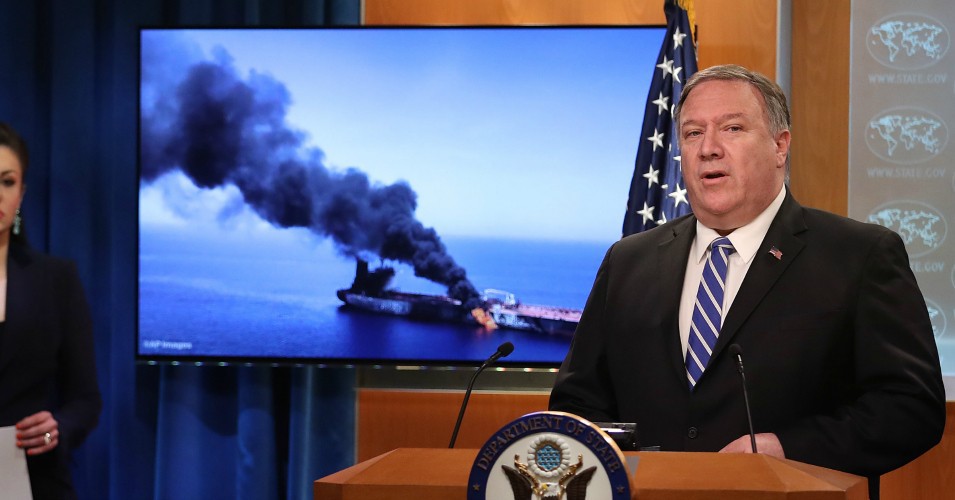
TEHRAN, Jun. 19 (MNA) – “It is the assessment of the United States government that Iran is responsible for the attacks that occurred in the Gulf of Oman today,” said US Secretary of State Mike Pompeo.
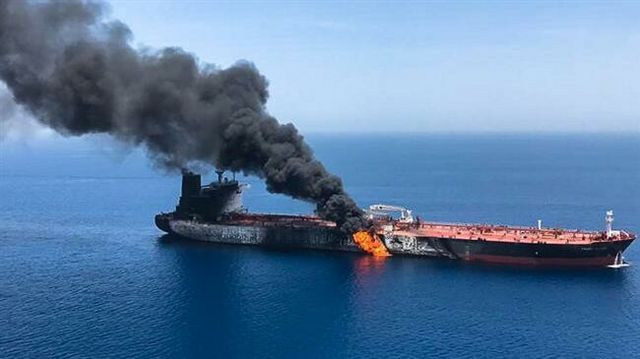
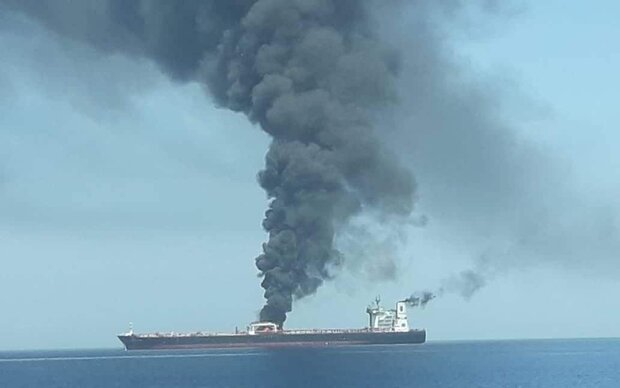
On June 6, 2019 two tankers, one Japanese and the other Norwegian, were attacked by unknown assailants in the Gulf of Oman.  The incident occurred less than a month after a series of acts of sabotage on four tankers, two Saudi, one UAE and one Norwegian, anchored off the coast of the United Arab Emirates near the port of Fujairah.
The Norwegian tanker, the Front Altair, was flying the flag of the Marshall Islands and was loaded with ethanol from Qatar, while the Japanese tanker, the Kokuka Courageous, was flying the flag of Panama and was carrying crude oil from the Saudi port of Jubail on the Persian Gulf.  The attacks, which occurred at the time of a high-level visit by Japan’s Prime Minister Shinzo Abe to Ayatollah Khamenei, may have been intended to embarrass the Islamic Republic or to thwart Japanese efforts towards the de-escalation of tension.
US Secretary of State Mike Pompeo was quick to lay the blame on the Islamic Republic of Iran, as was National Security Adviser and Iranophobe, John Bolton, who, following the first series of attacks, remarked, “There is no doubt in anybody’s mind in Washington who is responsible for this and I think it’s important that the leadership in Iran know that we know.” The perennial prevaricator on the Potomac trumpeted his concurrence in a television interview on Fox and Friends on Friday, June 14, insisting, “Iran did do it.”
Iran categorically denied Pompeo’s unsupported accusations, which were patently absurd given that the 44 sailors on the two burning tankers were rescued by an Iranian vessel that responded to their distress calls. Despite claims by the US Navy that the stricken tankers were under their purview, the Iranian rescue ship was the first to arrive on the scene of the incident and pull the tankers’ crewmembers to safety.  Furthermore, given the timing of the attacks, it would be beyond irrational for Iran to target a Japanese-owned tanker while the country’s prime minister was meeting with Iran’s Supreme Leader. Yet, Pompeo, turning logic on its head, claimed that the Iranian government had indeed “insulted Japan by attacking a Japanese-owned oil tanker just outside Iranian waters,” while simultaneously assuring Abe that it did not want war.
As if on cue, Pompeo came on stage with rhetorical escalation, declaring, “Taken as a whole, these unprovoked attacks present a clear threat to international peace and security.” Previously, the US secretary of state went so far as to suggest that Iran carried out the attacks, including the May 12 sabotage near Fujairah, “to raise the price of crude oil throughout the world.”  US Central Command officials even trotted out a grainy video, which they claimed was taken by a navy surveillance plane, of an unexploded mine attached to the hull of the Kokuka Courageous. The mine, referred to as a “limpet,” was supposedly of a type used by Iran and was similar to the explosive devices used in the previous attacks.
However, Yutaka Katada, the president of Kokuka Sangyo, the shipping line that owns the Kokuka Courageous, disagreed with the US official narrative about a limpet mine being the cause of the explosion. “I do not think there was a time bomb or an object attached to the side of the ship,” he said. “Our crew said that the ship was attacked by a flying object,” he added citing the fact that the holes caused by the explosion were well above the water line. Because of this fact, he explained, “There is zero possibility that they were torpedoes.”
Previously in May, the US had escalated tensions in the Persian Gulf by dispatching the USS Abraham Lincoln carrier strike group and a B-52 bomber task force allegedly to counter heightened threats to US forces posed by Iran. Given that Iran is literally encircled by US nuclear-capable forces, it seems utterly implausible that the Islamic Republic is the state actor posing the threat. Nevertheless, US Marine Corps Gen. Joe Dunford, the chairman of the Joint Chiefs of Staff, insisted that the deployment was not confrontational. “This is not intended to be a provocation,” he emphasized. “This is not intended to reinforce our offensive capability in the region,” even though it obviously looks like the US is preparing for a strike on Iran.
If the plot woven by Pompeo and his accomplices induces a vague but familiar feeling, perhaps it is due to the uncanny similarity with an incident in the Gulf of Tonkin in 1964, which was used by US officials to create a pretext for launching a full-scale war on Vietnam. The plot should have a familiar ring: a patrol boat from the Democratic Republic of Vietnam was reported to have attacked the USS warship Maddox without provocation in international waters, thereby justifying a severe US military response, which was announced shortly after the 11 o’clock nightly news by US president Lyndon Baines Johnson (LBJ) on August 4.  
There had been a defensive response by North Vietnamese patrol boats against ongoing CIA covert raids along the coast involving the Maddox on August 2, and intelligence reports suggested another retaliatory action was planned for August 4. However, the attack never happened. Admiral John Stockdale, who was flying an aircraft from the USS Ticonderoga, said that he saw nothing at all to indicate the North Vietnamese had made an assault on the Maddox. Yet despite the lack of clear and convincing evidence, defense secretary Robert McNamara called LBJ at 11:00 am to report that US destroyers Maddox and C. Turner Joy were under attack, convincing the US president to sign off on a retaliatory strike. 
“We're going to retaliate and we’ll make an announcement a little later in the evening, in the next hour or so and we’ll ask Congress for a resolution of war the next day to support us,” Johnson explained. By 9:15 pm, LBJ and McNamara had decided to make the public announcement of the non-attack by North Vietnam at 10 pm, so as to coincide with the commencement of an aerial assault by US warplanes on four North Vietnamese ports. However, crews were unable to load and launch the aircraft in time, forcing LBJ to delay his statement, which he finally made at 11:36 pm Eastern Time.
In his televised speech to the American people that night, LBJ announced, “Renewed hostile actions against United States ships on the high seas in the Gulf of Tonkin have today required me to take action and reply.” Still, he insisted, “Our response, for the present, will be limited and fitting. We still seek no wider war.” Two days later, the US congress passed the Gulf of Tonkin Resolution by a nearly unanimous 504 to 2 vote, allowing the US president to use military force without the constitutional constraint of seeking a congressional declaration of war. Johnson himself expressed doubts about the veracity of the reported incident a few days after the passage of the resolution, declaring that the alleged attack was nothing more than some sailors “just shooting at flying fish.”  
If Pompeo’s plot becomes a Gulf of Tonkin revival in the Gulf of Oman, who would benefit from the ensuing chaos in the Persian Gulf? Certainly the United States, since the shale oil and gas boom has made energy independence possible, thereby allowing Washington to indulge in aggressive behavior with few constraints.  The same may hold for Saudi Arabia, which, along with the US, would benefit from higher oil prices. Finally, the Zionist regime would have uncontested regional hegemony and could act with even greater impunity.
By 1969 LBJ’s response to a single alleged attack had spiraled into an all-consuming conflict: some 4.5 million tons of bombs had been dropped on Vietnam and neighboring Laos and Cambodia, killing an estimated 2 million civilians. Pompeo should carefully consider these horrific historical facts before continuing his cavalier accusations against Iran.
*******
Despite claims by the US Navy that the stricken tankers were under their purview, the Iranian rescue ship was the first to arrive on the scene of the incident and pull the tankers’ crewmembers to safety.  
************
Given the timing of the attacks, it would be beyond irrational for Iran to target a Japanese-owned tanker while the country’s prime minister was meeting with Iran’s Supreme Leader.

Monday, June 17, 2019

US is the obvious benefactor of attacks in Oman Sea: Cartalucci

US is the obvious benefactor of attacks in Oman Sea: Cartalucci

TEHRAN, Jun. 16 (MNA) – Referring to US policy papers, Bangkok- based geopolitical expert says familiar pattern by the US to rush to conclusions before any investigation makes the US and its allies the prime suspects of attacks in Oman Sea, not Iran.
While the Japanese Prime Minister was visiting Iran after 4 decades and many expected even more reduction of the tensions in the region due his visit, in another suspicious and provocative move two large tankers were hit by explosions in the Sea of Oman on Thursday, a move that can intensify the tensions more than before.
Following the attack, US Secretary of State Mike Pompeo hastily accused Iran of carrying out the attacks without providing any evidence to back up his accusation.
In this regard, Iran rejected US Secretary of State Mike Pompeo's anti-Iran accusations, saying the suspicious nature of the recent attacks on two oil tankers in the Sea of Oman is "not funny or ridiculous but alarming".
To shed more light on the issue, an interview was done with Bangkok- based geopolitical researcher Anthony Cartalucci.
Following is the full text of the interview:
The US administration has hastily accused Iran of being behind the attacks on two oil tankers in Oman Sea. How do you assess validity of the accusations?
As the US has done before with now verified fabrications, it has hastily - and without any evidence or investigation - accused Iran of being behind these attacks. It did so within the same day of the attacks. So of course, there is no validity to the accusations. Even a local crime committed within the United States cannot be "solved" in a single day and without any sort of investigation, so how could an incident as serious as this be somehow solved without an investigation or evidence so quickly?
The US reveals its hand by quickly accusing Iran before any sort of independent investigation can be mounted. We've seen this pattern before in Iraq in 2003 where the rush to war was made before inspectors could confirm US claims of "weapons of mass destruction" in Iraq. We also saw the US did this last year in Syria where it quickly accused the Syrian government of a "sarin chemical attack" in Douma before carrying out military strikes - all done before the OPCW could even begin its investigation - which by the way, concluded claims of sarin gas were false.
This familiar pattern by the US to rush to conclusions before any investigation is mounted makes the US and its allies the prime suspects, not Iran.
Is it rational for Iran to commit such an action, while the Japanese PM is visiting Iran?
For Iran, it is not rational at all to carry out such an attack, and especially so against a ship belonging to Japan while the Japanese Prime Minister is in Iran. Iran's greatest strength at the moment is Washington's lack of credibility and increasingly blatant aggression against Iran. The international community can see that Iran upheld its part of the so-called "Iran Nuclear Deal" and that it was the US who walked away from it without justification. The best cards in Iran’s hand are the growing consensus that it is being victimized. Thus Tehran has nothing at all to gain by staging attacks against international shipping through the Strait of Hormuz.
Who in fact is the biggest beneficiary of the provocative incidents taking place in the region that threatens world energy security and route? Can any instability in the region affect EU interests?
The United States in its own policy papers - like Brookings Institution's 2009 "Which Path to Persia?" report - openly admit that the US would greatly benefit from a "provocation" that would allow them to increase military aggression against Iran.
Brookings policymakers would literally claim, "...it would be far more preferable if the United States could cite an Iranian provocation as justification for the airstrikes before launching them. Clearly, the more outrageous, the more deadly, and the more unprovoked the Iranian action, the better off the United States would be. Of course, it would be very difficult for the United States to goad Iran into such a provocation without the rest of the world recognizing this game, which would then undermine it."
The US is the obvious benefactor. Its partners in the region - believing in whatever promises were made to them by Washington about a "post-Iranian" Middle East - would also benefit by aiding this agenda.
Higher oil prices while sanctions squeeze Iran, Venezuela, and Russia can only benefit Western oil corporations. For the EU - interests are divided between multinational corporations there that seek to dominate the Middle East alongside Washington and Wall Street and those who seek to do business with Iran. Obviously pressure from Washington to accept its version of events would tilt the balance in favor of the former and place greater pressure on those seeking peace and cooperation - just as the staged attacks were designed to do. Higher oil prices as a result of instability and violence in the Middle East will further complicate European energy security which only further plays into Washington's hands which seeks to pry Europe away from Russian and Iranian hydrocarbons in favor of its "freedom gas" and sources from among its allies.
Interview by Payman Yazdani

Sunday, June 16, 2019

Pompeo’s Tanker Narrative

It appears that Mike Pompeo has a hard time kicking his old habits.  He appears to be as smug about lying as a CIA operative as he is as Secretary of State.  Categorically blaming the Iranians for the recent oil attack tankers has left allies scratching their heads; and perhaps leaving foes thinking: “Thank God my enemy is so stupid”!
On June 13, 2019, as Ayatollah Khamenei was holding talks in Tehran with Japanese prime minister, Shinzo Abe, two oil tankers carrying oil to Japan were attacked.  As investigations into the incident were just beginning, Pompeo had already concluded his assessment and had it ready for the press.  Much to the audible surprise of the world, and without any proof or supporting documents, he laid the blame firmly at Iran’s feet citing “intelligence”.
To his relief, in no time at all, US officials claimed that they had managed to get their hands on videos and pictures.  They presented a grainy video alleging to show an Iranian navy boat removing mines from the damaged Japanese ship.  It is easy to understand why the grainy video’s existence was necessary.
Precisely a month prior, on May 13th,  four oil tankers were damaged in the region.   The United States blamed Iran without any evidence.  Saudi Arabia followed suit.  The rest of the world was skeptical and doubts floated about the about the accuracy of US claims.  This time around, Pompeo was saved by the video – although not for long! The Japanese vessel owner disputed the presence of mines damaging his vessel (as suggested in the blurry video).
Even allies were skeptical.  To enforce its position and allegations against Iran,  the Trump administration made its argument  based on misinterpreting what Iran had said about the oil embargo.   Following Trump’s announcement on April 22nd that America would not renew US waivers for countries which imported oil from Iran, in essence, imposing an oil embargo, on April 25the Iranian government retorted by condemning America’s illegal demands and stated that no other country could take its share of the oil market.
The Trump team would like us to believe that what Iran meant was the sabotage of the oil tankers.   This is far from true.    Iran was referring to its legal right under the 1982 United Nations Convention on the Law of the Sea (UNCLOS) which legally allows it to impede the passage of oil shipments through its territorial waters – the Strait of Hormuz.
While UNCLOS stipulates that vessels can exercise the right of innocent passage, and coastal states should not impede their passage, under the UNCLOS framework, a coastal state [Iran] can block ships from entering its territorial waters if the passage of the ships harms “peace, good order or security” of said state, as the passage of such ships would no longer be deemed “innocent”[i].
Given Iran’s recourse to international law, American diplomacy at its all time low, and the rally behind Iran – if only verbally – it makes absolutely no sense for Iran to blow up oil tankers and turn the world opinion in favor of  Trump and his the warmongering advisors – Pompeo and Bolton.
But tankers were blown up.   What other motivation were there?
Perhaps NOPEC – No to Oil Producing and Exporting Cartels Act.   In February, House passed a Bill that would cripple OPEC.   The Bill would prohibit OPEC from coordinating production and influencing prices.  While the Bill was said to provide a useful leverage for the White House, Persian Gulf Arab states sent their warnings to Wall Street.
On April 5th, Saudi Arabia even threatened to drop Dollar for oil trades in order to discourage US from passing the NOPEC Bill.  The Saudi threat came on the heels of UAE cautions the prior month that if such bill passed, it would in effect, break up OPEC.
Perhaps this was the reason behind Saudi Arabia’s lack of cooperation.   After Trump announced his Iran oil embargo, a senior US administration assured the world at large that Trump was confident Saudi Arabia and the United Arab Emirates would fill any gap left in the oil market.  He was mistaken. On April 29th, the Saudi Energy Minister, Khaled el-Falih made it clear that Saudi Arabia would not “rush to boost oil supply to make up for a loss of Iranian crude”.
After the May 13th incident, apparently America’s accusations did not carry any weight around the world, but they did have an impact on the jittery Saudis.   On June 3rd, Bloomberg reported that over the last month, the Saudis  raised their oil production to replace lost Iranian oil.    The oil market was satisfied and America could continue to put pressure on friend and foe to stop buying Iranian oil – there would be no shortages.
What then explains the second tanker incidents of June 13th?
Perhaps the motive is two-fold.  Firstly, the United States would reinforce its unfounded allegations that Iran is a ‘bad actor’ and discourage and dissuade the international community from cooperation with Iran.  And secondly, the hike in the price of oil as a result of the tanker attacks no doubt sent a sigh of relief to shale oil producers in the United States.  A drop in oil prices would greatly harm or bankrupt US shale-focused, debt-dependent producers.
Not on Trump’s watch.
Although many states in the US and some countries in the world have banned shale oil production due to its adverse effects on the environment, specifically water, the United States’ goal is to be the biggest producer and supplier of oil depending on its shale oil production.  Currently, according to the latest US Energy Information Administration (EIA), the United States is a net importer of oil.   With low oil prices, a halt or slowing of shale, the trend would continue to be an importer.
Having Saudi Arabia cower to US demands, demonizing Iran, intimidating allies and non-allies with fear of conflict in the region in order to press further demands on Iran, increase in the price of oil, and the weapons that would be purchased by US allies in the nervous neighborhood, seems like a win-win situation for America.  For now.
Soraya Sepahpour-Ulrich is an independent researcher and writer with a focus on U.S. foreign policy.


[i] Martin Wahlisch, The Yale Journal of International Law, March 2012, citing UNCLOS, supra note 12, , art. 19, para1, and art. 25, para1.

Trump doubles down on US lies about Iran

US President Donald Trump escalated the war threats against Iran Friday, insisting that Tehran was responsible for the damage done to two oil tankers in the Gulf of Oman the previous day and vowing US retaliation for any Iranian action to shut the strategic Strait of Hormuz.
Trump based his ignorant and belligerent remarks on a grainy, black-and-white video released Thursday night by the US Central Command (CENTCOM), which directs US military interventions throughout the Middle East.
CENTCOM claimed that the video, apparently shot from a US spy plane, showed a small boat of the Islamic Revolutionary Guard Corps (IRGC) approaching one of the damaged tankers, the Japanese-owned Kokuka Courageous, and removing an unexploded limpet mine attached to its hull. The video was touted as proof that Iran carried out attacks on the vessels and had sent the IRGC boat to remove any incriminating evidence.
Fire and smoke billowing from Norwegian-owned Front Altair tanker said to have been attacked in the waters of the Gulf of Oman on June 13, 2019 [Credit: ISNA]
In a Fox News television interview Friday, Trump declared, “Well, Iran did do it, and you know they did it because you saw the boat.”
He continued: “I guess one of the mines didn’t explode, and it’s probably got essentially Iran written all over it. And you saw the boat at night, trying to take the mine off and successfully took the mine off the boat. And that was exposed. That was their boat. That was them, and they didn’t want the evidence left behind.”
He went on to denounce Iran as a “nation of terror”, adding that “they’re in deep, deep trouble.” He also told Fox News that if Iran shut down the Strait of Hormuz, “it’s not going to be closed for long.” The strait, which connects the Persian Gulf with the Gulf of Oman and the Arabian Sea, is a 21-mile-wide seaway through which 30 percent of all seaborne-traded liquid products pass, most of them petroleum-based.
The claims by Trump and the Pentagon that the CENTCOM video is some kind of smoking gun proving the culpability of the Iranian government in the apparent attack on the Kokuka Courageous and the second tanker, the Norwegian-owned Front Altair, is nothing of the kind.
Unsubstantiated is the claim that those depicted in the video were removing a limpet mine from the hull, not to mention that in supposedly doing so they were engaged in a coverup designed to conceal evidence of Iranian culpability.
The CENTCOM video recalls nothing so much as the incontrovertible “proof” presented by then Secretary of State Colin Powell to the UN Security Council in 2003 of Iraqi “weapons of mass destruction”.
The US claims ran in direct contradiction from the owners of the tanker shown in the video. Yutaka Katada, president of the Kokuka Sangyo shipping firm which owns the Kokuka Courageous tanker, told reporters Friday in Tokyo that the claim the ship had been damaged by limpet mines was “false”.
“The crew are saying it was hit with a flying object. They say something come flying toward them, then there was an explosion, then there was a hole in the vessel. Then some crew witnessed a second shot,” Katada said.
“To put a bomb on the side is not something we are thinking,” he added, noting that the damage to the ship “was above the water surface by quite a lot.”
As for Trump’s denunciation of Iran as a “terror nation”, the wholesale terror that has been inflicted upon the Middle East has the clear imprint of “Made in the USA”.
Successive US wars against Iraq, which culminated in the illegal invasion of the country and cost the deaths of well over a million people, have been followed by the wars for regime change in Libya and Syria in which Washington utilized, funded and armed Islamist militias tied to Al Qaeda for the purpose of overthrowing the government of Muammar Gaddafi and the attempt to overthrow that of Bashar al-Assad.
Now Washington is attempting to accomplish the same goal in relation to Iran a far larger and more powerful country, with four times the landmass and more than twice the population of Iraq.
It has implemented what Secretary of State Mike Pompeo Thursday boasted was a “campaign of maximum pressure” designed to starve the Iranian population into submission. Having abrogated last year the 2015 Iranian nuclear accord reached between Tehran and the five permanent member nations of the UN Security Council, plus Germany, Washington has reimposed and sharply intensified crushing economic sanctions that threaten not only Iran but any country or company doing business with it. The aim, as the US has made clear, is to reduce Iranian oil exports, which count for the overwhelming share of the country’s export earnings, to zero.
These measures, carried out unilaterally and in direct violation of UN resolutions, are the equivalent of a full-scale economic blockade, an act of war.
Iran responded to the latest threats from Trump and the Pentagon calling them “alarming and worrisome.”
Just before Trump gave his interview to Fox, Iranian Foreign Minister Mohammad Javad Zarif denounced Washington for having “immediately jumped to make allegations against Iran [without] a shred of factual or circumstantial evidence.”
On Thursday, Zarif called attention to the fact that the two tankers, one owned by a Japanese firm and the other carrying a Japanese-related cargo, had been struck precisely at the moment that Japanese Prime Minister Shinzo Abe was meeting with Iranian Supreme Leader Ayatollah Khamenei. “Suspicious doesn’t begin to describe what likely transpired,” he said.
Pompeo, in his bullying speech at the State Department Thursday afternoon, declared insultingly that Zarif was trying to be “funny”. On the contrary, the Iranian foreign minister was merely hinting at the conclusion drawn by many around the world that Tehran would hardly be motivated to strike the tankers just as Abe was in Tehran crediting the Iranian government with abiding by the nuclear accord and forswearing the development of nuclear weapons. While there, he declared that “major progress has been made toward securing peace and stability in this region.” Japan had been one of the major purchasers of Iranian oil before last month when the Trump administration abrogated waivers that had been granted to several importing countries.
In examining the crime from the standpoint of the age-old detective maxim of Cui bono?, or Who benefits?, the answer is obvious: those who want to prevent Iran from reaching accommodations allowing it to loosen the economic noose tied around its neck by US imperialism. This includes both Washington itself, as well as its principal regional allies, including Israel, Saudi Arabia and the United Arab Emirates, all of which are entirely capable of carrying out strikes on tankers in order to blame them on Tehran and set the stage for a catastrophic war.
The apparent attacks on the two tankers came just days after German Foreign Minister Heiko Maas traveled to Tehran with the aim of salvaging the nuclear accord repudiated by Washington and forestalling a region-wide war.
Maas promised Iran that Germany, the UK and France would soon put into operation a payment channel to sidestep US sanctions known as INSTEX, while warning that the European powers could not do “miracles” in the face of punishing US sanctions feared by companies who previously did business in Iran.
Germany and the other European powers–with the exception of London, which, as in the run-up to the 2003 Iraq invasion, is marching in lockstep with Washington–have voiced skepticism about the US charges of proof of Iran’s guilt in relation to the tankers and have called for de-escalation by both sides.
China, meanwhile, has rejected the US charges. Meeting on the sidelines of the Shanghai Cooperation Organization summit in Kyrgyzstan, with his Iranian counterpart Hassan Rouhani, Chinese President Xi Jinping vowed that Beijing would deepen its ties with Tehran no matter what the situation in the region. He and Rouhani both placed central responsibility for the tensions on Washington’s unilateral abrogation of the nuclear treaty.
Washington is determined to blow up any attempts to circumvent its sanctions regime and clear the way for direct military intervention in Iran. This is the most likely motive for the tanker attacks.
This conclusion is borne out by an editorial published in the Wall Street JournalThursday which stated: “Lately, some have doubted the importance of the U.S. role in the region. Two oil tankers in flames from torpedo attacks in the Gulf of Oman refute that view. The unavoidable fact is that Iran remains the primary threat to stability in the Middle East. The U.S. is right to be there, in force and prepared to defend the interests of itself and its allies.”
The Journal added that it was “all the more important that the West unite in opposition to Iran’s aggression, It would send the worst possible signal if in the aftermath of these attacks the Europeans buckled to Iran’s military pressure.”
Similarly, the Washington Post’s David Ignatius, a columnist with close ties to the US military and intelligence apparatus, wrote in a piece published Thursday titled “Is the Iran-U.S. tinderbox about to ignite?”: “Trump has a new opportunity to broaden international support for his Iran policy, after isolating the United States last year by abandoning the Iran nuclear agreement.”
What is being prepared with the provocations in and around the Persian Gulf is a war that could quickly claim the lives of tens of thousands. An outright US invasion of Iran would require the mobilization of hundreds of thousands of US troops, forcing the re-introduction of the draft and creating revolutionary conditions in the US itself.
At the same time, as the tensions with Europe and China signal, such a bloody conflict would pose the direct threat of triggering a third world war.

Another Act of Tanker Terrorism by CENTCOM

By:Kayhan Int’l 

Isolated on the international level and viewed by the world as the source of all evil, the administration of Donald Trump, having lost all commonsense, is clearly on a suicidal course.
The sooner the regime in the Washington destroys itself the better for world peace and the security of mankind, including the 327 million people living in the US. 
In their death throes, however, Trump and his team of thugs, through their clumsy acts of terrorism, are exposing themselves to be the most crazy criminals, as was evident last Thursday when on hearing the firm response from Iran of the futility of any talks with the US, the CENTCOM terrorists triggered another set of blasts, following last May’s sabotage of 4 oil tankers off the coast of Fujairah. This time they targeted two oil tankers passing through the crucial Strait of Hormoz in a vain bid to lay the blame on the Islamic Republic.
What a bunch of idiotic elements they are! Frustrated at the fruitful discussions that Japanese Prime Minister and his delegation held in Tehran with their Iranian hosts on a wide variety of issues of mutual cooperation, including Shinoza Abe’s cordial meeting with the Leader of the Islamic Revolution, Ayatollah Seyyed Ali Khamenei, and the latter’s rational explanation that the lawless, untrustworthy, and unprincipled Trump doesn’t deserve any reply to his dubious message, the enraged Americans targeted a Japanese tanker. 
The intention was to insult Premier Abe for his praise of Islamic values and the fatwa of Ayatollah Khamenei prohibiting manufacture of any weapons of mass destruction, including nuclear bombs, during his press conference with President Hassan Rouhani on Wednesday that nailed the lie of the US administration.
Perhaps, some of the harebrained CENTCOM terrorists, or their proxies in the region, such as the Saudis and the Israelis, may have thought that by choosing a Japanese vessel for their act of sabotage and then laying the blame on Iran through release of a grainy video of a barely visible person abroad a small supposedly Iranian boat removing an object (allegedly an unexploded mine), from the Kokuka Courageous after it had suffered the blast, they would cause a strain in Tehran-Tokyo ties.
The Japanese government and the Japanese people are too wise to bite the bait, especially after having been the victims of US terrorism during World War 2 when the cities of Hiroshima and Nagasaki were razed to the ground by American atomic bombs.
Following the usual blaming of Iran by the gangster Mike Pompeo and his boss, Trump, Iran’s Foreign Ministry spokesman Abbas Mousavi noted on Friday: "While Japan’s prime minister is meeting with the number one figure of the Islamic Republic of Iran to reduce tensions, which clandestine hands seek to undermine these efforts in the region and who benefit from it?” 
Moreover, the Japanese ship operator on Friday disputed the US claims, saying sailors on board the Kokuka Courageous saw "flying objects” just before the attack, suggesting the tanker wasn’t damaged by mines. 
The claim by the CENTCOM terrorists of rushing to the rescue of the damaged tankers and evacuating their crew also turned out to be a lie when Iranian TV channels showed clear footages of crew members of the tankers relaxing on Jask Island after their rescue by Iranian vessels.
A habitual liar, Trump has lost all credibility, and no one believes his words and that of his team of thugs – neither the traditional US allies, the West Europeans nor the majority of US people.
Iran’s principled stance is crystal clear for the whole world. As long as the CENTCOM terrorists continue their filthy presence, the region, unfortunately, will be wracked by more such acts of terrorism. 

Saturday, June 15, 2019

Russia warns of US’ Iranophobic policy over tanker incident

Russia warns of US’ Iranophobic policy over tanker incident

TEHRAN, Jun.15 (MNA) – Voicing concerns over tensions in the Sea of Oman, the Russian foreign ministry on Fri. warned against “deliberate efforts to whip up tensions, which are largely encouraged by the United States’ Iranophobic policy.”
"First of all, we would like to thank the Iranian authorities for assistance in rescuing eleven Russian mariners, crewmembers of one of the tankers (Front Altair)," the Russian foreign ministry was quoted by Tass news agency as saying in a statement on Friday. "All of them were promptly evacuated from the burning vessel and taken to the port of Jask."
"Moscow resolutely condemns the attacks whoever might be behind them," the ministry stressed. "We think it necessary to refrain from quick conclusions. It is inadmissible to place responsibility for the incident on anyone until a thorough and unbiased international investigation is over."
"We are worried over the tensions in the Gulf of Oman. We take note of deliberate efforts to whip up tensions, which are largely encouraged by the United States’ Iranophobic policy," the ministry noted. "We call on all the parties to show restraint."
The ministry once again emphasized that there is no alternative to dialogue to prevent further degradation of the situation in the region.
On Thursday morning, two oil tankers – one sailing under a Panama flag and owned by Japan and another bearing the Marshall Islands’ ensign owned by Norwegian Frontline – were hit by yet unspecified accidents in the Sea of Oman. Iranian rescuers rushed to the assistance, transferring all of their 44 crew members to Iran's southern shores.
Following the attack, US Secretary of State Mike Pompeo rushed to accuse Iran of carrying out the attacks without providing any evidence to back up his accusation.
In a statement on Thursday, the Iranian mission to the UN strongly rejected the “unfounded” US claims, warning of "another Iranophobic campaign" being waged by Washington and its allies.
Meanwhile, a UN Security Council held on Thursday to address the incident concluded with no results, despite the US efforts to pin the blame on Iran. 

Kuwait disputes US’ anti-Iran claims on PG oil tanker attacks

Kuwait disputes US’ anti-Iran claims on PG oil tanker attacks

TEHRAN, Jun. 15 (MAN) – A close ally of Saudi Arabia and the United States, Kuwait has also implicitly disputed Washington’s accusations against Iran over the Thursday attacks on two oil tankers in the Sea of Oman, calling for an “unbiased, objective investigation” into the matter.
Two large tankers were hit by explosions in the Sea of Oman — also called the Gulf of Oman — on Thursday. The tankers were identified as the Marshal Islands-flagged Front Altair and the Panama-flagged Japanese-owned Kokuka Courageous.
Kuwait's Permanent Representative to the UN Mansour Al-Otaibi said on Thursday that the attack on tankers in the Sea of Oman is "a violation of international law," calling for an unbiased investigation into the matter, instead of jumping into hasty and baseless conclusions.
"We want a thorough investigation so that we know who stands behind this incident," he noted.
"Everybody wants an unbiased and objective investigation. However, there have been no proposals, no decisions by the UN Security Council yet on who should conduct this investigation," the diplomat said.
Member countries of the UN Security Council have also called for an investigation into the attacks on the two tankers in the Gulf of Oman, Al-Otaibi said.
"We have not discussed any evidence," Al-Otaibi stressed, while Kuwait's ally, the United States, has accused Iran of being involved in the suspicious attacks.
US Secretary of State Mike Pompeo quickly blamed Iran. President Donald Trump did the same on Friday. US military also released video footage to blame Iran for the attacks on the oil tankers; however, the claim has been disputed even by Washington's allies and Western analysts.
The US claimed the ships hit a mine planted by Iran.
The claim, however, was soon rejected by the Japanese ship's operator, whose president said on Friday its sailors on board the Kokuka Courageous saw "flying objects" just before the attack, suggesting the tanker wasn't damaged by mines.
"The crew told us something came flying at the ship, and they found a hole," President Yutaka Katada of Kokuka Sangyo told a press conference in Tokyo. "Then some crew witnessed the second shot."
Iran has strongly dismissed the US’ claims, saying the suspicious nature of the recent attacks on two oil tankers in the Sea of Oman is "not funny or ridiculous but alarming."
Less than a day after the US Central Command (CENTCOM) released the video late Thursday purportedly showing "Iranian sailors" removing a mine from the Japanese-owned Kokura Courageous' hull earlier in the day, European governments — except for Britain — have so far refused to accept the US' narrative that Tehran was to blame for the "suspicious" attacks.
They are reluctant to accept the White House’s claims at face value and do not want to provide Washington with any pretext for war.
German Foreign Minister Heiko Maas said on Friday the video is not sufficient to prove the US claim that Iran was behind the attacks.
"The video is not enough. We can understand what is being shown, sure, but to make a final assessment, this is not enough for me," Maas, who was in Iran earlier this week on an official two-day visit, told reporters in Oslo.
Nathalie Tocci, a senior adviser to European foreign policy chief Federica Mogherini also rejected the US allegations, saying, “Before we blame someone, we need credible evidence.”
Iranians are deeply rational actors, she said. And for Iran to have attacked a Japanese ship when the Japanese prime minister was in Tehran “is not an especially rational thing to do.”
Speaking on Friday, UN Secretary-General Antonio Guterres also denounced the incident, calling for in an “independent investigation” to establish those responsible for the attacks.