Showing posts with label Saudi Aramco. Show all posts

Thursday, October 03, 2019

Yemeni Defenders’ Shock and Awe Resistance

Hit on Saudi Aramco sends chills through global colonial hegemony

Brecht Jonkers
On September 14, the world experienced a shockwave. The mujahidin of Yemen struck the world’s largest oil refinery complex in a highly successful drone strike on Abqaiq and Khurais in Saudi Arabia.
It is not possible to overstate the importance of the strike on Saudi Aramco facilities in the grand scheme of things. Yemen has been a forgotten and underreported conflict ever since the Saudi-Emirati-US alliance invaded the impoverished country in March 2015. It is a war so vile, so destructive, and so bereft of any justification, that the imperialist mainstream media outlets have decided to not even try to justify it. Rather, they have opted for silence. Ignore it and people will not notice, is their policy.
For four and a half years, the aggressors have subjected impoverished Yemen’s civilians to constant bombings. Nearly half of the country’s landmass has been occupied. There is constant infighting and mass murders in the occupied east and south of Yemen. The Saudi-UAE invaders provide open support to terrorist organisations such as al-Qaeda and Da‘ish. Despite all this being known publicly, there is barely a peep in the major media outlets of the US, UK, or the rest of Europe.
But all that changed in one swift operation by the forces of the National Salvation Government of Yemen, often called “the Houthis” by the imperialist media. As many as 10 drones were reported to have struck the Abqaiq and Khurais petroleum refineries. The economic damage to the Kingdom is devastating. More than half of the petroleum production and export of the Wahhabi state was cut down in a single day, making Riyadh lose out on as much as 5.7 million barrels of crude oil exports daily.
According to specialist consultancy agency Energy Aspects, the Saudi kingdom also suffered a setback of 18% in natural gas production and as much as 50% in ethane and liquified gas output. The massive decrease in available crude oil, combined with damage to the refinery, have had the additional effect of causing a shortage of refined petroleum products. These are needed to repair and run the refinery’s machinery.
In stark irony, Energy Aspects reported that it is highly likely that Saudi Arabia, the kingdom founded because of oil and entirely dependent on it, will be forced to import gasoline, diesel and fuel oil just to keep its own oil-based economy afloat.
While the royals and their ministers in Riyadh guaranteed that the Abqaiq and Khurais facilities were up and running again by September 16, experts estimate that full recovery will take at least two weeks. That is, if no further retaliatory strikes are carried out from the land of Sheba. That does not take into account the hydrogen sulphur that has been released by the fires when the strike occurred. This is likely to directly reduce the efficiency of pumping installations.
The results of the Yemeni retaliation against their invader’s bread and butter were felt around the world. Oil prices jumped by no less than 20% on the global markets, forcing the US to announce a release of its own strategic petroleum reserves in order to avoid a major economic disaster.
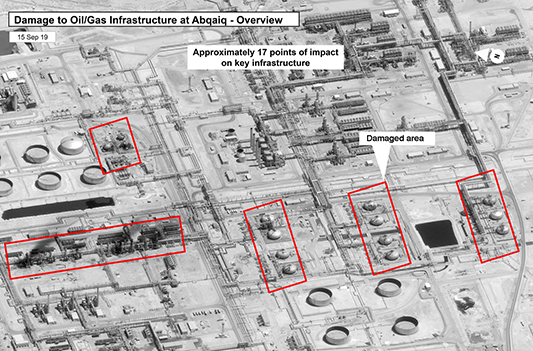
Aerial image of the points of impact of Yemeni retaliatory drone/ cruise missile attack on Saudi oil production infrastructure at Aramco facilities in Abqaiq, 9-14-2019. Reports now coming in from investigators indicate this was a sophisticated attack, perhaps taking months to plan, and waiting on the ideal conditions to execute: lead drones first took out the US Patriot radar installations and then follow on cruise missiles hit the intended targets. The accuracy of the drone/ missile strikes suggests that oil workers sympathetic to Ansarullah, or Yemeni agents posing as workers placed cell phones in appropriate places to act as homing beacons. Regardless, the fact that the US, with its billion dollar surveillance equipment and satellite technology, still has not determined where the drones/missiles came from over ten days after the attack took place, and could not protect the economic lifeline of the entire developed world indicates that US power is no longer invincible and Muslim military parity is fast becoming a reality.
Naturally, accusations from Riyadh and Washington went straight to the Islamic Republic of Iran, claiming Tehran was behind the strikes. And reflecting raw racism, they claimed the proud people of Yemen are “too backward” to pull off an attack of this magnitude. However, unbiased analysis of the facts show that Yemen most definitely could, and would, retaliate against their aggressors in such a spectacular manner. The accusation against Iran was also meant to divert attention from Saudi incompetence and the failure of US-supplied billion-dollar-a-piece Patriot missile batteries to intercept incoming drones.
It must be borne in mind, this is not the first airstrike, be it by missiles or by unmanned aircraft, that the Republic of Yemen has carried out against the Najdi invaders. While counterattacks deep inside Saudi territory have been taking place ever since the start of the war, the year 2019 has seen a surge in successful high-profile retaliations.
On May 14, the Saudi regime was forced to stop pumping crude oil in its main pipelines across the country, following Yemeni drone strikes against two Aramco facilities west of Riyadh. On June 12, a missile strike launched from inside Yemen hit Abha International Airport, which was in use by the Saudi military at the time, exploding right in the arrivals hall and causing major damage. It is noteworthy that Abha is over 100 km from the Yemeni border. The airport was hit again just five days later and yet again on July 2, destroying a hangar for military planes. Together with the Saudi military airbase of Khamis Mushayt in ‘Asir province, the airport of Abha has been struck multiple times in the past few months. This reflects the total incompetence of Saudi air defence systems.
The month of August 2019 started with a double missile and drone attack against two very different Saudi targets. First, a joint missile and UAV strike at a camp of Saudi-backed mercenaries in the southern port city of Aden killed dozens of collaborators. And then the Yemeni mujahidin hit a Saudi military base in Dammam city, in the Eastern province of Saudi Arabia that is hundreds of kilometres away from the Yemeni border.
On August 17, an attack took place that can be seen as a general rehearsal of sorts for the Abqaiq and Khurais strikes. Using a fleet of drones, Yemen’s revolutionaries attacked the Shaybah oil refinery. The massive refinery unit, located no less than 1,100 km from Yemen, was chosen specifically for its proximity to the United Arab Emirates (UAE). In one attack, the Yemeni revolutionaries not only proved their capacity to strike deep inside Saudi Arabia and hit its economic lifeline, but also sent shivers down the spine of the Emirate rulers.
“The UAE must quit the Saudi-led aggression if it wants to save its glass towers,” Yemeni military spokesman Yahya Sari‘ warned in crystal clear terms after the mid-September strikes.
The Yemeni struggle for independence and liberty has been a source of inspiration for years. Yet after September 14, the war against the US-Israeli-Saudi-UAE-led aggressors has entered a new phase. It may lead to the collapse of Bani Saud’s rule over the Kingdom. Should that happen, it would be widely celebrated by committed Muslims worldwide.
 

Brecht Jonkers


Saturday, September 28, 2019

A look at London’s suspicious positions on Iran and Aramco

By Hamid Bayati

Recent statements by the British prime minister and foreign secretary indicate that London demote itself to the position of an agent by accepting a new mission, and has begun a suspicious scenario against Iran. Britain, hostility of which to Iranian people is historically proven, has shown that it seizes any opportunity to hit Iran. Following the September 14 attacks on the Aramco oil facilities by Yemenis, Britain launched a new campaign against Iran.
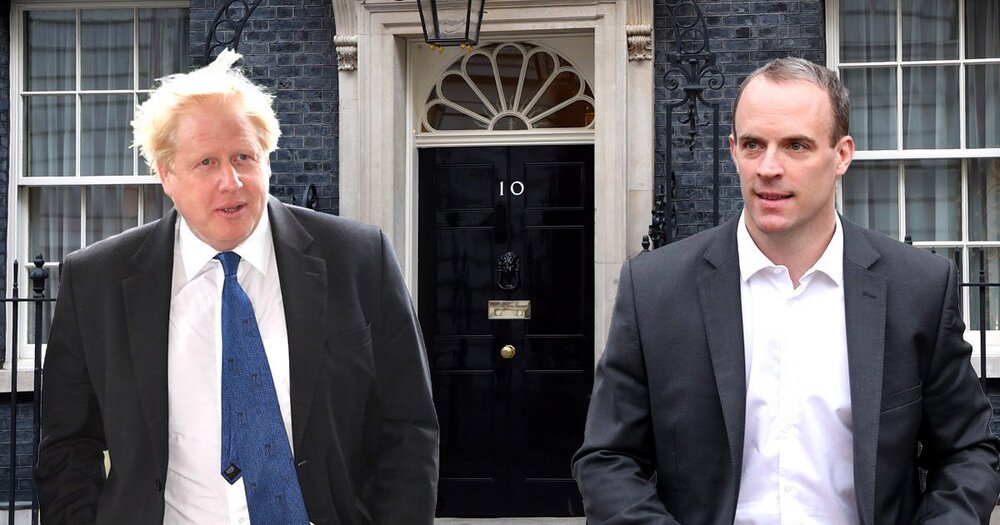
 As evidence shows, London has been commissioned by Saudi Arabia to incite the international community against Iran, and form an international coalition against the Islamic Republic. Prime Minister Boris Johnson and Foreign Secretary Dominic Raab are the main drivers of the scenario.
Immediately after the attacks, the Yemenis announced that they had carried out the strikes, but a few days later Riyadh tried to lay the blame for the attacks on Iran.
Johnson and Raab’s mission began after Saudi officials exposed some parts of missile and fallen drones, claiming that Iran was in charge of the attack.
In this regard, Raab who tried to add fuel to fire since the beginning, started a new phase of his actions on Sunday, September 22. He explicitly claimed that Iran was in charge for the attacks.
Raab said in an interview, “Based on information that I have observed, I found that it is almost impossible that the attacks on Aramco was carried out by Houthis. It is invalid to say that Houthis attacked Aramco.”
Raab did not point out what group or country was responsible for the attacks from London’s prospective.
“Before we blame someone for the attacks, I want that the matter be clear for me, because the action that we intend to take will be powerful and widely backed,” he said.
On Monday, he wrote in a message on Twitter, “London is cooperating with international partners to offer a strong diplomatic response to the attack on Aramco oil facilities, and to establish security in the Middle East. Britain believes that Iran is most likely responsible for illegal attack on Saudi oil facilities. ”
In the meanwhile, Johnson made statements against Iran, claiming that Iran is in charge for the attack on the Saudi oil facilities, and British military is likely to participate in protecting Saudi Arabia against future attacks.
Saudi Arabia turning from the U.S. to Britain
The way that Saudi Arabia responded to the attacks on the Aramco oil facilities shows well that Riyadh is not satisfied with U.S. reaction to these attacks. The positions taken by American officials toward the incident does not meet Riyadh’s desires. Therefore, Saudi rulers decided to use another actor to achieve their goal, so which option is better than Britain?
Donald Trump and Secretary of State Mike Pompeo have repeatedly stated in recent days that they are willing to use diplomacy in case of Iran. In case of Aramco, Saudi Arabia should make the final decision about Iran and possible action.
Of course, Trump agreed to dispatch new troops to Saudi Arabia and the UAE to make Riyadh keep quiet, but this position failed to meet Riyadh’s demand.
Supplying Brexit costs
There are many reasons why Britain has entered the game, but the main one is the cost of leaving the European Union.
Leaving the EU, if possible, will have great financial cost for London, one of which is paying £39 billion to Brussels. Johnson has claimed several times that Britain would not pay this sum to the EU and has announced some conditions for paying the bill at a lower cost.
In addition to the financial costs, leaving the European Union will also have political costs for Britain. One of the main costs will be a gap between London and European allies. So being next to Saudi Arabia, a country that world powers bow to its dollars, can minimize Brexit’s political consequences for Johnson.
Increasing the gap between London and France
Britain has launched a propaganda campaign against Iran, while the French president has made every efforts to maintain the JCPOA. Britain’s measures can at least disrupt the space that Emmanuel Macron is trying to create, and it means a gap between Paris and London. In other words, France is seeking to reduce tensions in the region, but Britain’s recent actions are intensifying them.   
Britain has earlier displeased France with a careless action in recent months. It was related to a French plan to create a European maritime coalition in the Strait of Hormuz, while Britain backed the U.S. alternative plan all at once. As a result, France proposed European coalition without Britain.
Relying on the fleeting government
Saudi Arabia has selected Johnson and Raab to carry out the mission, while the situation of the British government is not stable at all. There are arguments about no confidence vote to Johnson as the parliament will start its work after a vacation.
Britain is dealing with Brexit, a crisis that has so far victimized administrations of David Cameron and Theresa May, and Johnson’s cabinet maybe its third victim.
However, the claims against Iran regarding attacks on Aramco are so futile that the U.S. has so far refused to accompany Saudi Arabia properly. The result of these changes will lead to isolation of Johnson and Raab among European allies.

Tuesday, September 24, 2019

Reuters frustrated U.S. not striking Iran for Aramco attacks despite no evidence of Tehran’s involvement

By Alireza Hashemi

The corporate media is having the false accusations repeated until the need for Iran attack becomes consensus reality in the west.
TEHRAN- Some in the mainstream western media are lamenting why U.S. President Donald Trump is dragging its feet to march off to another open-ended military conflict in the Middle East, after days of reckless efforts to implicate Iran in the September 14 Yemeni attacks into Saudi oil installations.
The MSM outlets are repeating that Iran was behind the attack, despite the fact Iranian complacency with the Yemeni strike has not yet been publicly demonstrated.
They are following in the footsteps of U.S. Secretary of State Michael Pompeo, who has put American credibility on the line by accusing Iran of perpetrating an “act of war”.
The attack, the latest in a series of strikes into key Saudi Arabian targets this year, was launched from south-western Iran using drones and cruise missiles, according to the American narrative.
This is while the Yemeni Houthi movement has claimed responsibility for the attacks, explaining in detail how the assaults were carried out.
The strike fits a pattern of Yemeni strikes against Saudi economic infrastructure, and it follows Yemeni threats made last month.
There is no plausible reasons to believe Iran was behind the attacks, and it’s even unclear if Iran has indirectly played a role in the attacks.
Although the U.S. government and establishment media often call the Houthis a proxy of Iran, the fact is this is an independent force grown out of decades-long conflicts in Yemen.
The extent to which Iran offers support to the Yemeni forces has never been established.
Anyway, even if factual evidence does emerge that Iran has provided weapons used in the attack, there would be much less actual guilt on the part of Tehran than what the western outlets say. Why would this justify a U.S. military response?
Assemblage of junk
Surprisingly, neither the U.S. nor Saudi Arabia have so far presented a shred of credible evidence proving Iran launched the attack on Aramco.
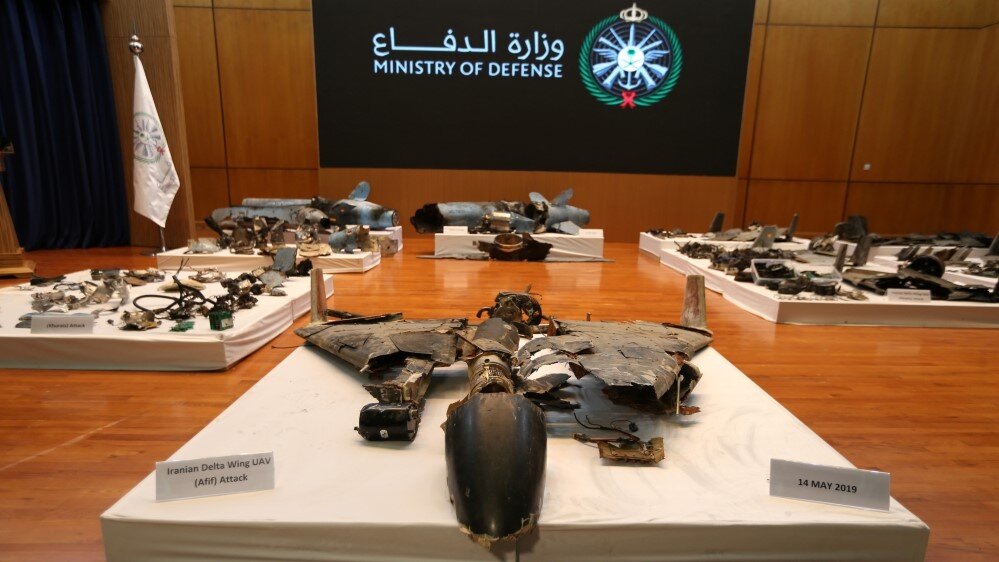
In a press conference Wednesday night, Riyadh put on display a wreckage of what it said were remnants of weapons used in the attacks
In the show, the Saudi Defense Ministry Spokesman Turki al-Maliki claimed the wreckage showed the attacks were "unquestionably sponsored" by Tehran.
But many believe the assemblage of junk were not that much-anticipated “concrete evidence” Saudi officials had vowed to provide.
Al-Maliki did not say what area the strikes were fired from, just asserting they “could not have originated in Yemen”.
Separately, Saudi Arabia's Minister of State for Foreign Affairs Adel al-Jubeir on Saturday showed he is clueless about the perpetrator of the attacks.
Al-Jubeir said Riyadh would take the appropriate steps if its investigation confirmed that the attacks were launched from Iranian soil. 
"The kingdom will take the appropriate measures based on the results of the investigation, to ensure its security and stability," al-Jubeir told a news conference.
Reuters eggs on war
However, it seems Reuters and other western outlets are bent on nudging the idea of war forward, picking up the anti-Iran narrative and running with it.  
The corporate media is having the false accusations repeated until the need for Iran attack becomes consensus reality in the west.
Of dozens of Reuters articles on the Aramco attack, almost all take Iran’s involvement in the attack for granted.
The articles generally repeat the same demonology pro-war voices offered for years to try to justify an attack on Iran.
A Friday piece, titled “United States sending troops to bolster Saudi defenses after attack”, says the US officials have told Reuters southwest Iran was the staging ground for the attack that might has been “authorized by Iran’s Supreme Leader Ayatollah Ali Khamenei.”
The article says this is “an assessment based at least in part on still-classified imagery showing Iran appearing to prepare an aerial strike”.
But the agency doesn’t explain why the evidence that reportedly justify an attack to a sovereign country are still classified.
The article also says the Pentagon’s late Friday announcement that it will send some troops to Saudi Arabia to bolster defense systems “appeared to close the door to any imminent decision to wage retaliatory strikes against Iran following the attack”.
Ouch! Isn't it too bad that the doors to “retaliatory strikes” are closed?
The title of a Saturday column says, “Saudi oil attack shows how Iran sees new Mideast game”.
This column clearly suggests Iran was behind the attack. A paragraph says,” Iran has been testing drones and supplying them to regional allies such as Hezbollah for years. This attack, however, showed significant recent progress. That the missiles were reportedly able to evade Saudi air defenses by flying behind them demonstrates striking sophistication”.
A Thursday article reads, “Saudi Arabia shows attack site damage as Iran pledges tough defense”.
This article relates a Saudi-organized tour of the damaged facilities for western reporters to Friday remarks by an Iranian official that Iran would give firm response to any U.S. military plot in the region.
This is also the case with two other articles, titled “Iran says it will destroy any aggressor” and “Iran navy commander says Iran ready to defend its marine borders”.
Both articles link pledges by Iranian commanders to defend Iranian territory, made in speeches on the occasion of the 39th anniversary of the beginning of the Iraqi invasion of Iran, to the Aramco attacks.
Striking example
Perhaps no article demonstrates the Reuters pro-war stance than a major piece released early on Wednesday.
BY ali
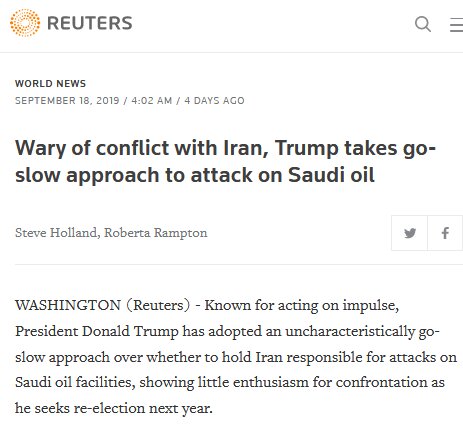
Screenshot of a Reuters article published on September 18, 2019.
In the article, published hours before Saudi Arabia held its news conference, Reuters lamented why Trump was not taking action immediately.
The title is provocative enough:” Wary of conflict with Iran, Trump takes go-slow approach to attack on Saudi oil”.
Reuters reports Trump has adopted an “uncharacteristically go-slow approach” over whether to “hold Iran responsible” for attacks on Saudi oil facilities, apparently because he “seeks re-election next year” and he is “famously skeptical of his intelligence community”.
But one can hardly conclude Trump’s approach towards the Sept. 14 attacks was “uncharacteristically go-slow”, taking into account Trump’s approach to the explosions off the coast of the UAE’s Fujairah in May, the attacks on two oil tankers in the Gulf of Oman mid- June and the shootdown of a U.S. spy drone inside Iranian territory late June.
Probably in all cases there was “no doubt” that Iran was the culprit - although even stanch allies of the U.S. wanted clear evidence - but Trump reportedly decided to back down.
The Reuters piece itself mentions Trump’s behavior towards Venezuela, reporting Trump has resisted suggestions for a “stronger focus on military planning” while a U.S.-led campaign of economic and diplomatic pressure has failed to “rescue” its people by toppling the Venezuelan government.
Reuters continues, “Trump’s stance today is in stark contrast to 2017, less than three months into his presidency, when he waited only two days before launching air strikes to punish Syrian President Bashar al-Assad’s forces for a chemical weapons attack.”
Wait a minute.  Was Trump entitled to bombard Syria as a punishment for a “chemical weapons attack”? Which global authority did sanction such attacks?
And there are no convincing proof to believe the Syrian government has ever committed chemical attacks.
CNN anchor echoes Reuters
Interestingly, a famous CNN anchor also egged on war with Iran, tweeting why Trump “balks” at military retaliation.
Trying to portray Trump’s picking of sanctions instead of airstrikes as a sign of weakness, CNN anchor Jim Sciutto replied with a carefully worded question: “does this mean the president is again balking at military retaliation?”
According to Sputnik, the purpose of Sciutto’s question is to frame Trump’s choice as between showing strength by ordering an airstrike - which seems to be the obvious decision for any red-blooded American - or weakness by “balking” at that option.
A love for war
Seemingly, the mainstream media loves it when the U.S. bombs things.
The Trump-ordered missile strike on Syria’s Shayrat Air Base in April 2017 was widely admired by the MSM.
A day after the attack, CNN’s Fareed Zakaria said he thinks Trump had just “became President of the United States", Washington Post columnist David Ignatius asserted “put more umph” back into “the credibility of American power,” and Fox News’ Jeanine Pirro claimed “We finally have a man who knows the difference between right and wrong and good and evil, and it makes us proud.”
Global Research and other respected alternative outlets have clearly demonstrated how big U.S. outlets, including the New York Times, CBS, and CNN, sold the Iraq war to the American people.
“Such was the barrage of propaganda directed at the American public that 69% believed Saddam Hussein was personally involved in the September 11 attacks. That is a significant achievement in manipulation. The poll results must have been news to the Iraqi dictator himself, a forgotten one-time American ally,” Global Research reports.
The pattern continues into other illegitimate interventions, as the liberal Guardian newspaper championed the demolition of Libya in 2011, with editorials imploring, “The quicker Muammar Gaddafi falls, the better.”
Now one can better grasp why William Arkin, one of NBC’s political commentators, quit in January. In his resignation letter, Arkin denounced the network as a “cheerleader for open and subtle threat mongering,” full of people who “accept that a state of perpetual war” is a necessity.
Trump decided to impose yet another round of sanctions to punish the people of Iran for what there is no public proof of, but MSM outlets are furious that Trump has backed away from an all-out war.
Trump can be almost certain that the day he orders air strikes, the MSM will cheer the decision as “presidential”.

Monday, September 23, 2019

Was Iran really behind the attack on Saudi Aramco facilities?

Omar Ahmed
On 14 September, state-owned Saudi Aramco’s oil processing facilities at Abqaiq and Khurais in the Eastern Province were the target of a sophisticated drone and cruise missile attack. The Houthis of Yemen were quick to claim responsibility for “Operation Deterrent Balance 2”, which more than halved Saudi Arabia’s oil output and caused a surge in oil prices by 20 per cent at one point.
If true, this would be their most significant and daring attack in the Kingdom to date. A month ago, they carried out the first “Operation…” using 10 drones against the Shaybah oil fields in south-east Saudi Arabia near the border it shares with the UAE.
Houthi military spokesman Yahya Saree said that new drones had been used, which likely refers to the long-range Samad-3, unveiled officially on 7 July by the Supreme Political Council and named after former Council president Saleh Ali Al-Samad who was killed in a Saudi-led coalition drone strike last year. The same “suicide UAV” Samad-3 was used by the Houthis to strike Abu Dhabi’s International Airport last year.
However, dismissing the Houthi claims, both the Saudis and the US are intent on laying the blame on Iran. Describing the events as an “act of war”, US Secretary of State Mike Pompeo has stated explicitly that Iran carried out the operation and requested all nations to “unequivocally condemn Iran’s attack”, thus leaving no room for an alternative narrative. US President Donald Trump, meanwhile, has been less keen to label Iran as the perpetrator.
For its part, Iran has flatly denied the allegation and reiterated Yemen’s right to defend itself against foreign aggression. Moreover, Turkish President Recep Tayyip ErdoÄŸan implied that Saudi Arabia was to blame for dropping bombs on Yemen in the first place. Close US allies such as Japan and France have also confirmed that there is no actual evidence of direct Iranian involvement; even Gulf neighbour and coalition partner the UAE has not backed the allegation.
Saudi Ministry of Defence spokesman Colonel Turki Al-Malki revealed to the press on Wednesday the wreckage of drones and missiles which he said were fired from the north or north-west. He told reporters that the attacks were “unquestionably sponsored by Iran.” However, when pressed by journalists, he too failed to state explicitly that the attacks emanated from Iranian territory.
One of the most far-fetched claims thus far has been from US investigators suggesting that the Saudis have recovered a “pristine circuit board” from a cruise missile retrieved from the attack site. This is reminiscent of the claims that one of the 9/11 hijackers’ passports survived the attack on the World Trade Centre.
9/11 attacks [File photo]
What the Saudis did state, though, was that 18 drones were launched against the Abqaiq oil facility and seven cruise missiles targeted the Khurais oil fields, three of which fell short. Satellite images provided by the US government of the attack sites revealed at least 17 separate impact points.
However, this is not sufficient evidence that the attacks came from Iranian territory. Retired General Mark Hertling told CNN that the images “really don’t show anything, other than pretty good accuracy on the strike of the oil tanks.”
Furthermore, the evidence made public does not suggest that the attacks came from the north or north-west (which would have us believe that the source was either Iran-aligned Iraqi territory or from south-west Iran, which would be north-east of the attack sites). They also do not point to the south, which would be the most likely trail leading to the Houthis in Yemen.
It appears more likely that the targets were struck from the west when one looks at the close-up images of the tanks from the Abqaiq facility against the arrow indicating due north. This may corroborate an announcement by Houthi spokesman Saree following the attack, that after careful intelligence gathering and monitoring, it was implemented with “the cooperation of honourable and free men within the Kingdom”, a likely reference to the 15-20 per cent of the population who form the Saudi Shia community concentrated mainly in the oil rich but socio-economically deprived east of the country.
Dr Stephen Byren, writing in the Asia Times, is of the opinion that the Houthis did not carry out the attack, but he certainly believes that, “Saudi Arabia was infiltrated by well-trained operators who were close to the targets and were able to guide the terminal phase of the attacking cruise missiles (and maybe the drones) via video transmitted from the missiles and drones.”
This theory adds credence to the idea of local involvement. Arguably, the targets were carefully selected. With regard to the Abqaiq oil processing plant, at least 11 of the 17 points of impact were tanks containing liquid gas; the piping, it has been suggested, was configured such that any damage to one or a group of tanks, would not affect the overall production process, as it would simply be re-routed to the next tank. However, with all tanks in this particular area being taken out, production was interrupted. “The targeting for this attack was done with detailed knowledge of the process and its dependencies… they may have been launched from within Saudi Arabia.”
This is not to say that Iran did not have a rational motive to carry out the attack. With increased sanctions and external attempts to cripple its economy and ability to export oil, from Tehran’s perspective if Iran is not able to sell oil, then no one else should be. It could also be interpreted as intended to inflict a humiliating blow on the US.
It is their advanced weaponry and defence systems that the Saudis are ultimately employing and relying upon for their state security. The Gulf, after all, is one of the most monitored areas in the world, with US-supplied radar systems and missiles facing Iran, not only in Saudi territory, but also in other Gulf neighbours and on US ships fitted with Aegis air ballistic defence systems. If true, this attack exposes the failure of the US defence systems as deployed there.
The question that must be asked is this: how were almost two dozen missiles and drones not detected, especially if they came from Iran? A former US Navy officer who has experience in the region told Business Insider, “It’s very hard to imagine a salvo of 17 shots from Iranian territory not being picked up via some land and sea radars.”
If there is concrete evidence of Iranian involvement, it should be available from US radar data gathered in the Gulf. A NATO military official posted to Saudi Arabia acknowledged that such data can be obtained easily if the US wanted it, but, “If they haven’t released that info, it’s because either they don’t have it or the Saudis asked for a delay for domestic political reasons.”
One Twitter user on a blog about Iranian geopolitical issues shared an image which purportedly illustrates the reach of Saudi Arabia’s air defence systems near the affected areas.
He argues that the drones were within the range of the Patriot PAC-2 system but just outside that of the Hawk’s; their small size was a possible reason for passing through undetected.
Although, as the Military Times points out, the multitude of US made Patriot air defences in Saudi’s arsenal “are meant to shoot down hostile aircraft or shorter-range ballistic missiles. Patriots provide ‘point defence’ — not protection of wide swaths of territory — and it’s unclear whether any were positioned close to the oil sites.”
In spite of the billions which Saudi Arabia has spent on US-made defence systems, and its reliance on US intelligence, the US does not have “an unblinking eye over the entire Middle East at all times,” said Marine General Joseph Dunford, chairman of the Joint Chiefs of Staff.
The failure of US defence systems was probably why Russian President Vladmir Putin suggested to Riyadh that it should purchase his country’s S-400 defence systems this week.
Whoever was behind the attack, the truth is that the balance of power has changed with the human costs in Yemen pitted against the economic and political costs of the war for the Saudis. Yemen was already the poorest country in the Arab region to begin with and has little else to lose, comparatively speaking. The realisation that there is a very serious capability to interrupt, halt or destroy Saudi Arabia’s oil production may be enough for the Kingdom to rethink its actions in Yemen.
The Yemenis, of course, are within their right under international law to defend themselves against foreign aggression. In their eyes, an attack on an oil producing facility that contributes to the Saudi war machine — which has included 17,000 air raids and the dropping of 50,000 bombs, many on non-military targets — is entirely legitimate.
The fact that the drones were Iranian made or supplied should not be a reason to go to war with Iran. After all, Tehran has merely done the same as Washington by supplying arms to one of the belligerents in the conflict.
Avoiding war with Iran becomes increasingly difficult, however, when there are policymakers intent on justifying military action, especially without providing credible, concrete evidence. This won’t be the first time that a war was predicated on lies, though. There are also those in the media with their delusionary push for armed conflict.
Conrad Black’s timely piece in the National Review, for example, wherein he argues that “an air assault on Iranian oil facilities and nuclear military sites would be entirely justified”, gives little thought to the consequences for the region. Such a response would surely have been undertaken already if the political will existed. Then again, according to Black, Saudi Arabia is “a much more reputable regime than the terrorism-promoting, bigoted theocracy of Iran,” so we know where he is coming from.
For now, Donald Trump plans to impose further sanctions on Iran, which so far have not had any impact on Tehran’s resolve and defiance. The US President has previously turned down plans to strike against the republic in the wake of the downing of a US Navy drone on 20 June, so there is hope yet that common sense can prevail and war is not inevitable.

Sunday, September 22, 2019

Zarif: ‘Even Saudis themselves don't believe the fiction of Iranian involvement’ in Aramco attack

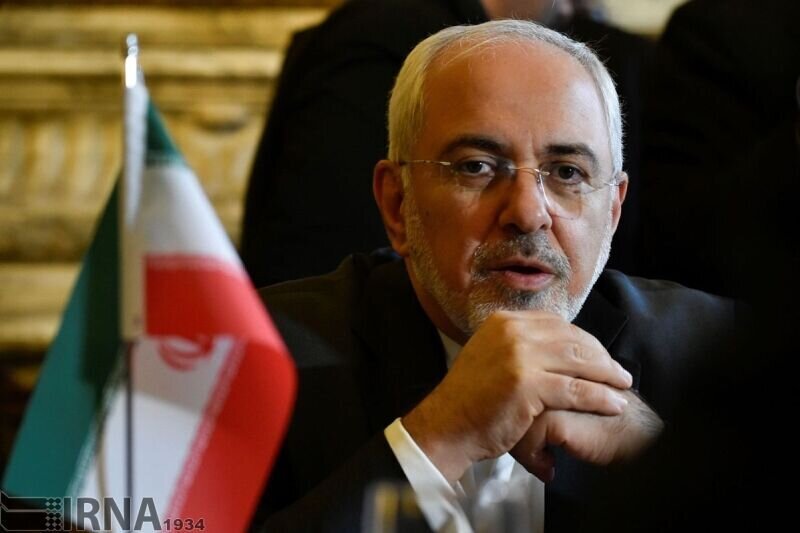
TEHRAN – Iranian Foreign Minister Mohammad Javad Zarif said on Friday that “even the Saudis themselves don't believe the fiction of Iranian involvement” in the attacks on the Aramco oil facilities, citing Saudi Arabia’s retaliation attack on Hodaideh in Yemen as a reason.
According to Press TV, Saudi Arabia announced on Friday that it had launched a military operation against Hodaideh because the port city was being used by Yemeni fighters to launch ballistic missiles and drones.
In a post on his Twitter account, Zarif said it was "curious" that the Saudis, who had blamed Iran for the September 14 air raids on two major Saudi oil facilities, had retaliated against Hodaideh in violation of a UN-brokered ceasefire agreement signed in Stockholm in December 2018.
“Since the Saudi regime has blamed Iran—baseless as that is—for the attacks on its oil facilities, curious that they retaliated against Hodaideh in Yemen today—breaking a UN ceasefire. It is clear that even the Saudis themselves don't believe the fiction of Iranian involvement.” 
A Yemeni military spokesman described the assault as a serious escalation and a reprisal for the Yemeni assault on the Saudi oil installations.
Both Riyadh and Washington are continuing to point the finger directly at Iran, with the U.S. Secretary of State, Mike Pompeo, describing the attack as an act of war by Tehran. Donald Trump has also made a veiled military threats against Iran, saying the U.S. was “locked and loaded”.   
Tehran has vehemently rejected accusations of involvement in the raids as "lies" and warned of "an all-out war" in the event of military strikes against the country.
In a letter to the UN Security Council on Friday, Iranian Ambassador to the United Nations Majid Takht Ravanchi said, “It has become a standard practice of certain officials of the United States who, following any incident -- no matter where and by whom – without exception, immediately and without any investigation and evidence, declare Iran as the culprit.”
Takht Ravanchi added, “This “maximum deception” campaign is in line with and a living example of the so-called “maximum pressure” policy of the United States against Iran.”
On Friday, Yemeni Ansarullah’s president of the Supreme Political Council Mahdi al-Mashat said Yemenis were calling a halt on drone and missile attacks, hoping "the gesture would be answered" by the Saudis.
Al-Mashat said the peace plan was aimed at ending the conflict "through serious negotiations to achieve a comprehensive national reconciliation which does not exclude anyone".
The official, however, warned that the Yemenis “would not hesitate to launch a period of great pain” if their call for peace was ignored.
Saudi Arabia and its allies launched the war on Yemen in March 2015 in an attempt to reinstall the toppled government of Mansour Hadi who was toppled by the people. The Western-backed offensive, coupled with a naval blockade, has destroyed the country’s infrastructure, and led to a massive humanitarian crisis.

Pompeo will have less weight in Trump’s national security team: expert

By Javad Heirannia

TEHRAN - Research Assistant at Princeton University's Program on Science and Global Security, says in the absence of Bolton, I think Pompeo, another Iran Hawk will have less weight in Trump’s national security team.
Sina Azodi adds “Keep in mind that an ordinary president would usually cave into such pressures, but Trump as has been proven many times, is not an ordinary president.”
Following is the full text of the interview:
Q: What is your assessment of John Bolton's dismissal? Will the militant faction become a minority with this layoff?
A: On the dismissal of John Bolton, I have two theories; one is related to Afghanistan, where he had been in intense argument with President Trump over inviting the Taliban representatives to the Camp David, on (or tear the anniversary) of the 9/11 terrorist attacks. He (correctly) had argued that this will not work well for the administration - 
Other theory is his disagreement with Trump over extending olive branch to Iran and Trump’s considering of the French proposal for extending a 15 billion dollar credit line to Iran to ease the sanctions; in addition to the possibility of a meeting with Rouhani.  
Bolton has been a long Iran-hawk, has written on the need to “bomb Iran, and has further appeared frequently on MEK events, receiving speaking fees from them.  Needless to say that, while Trump claims that Bolton has been fired, Bolton says he offered his resignation first. 
Q: What effect will Bolton's dismissal have on U.S. foreign policy toward Iran?
A: In the absence of Bolton, I think Pompeo, another Iran Hawk will have less weight in Trump’s national security team. Keep in mind that an ordinary president would usually cave into such pressures, but Trump as has been proven many times, is not an ordinary president. At the end of the day, he goes by his gut feelings and not the advice.  So on Iran, he is really interested in making a deal with Iranians and claiming the victory. Will he do it? We don’t know because he just tweeted, falsely claiming that he never said the he would meet with Iranians without preconditions. 
Q: With Bolton fired, it was speculated that Trump would be on a diplomatic course with Iran. On the other hand, Yemeni attacks on Aramco have prompted Washington to declare that it is ready to fight Iran. What is your assessment of this situation?
A; On this question, I would argue that it is Trump making threats because at the end of the day the President of the U.S. doesn’t get to declare war on any country because the crown prince of Saudi Arabia says so (referring to his tweet last night). There is also the possibility that a third party wants to drag the U.S. into a war with Iran, using the U.S. blood and treasury.
Q: Given the change of personality like Bolton, are Israeli policies in the U.S. State Department going to fade or shift?
A: I think that pro-Israeli policies are more embedded in the U.S., both in the Congress and the White House and change of personality cannot change the influence.

Houthi retaliation on Saudi oil facilities checkmates Trump

By Yuram Abdullah Weiler

“We promise the Saudi regime that our future operations will expand further and be more painful than ever as long as it continues its aggression and siege.” —Yemeni Armed Forces spokesman Brigadier General Yahya Sari'
In a highly coordinated retaliatory attack deep inside Saudi Arabia, Yemeni Armed Forces targeted Aramco oil refineries at Buqayq and Khurais on September 14, 2019.  Ten drones carried out the sophisticated operation, which has effectively reduced Saudi output by 50 percent and the global oil supply by 5 percent, raising the specter of $100 a barrel oil prices once again.  The Houthi strike came at a time when the oil giant was preparing for a public stock offering “as soon as possible” according to Saudi Energy Minister Abdulaziz bin Salman.
For his part, Mike Pompeo, the Trump regime’s diplomatic hitman, blamed Iran for the astonishingly well-executed operation, calling it “an unprecedented attack on the world’s energy supply.” Concurring and always ready to blame Iran for the results of failed U.S. policies, chicken hawk senator Lindsey Graham threatened, “It is now time for the U.S. to put on the table an attack on Iranian oil refineries if they continue their provocations or increase nuclear enrichment.” In response to these spurious accusations and threats, Iran’s Foreign Minister Mohammad Javad Zarif wrote, “Having failed at ‘max pressure’ US Secretary of State Mike Pompeo turning to ‘max deceit’.”
The Saudis have blamed Iran for the attack on their country’s oil facilities out of embarrassment due to their inability to achieve their geopolitical goals despite U.S. backing. One must ask, how is it possible for the heavily-armed Saudis, awash in U.S. weaponry, appear weak and impotent in their military operations against the Houthi rebels? Why weren’t the sophisticated Saudi air defenses able to intercept the Houthi drones before reaching their targets? Ineptitude on the part of the Saudis is unacceptable, so Iran must be to blame. This is the mindset of the rulers in Riyadh, who are likely wondering if their Washington ally will come to their rescue.
In reality, Iran’s influence within Yemen is at best marginal, and certainly the Houthis are not aligned with the Islamic Republic in a manner such that they could be termed proxies. The main ignitor of the raging fire of conflict in Yemen is Saudi Arabia, whose de-facto leader, Mohammad bin Salman (MBS), made the misguided decision to invade the country in March 2015 to restore the exiled government of Abd Rabbu Mansour al-Hadi. While the western narrative accusing the Islamic Republic of aligning with the Shi’a Houthis strictly due to religious considerations simply does not hold up to a closer examination, Iran does, of course, cultivate ties with non-state actors who are in opposition to the U.S.-Israeli-Saudi regional hegemonic axis. For their part, the Houthis have the same goal as in the 1990s when the movement was born, and that is for increased autonomy, but not necessarily independence, from the central government.
Trump, being the draft-dodging, bellicose blowhard that he is, announced he is “locked and loaded” for a military operation, presumably against Iran, for which he is busy manufacturing consent. The argument being put forth is that the Houthi Ansar Allah forces lack the expertise to pull off the missile attack, which impacted 17 different points within the critical infrastructure of Aramco’s Abqaiq oil processing facility in Buqyaq. U.S. officials claim that, based on satellite imagery of the 19-odd impact points at both targets, the projectiles most likely originated in Iraq or Iran. Such an argument underscores the enduring colonial mindset of western officials, who readily accept as axiomatic that Ansar Allah is made up of backward, tribal people who could never carry out such a sophisticated attack. Nevertheless, some unnamed, but perhaps more enlightened, U.S. officials conceded that the trajectories could have originated in Yemen.
Regardless of the origin of the drone attack, its execution and timing display a brilliant sense of strategic thinking and planning, as well as a profound grasp of tactics.  Think about it for a moment: with comparatively low-tech weaponry at their disposal and at relatively modest cost, resistance fighters of Ansar Allah, or their backers as the case may be, were able to take a critical Aramco oil production facility off line and cut Saudi oil output by 50%, all in a military “op” that did not take a single human life. Global oil markets have surged in reaction to fears of shortages, if the imbroglio escalates, while the White House has announced its intention to release oil from the U.S. strategic petroleum reserves, an indication that U.S. political leaders fear a worldwide economic slowdown should crude prices take off. 
According to U.S. Federal Reserve Chairman Jerome Powell, “The global growth outlook has been deteriorating since the middle of last year.”  So given the sluggishness of the world’s economy, which, according to the International Monetary Fund, is being held back by “rising trade uncertainty,” any further escalation of tensions in the Persian Gulf may be sufficient to initiate a global recession. With the IMF World Trade Uncertainty Index already at levels exceeding previous records by an order of magnitude, the Washington warmongers must be fully aware that initiating any military action against Tehran would come with an extremely high economic cost. Trump himself has indicated his awareness of this reality by his remarks on Twitter that he is “waiting to hear from the Kingdom as to who they believe was the cause of this attack and under what terms we would proceed!”
And then there are the coming U.S. elections in November of 2020 and, of course politicians are already on the campaign trail stumping for re-election.  Trump is no different in this regard, having organized numerous campaign rallies in anticipation of his re-election. Currently engaged in a vigorous trade war with China, the current occupant of the Oval Office is desperately in need of some positive economic news to parade before American voters.  From this fact, we can conclude that starting a war with Iran, and its ugly economic consequences, is most likely not a viable option if Trump wants to be re-elected. This explains why, so far, the White House reaction to the Ansar Allah military strike has been vague and subdued.
But then the bellicose, anti-Iran rhetoric, which the former reality TV star and his B Team less Bolton has relentlessly regurgitated since his initial presidential campaign speeches, seems to resonate with a significant portion of his electoral base. Along with Pompeo and Bolton, Trump has been upping the rhetorical ante with Iran to the point where if he does not respond militarily to Ansar Allah’s successful retaliatory raid on Aramco’s oil processing facilities in Saudi Arabia, he will look decidedly weak and foolish. The director of the Future of Iran Initiative at the Atlantic Council, Barbara Slavin, noted that Trump has been “[r]ejected again and embarrassed by the escalation in the Persian Gulf his policies have incentivized,” and is likely to do more of the same.  Trump certainly appears to engage in behavior that Slavin previously dubbed “head-snapping schizophrenia” after his pontifical performance at the U.N. in September 2018.
In short, Trump has checkmated himself. He must do what he cannot afford to do militarily or economically, but if he does it, namely launch an attack on Iranian oil facilities, he will risk causing a global recession, which will negatively impact the U.S. economy and hence his chances for re-election.  Checkmate!