Friday’s downing of yet another American drone by the Ansarallah Movement again made military experts monitoring the almost 5-year war wonder whether the Yemenis are in possession of daily improving sophisticated technology or whether the U.S. has supplied obsolete weaponry to Saudi Arabia in return for hundreds of billions of dollars.
Whatever the truth, the fact that cannot be denied that Yemen’s indomitable defenders who on September 14 carried out a spectacular drone attack that crippled the giant Abqaiq oil installations in retaliation for the Riyadh regime’s war crimes, have time and again proved the effectiveness of their homemade projectiles in penetrating the Patriot missile defence system which the U.S. has set up throughout Saudi Arabia.
The Scan Eagle unmanned aircraft was on a spying mission when it was downed in northern Yemen.
The Americans and the Saudis have both been embarrassed by the loss of a costly drone, but instead of coming to their senses, they continue their bombing campaign, which according to the London-based Armed Conflict Location and Event Data project (ACLED), which tracks confirmed fatalities in the conflict and claims to reliable, the number of men, women, and children killed by the Saudis and the Emiratis over the past five years crossed the 100,000 mark.
This year alone, the coalition of criminals, dent the determination to defend their homeland of the Ansarallah fighters, has so far killed 20,000 Yemeni civilians in the mostly cowardly manner.
It is too high a death toll, but the Yemenis, especially the northerners, have refused to bow down to the Saudi-UAE invaders, unlike the people, tribes, and militias of southern Yemen, who seem to have submitted to the aggressors, chiefly because of traitors in their midst like the so-called government led by the fugitive from justice Mansour Hadi.
The Ansarallah have appealed to their brethren in Aden and other parts to stand up, but so far except for a few, the call for national unity has been drowned in the sectarian propaganda of the Wahhabi cult which has tried to depict the Zaydi Shi’a Muslim followers of the School of the Blessed Household (Ahl al-Bayt) of Prophet Muhammad (SAWA), as Iranian agents.
Nothing could be far from the truth, although there is no denying of the fact that Iran, as per the articles of the constitution of the Islamic Republic, is a staunch supporter of the rights of the Muslims and oppressed anywhere in the world, including the southern Yemenis, the moment they decide to throw off the Saudi-UAE yoke from their necks.
Meanwhile, reports speak of deliberate bombing by the desert-dweller Saudis of the fabled terraced farmlands of Yemen, which over the years have suffered thousands of airstrikes, in addition to the 800 bombings that struck local food markets, and about 500 airstrikes that hit silos and other food storage facilities.
These are indeed crimes against humanity by the coalition of the cowards. Unfortunately the UN has turned a blind eye to the destruction of Yemen’s agriculture that is causing malnutrition and famine in a country, which unlike Saudi Arabia and the UAE, was not just self-sufficient in this vital field, but used to export fruits and vegetables to the Persian Gulf markets.
In view of these facts, it should not surprise anyone if the Yemeni decide to carry out a retaliatory operation greater in magnitude than the Abqaiq attack with the technology they have at their disposal which is capable of neutralizing whatever state-of-the-art military hardware the Americans can supply to the Saudis.
The corporate media is having the false accusations repeated until the need for Iran attack becomes consensus reality in the west.
TEHRAN- Some in the mainstream western media are lamenting why U.S. President Donald Trump is dragging its feet to march off to another open-ended military conflict in the Middle East, after days of reckless efforts to implicate Iran in the September 14 Yemeni attacks into Saudi oil installations.
The MSM outlets are repeating that Iran was behind the attack, despite the fact Iranian complacency with the Yemeni strike has not yet been publicly demonstrated.
They are following in the footsteps of U.S. Secretary of State Michael Pompeo, who has put American credibility on the line by accusing Iran of perpetrating an “act of war”.
The attack, the latest in a series of strikes into key Saudi Arabian targets this year, was launched from south-western Iran using drones and cruise missiles, according to the American narrative.
This is while the Yemeni Houthi movement has claimed responsibility for the attacks, explaining in detail how the assaults were carried out.
The strike fits a pattern of Yemeni strikes against Saudi economic infrastructure, and it follows Yemeni threats made last month.
There is no plausible reasons to believe Iran was behind the attacks, and it’s even unclear if Iran has indirectly played a role in the attacks.
Although the U.S. government and establishment media often call the Houthis a proxy of Iran, the fact is this is an independent force grown out of decades-long conflicts in Yemen.
The extent to which Iran offers support to the Yemeni forces has never been established.
Anyway, even if factual evidence does emerge that Iran has provided weapons used in the attack, there would be much less actual guilt on the part of Tehran than what the western outlets say. Why would this justify a U.S. military response?
Assemblage of junk
Surprisingly, neither the U.S. nor Saudi Arabia have so far presented a shred of credible evidence proving Iran launched the attack on Aramco.
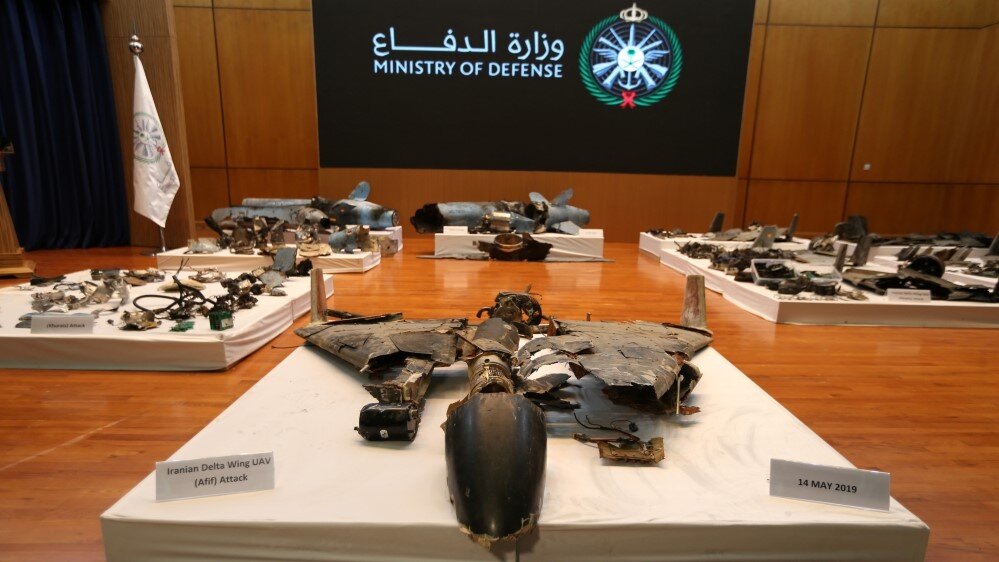
In a press conference Wednesday night, Riyadh put on display a wreckage of what it said were remnants of weapons used in the attacks
In the show, the Saudi Defense Ministry Spokesman Turki al-Maliki claimed the wreckage showed the attacks were "unquestionably sponsored" by Tehran.
But many believe the assemblage of junk were not that much-anticipated “concrete evidence” Saudi officials had vowed to provide.
Al-Maliki did not say what area the strikes were fired from, just asserting they “could not have originated in Yemen”.
Separately, Saudi Arabia's Minister of State for Foreign Affairs Adel al-Jubeir on Saturday showed he is clueless about the perpetrator of the attacks.
Al-Jubeir said Riyadh would take the appropriate steps if its investigation confirmed that the attacks were launched from Iranian soil.
"The kingdom will take the appropriate measures based on the results of the investigation, to ensure its security and stability," al-Jubeir told a news conference.
Reuters eggs on war
However, it seems Reuters and other western outlets are bent on nudging the idea of war forward, picking up the anti-Iran narrative and running with it.
The corporate media is having the false accusations repeated until the need for Iran attack becomes consensus reality in the west.
Of dozens of Reuters articles on the Aramco attack, almost all take Iran’s involvement in the attack for granted.
The articles generally repeat the same demonology pro-war voices offered for years to try to justify an attack on Iran.
A Friday piece, titled “United States sending troops to bolster Saudi defenses after attack”, says the US officials have told Reuters southwest Iran was the staging ground for the attack that might has been “authorized by Iran’s Supreme Leader Ayatollah Ali Khamenei.”
The article says this is “an assessment based at least in part on still-classified imagery showing Iran appearing to prepare an aerial strike”.
But the agency doesn’t explain why the evidence that reportedly justify an attack to a sovereign country are still classified.
The article also says the Pentagon’s late Friday announcement that it will send some troops to Saudi Arabia to bolster defense systems “appeared to close the door to any imminent decision to wage retaliatory strikes against Iran following the attack”.
Ouch! Isn't it too bad that the doors to “retaliatory strikes” are closed?
The title of a Saturday column says, “Saudi oil attack shows how Iran sees new Mideast game”.
This column clearly suggests Iran was behind the attack. A paragraph says,” Iran has been testing drones and supplying them to regional allies such as Hezbollah for years. This attack, however, showed significant recent progress. That the missiles were reportedly able to evade Saudi air defenses by flying behind them demonstrates striking sophistication”.
A Thursday article reads, “Saudi Arabia shows attack site damage as Iran pledges tough defense”.
This article relates a Saudi-organized tour of the damaged facilities for western reporters to Friday remarks by an Iranian official that Iran would give firm response to any U.S. military plot in the region.
This is also the case with two otherarticles, titled “Iran says it will destroy any aggressor” and “Iran navy commander says Iran ready to defend its marine borders”.
Both articles link pledges by Iranian commanders to defend Iranian territory, made in speeches on the occasion of the 39th anniversary of the beginning of the Iraqi invasion of Iran, to the Aramco attacks.
Striking example
Perhaps no article demonstrates the Reuters pro-war stance than a major piece released early on Wednesday.
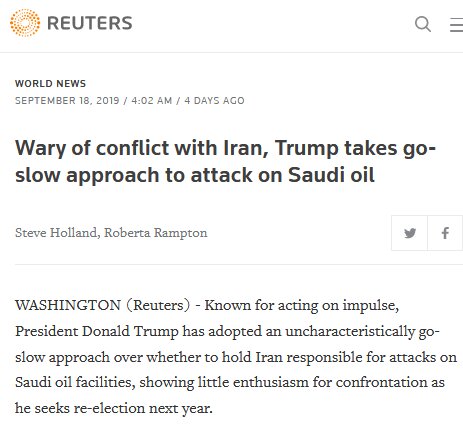
Screenshot of a Reuters article published on September 18, 2019.
In the article, published hours before Saudi Arabia held its news conference, Reuters lamented why Trump was not taking action immediately.
The title is provocative enough:” Wary of conflict with Iran, Trump takes go-slow approach to attack on Saudi oil”.
Reuters reports Trump has adopted an “uncharacteristically go-slow approach” over whether to “hold Iran responsible” for attacks on Saudi oil facilities, apparently because he “seeks re-election next year” and he is “famously skeptical of his intelligence community”.
But one can hardly conclude Trump’s approach towards the Sept. 14 attacks was “uncharacteristically go-slow”, taking into account Trump’s approach to the explosions off the coast of the UAE’s Fujairah in May, the attacks on two oil tankers in the Gulf of Oman mid- June and the shootdown of a U.S. spy drone inside Iranian territory late June.
Probably in all cases there was “no doubt” that Iran was the culprit - although even stanch allies of the U.S. wanted clear evidence - but Trump reportedly decided to back down.
The Reuters piece itself mentions Trump’s behavior towards Venezuela, reporting Trump has resisted suggestions for a “stronger focus on military planning” while a U.S.-led campaign of economic and diplomatic pressure has failed to “rescue” its people by toppling the Venezuelan government.
Reuters continues, “Trump’s stance today is in stark contrast to 2017, less than three months into his presidency, when he waited only two days before launching air strikes to punish Syrian President Bashar al-Assad’s forces for a chemical weapons attack.”
Wait a minute. Was Trump entitled to bombard Syria as a punishment for a “chemical weapons attack”? Which global authority did sanction such attacks?
And there are no convincing proof to believe the Syrian government has ever committed chemical attacks.
CNN anchor echoes Reuters
Interestingly, a famous CNN anchor also egged on war with Iran, tweeting why Trump “balks” at military retaliation.
Trying to portray Trump’s picking of sanctions instead of airstrikes as a sign of weakness, CNN anchor Jim Sciutto replied with a carefully worded question: “does this mean the president is again balking at military retaliation?”
According to Sputnik, the purpose of Sciutto’s question is to frame Trump’s choice as between showing strength by ordering an airstrike - which seems to be the obvious decision for any red-blooded American - or weakness by “balking” at that option.
A love for war
Seemingly, the mainstream media loves it when the U.S. bombs things.
The Trump-ordered missile strike on Syria’s Shayrat Air Base in April 2017 was widely admired by the MSM.
A day after the attack, CNN’s Fareed Zakaria said he thinks Trump had just “became President of the United States", Washington Post columnist David Ignatius asserted “put more umph” back into “the credibility of American power,” and Fox News’ Jeanine Pirro claimed “We finally have a man who knows the difference between right and wrong and good and evil, and it makes us proud.”
Global Research and other respected alternative outlets have clearly demonstrated how big U.S. outlets, including the New York Times, CBS, and CNN, sold the Iraq war to the American people.
“Such was the barrage of propaganda directed at the American public that 69% believed Saddam Hussein was personally involved in the September 11 attacks. That is a significant achievement in manipulation. The poll results must have been news to the Iraqi dictator himself, a forgotten one-time American ally,” Global Research reports.
The pattern continues into other illegitimate interventions, as the liberal Guardian newspaper championed the demolition of Libya in 2011, with editorials imploring, “The quicker Muammar Gaddafi falls, the better.”
Now one can better grasp why William Arkin, one of NBC’s political commentators, quit in January. In his resignation letter, Arkin denounced the network as a “cheerleader for open and subtle threat mongering,” full of people who “accept that a state of perpetual war” is a necessity.
Trump decided to impose yet another round of sanctions to punish the people of Iran for what there is no public proof of, but MSM outlets are furious that Trump has backed away from an all-out war.
Trump can be almost certain that the day he orders air strikes, the MSM will cheer the decision as “presidential”.
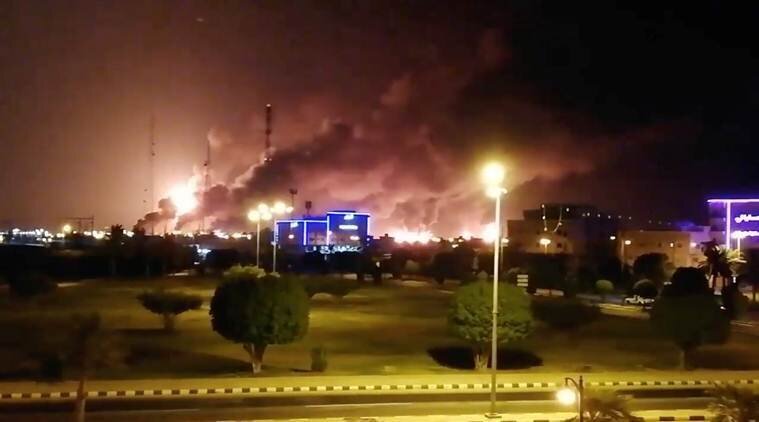
Major Saudi Arabian oil facilities of Abqaiq (Buqayq) and Khurais, east of capital Riyadh, were attacked last Saturday, September 14. The attack could be considered the most devastating in modern history affecting not just Saudi Arabia but also the global economy. Abqaiq, operated by the Saudi oil giant ARAMCO, is the largest oil processing facility in the world. It is reported to process about 7 million barrels of oil per day.
The immediate result of the attack resulted in slashing down of Saudi oil production down to 50%. This is equivalent to 5% of the global production of crude oil. Oil prices had already jumped to almost $65 per barrel and is expected to hover around $73 per barrel early 2020 assuming no new attacks against other oil facilities would take place.
To minimize the effect of such high prices within Saudi Arabia itself, Al-Saud ruling family, who owns ARAMCO, has shut off the 350 thousand barrel per day oil pipeline to Bahrain, and released its oil reserve to compensate for the loss. Unfortunately, the Saudi reserve may last only 37 days less than the amount of time that may take for experts to evaluate the damage, not mentioning the length of time to clean up the facilities, order new equipment and material, and rebuild the facilities. This may take a year of non-stop extensive labor if not any longer.
The extent of the damage is far worse than what Saudi Arabia would confess. The long-lasting repercussions on Saudi Arabia and on the world market will unfold gradually with time. We already are seeing one major effect namely that Saudi Arabia has been turned from an oil-producing to an oil-consuming country. On Thursday 19th, Saudi Arabian ARAMCO had asked Iraq’s State Oil Marketing Organization (SOMO) for some 10 million barrels of Basra Light, to load in October and November to compensate for Saudi’s loss of oil production. This is also reported and confirmed by Wall Street Journal.
The Saudi Dammam Marine Traffic office reported that there are at least 11 giant oil tankers docked at the port not knowing when they will be loaded with crude oil. It is also expected to receive fewer oil tankers than usual to dock at Saudi ports in the next few months. Oil tankers will be directed to other oil-producing countries. Such uncertainty will increase the cost of doing business and of insurance premiums for the tankers.
This particular attack caused the Saudi Exchange Market to plummet 5%, and will definitely push foreign investors to withdraw from Saudi economy due to lack of adequate security, and due to threats of possible further attacks that might directly hit their investments. Saudi Arabia could witness a repeat of the 2018 investors’ withdrawal worth of approximately $80 billion when investors such as JPMorgan, Blackstone, Ford, Standard Charter and Credit Suisse among others did not participate in the Davos in the Desert Conference, also known as the Future Investment Initiative, which put MBS’ dream project; NEOM, on indefinite hold. Those withdrawals increased the Saudi 2018 budget deficit to $35 billion. Spending billions on weapons purchase to continue the war on Yemen had also contributed greatly to the deficit.
The attack had come in a crucial time; a few weeks before Saudi’s plan to offer 5% of ARAMCO’s stocks to the market. The value of the stocks has been greatly reduced causing a huge loss to the royal family, who owns the company.
Saudi Aramco’s R&D Center in Dhahran, Saudi Arabia. (Source: Saudi Aramco)
This attack came as an expected consequence of the war against Yemen. Saudi Arabia and UAE had formed what was called Saudi Alliance to restore the Saudi puppet Abdrabbuh Mansur Hadi back to power in Yemen. A Houthi led revolution deposed Hadi, who fled to Saudi Arabia. The Saudi Alliance forces consist mainly of Sudanese and Ethiopian mercenaries led by some Saudi and Emirati military officials supervised, directed and armed by American, British, French and Israeli military and intelligence officers.
Let us be clear about the war on Yemen. It is a genocidal imperialist war incited by the Western power…
Let us be clear about the war on Yemen. It is a genocidal imperialist war incited by the Western power to gain control over the strategic Bab el-Mandab Straight controlling the southern entrance to the Red Sea, to control the strategic Socatra Island in the Gulf of Aden, and the oil and the rich mineral resources in the Yemeni mountains.
Contrary to the expectations that the war against Yemen would take only few months to accomplish its goals, it is now in its fifth year and is still going strong and with opposite than the expected results. It has been a genocidal devastating war with the Americans fueling and navigating fighter planes bombing every Yemini city, all infrastructures, governmental and civilian institutions including schools, hospitals, markets, factories, farms and even wedding and funeral processions. This genocidal war included soliciting Israel’s help to drop two nuclear bombs on Sana’a in May 2015. It also included an economic blockade killing civilians through starvation and preventable diseases.
Having the legitimate right of self-defense the Houthis stood up against Saudi aggression. Born in the country, used to its harsh climate, familiar with its rugged mountains, and defending country and families they started by rebelling and inflicting heavy casualties on the Saudi mercenaries, who are not familiar with the harsh terrain of Yemeni mountains. Then they manufactured and improved ballistic missiles and explosive-laden drones; long-range precision targeting controlled flying bombs.
Missiles and drone aircraft are seen on display at an exhibition at an unidentified location in Yemen in this undated handout photo released by the Houthi Media Office on September 17, 2019. Houthi Media Office
Unlike Saudi fighter planes that bombed Yemeni civilian targets, Houthis bombed Saudi military targets; airports for military fighters and military bases. Lately, they started bombing Saudi monarchy owned ARAMCO targets to affect heavy cost on the kingdom.
On May 14 of this year, the Houthis sent 10 drones to attack oil pumping stations west of the Saudi capital Riyadh, at Dawadmi and Afeef, disrupting the flow of oil through a 1,200 kilometer pipeline that carried crude oil from Saudi Arabia’s main eastern oil fields to the Red Sea port city of Yanbu in the West. This vital pipeline has a capacity of at least five million barrels per day.
On August 17th the Houthis again used ballistic missiles and drones targeting the Shaybah oil field near the border with the UAE, as well as the Dammam exporting complex in Saudi Arabia’s Eastern Province. Shaybah oil field produces about one million barrels of crude oil a day.
These two particular attacks demonstrated the long-range reach of the Houthis’ drone program. The Houthis had demonstrated that a new rule of military engagement has been achieved. Saudi Arabia can no longer bomb Yemeni targets with impudence and without any retaliatory action. The Houthis now can retaliate by sending their drones to bomb any target deep in the Saudi kingdom including its capital Riyadh.
Yet, instead of learning the lesson and continue peace negotiations with the Houthis, the Saudis, on September 7th, sent their fighter planes to the Yemeni city of Dhamar to bomb what they claimed to be a drone manufacturing facility. Unfortunately, the Saudis relied on faulty intelligence, and instead, they bombed a prison holding their own mercenaries, who were waiting for a prisoners exchange deal.
…with the ability to manufacture 6 such drones per day the Houthis are warning that more devastating attacks would target deep in Saudi territories if Saudi Arabia does not cease its aggression.
The Houthis’ devastating response came one week later, on Saturday, September 14th, when ten of their drones struck ARAMCOs’ oil facilities of Abqaiq and Khurais 12,000 kilometers deep on the eastern side of Saudi Arabia. Yahia Sarie; the military spokesman for the Houthis announced in a televised broadcast that the Houthis, with the help of on the ground intelligence from local operatives, were able to target the oil facilities with ten drones in pinpoint accuracy. He also explained that with the ability to manufacture 6 such drones per day the Houthis are warning that more devastating attacks would target deep in Saudi territories if Saudi Arabia does not cease its aggression. He also warned UAE that it could face similar attacks if it does not withdraw its mercenaries.
Having encouraged and benefited from arms sale to Saudi Arabia to perpetuate such war crimes these leaders have no right at all to condemn the legitimate Yemeni’s right of self-defense.
I was not surprised to see some Arab leaders, as well as European and American leaders, who stood watching the Saudi war crimes against Yemen during the last five years with their mouths shut without any criticism or condemnation, suddenly wake up and condemn the attack on the oil facility calling it a terrorist attack. Their conscience, if they have any, responds only to personal financial rather than to humanitarian loss. Having encouraged and benefited from arms sale to Saudi Arabia to perpetuate such war crimes these leaders have no right at all to condemn the legitimate Yemeni’s right of self-defense.
What surprised me instead, is their pathetic perspective of the Yemenis as undeveloped non-industrial and non-innovative people denying them the intelligence and the ability to manufacture their own defensive weapons. They claimed that drone technology and manufacture is beyond Yemeni intellectual capability. We did not hear such claim after the two drone attacks against ARAMCO facilities at Dawadmi and Shaybah, instead, the Saudi kept justifying their further extensive air raid as their willingness to destroy drone factories.
It might help to remember that many Yemeni military engineers had in the past been militarily trained and university graduates of the old Soviet Union, of today’s Russia, of North Korea, of East Germany and other eastern European countries. It takes only one scientist to teach others how to manufacture missiles and drones. Teenagers of today are learning how to build drones from the internet.
On Wednesday, September 18th, during a Saudi press conference the recently assigned energy minister Prince Abdulaziz bin Salman downplayed the extent of the damage to the oil facilities claiming that the facilities will be back in full production by the end of the month. This total nonsense aimed at providing a false sense of security in an attempt to maintain the price of crude oil as is. If you have watched the internet videos of the oil-blazed Abqaiq facility covering the sky with black smoke you would have an idea how devastated the attack was.
During the same press conference the Saudi defense ministry spokesman Lt. Col. Turki al-Malki accused Iran of the attack alleging that Iran had used very sophisticated missiles; way beyond the capability of the Houthis, to strike the oil facilities. Al-Malki claimed that Iranian made twenty-five delta-wing drones and missiles, used in the attack, came from north to south direction. Iran is north of Saudi Arabia while Yemen is on the south. He showed what he claimed as broken parts and unexploded missile collected from the site as proof that they were Iranian made. One should notice that these alleged parts were not charred by the huge blaze of the site, which cast serious doubts over this claim.
Colonel Turki al-Malik displays equipment he said was used to attack a Saudi Aramco oil facility
The absurd claim that the drones and missiles are allegedly Iranian made alludes that the attack was Iranian. Using the same logic we could conclude that the US has been attacking Yemen because Saudi Arabia had used American weapons to bomb Yemen.
The other absurd claim that the drones came from the north while the Patriot system is directed to the south is supposed to explain the failure of the system to detect the drones. It is known that radars work on a 360 degree fashion to detect any incoming flying object. If the radar was able to detect the drones; no matter which direction they came from, it would be easy to re-direct the Patriot missile system towards that direction unless they did not have Patriots protecting the facilities.
The American initial response to the attack was Trump’s emphatic claim that the US is “locked and loaded”; ready to punish the culprits. He tweeted on Sunday: “Saudi Arabia oil supply was attacked. There is reason to believe that we know the culprit, are locked and loaded depending on verification, but are waiting to hear from the Kingdom as to who they believe was the cause of this attack, and under what terms we would proceed!”
The CIA trained to lie and habitual lying Secretary of State Mike Pompeo hastened to repeat the American mantra of “Iran did it” even before the dust had settled in the Saudi oil facilities, before any examination or investigation of the facilities, and without any tangible proof or evidence. The US is ashamed to confess that its prized Patriot missile defense system and its very sophisticated satellites have miserably failed to detect the “rudimentary” cheap Houthi drones that flew 12,000 kilometers in Saudi territory without being detected. Such scandalous failure is bad business for the American military-industrial complex and needs to be concealed, otherwise other countries would resort to buying the Russian S-300/S-400 system as Putin had suggested to Saudi Arabia similar to what India and Turkey had done.
Iran had denied its responsibility of the attack, yet supported Yemenis’ right for self-defense. Iran does not benefit from attacking Saudi Arabia. Iranian officials had many times called on Saudi royal family to join Iran in a local alliance to safeguard the security of the Persian Gulf. The Iranians have the power and the courage to claim any military action they may take as we had seen when they shot down the American Global Hawk spy drone last June.
Besides the accusations of the habitually lying Pompeo and the American fake news media hinting about Iranian responsibility, no American military or political officials had directly blamed Iran. European and Asian leaders as well had also stated that there was no proof that Iran bombed the oil facilities. They all claimed that the origin of the drones is still unknown although the Houthis had claimed responsibility.
Trump had downplayed the effects of the attack on American consumer falsely claiming that the US is producing enough of its own oil, and it does not need Saudi oil. He authorizing the release of oil from the Strategic Petroleum Reserve as needed. According to reports by the US Energy Information Administration (EIA) the US oil production in 2018 was about 17.71 million barrel per day, while its consumption was about 20.5 million barrel per day.
To reduce the expected economic effects of the attack on the American economy the Federal Reserve chairman; Jerome Powell, announced on Wednesday 18th that due to expected economic continuous expansion on a moderate rate the Fed will lower the interest rate down to between 1.75% – 2%. This is the second time this year the Fed had reduced the interest rate.
Trump is an arms salesman. He just wants to keep milking his Saudi and Emirati cows further.
Trump admitted that the US has been selling weapons to Saudi Arabia, but the US has no defense treaty with the country, thus the US is not obliged to come to its defense. Trump has no interest in going to war against Iran on behalf of Saudi Arabia. Let us remember that he refrained from responding to Iranian downing of the American drone. Trump is an arms salesman. He explained that if Saudi Arabia needs protection it has to pay for it; buying more American weapons. And paying in billions, Saudi Arabia has been doing for the last five years but did not get the anticipated protection.
Trump does not want to take the US to war as he stated. He just wants to keep milking his Saudi and Emirati cows further. So he sent his Secretary of State Pompeo to Saudi Arabia and to UAE to discuss how buying more weapons would improve the security of their kingdoms. At the same time, as a face saving, he instructed his Secretary of Treasury; Mnuchin, to “substantially increase” the ineffective sanctions against Iran.
The so-called Saudi Alliance, and in fact the whole world, should not ignore the Houthis’ military capabilities and resolve to inflict a definite more devastating attacks deep in the Saudi territory that will affect the whole world, and should take this attack as a serious warning message to stop the war on Yemen.
The stabilization process is a form of partial distillation which sweetens "sour" crude oil (removes the hydrogen sulfide) and reduces vapor pressure, thereby making the crude oil safe for shipment in tankers. Stabilizers maximize production of valuable hydrocarbon liquids, while making the liquids safe for storage and transport, as well as reduce the atmospheric emissions of volatile hydrocarbons. Stabilizer plants are used to reduce the volatility of stored crude oil and condensate.
Soon after the attack U.S. Secretary of State Mike Pompeo went into full 'blame Iran' mode:
Secretary Pompeo @SecPompeo -21:59 UTC · Sep 14, 2019 Tehran is behind nearly 100 attacks on Saudi Arabia while Rouhani and Zarif pretend to engage in diplomacy. Amid all the calls for de-escalation, Iran has now launched an unprecedented attack on the world’s energy supply. There is no evidence the attacks came from Yemen. We call on all nations to publicly and unequivocally condemn Iran’s attacks. The United States will work with our partners and allies to ensure that energy markets remain well supplied and Iran is held accountable for its aggression
Abqaiq lies at the heart of the Saudi oil infrastructure. It processes more than half of the Saudi oil output.
The U.S. government published two detailed pictures of the attack's result.
The pictures show some 17 points of impact. There are cars visible in the second more detailed picture that demonstrate the gigantic size of the place. The targets were carefully selected. At least 11 of those were egg shaped tanks with a diameter of some 30 meter (100 foot). These are likely tanks for pressurized (liquidized) gas that receive the condensate vapor from the stabilization process. They all have now quite neat holes in their upper shells. The piping to and from the egg shaped tanks shows that these were configured in groups with double redundancy. Two tanks beside each other share one piping system. Two of such twin tanks are next to each other with lines to their processing train. There are a total of three such groups. Damage to any one tank or group would not stop the production process. The products would be routed to another similar tank or group. But with all tanks of this one special type taken out the production chain is now interrupted. Two processing areas were hit and show fire damage. At least the control equipment of both was likelycompletely destroyed:
Consultancy Rapidan Energy Group said images of the Abqaiq facility after the attack showed about five of its stabilization towers appeared to have been destroyed, and would take months to rebuild - something that could curtail output for a prolonged period.“However Saudi Aramco keeps some redundancy in the system to maintain production during maintenance,” Rapidan added, meaning operations could return to pre-attack levels sooner.
The targeting for this attack was done with detailed knowledge of the process and its dependencies. The north arrow in those pictures points to the left. The visible shadows confirm the direction. The holes in the tanks are on the western side. They were attacked from the west. The hits were extremely precise. The Yemeni armed forces claimed it attacked the facility with 10 drones (or cruise missiles). But the hits on these targets look like neither. A total of 17 hits with such precise targeting lets me assume that these were some kind of drones or missiles with man-in-the-loop control. They may have been launched from within Saudi Arabia. There is no information yet on the damage in Khurais, the second target of the attacks. The U.S. and Israel are able to commit such attacks. Iran probably too. Yemen seems unlikely to have this capability without drawing on extensive support from elsewhere. The planning for this operation must have taken months. A Middle-EastBBCproducer remarks:
Riam Dalati @Dalatrm -22:44 UTC · Sep 15, 2019 17 points of impact. No Drones or missiles were detected/intercepted. Saudis & Americans still at loss as to where the attack was launched from. #KSA seriously needs to shop elsewhere & replace the Patriot or reinforce it with a web of radar operated AA guns like the Oerlikon. A source familiar with #Aramco situation told us earlier today that it was a “swarm attack”, a mix of > 20 drones and missiles, at least half of which were "suicide" drones. #USA & #KSA, he said, are 'certain' that attack was launched from #Iraq but 'smoking gun still missing' They are also 'fairly certain' that #IRGC was behind the operation because, even though the missiles used were identical to those of the #Houthis, an inspection of the debris found in the desert revealed a 'couple of new updates' and a 'distinctly better craftsmanship'
The strikes knocked out 5.7 million barrels of daily production, and the officials said they still believe they can fully replace it in coming days. That would require tapping oil inventories and using other facilities to process crude. One of the main targets of the attack was a large crude-processing plant in Abqaiq. ... “It is definitely worse than what we expected in the early hours after the attack, but we are making sure that the market won’t experience any shortages until we’re fully back online,” said a Saudi official. ... Even if Saudi officials were successful in restoring all or most of the lost production, the attack demonstrates a new vulnerability to supply lines across the oil-rich Gulf. Tankers have been paying sharply higher insurance premiums, while shipping rates have soared in the region after a series of maritime attacks on oil-laden vessels, which the U.S. has blamed on Iran. ... Khurais produces about 1.5 million barrels a day and Abqaiq, the world’s biggest crude-stabilization facility, processes seven million barrels of Saudi oil a day, turning crude into specific grades, such as Arabian Extra Light.
The repairs at Abqaiq will likely take weeks, no days. Brent crude futuresroseby 19.5 percent to $71.95 per barrel, the biggest jump since 14 January, 1991:
Aramco gave no timeline for output resumption. A source close to the matter told Reuters the return to full oil capacity could take “weeks, not days”.Riyadh said it would compensate for the damage at its facilities by drawing on its stocks, which stood at 188 million barrels in June, according to official data.
U.S. President Donald Trump was way more careful in attributing the strike than his Secretary of State.
Donald J. Trump @realDonaldTrump -0:50 UTC · Sep 16, 2019 Saudi Arabia oil supply was attacked. There is reason to believe that we know the culprit, are locked and loaded depending on verification, but are waiting to hear from the Kingdom as to who they believe was the cause of this attack, and under what terms we would proceed!
Any direct attack on Iran would result in swarms of missiles hitting U.S. military installations in the United Arab Emirates and Qatar. Saudi water desalination plants, refineries and ports would also be targets. It is doubtful that Trump or the Saudis are ready to risk such a response. The attack on Abqaiq wasnot the last oneand all Saudi installations are extremely vulnerable:
Yemen’s Houthi rebels said oil installations in Saudi Arabia remain among their targets after attacks against two major sites slashed the kingdom’s output by half and triggered a surge in crude prices.The Iranian-backed rebel group, cited by the Houthi’s television station, said its weapons can reach anywhere in Saudi Arabia. Saturday’s attacks were carried out by “planes” using new engines, the group said, likely referring to drones.
Middle East Eye, a Qatari financed outlet,reportedyesterday that the attack was launched from Iraq by Iran aligned forces in revenge for Israeli attacks in Syria. The author, David Hearst, is known for slandered reporting. The report is based on a single anonymous Iraqi intelligence source. Qatar, which is struggling with Saudi Arabia and the UAE over its support for the Muslim Brotherhood, would like to see a larger conflict involving its rivals east and west of the Persian Gulf. The report should therefore be disregarded. Saudi Arabia has no defenses against this kind of attacks. The U.S.has no systemthat could be used for that purpose. Russia is the only country that can provide the necessary equipment. It would be extremely costly, and still insufficient, to protect all of the Saudi's vital facilities from similar swarm attacks. Attacks of this kind will only end when Saudi Arabia makes peace with Yemen and when the U.S. ends its sanctions of oil exports from Iran. As Iran's President Rouhanisaid:
“If one day they want to prevent the export of Iran’s oil, then no oil will be exported from the Persian Gulf”
It is high time for hawks like Pompeo to recognize that Iran means what it says and has the tools to fulfill that promise.
TEHRAN – As expected, oil markets started Monday trading with an unprecedented jump in prices following the attacks on Saudi Arabia’s oil facilities which wiped nearly five percent of the global oil supply from the market.
Drone attacks claimed by Yemen’s Houthi rebels on Saturday struck two of Saudi Aramco’s major oil facilities in Khurais and Abqaiq - the world's largest oil processing facility and crude oil stabilization plant.
Now, few days after the attacks, global oil markets are waiting to see how the disrupted oil is going to be compensated for.
Will Saudis be able to get their production back to its full capacity in a short period of time? If not, what are the options for replacing the lost barrels to keep the market in balance?
The market’s reaction
A few hours after the strikes, Aramco released a statement confirming that production of 5.7 million barrels of crude (more than half of the kingdom’s output) was affected by the attacks.
Aramco’s statement sparked a wave of panic in the oil markets across the globe, causing for bets on oil prices to go as high as $100.
As it was expected, in the first minutes of the Monday morning trades, Brent crude jumped $12 to reach $71 per barrel, posting its biggest ever surge in a day.
The market’s significant reaction to the incident could also be translated as an indication of the skepticism about the promises of recovery by the Saudis or vows of taping into emergency oil reserves by the United States.
It is also a manifestation of yet another aspect of the world’s energy cycle, that is the realization a
bout the vulnerability of the global oil market and the magnitude of the impact of geopolitical factors on this market.
As Ed Morse from Citigroup Inc. wrote in a research note, “No matter whether it takes Saudi Arabia five days or a lot longer to get oil back into production, there is but one rational takeaway from this weekend’s drone attacks on the Kingdom’s infrastructure -- that infrastructure is highly vulnerable to attack, and the market has been persistently mispricing oil.” So, despite all the reassurance, oil markets around the world are once again overshadowed by the geopolitical risks and at least for some time the geopolitical risk premium will be seen in the oil prices.
Replacements for the lost oil
Many analysts and experts believe that Saudi Aramco won’t be able to get all the lost capacity back over a short period of time and it would at least take a couple of weeks to get back to the full capacity.
Considering the worst case scenario, some analysts believe that the oil market should be looking for new sources of crude supply in case the damage to the Aramco facilities turn out to be more than what is seems and the Saudi’s oil production takes more time than expected to get back to its full capacity.
One option, as previously mentioned, is the U.S. emergency reserves which Trump has promised to release to balance the market. However, analysts believe that such an action will likely not be taken in the short term.
"I don't think a release is imminent," Bob McNally, president of Rapidan Energy Group, told S&P Global Platts. "Everything depends on how much damage has been done and how long will it last."
There is also the matter of distance and time, as Sandy Fielden, analyst at Morningstar puts it, “It takes 19-20 days to ship Ras Tanura (Saudi) to Singapore, but 54 days from Houston to Singapore. So U.S. ‘relief’ will take time.”
It should also be mentioned that, although the U.S. strategic reserves are estimated at about 625 million barrels, but its offshore borders have restrictions on oil transportation. As the U.S. Department of Energy said in a report in 2016, the United States could release up to 2.1 million barrels a day from its strategic reserves.
Another option which is more likely in the short term is Saudi Arabia’s own reserves in countries like China and Japan, but with the kingdom’s limited reserves, the loss could only be replaced for approximately 30-45 days, according to McNally.
“Saudi Arabia has about 188 million barrels of oil stockpiled, which can offset the 5-million-barrels of lost oil only for about 37 days,” McNally said.
Even if Aramco manages to recover 2 million barrels of the disrupted capacity in short term (as they have claimed), the other 3.7 million barrels should be supplied from the reserves.
So if the oil which has been disrupted is not replaced before the company’s stored supplies end, the market would go into an even more complicated situation.
Finally, some other believe that the easiest solution is to waiver the Iranian oil.
“The obvious short-term fix would be waivers on Iran sanctions, but politically that’s a hard pill for the Trump administration to swallow. By all accounts the Iranians have tankers full of storage ready to go,” Sandy Fielden said.
Jason Bordoff, founding director of the Center on Global Energy Policy at Columbia University also believes that Iran could be a reliable source of additional supply in case the disruptions prolong.