Showing posts with label Kaveh L. Afrasiabi. Show all posts

Saturday, October 05, 2019

Iran’s Counter-Discourse Of Hope

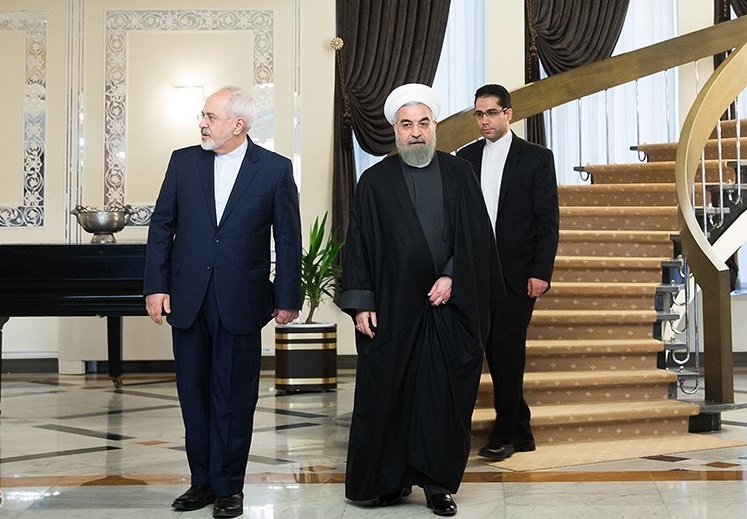
Mohammad Javad Zarif and Hassan Rouhani (Wikimedia Commons)
In his speech before the United Nations General Assembly last month, Iranian President Hassan Rouhani unveiled a new initiative for Persian Gulf peace and stability called the Hormuz Peace Endeavor (HOPE). Set against a backdrop of rising regional tensions, particularly in the wake of the September 14 attacks on Saudi oil installations—which have been attributed to Iran by several countries, including the United States, Saudi Arabia, Germany, France, and the United Kingdom—Rouhani’s peace initiative has gained traction in the international community, despite U.S. and Saudi misgivings.
Centered on the idea of peaceful cooperation among the eight littoral Gulf states—Bahrain, Iran, Iraq, Kuwait, Oman, Qatar, Saudi Arabia, and the United Arab Emirates—the initiative carries the potential to break significant ice between Iran and its Arab rivals in the region. Several foreign leaders, including German Chancellor Angela Merkel and Russian foreign minister Sergei Lavrov, have expressed interest in Rouhani’s peace initiative, with Lavrov stating that he finds it in sync, and parallel with, Russia’s recent idea for collective security in the Persian Gulf.
Rouhani left it to his foreign minister, Mohammad Javad Zarif, to elaborate on the details of the HOPE initiative. Zarif, who has been conferring with diplomats from Gulf states such as Qatar and Kuwait, and was given an opportunity to present a detailed outline of the initiative at the UN Security Council on September 27. According to Zarif, “Dialogue, Confidence-building, Freedom of navigation, Energy security, Non-aggression, and Non-intervention” form HOPE’s key components. This runs contrary to the logic of intensifying U.S. military presence in the region. Emphasizing security self-reliance instead of foreign dependence, HOPE rests on the premise that foreign (military) presence in the region is a security minus and brings only insecurity.
Of course, this is a tough sell to Gulf Cooperation Council (GCC) states that are heavily dependent on U.S. and other Western powers for underwriting their security and are also wary of Iran’s regional power, which shows no sign of diminishing despite the Trump administration’s “maximum pressure” campaign.However, here appears to be a greater willingness on the part of some GCC states to explore this new venue for cooperation and peaceful coexistence offered by Iran’s president, who has rejected the notion of dialogue with the Trump administration as long as “illegal” U.S. sanctions remain in place.
According to a Tehran political scientist who has spoken with the author on the condition of anonymity, “GCC states led by Saudi Arabia no longer harbor the false hope that the Islamic Republic would be overthrown as a result of Washington’s pressure. Iran has withstood the pressure and has applied maximum counter-pressure tactics with a great deal of success. As a result, Iran today is more respected in the region and its Arab neighbors are coming to terms with Tehran slowly but surely.”
Such hopeful expectations depend, first and foremost, on the future of Iran-Saudi diplomacy, which in turn rests to a large extent on the fate of the on-going Yemen war, notwithstanding the growing power of the Iran-backed Houthi rebels reflected in their cross-border drone/missile counter-attacks. Riyadh has now moved in the direction of a “partial cease-fire” in Yemen, which—if sustained and expanded—can definitely bode well for the improvement of Tehran-Riyadh relations.
There is room for Saudi-Iranian relations to improve even if the Saudis decide that their regional prestige dictates a military retaliation against Iran, which they maintain was responsible for the September 14 attacks—a charge vehemently denied by Rouhani. Concerning those attacks, a UN investigative team is probing the matter and its findings will be crucial in shaping the nature of proximate interactions between the Gulf’s two power houses. In the meantime, the in an interview with a U.S. television network, Saudi Crown Prince Mohammad bin Salman has emphasized diplomatic solutions with Iran, and the Iranian media has reported that the Saudis have used a Gulf intermediary to send messages to Iran. There are emerging reports that the Iraqi government is preparing to act as mediator between Tehran and Riyadh.
The future of Iran-Saudi ties also rests to some extent in U.S. hands, a fact that weighs heavy in the region’s security calculus. Washington is presently mobilizing its power to crush Iran’s economy, in light of the administration’s imposition of new sanctions on Iran’s Central Bank that are bound to further erode Iran’s ability to import food and medicine. The Trump administration is adamant on punishing Iran for resisting its will, and this has seemingly turned into a litmus test for U.S. power in the present global context. Increasingly, despite having certain shared interests with respect to issues like containing the Islamic State (IS), drug trafficking, and stabilizing Iraq and Afghanistan, the U.S. and Iran are threading the path of a zero-sum competition. Multiple diplomatic efforts to de-escalate tensions between the two countries, such as French President Macron’s initiative, have gone nowhere. A big question is, can the HOPE initiative help deescalate tensions and perhaps even contribute to an improvement in U.S.-Iran relations?
One possible answer to this may rest on Iran’s willingness to shrink back from the insistence that pan-Gulf security cooperation should come as an alternative to bilateral security arrangements between the U.S. and the various GCC states. It is the prerogative of those states to set their own security policies and a genuine Iranian offer of regional cooperation should respect the sovereign rights of its neighbors. Otherwise it will be interpreted as another sign of Iranian meddling, particularly since Iran itself is moving in the direction of increased cooperation with Russia and China in maritime security, including a planned joint naval exercise. From Iran’s perspective, this is conceived as a counter-weight to U.S. plans for a multi-national naval mission to escort tankers passing through the Strait of Hormuz. The principle of “non-interference” ought to extend to respect for the sovereign right of Gulf states to devise their own national security.
Therefore, the principal Iranian objective at this moment ought to be incremental confidence-building, dialogue, and low-security cooperation, as a prelude for more ambitious long-term cooperation. Only when the eight littoral states reach the point of high confidence in each other’s intentions—which may take a while, realistically speaking—will it be possible to imagine a genuine system of collective security, instead of the present pattern of competitive security systems and bifurcations. Inevitably, this path, involving a globalized oil hub, requires sustained dialogue with other, extra-regional, stakeholders as well and, in a word, should not be limited to the littoral states, who constitute the fulcrum of any new security architecture in the hitherto volatile region. Even a U.S.-Iran dialogue on regional security and other related matters is necessary and reminiscent of past U.S.-Iran dialogues on Iraq and/or Afghanistan.
A U.S. exit from the region, as imagined in Rouhani’s UN speech, is bound to remain a distant dream so long as Tehran and Washington are at loggerheads over regional issues. The common threat of terrorism is highly important and both sides can capitalize on the recent experience of conducting parallel operations against IS inside Iraq, which reached its crescendo in the liberation of Mosul. Amid some alarming signs of a second IS comeback, it is all the more important to prioritize counter-terrorism—a message implicit in Rouhani’s UN speech, when he reminded the audience Iran’s critical contribution to fighting ISIS in Iraq and Syria.
The real nature of the U.S.-Iran relationship is a non-zero-sum game of simultaneous competition and potential cooperation, presently buried under a one-dimensional confrontational policy wrapped in incendiary rhetoric, in light of Donald Trump’s UN speech accusing Iranian leaders of “blood lust.” Thus, an important prerequisite for even a minor breakthrough in the current U.S.-Iran stalemate is a moratorium in mutual demonization, followed by a genuine pursuit of diplomatic venues in which to tackle their outstanding differences. A whole generation of Iranians is presently suffering as a result of oppressive U.S. policies, and we are given hope for the sake of hopeless ones.
Kaveh Afrasiabi has taught at Tehran University and Boston University and is a former consultant to the UN Program on Dialogue Among Civilizations. He is the author of several books on Iran, Islam, and the Middle East, including After Khomeini: New Directions in Iran’s Foreign Policy (Westview Books, 1995) and most recently Iran Nuclear Accord and the Remaking of the Middle East (2018). He is the co-author of the forthcoming Trump and Iran: Containment to Confrontation.

Wednesday, June 12, 2019

Shinzo Abe’s Crucial Iran Visit

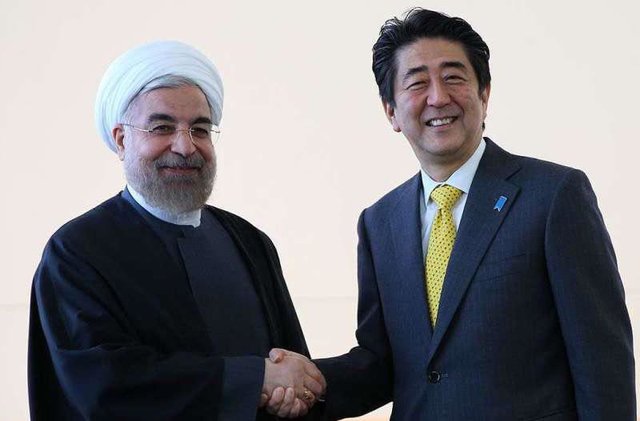
Hassan Rouhani and Shinzo Abe
by Kaveh L. Afrasiabi
Japanese Prime Minister Shinzo Abe will visit Tehran next week to mediate between the United States and Iran, taking center stage in one of the most vexing global issues today threatening international peace and security. Although this is the first official Tehran visit by a Japanese prime minister since 1978, Abe is no stranger to Iran’s leaders and, in fact, has met Iran’s President Hassan Rouhani on several occasions on the sidelines of UN gatherings in New York. Prior to President Trump’s lavish Tokyo visit last month, Abe met Iran’s Foreign Minister Javad Zarif and then openly broached the idea of going to Iran. Trump subsequently embraced this idea, pointing to Abe’s relationship with Iran’s leaders and, simultaneously, dialing back his “regime change” objective and suggesting that the United States can find a modus vivendi with the “existing leaders.”
Since then, the Trump administration has offered to engage in direct talks with Iran “without preconditions,” a move rejected by Tehran as tactical “wordplay.” At the same time, both Rouhani and Zarif have mentioned U.S. “respect” for Iran as one of the principal preconditions for U.S.-Iran talks, thus leaving the door for diplomacy ajar. Zarif’s deputy, Abbas Araghchi, who has also served as Iran’s ambassador to Japan, has welcomed Abe’s intervention as potentially easing tensions in the region.
Abe is not the only political leader seeking to act as interlocutor between Tehran and Washington. Secretary of State Mike Pompeo has been in Bellinzona, Switzerland, which represents U.S. interests in Iran, reportedly to enlist his hosts for a “limited dialogue” with Iran.  But what can Abe and others possibly achieve when the Trump administration is hammering Iran with relentless economic warfare and Iran completely distrusts the current U.S. administration, particularly after it unilaterally exited the Iran nuclear deal? After all, Iran has signaled that no direct talks with the United States is possible unless Washington reverses itself on economic sanctions, which is highly unlikely if Trump can’t point to significant Iranian concessions to U.S. demands.
Abe’s advantage is that his government, while a key U.S. ally, has nonetheless shown vital signs of independence on various Middle East issues. For example, Japan distanced itself from the U.S. recognition of Israel’s annexation of the Golan Heights and refused to follow Washington’s lead when it relocated its embassy to Jerusalem. Equally important, Japan has sided with Europe in defense of the Iran nuclear deal.
From Tehran’s vantage point, Abe’s visit, in addition to conferring legitimacy on the Iranian government, can highlight U.S. diplomatic isolation on the nuclear issue, particularly in light of the repeated International Atomic Energy Agency confirmation that Iran has faithfully observed its obligations under the Joint Comprehensive Plan of Action (JCPOA). However, Abe’s intervention in this complicated diplomatic quagmire might backfire, fueling criticism at home that he has jeopardized U.S.-Japan relations at a time of rising tensions in in the Pacific and around the Korean Peninsula. This mission offers both opportunities and risks for Abe, who may wish to play a more prominent conflict-management role beyond Iran if successful in this Iran trip. Given Japan’s heavy reliance on Middle East oil—which accounts for 80 percent of Japan’s oil imports—Tokyo has a vested interest in Persian Gulf stability, which has been rocked by the recent escalation of tensions between Iran and the United States.
On the positive side, Abe’s Iran visit may create an off-ramp alternative for the current U.S.-Iran standoff through deft and imaginative diplomacy that elicits compromises from both sides. This would bode well for Iran-Japan economic relations as well, which surged in the post-JCPOA environment with an investment treaty in 2016 before experiencing a decline due to U.S. sanctions. That investment treaty, which laid the groundwork for possible Japanese investment in Iran’s energy and non-energy sectors, could be implemented given a breakthrough in the U.S.-Iran dispute.
Yet, on the negative side, Abe’s initiative could bolster Washington’s tactic of playing the peace card without relinquishing any essential element of its coercive diplomacy. Iran’s concern is that the Trump administration might be bluffing with its recent olive branches and could use a “failed” Abe’s mission to its advantage by painting Iran, reeling under U.S. sanctions, as rigid and inflexible. For some hardline Tehran politicians and pundits, such as the editors of the conservative daily Kayhan, the United States is on the war path with Iran, similar to the run-up to the Iraq War, and wants to claim that it exhausted all the diplomatic chances of  a peaceful resolution of tensions with Iran’s theocratic rulers.
Indeed, the Trump administration has shown no sign of stepping back from its strategy of maximum pressure, which has resulted in a substantial loss of Iran’s oil export market, much of which has been picked up by Saudi Arabia, which has increased production to stabilize the oil market. Unless Abe succeeds in convincing the Trump administration to ease U.S. sanctions—for instance, by renewing the oil exemptions for countries such as Japan, South Korea, and India—Tehran will not likely take Trump’s offer of dialogue seriously. Brian Hook, the State Department’s point man on Iran, has been sending contradictory signals on the issue of oil exemptions, which suggests that the administration is unclear about its next Iran steps.
If Washington is serious about giving Abe a chance with his Iran initiative, it must not only shift from sticks to carrots but move more fundamentally away from a confrontation strategy, centered on a regime change in Iran, to one of peaceful coexistence and détente. Iran has been offering a “non-aggression pact” to Saudi Arabia and other GCC (Gulf Cooperation Council) states, which could be extended as well to the American patron state of these oil sheikhdoms. An important prerequisite for such a paradigm shift is a more nuanced U.S. policy toward Saudi Arabia, which enjoys unprecedented Washington backing for an aggressive regional policy that has alienated some of its Arab neighbors, including Qatar. A more balanced U.S. Persian Gulf policy is a sine qua non for de-confliction and a return of stability to a volatile region on the precipice of yet another calamitous war. Abe’s intervention could prove pivotal in tilting the United States toward just such a balanced relationship with the Persian Gulf states including Iran.
Kaveh Afrasiabi has taught at Tehran University and Boston University and is a former consultant to the UN Program on Dialogue Among Civilizations. He is the author of several books on Iran, Islam, and the Middle East, including After Khomeini: New Directions in Iran’s Foreign Policy (Westview Books, 1995) and most recently Iran Nuclear Accord and the Remaking of the Middle East (2018). He is the co-author of the forthcoming Trump and Iran: Containment to Confrontation.

Thursday, April 11, 2019

Letter to the American Experts

Kaveh L. Afrasiabi
Robert Einhorn and Richard Nephew are two former Obama administration officials who went on record repeatedly defending the Iran nuclear accord before Trump unilaterally dumped it, now singing a different tune in favor of a “new nuclear agreement” that would address the “flaws” and “shortcomings” of the agreement, known as the Joint Comprehensive Plan of Action (JCPOA). 

Thus, in their new report put out by the Brookings Institution, titled “Constraining Iran’s Future Nuclear Capabilities,” Einhorn and Nephew counsel the use of “sanctions as leverage” to bring Iran into line, without once bothering with the question of legality of these sanctions.  Nor do they bother with the obvious:  Even if Iran agrees to ditch the JCPOPA and negotiate a new agreement with the Trump administration, what would prevent the next US president to do the same thing as Trump did; ditch the agreement and demand a new one (and more concessions) from Iran.  This is a slippery slope that will have no end.   This is the mindset of arrogant Westerns who view negotiations as a way to bludgeon their opponent into total submission.

According to these authors, one of whom has romanticized hegemonic US sanctions as a beautiful “art,” a new nuclear agreement would “accelerate” the “JCPOA’s timelines” and extend the enrichment-related restrictions” for “at least 15 years from the time a new arrangement takes effect.  But, this begs the question of why should anyone in Iran have any listening for such “expert advises” in light of the fact that Einhorn himself once assured the Iran nuclear team, in his open letter to them during the marathon negotiations, that after a period of “around fifteen years”, the special restrictions on Iran's nuclear program during this period would be lifted and Iran would be "allowed to ramp up its enrichment capacity, including by mass producing, installing, and operating advanced centrifuges."  In my response to Einhorn’s letter back then, I wrote: “With the validity basis of Einhorn's argument deeply undermined by the inherent contradiction of its underlying illogic, Iran's nuclear negotiation team should be excused if they feel less than certain about Mr. Einhorn's assurances about the West's future respect for Iran's nuclear rights. Fact is that as long as the Western governments continue to cling to the extra-legal standards that obviate the NPT norms under the guise of "breakout concerns" there is very little prospect of their turnaround from the current pattern of coercive nuclear diplomacy vis-à-vis Iran.”

In retrospect, I dare say that history has proved me right and there is now absolutely no audience in Iran for these American experts, who want to keep themselves in currency by introducing new nuances in Trump’s illegal, and discredited, Iran policy.  Little surprise that they completely overlook the basic fact that Trump’s Iran sanctions and unlawful exit from the JCPOA represents a flagrant violation of international law, by virtue of defying the will of UN Security Council embedded in Resolution 2231, which calls on all member states to fully implement their responsibilities with respect to the JCPOA.  Einhorn’s and Nephew’s amnesia in this regard in effect makes a mockery of their pretensions as “experts,” reducing them to mere apologists of a coercive, and illegitimate, US policy toward Iran that has inflicted serious economic pain on an entire nation.  The fact that these authors try to soft paddle the US policy by suggesting vague “incentives” to Iran to come to table, compared to the more hawkish prescriptions such as a recent report put out by neocons at the Hoover Institution, matters little, particularly since Einhorn in particular has now lost credibility by reversing himself mentioned above.  

The only prudent US course of action is to make a U-turn on the JCPOA exit, re-embrace it in full and implement all the US obligations under this multilateral agreement that it has co-authored.  Einhorn and Newphew engage in a good deal of semantic acrobatics on whether or not their proposed new nuclear agreement should incorporate the JCPOA, thus excelling in the art of incoherence.  Their ‘middle of the road’ solutions will likely fall on deaf ears in both Tehran and Washington, threading divergent paths.   Trump’s Washington is sold to full demonization of Iran and is cognitively incapable of any decent “confidence-building” steps with a regime it has targeted for systematic vilification, its rupture of JCPOA triggering a long-term Iranian distrust toward US that will most likely become more entrenched as the country experiences the tumults of unjust US sanctions.   Another important point overlooked by these authors, as well as whole array of other more brazen apologists of US policy on Iran, including Bret Stephens a New York Times columnist, is that the damage to US global credibility as a result of its JCPOA misbehavior represents a significant cost that belie the narrative that Trump’s confrontational Iran policy has been “cost-free.”  This policy has caused a growing transatlantic rift with the European allies, who have rebuffed the US on Iran and have devised a new financial system to protect their trade with Iran, which has become politically stronger as a result of US bullying opposed by the vast majority of Iranians, whose patience is running thin and are increasingly turning their back on the JCPOA, increasingly viewed as a certificate of a great American betrayal.

 Fact of the matter is that Iran has faithfully implemented all its numerous obligations under the JCPOA, deserving credit, instead of being slated for more sanctions by the likes of Einhorn and Nephew, who ought to know better the importance of US sticking with its international obligations, instead of providing lame excuses that simply do not wash with anyone, particularly in Iran.  The only net effect of their report above-cited is therefore another stab at their own legitimacy, a sad yet fresh reminder of the Foucauldian knowledge/power interconnections and the servitude of American think tanks for the occupants of power in US government.

Saturday, March 09, 2019

The Elusive Quest for Pax Saudica

Kaveh L. Afrasiabi

The Elusive Quest for Pax Saudica

The advent of Trump administration has coincided with a renewed effort to impose a unipolar moment in Persian Gulf, i.e., a Pax Saudica, whereby the traditional balance of power approach would be overturned in favor of an uncontested Saudi hegemony, which is the hidden motive of Riyadh's ambitious Vision 2030 seeking to turn the country into the heartland of the Arab and Muslim world.

In this effort, the Saudis are much assisted by Trump, who has given a carte blanche to the Saudi rulers in the region while beefing them up militarily, turning a blind eye to their repressive mischiefs, and applying "maximum pressure" on Iran, the other regional pillar. Trump's confrontational Iran policy is not a recipe for war with Iran, nor an extension of the traditional containment strategy, rather it is calculated as a war of attrition to weaken Iran economically and (geo) strategically while simultaneously assisting the Saudis to improve their economy and military and security prowess to the point that a precious few years from now an economically-squeezed Iran would be "shrunk to size" and ultimately submit to the Saudi hegemony.

From the White House's vantage, this approach is working: Iran has been hit with a tsunami of capital flight, sanctions, and the related pain of a depressed economy that has turned recessionary after a couple of years of rapid post-JCPOA bloom. On a parallel track, the Trump administration is seeking to build a Saudi-led military bloc in part through the so-called "Arab NATO," which is not really germane to a Pax Saudica as it would involve out of area countries such as Egypt that harbor their own Arab ambitions. Thus, although this idea may not pan out, the gist of it in terms of expanding the wings of Saudi security domination will likely persist under one veneer or another.

For Riyadh, on the other hand, concrete progress toward their hegemonic ambitions has been made, which must be viewed in a comparative logic, e.g., whereas the Saudi and the entire GCC (Gulf Cooperation Council) economic forecast for 2019 is robust, Iran's economy this year is expected to have a negative growth rate, which may extend to next year or so if the pinching sanctions bite deeper, particularly after April when the renewal of the present US sanctions waivers is due, which may or may not happen. As a result, Iran is grappling with an alarmingly growing unemployment and inflation rate, budget shortfalls, etc., inevitably tapping into the national reserve and future generation fund, with little prospect of any major relief from Europe, this while even the Chinese and Russian companies and banks have begun to shy away from the Iran market due to the US's "secondary sanctions."

Needless to say, this is a worrisome trend from the prism of Iran's national (security) interests that may become even more vexing if the regional security environment deteriorates and tensions between Iran and other powers escalate, which could add to Iran's economic woes. Saudi Arabia is nowadays accused by Iran's authorities of bankrolling the terrorists operating from their Pakistan sanctuary, and the closer ties between Riyadh and Islamabad, reflected in the recent visit of Saudi Crown Prince only a few days after a deadly terrorist attack inside Iran, is yet another piece of the Pax Saudica puzzle carefully being orchestrated in several capitals. New revelations regarding the Trump administration's nuclear know-how transfer to Saudi Arabia irrespective of the US's own regulations is also key in this impending scenario, raising the specter of Saudi nuclearization at a time when Iran, under the terms of the JCPOA, has agreed to key nuclear self-limitations. In a worst case scenario, Iran and the rest of the Shia world would face not one but two Sunni nuclear-armed states, potentially threatening the world's Shia minority.

But, of course one does not need to succumb to paranoia and overlook the significant hurdles facing the Saudis and their American protectorate power in sowing the seeds of a Pax Americana. For one thing, there is a lack of fit between the economic and military indexes of power in the region and Iran has certain advantages in the latter category that will not be easily compromised, just as Iran's solidarity network in the region is also a formidable force that must be taken into account in any power comparison. Still, an important question is: how will Iran's current economic downturn, hit by sanctions, impact its military power and can the latter insulate itself from the dwindling budget allocated to military expenditure and if so, for how long? There is after all an organic connection in the long run between economic well-being and military capability that feeds on the economic resources of the nation. A realist interpretation of the regional trend in the realm of comparative military expenditures indeed leaves little doubt that by being outspent 7 to 1 (on a conservative estimate) does not bode well for Iran, particularly when there is a widening economic gulf between the traditional "twin pillars" favoring Iran's nemesis.

This aside, another challenge facing a Pax Saudica is, of course, the presently fractious GCC politics, which must be overcome in the Saudi favor for this goal to be materialized. That would mean an end to the present Saudi-Qatar tension, actively sought by the Trump administration after an initial nod to the Saudi-UAE-Bahrain blockade, which resulted in Qatar moving closer to Iran and Turkey. How this issue will be negotiated in the near future is relevant to the Saudi hegemonic ambition, which requires flexibility and compromise and not just an iron fist, which has proved less than effective in the Yemen quagmire. If the Saudis with Western assistance manage to get themselves out of this quagmire and bring Qatar back to their fold, then two important hurdles will have been removed. On both these however there is much work to be done and the likelihood of success is uncertain.

The above-said points should not be misconstrued as a negative appraisal of Iran's policies or actions, but rather to assess the regional situation objectively and then to consider the various options and counterstrategies at Iran's disposal -- that would neutralize the prospect of a Pax Saudica to the detriment of Iran (as well as Shia Iraq). One counterstrategy is to utilize Iran's hard power leverages as circuit-breakers even to the point of brinksmanship since the American strategy is to diminish Iran's power without incurring any costs. Another antidote would be to set aside Iran's traditional aversions toward entering into military alliances and forge a better military strategy that would substantially increase the strategic support received by Iran from other powers. A third option is to mirror the Saudi hegemonic effort by enhanced power projections that go beyond the familiar discourse on "strategic depth," which is essentially a defensive concept. A main criticism of Iran's security approach is that it is too defensive in orientation and not adequately preemptive, prone to incrementalism instead of being cemented in a longitudinal strategic power perspective. Such important adjustments are necessary to bolster Iran's position in the region, to counter the American pressures and with it the expansionist and hegemonic aims of Saudi rulers, who sense a historic opportunity through the Trump administration to knock Iran out of the contest for regional primacy; the latter, reflected in Iran's 20-Year Strategic Outlook, has received a major setback by the combination of US sanctions and the anti-Iran axis of US-Saudi Arabia-Israel, but which must be re-introduced in a more elaborate and project-specific manner analogous to the Saudi Vision 2030 if Iran is to have any chance of impeding Riyadh's hegemony.

Wednesday, February 06, 2019

The Myth of US War on Iran

Kaveh L. Afrasiabi
The Myth of US War on Iran
As Iran's Islamic Revolution turns forty, there is a great deal of media noise in the West regarding the likelihood of a US war with Iran. The assumption that the Trump administration populated by Iran hawks such as National Security Adviser John Bolton are plotting their way toward an open clash with Iran has been around since Trump took office 2 years ago and turned the previous Iran policy on its head by moving away from Obama's thaw to one of pure aggression led by a naked economic war. More recently, a New York Times disclosure that Bolton had requested from the military planners a plan for military strikes against Iran has obviously further fueled the concern that US has war aims on Iran that may put into practice sooner or later.

One of the principal reasons for this concern is the recent escalation of tensions between Iran and Israel, which has given further credibility to the coming war assumption, the argument being that Israel and its supporters in Washington are pushing the White House toward war with their chief Middle East rival accused of acting "hegemonically." Similar concerns about Saudi Arabia, which also accuses Iran of being "expansionist" and out to dominate the region, exist and, so the argument goes, there is a synergy of views between Riyadh and Tel Aviv acting as catalysts for the war scenario. But, should there be a US-Iran war, the dominant Western narrative would likely be along the lines of good versus bad, portraying Iran as the 'bad guy' wreaking havoc on the region and "exporting chaos," to paraphrase President Trump. Reminiscent of the 2003 Iraq war, a good deal of war propaganda as well as 'psychological warfare' goes along with any war scenario, making it difficult to distinguish facts from fabrications.

But, a key problem with the US war scenario is the underestimation of problems and challenges confronting the US military planners that, in turn, act as roadblocks and or disincentives against war. These planners are well aware of Iran's military capabilities that are in many respects quite formidable and capable of inflicting serious damages to US assets in the region, as well as to the assets of US allies. Any US attack on Iran risks engulfing the Persian Gulf, resulting in skyrocketing oil prices and triggering a global recession. It would also put at risk the oil installations of America's allies, e.g., Saudi Arabia, that are easily within the reach of Iran's precision-guided missiles. Iran has also threatened to close the Strait of Hormuz as well as other waterways in the region, which would mean that the US navy would have to shoulder the responsibility to keep them open for an indefinite period, representing a major costly chore.

Not only that, it is a safe bet that Iran's Hezbollah allies will rain down their missiles against Israeli targets as soon as US commences an attack on Iran, thus extending the theater of conflict. Armed with tens of thousands of missiles, Hezbollah’s strike capability plays an important role in Iran's deterrence and, therefore, any notion that a US-Iran war will be limited between the two countries is a naïve myth that needs to be debunked. Similarly, Iran can count on the solidarity of Shia popular mobilization groups in Iraq to strike back at the US assets inside Iraq, given Iran's critical contribution to Iraq's anti-ISIS campaign, and this too represents an important area of US vulnerability, just as its other forces in Iran's vicinity, such as in Afghanistan, could also be targeted.

Iran's asymmetrical warfare capabilities have been studied by Western think tanks for some time, and these by and large admit that although US superpower has a preponderance of power, it is liable to lose a number of warships in Persian Gulf in the event of a new US-Iran showdown. Compared to the previous showdown, when US destroyed a bulk of Iran's navy, Iran is not bogged down in a war with another enemy, has drawn the right lessons from that episode, and has considerable advantage over US in a number of crucial areas, such as superiority in ground troops, access to terrain, war morale, etc., while the US is overstretched as a result of its force deployments in other parts of the world and "war-fatigued." 

Of course, an important impediment to a US war on Iran has to do with just cause. US has no just cause against Iran, has acted like a rogue state by pulling out of the nuclear deal and defying the UN Security Council resolution 2231, and whatever its lame excuses for initiating a war against Iran would be a hard sell in the international community. The absence of a credible justification for war is, indeed, a principal reason against the war scenario. Thus, despite the occasional White House saber-rattling against Iran, Trump and his Iran hawk advisers ought to know the substantial risks to US national security interests if they embark on a reckless confrontation with Iran, which can easily turn into a regional conflagration.

Tuesday, August 21, 2018

Trump's Iran offensive: Regime change by other names

By Kaveh L. Afrasiabi*


Tehran, Aug 18, IRNA - US Secretary of State Mike Pompeo has now announced the creation of a new Iran 'action group' aimed at coordinating and advancing US's grand strategy against the Islamic Republic of Iran.

Trump's Iran offensive: Regime change by other names

Insisting that the purpose of US sanctions against Iran is to cause a 'change in the behavior' of Iranian government, Pompeo has tried to shield the administration from the criticism that it is seeking an unlawful 'regime change' in Iran in violation of UN Charter and international norms.

Pompeo's earlier 12-point demands from Iran, announced immediately after Trump's May exit from the Iran nuclear deal, conveys a similar impression and, subsequently, Pompeo has defended his maximalist demands from Iran, which lack any legal basis whatsoever and simply represent an arbitrary wish list on the part of US, as quite 'ordinary' when, in fact, there is nothing ordinary about a government leveling extra-legal and arbitrary demands from another government while holding the fingers on the trigger of unilateral and unlawful sanctions, reflecting the poison pills of American foreign policy.

Of course, the ruse of 'regime change' approach under the more marketable veneer of modifying Iran's 'behavior' falls by the way side when considering (a) the naked economic aggression aimed at 'crushing' Iran's economy in Pompeo's own words, (b) the US's total disregard for international norms and the UN Security Council's decision on the nuclear deal incumbent on all member states including the US, and (c) the concurrent blistering public attacks on Tehran in the strongest language, reflecting Iranophobia ran amok. Both Pompeo, and his even more hawkish co-conspirator John Bolton, aptly denounced by North Koreans who have refused to negotiate with him, are indeed strong 'regime change' advocates and, yet, refuse to acknowledge the actual US policy against Iran, among other reasons, because they are fully aware of the likely futility of their strategy against an adversary that has successfully resisted the American pressure for nearly 40 years.

This aside, to deconstruct the White House's hostile narrative on Iran, suffice to say that US is a poor candidate to act as the guardian of 'normal behavior,' in light of its own exceptional and highly dreadful history of interventionism and militarism abroad and callous disregard for international norms and principles, vividly demonstrated in its recent gambits in the Middle East, its misbehavior against a whole slew of nations such as Cuba and Nicaragua and Venezuela that hark back to the 19th century Monroe Doctrine and its license to invade under the guise of manifest destiny. Now it turns out that US's new manifest destiny is to 'normalize' its perceived adversaries by the illegitimate hammer of sanctions and threats, this while its own allies such as Saudi Arabia go unpunished while abusing human rights at home and violating the sovereignty of their neighbors and, worse, committing horrific atrocities in Yemen while aiding and arming radical salafi groups in Syria and elsewhere in the region.

Little wonder, then, that the US foreign policy is in serious trouble, with hardly any evidence of success on any front, in light of the trade wars with China and Europe, sanctions and open verbal warfare with NATO ally Turkey, and its present attempt at cajoling the rest of the world behind the 'sanctions regime' on Iran twisting the arms of allies and friends, such as India, whose brave foreign minister has openly questioned the legitimacy of US unilateral sanctions on Iran. Faced with a united front of other JCPOA signatories in defense of the nuclear deal, Pompeo faces the tall challenge of selling his illegitimate Iran policy to the rest of the world, that is still reeling by the impacts of US's 'pre-textual war' on Iraq costing trillions of dollars and heightening international terrorism. Instead of focusing on the real threat to stability, as witnessed in Afghanistan and the resurgence of ISIS terrorists in parts of Iraq today, Pompeo has singled out Iran by resorting to a systematic misrepresentation of Iran's regional behavior, which is in fact openly praised by Iran's neighbors particularly in the Caspian basin and Central Asia. Fact is that Iran has had a constructive role in regional stability and is the target of Saudi and Israeli politics of scapegoat aimed at deflecting attentions to their outrageous misbehavior decried in the international community except in the US.

Indeed, Mr. Pompeo ought to take a serious look at himself in the mirror and stop turning a blind eye to the abnormal and rogue behavior US's allies in the region that must be condemned by any stretch of rule-based imagination. With allies like these flouting international norms on a daily basis, US which is complicit in the Yemen atrocities, has no moral standing, let alone legal, to preach Iran how to behave in its own region. But, of course, the 'regime change' policy is poorly camouflaged as a more modest 'regime behavior change' is destined to fail both by virtue of its sheer illegality and the weight of history operating against Iran and exposing its true unsavory nature.

*Kaveh L. Afrasiabi is political scientist specializing in Iran’s foreign affairs. He has co-authored Iran Nuclear Accord and the Remaking of the Middle East (2018)