Showing posts with label Travel Risk Map. Show all posts

Tuesday, October 22, 2019

Iran is a hugely ‘friendly’ country despite propagandas, New Zealander professor says

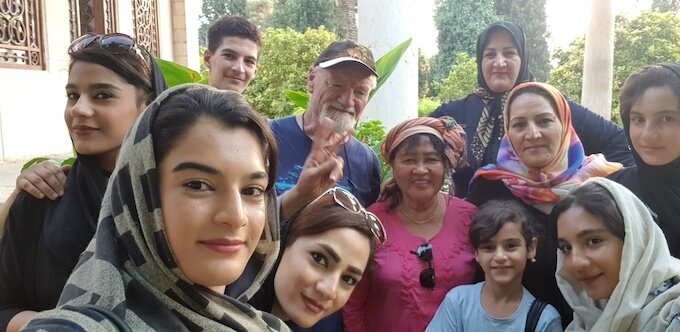
TEHRAN - David Robie, a New Zealander author, journalist, media educator and retired university professor believes that Iran is a hugely friendly country despite propagandas by Western media.
Robie has spent several weeks traveling in the country on sabbatical and finds that the media negativity far from the reality of the “most friendly” country he has ever visited.
“Iran attracts an onslaught of negative media in New Zealand and Western media. But is it fair or deserved?” the senior journalist wrote in an article released by Asia Pacific Report on Friday.
“Given the rising geopolitical tensions, as I was about to visit the country for several weeks as a visitor on sabbatical, I was keen to see the realities on the ground in Iran behind the sabre-rattling.”
“The headlines were chilling as we flew into Turkey and then Iran. ‘All out war’, trumpeted The New Zealand Herald, as being an imminent response to last month’s surprise drone attack knocking out almost 50 percent of Saudi Arabia’s oil production, blaming the attack on the Islamic Republic without convincing evidence,” he explained.
“The next day the Herald belatedly ran the other side of the story, quoting Iranian President Hassan Rouhani’s response denying the allegations and warning that Iran would defend itself in the case of a U.S.-Saudi attack while offering the ‘hand of friendship and brotherhood’ for overseeing security in the Persian Gulf.”
During the journey Robie held talks with some Iranian academics, including Professor Reza Ebrahimzadeh of the Islamic Azad University at Isfahan, who argues that foreign news organizations need to do a far better job in providing “context and history” about Iran to promote global understanding.
Robie, who covered the Asia-Pacific region for international media for more than two decades and was an associate professor in Auckland University of Technology School of Communication Studies in 2005 and a professor in 2011, concludes that “more journalists from New Zealand need to go to Iran to see for themselves.”
Where does the wrong perception come from?
Many visitors to Iran believe that certain Western media often portray Iran negatively, saying there is a widespread misunderstanding about the true nature and safety of the country, which is tainted by the reputation of some of its more politically unstable neighbors.
In this regard, Skift Inc., a New York City headquartered media company that provides news, research, and marketing services for the travel industry, in a July article noticed a hint of a “perception problem” deemed to be fueled by the Trump administration’s rhetoric toward Iran.
Official answers to the query comes from the U.S. State Department, which has had a travel advisory against Iran since 1979, citing “the risk of kidnapping, arrest and detention of U.S. citizens.”
 “It is a country that is often portrayed as unwelcoming, but the reality is quite the opposite,” said Jenny Gray, the global product and operations manager of the Australia-based Intrepid Travel.
“Iranians are warm, friendly and eager to show off their country to foreigners. The feedback from our travelers is a testament to this.”
The 2019 Travel Risk Map, which shows the risk level around the world, puts Iran among countries with “insignificant risk”, a category where the UK, Denmark, Switzerland, Norway, and Finland are placed in.

Tuesday, October 15, 2019

Spark your wanderlust: how influencers can help?

By Afshin Majlesi

In the current fast-paced realm of advertising and marketing, travel influencers have changed the whole game as they have succeeded to materialize a totally new and self-directed channels to reach audiences in a more authentic and personal way, even influencing to shape their wanderlusts.
We can say that the Instagram has backtracked old-school manners of travel advertising campaigns. Well-traveled influencers induce their avid followers to win sparking their wanderlusts by the means of the photo-sharing platform that enables sharing of wonderful moments and wandering adventures of their journeys.
Many believe that the Instagram has drastically changed the way people, especially the youth, travel, and it’s undoubtedly not all for the better. The trend, however, has its own harms, for instance, it may lead to overtourism, a relativity new term that you may cannot look it up in many dictionaries.
That’s why Iran’s tourism ministry has started to make the best use of new technologies in order to portray a true image of the country based on what travelers and influencers perceive during their visits to the country.
But, how does it work for Iran? It’s noteworthy to remind that Iran has been under U.S. sanctions and its anti-Iran propaganda for around four decades. Some Western media outlets have long tried to portray Iran’s global image as unsafe, unwelcoming and so on.
As an example, some of their messages carry themes from U.S. State Department’s travel advisory against Iran, which since 1979, warns about “the risk of kidnapping, arrest and detention of U.S. citizens.”
On the contrary, when you refer to people who have visited the country or even you read their travelogues on Iran, you usually perceive that Iranians are described as warm, friendly and eager to show off their country to foreigners. Moreover, almost all international tour operators and travel agents have the same attitude towards the country and its people.
The 2019 Travel Risk Map, which shows the risk level around the world, puts Iran among countries with “insignificant risk”, a category where the UK, Denmark, Switzerland, Norway, and Finland are placed in.
Tourism minister Ali-Asghar Mounesan said on Thursday that the ministry supports certain the Instagram influencers to travel to the country.
“Instagram influencers’ trips to Iran are backed by the Ministry of Cultural Heritage, Tourism and Handicrafts and, in the advertising arena, we do a lot of work to fight Iranophobia and introduce the true face of Iran,” Mounesan said.
“One of the areas [in travel & tourism advertising] is to bring famous figures to Iran, get the country known to them in terms of its rich culture, beautiful natural landscapes and historical monuments…this is part of programs to introduce the country that we will definitely continue.”
With over one billion active monthly users, it seems reasonable that the Instagram has enough power to set new trends on traveling to a country that boasts hospitable people and some of the world’s oldest cultural monuments such as bazaars, museums, mosques, bridges, bathhouses, madrasas, gardens, rich natural, rural landscapes and 22 UNESCO World Heritage sites to name a few.