Showing posts with label Trump. Show all posts

Monday, October 14, 2019

Can Trump’s ‘Middle Lane Nationalism’ Hold the Line Against System-Network Attack Strategy?

Alastair CROOKE

“Trump has blown the lid off. This is not going to go away. There is going to be a Nationalist alternative to [American] foreign policy; I don’t think you can just put it back in a box.” Professor Colin Dueck who has written a book on US foreign policy suggests: “The neoconservative and noninterventionist wings of the Republican party have long sought to take ownership of — and thence to shape — Trump’s unpredictable foreign policy. But the president simply has refused to fit into either mould:”
“He found a kind of the middle position, and that turned out to be the single most popular position in the Republican primary,” says Dueck: “I don’t think there was an established school of thought. He has certainly created a new position that did not exist before.” Dueck calls it middle lane nationalism.
He created space for these ostensibly competing Republican instincts. Another commentator suggests that this “instinctive and shoot-from-the-hip foreign policy style, may become the ‘new normal’ in what security experts say is an increasingly unsettled global threat environment.”
The point here, is that whilst this ‘give’ a little to one side of the policy debate, and then to offer a titbit to the other, may well serve the domestic US audience, it does not do anything to acknowledge global change. US defence policy hardly has evolved over the years – and despite rhetorical re-packaging, it still remains rooted in old-style, ‘big power-big military’, full-on, clashes. This is where the money is, of course, for the military-industrial complex. Similarly, US weaponry has failed to keep up. Again, the ‘big ticket’ items are where the money is. (‘show sales’ to gullible foreign states, rather than re-tool for a new, small-is-better, era).
So the question is, ‘can Trump’s instinctive, creative ambiguity’ hold the line of US ‘credibility’ (which exists more in the eye of the domestic beholder, than for the foreign one)? Can his idiosyncratic policy continue to survive the sealed retort of the US foreign policy machine — a zeitgeist stuck fast – when others’ surely have (i.e. the Russian deck of new weaponry, that has rendered obsolete traditional navies)?
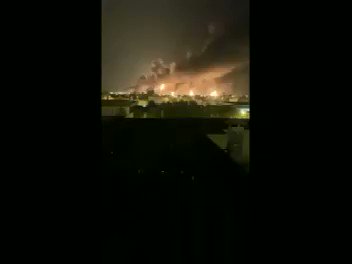
We have been given examples of other evolutions (and startling innovation), amongst America’s challengers in recent weeks. In fact, we can see an ‘alternative’ conflict paradigm taking shape: Firstly, with the 15 September strikes on two Saudi Crude processing plants, of crucial importance to the overall infrastructure of Saudi Arabia’s oil infrastructure. And secondly, by the extraordinary rout of three brigades of the Saudi armed forces (some of them from the élite National Guard) – by AnsarAllah (composed of Houthi, and loyalist Yemeni army elements).
Both actions were well planned, well researched, well executed and sophisticated. Together, they shattered any credibility lingering around the notion of Saudi having any military stature; they imploded the image of America’s ‘security umbrella’; and overturned US and Israeli smug assumptions about ‘rag-tag’ forces in the Region. They all must analyse afresh (after eating humble pie).
The delivery of precise strikes – a mix of drones and cruise missiles – on the Aramco facilities, guarded by an American-supplied air defence system, represents a novel, effective (and wholly inexpensive) attack strategy. How come, for starters, the Saudi missile defences did not work? Did the drones manage to blind the targeting radar; or was some form of electronic warfare (EW) deployed? Is the regional EW better than America’s now?
We are dealing here – it seems – with the Houthis using a new attack paradigm, a new mode of warfare: Some of these latter elements (attacks on oil infrastructure and tankers), seem remarkably consistent with concepts first identified by Russian military theorists Igor Popov and Musa Khamsatov in 2016, as a ‘system-network warfare’, (sistemno-setevaya voyna) in their book: The Future of War.
In this system-network notion, “the entire State and its society should be viewed as a system consisting of critical ‘nodes’, whose destruction would profoundly affect the defense potential [of the whole system], and therefore is likely to lead to a victory with relatively limited commitment from challengers. There would be no need to fight against all military forces of the adversary, nor [to fight against] the whole population. It would be enough just to destroy the ‘centers of gravity’.
Accordingly, the main drivers in such a war, would be what the authors call an “amorphous adversary,” whose “key structural elements and subsistence systems are located, not on one’s own territory; but rather, in the states of ‘near and far-abroad’: Territories or entities that formally are not party to the conflict […] This makes it very hard to point a finger at the real culprit.” That is to say, it provides plausible deniability – and spreads confusion and unease.
This seems to fit the model now being deployed jointly by the Houthis, Iran, the Hash’d al-Shaabi and Hisbullah. It is a model that can be deployed widely, and in differing contexts. But in the context of the Gulf, it signals that any large civilian infrastructure object, including energy, water and transport infrastructure can no longer be regarded as completely safe to Houthi retribution. The Gulf energy-risk calculus needs to be re-visited.
The point about paradigm change is well underlined in a unique interview given by Maj. General Qassem Soleimani, the Commander of the Quds Brigade. He outlines the ‘before’ situation (in the wake of 9/11). Massive US forces were deployed across the Middle East, and in Afghanistan. It was a daunting presence to its inhabitants; and it was clearly intended as the precursor to Condi Rice’s promise of coming painful ‘birth pangs to a New Middle East’. The West then, was cohesive and single-minded.
As Soleimani describes it, these widespread occupations served to give the US and Israel the latitude to contemplate an attack on Hizbullah, sufficient to force the displacement of the Shia population of Lebanon out of the South and into distant refugee camps – far from the Israeli border. (The 2006 war failed to achieve this aim). The psychological impact of this US dispersion, plus Israel’s 2006 precision bombing of Shia areas however, had its effect, Soleimani suggests. For the first time, Arab States sided with a foreign power against a significant Arab constituency (Hizbullah).
Compare that, with the situation with now (a comparison not offered by Soleimani): America’s wars were not successful – Hizbullah, Syria and Iraq all survived the onslaught. And are linked to the Iranian camp. The psychological climate has inverted: The US presence – then intimidating, now smacks of deep western cultural division, and policy uncertainty.
The US President now wants out of this troubled region. And instead, seeks to engage with his Iranian counterpart. Saudi Arabia, the former leader of the Iran-containment bloc, is being pressured by the White House to reach out to the Houthis and Iran. The other Gulf States have already made that switch, having assimilated the reality that the American ‘security umbrella’ offers no protection against system-network strategies.
What now? There are no easy answers to the military challenges posed to the US in the Middle East by amorphous opponents – other than the wearily standard, US military deterrent punishments that might plunge us into region-wide war. The next period may be crucial. The Houthis on the one hand, and Iran on the other, are likely to incrementally escalate counter-pressures – unless, that is, sanctions on Iran are lifted, and a settlement is reached in Yemen.
Really – Saudi has no option but to end its war on Yemen. It needs to monetise is its oil reserves (to fund Vision 2030) – and faced with the choice of monetising a whack of Aramco; or pursuing conflict with Iran, the outcome should be a ‘no brainer’. MbS already has begun to reach out to the Houthis and Iran; but can MbS survive the blow to his fading prestige, of capitulation to the Houthis? It is doubtful.
Trump probably will try to hold the line again, if there are yet further instances of ambiguously-sourced ‘system-network’ actions in the region? But, can he continue to hold out, as Iran periodically continues to ‘de-comply’ with the JCPOA? Trump has already been harshly criticised for eroding US ‘credibility’ through having not responded militarily to Iran (fingered by some in Washington as the source for the Aramco strikes). The pressures will be intense on a President entering the pre-election period.
And following the failure of Macron’s UNGA attempted mediation, it is unlikely that any mooted offers by the US President to ‘lift Iran sanctions’ will be viewed as being credible – with Congress locked into impeachment proceedings. The Democrats, who control US sanction legislation, will lend Trump no helping hand, on this, or any other issue, for time being.
In practice, Trump too, has few options: With Wall Street now having premonitions of US economic recession, Trump desperately needs an Art of the Deal success, (absent a buoyant US economy to claim as his own) – and certainly needs no Middle Eastern blunder (President Carter-style), to tarnish his Presidential candidature.
Yet, reason doesn’t always prevail. And, with Iran declining to meet him (absent the lifting of sanctions), Trump’s present path of hoping MbS or Imran Khan can network a meeting for him with Rouhani – does seem quite a stretch. And American neo-cons, as always, will be on the lookout for the opportunities that an impeachment-distracted President might offer, to seize control of policy.

Kurdish Fighters Always Feared Trump Would Be a Treacherous Ally

Patrick COCKBURN
In a field beside a disused railway station on the plain just south of the Syrian-Turkish frontier, a brigade of Syrian Kurdish soldiers were retraining in order to resist an invasion by the Turkish army. “We acted like a regular army when we were fighting Daesh [Isis],” Rojvan, a veteran Kurdish commander of the YPG (People’s Protection Units), told me. “But now it is we who may be under Turkish air attack and we will have to behave more like guerrillas.”
Rojvan and his men had just returned from fighting Isis for 45 days in their last strongholds in eastern Syria. I had met him first in a cemetery in the Kurdish capital Qamishli where he was burying one of his men who had been killed by an Isis rocket when driving a bulldozer to build field fortifications in the middle of a battle.
But now he and his men were learning new tactics to combat the Turkish military units that were beginning to mass on the Turkish side of the border.
Rojvan was a very experienced soldier and not given to false optimism, saying: “We are mainly armed with light weapons like the Kalashnikov and the RPG [rocket propelled grenade] launcher and light machine guns, but we will be resisting tanks and aircraft.”
Rojvan was speaking 18 months ago after the Turkish army and its Syrian Arab allies had invaded the Syrian Kurdish enclave of Afrin, forced most of its inhabitants to flee, and was preparing to replace them with Arab settlers.
What happened then may have been a preview of what we are about to see repeated on a much wider scale in northeast Syria after President Trump’s incoherent announcement that the US would not stand in the way of a Turkish invasion.
He has rowed back a little on this in the face of a deluge of criticism, but his basic message – that the US wants out, and does not object to the Turks coming in – has developed its own momentum and will be difficult to stop at this stage.
We are already on the downslope leading to the ethnic cleansing of up to 2 million Kurds in the vast triangle of land which the Kurds call Rojava in northeast Syria. Much of the Kurdish population lives in cities and towns like Qamishli, Kobani and Tal Abyad just south of the Syrian-Turkish frontier. They are unlikely to wait to see what a Turkish occupation, backed by bands of Syrian Arab paramilitaries with links to al-Qaeda type groups, is like.
Trump’s support for America’s Kurdish allies was always rickety, but the brazenness of the final betrayal is still breathtaking. All the credit for defeating Isis is given to US forces under Trump’s wise leadership, while in reality the US role was almost entirely confined to airstrikes and artillery fire.
Speaking of the Kurdish role as the military core of the Syrian Democratic Forces (SDF) in the crucial battle for the Isis capital Raqqa, Brett McGurk, the former presidential envoy to the anti-Isis coalition, says on Twitter: “The SDF suffered thousands of casualties in the Raqqa battle. Not a single American life was lost.” Overall, 11,000 Syrian Kurds were killed fighting Isis over the last five years.
McGurk denies that the Kurds ever received lavish supplies of military hardware from the US: “The weapons provided were meagre and just enough for the battle against Isis. (The SDF cleared IEDs by purchasing flocks of sheep.)”
Since 2015 I have been visiting Rojava watching the YPG soldiers advance west and south and always wondering what would happen when Isis was defeated and the US did not need them anymore. The Kurds, who are no political neophytes, wondered the same thing, but there was little they could do to change the direction of events, except hope that the US would not entirely let them down.
It seems that, in the event, their most pessimistic assumptions are being fulfilled, though – such is the nature of the Trump White House – the extent of American betrayal is unclear.
The most important feature by far of the US military presence in Syria is airpower and not the small number of troops on the ground. Will the US maintain an air umbrella over Rojava and, if so, does this mean that the Turks will not be able to deploy their air force against the YPG? If this is indeed the case, it would give the 25,000 battle-hardened YPG troops more of a military option, though, even so, their chances of long-term success are limited.
It is unclear how far the Turks will advance: their attack could at first be in a limited area between the towns of Tal-Abyad and Ras al-Ayn. But the White House statement spoke of Turkey taking responsibility for Isis prisoners, most of whom are in a camp at al-Hol that is deep inside Rojava, close to the Iraqi border. Taking over this would mean the Turks seizing much of northeast Syria.
Do the Kurds have any political options? The only obvious one – supposing the Kurdish alliance with the US to be a broken reed – is to look to President Bashar al-Assad and to Russia. The Kurds do not like the Syrian government, which persecuted and marginalised them for years before 2011, but they do prefer them to Turkish control and probable expulsion.
The problem here is that the Kurds may have left it too late. So long as they were allied to the US, they could not seriously negotiate with Damascus. Now they appear to have the worst of all possible worlds: neither Washington nor Moscow nor Damascus is going to protect them.
But the options were never quite as simple as that: the Syrian army has never been strong enough to fight Turkey. Presidents Putin and Assad do not want a Turkish invasion but they will also be glad to see the back of the American forces.
The de facto Kurdish state of Rojava could swiftly disintegrate under the impact of a Turkish incursion. A scramble for its territory is already beginning: Syrian and Turkish army units are reportedly racing each other to take over the Arab city of Manbij just west of the Euphrates that has been under effective Kurdish control. A new chaotic phase in the Syrian war is beginning.

Trump’s Syria Withdrawal? Relax, It’s Another PR Gimmick

Finian CUNNINGHAM


For a change, President Trump managed to unite the US Congress this week – in provoking broad condemnation of his surprise announcement to withdraw American troops from northeast Syria.
All the more so because his ad hoc deal with Turkish President Recep Tayyip Erdogan has quickly spun out of control, launching a Turk offensive against Kurds in northeast Syria.
Turkey labels Kurdish militants “terrorists”, while the US has allied with them, having used them as proxies ostensibly to fight jihadist terror groups. (The US has also covertly sponsored the jihadist terror gangs, such as Islamic State, or ISIS, indicating that the real role of the Kurds for the Americans was to annex parts of Syria.)
Trump was assailed by Democrats and Republicans for his “betrayal” of the Kurds and for “destabilizing the Middle East”. Even political allies like Senate Republican leader Mitch McConnell and hawkish advisers Lindsey Graham and Marco Rubio joined the fray to lambast Trump over his apparent policy shift.
Hold on a moment. The reaction is no doubt hyperventilating over-reaction, which gives Trump way too much credit in making a “strategic decision”.
Closer to the truth is that this president, in typical loose-cannon fashion, simply stumbled into what appears to be a major policy shift, when in reality what he was after was a cheap PR boost for re-election next year.
After all, we are in American presidential campaign mode. That’s why the Democrats are gunning for impeachment based on flimsy “evidence” of Trump’s alleged collusion with Ukraine against Democrat rival Joe Biden.
For his part, Trump is, of course, seeking a bit of glory with voters, and that most likely explains his announcement last weekend ordering US troops to withdraw from northeast Syria. That followed a phone call with Turkey’s Erdogan on Sunday in which Trump apparently acceded to demands to give Turkey a free hand to make an incursion in northeast Syria to push back Kurdish fighters.
Erdogan appeared to assure Trump that Turk forces would take responsibility for running prisons holding thousands of ISIS terrorists. That’s implausible given Turkey’s past covert liaison with these jihadists, but to Trump’s ear that probably sounded a great idea to save America money.
Everything about how Trump made the announcement indicates that his main purpose was to win votes, without a care for repercussions in Syria. It was classic Trump making up policy on the hoof and without any fore-planning. It was all about him looking victorious and “bringing our troops home”. He mentioned how he was elected to bring an end to “ridiculous, endless wars”, and now that’s what he was purportedly doing with his latest initiative in northeast Syria.
It’s obvious that Trump hadn’t even thought through the ramifications. His only goal was to give himself a big pat on the back for “defeating ISIS 100 per cent”, and handing over security matters to Turkey, in order to get American troops home (as promised three years ago!) and to save US taxpayers loads of money. It was transactional Trump choosing the path of least costs.
To fend off criticism about betraying the Kurds, he inanely said later in the week that the Kurds were not important allies with the US anyway, since they hadn’t helped “us in the Normandy Landings during World War Two”.
After the Sunday phone call with Erdogan, the White House issued a statement Monday, saying: “Turkey will soon be moving forward with its long-planned operation into northern Syria. The United States armed forces will not support or be involved in the operation, and the United States forces, having defeated the ISIS territorial ‘caliphate’, will no longer be in the immediate area.”
That statement contradicts claims made later by both Trump and Mike Pompeo, the US Secretary of State, saying the US hadn’t given Turkey a green light to go on an offensive.
Trump probably had cluelessly forgotten, or overlooked, that the Turks would see the US pullout as a “green light” to make an incursion into Syria to hit the Kurds. He thought his deal with Erdogan was about sub-contracting out security to Turkey and save America money.
Because, when the torrent of condemnation from US lawmakers erupted over the next few hours, Trump was forced into a making a spectacular U-turn. Amid vilification for betraying the Kurds, the president then made a wild threat against Turkey, saying he would “obliterate” its economy if it attacked the Kurds. (So far, Turkey seems to have ignored Trump’s threats.)
Trump tweeted: “As I have stated strongly before, and just to reiterate, if Turkey does anything that I, in my great and unmatched wisdom, consider to be off limits, I will totally destroy and obliterate the economy of Turkey (I’ve done before!)…”
You can tell from his egotistical, blustering words, that Trump is way out of his depth on what he thought he had agreed to with Erdogan.
In subsequent remarks, it was even more obvious that Trump was floundering over what was supposed to be a “big policy shift” and also making stuff up to scramble himself out of a hole he had just dug for himself.
Speaking from the White House on Monday, he said: “We’ve been there [Syria] for many, many, many years beyond what we were supposed to be. Not fighting. Just there. Just there. And it’s time to come back home.
Trump went on with delusional claims: “People are extremely thrilled because they say it’s time to bring our people back home. We’re not a police force. They’re policing the area. We’re not a police force. The UK was very thrilled at this decision … many people agree with it very strongly.”
Asked if he had consulted the US military chiefs of staff, he said: “I consulted with everybody. I always consult with everybody.”
Media reports indicated that Trump had not consulted with “everybody”. The Pentagon seemed to be blindsided by his impromptu agreement with Erdogan. The British government was not “thrilled”; Downing Street warned against any Turkish incursion into Syria, saying it would flare up dangerous conflict.
The way Democrats and Republicans have grandstanded over Trump’s flippant decision-making is equally contemptible. All the criticism of Trump has revolved around the false, conceited notion that American military in Syria are a force for good in a supposed fight against terrorism. The outpouring of delusional American claims about its troops in Syria has been sickening. American forces are in Syria illegally, are guilty of war crimes, and should be removed immediately in disgrace.
If Trump actually did remove US troops from Syria then that would be an unmitigated good thing, so that the blighted country could begin to restore its territory and sovereignty after eight years of American-sponsored covert war for regime change using terrorist proxies.
But the hullabaloo over Trump’s electioneering gimmick is completely out of proportion.
The State Department and Pentagon were reported to have said the number of US troops withdrawing from northeast Syria were as little as 50 individuals. There are reckoned to be about 2,000 American troops in total in Syria. They are not coming home in their thousands to ticker-tape welcomes on Main Street. That was just Trump’s vote-catching spin. After all, it was a year ago that he first mentioned US forces withdrawing from Syria. They’re still there.
Turkey’s Erdogan likes to brag about taking military action. It’s not clear if a massive ground invasion will go ahead, following heavy shelling against Kurdish positions in Hasakah and Raqqa Provinces east of the Euphrates River. Several civilians have been killed, according to Kurdish Red Crescent and Syria’s SANA station. There maybe further cross-border skirmishing, but Erdogan knows the risks of getting bogged down in Syria are great.
Only last month during a trilateral summit in Ankara, Erdogan signed a joint statement with Russia’s Vladimir Putin and Iran’s Hassan Rouhani, in which the three leaders vowed to respect Syria’s sovereignty and territorial integrity. We can be sure that Moscow and Tehran have firmly reminded Ankara of its commitments and will not take any backsliding kindly if Turkey were to annex northeast Syria.
For several reasons Trump’s Syria “withdrawal” announced this week does not portend anything significant, other than a myopic PR gimmick which has ruffled a lot of silly feathers in Washington.
Tragically, however, his ham-fisted PR gimmick may result in a lot of innocent lives being lost owing to the green light he clumsily flashed to Turkey, thinking he was getting a “good deal” for boosting his voters.

Friday, October 11, 2019

The Puzzling Logic Behind Trump’s Syria Withdrawal

Turkish President Recep Tayyip Erdogan (L) shakes hands with US President Donald Trump in Osaka, Japan, on June 29, 2019. Trump has now given Erdogan the green light to go into Syria.
Trump has tossed the ball right back into Erdogan’s court, and given Putin a headache
M.K. BHADRAKUMAR

Saturday, October 05, 2019

Journalism in an Era of Delusional Politics

Wayne MADSEN

There are several correlations currently being made between the current move by the US Congress to impeach Donald Trump for high crimes and misdemeanors and a similar action that resulted in the resignation of President Richard Nixon as a result of the Watergate scandal. However, there is a major difference between then and now: The Internet and the dissonant cacophony of polemics from non-journalists whose sole goal is to muddy the informational waters with far-out conspiracy theories and libelous prose.
During the Watergate scandal, newspaper, radio, magazine, and newspaper journalists all relied on the same tried and true standards to report from Congress, the White House, and federal courts on the scandal and its aftermath. The reportage included who, what, when, where, why, and how. Opinions were relegated to the editorial pages and television and radio news segments that were clearly identified as commentary, not hard news. The media has not always done a very good job of policing itself. The “yellow journalism” of William Randolph Hearst that led the US into a needless war with Spain in 1898. Media mogul Rupert Murdoch has assumed the Hearst role with regard to covering Trump.
There were scandalous newspapers, newsletters, and flyers published during the Watergate era. These included the “National Review,” “Human Events,” and “American Opinion,” which delved into whacky “left-wing” and “Communist” conspiracies about those who were responsible for investigating Nixon, but these publications and their diatribes were well known as being untethered to reality. Although “Human Events” was read widely by conservative Republican circles in and around Washington, DC, it had little circulation outside the capital. It was these publications that primarily circulated conspiracy theories about Watergate. Moreover, the flyers distributed by the far-right John Birch Society, co-founded by Fred Koch – the father of Trump billionaire political financiers Charles and David Koch – made outlandish claims about Nixon’s opponents. Along with declaring that Nixon was being targeted by a “Jewish Communist” conspiracy, the favorite bogeyman for right-wingers, the John Birch Society made wild claims about laetrile curing cancer, fluoridation of the public water supply, and “international bankers,” the latter a thinly veiled codeword for Jews.
Today, the new purveyors of right-wing conspiracies include a bevy of websites, including 4Chan and Gab. Some far-right conspiracy platforms, including “The Gateway Pundit,” Salem Radio, “The Federalist,” and “Human Events,” have possessed White House press credentials. Credentialing those who engage in libelous activity was a purposeful decision by Trump. It was intended to give them the same or greater degree of credibility than recognized media outlets, many with several decades of acting as the recognized scribes and chroniclers of American and world history.
In July of this year, Trump held a White House summit meeting of the leading “alternative news” websites, including those who promote such outrageous theories as there being “staged” mass shootings with no actual victims, Adolf Hitler being a “Communist” and not a Nazi, Associate Justice of the US Supreme Court Ruth Bader Ginsburg being dead, that former First Lady Michelle Obama is a man, and that South Africa’s government is behind the mass murder of white farmers. Some of these sites go even further, suggesting that the Apollo moon landings were all fakes and that the Earth is actually flat. One common thread among these various websites is that the Holocaust never occurred. Astoundingly, these theories, including the one about Hitler being a Communist, have adherents like Brazil’s far-right President Jair Bolsonaro, “The Federalist” write Paul Jossey, and Republican US Representative Mo Brooks of Alabama.
Social media platforms like Twitter, Instagram, and Facebook have tried to limit such vitriolic and hateful content. Some recent mass shooters have been inspired by racial and religious polemics they have read on such websites. Some associated with far-right websites defended by Trump marched in the 2017 Unite the Right rally in Charlottesville, an event where neo-Nazis and white supremacists committed acts of violence on counter-protesters, resulting in one counter-protester’s death and injuries of several others.
Trump has attacked Twitter and Facebook for violating the US Constitutional First Amendment rights of free speech and the free press. Trump told his alternative media summit, “To me free speech is not when you see something good and then you purposefully write bad. To me that’s very dangerous speech and you become angry at it. But that’s not free speech.” Trump’s lack of understanding of the Constitution, to which he took an oath to uphold, has been on full display. The Second Amendment states, “Congress shall make no law abridging the freedom of speech, or of the press.” The framers of the Constitution included no provisions governing the private sector’s right to limit content of a libelous and untrue nature. Editors and publishers in 1789 were just as cognizant of the need to separate themselves from the conspiracy-laden flyers and gossip of their day as legitimate media is today.
The effect of confabulation of news events has served to discredit legitimate investigative journalism that delves into mostly Republican-led criminal conspiracies. These include the 1963 assassination of President John F. Kennedy; Nixon’s dalliance with South and North Vietnam to ensure the defeat of Hubert Humphrey, his 1968 Democratic opponent; Watergate; the 1980 “October Surprise” that sealed President Jimmy Carter’s chances for a second term; the Iran-Contra affair; and 9/11, which boosted George W. Bush’s chances for a second term. The same strategy is now at work for the 2020 presidential election by Trump and the Republicans.
Trump is fond of attacking “The New York Times” and “The Washington Post.” While these newspapers have made their fair share of errors, there has been a mechanism to public corrections in errata segments. This does not occur with regard to the far-right media. They are in the very business of disseminating false information. Trump, whose knowledge of history is shallow to the degree of a millimeter, does not likely know that the co-founder of “The New York Times,” Henry J. Raymond, is considered the “godfather of the Republican Party.” Frank Hatton, the editor and second co-owner of “The Washington Post,” was a leading Republican figure during the late 1800s. The Post’s more recent 20th century owner was Eugene Meyer, also a Republican.
Several far-right websites are fond of hurling around accusations that certain targeted individuals are pedophiles. This is seen in the on-line rants of nebulous groups like “QAnon,” whose members are among Trump’s most ardent supporters. While there is absolutely no basis for their attacks, there is ample factual material that suggests Mr. Trump has had provable connections to pedophiles, including the late financial investor Jeffrey Epstein, who Trump, for several years, considered his “good friend.” It was the father of Trump’s Attorney General, William Barr, who played a part in hiring Epstein, who possessed no college degree, as a teacher of youngsters at Manhattan’s exclusive Dalton School.
More recently, Richard Ciccarella, a US Army staff sergeant with the White House Communications Agency and attached to Trump’s Mar-a-Lago club in Palm Beach, Florida, was convicted of uploading improper images of children to the Internet. Ciccarella’s sentencing memo contained astounding information about his responsibilities. In operating the White House switchboard in Washington, Ciccarella was “responsible for making and placing calls for the President, Vice President and senior White House Staff,” in addition to being “responsible for setup and maintained all of the communications for the President at Mar-a-Lago.” Epstein had once been a frequent Mar-a-Lago guest and he recruited at least one of his underage female “sex slaves” from the health spa at Mar-a-Lago.
George Nader, a Trump transition team adviser on the Middle East and a previously convicted pedophile, was charged on January 17, 2018 with “transporting visual depictions of minors engaged in sexually explicit conduct” after arriving at Dulles International Airport in Virginia on his way to Mar-a-Lago, where Trump was present.
Actual journalists rely on court filings, trial and deposition transcripts, interviews, and discovery documents to report factual news. It is a far cry from the far right-alternate media, which, although highly prized by Mr. Trump and his associates, obtains its delusional information from thin air.

Saturday, September 28, 2019

President Trump, Please End the American Era in the Middle East

Because people like Bret Stephens would keep sacrificing our men and women for a regional Pax Americana that never was.
Andrew J. BACEVICH
Reflecting on the latest Iran war scare, New York Times columnist and über-hawk Bret Stephens worries that “we may be witnessing the beginning of the end of the American era in the Middle East.” If so, then faster, please.
What is this “American era” to which Stephens refers? If the phrase implies some approximation of U.S. dominion or control, then no such era has ever existed. For several decades now, the United States has been engaged in attempting to establish some form of regional Pax Americana. That effort has failed irretrievably and at enormous cost to the United States and to others. What we have endured is an era of ineffectual American meddling.
Yet Stephens is by no means ready to throw in the towel. His confidence in the efficacy of U.S. military might remains undiminished. Disturbed by President Trump’s timid response to a series of recent provocations attributed to Iran, the most recent being a September 14 attack on Saudi oil facilities, Stephens urges retaliation. While not spelling out the scale of the punitive action he favors, he expresses confidence that a “limited military reprisal” will almost certainly “re-establish deterrence with Tehran.”
He does not explain the basis for his confidence, which remains defiantly intact despite the myriad failures, disappointments, and never-saw-it-coming surprises that the United States has experienced in the Middle East going as far back as the Iranian Revolution of 1979. Yet Stephens and other proponents of attacking Iran (with regime change in Tehran the tacit goal) have conveniently short memories.
Now Stephens and others of his ilk are keen to open up a new front on this open-ended military campaign. Arguing with all the assurance that they showed when fingering Saddam Hussein as the source of all evil, they would have us believe that, once spanked, Iran will behave, with the “America era in the Middle East” magically restored.
This is, to put it mildly, wishful thinking, as President Trump himself appears to appreciate. Now our president is many things, but he is not a sophisticated thinker. His own grasp of history appears to be quite limited. He possesses few if any principles from which to formulate a coherent approach to policy. Convinced of his own genius, he doesn’t take advice. Yet at some gut level, Trump has a deep—and commendable—aversion to war. In contrast to Stephens, he appears to believe that engaging in long, drawn-out armed conflicts is inherently undesirable.
One imagines that from Trump’s perspective, it’s like a business venture that turns sour. You cut your losses and move on, ideally sticking some other sap with the bill.
No doubt reinforcing this inclination is Trump’s determination to win election to a second term. The fact is that this president has not delivered on his campaign promise to end our endless wars. Nor has he achieved any significant foreign policy successes, unless you count withdrawing from the Iran nuclear deal and instigating a trade war with China (which I don’t). The last thing Trump needs politically is to start another shooting war to go along with the several he inherited.
So the president has no wish to lurch into another morass in the Middle East. However pure or impure his motives, let us acknowledge that this qualifies as a rare and welcome bit of good sense emanating from the Oval Office.
Sadly, however, neither Trump nor anyone in his administration seems to have the capacity to devise an actual alternative to the fantasy of creating an “American era in the Middle East.” Thus far at least, the administration’s response to this crisis has amounted to a little more of the same—more sanctions, more U.S. troops deployed to the region—but not nearly enough to make any meaningful difference. As is so often the case, instead of a meaningful policy, Trump offers a gesture.
Devising a real alternative would require this admission: in the Middle East, the military power of the United States has played a large part in exacerbating problems rather than contributing to their solution. With few exceptions, members of the establishment, Bret Stephens among them, lack the gumption to make such an admission.
The beginning of wisdom lies in acknowledging that the overriding U.S. interest in the Middle East is to restore stability. Period. It is not to pick winners. Stability requires not more war but less, nudging rivals such as Iran and Saudi Arabia—neither qualifying as “friends” of the United States—to realize that they too will benefit from reducing the level of violence. No doubt this qualifies as an enormous challenge, requiring patience and diplomatic sophistication. But to quote an old adage, perhaps it’s time to give peace a chance. And should Tehran and Riyadh disregard such peacemaking efforts and opt for war, well, it is not incumbent upon the United States to underwrite their folly.
How likely is it that Trump will aggressively pursue peace in the Middle East? Not very. Yet should he do so, the era of American meddling in the Middle East just might yield to an actually existing era of mutual coexistence. Talk about a legacy.

Monday, September 23, 2019

The US Should Not Fight a War for Saudi Oil

Steve CHAPMAN
From Donald Trump’s comments on the attack on a Saudi oil facility, allegedly by Iran, it’s not clear whether he’s itching for a fight, leery of a fight or willing to take part in a fight if his friends in Riyadh want him to. He alternates between talking tough, waxing conciliatory and sounding as though he has no idea what to do.
But the chance of U.S. military action can never be discounted, because, well, we’re the United States and military action is our default option — under presidents of both parties. We are never short of reasons to put our forces in harm’s way.
The reason in this case would be that Iran is our enemy and stands accused of being responsible for a strike on a complex that normally puts out 5.7 million barrels of oil per day — some 5% of the world supply. We would be coming to the aid of the Saudi rulers, who buy our weapons, get along with Trump and share our hostility toward Tehran.
They would be happy to hold our coat while we punch their foe. Former Defense Secretary Robert Gates once told the French foreign minister that the Saudis would “fight the Iranians to the last American.” But why Americans should take risky actions for their sake is hard to imagine.
Saudi Arabia is not a treaty ally. Its proxy war with Iran in Yemen has nothing to do with us. When the U.S. invaded Iraq in 2003, they were unhelpful. In 2016, Trump himself said the Saudis were “the world’s biggest funders of terrorism.”
A measure of the regime’s toxic character is that, as The New York Times reported, “the Islamic State adopted official Saudi textbooks for its schools until the extremist group could publish its own books in 2015.” Saudi agents murdered a Washington Post journalist and dismembered him with a bone saw.
We have sometimes found the Saudis to be a useful partner. But just because their interests sometimes converge with ours is no reason to put American lives at risk over their troubles with Iran. The kingdom has the third-biggest military budget in the world, and its arsenal includes American-made F-15s. The Saudis can punish Iran if they choose.
It’s worth wondering why Iran would lash out like this. It is suffering under U.S. economic sanctions — which University of Michigan Middle East scholar Juan Cole describes as the most severe ever imposed on a country in peacetime. For domestic and geopolitical reasons, Iran apparently thinks it has to retaliate. Disrupting the supply of oil is a way of communicating that if they are going to suffer, others will also feel the pain.
The reason the Iranians are suffering is that Trump walked away from a deal that rolled back their nuclear program in exchange for the lifting of sanctions. He then ratcheted up the sanctions, proving to Iranians the futility of compromising with Washington.
What can we do now? Sen. Lindsey Graham, R-S.C., said, “It is now time for the U.S. to put on the table an attack on Iranian oil refineries.” Punishing an attack that reduced oil supplies by mounting an attack to reduce them even more would be a bizarre tactic. It would compound the harm allegedly done by the Iranians rather than neutralize it.
Neutralizing it would not be so hard. The Riyadh regime says it can cover any shortfall from its inventory and restore full production shortly. Even if it can’t, University of Notre Dame political scientist Rosemary Kelanic, author of the forthcoming book, “Black Gold and Blackmail: Oil and Great Power Politics,” tells me strategic petroleum reserves in the U.S. and our allies could fill the gap for nearly two years.
Any increase in prices would also stimulate output everywhere from Russia to West Texas, which would soon bring them back down. The United States, keep in mind, is now the world’s biggest producer, pumping far more than Saudi Arabia.
The overall economic fallout of this episode is likely to be mild. A war with Iran, by contrast, would have brutal economic consequences around the world, not to mention the human carnage.
Maybe Trump should have thought of that before. He abandoned the nuclear deal in the belief that he could force Iran to beg for mercy — a strategy that has only backfired. He is learning an old lesson: It’s easier to get yourself into a fight than to get yourself out of one.

Saturday, September 21, 2019

The Deep State Is Dragging Trump Into War With Iran

Robert BRIDGE

Should we chalk it up to coincidence theory that just days after Trump gives John Bolton the boot as his National Security Adviser, Iran is blamed for an attack on a Saudi oil facility, forcing Washington to forego any hope of peace with Tehran?
One day before Bolton’s abrupt departure from the White House, Trump had reportedly discussed with his security advisers the possibility of easing sanctions on Tehran in an effort to create the “right conditions” for a possible meeting with Iranian President Hassan Rouhani at the United Nations later this month.
“We’ll see what happens,” Trump told reporters last week. “I do believe they’d like to make a deal.”
Now we may never know how things may have turned out because one week later that comment looks like a page torn from ancient history.
On Saturday, Yemen Houthi rebels claimed responsibility for sophisticated drone attacks on the Saudi Aramco oil factory, which is situated deep inside the country, more than 1,000 kilometers away from the Yemen border. If the claims are true, it would mark a serious turning point in the four-year military ‘intervention’, which has seen US- and British-backed Saudi forces take a heavy-handed approach to extricating the rebels from the capital, Sanaa.
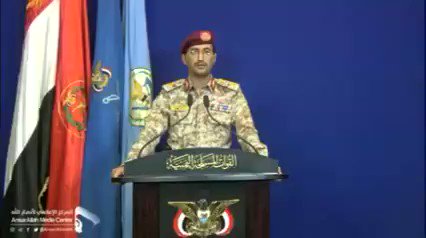
Yemeni military spokesman Yahya Sari said the attack involved an “accurate intelligence operation” that was assisted by “honorable and free” men working inside of the Kingdom. That televised confession, however, wasn’t going to stop the United States and its regional allies from believing what they wanted to believe, which was that Iran was solely responsible for the incident.
AnsarAllah’s drone attack on this oil facility which is at least 1000km away from AnsarAllah areas, will have huge impacts on ’s economic & the continuation of these strikes on vital refineries will change the balance power, making the future of battles undergo many changes

Yahya Sari': "10 UAVs Targeted the Aramco's Refineries in Buqayq and Khurais"

He said: This operation took place after accurate intelligence operation with help of honorable and free mans within the Kingdom.

Details here: http://www.english.iswnews.com/7201/yahya-sari-10-uavs-targeted-the-aramcos-refineries-in-buqayq-and-khurais/ …
30 человек(а) говорят об этом
Secretary of State Mike Pompeo, whose pugilistic presence in the Trump administration makes Bolton’s absence seem almost imperceptible, proclaimed in a tweet that Iran is responsible for launching “an unprecedented attack on the world’s energy supply.”
Pompeo went on to say there was “no evidence the attacks came from Yemen,” while never proving evidence the attack originated from Iran either. In other words, Trump is being pushed into a situation where he has no choice but to fight. Not the best situation for an incumbent president heading into the election season. And it certainly doesn’t help his situation when members of his own party shake the pompoms for war, as Senator Lindsey Graham did when he called for attacks on Iran’s oil refineries.
Tehran is behind nearly 100 attacks on Saudi Arabia while Rouhani and Zarif pretend to engage in diplomacy. Amid all the calls for de-escalation, Iran has now launched an unprecedented attack on the world’s energy supply. There is no evidence the attacks came from Yemen.
18,3 тыс. человек(а) говорят об этом
Thus, in a matter of hours, Trump has gone from being open to the idea of talking to Iran to saying the US is “locked and loaded” and just waiting to “hear from the Kingdom” before the White House takes some kind of action against the suspected perpetrator.
Incidentally, although that ominous tweet certainly got the attention of Iranian officials, it is worth noting that just over two years ago, as the war rhetoric between Pyongyang and Washington was hitting its crescendo, Trump used exactly the same threatening phrase “locked and loaded.” Yet today relations between the two countries have calmed considerably and Trump even went on to become the first US leader to enter North Korea. Was Trump sending a message to Tehran? Will the maverick from Manhattan soon be strolling down the streets of Tehran, shaking hands with imams as he did Kim Jong-un? Nothing would enrage the US deep state more.
With regards to the idea that Iran was behind the attacks on the Saudi oil factory that claim sounds highly dubious. Once again, we are expected to accept the narrative that sovereign states have some sort of suicide wish, and would happily submit to a mortal self-inflicted wound at the most incongruous time (as was the case with Syria, by the way, which, as the media desperately wanted everyone to believe, decided to carry out chemical attacks against the rebels, thereby risking a full-blown attack by the US military and half of NATO).
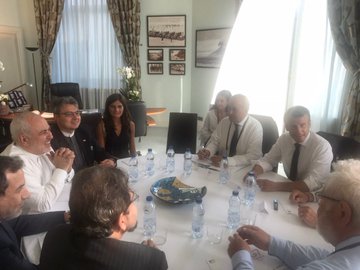
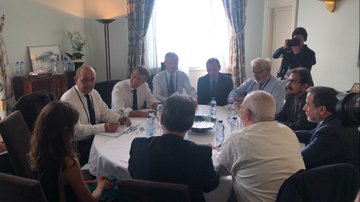
Indeed, why would Iran, even through the use of proxy forces, risk an attack on Saudi Arabia that could set the entire Middle East alight? The idea becomes all the more preposterous when we remember that just several weeks ago, Iran’s foreign minister, Mohammad Javad Zarif, made a surprise visit to the G7 summit, hosted by France, where world leaders, including US President Donald Trump, were gathered. Trump, alongside French President Emmanuel Macron during a post-summit press conference, agreed to the possibility of meeting with his Iranian counterpart, Hassan Rouhani.
Trump even seemed open to the idea of backing away from current US policy of “maximum pressure” on Tehran, saying he would consider providing Iran with an emergency credit line backed by its oil production.
Why would Tehran risk igniting World War III when the prospect for peace – not to mention financial relief – seems to be near at hand?
Iran's active diplomacy in pursuit of constructive engagement continues.

Met @EmmanuelMacron on sidelines of after extensive talks with @JY_LeDrian & Finance Min. followed by a joint briefing for UK/Germany.

Road ahead is difficult. But worth trying.
Посмотреть изображение в ТвиттереПосмотреть изображение в Твиттере
2 000 человек(а) говорят об этом
The circumstantial evidence points to the fact that Iran, as it has vociferously declared, had nothing to do with the brazen assault on Saudi Arabia. Trump, I would imagine, is probably also very wary of the accusations, spouted by none other than his own Secretary of State, since he is very familiar with such underhanded tactics due to his experience in Syria.
Thus far in his presidency, Donald Trump has been able to avoid full-blown war despite serious efforts by a consortium of concerns to trigger such an event. Despite the hawks he gathers around himself, probably in an effort to “keep his enemies closer,” as Sun Tsu recommended, Trump is clearly not enamored of the battlefield as are so many others in Washington. Trump is a businessman, and sees much more advantage in walking away from a hard-won contract than walking away from an obliterated landscape, the worst imaginable thing for a real estate developer. Nevertheless, it is a nerve-racking experience watching the author of the ‘Art of the Deal’ bluster and bluff his way against rivals right up to precipice of disaster before retreating back again to stable ground.

This strategy keeps the Deep State constantly off guard as to his real intentions, which is not about triggering World War III. How long the Deep State will tolerate such a relative atmosphere of global peace is another question, but they will certainly be doing everything in their power to ensure he does not secure another four years in the White House. And that is the tragic reality of Donald Trump’s real war.