Showing posts with label Shinzo Abe's visit to Iran. Show all posts

Sunday, June 16, 2019

Pompeo’s Tanker Narrative

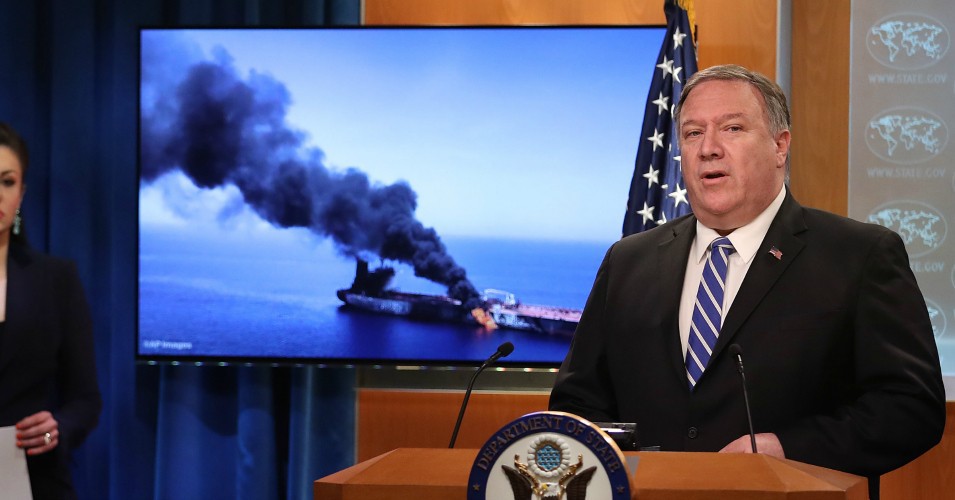
It appears that Mike Pompeo has a hard time kicking his old habits.  He appears to be as smug about lying as a CIA operative as he is as Secretary of State.  Categorically blaming the Iranians for the recent oil attack tankers has left allies scratching their heads; and perhaps leaving foes thinking: “Thank God my enemy is so stupid”!
On June 13, 2019, as Ayatollah Khamenei was holding talks in Tehran with Japanese prime minister, Shinzo Abe, two oil tankers carrying oil to Japan were attacked.  As investigations into the incident were just beginning, Pompeo had already concluded his assessment and had it ready for the press.  Much to the audible surprise of the world, and without any proof or supporting documents, he laid the blame firmly at Iran’s feet citing “intelligence”.
To his relief, in no time at all, US officials claimed that they had managed to get their hands on videos and pictures.  They presented a grainy video alleging to show an Iranian navy boat removing mines from the damaged Japanese ship.  It is easy to understand why the grainy video’s existence was necessary.
Precisely a month prior, on May 13th,  four oil tankers were damaged in the region.   The United States blamed Iran without any evidence.  Saudi Arabia followed suit.  The rest of the world was skeptical and doubts floated about the about the accuracy of US claims.  This time around, Pompeo was saved by the video – although not for long! The Japanese vessel owner disputed the presence of mines damaging his vessel (as suggested in the blurry video).
Even allies were skeptical.  To enforce its position and allegations against Iran,  the Trump administration made its argument  based on misinterpreting what Iran had said about the oil embargo.   Following Trump’s announcement on April 22nd that America would not renew US waivers for countries which imported oil from Iran, in essence, imposing an oil embargo, on April 25the Iranian government retorted by condemning America’s illegal demands and stated that no other country could take its share of the oil market.
The Trump team would like us to believe that what Iran meant was the sabotage of the oil tankers.   This is far from true.    Iran was referring to its legal right under the 1982 United Nations Convention on the Law of the Sea (UNCLOS) which legally allows it to impede the passage of oil shipments through its territorial waters – the Strait of Hormuz.
While UNCLOS stipulates that vessels can exercise the right of innocent passage, and coastal states should not impede their passage, under the UNCLOS framework, a coastal state [Iran] can block ships from entering its territorial waters if the passage of the ships harms “peace, good order or security” of said state, as the passage of such ships would no longer be deemed “innocent”[i].
Given Iran’s recourse to international law, American diplomacy at its all time low, and the rally behind Iran – if only verbally – it makes absolutely no sense for Iran to blow up oil tankers and turn the world opinion in favor of  Trump and his the warmongering advisors – Pompeo and Bolton.
But tankers were blown up.   What other motivation were there?
Perhaps NOPEC – No to Oil Producing and Exporting Cartels Act.   In February, House passed a Bill that would cripple OPEC.   The Bill would prohibit OPEC from coordinating production and influencing prices.  While the Bill was said to provide a useful leverage for the White House, Persian Gulf Arab states sent their warnings to Wall Street.
On April 5th, Saudi Arabia even threatened to drop Dollar for oil trades in order to discourage US from passing the NOPEC Bill.  The Saudi threat came on the heels of UAE cautions the prior month that if such bill passed, it would in effect, break up OPEC.
Perhaps this was the reason behind Saudi Arabia’s lack of cooperation.   After Trump announced his Iran oil embargo, a senior US administration assured the world at large that Trump was confident Saudi Arabia and the United Arab Emirates would fill any gap left in the oil market.  He was mistaken. On April 29th, the Saudi Energy Minister, Khaled el-Falih made it clear that Saudi Arabia would not “rush to boost oil supply to make up for a loss of Iranian crude”.
After the May 13th incident, apparently America’s accusations did not carry any weight around the world, but they did have an impact on the jittery Saudis.   On June 3rd, Bloomberg reported that over the last month, the Saudis  raised their oil production to replace lost Iranian oil.    The oil market was satisfied and America could continue to put pressure on friend and foe to stop buying Iranian oil – there would be no shortages.
What then explains the second tanker incidents of June 13th?
Perhaps the motive is two-fold.  Firstly, the United States would reinforce its unfounded allegations that Iran is a ‘bad actor’ and discourage and dissuade the international community from cooperation with Iran.  And secondly, the hike in the price of oil as a result of the tanker attacks no doubt sent a sigh of relief to shale oil producers in the United States.  A drop in oil prices would greatly harm or bankrupt US shale-focused, debt-dependent producers.
Not on Trump’s watch.
Although many states in the US and some countries in the world have banned shale oil production due to its adverse effects on the environment, specifically water, the United States’ goal is to be the biggest producer and supplier of oil depending on its shale oil production.  Currently, according to the latest US Energy Information Administration (EIA), the United States is a net importer of oil.   With low oil prices, a halt or slowing of shale, the trend would continue to be an importer.
Having Saudi Arabia cower to US demands, demonizing Iran, intimidating allies and non-allies with fear of conflict in the region in order to press further demands on Iran, increase in the price of oil, and the weapons that would be purchased by US allies in the nervous neighborhood, seems like a win-win situation for America.  For now.
Soraya Sepahpour-Ulrich is an independent researcher and writer with a focus on U.S. foreign policy.


[i] Martin Wahlisch, The Yale Journal of International Law, March 2012, citing UNCLOS, supra note 12, , art. 19, para1, and art. 25, para1.

Thursday, June 13, 2019

President Rouhani: Japanese PM's visit to Iran, turning-point in Tokyo-Tehran ties

President Rouhani: Japanese PM's visit to Iran, turning-point in Tokyo-Tehran ties


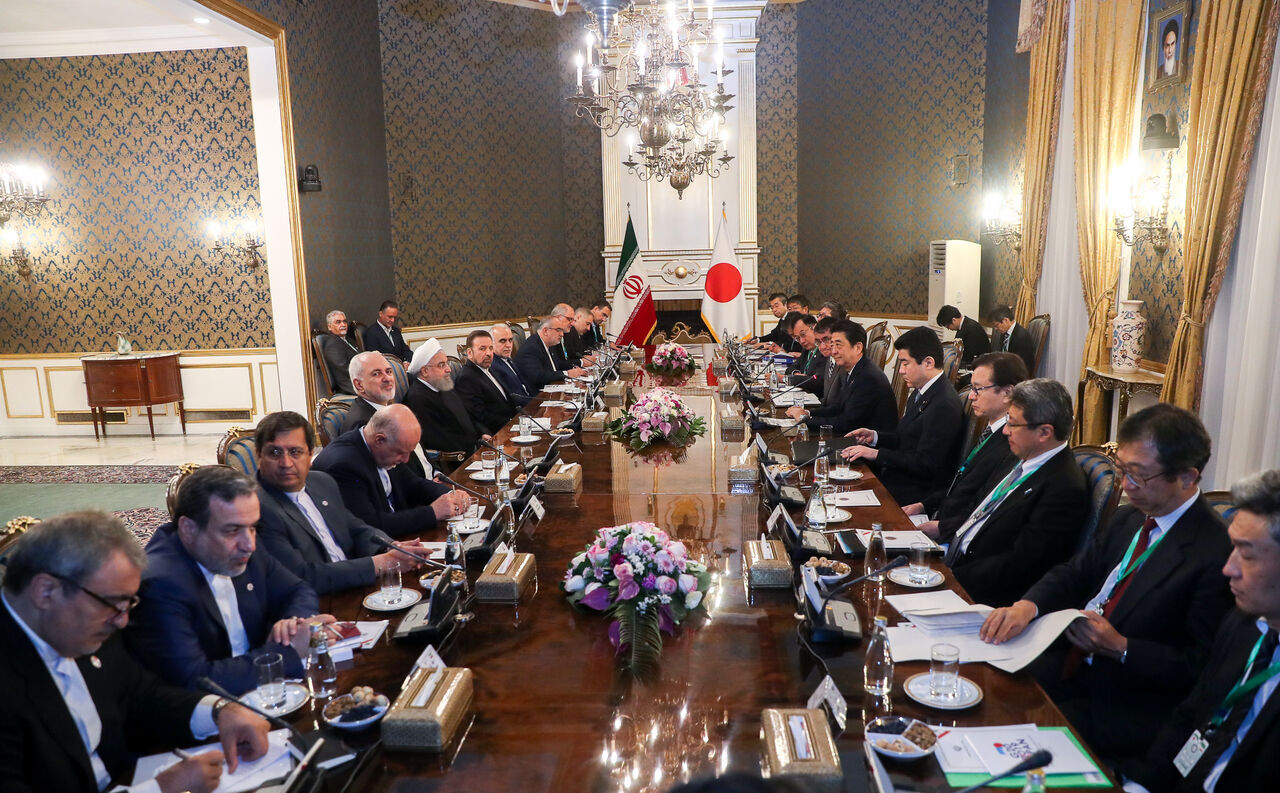
Tehran, June 13, IRNA – President Hassan Rouhani announced that Iran attaches great importance to its relations with Japan, saying the visit of Japanese Prime Minister Shinzo Abe to Iran is a turning-point in mutual cooperation.
President Rouhani made the remarks at a joint meeting of high-ranking Iranian and Japanese delegations in Tehran on Wednesday evening.
Referring to Abe's travel that took place concurrent with the 90th anniversary of the establishment of diplomatic relations between Iran and Japan, the president said Tehran is keen to boost friendly and long-lasting ties with Tokyo.
He also welcomed Japan's willingness to invest in the southern Iranian strategic port of Chabahar development projects.
He stressed the necessity of accelerating implementation of the previous energy and treatment agreements between the two countries.
Iran is ready to hold talks with Japan on cooperation in regional questions, President Rouhani said.
Elaborating on Iran's counter-terrorism measures, the president said if Tehran did not take the measures, terrorist groups particularly Daesh (ISIS) would drag the entire region into crisis.
The issue of security is important for Iran, so the country is not after tension or war with any country, including the United States; however, Tehran will give a knockout response if it would be attacked, he noted.
President Rouhani went on to say that Iran well understands Japan's sensitivity towards nuclear weapons as the country has been the victim of the US atomic bombings.
Iran, too, as a victim of chemical weapons during era of former Iraqi dictator Saddam Hussein is not seeking nuclear weapons, instead it is after peaceful nuclear technology.
Talking about Iran's measures to help refugees, including Afghans, the president said Iran is hosting millions of [our] Afghan brothers and sisters who are receiving free education in different Iranian cities.
Iran has been pioneer in welcoming the refugees and countering drug trafficking activities mainly from northeastern neighbor, Afghanistan (which is still the world's biggest opium producer,) Rouhani said.
But now, Iran is facing economic problems due to the US unjust economic sanctions, he added.
The president further hoped Tehran and Tokyo would widen bilateral ties in the fields of refugees and the fight against illicit drug trafficking, so that Iran can continue its humanitarian activities.
The Iranian president termed the United States as solely responsible for all regional concerns.
"This [regional] tension started from the US economic war against the Iranian nation."


Touching upon the issue of Iran Deal formally known as the Joint Comprehensive Plan of Action (JCPAO) from which the US withdrew unilaterally on May 8, 2018, the president said Iran does not want the nuclear deal to be killed, but all decisions taken by Iran at the first anniversary of the US exit have been under the Article 36 of the deal.
Iran hopes the US would change its action instead of its words, Rouhani stressed.
The Japanese premier, heading a high-ranking political delegation, arrived in the Iranian capital on Wednesday afternoon.
His visit is the first of its kind since the 1979 Islamic Revolution.

Wednesday, June 12, 2019

Shinzo Abe’s Crucial Iran Visit

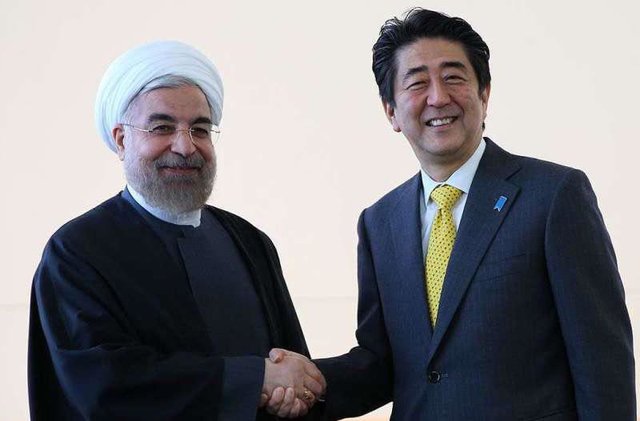
Hassan Rouhani and Shinzo Abe
by Kaveh L. Afrasiabi
Japanese Prime Minister Shinzo Abe will visit Tehran next week to mediate between the United States and Iran, taking center stage in one of the most vexing global issues today threatening international peace and security. Although this is the first official Tehran visit by a Japanese prime minister since 1978, Abe is no stranger to Iran’s leaders and, in fact, has met Iran’s President Hassan Rouhani on several occasions on the sidelines of UN gatherings in New York. Prior to President Trump’s lavish Tokyo visit last month, Abe met Iran’s Foreign Minister Javad Zarif and then openly broached the idea of going to Iran. Trump subsequently embraced this idea, pointing to Abe’s relationship with Iran’s leaders and, simultaneously, dialing back his “regime change” objective and suggesting that the United States can find a modus vivendi with the “existing leaders.”
Since then, the Trump administration has offered to engage in direct talks with Iran “without preconditions,” a move rejected by Tehran as tactical “wordplay.” At the same time, both Rouhani and Zarif have mentioned U.S. “respect” for Iran as one of the principal preconditions for U.S.-Iran talks, thus leaving the door for diplomacy ajar. Zarif’s deputy, Abbas Araghchi, who has also served as Iran’s ambassador to Japan, has welcomed Abe’s intervention as potentially easing tensions in the region.
Abe is not the only political leader seeking to act as interlocutor between Tehran and Washington. Secretary of State Mike Pompeo has been in Bellinzona, Switzerland, which represents U.S. interests in Iran, reportedly to enlist his hosts for a “limited dialogue” with Iran.  But what can Abe and others possibly achieve when the Trump administration is hammering Iran with relentless economic warfare and Iran completely distrusts the current U.S. administration, particularly after it unilaterally exited the Iran nuclear deal? After all, Iran has signaled that no direct talks with the United States is possible unless Washington reverses itself on economic sanctions, which is highly unlikely if Trump can’t point to significant Iranian concessions to U.S. demands.
Abe’s advantage is that his government, while a key U.S. ally, has nonetheless shown vital signs of independence on various Middle East issues. For example, Japan distanced itself from the U.S. recognition of Israel’s annexation of the Golan Heights and refused to follow Washington’s lead when it relocated its embassy to Jerusalem. Equally important, Japan has sided with Europe in defense of the Iran nuclear deal.
From Tehran’s vantage point, Abe’s visit, in addition to conferring legitimacy on the Iranian government, can highlight U.S. diplomatic isolation on the nuclear issue, particularly in light of the repeated International Atomic Energy Agency confirmation that Iran has faithfully observed its obligations under the Joint Comprehensive Plan of Action (JCPOA). However, Abe’s intervention in this complicated diplomatic quagmire might backfire, fueling criticism at home that he has jeopardized U.S.-Japan relations at a time of rising tensions in in the Pacific and around the Korean Peninsula. This mission offers both opportunities and risks for Abe, who may wish to play a more prominent conflict-management role beyond Iran if successful in this Iran trip. Given Japan’s heavy reliance on Middle East oil—which accounts for 80 percent of Japan’s oil imports—Tokyo has a vested interest in Persian Gulf stability, which has been rocked by the recent escalation of tensions between Iran and the United States.
On the positive side, Abe’s Iran visit may create an off-ramp alternative for the current U.S.-Iran standoff through deft and imaginative diplomacy that elicits compromises from both sides. This would bode well for Iran-Japan economic relations as well, which surged in the post-JCPOA environment with an investment treaty in 2016 before experiencing a decline due to U.S. sanctions. That investment treaty, which laid the groundwork for possible Japanese investment in Iran’s energy and non-energy sectors, could be implemented given a breakthrough in the U.S.-Iran dispute.
Yet, on the negative side, Abe’s initiative could bolster Washington’s tactic of playing the peace card without relinquishing any essential element of its coercive diplomacy. Iran’s concern is that the Trump administration might be bluffing with its recent olive branches and could use a “failed” Abe’s mission to its advantage by painting Iran, reeling under U.S. sanctions, as rigid and inflexible. For some hardline Tehran politicians and pundits, such as the editors of the conservative daily Kayhan, the United States is on the war path with Iran, similar to the run-up to the Iraq War, and wants to claim that it exhausted all the diplomatic chances of  a peaceful resolution of tensions with Iran’s theocratic rulers.
Indeed, the Trump administration has shown no sign of stepping back from its strategy of maximum pressure, which has resulted in a substantial loss of Iran’s oil export market, much of which has been picked up by Saudi Arabia, which has increased production to stabilize the oil market. Unless Abe succeeds in convincing the Trump administration to ease U.S. sanctions—for instance, by renewing the oil exemptions for countries such as Japan, South Korea, and India—Tehran will not likely take Trump’s offer of dialogue seriously. Brian Hook, the State Department’s point man on Iran, has been sending contradictory signals on the issue of oil exemptions, which suggests that the administration is unclear about its next Iran steps.
If Washington is serious about giving Abe a chance with his Iran initiative, it must not only shift from sticks to carrots but move more fundamentally away from a confrontation strategy, centered on a regime change in Iran, to one of peaceful coexistence and détente. Iran has been offering a “non-aggression pact” to Saudi Arabia and other GCC (Gulf Cooperation Council) states, which could be extended as well to the American patron state of these oil sheikhdoms. An important prerequisite for such a paradigm shift is a more nuanced U.S. policy toward Saudi Arabia, which enjoys unprecedented Washington backing for an aggressive regional policy that has alienated some of its Arab neighbors, including Qatar. A more balanced U.S. Persian Gulf policy is a sine qua non for de-confliction and a return of stability to a volatile region on the precipice of yet another calamitous war. Abe’s intervention could prove pivotal in tilting the United States toward just such a balanced relationship with the Persian Gulf states including Iran.
Kaveh Afrasiabi has taught at Tehran University and Boston University and is a former consultant to the UN Program on Dialogue Among Civilizations. He is the author of several books on Iran, Islam, and the Middle East, including After Khomeini: New Directions in Iran’s Foreign Policy (Westview Books, 1995) and most recently Iran Nuclear Accord and the Remaking of the Middle East (2018). He is the co-author of the forthcoming Trump and Iran: Containment to Confrontation.