
By: Yuram Abdullah Weiler
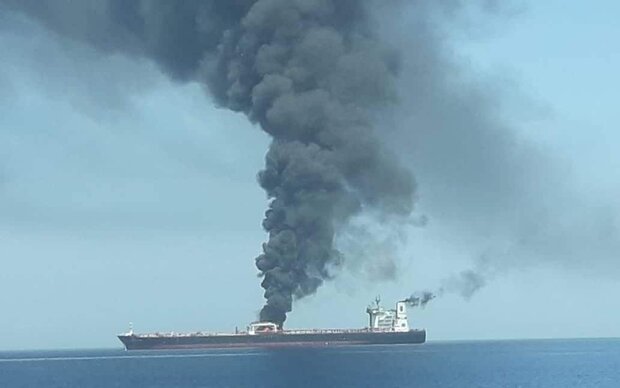
TEHRAN, Jun. 19 (MNA) – “It is the assessment of the United States government that Iran is responsible for the attacks that occurred in the Gulf of Oman today,” said US Secretary of State Mike Pompeo.
On June 6, 2019 two tankers, one Japanese and the other Norwegian, were attacked by unknown assailants in the Gulf of Oman. The incident occurred less than a month after a series of acts of sabotage on four tankers, two Saudi, one UAE and one Norwegian, anchored off the coast of the United Arab Emirates near the port of Fujairah.
The Norwegian tanker, the Front Altair, was flying the flag of the Marshall Islands and was loaded with ethanol from Qatar, while the Japanese tanker, the Kokuka Courageous, was flying the flag of Panama and was carrying crude oil from the Saudi port of Jubail on the Persian Gulf. The attacks, which occurred at the time of a high-level visit by Japan’s Prime Minister Shinzo Abe to Ayatollah Khamenei, may have been intended to embarrass the Islamic Republic or to thwart Japanese efforts towards the de-escalation of tension.
US Secretary of State Mike Pompeo was quick to lay the blame on the Islamic Republic of Iran, as was National Security Adviser and Iranophobe, John Bolton, who, following the first series of attacks, remarked, “There is no doubt in anybody’s mind in Washington who is responsible for this and I think it’s important that the leadership in Iran know that we know.” The perennial prevaricator on the Potomac trumpeted his concurrence in a television interview on Fox and Friends on Friday, June 14, insisting, “Iran did do it.”
Iran categorically denied Pompeo’s unsupported accusations, which were patently absurd given that the 44 sailors on the two burning tankers were rescued by an Iranian vessel that responded to their distress calls. Despite claims by the US Navy that the stricken tankers were under their purview, the Iranian rescue ship was the first to arrive on the scene of the incident and pull the tankers’ crewmembers to safety. Furthermore, given the timing of the attacks, it would be beyond irrational for Iran to target a Japanese-owned tanker while the country’s prime minister was meeting with Iran’s Supreme Leader. Yet, Pompeo, turning logic on its head, claimed that the Iranian government had indeed “insulted Japan by attacking a Japanese-owned oil tanker just outside Iranian waters,” while simultaneously assuring Abe that it did not want war.
As if on cue, Pompeo came on stage with rhetorical escalation, declaring, “Taken as a whole, these unprovoked attacks present a clear threat to international peace and security.” Previously, the US secretary of state went so far as to suggest that Iran carried out the attacks, including the May 12 sabotage near Fujairah, “to raise the price of crude oil throughout the world.” US Central Command officials even trotted out a grainy video, which they claimed was taken by a navy surveillance plane, of an unexploded mine attached to the hull of the Kokuka Courageous. The mine, referred to as a “limpet,” was supposedly of a type used by Iran and was similar to the explosive devices used in the previous attacks.
However, Yutaka Katada, the president of Kokuka Sangyo, the shipping line that owns the Kokuka Courageous, disagreed with the US official narrative about a limpet mine being the cause of the explosion. “I do not think there was a time bomb or an object attached to the side of the ship,” he said. “Our crew said that the ship was attacked by a flying object,” he added citing the fact that the holes caused by the explosion were well above the water line. Because of this fact, he explained, “There is zero possibility that they were torpedoes.”
Previously in May, the US had escalated tensions in the Persian Gulf by dispatching the USS Abraham Lincoln carrier strike group and a B-52 bomber task force allegedly to counter heightened threats to US forces posed by Iran. Given that Iran is literally encircled by US nuclear-capable forces, it seems utterly implausible that the Islamic Republic is the state actor posing the threat. Nevertheless, US Marine Corps Gen. Joe Dunford, the chairman of the Joint Chiefs of Staff, insisted that the deployment was not confrontational. “This is not intended to be a provocation,” he emphasized. “This is not intended to reinforce our offensive capability in the region,” even though it obviously looks like the US is preparing for a strike on Iran.
If the plot woven by Pompeo and his accomplices induces a vague but familiar feeling, perhaps it is due to the uncanny similarity with an incident in the Gulf of Tonkin in 1964, which was used by US officials to create a pretext for launching a full-scale war on Vietnam. The plot should have a familiar ring: a patrol boat from the Democratic Republic of Vietnam was reported to have attacked the USS warship Maddox without provocation in international waters, thereby justifying a severe US military response, which was announced shortly after the 11 o’clock nightly news by US president Lyndon Baines Johnson (LBJ) on August 4.
There had been a defensive response by North Vietnamese patrol boats against ongoing CIA covert raids along the coast involving the Maddox on August 2, and intelligence reports suggested another retaliatory action was planned for August 4. However, the attack never happened. Admiral John Stockdale, who was flying an aircraft from the USS Ticonderoga, said that he saw nothing at all to indicate the North Vietnamese had made an assault on the Maddox. Yet despite the lack of clear and convincing evidence, defense secretary Robert McNamara called LBJ at 11:00 am to report that US destroyers Maddox and C. Turner Joy were under attack, convincing the US president to sign off on a retaliatory strike.
“We're going to retaliate and we’ll make an announcement a little later in the evening, in the next hour or so and we’ll ask Congress for a resolution of war the next day to support us,” Johnson explained. By 9:15 pm, LBJ and McNamara had decided to make the public announcement of the non-attack by North Vietnam at 10 pm, so as to coincide with the commencement of an aerial assault by US warplanes on four North Vietnamese ports. However, crews were unable to load and launch the aircraft in time, forcing LBJ to delay his statement, which he finally made at 11:36 pm Eastern Time.
In his televised speech to the American people that night, LBJ announced, “Renewed hostile actions against United States ships on the high seas in the Gulf of Tonkin have today required me to take action and reply.” Still, he insisted, “Our response, for the present, will be limited and fitting. We still seek no wider war.” Two days later, the US congress passed the Gulf of Tonkin Resolution by a nearly unanimous 504 to 2 vote, allowing the US president to use military force without the constitutional constraint of seeking a congressional declaration of war. Johnson himself expressed doubts about the veracity of the reported incident a few days after the passage of the resolution, declaring that the alleged attack was nothing more than some sailors “just shooting at flying fish.”
If Pompeo’s plot becomes a Gulf of Tonkin revival in the Gulf of Oman, who would benefit from the ensuing chaos in the Persian Gulf? Certainly the United States, since the shale oil and gas boom has made energy independence possible, thereby allowing Washington to indulge in aggressive behavior with few constraints. The same may hold for Saudi Arabia, which, along with the US, would benefit from higher oil prices. Finally, the Zionist regime would have uncontested regional hegemony and could act with even greater impunity.
By 1969 LBJ’s response to a single alleged attack had spiraled into an all-consuming conflict: some 4.5 million tons of bombs had been dropped on Vietnam and neighboring Laos and Cambodia, killing an estimated 2 million civilians. Pompeo should carefully consider these horrific historical facts before continuing his cavalier accusations against Iran.
*******
Despite claims by the US Navy that the stricken tankers were under their purview, the Iranian rescue ship was the first to arrive on the scene of the incident and pull the tankers’ crewmembers to safety.
Despite claims by the US Navy that the stricken tankers were under their purview, the Iranian rescue ship was the first to arrive on the scene of the incident and pull the tankers’ crewmembers to safety.
************
Given the timing of the attacks, it would be beyond irrational for Iran to target a Japanese-owned tanker while the country’s prime minister was meeting with Iran’s Supreme Leader.
Given the timing of the attacks, it would be beyond irrational for Iran to target a Japanese-owned tanker while the country’s prime minister was meeting with Iran’s Supreme Leader.


