
By Palestine Chronicle Staff
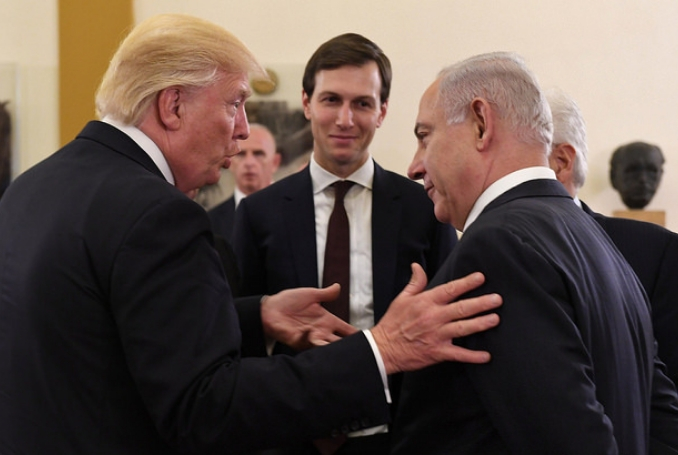 US President, Donald Trump (L) with his son-in-law, Jared Kushner (C) and Israeli leader, Benjamin Netanyahu. (Photo: File)
Washington announced Gaza’s new governance bodies—but who will truly control Gaza during the next phase?
The White House announced on Friday the formation of a so-called “Board of Peace” for Gaza and unveiled the leadership of the National Committee for the Administration of Gaza (NCAG), marking a major step in the second phase of the US-brokered ceasefire plan.
The announcement, issued as Israeli attacks continue despite the ceasefire, detailed the structure, leadership, and international oversight mechanisms intended to govern Gaza’s transition from war to reconstruction.
Purpose of the ‘Board of Peace’
According to the White House, the Board of Peace will provide strategic oversight for the implementation of President Donald Trump’s 20-point plan for Gaza, focusing on stabilization, reconstruction, economic development, and the transition to long-term governance.
The framework is designed to manage the shift from active conflict to postwar administration while mobilizing international resources and enforcing accountability during the transitional period.
Executive Leadership of the Board
The Board of Peace will be chaired by President Trump and supported by an executive board that includes US Secretary of State Marco Rubio, Special Envoy Steve Witkoff, Jared Kushner, former UK Prime Minister Tony Blair, World Bank Group President Ajay Banga, billionaire Marc Rowan, and US political adviser Robert Gabriel.
The White House said each member would oversee specific portfolios, including governance, regional coordination, reconstruction financing, and investment.
Aryeh Lightstone and Josh Gruenbaum were appointed senior advisers responsible for day-to-day strategy and operational coordination.
Gaza Executive Board
A separate Gaza Executive Board was announced to support on-the-ground administration and coordination. Its members include Turkish Foreign Minister Hakan Fidan, UAE Minister of State Reem Al-Hashimy, Egyptian intelligence chief Hassan Rashad, veteran Qatari diplomat Ali Al-Thawadi, Bulgarian diplomat and former UN envoy Nikolay Mladenov, Cypriot-Israeli businessman Yakir Gabay, and Dutch politician Sigrid Kaag.
Mladenov was appointed High Representative for Gaza, tasked with linking the Board of Peace to the Palestinian administration and overseeing reconstruction and governance efforts.
Security and Stabilization Arrangements
The White House confirmed that US Major General Jasper Jeffers will command the International Stabilization Force (ISF), which will operate under the strategic direction of the Board of Peace.
The ISF’s mandate includes monitoring the ceasefire, supporting security arrangements, ensuring permanent disarmament, preventing the re-establishment of military infrastructure, and facilitating humanitarian corridors.
National Committee for the Administration of Gaza
The NCAG will serve as the executive authority responsible for daily civil administration inside Gaza. Its mandate includes restoring public services, rebuilding civil institutions, stabilizing daily life, and laying the foundations for sustainable governance.
The committee will be chaired by Dr. Ali Abdel Hamid Shaath, a former Palestinian deputy minister for planning. The White House described Shaath as a technocratic figure with extensive experience in public administration and economic development.
Alignment with International Legitimacy
US officials said the framework aligns with UN Security Council Resolution 2803, which endorsed the ceasefire plan and welcomed the establishment of an international mechanism to oversee Gaza’s transition.
Washington said it would coordinate closely with Israel, Arab states, and international partners to ensure implementation, adding that additional names for both executive bodies would be announced in the coming weeks.
Regional and Arab Reactions
Several Arab states welcomed the announcement, with Gulf countries describing it as part of a broader political track, while stressing the need to uphold the ceasefire, ensure humanitarian access, and protect Palestinian rights.
Saudi Arabia, Jordan, and Gulf Cooperation Council states expressed support for the Palestinian technocratic committee as a temporary transitional body, emphasizing Palestinian territorial unity and early recovery.
Ceasefire Under Strain
The announcement comes as Israel continues to violate the ceasefire in Gaza. Since October 2023, more than 71,000 Palestinians have been killed and over 171,000 wounded. Since the ceasefire took effect, nearly 450 Palestinians have been killed and more than 1,200 injured, according to Gaza’s Health Ministry.
Palestinian officials have warned that continued Israeli military operations threaten the viability of any governance or reconstruction process and undermine the ceasefire’s second phase.
(PC, Anadolu, AJA)

No comments:
Post a Comment