
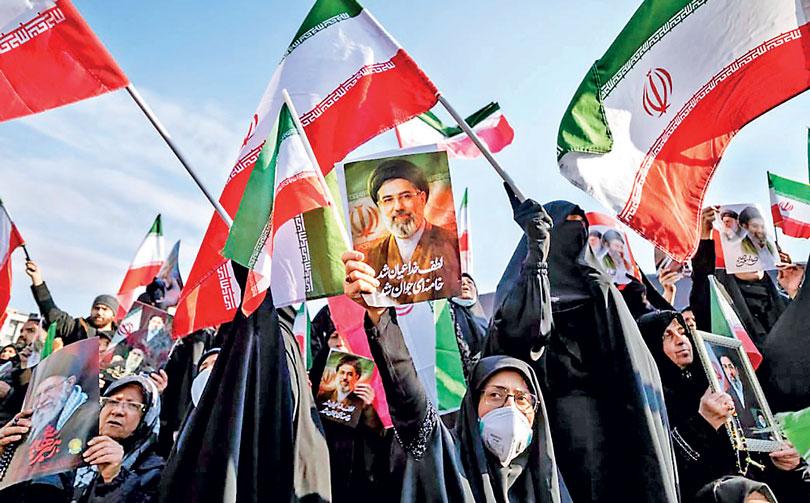
Iranians celebrate after the announcement that Mojtaba Khamenei, the son of the late Ayatollah Ali Khamenei, has been named the new Supreme Leader. -AFP

As the unprovoked and illegal war on Iran continues for the 14th day, one thing is certain: the United States and Israel—the aggressors in this case—are not winning, nor is Iran losing.
Yet in Washington and Tel Aviv, there is no shortage of arrogant rhetoric. US President Donald Trump and the dimwitted members of his administration keep saying, “We won the war, but we will stay in the fight to finish the job.” If that is so, why waste your fast-depleting, costly ammunition, Mr Trump?
Earlier, one week into the war, the loquacious Trump had the chutzpah to call on Iran for an “unconditional surrender” and to say he would pick “acceptable” new leadership for the country. The Iranians responded with a sterner resolve to fight on until they received assurances of no further deception or attacks.
As the war continues, with the United Nations and its Secretary-General nowhere to be seen, Iran remains on the right side of history. It has done no wrong, as far as international law is concerned.
The US–Israel axis miscalculated the war plan, assuming that with the killing of Iran’s highly respected Supreme Leader Ayatollah Khamenei and a barrage of attacks, Iran would surrender. Far from it, the US–Israeli attacks only reenergised the nation to resist the aggression and united its people. Even those who had been protesting against the government only weeks earlier came out to condemn the killing of the Ayatollah and rally under the nation’s banner. They are pledging their loyalty to the newly elected Supreme Leader, Ayatollah Mojtaba Khamenei, the son of the martyred leader.
With such national unity on public display, the US-Israeli plans for regime change have collapsed. Equally unsuccessful is the attempt to use Iraqi Kurdish militias—viewed as US-Israeli proxies—for a land invasion. Besides the Kurds’ apprehensions about America’s trustworthiness, they are also being cautioned by the Iraqi government against such a move. Iran and its allied militias inside Iraq have reinforced this warning by striking US facilities within the Kurdish autonomous region.
Iran is fighting back with all the resources at its disposal. Its refusal to surrender despite unprecedented bombardment is, in itself, a moral victory. In this asymmetrical conflict, Iran’s strategy is unfolding with precision, just as it wargamed and prepared itself for the eventuality—a strategy able to survive shocks, assassinations and even a nuclear attack.
Analysts say the war’s outcome is being shaped by two main targets of Iran’s strategy—munitions and the market (MM). By forcing enemy air defence systems—especially the billion-dollar Patriot, THAAD, Arrow, David’s Sling, and Iron Dome batteries deployed across the Middle East—to intercept cheap, outdated drones and missiles, Iran has triggered an ammunition crisis and compelled the US and Israel to frantically seek replenishment. Reports say Trump is planning to redeploy defence systems from South Korea and even war‑hit Ukraine to the Middle East for a war he has joined in complete servility to Israel.
Meanwhile, Iran’s ballistic and hypersonic missiles and Shahed drones have succeeded in destroying or disabling radar installations at US military bases across the region. Since radars are the eyes of air defence systems, the damaged system is firing blindly. As a result, Iran and its ally Hezbollah in Lebanon are gaining freer air passage over Israel for their missiles and rockets. Footage that has slipped past Israel’s strict military censorship suggests that the destruction, particularly in Tel Aviv and Haifa, is more severe than Israel can endure.
Iran’s second strategy is to inflict economic pain on the market. By closing the Strait of Hormuz, it succeeded in sending world oil prices soaring—bad news for politicians, especially in the US, where rising pump prices are eroding support for Trump’s Republican Party ahead of the midterm elections. To address the situation, Trump persuaded the International Energy Agency to release 400 million tonnes of oil into the market, cushioning the shock only temporarily. The strategy is faltering, with oil prices climbing past the 100‑dollar mark yesterday for the second time this week after a brief correction, as Iran attacked more vessels that tried to break the blockade.
Meanwhile, the Strait of Hormuz is also vital for other supplies—especially fertiliser. After Russia, the Middle East is the second‑largest source of fertiliser. With Iran blockading this critical choke point, global food insecurity is looming, and severe supply chain disruptions are dragging the world toward a deep recession.
The stark reality is now hitting developed and developing nations alike—adding urgency to behind‑the‑scenes efforts to secure a ceasefire. But Tehran has made it clear it will not agree unless there are international guarantees against further US-Israeli attacks. Upping the ante, it is also demanding war reparations and recognition of Iran’s legitimate rights.
Even if Iran suffers militarily, the moral victory belongs to Iran. This moral victory, together with Iran’s resolve to stand up to aggression, should inspire the Global South to resist imperialism in whatever form it appears. Iran’s moral victory recalls, in some ways, the Russo-Japanese War of 1904–1905, though the comparison is imperfect. Japan’s victory shattered the myth of European colonial invincibility and inspired freedom fighters in Asia and Africa to fight for independence with confidence.
Today, Iran is instilling similar confidence in Global South countries, some of which continue to genuflect before the US-Israeli axis for economic aid or crumbs from the table. Iran’s struggle is a lesson in resistance. Venezuela, for instance, kissed the hand it could not bite after Trump’s military thugs kidnapped its president and brought him, along with his wife, to the US to face a phoney trial.
But Iran has proved it is no Afghanistan, Iraq, or Venezuela. “Dare to hit me,” it challenged the US. Now Washington is struggling to find an off‑ramp—a face‑saving exit.
In the Middle East and the Global South, popular support for Iran is rising, while most Arab regimes—long accustomed to hiding behind Uncle Sam’s coattails—are beginning to realise that the vast US military bases on their soil and the billions they have paid in protection money serve not to defend them, but to protect Israel. They are coming to see that a strong Iran, once viewed with suspicion, may be their best defence against Israel’s expansionist ambitions. Yet they remain too fearful to acknowledge it openly or act accordingly.
With Iran’s response seen by people across the Arab and Islamic world as a heroic stand against the very force that commits genocide in Palestine, Arab leaders face a dilemma. On one hand, they must defend themselves when Iran strikes US military assets in their countries. On the other, they risk the wrath of their own people if they join the war against Iran. If they do, it will be seen as a betrayal of the Islamic cause now that a Muslim nation has dared to confront Israel.
A Muslim Davood (David) is fighting a Zionist Jalut (Goliath).
For the first time since the collapse of the Ottoman Empire, a Muslim country is confronting not one but two nuclear-armed powers hostile to Muslims.

No comments:
Post a Comment