
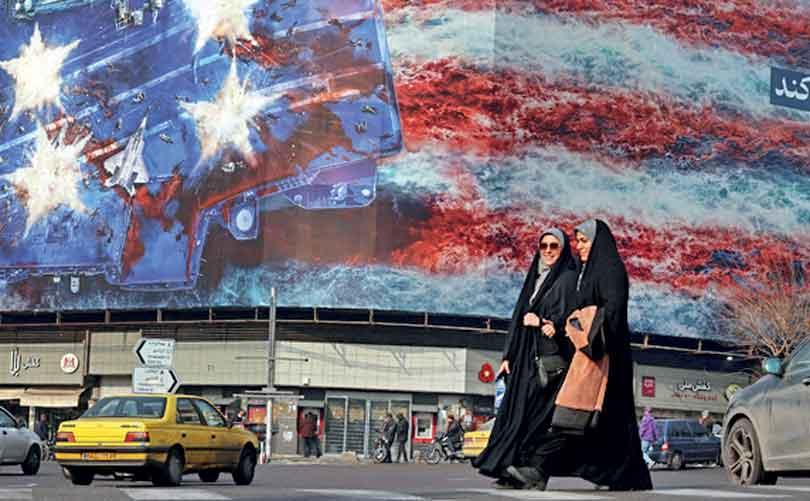
The United States is preparing for a war on Iran. Already at a fever pitch is the war of words between the two countries—one, a superpower with unmatched military might, an appetite for endless wars, and hubris to boot; the other, a middle power battered by sanctions simply for asserting its sovereignty and resisting US-Israeli hegemony.
The US is playing a game of brinkmanship, keeping the world on edge. John Foster Dulles, the US Secretary of State during the height of the Cold War in the 1950s, described brinkmanship as the “necessary art” of securing American interests—getting “to the verge without getting into the war.” But the danger of brinkmanship lies in its inability to prevent war. One misstep, and war is at the doorstep.
Trump and his imperialist war party use brinkmanship as a prelude to military action. Venezuela faced this earlier this month. Iran could be next.
The massive US military build-up in the Persian Gulf cannot be compared with the US-Soviet brinkmanship during the 1962 Cuban missile crisis. Both the US and the Soviet Union were nuclear powers, and the fear of nuclear confrontation helped defuse the crisis. But Iran does not have the deterrent of a nuclear weapon; therefore, the US is not bound by fears of a nuclear war. Reports of Iran possessing such weapons are only speculation. Thus, a war appears imminent.
The US needs wars. It sees war as the only path to preserve its global supremacy, now under strain from China’s rise and the pressures of de-dollarization. Signs that the dollar is losing its status as the world’s reserve currency are emerging. The rise of gold and silver prices and China’s reduction of its holdings of US federal debt—from $1.3 trillion in 2015 to roughly $700 billion today—illustrate this transition. Furthermore, the petrodollar is being increasingly challenged by the petroyuan. China’s central bank is aggressively advocating for the internationalisation of the renminbi, while several BRICS+ nations increasingly adopt non-dollar transactions.
What, other than imperial wars targeting resource-rich countries, can help America stave off the fall of the dollar, the collapse of its economy, and the erosion of its global power?
A nation’s immoral quest for power brings in its wake its own destruction. Nothing explains this political truism better than the fable of the scorpion and the frog. The scorpion wants to cross a river and asks a frog to carry it across. The frog hesitates, afraid the scorpion might sting. The scorpion assures the frog, “If I sting you, both of us will drown.” The frog finds this argument sensible and agrees. Midway across the river, the scorpion stings anyway, dooming them both. The dying frog asks why, despite knowing the consequences, the scorpion stung. The scorpion replies, “I am sorry, but I couldn’t help myself. It’s my nature.”
Just as the scorpion perished, so too will any nation that believes war is its nature.
Just as the scorpion stings, despite its ‘peace’ promise to the frog, the nature of the US is war despite its peacemaker claims. In a post on his Truth Social platform on Tuesday, Trump revived his threat to attack Iran, saying, “A massive armada is heading to Iran.”
The US fleet is “ready, willing, and able to rapidly fulfil its mission, with speed and violence, if necessary,” he said, adding: “Hopefully Iran will quickly ‘Come to the Table’ and negotiate a fair and equitable deal—NO NUCLEAR WEAPONS—one that is good for all parties. Time is running out; it is truly of the essence! As I told Iran once before: MAKE A DEAL!”
In response, Iran’s Foreign Minister Abbas Araghchi said no invitation had come from the US for any talks on its nuclear programme. However, he warned that the Iranian Armed Forces are ready to “immediately and powerfully” respond to any possible attack by the United States.
“Our brave Armed Forces are prepared—with fingers on the trigger—to immediately and powerfully respond to ANY aggression against our beloved land, air, and sea,” Araghchi wrote on social media on Wednesday.
In recent days, Trump has been bragging about secret US weapons, which he says he is not supposed to reveal. Referring to his military success in kidnapping Venezuela’s President Nicolás Maduro early this month, he said the US used a “discombobulator” to capture him. “The discombobulator” I’m not allowed to talk about it,” Trump told the New York Post. “It made [enemy] equipment not work.”
US officials suggested Trump may have conflated several capabilities into a single, nonexistent weapon. Reports say that during the capture, the US military also utilised acoustic systems to disorient personnel on the ground.
Trump may be daydreaming of using the discombobulator to kidnap Iranian leaders.
Trump is too dangerous to be vested with devastating military power. He is narcissistic and unpredictable. Besides, he is showing signs of dementia, said to be hereditary. Calling Greenland “Iceland” may be an early sign of memory loss—the very condition he mocked when his predecessor Joe Biden, alias “Genocide Joe”, fumbled during public speeches.
Iran’s neighbours, including the UAE—often derided on social media as an Israeli lackey—have said they will not allow the US to use their airspace or US bases on their soil to attack Iran. Saudi Arabia was emphatic in its opposition to Trump’s Iran war. Turkey has called for step-by-step talks to untangle the US-Iran nuclear dispute. They all fear the consequences, which will be nothing like the 12-day war in June last year.
Needless to emphasise, any war on Iran will send oil prices soaring, with Iran, as a last resort, closing the vital Strait of Hormuz, disrupting the flow of one-fifth of the world’s oil supplies.
As Trump drags the world back to the barbaric era of imperialism—where selfishness is seen as a virtue—Iran has warned that no US base in the region will be spared if war is imposed on it.
Iran may not win the war, but it will not lose it either. The US may have the best of weapons—AI-guided, acoustic, and even “discombobulators”. Iran’s enemies can strike from the air. But a land invasion would be a road to Waterloo.
By banking on dissidents within Iran and public protests earlier this month, the US‑Israeli axis thought a regime change was at hand. Trump told the dissidents to keep protesting, assuring them that help was on the way.
The protests only enabled Iranian security forces to expose a fifth column funded by Mossad and the CIA inside Iran. It was such traitors who helped Israel carry out precision attacks on Iranian military leaders and scientists during the 12‑day war. By using advanced military technology, probably obtained from Russia, Iran managed not only to jam supposedly unjammable Starlink devices provided by the CIA and Mossad but also to arrest their users. This was a major victory for Iran and a humiliating setback for the US-Israeli axis.
Smarting over Iran’s success, Trump has sent the US armada to the region in a display of brinkmanship that could go either way—war or talks to resolve the nuclear issue. But given Israel’s influence on Washington and its designs to Balkanise and weaken Arab and Islamic countries, a war that would further destabilise the Middle East appears more likely.

No comments:
Post a Comment