
By Bobby Ciputra
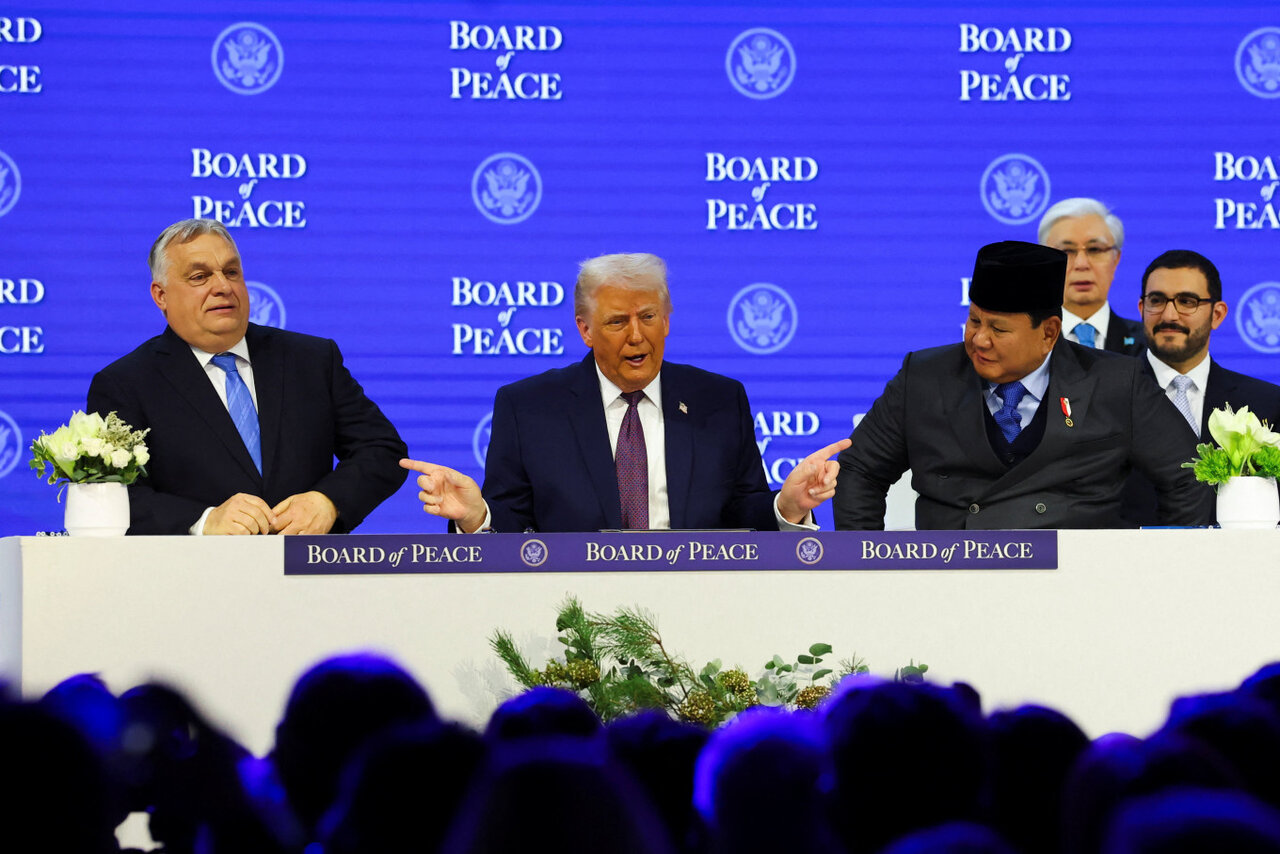
JAKARTA – Indonesia’s decision to sign US President Donald Trump’s Board of Peace (BoP) charter in Davos marks a defining moment for President Prabowo Subianto’s foreign policy, revealing a strategic shift from traditional multilateralism toward calculated maneuvering within an emerging parallel global order.
A symbolic handshake with strategic consequences
The signing of the Board of Peace (BoP) charter on January 22 was far more than a ceremonial gesture. Standing alongside Trump and Hungarian Prime Minister Viktor Orbán, President Prabowo Subianto entered a political arrangement that challenges the foundations of the post-1945 international system.
The BoP is not designed as a conventional peace mechanism. Rather, it represents a parallel power platform built outside established multilateral institutions. Trump’s well-documented skepticism toward the United Nations and traditional diplomacy has translated into a structure centered on personal loyalty, transactional politics, and centralized authority. According to the draft charter, Trump positions himself as chairman for life with absolute veto power.
Prabowo appears fully aware of this logic—and chose engagement over distance.
A parallel order built on personal power
Trump’s approach to global governance departs sharply from institutional multilateralism. Instead of consensus-based decision-making, the BoP relies on minilateral alignment, symbolic allegiance, and economic coercion. Loyalty is rewarded, while dissent is penalized.
This dynamic was evident in the absence of major Western powers from the signing ceremony. Britain, France, Germany, and Norway declined to participate, citing concerns that the BoP would undermine the legitimacy of the UN. French President Emmanuel Macron openly criticized the charter, prompting Trump to threaten punitive tariffs on French wine and champagne.
The message was unmistakable: cooperation is transactional, and criticism carries economic consequences.
From ‘free and active’ to strategic maneuvering
Indonesia’s long-standing “free and active” foreign policy doctrine was forged during the Cold War, emphasizing non-alignment and sovereignty amid bipolar rivalry. Today’s geopolitical landscape, however, is defined by fragmentation, uncertainty, and weakening multilateral institutions.
Prabowo has not abandoned this doctrine; he has reinterpreted it. What is emerging is a “free maneuver” approach—one that prioritizes flexibility over fixed alignments. Indonesia engages without submitting, participates without committing, and approaches power centers without being absorbed by them.
Within this framework, joining the BoP is not an ideological endorsement but a tactical move. The platform is a tool, not an end. By participating, Indonesia signals that it can engage Western power structures on their own terms, while retaining room to maneuver elsewhere.
National security calculations behind the move
Strategic considerations underpin Prabowo’s decision. Participation in the BoP may help Indonesia secure informal U.S. commitments regarding stability in the North Natuna Sea, particularly amid tensions in the South China Sea. From Washington’s perspective, the BoP also serves as a vehicle to nudge Indonesia toward implicitly countering China’s maritime claims—without forcing Jakarta into overt confrontation.
For Indonesia, this alignment offers leverage without formal obligations. It reflects an understanding that mid-sized powers can no longer rely on a single institution or alliance. Instead, they must construct overlapping safety nets across multiple diplomatic platforms.
The BoP is one such net—controversial, imperfect, yet strategically relevant.
Balancing between two competing orders
Indonesia now finds itself navigating between two global frameworks. On one side stands the traditional order: the United Nations, ASEAN centrality, and international law. On the other is the emerging parallel order represented by the Board of Peace—informal, personality-driven, and dominated by power politics.
When these orders collide, Indonesia will face difficult choices. Supporting UN mechanisms preserves legitimacy and Global South solidarity. Aligning with the BoP ensures access to Trump’s inner circle and potential short-term strategic gains.
Prabowo’s strategy is to avoid choosing—using both arenas as circumstances demand. This is the essence of the free maneuver approach. Yet it also requires constant recalibration, diplomatic stamina, and a clear hierarchy of principles.
The risks of orbiting personal power
While the strategic logic behind Prabowo’s decision is evident, the long-term risks should not be underestimated. Indonesia’s strength lies in its democratic foundations, its leadership within the Global South, and its commitment to multilateral norms.
Engagement must not slide into dependence. Indonesia cannot afford to be absorbed into the orbit of any personal power—whether Trump, Putin, or Xi Jinping. Tactical flexibility must remain anchored in core principles: sovereignty, justice, democratic legitimacy, and solidarity with developing nations.
“A thousand friends are too few; one enemy is too many,” Prabowo often says. But between friends and enemies, there are red lines that must not be crossed. Upholding them will determine whether Indonesia’s evolving foreign policy remains truly free—and genuinely active.
Bobby Ciputra is the Chairman of Indonesian Young Socialist Movement (Angkatan Muda Sosialis Indonesia - AMSI)
(The article reflects the author's opinions and not necessarily the views of the Tehran Times.)

No comments:
Post a Comment