
The Kurdish militia has rejected a new agreement with the Syrian government following a tense meeting between Ahmad al-Sharaa and the SDF chief
News Desk - The Cradle

The Turkish Foreign Ministry released a photo of Barrack and Fidan on X, without giving any further details.
Barrack quoted the post on social media and said, “Continuing discussions with Foreign Minister Hakan Fidan today.”
Kurdish news outlet Kurdistan24 reported that the talks focused on “the implications of the conflict for regional stability.”
Earlier on Tuesday, a Kurdish official cited by AFP said the ceasefire in northern Syria has “collapsed entirely.”
Al Jazeera cited a Syrian official as saying the SDF “has rejected” the new, 14-point agreement with Damascus – based heavily on the March deal agreed upon by Syria and the SDF.
The Kurdish militia has issued a call to Kurds across the region to “join the resistance” against government forces.
The Fidan–Barrack meeting comes hours after Syrian state media reported that US President Donald Trump held a phone call with ex-Al-Qaeda chief and self-appointed Syrian president Ahmad al-Sharaa.
“During the call, the two presidents stressed the importance of preserving Syria’s territorial unity and independence, and supporting all efforts aimed at achieving stability. Both sides underlined the need to guarantee the rights and protection of the Kurdish people within the framework of the Syrian state,” state news outlet SANA reported on Monday night.
Informed sources cited by Al-Monitor said Trump told Sharaa he wants an end to the ongoing fighting across northern Syria, and received a “pledge” from the Syrian president that government forces will not enter Hasakah city.
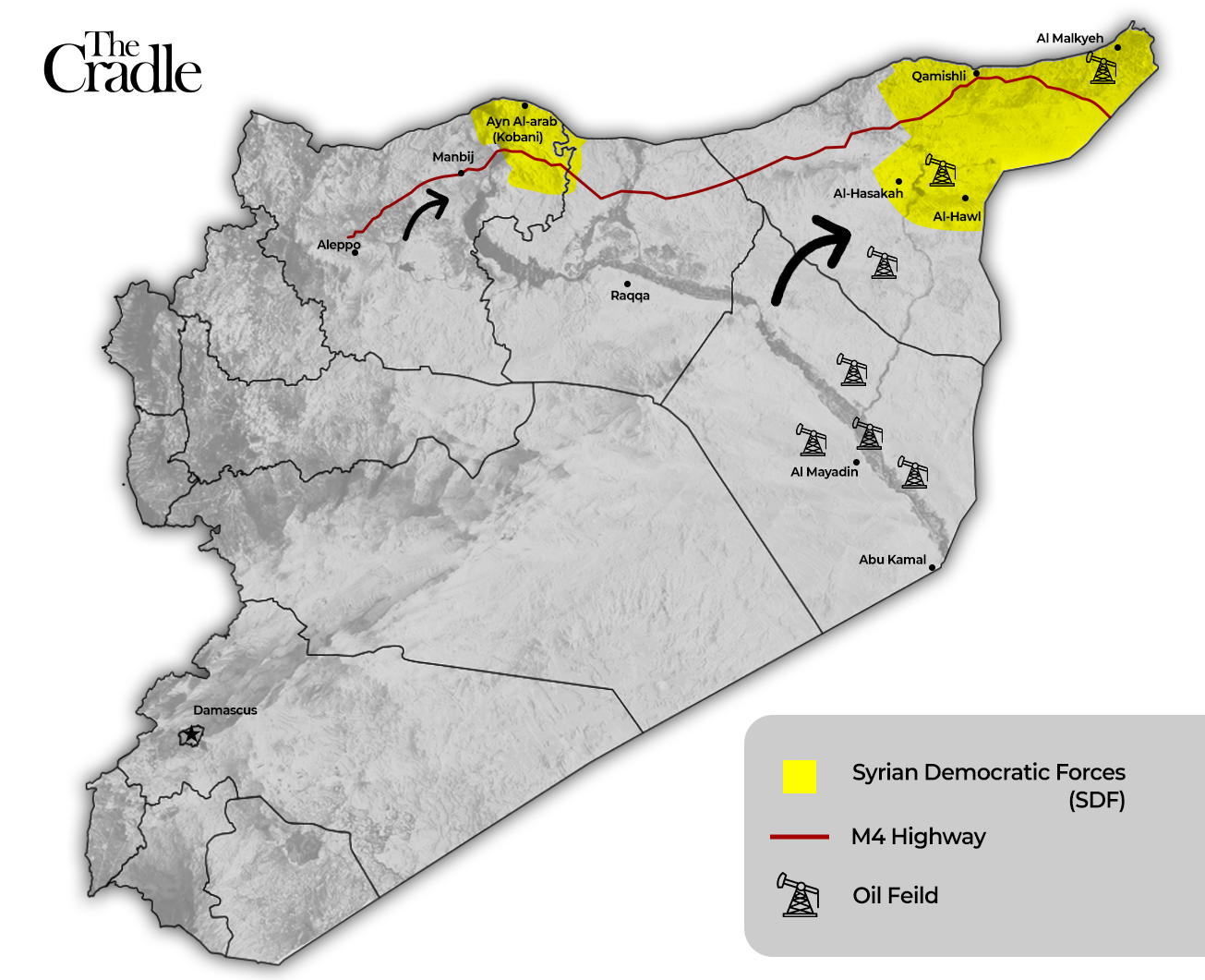
Over the last few days, the Syrian army has captured large swathes of northern and eastern Syria, including all the major oil fields and several strategic cities such as Raqqa. This came after heavy clashes between SDF and the Syrian army in Aleppo – where Kurdish forces no longer have any significant presence.
The SDF and allied militias still hold Ain al-Arab (Kobane) in Aleppo, as well as the Hasakah city center. Government troops have entered the Hasakah governorate and are preparing to enter the city of Qamishli.
Sharaa had met with SDF chief Mazloum Abdi in Damascus on 19 January, but a Kurdish official told Rudaw the meeting was “not positive.”
“Surrender is not an option. The only option is resistance,” the official added.
Abdi had initially announced his acceptance of the 18 January ceasefire deal in order to “stop bloodshed” and avoid all-out civil war.
The agreement included the handover of Deir Ezzor and Raqqa governorates, as well as all border crossings, oil fields, and gas fields in the region to the Syrian government.
It also reiterates demands for the complete integration of all SDF military and security personnel into the structures of the Syrian Ministries of Defense and Interior on an individual basis, rather than as Kurdish-commanded units – as the SDF was seeking.
Despite agreeing to this, SDF and allied forces are still attempting to resist the continued government advance on multiple fronts. Both sides are accusing each other of violating the ceasefire and of releasing hundreds of ISIS fighters from SDF-run prisons.
Extremely violent clashes are being reported. Videos on social media show extremist government soldiers abusing female Kurdish fighters captured during battles, calling them pigs, and shooting at and stepping on dead bodies. In one video, a Syrian soldier films two women who he says he has brought as a “present” for his commander.
Unconfirmed reports of Syrian soldiers carrying out beheadings have also emerged.
The Syrian government and the SDF signed an agreement in March aimed at integrating the Kurdish group into Damascus’s forces. Both sides have been in disagreement about the deal’s implementation – particularly the SDF’s wish to remain under Kurdish command and enter the army as a bloc rather than dissolve and conscript, as Damascus is demanding.
The Kurdish group has also insisted on a decentralized system that would allow it a degree of autonomy in north and east Syria, as has been the case in recent years.
As a result, clashes have intermittently broken out between government forces and the SDF over the past several months, with both repeatedly accusing each other of obstructing the March agreement.
The SDF was formed by the US-led military coalition in Syria in 2015, and has since helped Washington oversee its occupation of Syrian oil fields.
The latest tensions follow a significant reduction in the US military presence in Syria in recent months. Washington has left five of eight major bases in the country.

No comments:
Post a Comment